


Translated with the help of AI. We apologize for any errors and would appreciate your help in correcting them.
Translated by order of the educational portal university.poker
Original source: GTO Wizard
Before the advent of solvers, the open limp was considered the lot of passive, gambling amateur players who just wanted to see more flops. And, frankly, for the most part, it still is. Raise first in the pot gives huge advantages. At best, you can win blinds and ante right away. Even if you don't, you're stripping the equity of players after you, especially players on blinds who would otherwise get a cheap or free flop. However, there are situations when solvers offer to play a hand through the open limp, which prompted many players to reconsider the validity of this game. These solver-approved limps most often appear in late positions and with a shallow stack.
- Example: Limping makes the most sense in a late position because there are fewer players behind you that you would deprive of equity in a raise. Min-raise from the button, especially with a small stack, usually leads to a one-on-one game against BB button. A limp usually gives the same result but at a lower cost, allowing you to use VPIP over a slightly wider range.
The open limp with BTN will allow you to go one-on-one with BB almost as often as the raise, but for half the cost!
A limp with a shallow stack can also keep your equity and velly in your position. The shorter the effective stack, the wider the range of blinds they can use to push your open raises. This is a disaster when you lose the delivered 2bb without even seeing the flop, but even if you call all-in, you will no longer be able to use the edge of your position to sell your equity well or somehow squeeze your opponent out of the pot. If you always limped only those hands that did not want to go all-in on preflop, the blinds could exploit you with aggressive raises.
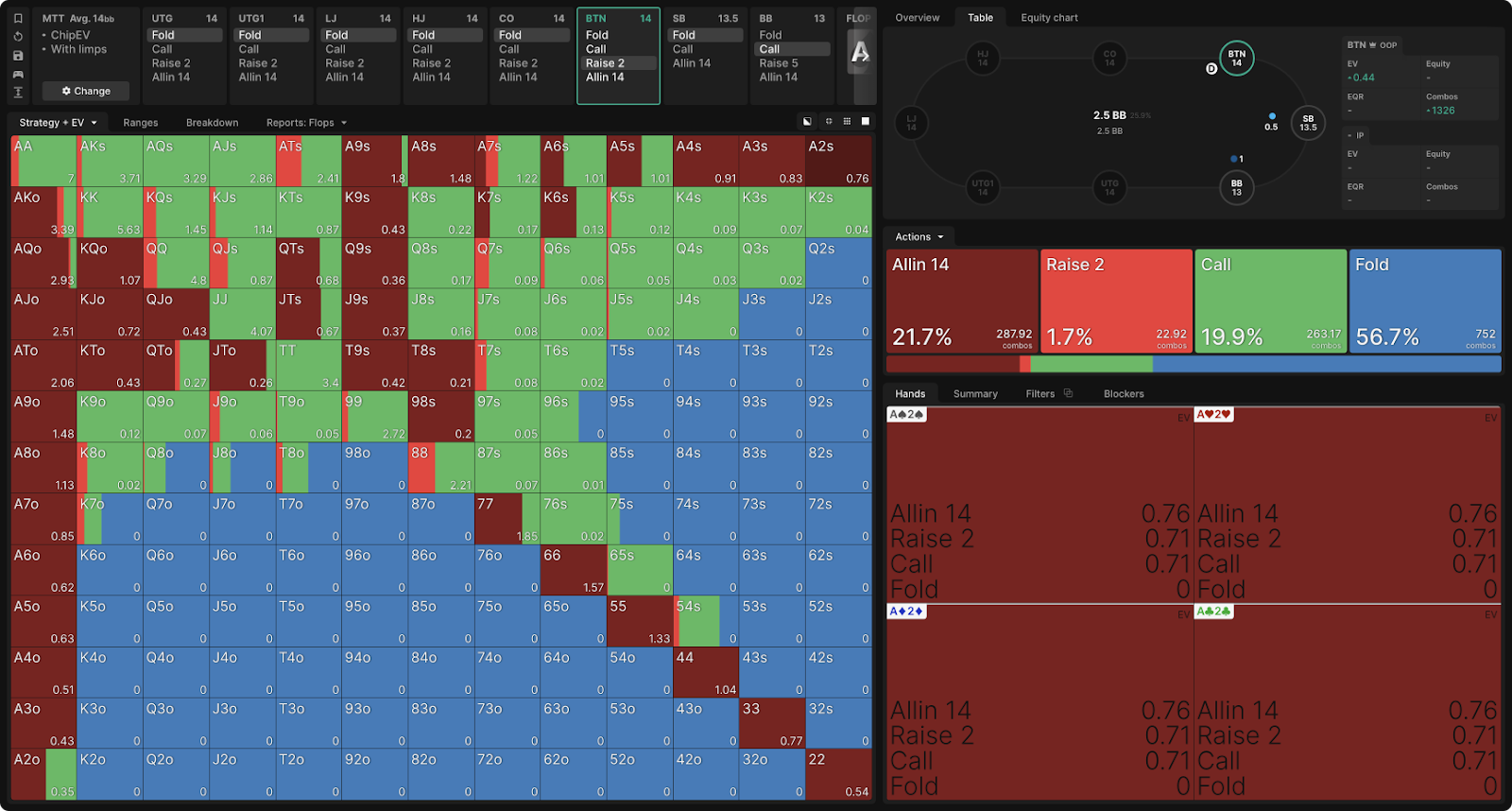
Thus, a balanced limp strategy includes traps with very strong hands that would like to provoke these raises and are not particularly vulnerable in order to allow the blinds to get a cheap flop with bad hands. Natural candidates for this are large pair, while suited broadway hands also retain their equity well in a limp pot. This ChipEVstrategy for 14bb depth on BTN perfectly illustrates the above. Note that the d and range of the limp is polar and consists of large pair and suited Broadway traps, as well as many weak hands (most of them suited) that would folds in response to all-in if open-rised.
Range of short stack limes are polar and complemented by mid-range fluffs.
The middle of the BTN range consists mainly of hands that are too strong for a raise-fold, but not so strong as to cause restyling (for the most part they will be pushes). At the same time, such hands as AKo and AQo also fall into this range, because they retain their equity not as well as their suited “colleagues”, and therefore do not play well in limped banks.
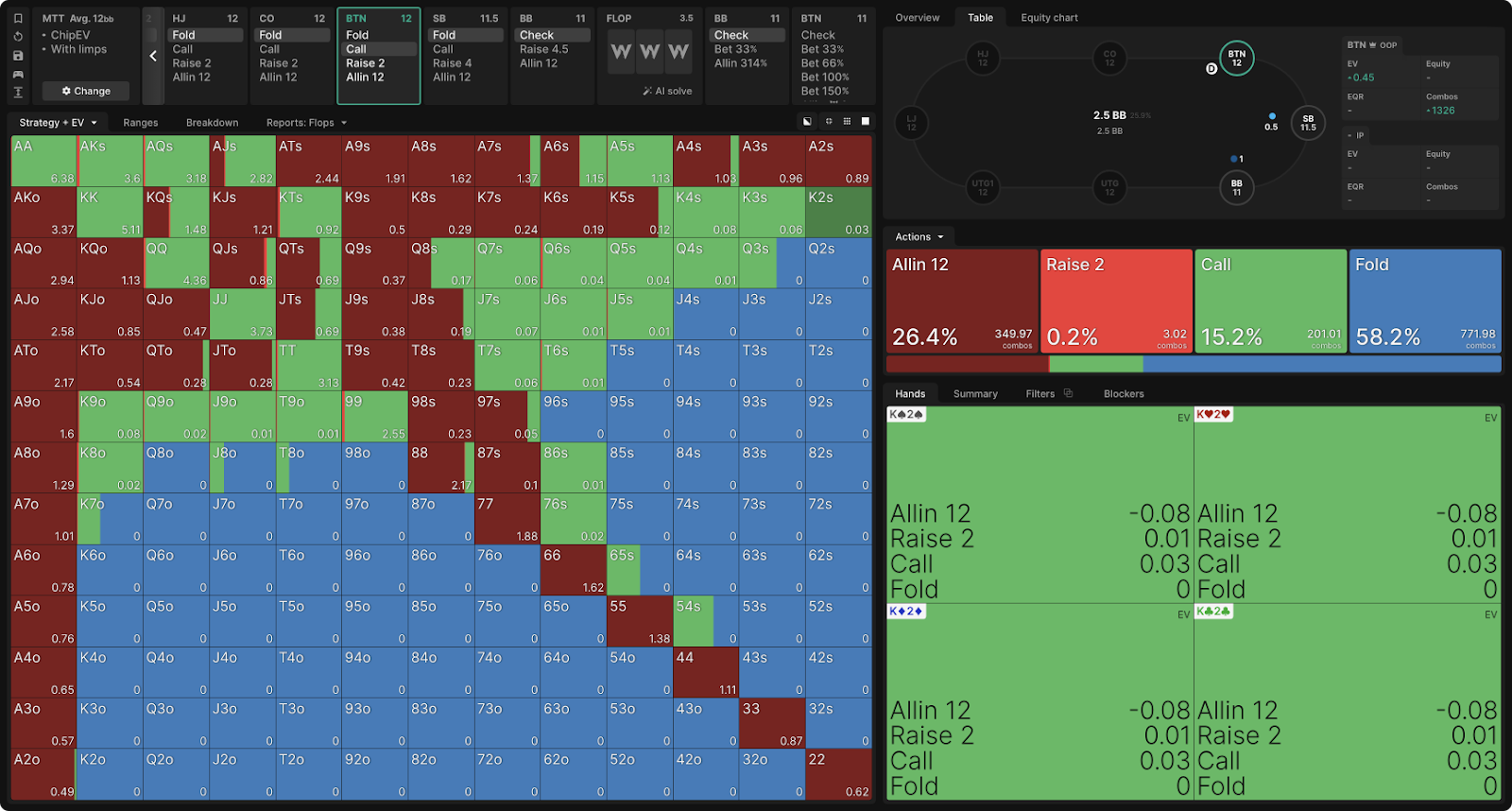
The BTN range at 12bb follows the same pattern, albeit with more push (due to better risk/reward ratio).
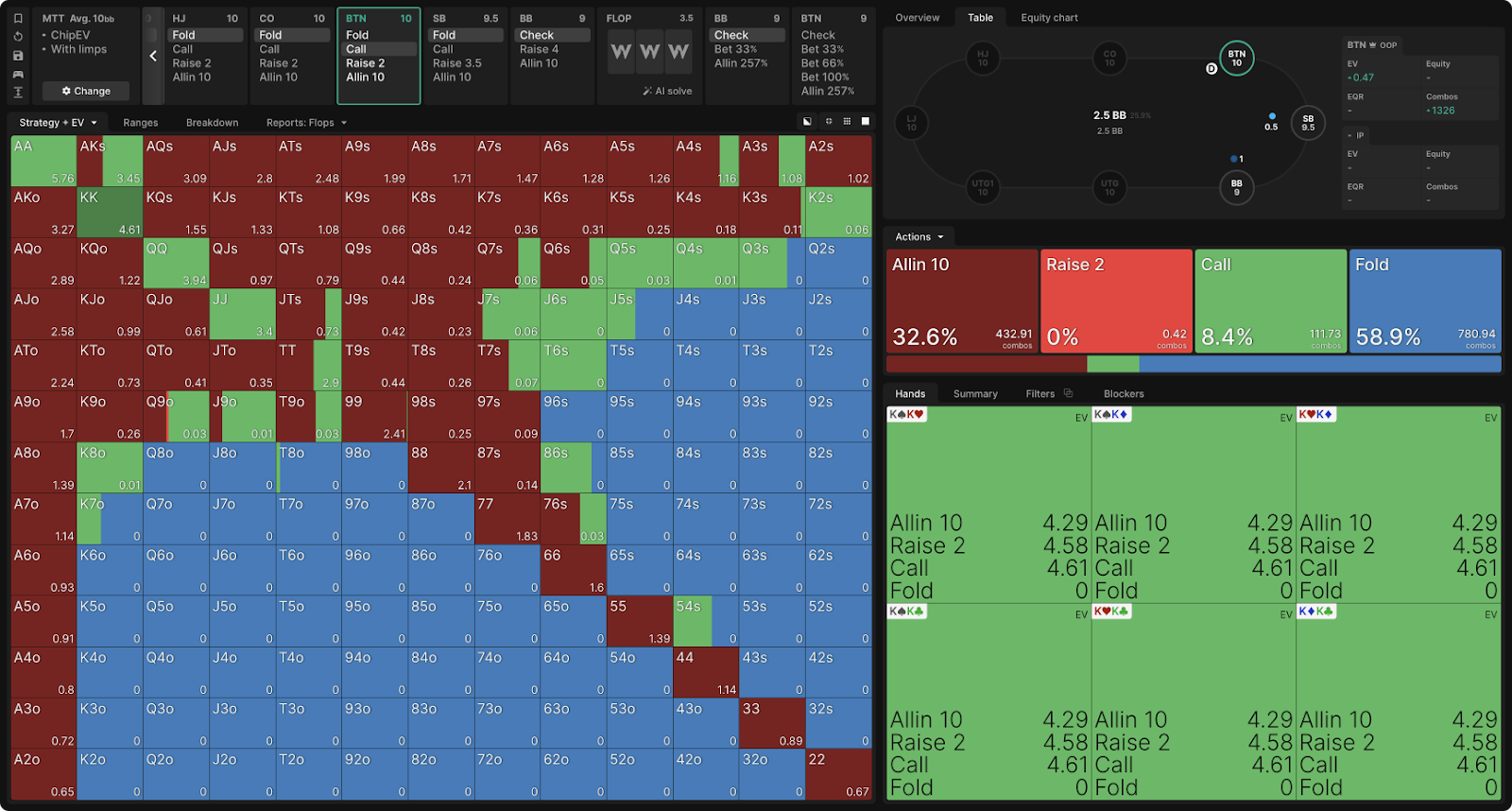
With a 10bb stack, Push happens more often than limp in most cases. And only the weakest and strongest hands prefer to call.
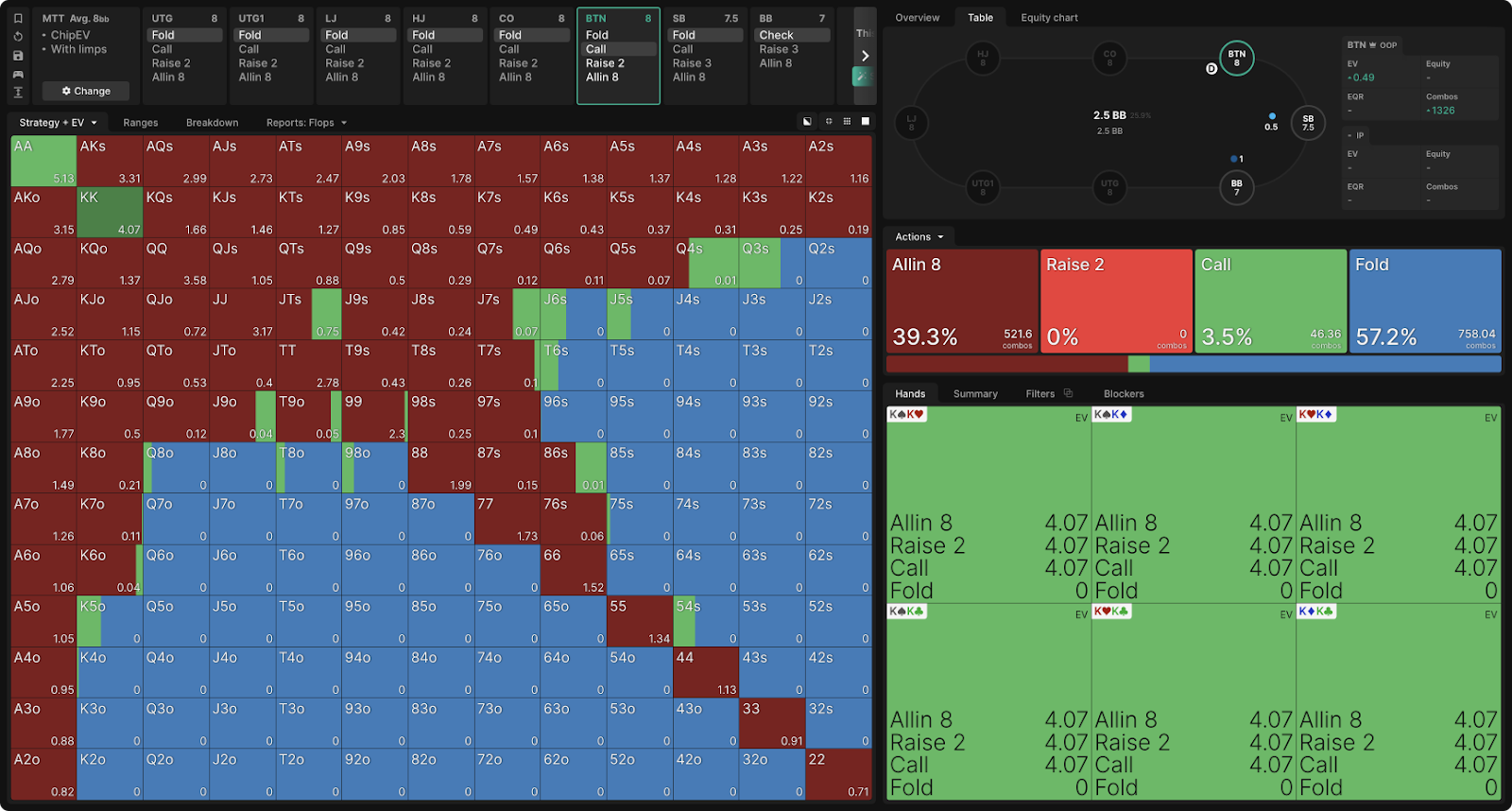
This effect is even more noticeable with the 8bb stack. Below this threshold, the limp is no longer relevant because the stack is not deep enough to fold cards in response to all-in with either hand after the limp.
Moving in the opposite direction, we see that with stacks of 17 BB, the min-raise becomes more attractive, and very few hands give a strict preference to the limp (without mixing with the open-raise or push). Among other things, the open limp with large pairs is a greater responsibility for players with deeper stacks, as these hands prefer to play with a low SPR after the flop.
The deeper your stack, the more important it is to start building your pot on preflop.
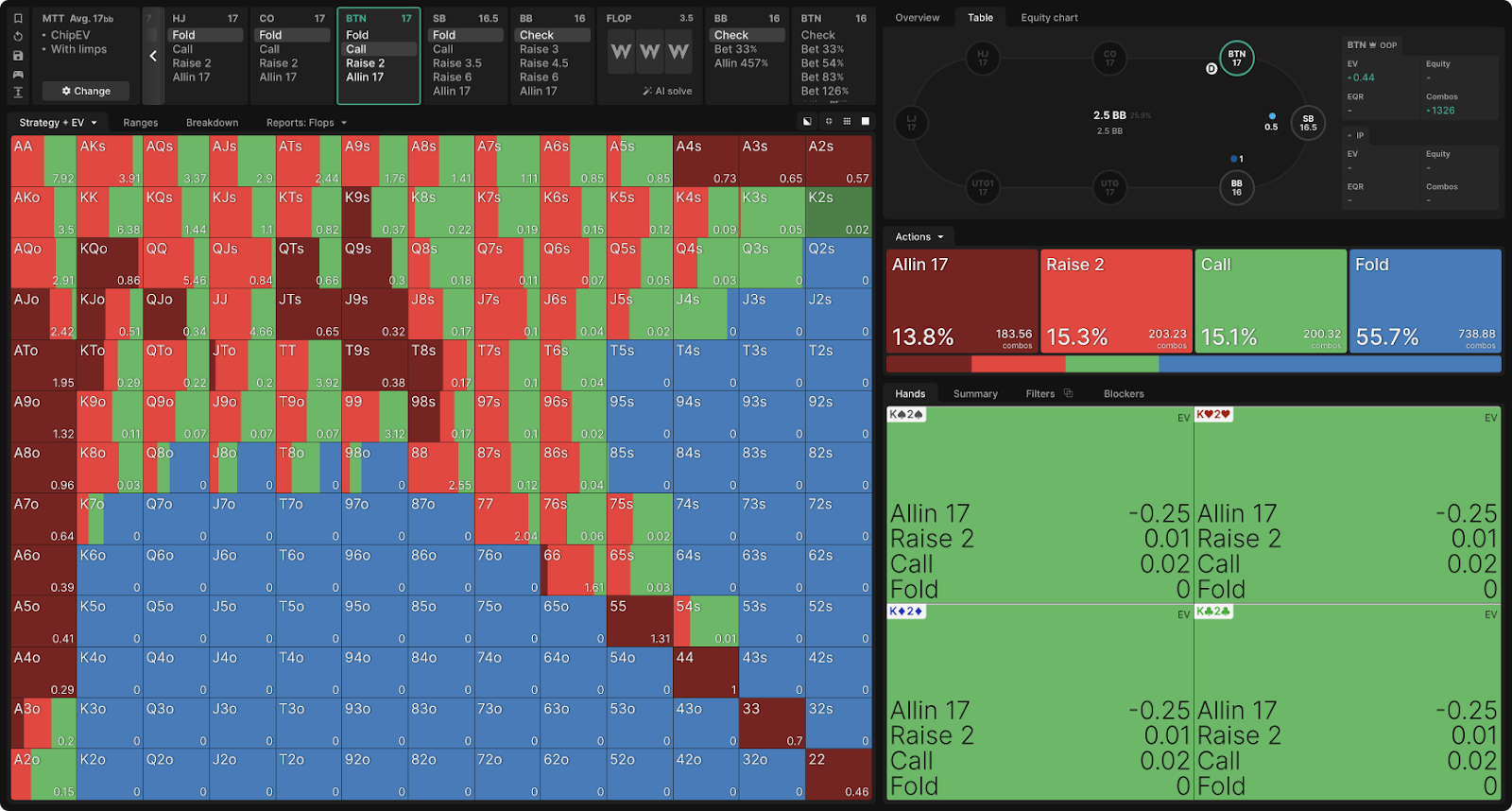

1. Reaction to raise after limp
If one of the blinds goes all-in after you limit, your answer is simple: you call with the best hands, and the rest reset. But you can also come across a regular isolate, then everything will become a little more complicated. Here is the BTN reaction after the rise in 4bb from SB after the BTN limp.
Depth 14bb:
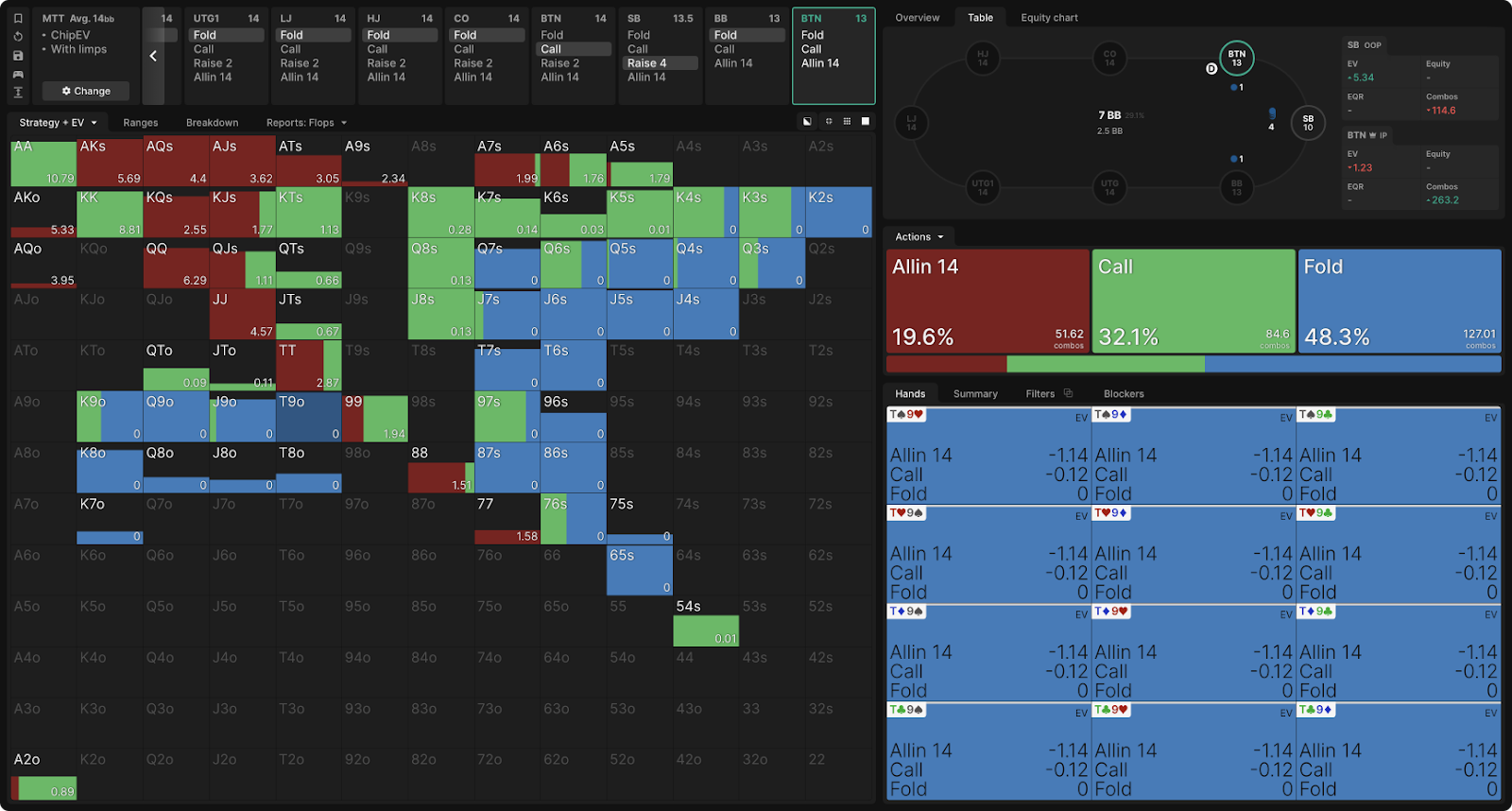
As with the original limp, we see pushes from the mid-range of the button and callas from the hands that are not strong enough to push, as well as several traps. Only the best hands are caught, because when the pot is already 7bb, immediately picking it up is a great result, even with QQ or AK. BTN, thanks to its bank chances and position, can afford a call with a clearly modest range.
- The BTN response to a raise from BB (up to 4,5bb) is similar: more calls and less pushes, since the range of the BB raise is more polarized than that of the SB.
Since there is no third player who can be pushed out of the pot, BB has less incentive to raising middle hands that could just as well see the flop for free. QQ and JJ are less effective against the top of the BB range and more dominant at the bottom, making them respectively less attractive to push and more attractive to call than against SB.
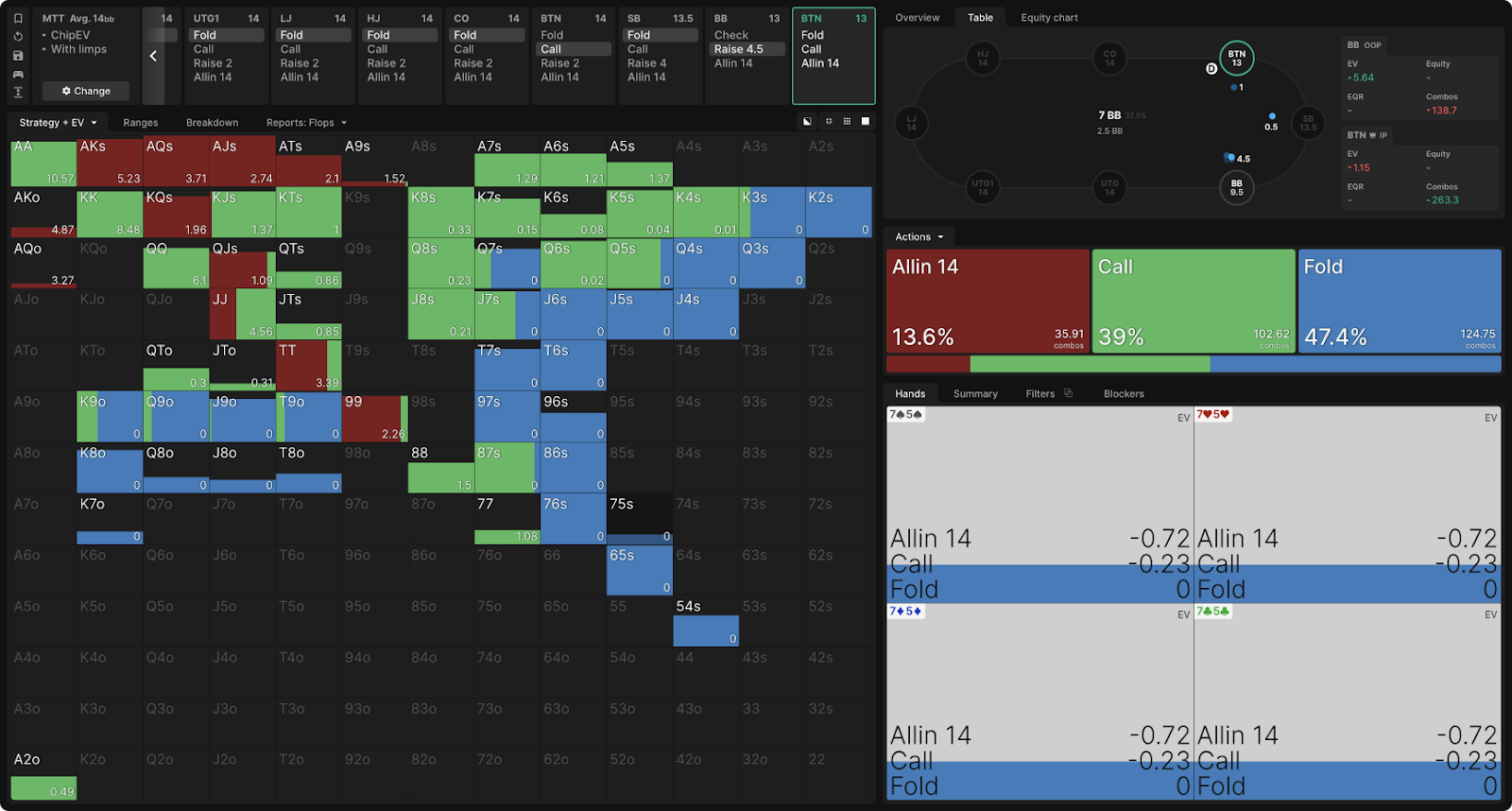
2. Heads-up on a post-flop in a limp pot
Heads-up against BB in a limp pot is played in a similar way to playing a single raise sweat (PSA) for the same reasons. BTN, as the player who made the VPIP on the pre-flop, has a nuts and equity advantage on most flops, as well as a positional edge. The BB range is even weaker than it would have been in the PSA because it has not yet had the opportunity to fold its worst hands. A one-on-one game in a limp pot is played in the same way as in the single raise sweat.
As a result, BB basically has to check, and BTN most often makes small bet bets.
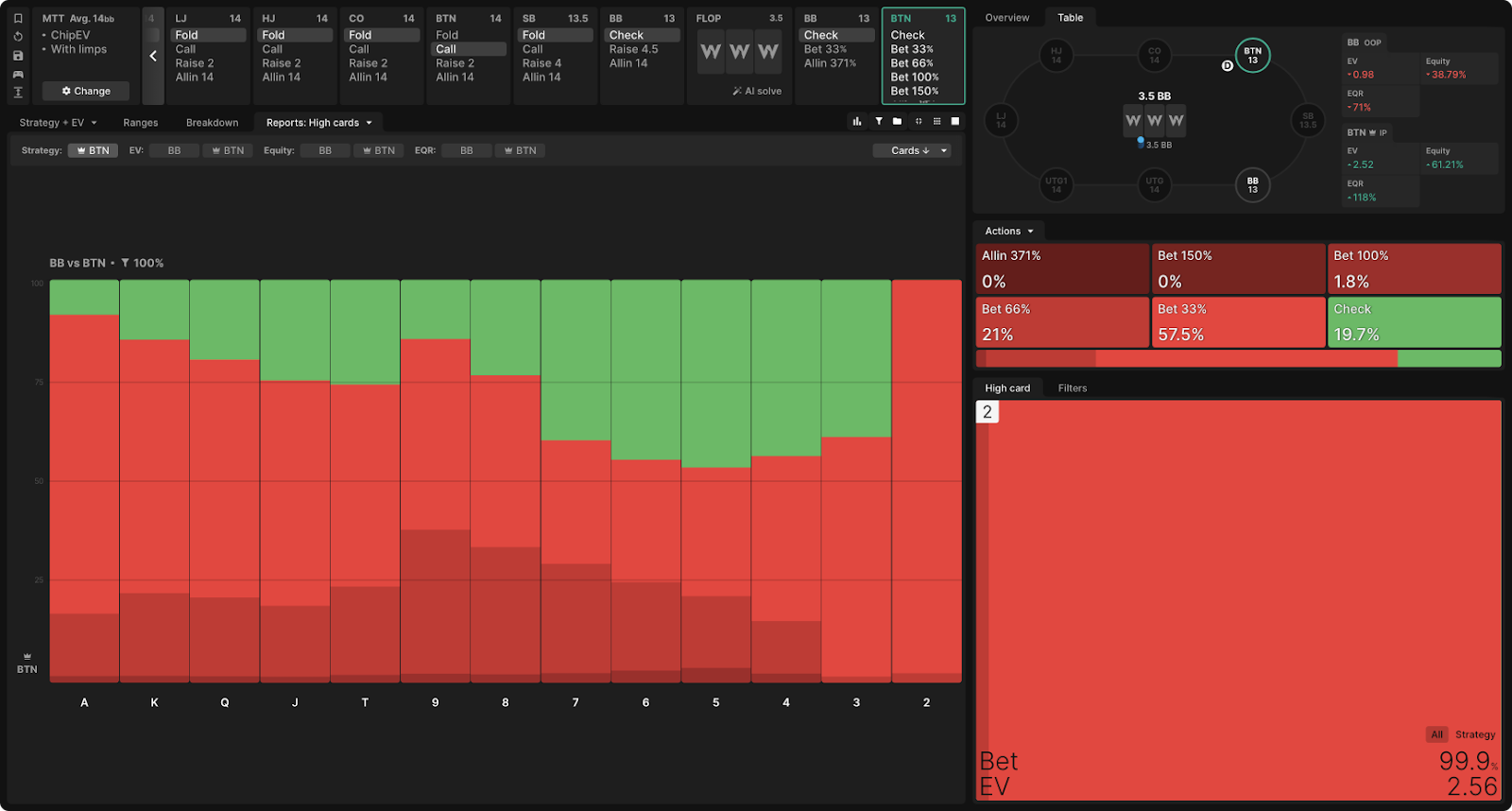
The exception is rare flops with low maps, especially more coordinated ones.
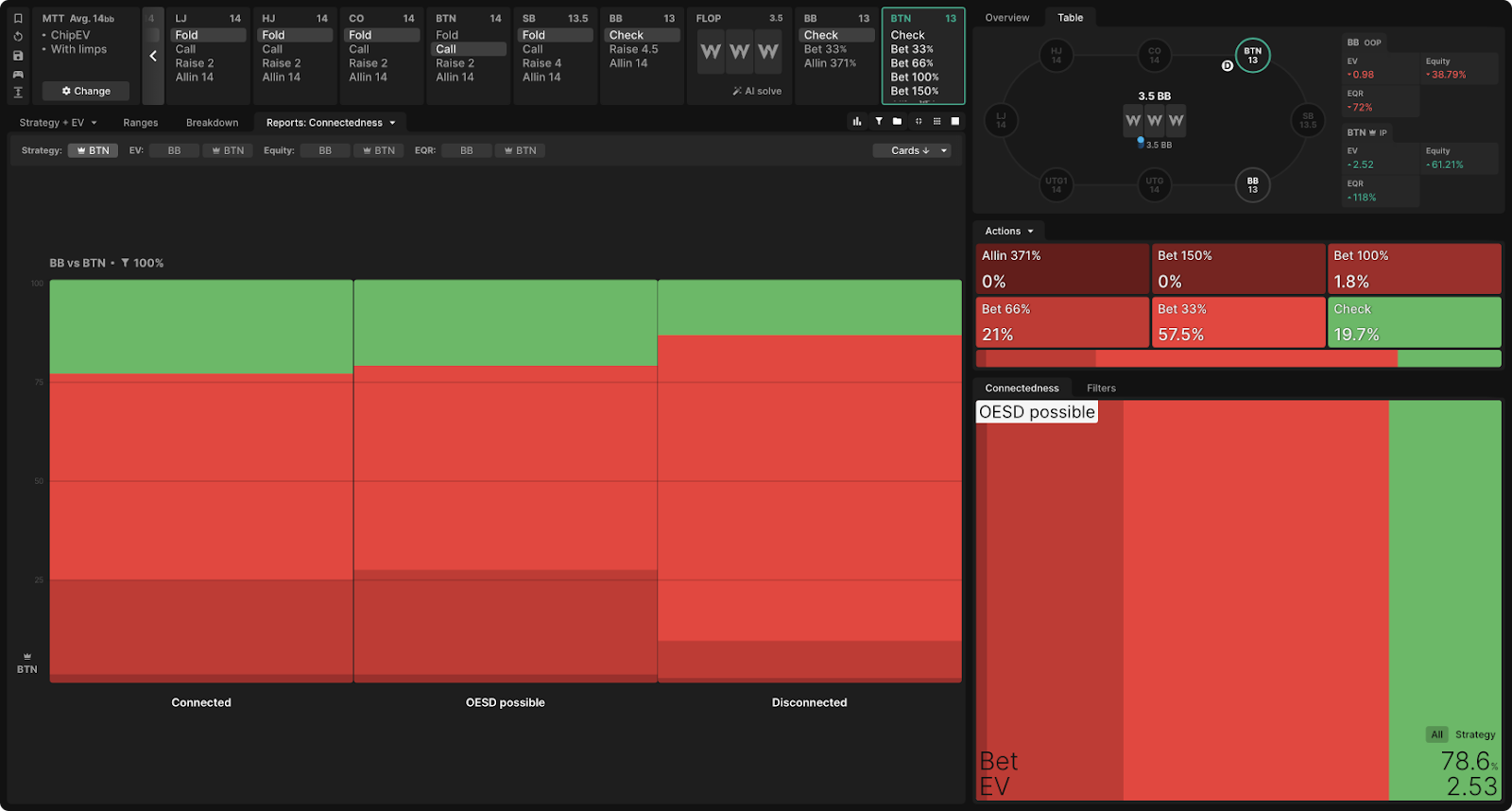
The highest response rate for BTN is on the mixed flop 5-4-2, where BB actually has an advantage in terms of nuts combinations along with a slight equity advantage:
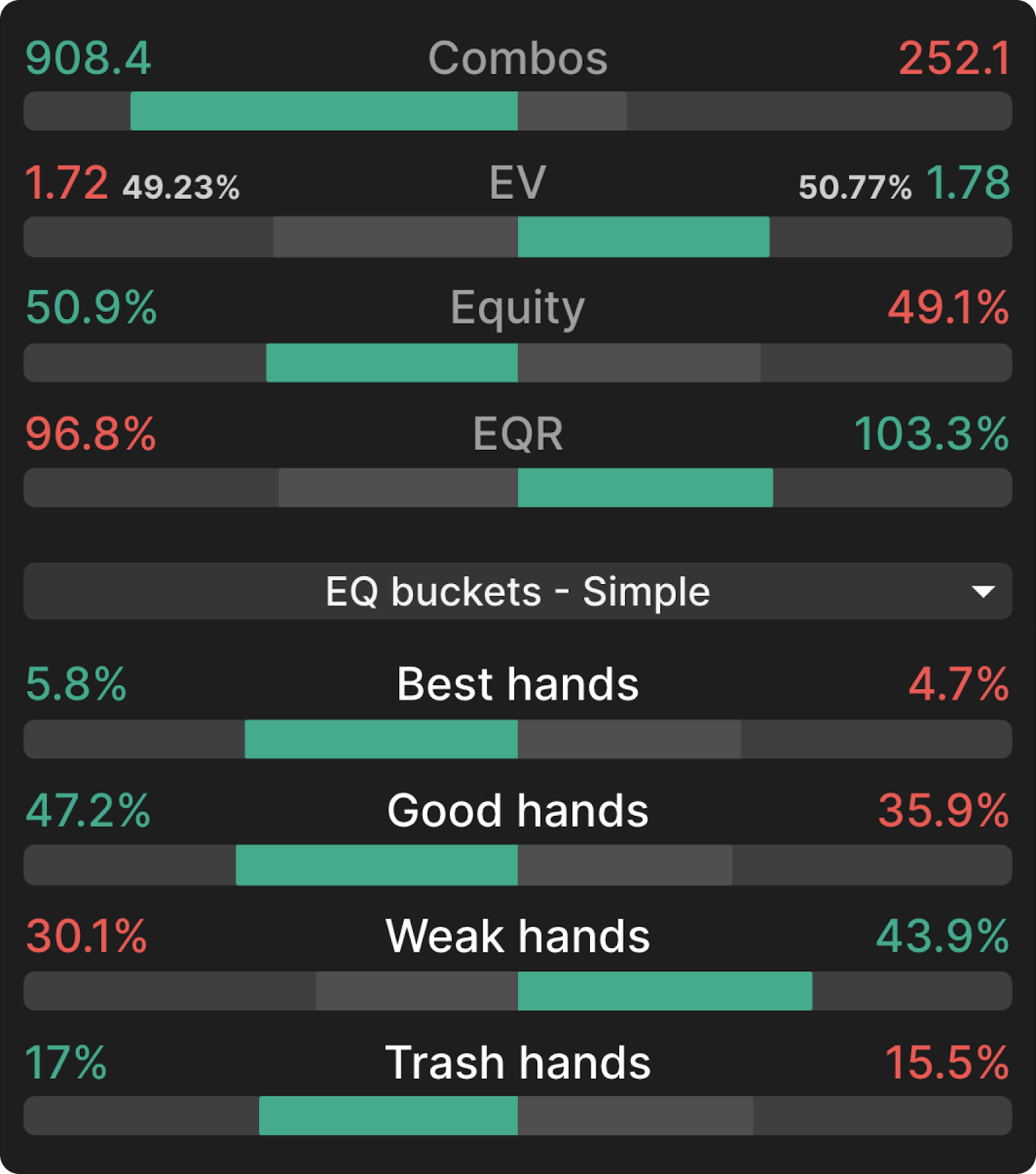
Learning the BTN strategy on this flop gives some insight into building a check range in exceptional cases when needed.
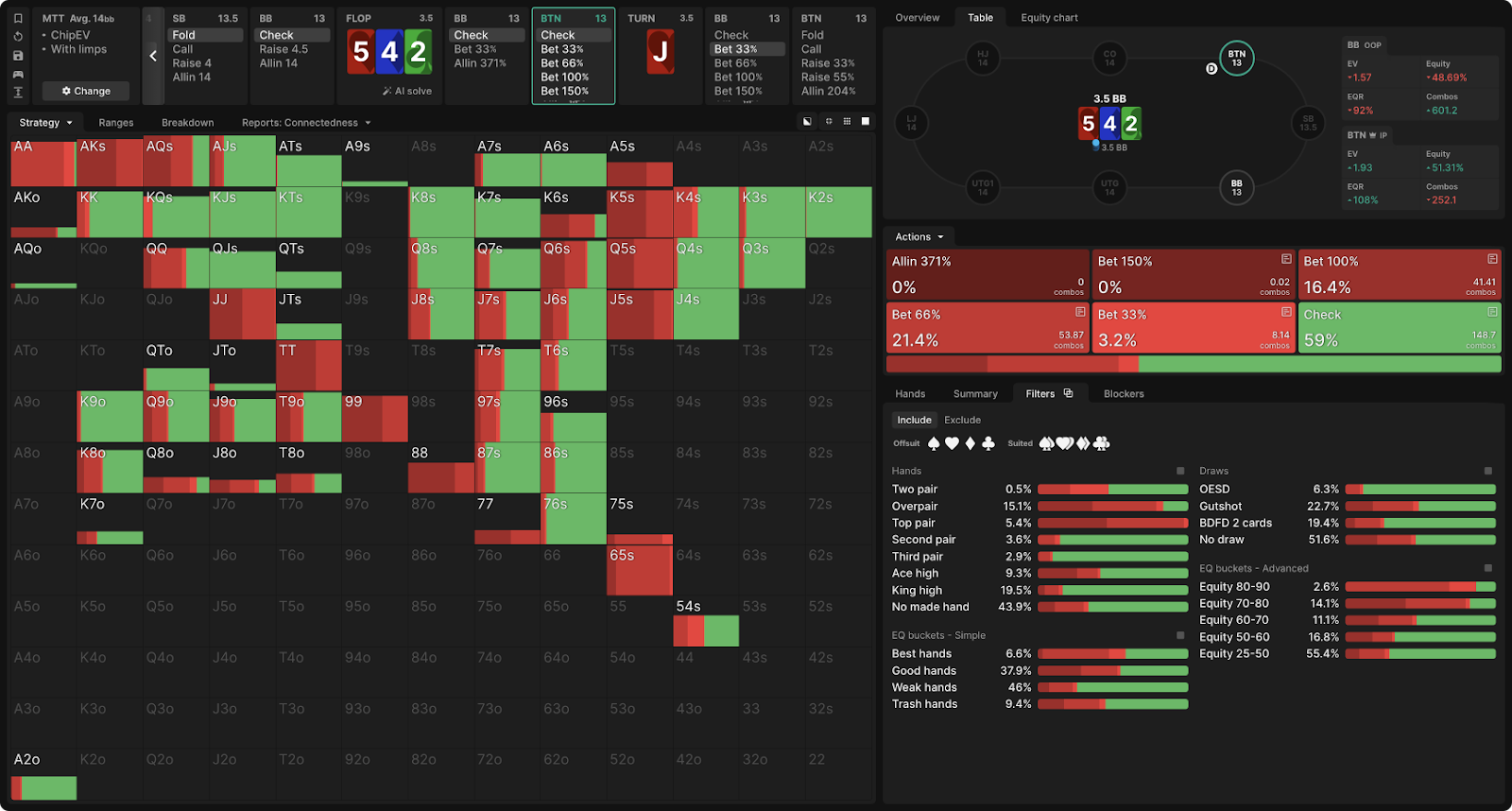

BTN puts mainly the polar range and therefore prefers larger bet, which can knock out such strong hands from BB as two overcards with a gatshot. There is very little sloppy play here, as the board is dynamic, and most of BTN's best hands are top pair or overpairs, which are vulnerable not only to straight draw, but also to overcards. The second pair, the younger pair and the Ace and Ace with a gatshot are not so attractive for bet. Not because they are afraid that their equity will be knocked out (they always call if BB overbet pushes), but because nothing particularly good happens when they place a bet. BB never folds his good hands, and these second pair and Ace-x are not favorites at Colleague or Raise.
3. Playing on the Late Streets
On a heterogeneous flop of 5-4-2, it is better to check the middle hands of BTN, and then call or raising on the turn. The lack of strong hands in the BTN check range gives BB a lot of incentives to bet on the turn, and stimulating those bet is where BTN's middle hands make their value.
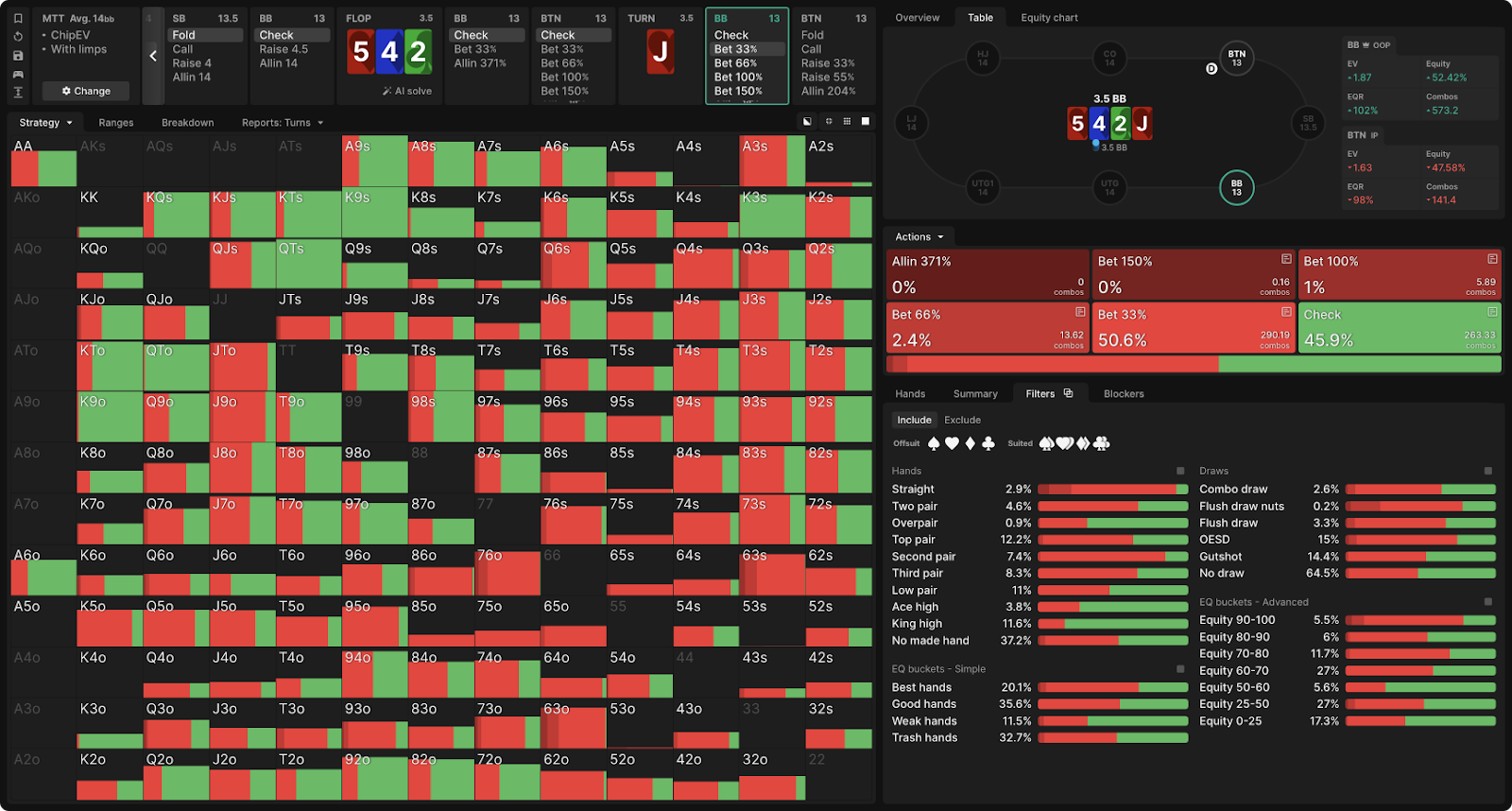
- Example: here is the bet range BB on the turn
 , if both check on the flop.
Please note that this includes not only bluff and semi-bluff, but also Velu Beta from most second and younger pair.
Therefore, when BTN is checks on a flop with a hand like K4, on most thorns it still receives a valley from the second strongest value of the hands:
In fact, most of the scenarios on the turn and river will play out the same way as in the single raise sweat between BTN and BB. This means that then you can play your hand as in a normal spot with a preflop racer.
4. Three-way (three-way) pots with a limp
We won't be able to calculate all the three-way cans with a limp between BTN and both blinds with a solver yet, so we will have to rely on the usual heuristic in multiway pots.
Let's see what the benefits are:
Positional edge.
Of course, BTN has it. Other things being equal, a check on the flop on the blinds and a small bet from the button should become common behavior in such a situation.
Edge in equity.
Usually, BTN also has it, but, importantly, it will not have such a big (!) advantage that would allow it to put its entire range on most flops. The equity edge can usually be determined based on who took the most risk on the preflop. BTN risked betting the entire big blind plus a raise from the two players behind it. SB risked half the big blind plus a single-player raise. BB did not take any risks at all and therefore has the weakest range. As we saw above, this equity distribution may vary on certain flops, but it is a certain standard based on preflop actions.
Edge of nut combinations.
BTN has the largest pair and large unpaired cards in its range, which (especially in the low SPR) means that they will catch nut hands on the flop more often than the blinds. However, the edge of nuts is more sensitive to the texture of the board than the edge in equity, so you will have to adapt to it accordingly.
5. Conclusion
The open limp may seem strange, but once you get into the details, this action makes sense. The subsequent game should largely mimic the single raise sweat that you are used to.
If you have a short button stack, consider experimenting with hand limes that you would normally mini-raise while maintaining your open-push range as usual. You don't have to know the details, you just need to navigate unfamiliar situations better than your opponents. And now that you've learned a little bit about limp sweats, they should be less unfamiliar to you.