


Translated with the help of AI. We apologize for any errors and would appreciate your help in correcting them.
Translated by order of the educational portal university.poker
Article author: Tombos 21, original source: GTO Wizard
Despite the fact that a lot of work has been devoted to researching and explaining the heads-up sweat strategy, multiway sweats are still an unexplored area in poker. They have very different strategic ideas compared to one-on-one banks. As experienced player Matt Hunt has stated, “ On post-flop, multiway sweat is still more like a multiway pre-flop than a heads-up spots post-flop.” We wrote this article to provide a theoretical framework for improving your multipot game. GTO Wizard plans to provide post-flop solutions for multibanks in 2024.
However, the purpose of this article is to give you the knowledge you need to crush your opponents right now. It is important to note that many heuristics (a set of techniques and methods that facilitate and simplify decisions in the game) used in pre-flop multi-banks are also applicable in the post-flop game. Many players mistakenly believe that these principles are only suitable for preflop, when in fact they are not.
1. Equilibrium problems in multibanks
Before we get into the details, we must study how the fundamental positions of the Nash equilibrium (GTO) change in multiway situations. Nash Equilibrium has an attractive property: if you follow the GTO strategy, you are guaranteed a minimum EV, and your opponent's mistakes can only increase your winnings. This guarantee is not available in multiway banks. Also, there is no such thing as an unusable strategy. Expected equity is no longer guaranteed.
When someone makes a mistake in a multiway pot, their expected equity is not simply distributed among the remaining players in the hand, as might be expected. This player's mistake may reduce the expected value of the other player in favor of the third player! No strategy, whether GTO or exploit, is immune to this effect. If so, how can we be sure that our GTO solutions for multiway scenarios will work? This question was asked by Noam Brown, a prominent expert in the field of computational game theory and the creator of advanced poker AIs such as Libratus and Pluribus. When asked in an interview with Lex Friedman about the difference between heads-up and multiway poker, Noam stated (to paraphrase):
It turns out that the techniques used to achieve equilibrium in two-player poker work effectively in practice for six-player poker due to the adversarial nature of the game when players do not cooperate.
Noam Brown: AI vs Humans in Poker and Games of Strategic Negotiation | Lex Fridman Podcast #344 (excerpt from the interview)
We know that GTO can be approximated for a multipot. Another confirmation of this is that the algorithms of different solvers achieve the same results, even using completely different strategies. Leaving aside the rigid theory, let's now delve into the most important factors in multiway sweats.
2. Burden of Protection
In poker, we use Minimum Defense Frequency (MDF) to calculate how far one player needs to defend to prevent another from bluffing profitably.

Think about what would happen if you made a bluff the size of a pot in a multipot. For your bluff to be profitable, you need to pick up the pot at least 50% of the time. This means that in heads-up your opponent will have to defend at least half of the time. However, in multipot, the burden of protection is shared! The frequency of folds is multiplicative: each player needs to defend so that together they would fold only half of the time. Roughly speaking, when one player bets, the other two decide among themselves who will continue now, but so that it is no more and no less than 50% of the time. Thus, the probability of taking the pot at a certain rate is:
Total fold% = Player1 fold% × Player2 fold% × Player3 fold% etc…
Then the middle fold frequency per player is equal to the alpha of the root of the nth degree from among the defending players:

- n = number of defending players
- α = Alpha bet HU equal to s/(s+1)
- s = bet/pot
In practice, the player completing the action takes on more defense than the players before him. This is due to the fact that the player who closes the action has a more advantageous protection, since he does not risk being pushed out of this street. However, we can use the above simplified equation to demonstrate the strategic differences in multipots.
The following table shows the protection, the frequency of which is on average necessary for each player to meet the MDF (minimum protection frequency):
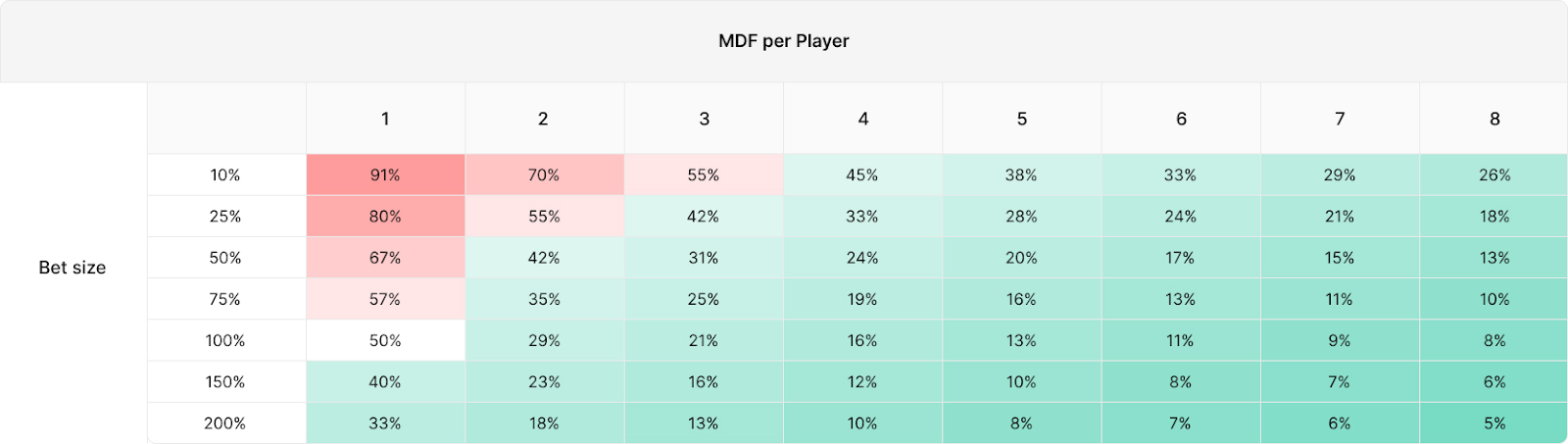
In heads-up, if your villain bets 10% of the pot, you'll have to defend 91% of their range to keep them from bluffing profitably. If 8 players defended against this tiny bet, the frequency of your defense will drop to about 26%! The difference is significant. In fact, even a bet of 1% pot offers a sharp decrease in your overall protection. In heads-up villain, if your opponent bets 1% of the pot, you will have to defend about 99% of your pot range. In a bank of 9 participants, this figure drops to 44% pot.
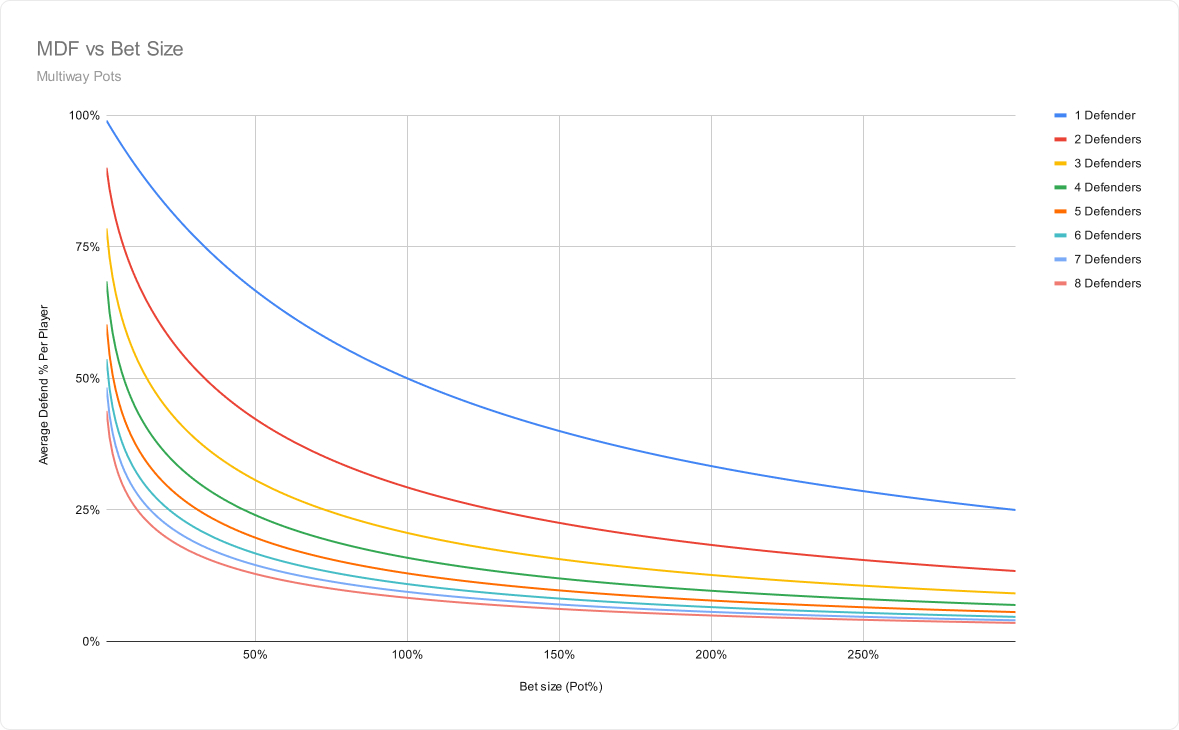
In multipots, the risk/reward ratio with a pure bluff is absolutely terrible. Your opponents can defend much harder, even against very small bet, while at the same time preventing you from bluffing profitably. At the same time, the pot's chances do not change. Any hand that can collect enough EVs can continue playing against that bet.
3. Stealth is the right thing to do
As shown in section 2, in multiway banks, your opponents may defend less frequently without becoming vulnerable to exploitation (a smaller duty of protection), while they may defend more frequently if your range is too weak. This leads to a very simple but important heuristic:
Stealth is the right thing to do!

You don't have to defend nearly as widely in multipots as you do in heads-ups. The thresholds of which hands should continue against a certain bet size become much stiffer. At the same time, your bet range should become much stronger. Pure bluff is ineffective when playing with multiple people; you need stronger Velu Beta and stronger bluff. With the exception of the river, you should almost never bluff with a hand without a solid draw equity.
4. Stop making range bets (range bet)
Range bet means betting on your entire range in a specific situation, usually a small size. This strategy is common in head-up post-flop spots, but fails in most multipot situations. The strategic premise of range bet is that you have such an overwhelming edge that your villain is forced to fold despite the fact that you are betting with any two cards (from your opening range from this position). However, in multipots, your opponents are not required to defend very widely at all.
This directly contradicts the principle of range bet – all additional fold equity that you would receive in heads-up is reduced here many times.
So, the simplest change you can make to improve your multipot strategy is this: stop making range bet. Surrender more often with garbage hands. Narrow your thresholds for vellyu bet. Wait in return for more hands with medium force and go with them to the showdown.
5. nuts potential – the basis
Nuts potential is the probability that the draw will become a nuts or very close to it. For example, on a flop such as


 , a draw hand of the type
 has a poor nuts nuts potential, since it can only collect a weak flush. However, the hand of the type
 pulls on the nuts flush and, therefore, has a strong nuts potential.
Nuts potential is vital because the range for exposures becomes much narrower in multipots.
When considering a semi-bluff in a multipot, pay more attention to your outs. Are you just aiming for a strong hand or a nuts? Does any of your outs make a stronger draw? The importance of these issues is greatly enhanced in the multipot. Moreover, the frequency of multipot bet strongly correlates with the nuts' advantage. A player with a range advantage who lacks the strongest hands should usually play more passively (unless the SPR is very low). Consider what would happen if you placed a range bet on a 7-5-3 offsuited board on BTN vs. SB and BB. Of course, you have overpairs, but opponents have proportionally much more nuts' hands, such as sets, two pair and straights. Your overpairs benefit much less from marginal pair of opponents and are much more likely to be attacked by dangerous check-raises.
6. Estimated (and vice versa) odds

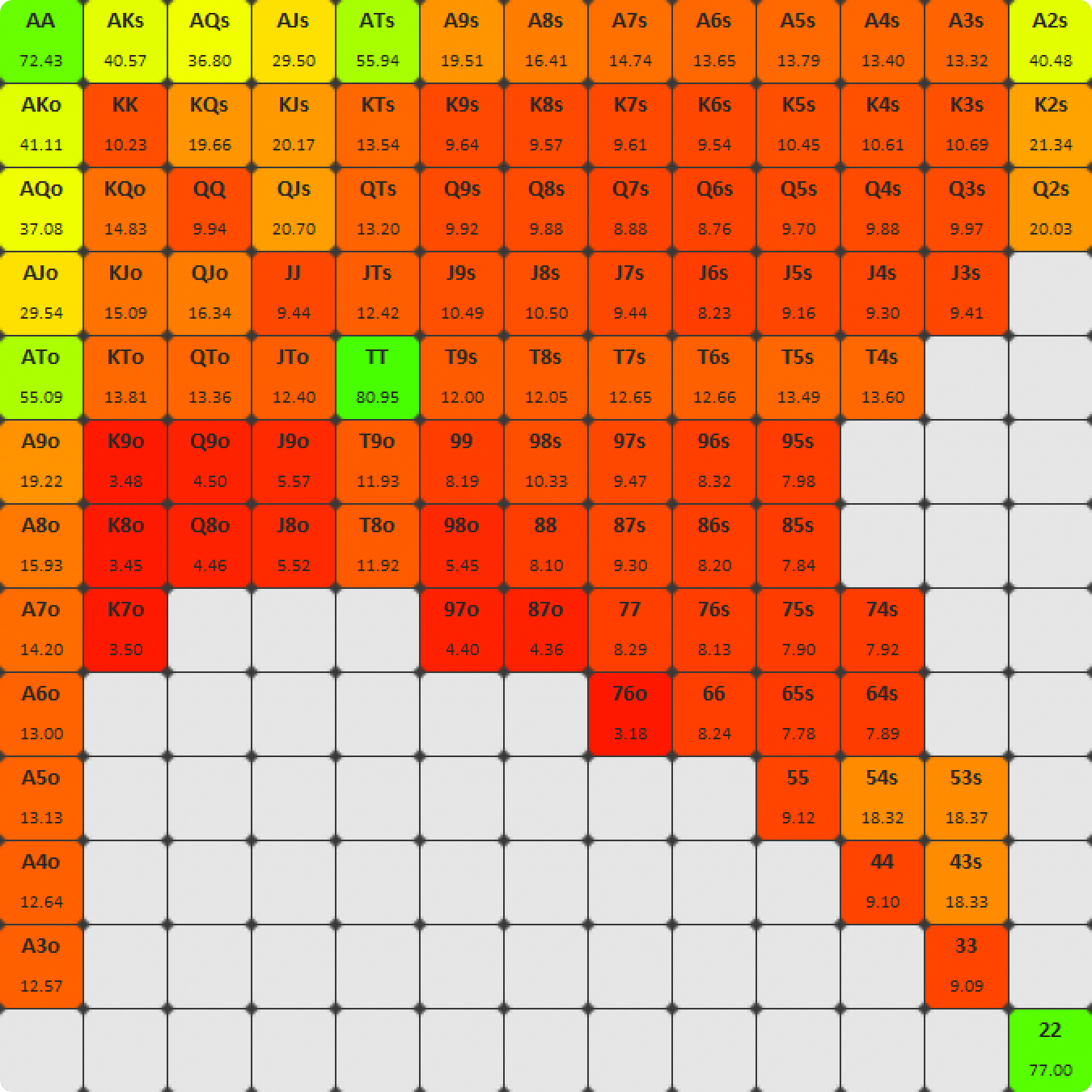
Exact numbers don't matter. Instead, pay attention to the color gradient. Multipots increase the assumed and vice versa implied odds. The effect is similar to how implied odds increase in banks with deep stacks. The narrower betting thresholds in multipots mean that you need stronger hands to go all-in on a valley than in heads-up sweats. Static bluff catchers, medium hands that will be difficult to improve, even some top couples lose a lot of equity here. Hands that do well with multipots have more room for nats. The ability of your hand to improve to something very nutritious is much more important.
Imaging of implied odds:
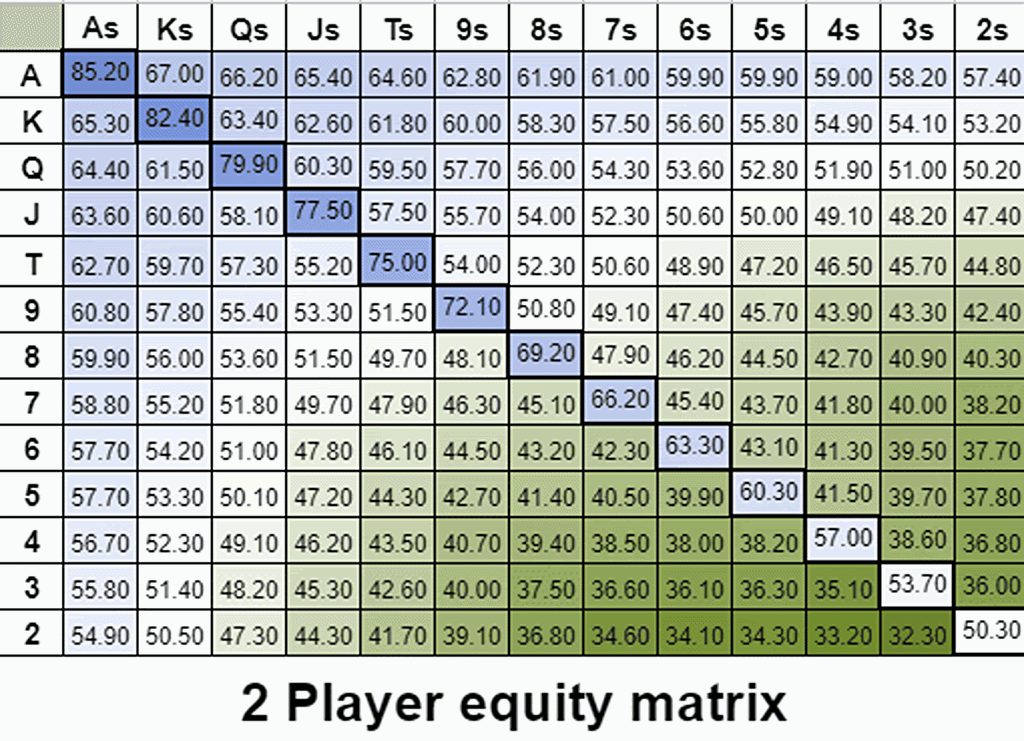
Hands that retain equity in multipots usually have a strong draw potential. Suited connectors, suited gaps, hands that can assemble a nuts flush, etc.
7. Use smaller bet sizes
We have said this before and we will say it again: the protection becomes much more secretive in multipots. Therefore, it is very easy to overplay your range if you use large sizes. Think carefully about keeping your equity in multipots.
Saving equity is how much equity is left in your hand after your bet has been called.
BTN opens, BB - call, flop 

 . In heads-up on such a board, the button usually prefers overbet. Here is his equity when BB equalizes the rate sized at 125% of the pot (here BB is even a little overfolded!).
Most strong top pairs are still well ahead of the call range.
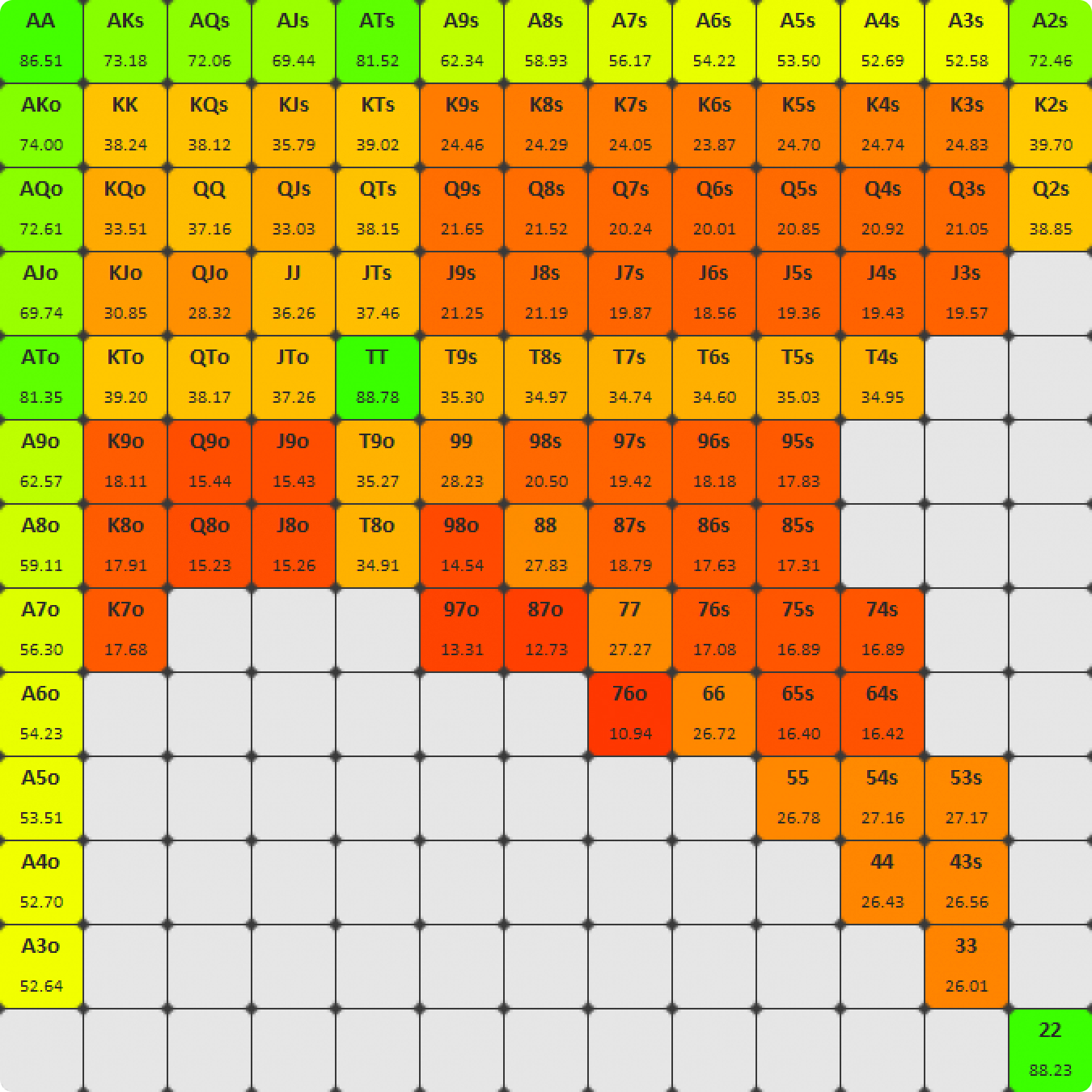
Now let's compare this in a multipot situation.
BTN opens, SB calls, BB calls. We will use the range from the GTO Wizard. Middle defense load is 25% on the player faced with such an overbet (compared to 44% in heads-up sweat). Typically, SB will defend less than BB, but let's simplify and get both players to collide with the entire upper quarter of their preflop call range. We remind you that the flop is on.
Here is the BTN equity against the top 25% of the SB and BB bands.
Surprisingly, even some of the two pair, such as A2, or a strong top pair, such as AK, are behind the collective call range! We actually outplayed the two pair by making a continued bet on the flop… Note that the blinds should actually fold a little more often, so I'm overestimating the BTN equity here. This is why you should usually reduce your multipot bet. Your equity retention just plummets off the cliff as collective protection at high stakes leaves extremely strong range. However, there are certain situations in which you can do overbets in multipots. These strategies are for scenarios in which you have a significant edge in the nuts and you can profitably play the entire stack with the nuts hands. Overbets in heads-up sweats are much more common than in multipots.
8. Increase positional advantage
The positional advantage comes from the information received from your opponents acting first, as well as from the ability to complete the action on each street. In multipots, the positional edge is amplified as you have even more information and completing the action becomes more valuable. Conversely, it is much less profitable to play when someone else has not done the action behind your back. The easiest way to demonstrate this principle is to compare the BTN call range with the SB call range. In most cash games, BTN should be defended more broadly than SB in open raises, despite BTN having more players left to act and a worse price per call. Let's pick a deep stack situation to demonstrate this principle (deep stacks further increase the positional edge).
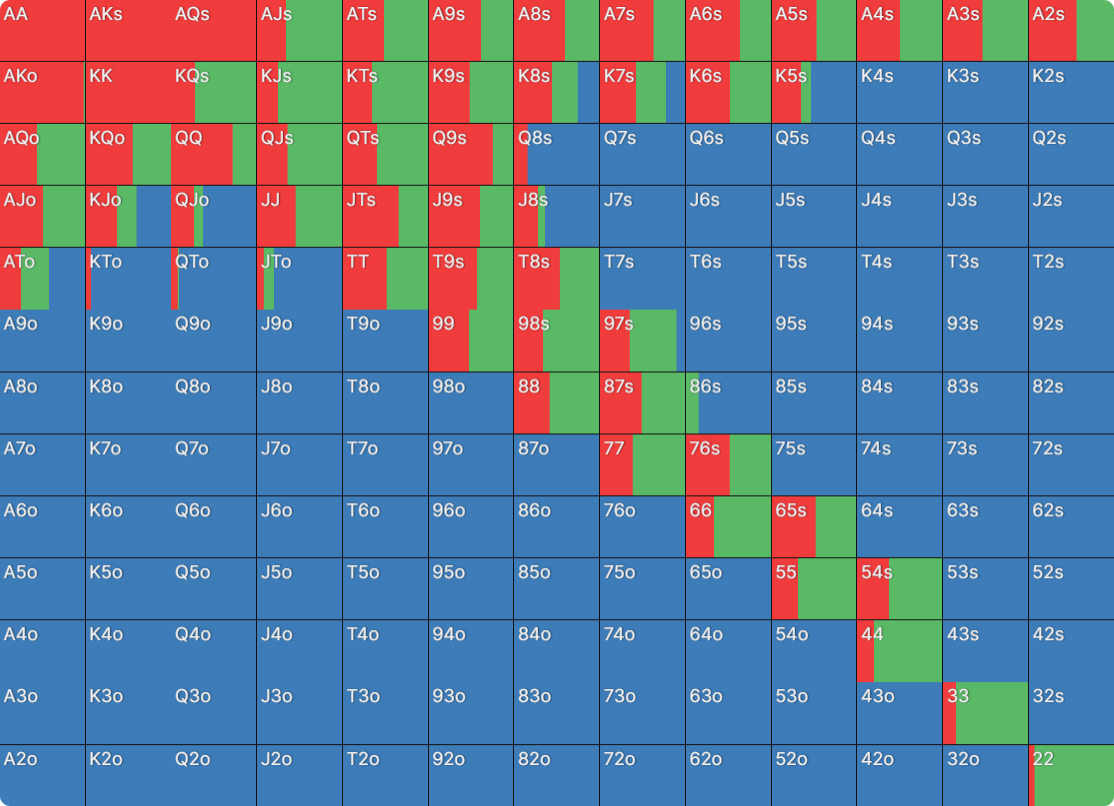
CO opens 2,5bb. Let's compare BTN and SB protection on preflop.
BTN vs CO RFI
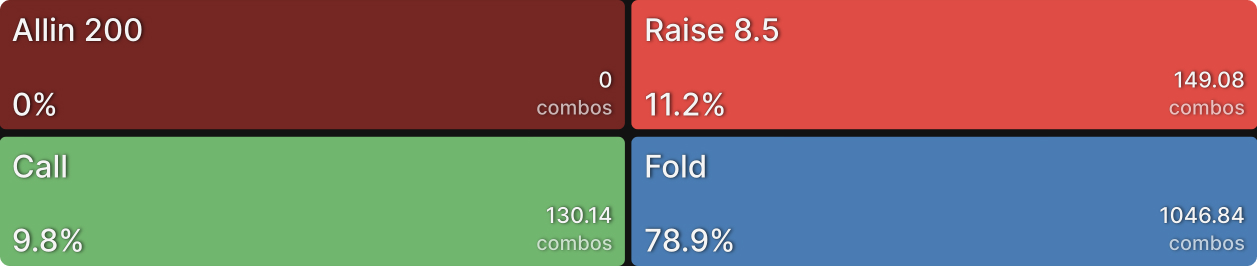
SB vs CO RFI
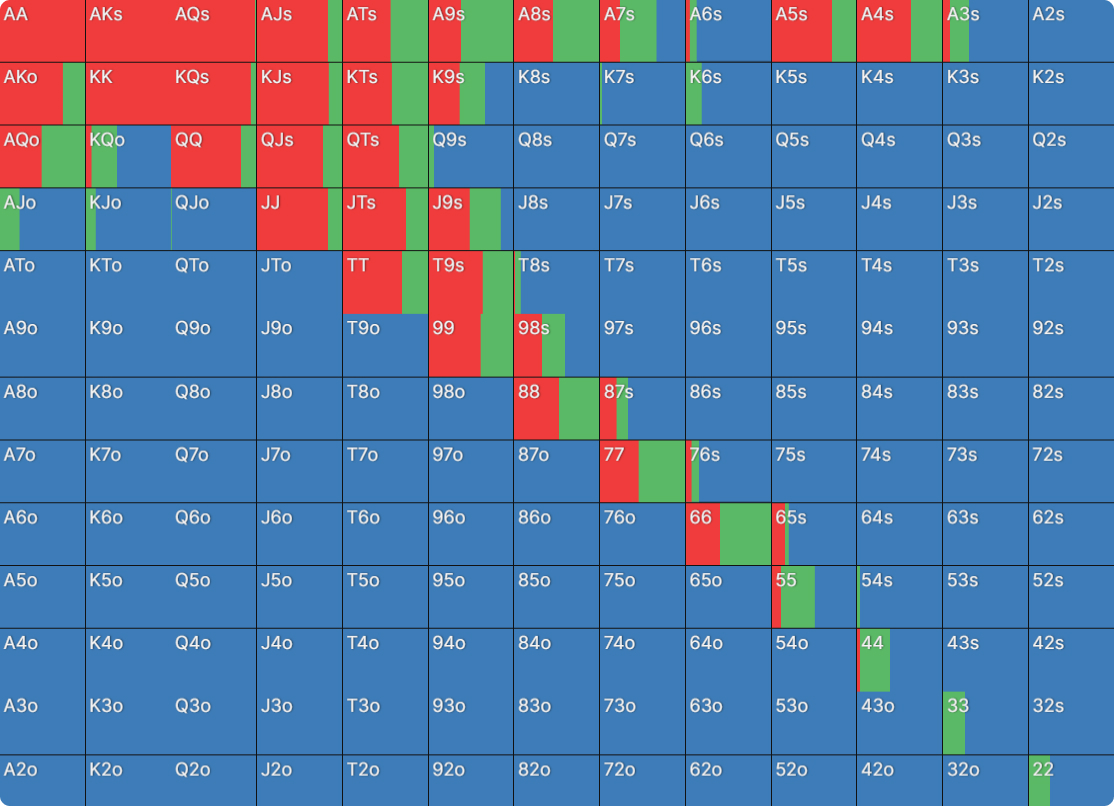
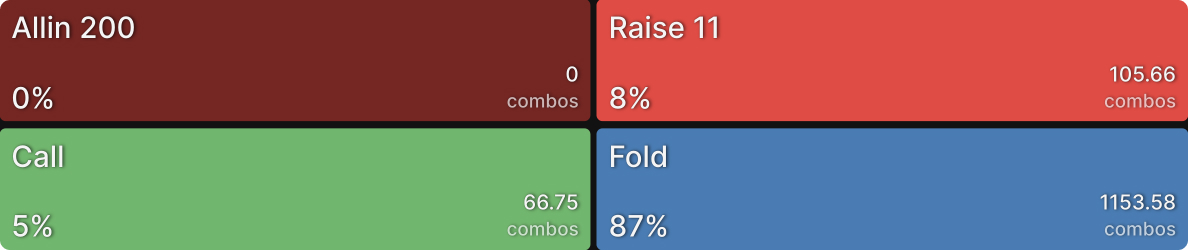
Note that BTN protects 8% wider than SB!
This is due to the fact that the BTN will always be in position on the pre-flop racer, and also because with the multipot it will also be in position on all remaining players. The SB gets the best price, and there are fewer players behind it. But these two factors do not alleviate the pain of not being in a position for both the open racer and the button player. Thus, in this situation, SB plays more tight than BTN. Obviously, to be without a position against two is very bad. But what about the one in the middle?
Playing "monkey" with a player behind you and in front of you is also not a particularly attractive offer. A common mistake many players make is that they believe BB should defend a much wider preflop range after SB calls the open-raise, but that's not really the case. Yes, you get the best chance of the bank when copying, but your equity retention strategy in the multipot will be much worse with a wide stake on BB. As previously mentioned, most hands lose value when playing with multiple players in the pot. There are exceptions to this rule: for example, if one of the cold collars is very wide, then you can also make a wide overcall. The price of the initial bet also plays a big role.
9. The blocker factor is amplified
Blockers are becoming more important in multipots. As they interact with more ranges and the effects of deleting cards become more powerful.
- Here's an example: Let's say the UTG opens. How often does UTG expect to pick up the pot?
Here's how often he styles blinds when opening with different hands:
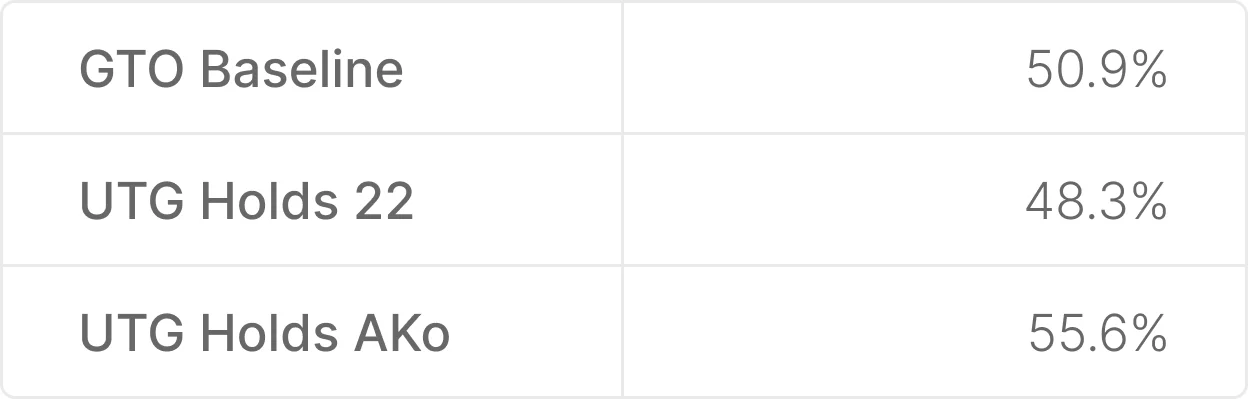
That's a pretty significant difference. When opening with UTG, AK expects to steal blinds 7.3% more often than 22! This is because AK blocks hands that call or raise the UTG open rate, while 22 mainly blocks hands that fold. The same concept applies to post-flop. Blocking the nuts means much more, it makes it much more difficult to get money with the help of your value hands. Blocking empty hands is more problematic for your own bluff.
10. Dropped range is less susceptible to exploit
The "capped" range does not contain the strongest hands. In heads-up sweats, you need to care much more about the possibility of exploiting your range. If you expect too many weak hands and don't slouple with strong enough hands, then your opponents can exploit your check range with excessive aggression! However, in multipots, drooped range becomes less of an issue as the burden of defense is shared by multiple players. The aggressor will have to cope with several opponents at once with an advantage in the range.
- Here's an example:
UTG opens 2bb. Here is the BB protection if all folds are reset in front of it:
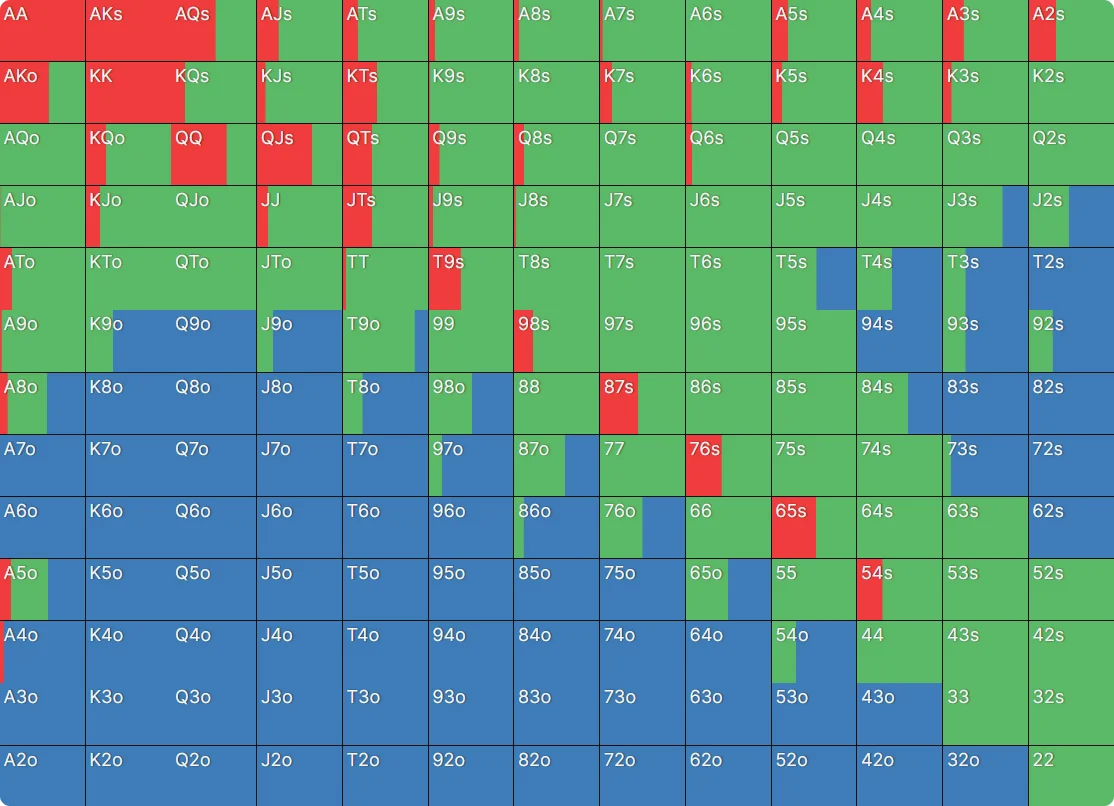
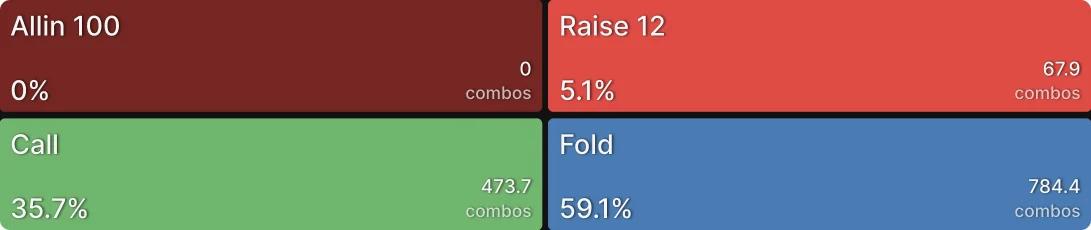
Compare the above range with the range below, which shows how BB is protected after the SB cold call:
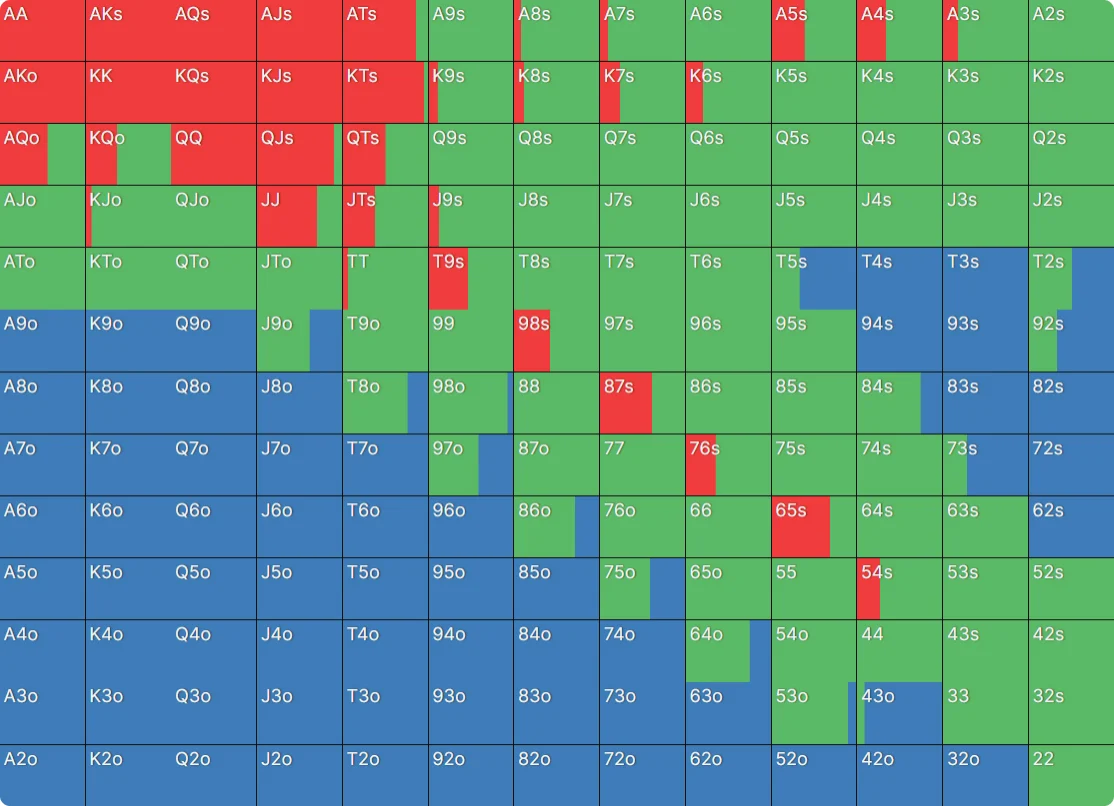
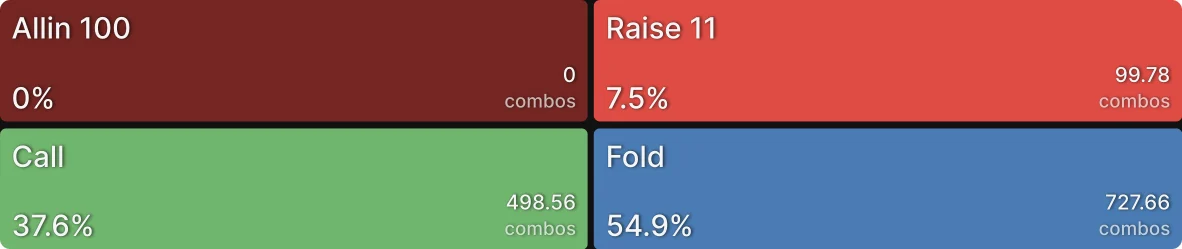
When BB plays 1 vs 1 vs UTG, it rivals strong hands like AKo and QQ and sometimes AQs. These strong traps are necessary to ensure that the rest of his call range is not exploited. Compare this to the BB strategy after flat on SB – it is much more prone to squeeze with the top of its range and leave its call range more vulnerable. This is partly due to the incentives to squeeze, but also due to the fact that the trapped range is less exploitable in multipots. Most squeeze strategies are very linear, and that's why they have a lot of cards from the top of the range. Generally speaking, you need to play "more honestly" in multipots.
Range of bet becomes more straightforward in multipots on both preflop and postflop. By “honestly,” I don't mean there is literally no cheating, but the player's actions should more accurately reflect the value of their range. If someone makes too big and too weak a bet, they will rarely get the fold equity needed for their bluff, and their valley range will quickly melt away from the narrow call ranges of defending players.
Retention of equity is dramatically complicated and becomes extremely vulnerable to check-raises or counter-aggression. What's more interesting, though, are the check range. The range of the check for players is usually weak and heavily capted in multipots. This is partly due to the fact that the betting range is more fair, but also due to the fact that the need for protection is slightly less, since several players share the burden of protection. In a sense, other players act as a shield that prevents anyone from displacing your trapped capped range. This means that the range on the river is often quite weak when everyone has check in multiple times. For this reason, many players promote aggressive multipot bluff in situations where they wait until the river.
11. Conclusion
The biggest problem with betting in multilateral banks is that players can defend themselves much more tight, without being exposed to the danger of exploitation, and at the same time they can defend themselves more often than necessary if the bet is too weak.
As a result:
- Players share the burden of defense together, resulting in a narrower call range.
- Empty bluff or range betting (Range bet) is usually not a good idea.
- Use smaller bet sizes due to more difficult equity retention.
- Use stronger bet with narrower thresholds for Velu Beta and bluff.
- Pay more attention to the assumed chances, preservation of equity and nutritional potential.
- The positional edge becomes more important and valuable.
- Blockers are more important because the effect of removing cards interacts with multiple ranges.
- It becomes more difficult to attack the trapped range if other players are involved in the pot.
- Bet becomes more straightforward and checks become more droopy.
- GTO solutions no longer guarantee the impossibility of exploiting in multipots.