


Translated with the help of AI. We apologize for any errors and would appreciate your help in correcting them.
A poker position is not the place you physically occupy when playing offline or where your avatar is located at a table in one of the poker rooms.
In the hand, this term means finding each player relative to the Dealer (button) chip. After each draw, the button moves one place clockwise button. This ensures honesty, as all players in the lap will visit each of the positions.
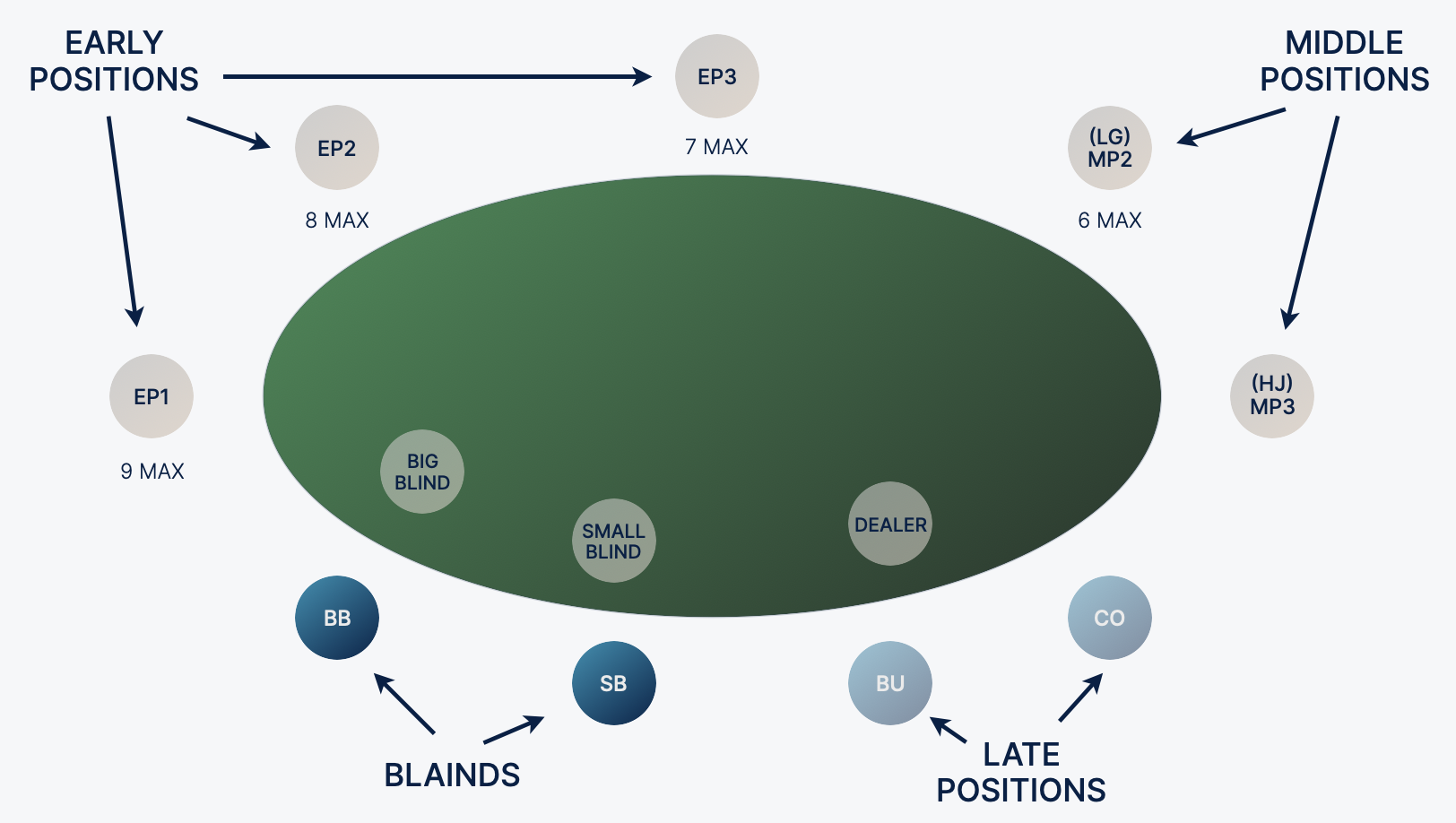
We will introduce you to all the positions in poker at a full table, designed for 9 players.
1. Types of positions at the poker table
There are several dimensions of tables in poker:
| Number of players at the table | Description |
| For 10 players | It is often found offline. Not used online |
| 9 players | Outdated online desk format. Occasionally |
| 8 players | The most common format at the moment |
| 7 players | Rare table type |
| 6 players | The so-called “short” table |
| 4 players | Rare |
| 2 players | Heads-up, also rare |
Most of the MTT takes place at 6-max and 8-max tables. For cash games, the popular format is 6-max.
2. How to determine the position at different types of tables
Below are tables detailing the positions at the different table types.
Positions at the 8-max table
| Item type | Description at the 8-max table |
Early - EP1 | EP2 or UTG | UTG+1 | Two places right after the blinds |
Middle - MP2 (LG) | MP3 (HJ) | The next two places after the EP |
Late - BU | CO | This group includes strictly two positions — Cut-Off and Button (dealer) button |
Blinds - BB | SB | The two most difficult positions for a profitable hand draw at the the long run |
Positions at the 9-max table
Item type | Description at the 9-max table |
Early - EP1 | EP2 | EP3 or MP1 | Two places right after the blinds |
Middle - MP2 (LJ) | HJ | The next two places after the EP |
Late - BU | CO | Same as previous table |
Blinds - BB | SB | Same as previous table |
Positions at the 7-max table
Item type | Description at the 7-max table |
Early - EP | One spot right after the blinds |
Middle - MP2 (LG) | MP3 (HJ) | Same as previous table |
Late - BU | CO | Same as previous table |
Blinds - BB | SB | Same as previous table |
Positions at the 6-max table
Item type | Description at the 6-max table |
Early - | One spot right after the blinds, though, |
Middle - HJ | One next place after EP |
Late - BU | CO | Same as previous table |
Blinds - BB | SB | Same as previous table |
Positions at the 4-max table
Item type | Description at the 4-max table |
Early | None |
Middle | None |
Late - BU | CO | Same as previous table |
Blinds - BB | SB | Same as previous table |
Thus, when the table decreases, the number of positions changes - first one middle position leaves, then one early position leaves, then another early position leaves, and so on. Let's talk about each of them.
Blinds — automatic bet before cards are dealt.
On the small and big blind, you place mandatory bet even before the dealer has dealt the cards. This is their distinctive feature and the catalyst for the entire poker game, because even before the distribution of cards, a minimum pot has already been formed. It is important to learn how to competently protect the big blind and open a lot of hands from a small position. In these two positions, we need to play the most hands, because we have already invested chips in the pot. Detailed information about this is available in the course for beginners and fans of the “Basics of preflop and postflop games”.

On the preflop, you lay the tactics for the whole play, so the wrong choice of the opening range from the small blind or the protection of the big blind leads to serious problems and difficult situations on the subsequent streets.
Features of playing on blinds:
- On preflop, you complete the trade.
This allows a large number of starting hands to enter the pots and guaranteed to see the flop. It is very important to strictly observe the preflop charts in order not to lose too many chips in the the long run. - On post-flop, you open trades, making decisions first.
This is the most disadvantageous position in poker, since you do not know the actions of the other opponents. But in a certain part of the flop structures, you have the right to act aggressively using such a technique as check-raise. This is the most difficult, interesting and important part of modern poker. - From the small blind, aim for most hands to play through the 3-bet compared to the BU.
This gives us the initiative on the post-flop, which is compensation for playing without a position.
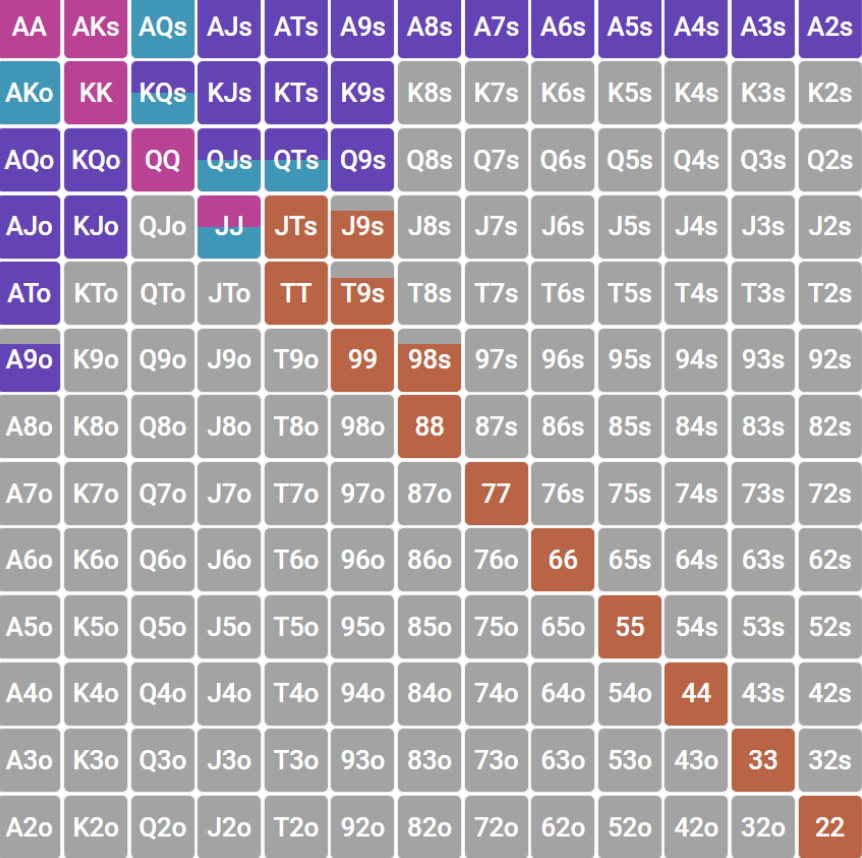
Early poker positions are the narrowest opening range
Playing from early positions in poker is both easier and more difficult at the same time. On the pre-flop, you open the trading circle, and on the post-flop, you say the word immediately after the blinds. Often, MB and BB folds still on the preflop, so the first word on the later streets automatically goes to you. The simplicity of the strategy game from UTG (EP) is explained by the narrowest range of starting combinations. From here, there are few open raises even on middle hands, not to mention the weak ones, since the whole table still sits after you. There is a high probability that one of the opponents will have a really strong hand, you will get a 3-bet — and put yourself in a difficult position, in which the best option is just to fold most of the hands and thus give the chips to the opponent, realizing that the range of 3bet against EP will also be very narrow.

Average positions — expanding the range
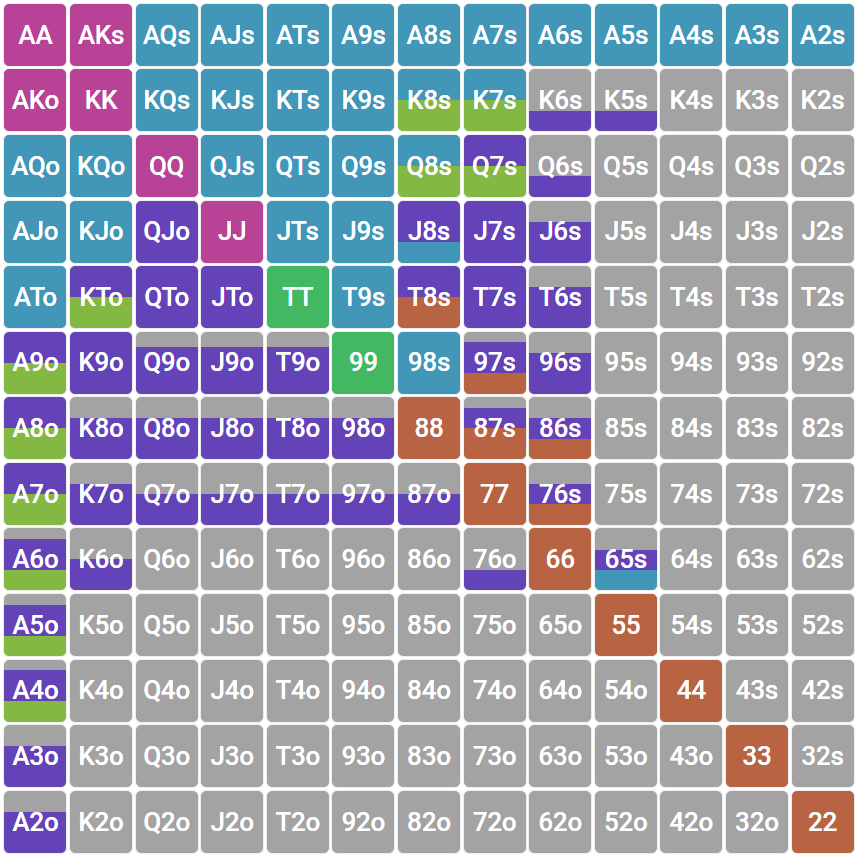
The two middle positions allow you to expand the range of combinations to be opened. MP (MP2 is the old name for 9-10 max tables) and MP3 (Hijack or HJ, as everyone now calls it). MP mechanics — after you, there are still a lot of players who can enter the hand and gain an advantage over you, since they will play in a position. But there are already fewer players after you than when you are on the EP, so the range of combinations played is gradually growing. It grows with each subsequent position at the table. Each of the positions has the "golden number" of combinations that can be played as a plus, and the rest are better to throw away fold. This information is very beautiful and structurally given for you in our free video course “Basics of preflop and postflop games”. This course contains both the basic preflop for winning microlimits and the basic postflop. The course is available for free through our loyalty program.

Cut-off
The cut-off position got its name for the opportunity to “cut” the button and players on the blinds from the button game. This can be done by playing through the open-raise or 3-bet of the previous bet increase. Opening with a raise from a cut-off is called "style" in poker terminology (from English Steal - theft, theft) or theft of blinds. Such a term began to be used because it is not always possible to raise bet rates from late positions with a good starting combination.
Often you will open your borderline hands in the hope of picking up mandatory bet (i.e. blinds) immediately on the preflop or using the c-bet on the flop, thus “stealing” small but pleasant pots. This is a basic poker strategy that everyone knows about. But few people understand how wide it is possible to open from late positions with a raise. The range of opening from the cut-off becomes wider, since only three rivals remain after you. If the button drops your hand, you will be playing in a position against the blinds.
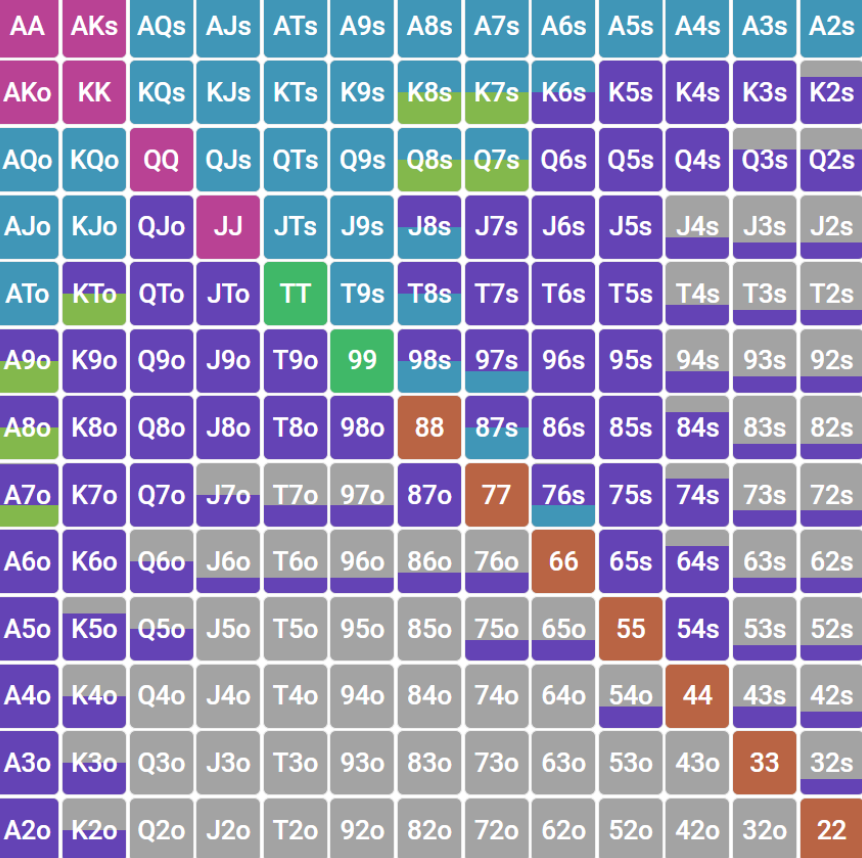
Button — the most advantageous position in poker
In this position, you are directly in front of the blinds. That is, all the players who came before you into the game and the blinds after you will make their decision on the post-flop before you.
You are the very last player in the decision queue on subsequent streets. This is profitable.
In addition, the open-raise range from the button is very big, since there are only 2 positions left for you, and both put the blinds blindly, so it is very profitable to attack them over a wide range. Moreover, most players are so poorly protected on the blinds that we often have the right to open under 100% of the range of starting hands, squeezing opponents out of the bank on subsequent streets using bet. And it will be mathematically justified.
3. Playing on the post-flop: in position and without position
After completing the first round of betting (preflop), 3 common table cards (flop) are opened and a new round of betting begins. In total, there will be 3 more – flop, turn and river, these stages are called "streets". On all "streets", the order of decision-making among the players at the table will be the same. It is determined by positions on the preflop, as mentioned in the article above. Thus, on the post-flop you can be in a position (In Positions, IP) or without a position (Out of Positions, OOP) relative to your rivals.
IP (In Positions)
Means that you are the last to make a decision on the post-flop regardless of how many players are involved. It is much easier to play in the post-flop position, so the VPIP indicator (how often you voluntarily deposit chips into the pot on the pre-flop) should be the maximum in the button position (among blind-free positions).
OOP (Out of Positions)
After you, there are still players who make decisions on the post-flop. If you play 1 vs 1 , it's strictly OOP. If you're playing 2nd out of 3 players, that's OOP too, but poker players like to call that position “in the sandwich.” The strategies of the game will be the same in some areas, but in some cases will differ depending on whether you are in the position or not. You will learn these concepts later in articles and videos from our website. Of course, it is much easier for you to play your hands in a position, so the construction of preflop game ranges largely depends on this factor. But you do not need to understand this, just remember and implement the correct charts of the preflop game in the game and believe them, not considering yourself the smartest of all. Gradually, with experience, you will learn how to properly expand or narrow them against specific opponents, based on their style of play.
4. Tactics for different positions
At the first stage of your poker development, you need to learn how to observe the charts of the preflop game as accurately as possible, even without understanding the logical meaning of their construction. Understanding will come later with experience.
But if you do not go out of the charts, believing that you can play something other than them — this will be the best manifestation of discipline and student attitude. This will allow you to develop your poker skills faster. You will immediately learn how to play correctly, respectively, your mind will build the initially correct logical chains on its own. Here are some examples of strategic techniques that are directly related to positions:
Steal
As mentioned above in the article — theft of blinds. A very important tactic for earning chips. It is especially effective from late positions (BU, CO), because due to being in a position, we get a solid edge on the post-flop, which allows us to easily play pots in a big plus even on the post-flop, not counting the preflop advantage in the range over the positions of the blinds.
Resteal
Effective technique against style — resteal. This is what 3-bet is called against the style from one of the later positions: cut-off, button or small blind. You understand that stealing blinds is profitable, which means that other players will do it on a large number of weak hands. So you need to “protect the blinds” by making a 3-bet on suitable hands (both on the value and as a bluff). Range of 3bet from all positions you can also get by joining the loyalty program of our site for only 1 room, registered through our site. But there is also a completely free version that will come to your email immediately after registering on the site.
Postflop pressure after EP raise
You are feared when you open up from an early position. Everyone understands that your range is strong. This can be used to further bluff aggression on a post-flop.
The reverse side of the coin — there will be little bluff in active actions against you, take this into account when making decisions.
Study the material on game strategies, including the most basic materials on our website, and it will be easiest for you to succeed. We spare no time in maintaining the relevance of knowledge and writing author's articles, rather than copied or reprinted from different sources. This is personally monitored by our head coach and project creator Alexey Exan13.