


Translated with the help of AI. We apologize for any errors and would appreciate your help in correcting them.
Article by Andrew Brokos, original source: GTO Wizard
The monotonous structures of the boards in poker (3 cards of the same suit) usually cause strong concern among players. It's easy to imagine that your opponent already has a monster on the flop. And if you yourself have collected a flush from the flop, then you are afraid that the fourth card in suit will kill all actions and devalue your hand. Such fears (although understandable) will not allow you to play these boards optimally if you do not learn how to cope with them.
The truth is that flushes on the flop are quite rare, and if your opponent didn't have a flush on the flush, it's also unlikely that he will collect a flush on the turn or river. In most cases, the opponents will not even have a banal flush draw. As players place bet and equalize, the pot grows, the range narrows more and more around the flash cards. However, even in this case, despite the risk, in general, it will be correct to continue playing strong hands on the vellya value. While we can't discuss all possible scenarios in this article, we'll look at a few key situations to understand the strategic principles that will prove useful on any monotonous flop.
1. Flashes are unlikely with small cans
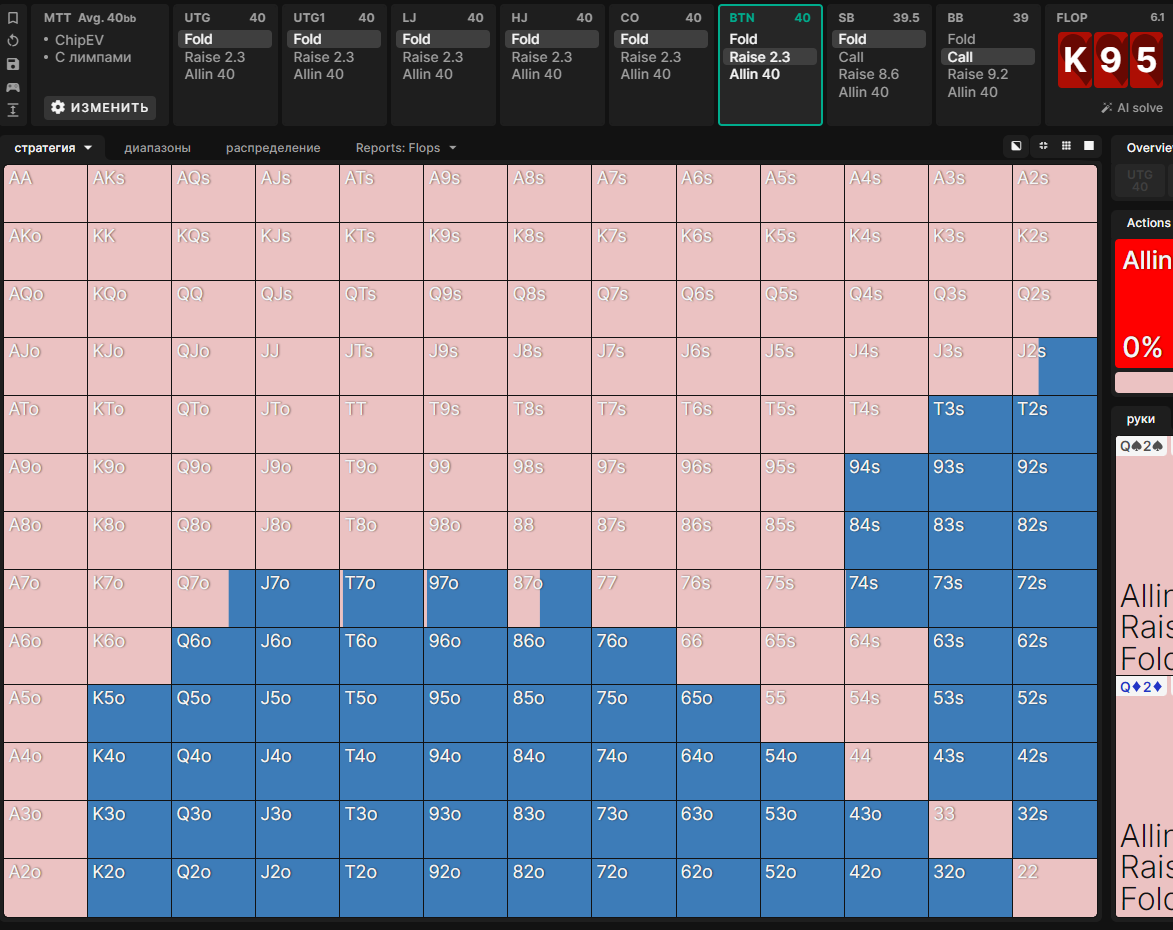
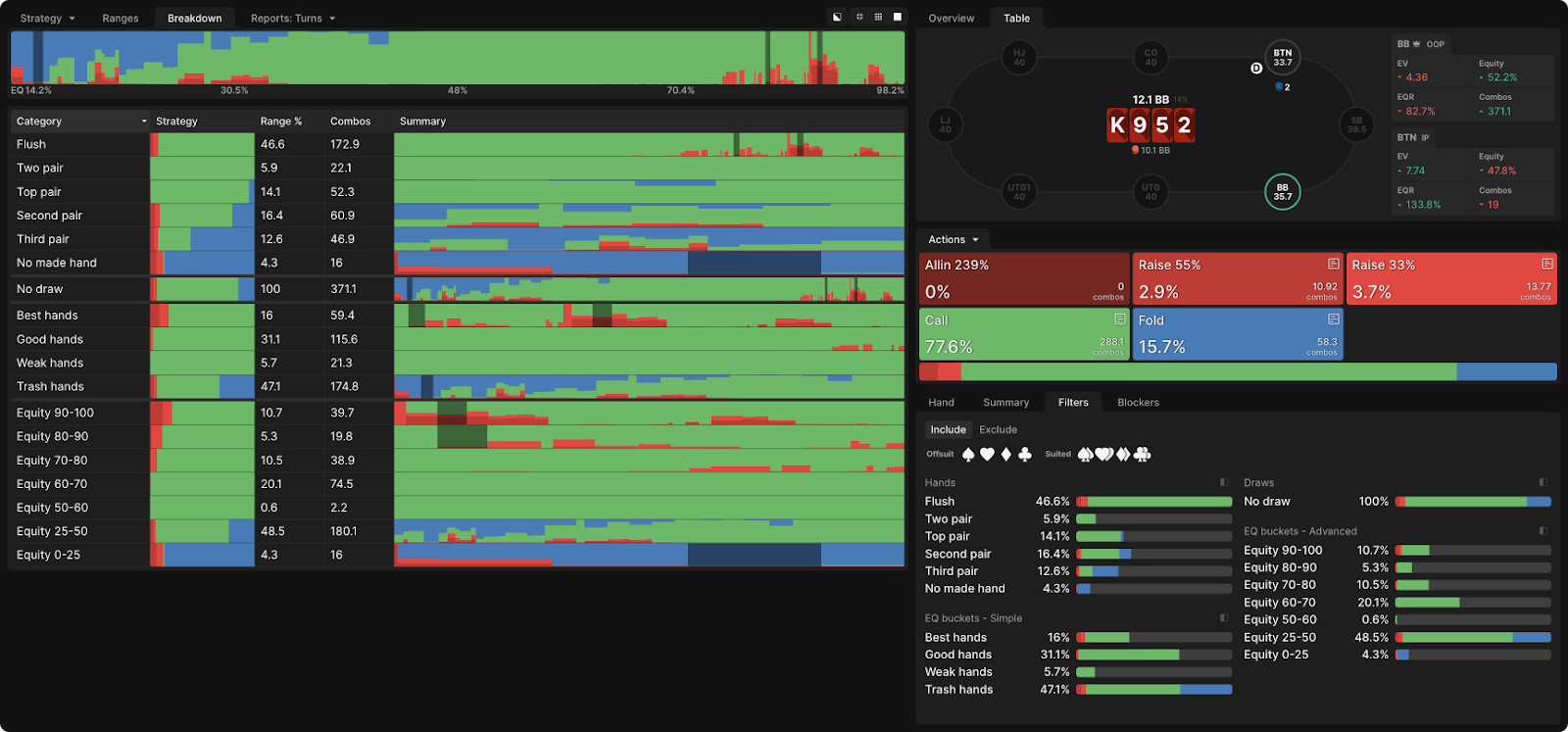
It is very difficult to collect a flush immediately on the flop. Most hands are not suited, and even if they are suited, they coincide with the suit on the board in less than 25% of cases due to the effect of removing cards (an effect that changes the likelihood of cards appearing on the board or in the opponent's range due to the issued cards). In the single-raise pot in 40 bb stacks, BTN sees flush only in 5% of cases on the monotonous 

 BB flop, which plays more low suited cards, in 6% of cases it collects flush on the flop.

Although flash cards are strategically important on monotone boards, this does not mean that in this spot everything should now revolve around the flash and only.
In the confrontation between UTG and BB, the range of both players on the preflop is slightly more focused on suited hands. UTG on the flush collects flush 5.5% of the time on K95, and BB collects flush 8% of the time. Let's change K to A, and the BB frequency will not change much, but the UTG will drop to 4.3%, because with UTG, the suited hands will most often be hands with the Ace. We already see the ace on the flop, which means that we remove all suited aces of this suit (worms in our case) from the not very wide range of UTG.


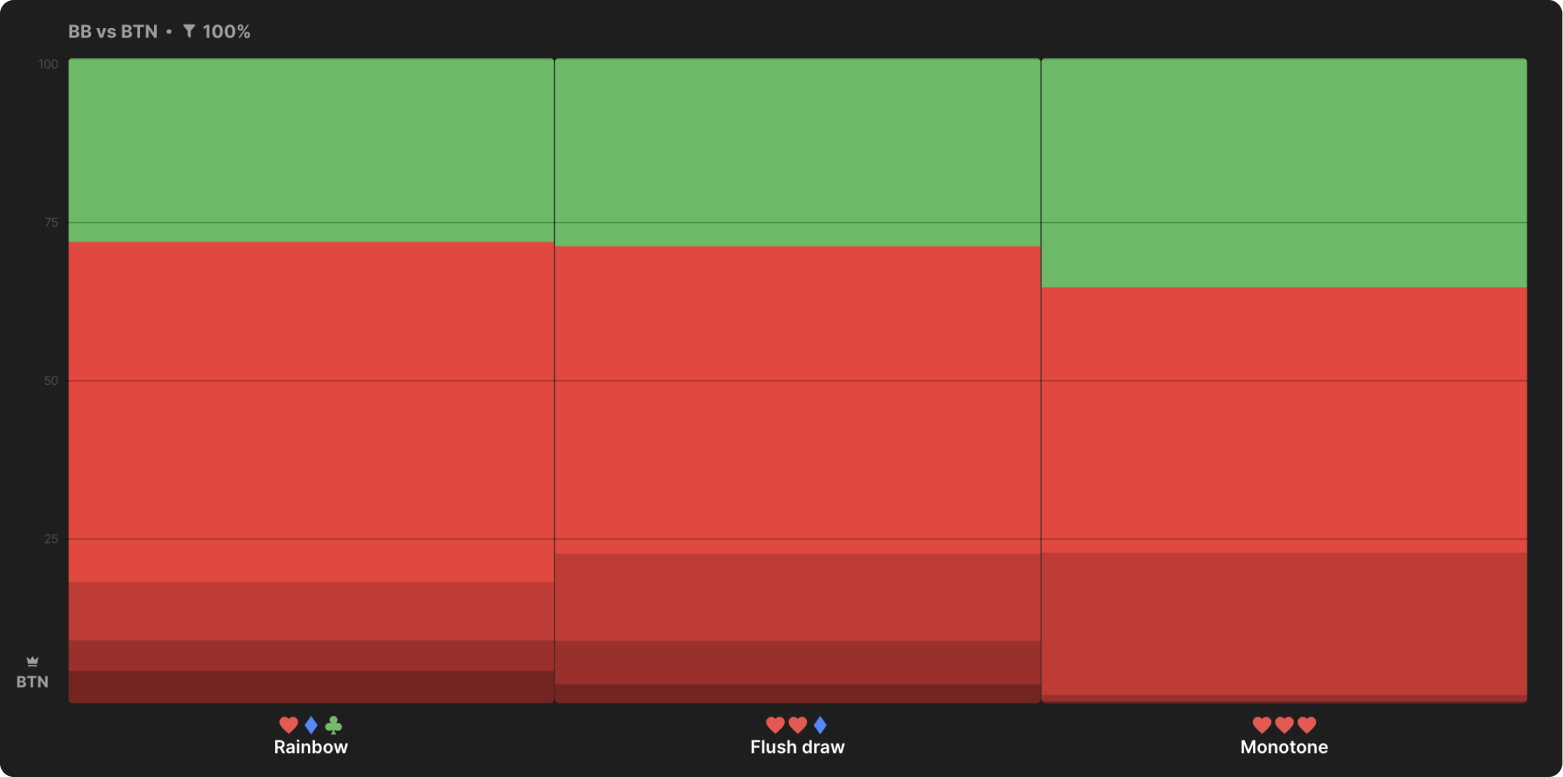
(In the Category, the combination is indicated, and in the Summary, the horizontal distribution of this equity combination from 0% (left) to 100% (right) is indicated, and the vertical bet colors are green (check), blue (hereinafter referred to as fold), reddish - bet, strongly red - a large bet or all-in). In most scenarios, the player collects flush draw on a monotone board 25-30% of the time. However, this number decreases for BB when it collides against an early position. On the K95 board against UTG, he collects flush draw only 21.6% of the time (but remember that he collects flush draw a little more often).

When a monotonous flop comes out, the probability of a fourth worm falling on the next street is approximately 20% (slightly higher if you do not have worms in your hand, and lower if you have one worm, and much lower if you have two hearts). The bottom line is that when a monotonous flop opens, your opponent is extremely unlikely to have a flush and probably won't even have a flush draw. And even if it has a draw on the flop, it probably won't improve to a flush. All of this is true for you too.
Although flash cards are of great importance on such board, they should not suppress the usual strategic considerations such as bank control, fine collecting of value and playing the vellya. All this implies a one-on-one pot. The more players saw the flop, the more likely it is that someone collected a flush or strong draw on the flop. If several hand participants continue to invest money in the bank on a one-masted flop, almost certainly at least one of them will have a flush draw or ready-made flush.
2. As the pot grows, flash cards become more important
As players place bet and equalize and the pot grows, the range is increasingly centered around flash cards. When you're mulling all-in on the river or calling all-in, these cards are paramount. The following chart shows the probability that each player will have a flush or flush draw as the pot grows. The calculation takes the stack depth of 40 bb, BB defends against BTN in a single-raise sweat on the board 
 after three barrels of BTN.
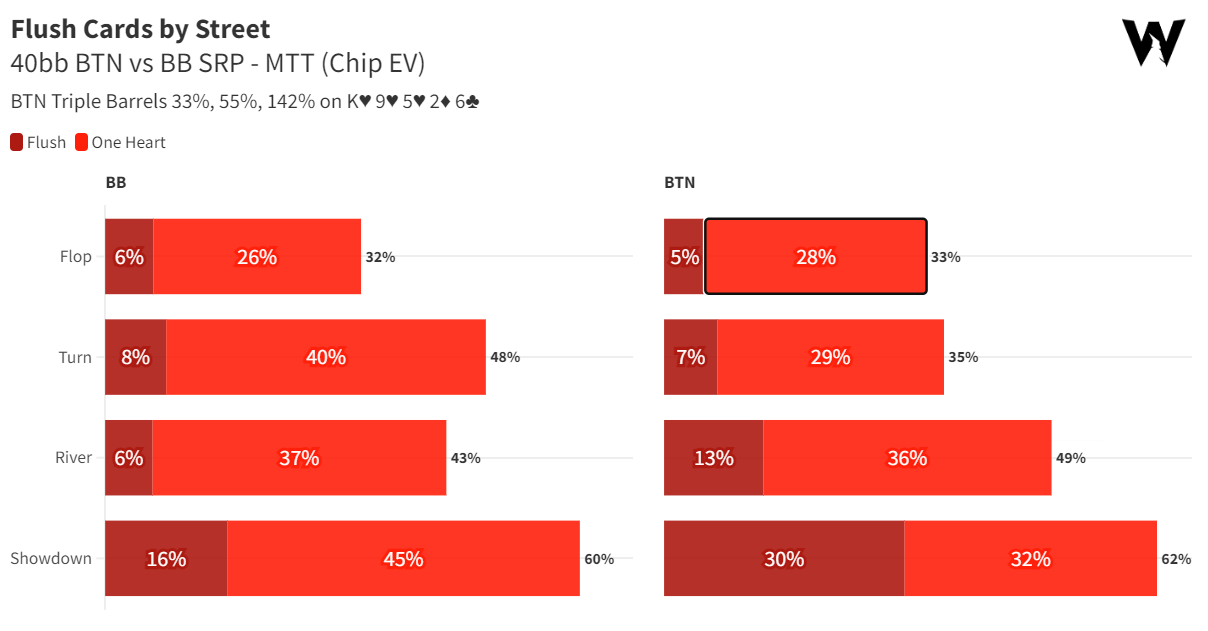
In this picture on the left BB , on the right BTN , from top to bottom 3 streets + SD (4 lines), each divided into 2 parts: on the left the probability of flush, on the right the probability of draw. For example, for BB on the flop the probability of flush is 6%, and draw is 26%, for BTN 5% flush from the flop and 28% draw from the flop. BTN attacks with 3 barrels of 33%, 55% and 142% on the board.
On a flop, flushes and flush draw are not so likely that other strong hands don't matter.
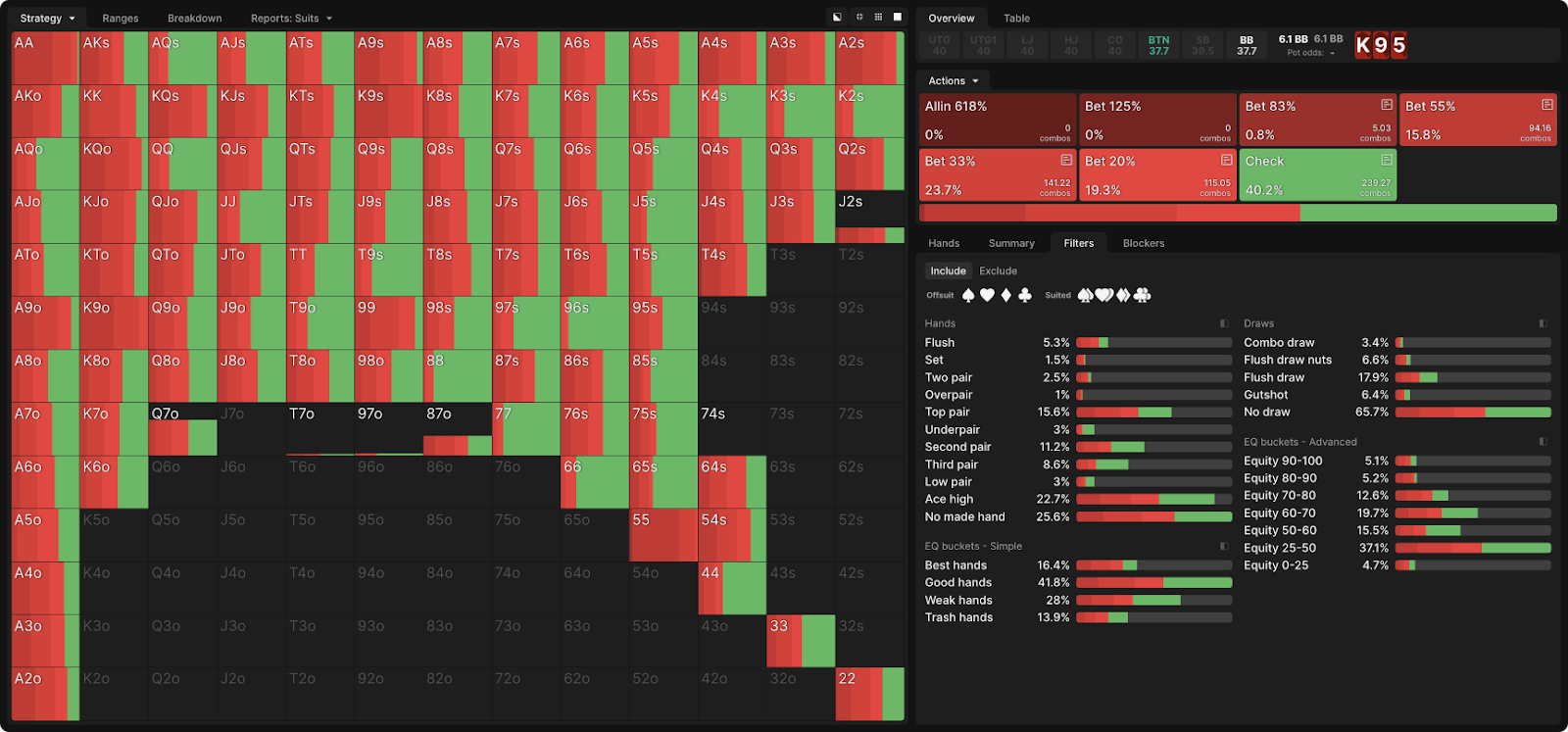
Monotonic or not, K95 is a great flop for a button, and it should do a c-bet with a high frequency. Thus, the bet of 33% of the pot on the flop does not have a strong bias towards the flush and flush draw.
However, a barrel on a turn nearly doubles the chances of a flush (7% → 13% from turn to river) and makes flush draw about 20% more likely, so that about half of a barrel range on a turn contains at least one turn card.
At the same time, when BTN goes to all-in on the river, it most likely does not have such a card in its hands. Of course, he will be Velha-beta with all his flushes, but Velha-bets with weak hands are also more desirable when they block flushes. Blocking flushes also makes the bluff more profitable, as the BB call range on the river is also heavily focused on flash cards.
Why is the BB range not as concentrated around the flush draw and flush draw in front of the river as it is in BTN? That's because we're only looking at his call range. Although these hands make good callas, they make even better raises. Flushes make up almost 20% of their rise range on the flop and almost 40% of the rise range on the turn.
3. Strategies for playing monotonous flops
The pre-flop racer has an equity advantage on most flops and prefers to use this edge by aggressively making counterbets. We have seen that none of the players are likely to catch a flush or flush draw on the flop, but these combinations become more likely as the pot grows. Thus, even more than on a regular flop, the pre-flop racer prefers a small size of the continuation bet. This allows him to increase his earnings by relying on his overall stronger range than BB without fear of inflating the pot from flushes, which can make up most of BB's range.
Let's take a look at the BTN vs BB strategy on all flops at 100 bb depth:
For the same reasons, BB is unlikely to bet on a monotonous flop, preferring to check-raise when a monster comes to him on the flop:
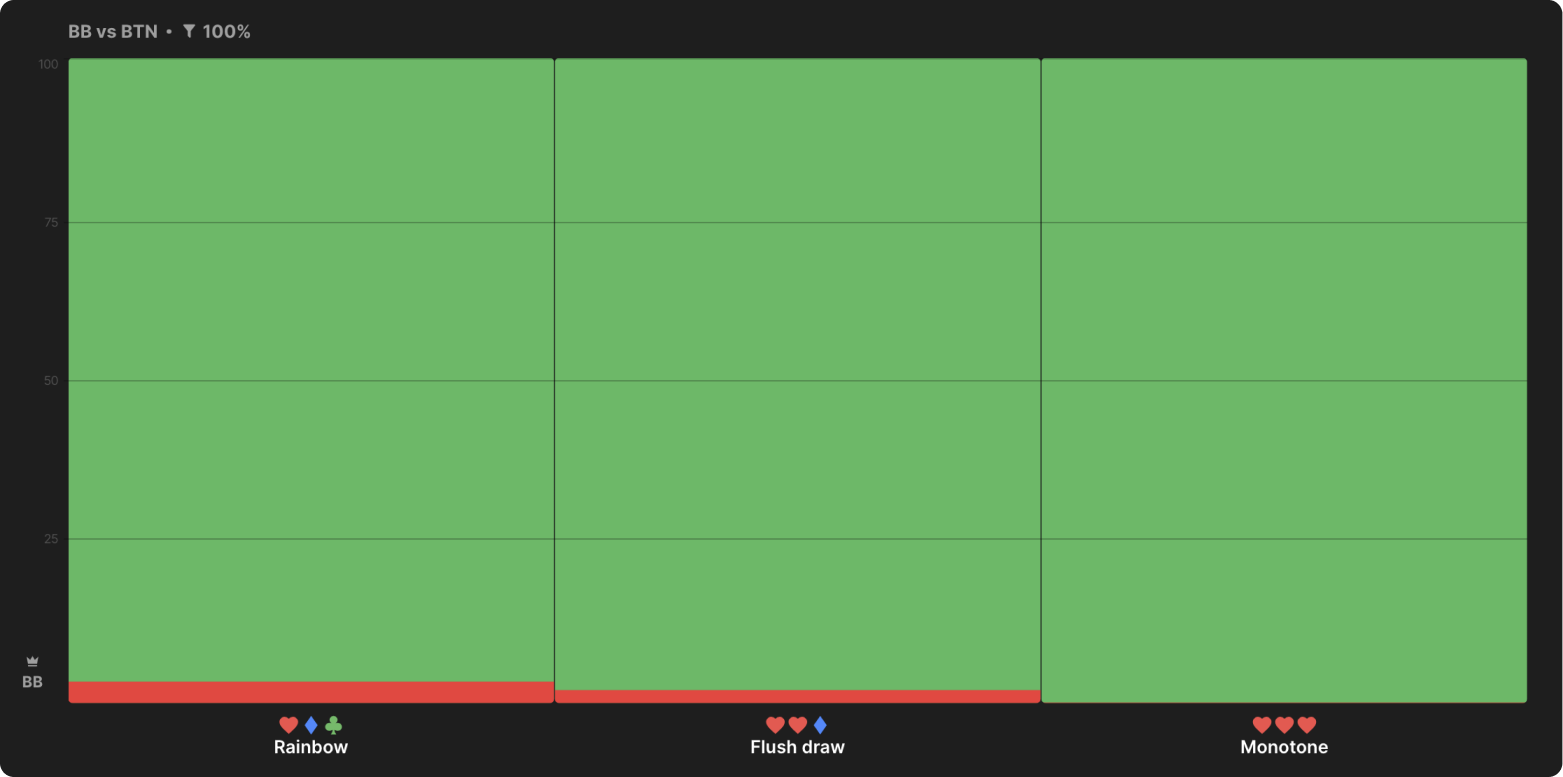
In fact, two pair is the hand with which BB check-raising is most often on the board, surpassing even flushes and strong draw in the most desirable candidate for check-raising:
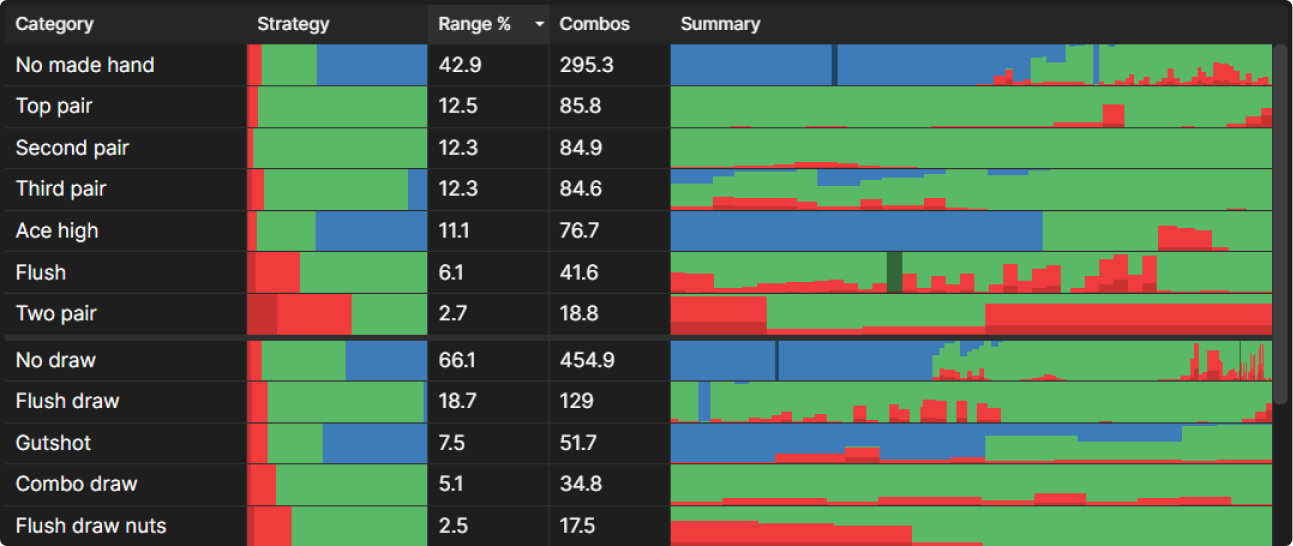
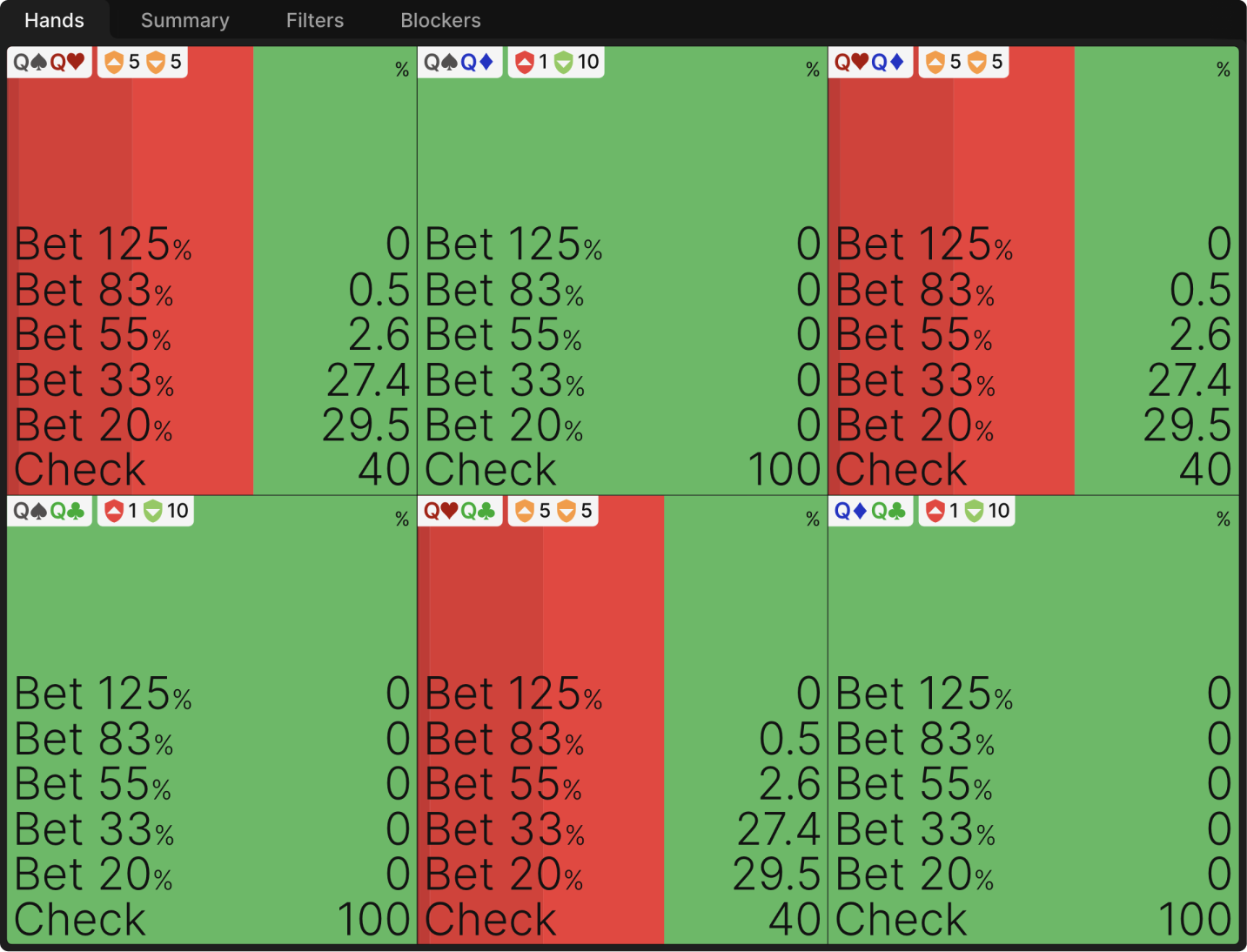
This confirms the fact that on the flop, flushes and flush draw are not so likely that other strong hands do not matter. The two pair and sets are a particularly desirable category of hands to raise on the flop, as they currently represent a strong hand that is vulnerable to losing much of its value as more cards are laid out on the cloth. Moreover, such hands still have the potential for your opponent's flash cooler (meaning outs on full-house)!
Therefore, immediate receipt of money is the first priority when playing with such hands. Low flushes can be just as vulnerable. The heart breaks at how easy it is to imagine a fourth worm card on a turn, but it's actually quite unlikely. If your two pocket cards are hearts and your three community cards are also hearts, there will only be eight hearts left in the deck, meaning that the worm will only come out on the turn about 17% of the time.
The risk is even lower if your opponent also has a worm. Even the exit of the 4th worm card will still not cost you a pot more often, because the opponent may try to bluff you out of the pot. As for the button, it will be a good flop for it, giving more than 55% equity and a profitable bluff with any two cards. It can combine a standard low bet strategy with a high frequency, hands based check range that will perform worst in a bloated bank - medium pair without hearts.
4. Playing the Turn
After the check and call on the monotonous BB flop, he is even more inclined than usual to make a check on the turn.
This is true even for paired thorns, which often stimulate dock betas:
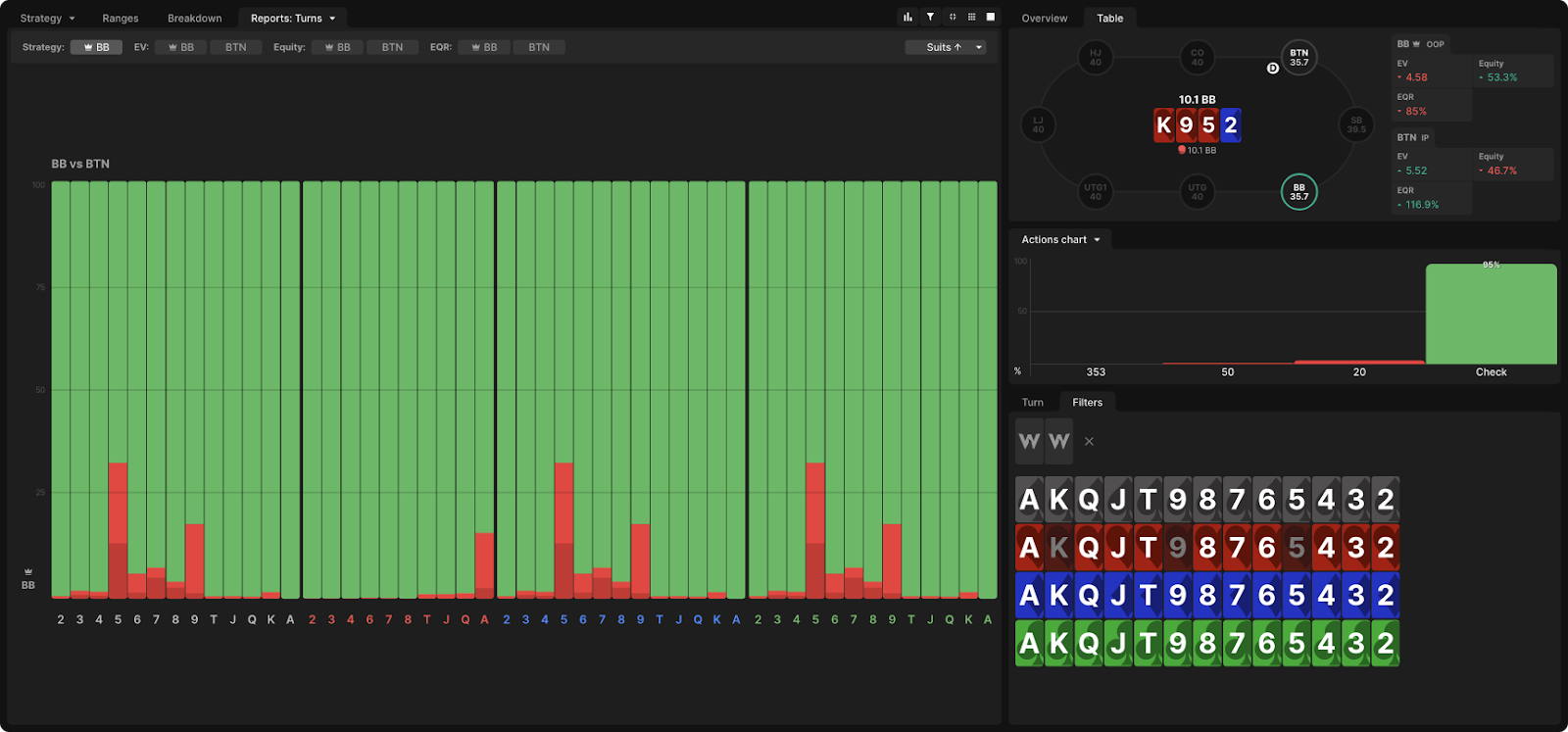
Trips on a turn are less valuable on a monotonous board. After a 3bet with all the pocket pairs on the preflop (at a stack depth of 40bb) and a check-raise with many two pairs on the flop, BB doesn't have many full houses on the turn.
The BTN barrel frequencies do not vary much between worm and non-worm thorns, although, of course, the composition of these ranges will vary with the map released:
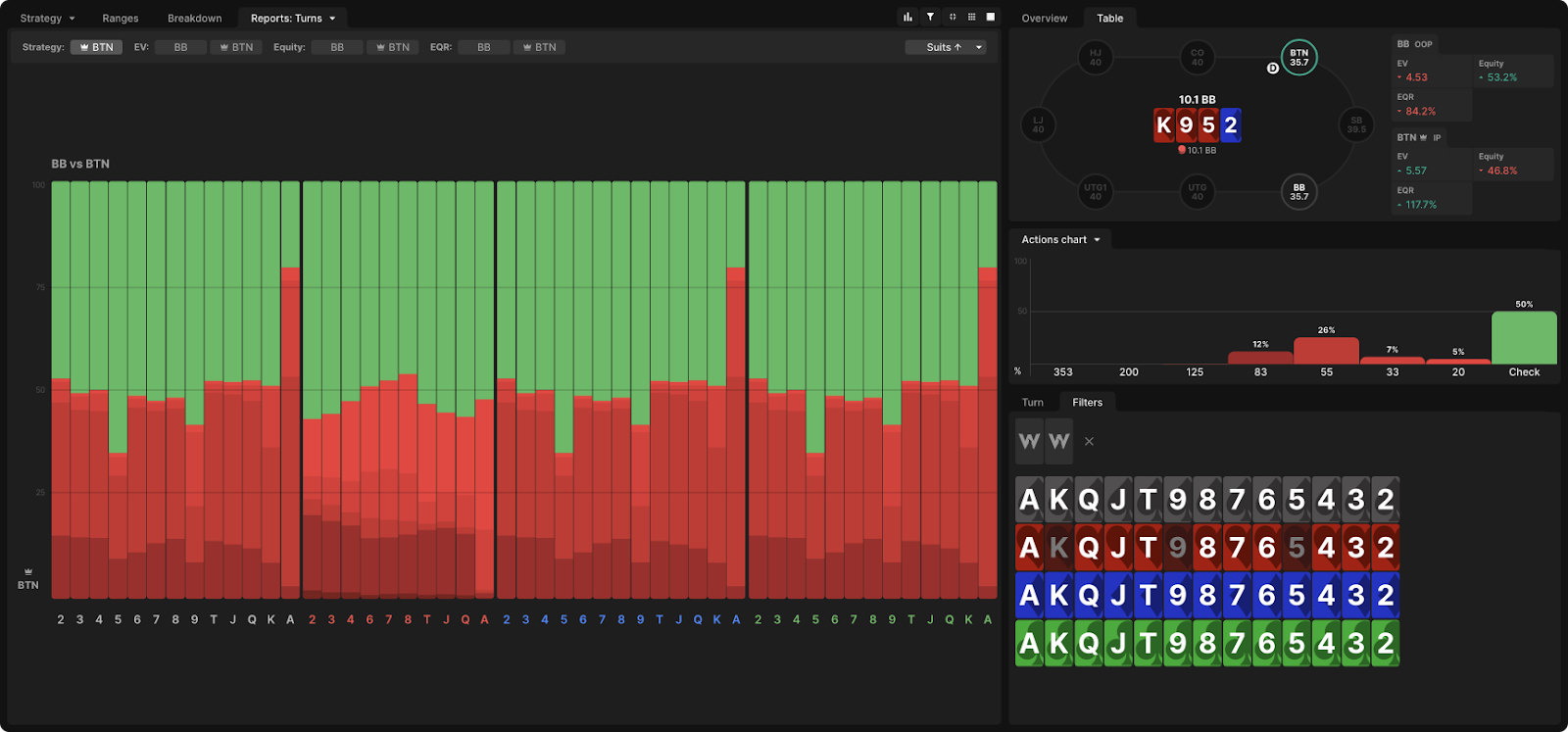
The main exception is , which occupies such a prominent place in the c-bet BTN range on the flop. Such a turn strongly blocks BTN flushes. Of course, it also blocks many BB flushes, but BB has a more diverse hand range with a single worm card, and is therefore less affected by such a turn. On a blank turn such as, BTN has a polarized range and almost always checks its middle pair, making exceptions only when it has a strong worm as a kicker. Its valley range consists not only of flushes, but also of sets, two pair, overpar Tuz-Tuz, and there is also a fair share of top pairs.
With a worm kicker, K-x hands should definitely be put; without a worm kicker, this is a more even combination of bet and checks:
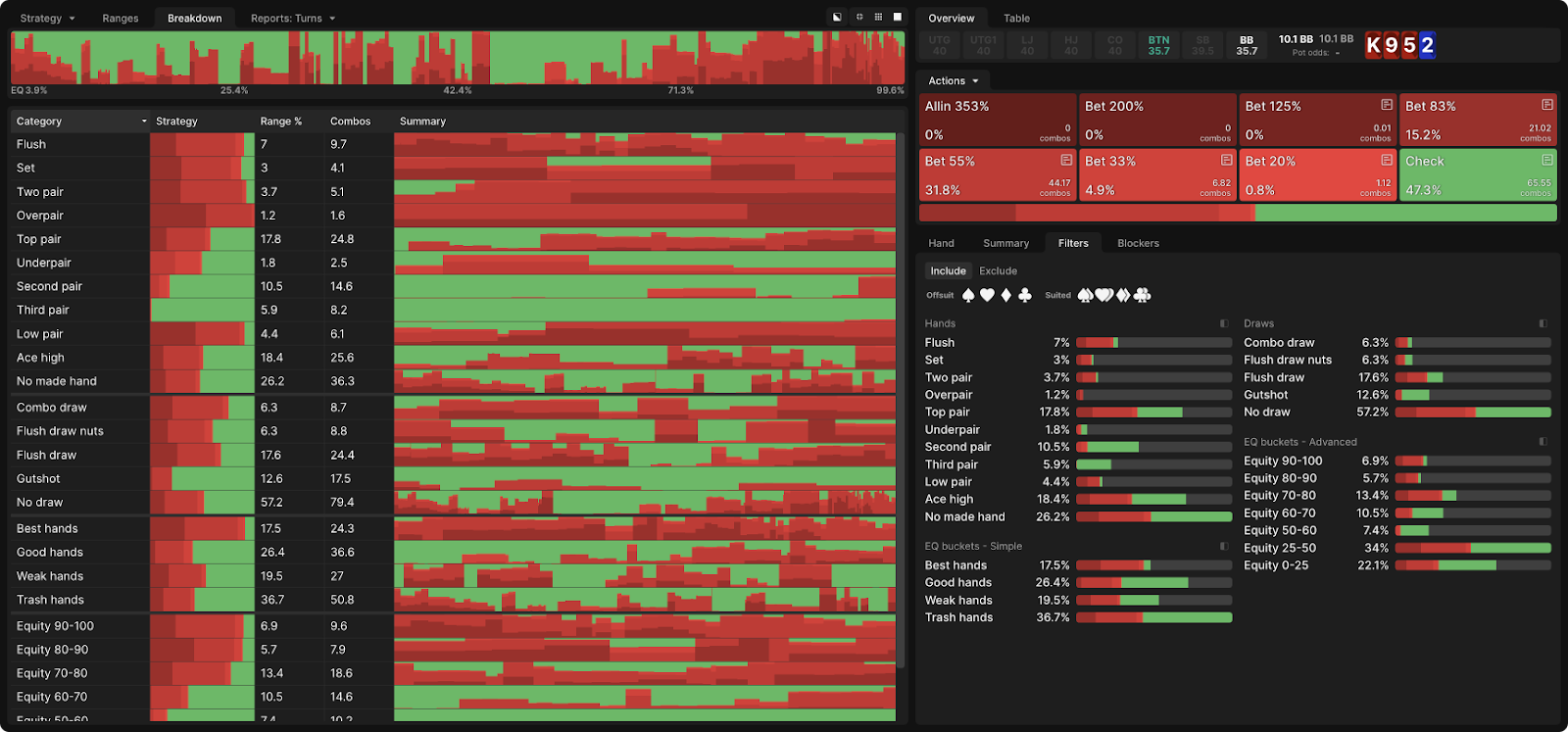
When bluffing, the button looks for some combination of overcards to the 9th with a worm blocker per draw. So again, we see that while playing with around the worm suit is important, it's not the only factor. The range of the BB call contains a lot of 9-x hands, so the presence of outs on an older pair increases the fold equity bluff.
5. Blank river play
On a blank river such as, BB never makes a dunk bet. BTN mainly plays the "Push or check" strategy, while any hand stronger than one pair is the purest all-in. Even the AK is pushed immediately if the ace is worm, which reduces the likelihood that the all-in is aimed at the opponent's sloped flush. On dry runout, BB is just unlikely to have a flush. BTN can and should pick up the extract value from many weaker value hands.
How much extract value can be obtained in such a situation will depend on several variables, such as stack depth, board position and texture, but even with triple BTN barring, a flush or even a flush blocker is not required for the push on the value. For a bluff, one is not always enough, because such hands, like  and
and  , actually have some show of down value at the autopsy.
  and
and  to push will be better, and
  can even scare, because the value of blocking two pair outweighs the value at the autopsy for this hand.
BTN frightens most of its worst unsteamed hands, even without a blocker on the worm. Taller unpaired hands such as QJ are an unwanted bluff even with a blocker on the worm because such a hand blocks most of the BB fold range. Two pair or higher is an insta call for BB. Also, the older pair is not necessarily better suited for bluffcutting than the middle or lower pair. For most pair, the situation is indifferent, but the older the blocker for the flush, the higher the incentive for the call.
6. play of worm rivers
BB does not dunk bet on the worm's turn, because even in the rare case when he has a nut hand, getting a free card is not dangerous. The BTN strategy  is interesting in that it assumes a more polar bet range of 83% of the pot.
The bet of 20% is mainly a thin vellya, and the check range consists almost exclusively of medium strength hands:
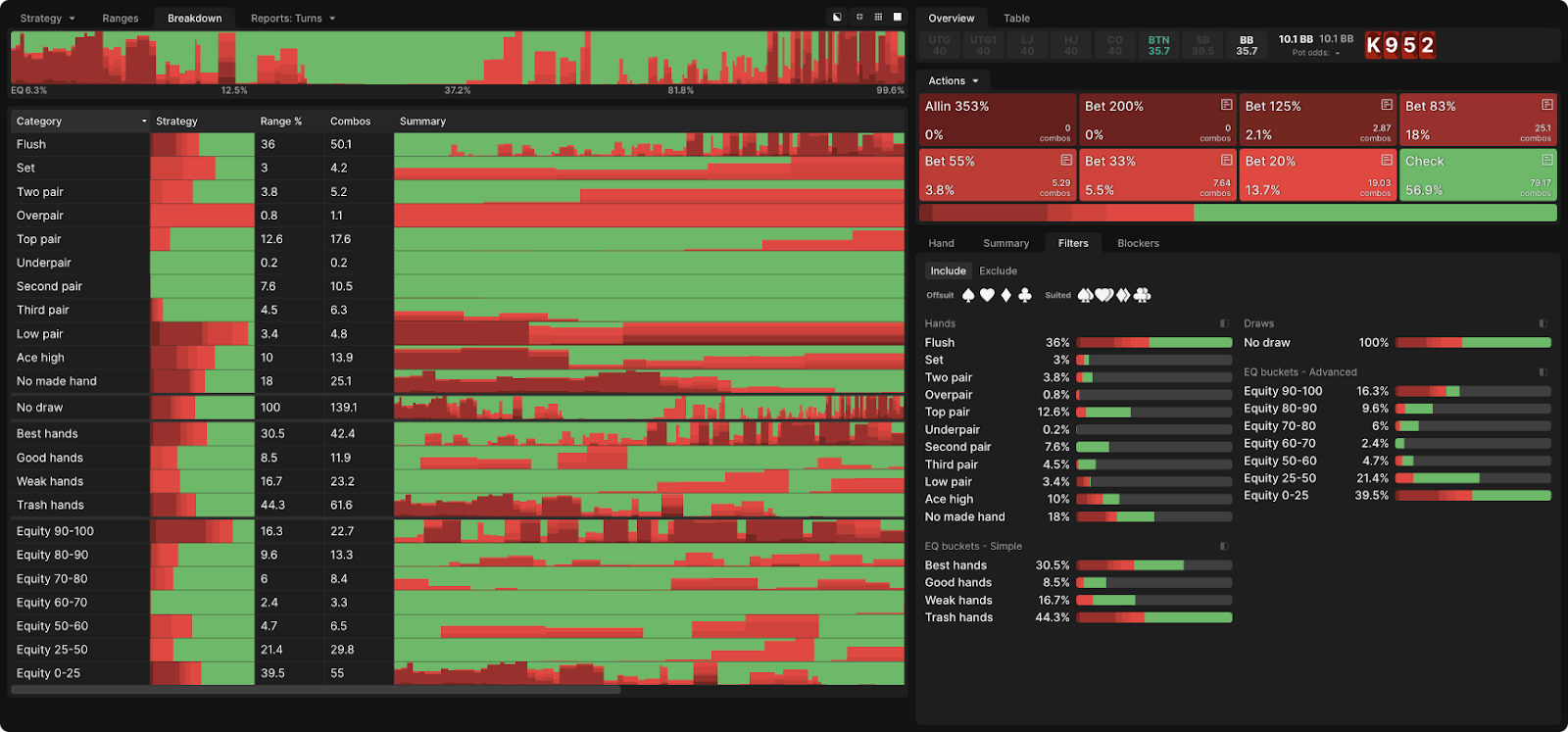
The BTN bet of 20% of the pot on the worm turns acts as a proactive blocking bet.
The 83% bet consists of most of the combinations  and, as well as the bad hands, the same ones that bluffed on the river
  in the section above. The 20% pot bet contains hands such as two pair, sets, and even some AK and AA. It acts as a proactive betting block, allowing BTN to squeeze a little more value with these hands, and then make a check-behind for a free necropsy on the river.
There are very few bluff in this range, as the bet implies a very good price, but there is a small trap here if BB decides to check-raise. The best candidates for this are hands like and , which contain two large hearts and therefore block many of the best hands for a BB call.
Lower flushes are not in the range of this small bet. They make a check on the turn, intending to call on the river. Faced with a more polar rate of 83%, BB's response would be strictly call or fold. Two pair and flush are pure callas. A few top pairs are mixed to get into the Minimum Protection range, but basically everything that is less than two pair is reset. Two pair (because of their potential to improve to full house) are above average bluff ketchers. Against a bet of 20%, you need to be much more stubborn.
Here, BB still makes little progress and folds only their worst hands, mostly the third pair and below:
7. play of the river
BTN complements its turn bet of 83% of the pot with another polarized bet on the river, regardless of whether the river is a worm card.
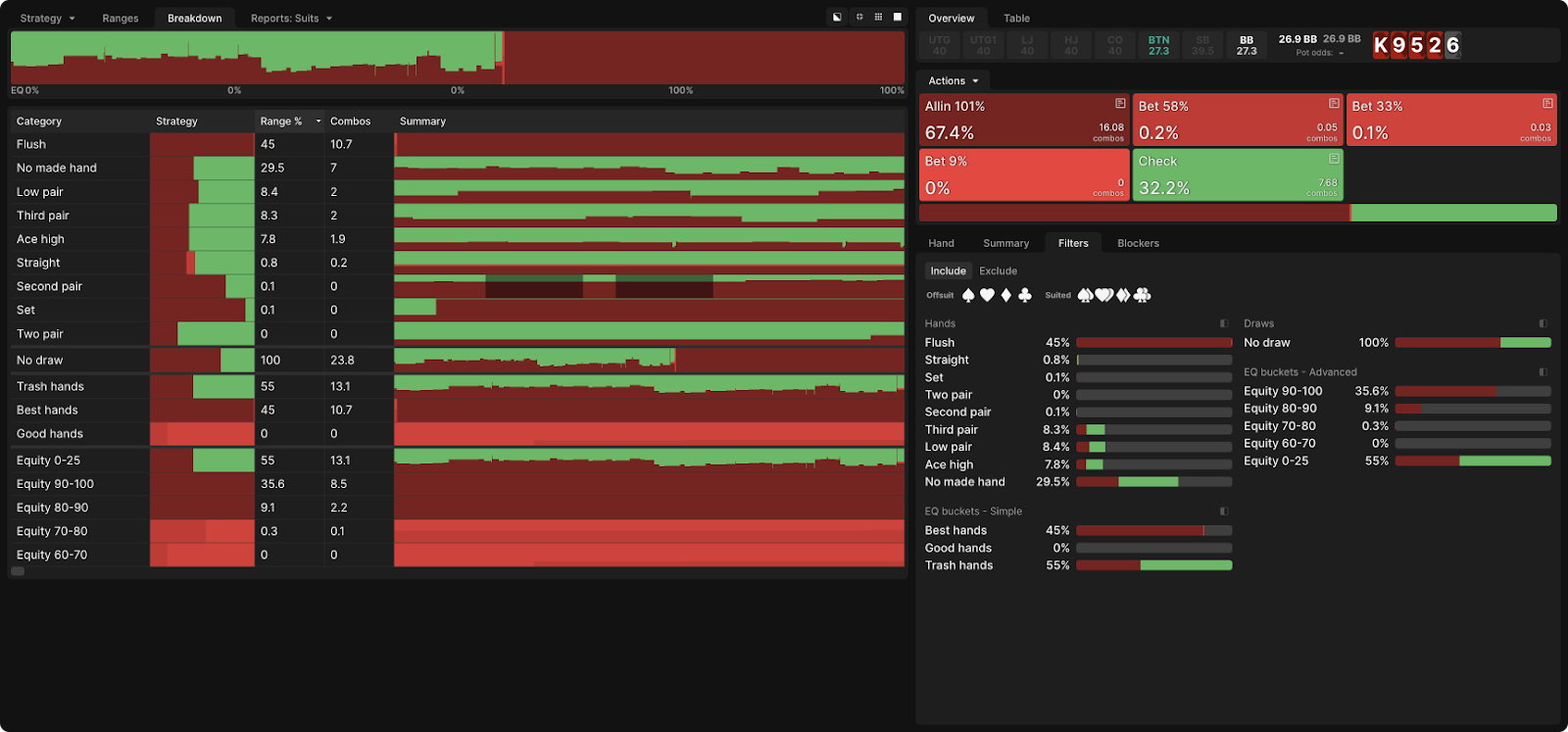
On the non-worm river, all his weak hands work equally well in a bluff: as a bluff:
On the worm river there are some clean bluff and clean check-folds, the difference in EV between them is insignificant:
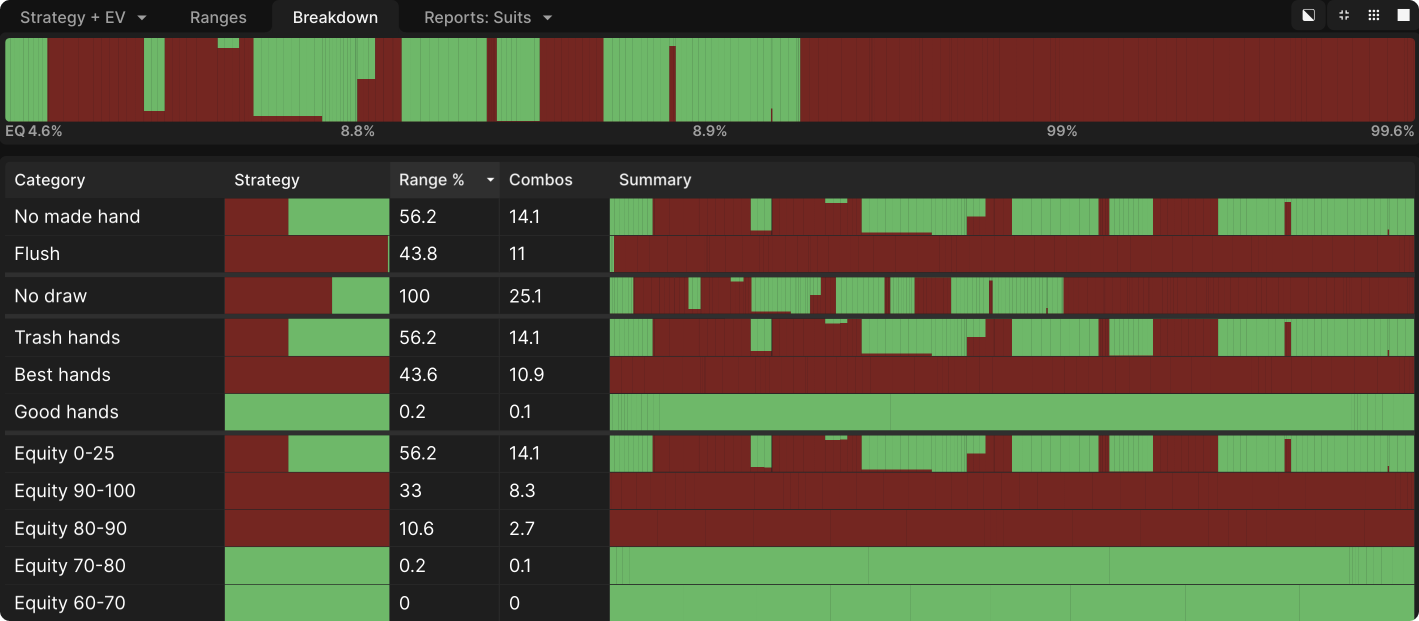
Against most regular players in this scenario, you'd better not to bluff as a bluff. These bluff are based on the fact that BB resets not only all his split, but even some hands that hit the board, and an ordinary player will not want to make such folds. Betting 20% pot on the turn, the button often checks on the river, but pushes its traps and bluff. However, on the river, BB actually has a robust block range after a small turn bet check-call.
On the river, he leads at 35% of the pot with most of his hands except for the King and the Ace as they block BTN folds. Since BB can often beat the board, while the range of a small bet BTN on the turn falls very heavily on this board of 5 worm cards: - -, this bet deprives BTN of a cheap opening, which he often counts on in such a situation.
If the river 6 is not worm, but peak, then BB makes bet less and less often. Bet of 11% from the bank acts as a blocking bet, similar to a small bet on the BTN turn, allowing BB extract value to get a little value from low flushes and even two pair. It also includes some traps: hands with two large worm cards that block the BTN Velu Beta range.
8. Conclusion
As you can see, monsters are hard to find even on monotonous boards. Make bet with good hands, slouple when necessary, and do not give opponents free chances to implement, especially before they invest a lot of money in the pot. They probably don't have a flush and they're probably not going to knock your hand out. There are many other hands from which you can get the extract value or knock them out of the pot. As the pot gets bigger, the likelihood of flushes increases, and so blocking them also becomes more important. Even in this case, as long as there are no 4 suited cards on the board, you should continue to collect the Velha from other strong hands and put pressure on numerous non-flush hands of your opponent.