

Translated with the help of AI. We apologize for any errors and would appreciate your help in correcting them.
This article explains how to properly analyze preflop ranges with ICM in tournament poker. It covers why it is important to start with Chip EV, how payout structure, stack sizes, bubble factor, and risk premium change decisions, and what to look at to understand not only a specific spot but also the general principles of ICM strategy.

Translated for the educational portal university.poker
Original source: GTO Wizard
In a sense, tournaments can be considered a more complex format compared to cash games. This is because tournaments involve more variables, especially when ICM becomes a significant factor. Strategy is affected by payout structure, changing stack sizes, and the tournament stage. So much so that blindly following a single range in all similar situations would be a mistake. Nevertheless, much can be learned from the ICM solutions in the GTO Wizard solution library. In this article, we will examine how to study preflop ranges under ICM in a way that allows you to draw universal lessons and apply them to other similar scenarios.
1. Gather Data
Although GTO Wizard currently does not allow you to run your own custom ICM simulations from scratch, the library already contains many pre-solved spots that are close enough to hands you have played in real games.

Let's look at an example.
Recently, I encountered a situation where I was unsure what my range should look like from the small blind against a middle-position open with effective stacks of around 30bb, when ICM is a moderately significant factor. This is not the ITM bubble or the final table bubble, but rather a stage where the money bubble is approaching or has just burst.
Last week, I played a hand where HJ opened and covered my stack. I had around 32bb in the SB, slightly below the tournament's average stack. The money bubble had recently burst, so ICM still affected decisions, but the pressure had already eased noticeably. My specific hand was ATs, and I was wondering whether calling would be better than 3-betting. While GTO Wizard AI cannot yet solve a simulation for this exact situation, the solution library contains many pre-solved ICM spots.
To find a suitable scenario, you need to:
- go to the solution selector (the Change button in the upper-left corner);
- select the closest tournament stage: 10% of the field remaining, large field;
- click the SB column to sort small blind stacks;
- find all spots around 30bb;
- select those where the stack distribution at the table is as similar as possible to yours.
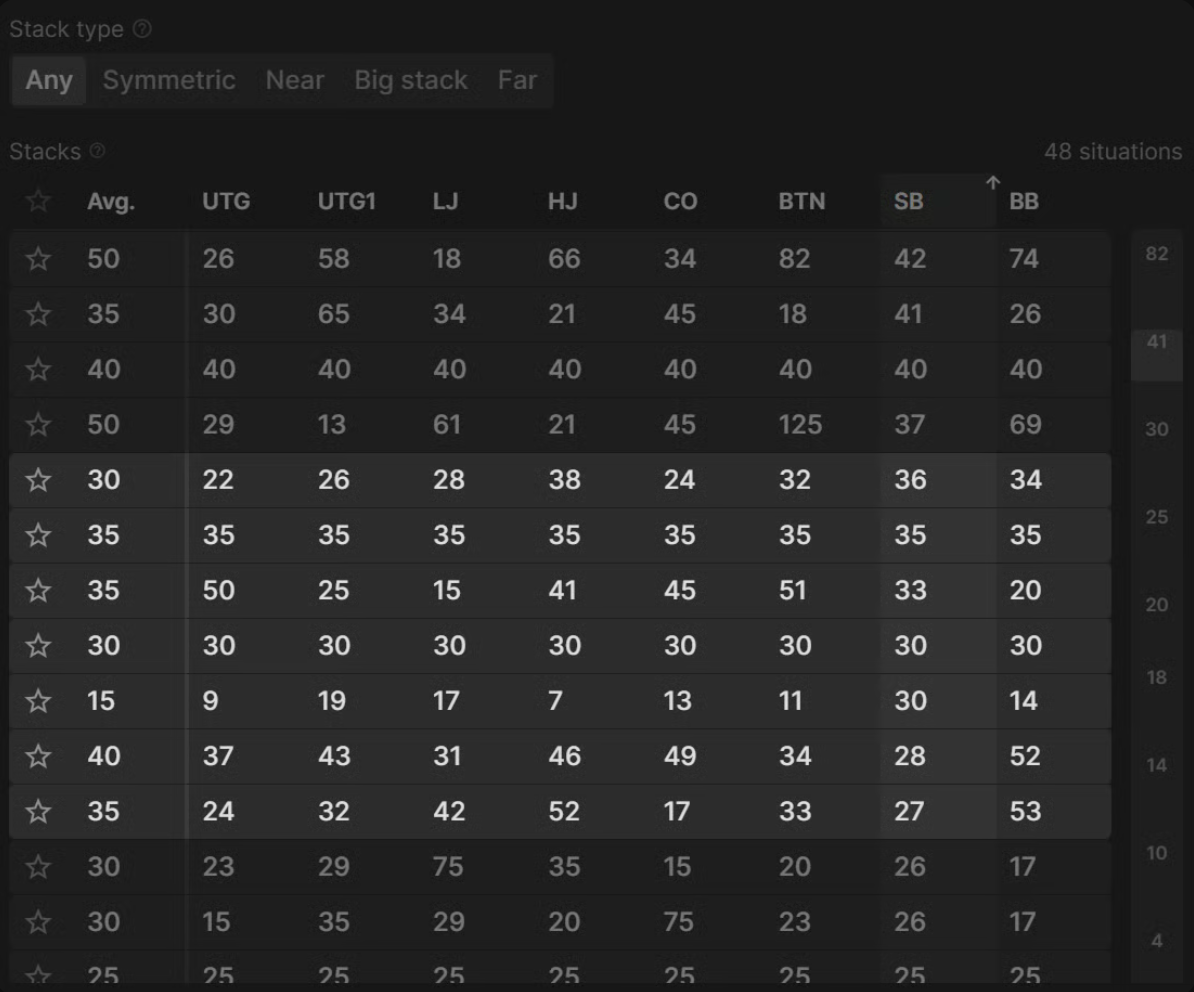
Sometimes, there may be an extremely large stack that significantly changes the strategy. But in most cases, the differences between spots will be minor. As we will see later, it is useful to study several similar spots at once.
2. Start with Chip EV
Paradoxically, the first step in analyzing any ICM spot should begin not with ICM ranges, but with Chip EV. Chip EV ranges should be viewed as the baseline strategy. You need to understand what the solution looks like without ICM influence; otherwise, it is impossible to assess exactly what adjustments ICM makes. Therefore, before analyzing ICM, we will first establish the baseline.
Here is the opening range for HJ at 30bb effective in Chip EV.

The range is fairly wide and linear: 29.6% of the best hands, with good board coverage.
Now let's see how SB responds to the HJ open.

The total SB 3-bet range is 13.2% of hands, with roughly half of this range going all-in. The 3-bet range is mostly linear and consists of the strongest hands.
Shoves predominantly consist of suited Broadway hands that:
- play well when called;
- are happy to get folds from Ace-x;
- block strong calling hands (AK, KK, QQ, etc.);
- while not blocking many folds (weak suited high-card hands such as A6s, K7s).
The calling range is 12.7% of hands.
This is a more capped range that:
- plays well against a wide open;
- performs reasonably well in multiway pots (if BB continues often);
- but would struggle if it 3-bet and got called.
My hand, ATs, which prompted this analysis, is a call in Chip EV, matching my initial intuition. We will return to this later.
It is important to remember: Chip EV decisions are based on the effective stack, meaning the shortest stack in the hand.
With ICM, it is different: relative stack differences are critically important, so they must be taken into account.
3. Consider the Payout Structure and Chip Distribution
ICM solutions assume an equal player skill level.
Strategy is influenced by:
- blind level;
- stack sizes;
- tournament stage;
- payout structure.
In PKO MTTs, there is one more factor: bounties. We have already discussed in detail how payout structure affects ICM.
In short: a flat payout structure usually has a particularly strong constraining effect on the ranges of medium stacks as well as short stacks.
Conversely, a top-heavy payout structure makes ranges looser. With a flat structure, moving up the payouts (laddering) is more important. With a top-heavy structure, playing for the win receives greater priority. The presence of bounties always widens ranges, although with ICM they will still be tighter than in Chip EV. A very important question is who covers whom by stack and by how much. If a player who covers your stack remains behind you, your range narrows.
If you cover an opponent, you can play more aggressively. When players with different stacks remain behind you, this creates a push-pull effect on ranges. The earlier the tournament stage, the less ICM affects decisions and the closer strategy is to Chip EV. The first major ICM peak occurs on the money bubble, after which ICM influence quickly weakens. Smaller peaks and dips follow until the pressure rises sharply again on the final table bubble, where ICM becomes particularly significant. After each elimination, ICM influence declines because tournament EV is gradually realized and the payout gaps grow.
When two players remain in a tournament, we fully return to Chip EV. Let's consider a suitable spot in GTO Wizard.
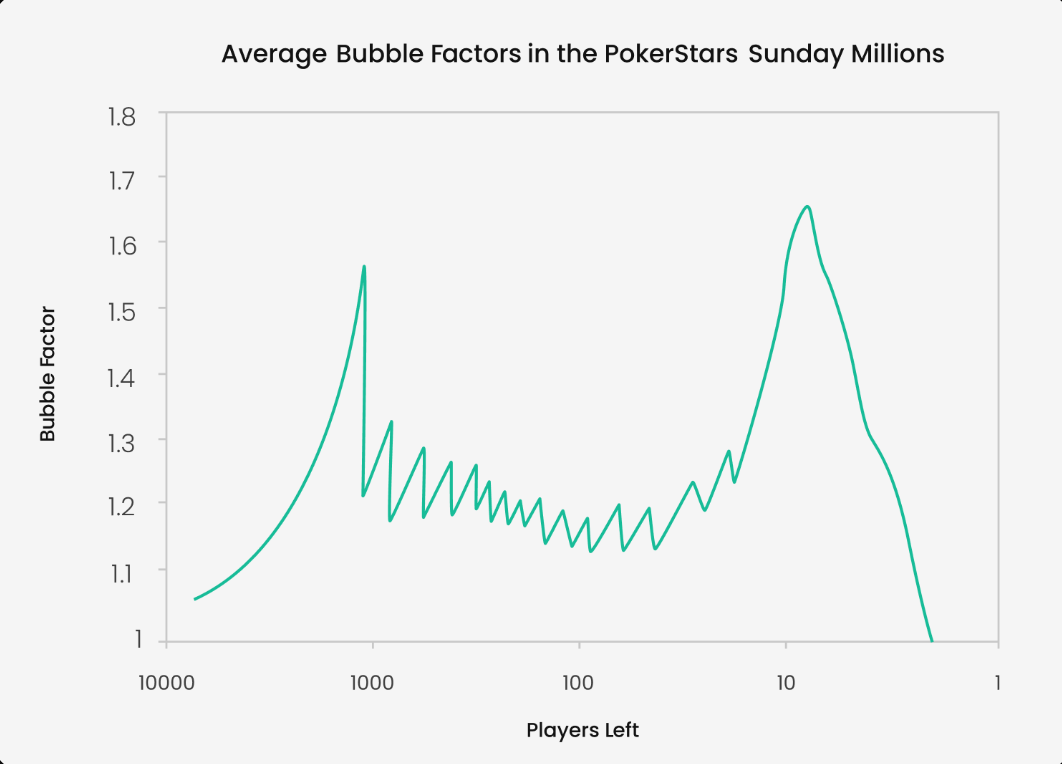
This is a tournament with 1000 players, with 10% of the field remaining. The money bubble has already burst. We are in the SB with 28bb, which is close to the 30bb stack considered earlier.
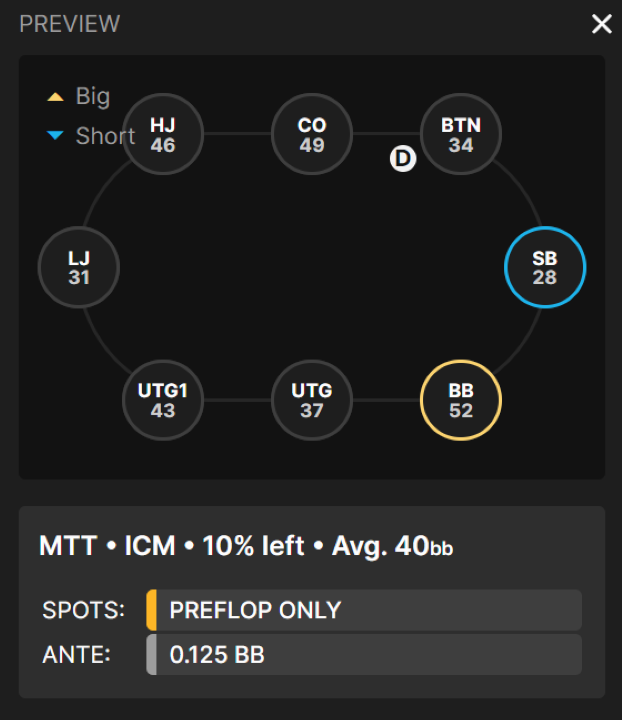
ICM is already affecting play, but the final table is still far away. Let's look at the stack distribution. We are the shortest stack at the table with 28bb. The chip leader is in the BB with 52bb. HJ, who opened in our example, is third in chips with 46bb. We can now make some assumptions about how chip distribution affects strategy. The presence of the chip leader in the BB will most likely have a constraining effect on the ranges of the other players. HJ is covered not only by BB but also by CO. Therefore, we can assume HJ will open tighter than in Chip EV.
In response to HJ's tighter open, and considering the threat from BB, we can assume SB should also play tighter. We can also expect blockers to play a more important role in the raising range, since winning pots without showdown becomes especially valuable for survival. It is useful to develop the habit of making such assumptions in advance. Later, when analyzing ICM ranges, you will be able to verify them.
4. Assess ICM Through Bubble Factor / Risk Premium
Bubble factor and risk premium quantitatively reflect the impact of payout structure and stack distribution.
The practical rule is simple: The higher the bubble factor, the more your stack-off range should narrow.
Before looking at ICM ranges, after analyzing stacks, look at the bubble factors.
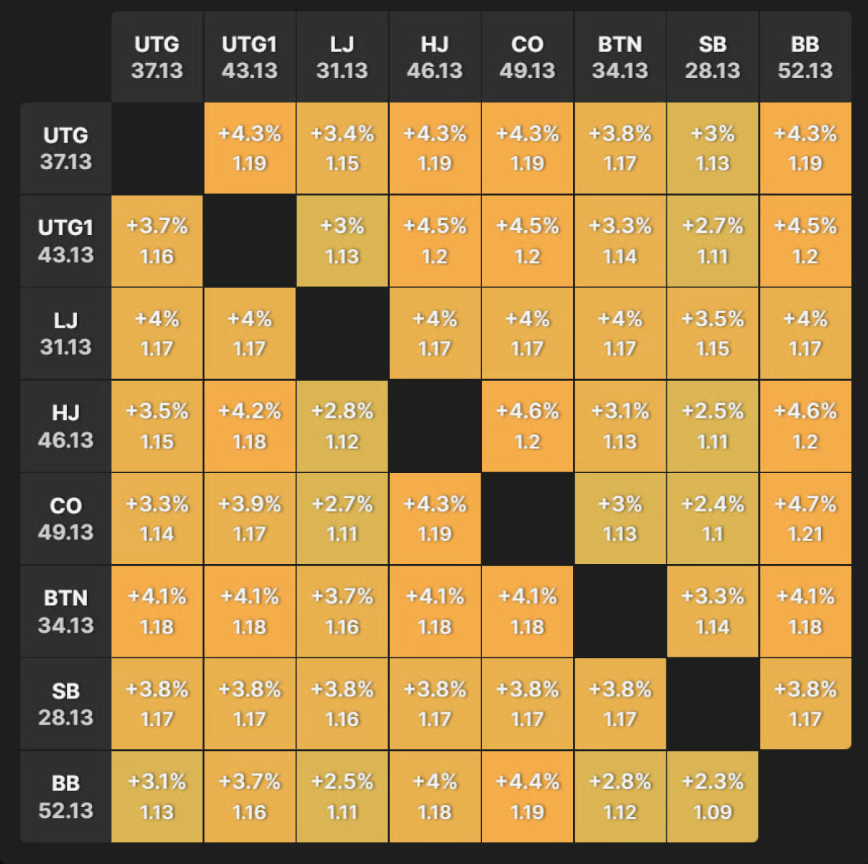
In our example, the average bubble factor turned out to be fairly low, as expected, since the money bubble had already burst and the final table was still far away. The minimum bubble factor is 1.09, and the maximum is 1.2. The difference between them is small, so strategic differences will be minimal. Nevertheless, ICM influence is present.
A useful habit: look at bubble factors before analyzing ranges.
Over time, this will allow you to assess them intuitively in other spots.
It is important to remember: bubble factor reflects the fundamental driving forces of ICM strategy.
The same bubble factor will have the same impact on strategy regardless of where it arises:
- on the money bubble;
- on the final table bubble;
- in PKO;
- at an early stage of a regular MTT.
If the bubble factor is the same, its impact on strategy will also be the same. This makes the lessons learned universal.
5. How Did ICM Change the Ranges?
Now we can move directly to the ranges. First, let's look at the HJ open.

In this post-bubble ICM environment, HJ opens 27.5% of hands. For comparison, in Chip EV it opened 29.6% of hands. The change is noticeable but not radical. However, frequency is not the only important factor. It is much more informative to look at the change in the shape of the range. The range has become tighter, but some hands were added.
For example:
- K3s was absent in Chip EV but is now played sometimes;
- A7o disappeared;
- A5o appeared.
Now let's look at SB's response.

As expected, there are more folds in this situation. Mainly, the bottom part of the Chip EV calling range disappears. The main difference is significantly fewer shoves. Here, shoving occurs only 2.9% of the time, whereas in Chip EV it was 6.9%. The overall 3-bet range becomes much more polarized.

We see more bluff 3-bets with hands such as:
- A2s
- K5s
These are hands that:
- block calls;
- but can make a strong hand when called.
My specific hand, ATs, which started this entire analysis, still remains a call.
These observations allow us to draw several conclusions about the impact of ICM that can transfer to other similar spots:
- Blockers become more valuable.
- Fold equity becomes more important.
- Survival receives higher priority, so there are fewer shoves.
Frequencies can change dramatically when ICM becomes an extreme factor. But it is precisely the analysis of changes in range shape that is key to understanding ICM strategy.
Experiment with Different Scenarios
Even a small change in:
- payout structure;
- tournament stage;
- stack distribution;
can significantly affect strategy when ICM plays a significant role. GTO Wizard currently does not allow custom ICM simulations, but the library contains many pre-solved spots. It also includes mirrored scenarios for different tournament stages, where stack sizes are the same but the tournament stage differs.
For example, let's consider the same spot, but near the money bubble.
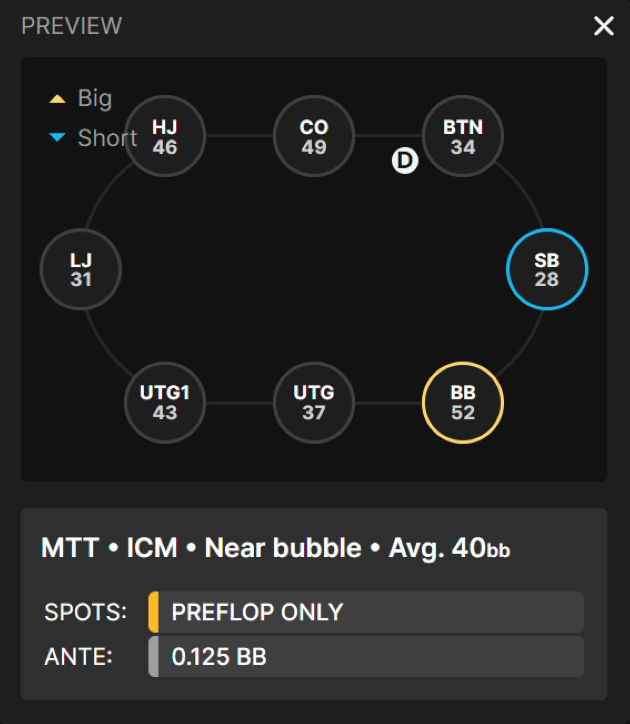
The stack sizes are identical to the previous example, but ICM is now extreme.
All else being equal, we can assume:
- players at risk of elimination will play tighter;
- big stacks will be able to apply more pressure.
Let's look at the bubble factors.
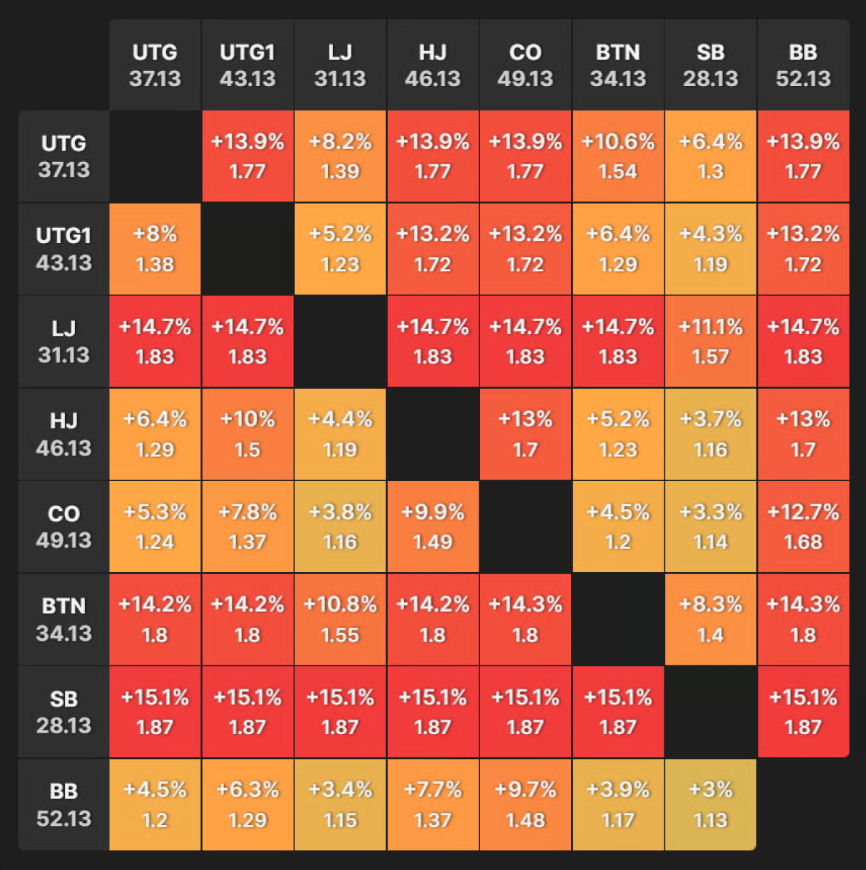
If you have already analyzed similar tables, one glance at the number of red values is enough to understand a lot. Bubble factors now reach 1.87. This means all players have to play noticeably tighter. Short stacks experience the largest relative increase in bubble factor. The reason is that on the money bubble, a significant portion of their tournament EV is tied to the min-cash. A medium stack also does not want to clash with the chip leader, but its overall pressure is lower.
With this in mind, let's look at HJ's opening range.

Interestingly, the opening frequency is very close to Chip EV.
Now let's consider SB's response.

The range becomes significantly tighter, around 13.8%. There are noticeably fewer shoves. The raising range is very strong, while bluffs are heavily based on blockers. The calling range also narrows substantially and consists mainly of hands that realize well postflop.
For example, under ICM it is much easier to play hands such as:
- 55
- QTs
The situation with them is clearer:
- either you improve;
- or you can easily exit the pot.
This favorably distinguishes them from hands such as:
- K7s
- T8s
They were part of the Chip EV range. Interestingly, my hand, ATs, remains a call once again. There is a huge number of spots to study, including bounty scenarios. Ignoring such an opportunity would be a mistake, because just a few clicks can provide very valuable strategic insights.
6. Conclusion
Although GTO Wizard currently does not allow you to build custom ICM solutions, the database already has enough spots from which you can draw valuable lessons and transfer them to other situations.
My process for reviewing preflop hands under ICM consists of the following steps:
- First, open the Chip EV ranges. They represent the baseline strategy. It is impossible to understand how ICM adjusts ranges if you do not understand the fundamental strategy from which the deviation occurs.
- Find the most similar ICM spot. Choose a situation as close as possible to yours, even if there is a difference of several big blinds.
- Assess ICM influence before viewing the solution. Analyze the payout structure, tournament stage, and stack sizes. Pay particular attention to who covers whom. Look at the bubble factors, as they quantitatively reflect ICM influence. They show how much each player's strategy deviates from the baseline against the other players.
Analyze not only frequencies but also the shape of the range. Frequency changes are easy to notice. Players who are covered by stack usually play fewer hands. Players who cover opponents can widen their ranges. But analyzing exactly how the shape of the range changed relative to Chip EV provides even more useful information.
Do not strive for a perfect spot match. Perfect is often the enemy of good. Rather than trying to find an exact copy of your hand, it is more useful to study several similar scenarios. This will allow you to get the most out of the large database of ready-made solutions.