


Translated with the help of AI. We apologize for any errors and would appreciate your help in correcting them.
Translated by order of the educational portal university.poker
Original source: GTO Wizard

In Single Raise Pot (SRP) banks, there is usually a clear correlation between the aggression of one player and the passivity of another. Typically, an OOP poker checks most of its range or the entire range to an IP racer, which then makes bet with most of its range. There are rare cases when a player in a position is not motivated to bet often. Conversely, it is also very rare for an OOP player to dunk on the flop.
There is usually a clear correlation between the aggression of one player and the passivity of another.
However, this does not apply to SRPs where the caller is in position. In such situations, solvers often recommend a high check rate on the flop for both players. Despite the recommendations of the solver, many players perceive the check from the raiser as a signal to bet. And they don't necessarily make a mistake if their opponents are waiting for an unbalanced, too weak range. However, as with any deviation from equilibrium, they are substituted for operation. In this article, we will look at how to exploit opponents who are too often put on the flop if the OOP pre-flop raiser has made a check.
1. Experiment
To see how your strategy on the flop needs to change to operate an overly aggressive cold collar, we will use custom solutions and nodelocking in the solver. This means that we will not be able to view the reports to see the overall strategy for all flops. Instead, we will look at a few carefully selected flops and draw conclusions based on them. To begin with, we will look at the situation in the MTT between CO and BTN in the depth of 40bb in the chip EV environment. Ultimately, we will derive heuristics that will be useful in other structurally similar scenarios, this option is suitable for research, since it is one of the most common cold call spots. MTT ChipEVsimulations involve more cold calls than cache simulations, and the CO vs BTN situation is the most common.
We use a custom solution in which players are allowed to bet 33% pot, geometric dimensions for bet on three streets, geometric dimensions for two streets or Push on the flop, with similar options on subsequent streets:
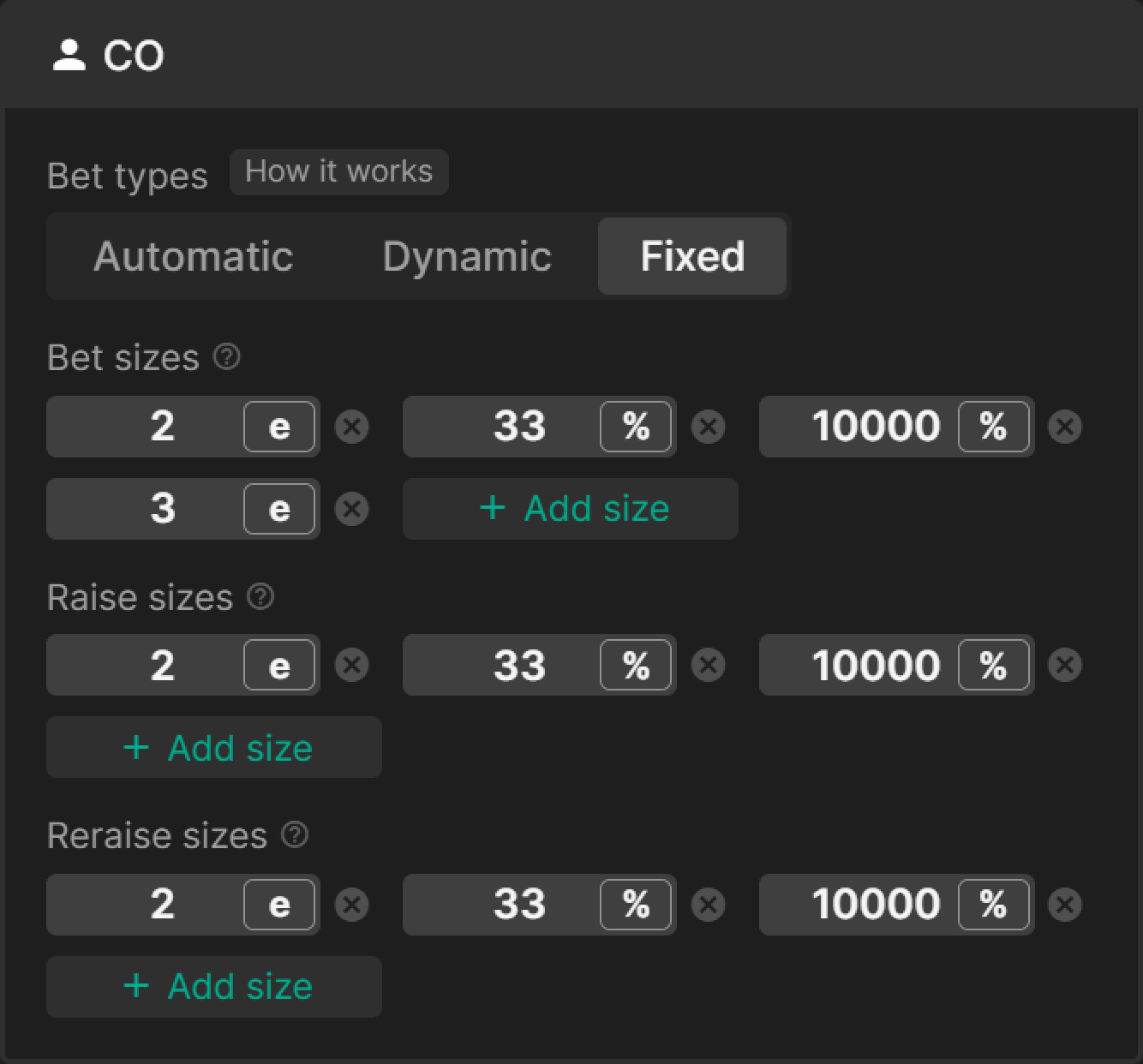
We will compare the CO in equilibrium strategy on several exemplary flops with the operational strategy on them, when the BTN strategy is locked so as to check in half as often as in equilibrium.
- First, we'll look at


 the flop where BTN most often waits in equilibrium. Halving the frequency of BTN checks on this flop will lead to a significant increase in its bet frequency, which will cause pronounced and easily observed changes in the CO strategy for maximum exploitation.
 - We will then look at one of the flops where BTN bets most often (
 ) to see if these changes persist when frequent bet is a much smaller error. It turns out that replacing the ace with a heterogeneous jack creates such a flop, providing a simple "apple to apple" comparison.
2. flop where BTN most often checks: A♠J♠3♠
Flop is one of those where both players have to wait very often. Although BTN rarely has to bet after a check, CO nevertheless checks almost 90% of its checks:

After CO checks, the equilibrium BTN strategy assumes a check of about 75% of hands. If BTN still makes a bet, it uses the size of 63% of the pot (geometric bet-sizing for three streets):

This is logical for a static board. BTN can predict with high accuracy what will be the strength of his hand on the river, and he is not interested in bet for protection. Therefore, when BTN puts, its range immediately becomes polar, with the expectation of playing the entire stack for three streets. CO has little incentive to raise against such a polar bet.
Therefore, his response strategy comes down to two actions: call or fold, and the range is divided approximately equally between these options:

Although BTN never uses a bet of 32% of the pot in an equilibrium strategy, one can consider how CO responds to such a bet.
As expected, this implies more calls, but still very few raises:

3. Operation of the flop
When we catch the BTN strategy so that it waits for 38% of hands instead of 75%, CO completely loses the incentive for bet. This is logical - if you expect your opponent to make a mistake on a certain branch of the decision tree, it is profitable for you to direct him along this branch. Having a hand with which to place a bet is advantageous, you can instead play a check-raise and profit from the opponent's erroneous bet. Reducing the frequency of BTN checks gives the solver more freedom in choosing the size of bet for those hands with which he would prefer to check.
Interestingly, BTN is still significantly more likely to use the 63% pot bet than 32%:

If you expect your opponent to make a mistake on a certain branch of the decision tree, it is advantageous for you to direct him along that branch. However, CO's response to the bet in 63% of the pot has changed. Now he folds much less often and adds a significant range of raises.
This is due to both the weaker range of BTN bet and the stronger range of CO checks, which now includes disproportionately strong hands with which he would put the flop in equilibrium:

And at the BTN rate of 32%, the CO pot acts even more aggressively, almost does not fold and adds large polar raises!

Conclusions for CO in case BTN puts too often:
- Wait for your range, giving BTN the opportunity to make a mistake.
- Respond persistently, if less than the Minimum Protection Frequency (MDF).
- Form a range of raises, even against large polar bet.
- Raise very aggressively against smaller, more linear bet rates.
Forcing BTN to bet more often affects not only the bet nodes, but also makes its check range more vulnerable on the following streets, especially on the turn turn. Let's look at how CO can take advantage of this.
4. Operation on the turn (after everyone has check on the flop) turn
Most thorns after a static flop are blank in nature.
Let's compare the CO turn betting strategies  after the check on the flop:
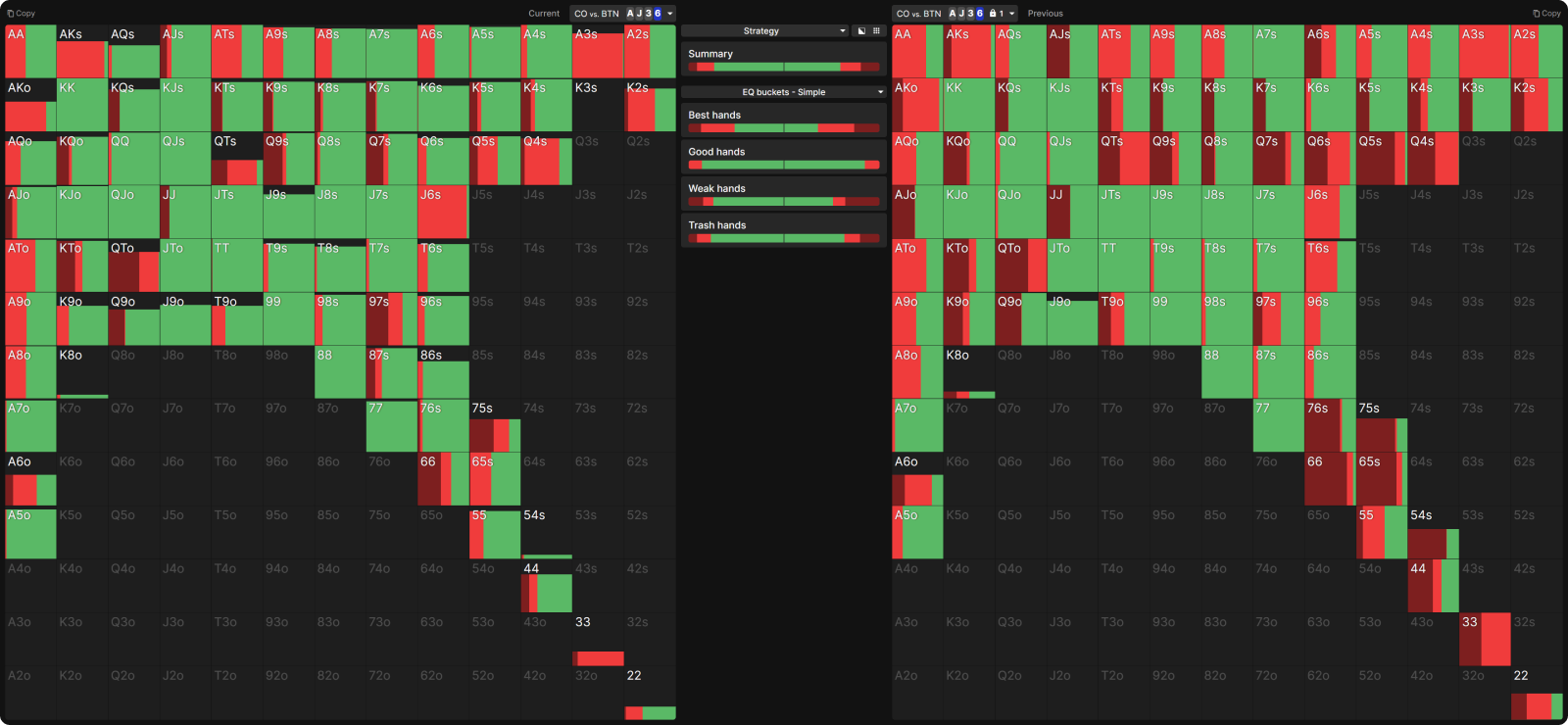
- Left: equilibrium simulation.
- On the right: a locked-in simulation, where BTN was forced to bet more often.
Forcing BTN to bet more makes its check range vulnerable on the turn.
The main difference in the CO strategy is a significant increase in the frequency of overbets, from 9% to 19.9%. A BTN that puts too much on the flop is unlikely to have strong hands after a check, making it an easy target for overbets. To be clear: BTN can still wait for strong hands. Blocking the strategy only affects the frequency of receipts, but the solver optimizes the range of receipts within the set limit. If BTN starts to wait for strong hands more often, it will make its bet range more vulnerable to aggression.
CO uses a similar strategy on the turn, even if replaced by  (fourth spade):
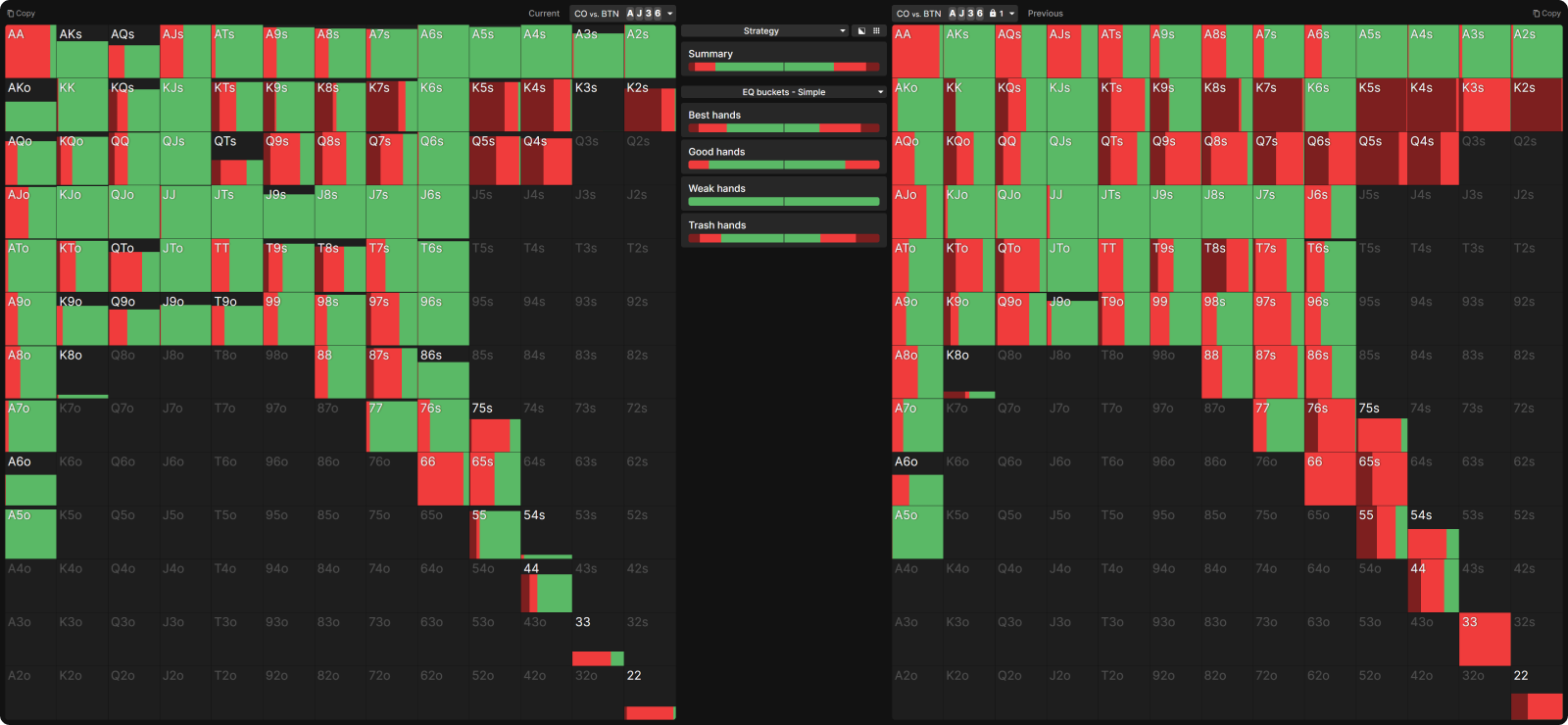
CO increases its aggression, especially through overbetting
5. When the bet on the flop becomes a mistake: J♠J♥3♠
The flop is not the most popular for BTN checks, but it is interesting for the experiment, as it changes only one card from the previous example. This minimizes the variables. Consider JJ3 (with flush draw) instead of JJ2 (with flush draw), where BTN has the highest bet rate in equilibrium.
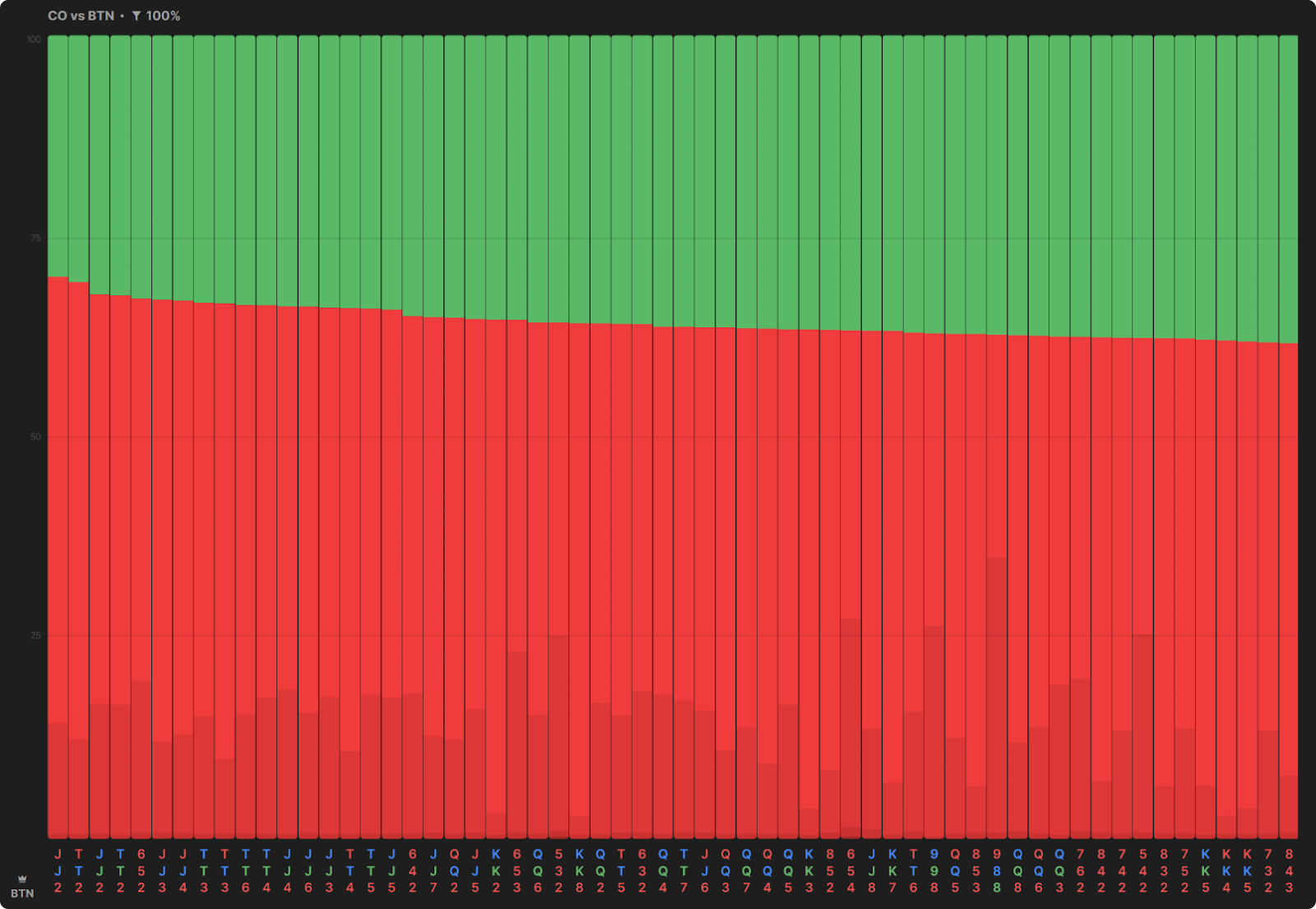
CO also has a very high check rate on this flop:

After the CO check, BTN puts more than half of its range.
On a dynamic flop, he strictly prefers a small bet size, which contributes to a more subtle game of valley or defense value:

Against a more linear BTN bet, CO responds more aggressively.
He also prefers small bet sizes to collect a thin value on a dynamic board:

5. Operation of CO when BTN bet increases
If we force BTN to bet more often (78% instead of 56%), CO completely abandons bet and plays the entire range by check. This allows the opponent to make predictable mistakes. BTN still uses exclusively bet rates of 32% of the pot, and CO responds predominantly with a raise of 33%. Interestingly, the CO fold frequency is virtually unchanged from the equilibrium simulation. The main difference is that hands that used to be colored are now more likely to prefer raise.

We are again seeing increased aggression from CO after both check out the flop.
However, since the reduction in the frequency of BTN checks is less dramatic here, the changes in CO aggression on the turn are also less significant:
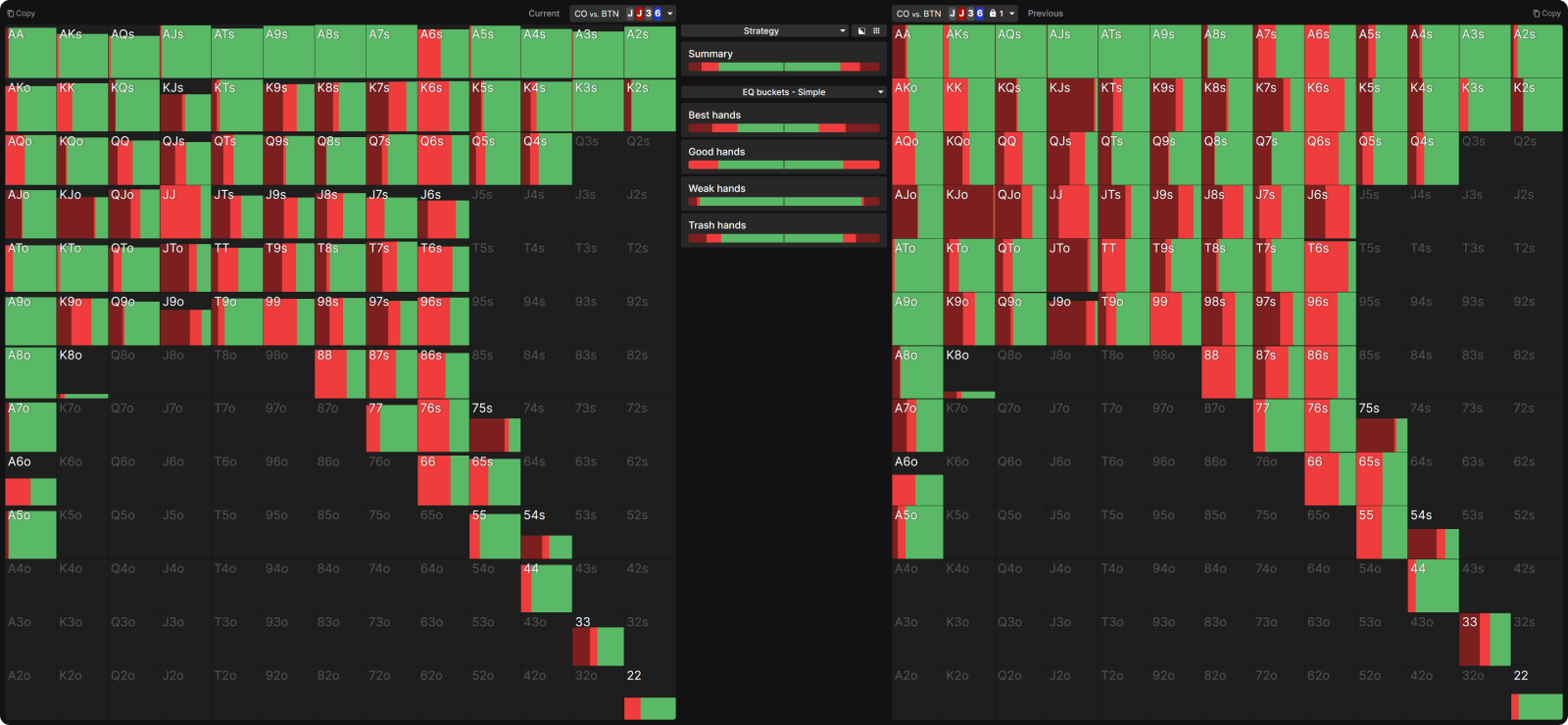
6. Conclusion
On two completely different flop textures, where the cold caller player uses different equilibrium strategies when checking, the exploitation methods remain basically the same if you assume that the player (BTN) will bet too often:
- Check in to give him the opportunity to make a mistake.
- After his bet, be inclined to raising more often, especially against small bet and on more dynamic boards.
- If he does not bet, assume that his range is weaker and more dribbled than in equilibrium, and bet aggressively on the turn, including overbets.
The main difference between the ways CO is exploited on these two flop textures is its response to the bet. This brings us to a more fundamental question: why is BTN bet too often a mistake at all? In a pot with one preflop raise (SRP), BTN does not bet due to a significant equity advantage. CO and BTN preflop bands are equally strong, so while some flops will be more suited to BTN, none of them creates such an equity imbalance that it would often be possible to bet as against a collier on the big blind. BTN mainly bet using the edge of the position, which allows it to more comfortably increase the pot than its opponent, despite similar range.
On more static boards, high-frequency bet requires investing in hands that are too weak. By definition, on static boards, it is more difficult to regain positions by investing with a weaker hand.
CO in this case exploits the BTN, expanding its call range. He doesn't have to worry too much about knocking BTN out of the bank because the weakest part of the BTN bet range already has little equity. Thus, CO may be able to call with more strong hands, making it safe to call with weaker hands.
On more dynamic boards, weaker hands in the BTN range have more equity. The main problem with bet ting with them is not that they will be called, but that they can be knocked out of the bank by a raise pot.
This increases CO's incentive to raise, including his strongest hands. However, due to the fact that CO includes so many strong hands in his raise range, he cannot sufficiently protect his call range. He becomes obviously weak and vulnerable to aggression on the subsequent streets. As a result, CO continues to fold with almost the same frequency as in equilibrium, but much more often than not.