


Translated with the help of AI. We apologize for any errors and would appreciate your help in correcting them.
Translated by order of the educational portal university.poker
Original source: GTO Wizard

One of the most memorable poker tips I've ever received was from my longtime podcast colleague Nate Mavis.
He said:
The freedom to wager any amount is a key feature of unlimited hold 'em. If you always bet between 50% and 100% of the pot, you are severely limiting yourself.
I heard this advice at a time when poker strategies were not yet based on GTO (game theory optimal) decisions. Few players used very large or very small bet then, and even fewer understood when and why it was worth doing. I was no exception, but this comment prompted me to start experimenting. Today, most players understand that overbets are used to polarize the range, even if they rarely do so themselves. However, the small bet remains less clear. Many have noticed how experienced players use small continuation bet, and even modeled them in solvers. But, as my teaching experience shows, even those who apply such bet can often not explain why a small sizing is preferable, as well as in what situations it should be used.
In this article, we will study the example of small bet on the flop to understand what conditions make them optimal. And try to identify other situations where they can improve the game.
1. bet (Continuation Betting)
- A classic example of a small continuation bet looks like this: depth 30bb, CO (catoff) makes a raise, BB (big blind) collides, flop comes out


 . BB checks and CO puts 20% of the pot.
Solver prefers this sizing for almost the entire CO range:

- But why? Why is it profitable to put CO even with the worst hands?
- And why is such a small bet optimal?
The answer lies in the distribution of equity.
Here is a graph of the CO and BB ranges on this flop:
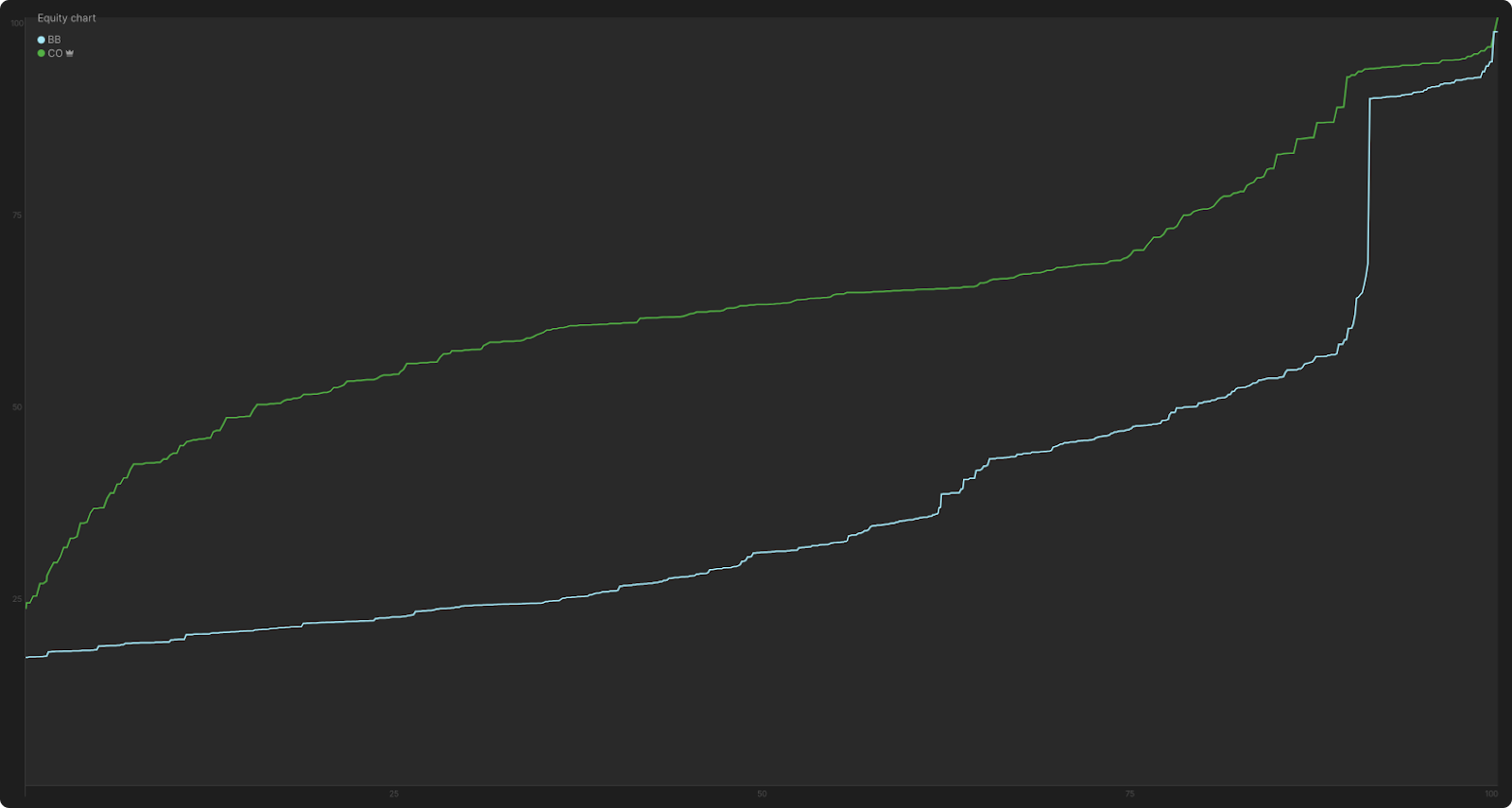
The CO range is significantly stronger on average, with the exception of the very top, where both players fall into a thrips or something stronger with approximately the same frequency. In other words, CO has a significant edge in equity, but not a big edge in nuts. CO wants to increase the pot as it is way ahead in most cases. But if the pot gets too big, its edge may diminish. Therefore, a small bet is a good solution.
2. Why the bet is so small
When players bet in this situation, they usually hope the opponent will fold. If they do not have a thrips or a large pocket pair, it is difficult for them to feel confident on such a flop. Indeed, most CO hands will have a higher EV than the multitude of hands BB dumps than the minority he colludes with (or, God forbid, raises!). It is reasonable to assume that the opponent will rarely fold on a small bet. So why not bet more?
The small bet on the entire range on the flop is not based on BB's answer, but on what happened on the pre-flop.
It is true that the opponent will often fold for a larger bet. The problem is that its range will become stronger in cases where it does not fold against a larger bet, and your probability of winning the pot will decrease. The reward for a big bet may be higher, but the risk also increases, which ultimately makes the risk/reward ratio less profitable.
This small bet across the range is profitable no matter how BB reacts to it. It does not use the BB reaction, but the edge gained on pre-flop, when CO took the risk of a raise against several rivals, and BB staked at a discount, closing the auction. That is why BB sees a flop with much more weak hands than CO, and why CO can bet profitably with any two cards.
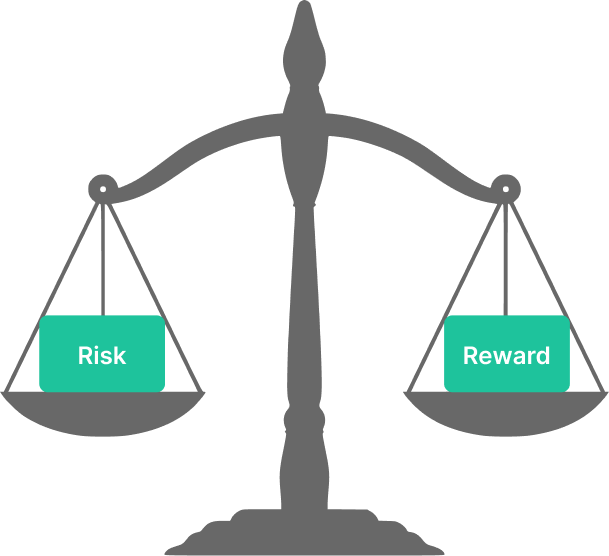
Some players call this “pushing equity.” Due to its advantage in equity, the bet creates a win-win situation for CO, regardless of how BB reacts. All but the strongest CO hands are happy with any folds they can get, as BB will often drop two live cards. And if BB never folds, that's okay too. The CO range is stronger, so if both players invest more money with their full ranges, it is ultimately beneficial for the CO.
3. When CO has all the benefits
On the flop, CO had an equity advantage, but not a big edge in nuts.
For comparison, this 
 is a good example of a flop where CO has both:
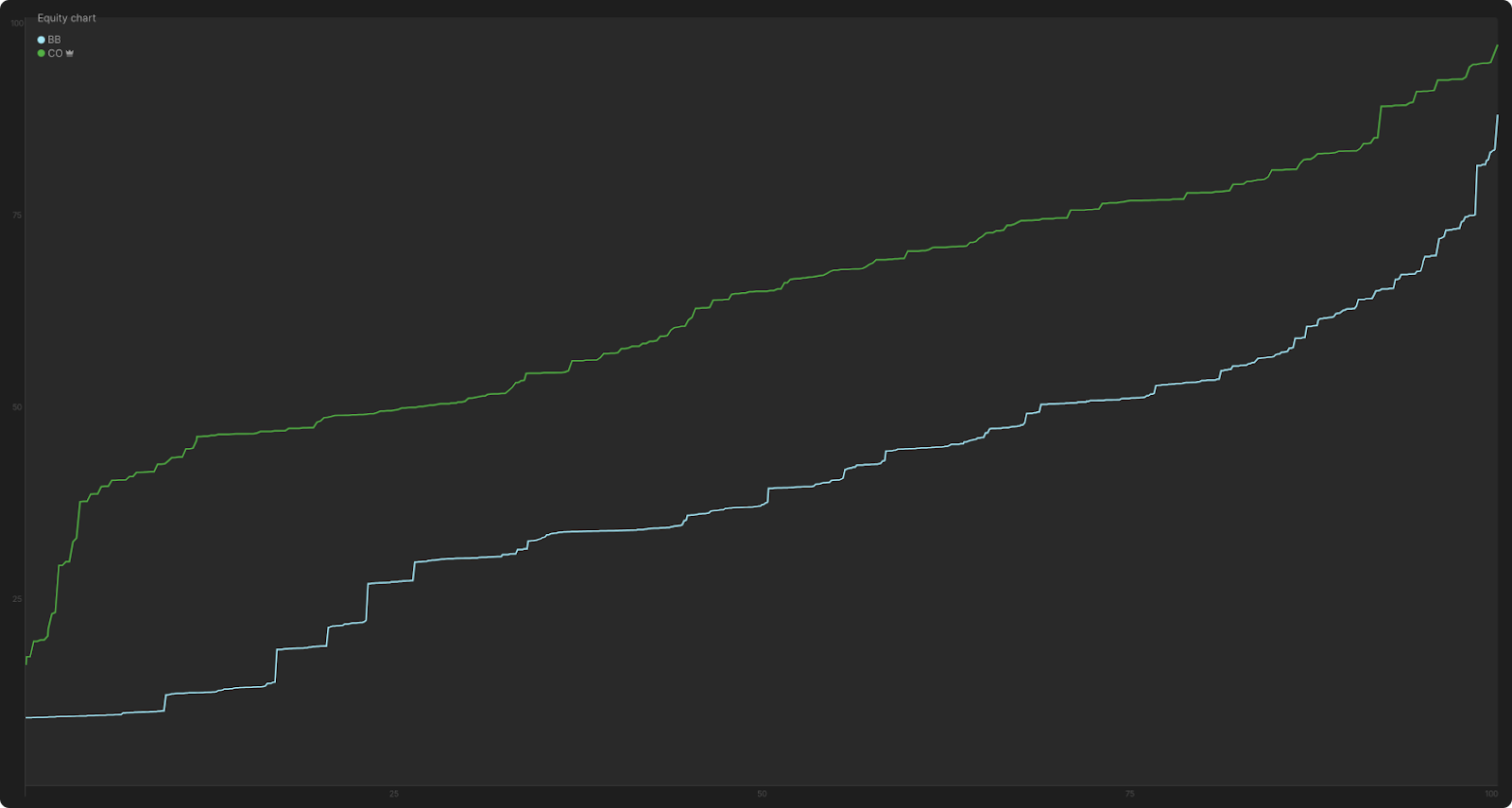
The solver strategy for CO still assumes a full range bet, but now a larger bet size is mainly used, as many more CO hands want to increase the pot as much as possible:

In other words, on this flop CO "pushes" not only the edge in equity, but also the edge in nuts. This makes small bet less preferable.
4. Sample-beta of the river
Suppose that on the flop CO made a bet of 55% of the pot, and BB called. Both players check on the turn , and the river came out
 , which gave the final board.
The BB strategy on the river, when he puts first, includes a lot of small bet:

This is another case where one of the players has both an edge in equity and an edge in nuts:
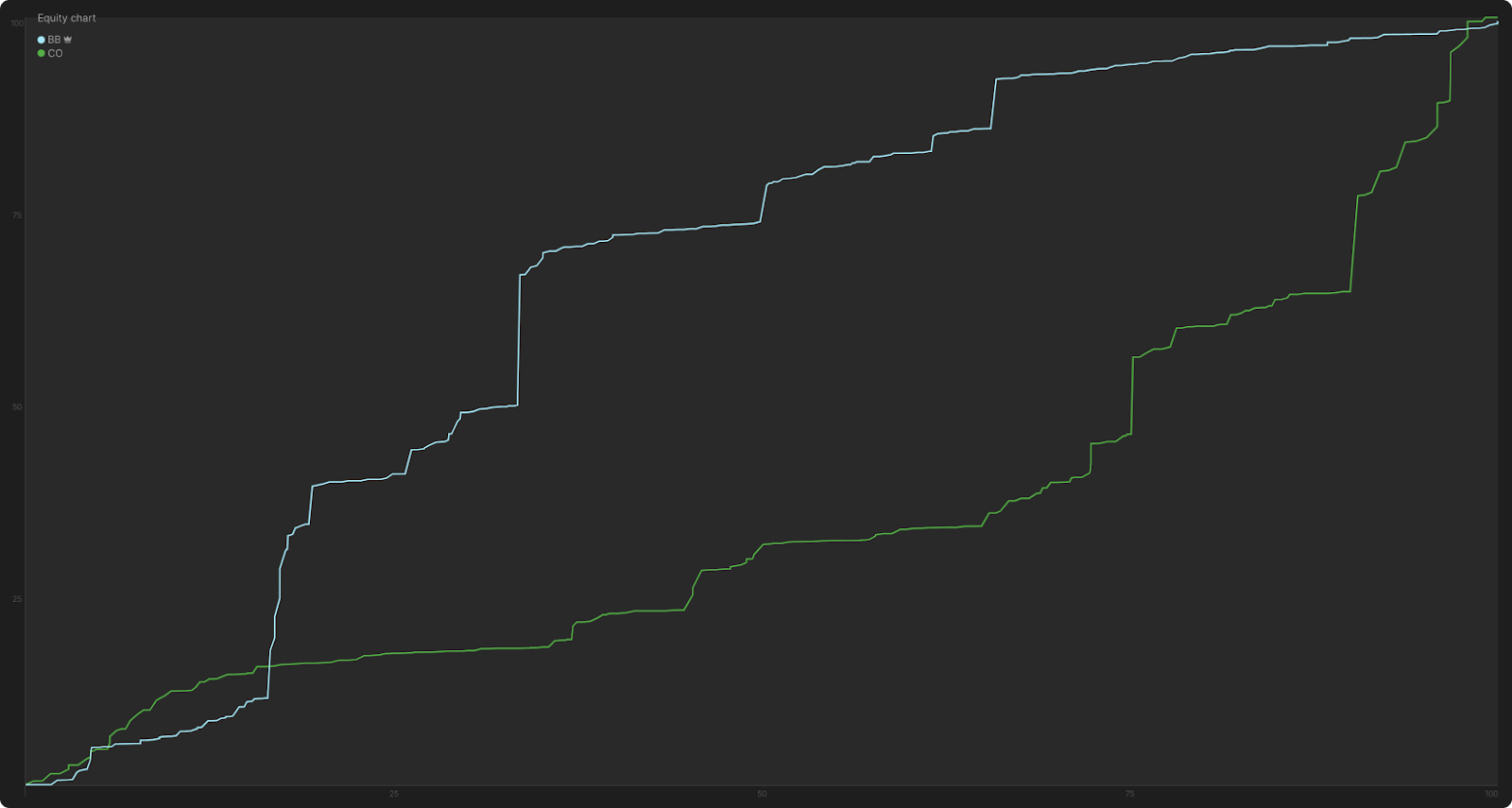
On the river, however, BB has more reasons to use different bet sizes to achieve different goals for different parts of its range. The strongest BB hands (for example, Q4 and even Q7 — after the check on the turn, in order to have a edge on nuts, you do not need to own a literal nuts) most often want to scare. But what about hands like the T9? These hands are often in front, but they can't count on weaker hands to call a bigger bet.
Again, the solution is a small bet! As can be seen in this “Manhattan chart”, small BB bet (indicated in light red) on a thin velly mainly come from hands that have 50%–80% equity:

It is undesirable to make a big bet with such hands, since large bet will most often be to call only the strongest hands of CO, against which BB will not be the favorite. A smaller bet encourages CO to call more weak hands, offsetting BB's risk of bumping into stronger ones. Another risk of a small bet is to get a bluff-raise. Therefore, BB sometimes makes small bets and with very strong bet hands (these are again light red marks, but now they are closer to the right edge of the chart where strong hands are marked) as a trap. The same thing happens when CO makes a small bet on the flop:
This is harder to notice
though, as this is the only bet size he uses. But the fact that CO puts in so many weak and middle hands gives BB an excuse to make check-raises with his own weak and middle hands. These check-raises are one of the reasons why even the strongest hands of CO show the best result with a small counterbet. Just as the small CO bet on the flop used the power of its action on the pre-flop relative to BB's actions, so the small BB bet on the river does the same.
In this case, BB's actions on the flop were stronger than CO's, as CO put with all its range, including the worst hands, while BB dropped his worst fold hands. CO further weakens its range by waiting out the turn, as it has little incentive to do so with strong hands. Thus, on the river, when BB made a relatively strong action (called a bet on the flop), and CO — weak (checked the turn), BB's middle hands are stronger than CO's and can take advantage of a small bet.
5. Suitable board
Small bet are most common when actions on previous streets cause one player's average hands to become significantly stronger than those of his opponent.
In more rare cases, small bet also makes sense when a particularly favorable board card increases the value of one player's middle hands compared to his opponent's.
- For this example, we will consider a situation where a player on a UTG with 30bb opens and BB collides.
On the flop, 
 BB makes a check and calls a bet of 20% of the bank pot. We have already discussed what such an action does to make the lower part of the BB range stronger than the lower part of the UTG range. This will also continue on most thorns. However, certain cards disproportionately strengthen many UTG middle hands.
For example, here is how the distribution of equity on the turn looks like  :
:
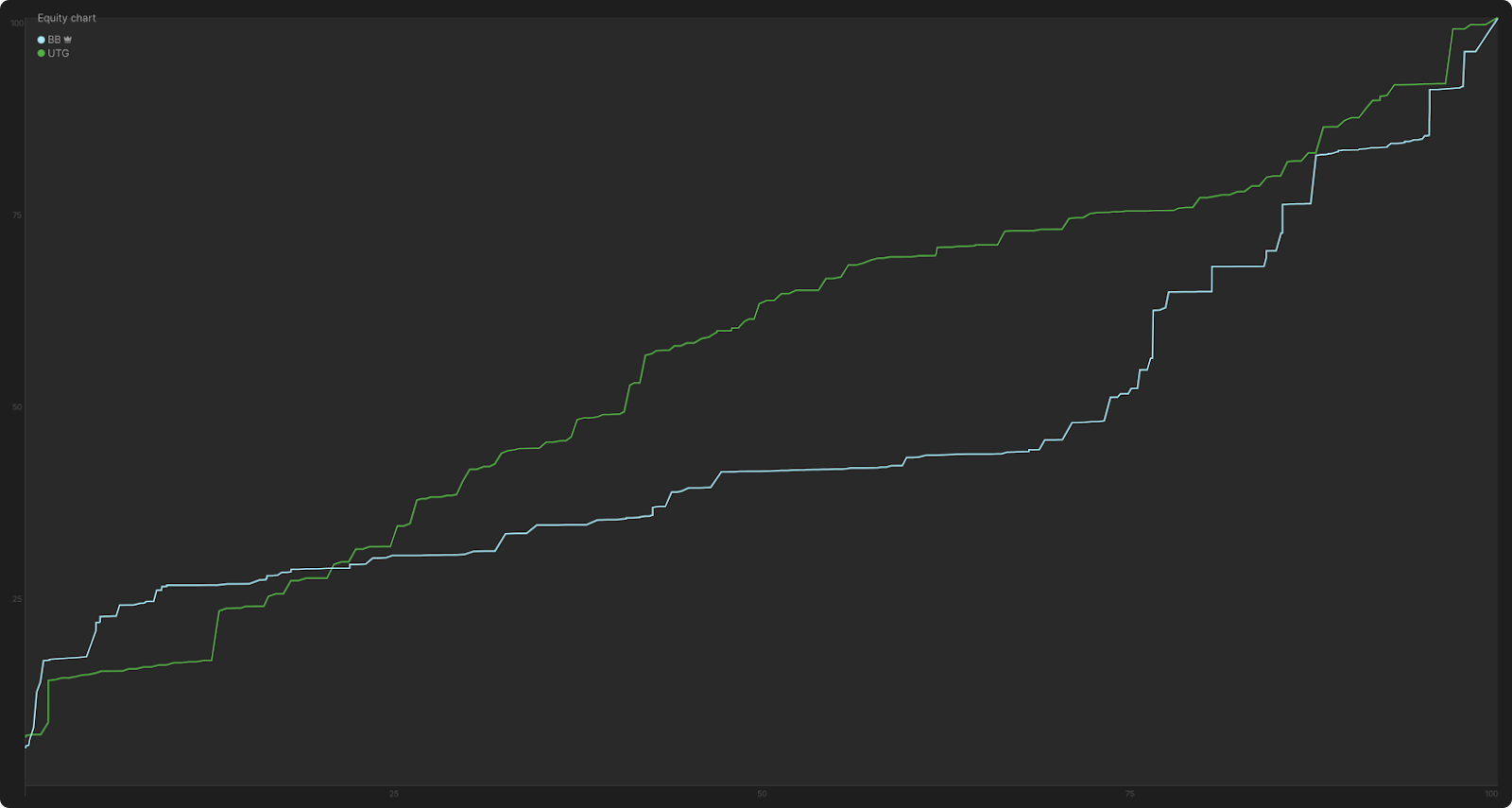
Many of the weaker UTG hands for bet on the flop are unpaired K-x, while BB most often dumps its K-x. The only king BB consistently colludes with is the one he can't have if he comes out on the turn. UTG would like to make a Velle Bet with a top pair, but cannot bet too large due to the risk of stumbling upon thrips, flushes and full houses. Therefore, he chooses a bet of sized 33% or 55% of the pot (this is a small bet for thorns — on most thorns, the most common UTG bet is 83% of the pot).

6. Conclusion
Bet in poker is basically aimed at profiting from the advantage you have over your opponent. Players without an advantage are usually not inclined to bet. This, for example, explains why the caller on the BB so often checks on the flop against the preflop racer.
The nature of the advantage determines the size of the bet:
- When you have more nut hands than your opponent, you often want to polarize the range with big bets.
- When your edge is in the middle hands, you enjoy lower bets.
As we saw in the example on the river, you can even do both if your range is stronger than your opponent's range in all categories!
The profitability of a balanced bet strategy that takes advantage of the edge does not depend on the reaction of the opponent. If it folds too often, you profit from bluff and from burning your opponent's equity. If he calls too often, you profit from Velu Betas and maybe bluff on the late streets.
The only way to get into an unpleasant situation is if the opponent constantly has the strongest hands. This will not happen if you have correctly identified the situation where you have the edge of range. We have reviewed some of the most common cases where small bet rates are used and confirmed the necessary conditions for their application. But there are other cases. Now that you know what to look for, try to find more of these situations yourself and maybe share them in your poker communities!