


Translated with the help of AI. We apologize for any errors and would appreciate your help in correcting them.
Prolonged bet or cbet is one of the most common techniques of modern poker used on post-flop. However, despite its widespread use, cbet is fraught with many subtleties, some of which are discussed today by one of the coaches of our portal - PavKom.
1. History of small c-bet
If we look at the history of the evolution of c-bet, we find that until 2013, cbet in 50% of the pot was a standard action, and until then it worked perfectly. When the field gradually realized that the aggressors (the aggressor is a pre-flop racer, that is, a player who came to the flop with the initiative) put cbets in almost 100% of cases, there was a great opportunity to exploit this, increasing the frequency of the flop check-raise! This is exactly what I used to call poker immunity! Absolutely any motion, line, etc. works best in this game at the very beginning, that is, it has not yet passed the process of adapting the field to a specific action. Over time, your opponents develop so-called immunity, after which you no longer receive the profits that you did before. This is normal.
A small cbet of 33% was born around 2013, when it became obvious that the field was ready to fold for a smaller bet, almost the same as for a 50% cbet.
This was a real breakthrough in the strategy of the game, since in mathematics, a bet of 1/3 should work at least 25% of the time to bring automatic profits. Obviously, back in 2013, it showed an incredibly high EV! However, the immunity of the field does not sleep here either. Now small cbets are still popular and form part of the database of good reg players. However, over time, it was the shallow sizing of the c-bet that led many players to the concepts of super-wide protection.
2. big blind vs. small c-bet
First of all, I would like to clarify that by small counterbet I mean a bet of any size of 40% of the pot or less. In the vast majority of cases, we see continued rates on the flop in the range from 30 to 35% of the pot. This is a certain standard. In today's realities, the field protects against such a counterbet an incredibly wide range of hands.
- Let's look at one specific example:
Board: 


You play the EP opening range and get a call from the big blind (BB). Effective stack 40 bb. In this example, you bet a continued 30% bet with your hand
 , and the villain equalizes.
Lose yourself from reading and think about what he is ready to call here? I am ready to back up my arguments with a screenshot from my beloved Flopzilla.
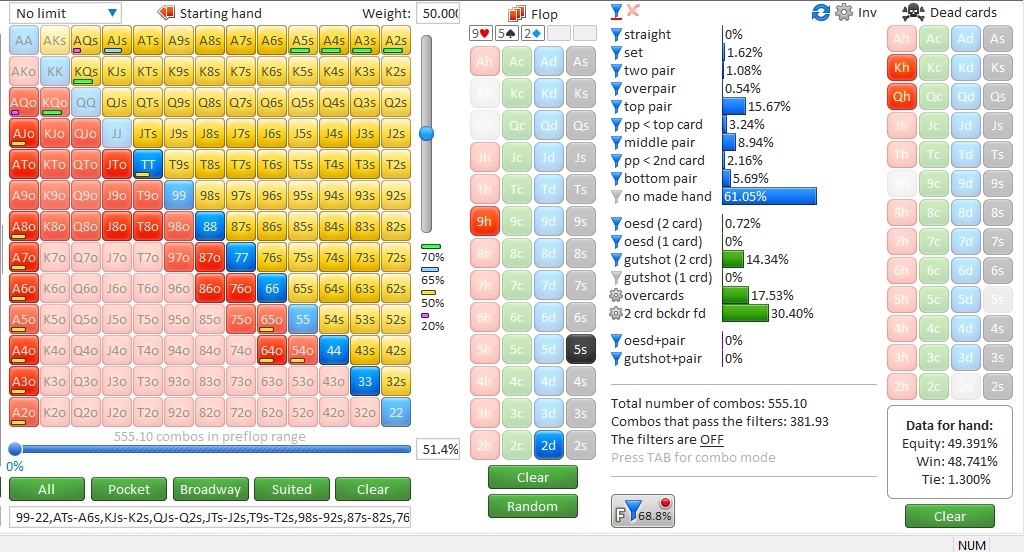
In the figure above, we see a range of about 70%. This is the range that stays in the game. That is, we do not think that the villain is always calling here. Part of the hands will obviously go to check-raise. We are interested in the part of the hands that we knock out. And we beat out a little more than 30%. Given that in addition to the obvious nuts and coincidences, the field here will have to collide with all the gatshots (of which there are quite a few) and overcards, especially those that have backdoor equity. Thus, even on such a relatively dry board, we will not receive too many folds in response to our bet. After my calculations, we gain only 31.2% of net folds. The rest of the range mostly collides, and part of the hands leads to the check-raise.
I will say right away that I put backdoor flush draw and overcards in such a range of protection with a large, but still not full weight. Depending on the specific player, this weight will vary. If you try to express these values in more specific numbers, the field will not throw out from 64 to 80% of the hands here. On average, you can average this indicator and stop at 70-72%. That is, even with such figures, we see that our continuation rate of 33% will not be unprofitable in any way, but it will not bring us over-profit. So is it worth doing it then? Obviously, yes. But only if we adjust for the fact that for most runouts of the turn, we want to continue the aggression and put the second barrel!
I gave this example solely to clearly show how the trend towards overcalls has expanded in such situations. Now I propose to move on to more non-standard solutions.
3. Increased cbet per value
- Let's look at the following situation. You ride from the HJ position with a pair

 and get a cold-call from BB.
The flop opens:


BB – check.
And how do you act in such a situation? Before us is a monotonous board, which is coordinated as much as possible. If you place a small bet here between 28 and 40%, you are very weakly defending your hand. In the case of a check-raise from an opponent, you will at least still have the opportunity to “twist” by playing the bet / 3-bet line. But in the case of a check/call, we will often have a rather complicated play here. Yet we want to think half a step ahead. Just imagine how many so-called “action killers” can come through the thorns!
“Action Killer” is a card that will make the board even more scary, capable of devaluing the equity of many strong hands, primarily overpairs, dopers and sets.
Any peak, as well as any 4, 5, 9 and T, is covered with four cards, either straights or flushes. Such textures make the profit-making process as inefficient as possible even with such a strong hand as a set. Therefore, returning to the post-flop, we want to play more linearly here and place a large extended bet here on the flop, from 70% and above!
CONCLUSIONS: We want to quickly deposit money into a pot with strong hands on dangerous textures, that is, to bet 60%+ cbet for maximum protection of our hand.
4. Continued bet less than 30%
In fact, there are situations in which we can play with super-small counterbets.
Let's look at some specific examples:
- First, you have a super-nats, let's say an average set on the board:
It makes no sense for


you to run your hand over such a board. A super-small bet of 20-28% will not allow your opponent to fold any backdoor, and can also increase counter aggression in the form of a check-raise.
- Secondly, situations where even such a small bet will bring you a good fold equity.
Suppose you are playing a late stage, such as the pre-final stage of a tournament. You open with a regular mini-raise with a 25 bb stack with a hand
 , and your raise calls BB, its stack is only 10 bb.
There is nothing surprising in his defense against your raise. Because the shorter the player's stack on the big blind, the wider his protection!
However, if he does not cling to the board, he will have nothing to play with check/Push, and for a check/call with another backdoor, even the minimum bet will be expensive with such a stack size. It is in such situations that it will be beneficial for us to put a minimum bet even in cases when we do not cling to the flop at all. If we translate this bet into interest, in an ordinary razed pot it will be cbet less than 20% of the pot! Or just over 18% if we put 1 bb into a 5.5 bb pot.
5. Tight cbet in bluff as a bluff
There are certain types of boards in poker that are quite unpleasant for a preflop aggressor. Such situations arise when your villain visually clings to the opened board much better than you.
- Example:
 the flop is much more suitable for protecting the big blind than the razer that opened with the EP. And in a situation where you do not get into the board at all (say, you have a hand
 ), it will not be particularly profitable to play from a traditional small bet. Here is just the right situation to bet a cbet of 70-75%!
In other words, we want to play one big bet here, which will help to achieve the following results:
- You will significantly reduce the frequency of check-raises as a bluff or semi-bluff from your opponents.
- Virtually all hands with weak potential equity (such as backdoors, overcards, and weak matches) will often fail.
- In the case of a call, you will be well aware that you have fallen into a fairly strong part of the opponent's range (top pair, strong draw or better), and will not continue aggression on later streets, thereby saving chips.
Note: In case of inconvenient stack, increased ICM-pressure on your stack or other unfavorable factors, you can always consider a check as an alternative, abandoning such a motion.
6. c-bet sizing 50-70% of the pot
It will also be beneficial to use increased sizing against “calling-station” on the value even on relatively safe boards for us. That is, in the game against the “answering machine”, you can safely put hands on the board with 

 a “rainbow” such as a top pair with the best or average kicker, collecting value from top pairs worse, from middle pair, gatshots and even some backdoor hands. And all this is ready to pay for your pot in 50-60% of the bank, and sometimes even larger bet!
Note: And only in the later stage of the tournament in cases where such an opponent will have a relatively small stack, you can get a extract value with a smaller size, so as not to overstate the fold equity.
CONCLUSIONS: As we can see from this example, the size of the continued bet in some situations can be adapted to your opponent's style of play.
7. Optimal c-bet frequencies
RAZER (in position)
We want to realize the highest c-bet frequencies playing in a position against one opponent, that is, in single pots. In such a situation, I will bet cbet 90-92% of the time. Analyzing the bases of various players in my training, I periodically see slightly lower indicators (85-90%). I think it's still a great frequency! But if your statistics show figures of 75% or lower, this signals that you are missing out on potentially profitable situations for betting.
RAZER (no position)
In those banks where you do not have a position, we really want to significantly reduce the frequency of the extended bet – up to 55-65%. However, we would like to have a protected range of our check here as well.
That is, in those spots where we play from the check, we will have not only a check/fold line, but also a check/call and even in some situations a check/raise (or a check/Push if the game takes place in restyling stacks). If we separately filter the hands in which we play against 3 or more opponents on the flop, we get the lowest possible counterbet percentage, below 40% c-bet. Since here we are already inclined to continue the attacking line only when we really get into the board well.
8. Conclusion
Summarizing all the information set out above, I would like to summarize:
- Prolonged bet on the flop will be the right decision in most situations, since by abandoning the c-bet you give up the initiative and lose the attacking advantage.
- Any bet at a distance generates a certain percentage of fold equity, which significantly affects such fundamental criteria of the game as EV and potential profit in general.
- We want to realize the highest c-bet frequencies playing in a position against one opponent, that is, in single pots.
- The lowest possible frequencies are in situations where the racer does not have a position in the multipots.
- The choice of sizing an extended bet is primarily based on factors such as the texture of the board and the style of play of your opponent.