

Translated with the help of AI. We apologize for any errors and would appreciate your help in correcting them.
Translated by order of the educational portal university.poker
Article by Dan B, Original Source: UPSWING Poker
Overbet (bet more than the size of the pot) is a powerful game. If you use this tactic at the right time, you will win the maximum with strong hands and hold more effective bluff. In this article, you will find 3 overbetting tips on the flop that will help you make more profit at the table. Let's figure it out!
NOTE: Parts of this article are quite advanced.
You need to be familiar with the following concepts:
- Range;
- Optimal Game Theory (GTO);
- Solvers and Mixed Strategies.
1. Mathematics underlying the overbet on the flop
Tip #1: For standard stacks of 100bb, use overbets only in banks with one raise
Pots with one raise (single raise pots) are banks in which only one raise was made before the flop. Let's say you open on a button, and the big blind is colliding. One of the main reasons for overbetting on the flop is the need to build up the pot as quickly as possible. This allows you to comfortably deposit your entire stack in the pot to the river. Because it worsens the odds of your opponent's pot, overbet also maximizes the number of bluff that you can profitably include in your bet range.
And now here's a practical (not theoretical) consideration. Compared to an overbet on a river, an overbet on a flop can help opponents feel more comfortable making a call. This is because the bet does not seem so big compared to the pot. It is psychologically easier to make a call for $15 in a pot on a $10 flop than for $150 in a pot on a $100 river (although both bet rates are 150% of the pot).
IMPORTANT NOTE: overbet is only appropriate on certain flops. Tip #2 deals with one such flop. Read this guide to learn how to self-determine the flops suitable for an overbet.
In a one-raise, one-on-one pot, the pot will be about 6bb on the flop (or a little more if you play live poker).
Here are some bet size schemes that will allow you to put your 100bb stack in all-in on the river without overbetting on the flop (rounded for simplicity).
- Option No.1: bet 33% of the pot on the flop (2bb in 6bb), 135% on the turn (13.5bb in 10bb), 220% on the river (81bb in 47bb).
- Option No.2: bet 75% of the bank on the flop (4,5bb in 6bb), 135% on the turn (20bb in 15bb), 135% on the river (74bb in 55bb).
- Option No.3: bet 75% of the bank on the flop (4,5bb in 6bb), 75% on the turn (11bb in 15bb), 215% on the river (80bb in 37bb).
These are very large overbets on late streets, especially in variants No.1 and No.3.
But let's look at the fourth option, in which you make an overbet on the flop:
- Option #4: bet 135% on the flop (8bb in 6bb), 100% on the turn (22bb in 22bb), 100% on the river (67bb in 66bb). This is a matter of opinion, but the fourth option just seems to me the most convenient. Solvers like it too (as you'll see in tip #2).
2. Briefly about 3-bet and 4-bet potat with stacks of 100bb
When one or two reraises have been made before the flop, overbets are not needed because you can put all-in without overbet on any street. This is because the pot is already so much inflated because of the actions on the preflop.
- For example, in 3-bet pot the pot will usually be around 20bb on the flop. If you bet 33% of the pot on the flop and 75% on the turn, you can go all-in with a comfortable rate of 75% of the pot on the river sized.
Tip #2: Overbets tend to make sense on associated flush draw flops
These linked + flush draw board (such as 

 or
or

 ) provide many opportunities for both players. You and your opponent can easily have combo draw, flush draw, OESD and gatshots. When you have a ready hand (for example, overpair), these high equity draws are a serious problem because they have so many outs to improve. This is probably the main factor preferred by the solver for overbet on these flops. Strong draw have enough equity (and estimated chances) to equalize both the bet of 75% of the pot and the bet of 135% of the pot. So you just collect more velly using overbet value. Gatshots are dangerous on their own. Pushing them out of the bank with the help of an overbet on the flop is also valuable.
| Let's compare the board | |
|   |
Suppose that everyone folds to us on the button, and we make a raise. The small blind resets, and the big blind (BB) calls. Let's compare the optimal strategy in this situation on a pair of the above flush draw and one without flush draw flops. We will use the solver to visualize the strategies generated by it for these situations.
In this screenshot you can see the strategy for Button on the flop after the button check:
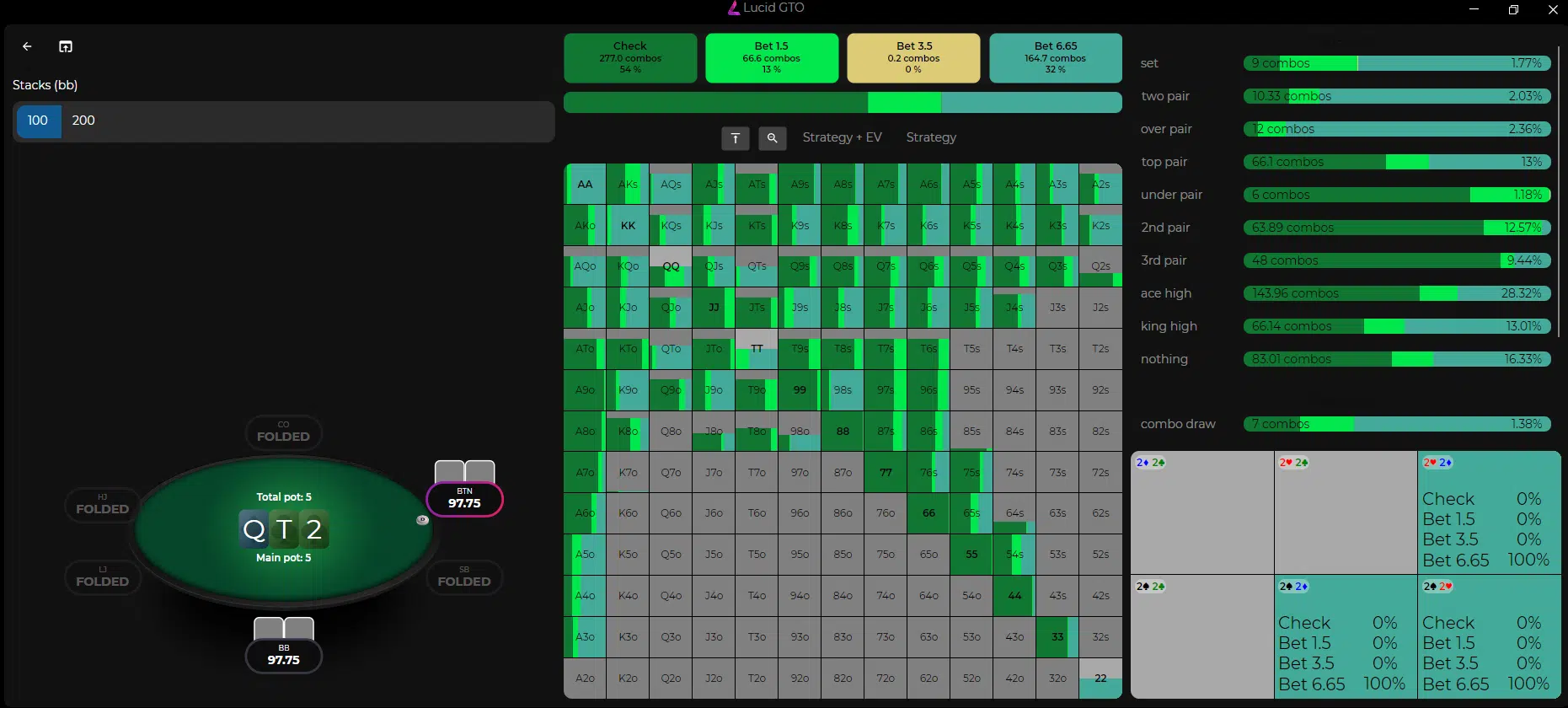
The preferred size of the solver bet is overbet (6.65bb in 5bb) on this flop.
Compare this with the second screenshot showing Button's c-bet strategy on in the same situation:
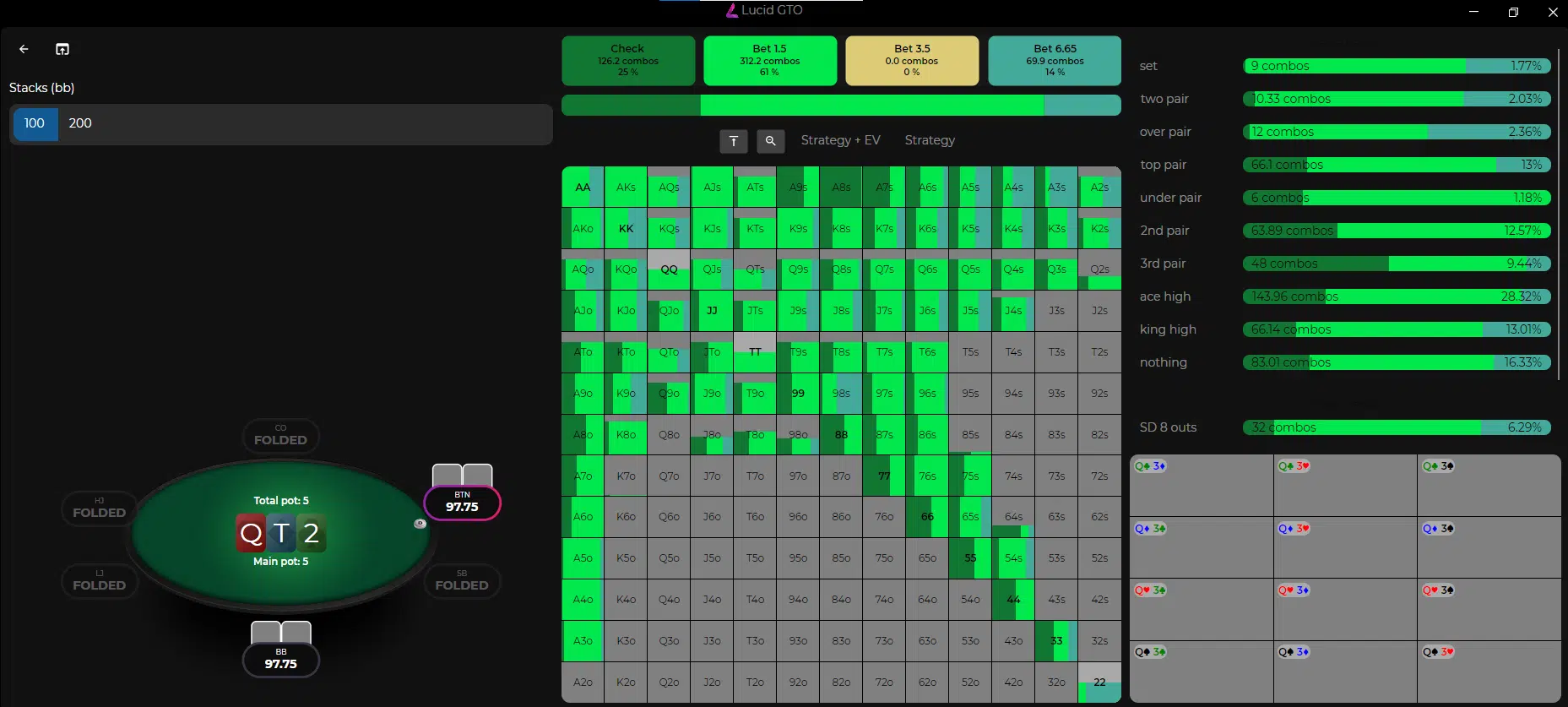
The preferred bet size is now a small bet (1.5bb in 5bb). This confirms that solvers prefer to do overbets on a flush draw board (32%) compared to a variegated board (14%).
NOTE: This is one of the best ways to improve your game with solver training. They make it easy to see the optimal bet sizes on different flops so you can hone your bet sizing skills.
Tip #3: Polar range overbet
To make overbet a viable strategy, you need to do it with the polar range, which consists of both strong valley hand and bluff. Below we will look at how this can be implemented.
Velu value range:
- Sets;
- Two pair;
- The older pair + a good kicker;
- The older pair + flush draw.
Range of bluff:
- Strong draw;
- Combo draw;
- Flush draw;
- Open-enders;
- Gutshot;
- Lower pair;
- Weak draw;
- Backdoor flush draw;
- Backdoor Street Draw.
- Let's look at a specific example using the board discussed earlier.
Again, Button makes a raise, BB calls, a flop comes out:
The player on the BB makes a check, and the action goes to Button.
Here's a visual representation of what a GTO strategy should look like, and then I'm going to break it down:
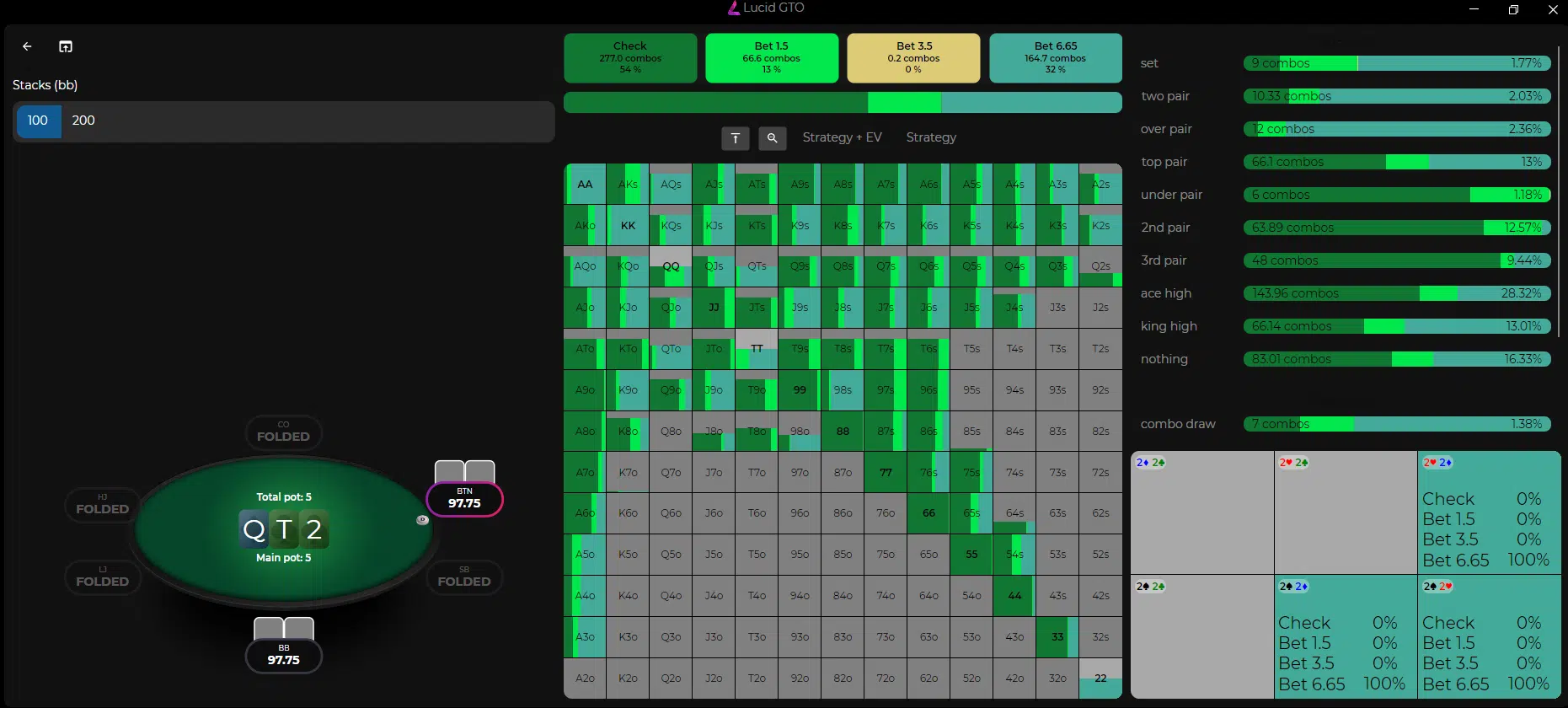
Although we see that the solver sometimes uses a small bet (13%), it is quite acceptable (and perhaps preferable) to use overbet here. Let's take a look at the categories of hands I listed above, the way I would play them (and note that some hands will play a mixed strategy).
Velu value range:
- Sets (pocket Queens, pocket tens, pocket deuces) with a frequency of 100%;
- Two pair (lady-ten, lady-two suited) with a frequency of 100%;
- Senior pair + 2nd kicker or better (ace-dame, king-dame) with a frequency of 100%;
- The older pair + flush draw with a frequency of 100%.
Range of bluff:
Strong draw
- Combo-dro (

 ,,
,, ,,
,, ,
,  ,) with a frequency of 100%;
 - Flush draw with a frequency of 50%;
- Open-enders with a frequency of 50%;
- Gatshots (Kx9x, Jx8x, and 9x8x with a frequency of 75%, ace-king and ace-valet with a frequency of 25%);
- Low pair (ace-two suited, king-two suited) with a frequency of 75%.
Weak draw
- Backdoor flush draw (for example:

 ,,
,, ,
, , 5x, 4x) with a frequency of 75%;
 - Backdoor straight draw with an overcard to a dozen that is not an ace
(e.g.:
 ,,
,,


 ,
, ) at a frequency of 25%.
While the strategy I have described is not a perfect copy of the GTO strategy, it incorporates this core and is extremely robust. It will be very difficult to play against her on the big blind. You can see a clear pattern in the bluff range. Stronger draw bet more often than weaker draw. This is both mathematically proven to be optimal and intuitively understandable to the human mind. Stronger draw will often be very large hands. Very big hands want to be in very big banks. Therefore, you should bet (bigger) with stronger draw to create bigger pots.
3. Conclusion
These are the main ideas behind the overbet on the flop. With this information, you should be on your way to incorporating overbets into your strategy and creating hell for your opponents at the tables. Sounds fun, doesn't it? Until next time, good luck, grinders!