

Translated with the help of AI. We apologize for any errors and would appreciate your help in correcting them.
Translated by order of the educational portal university.poker
Original source: GTO Wizard
In community card games such as holdem, the open cards on the board are an important source of information about the hands you are most likely to see at autopsy. The texture of the board determines which pair is likely and whether straights, flushes or full houses are possible. Each time a new card is opened, you learn new information about these variables and how likely you are to have a winning hand.
The flop reveals more information than any other street. We can classify flops based on their higher cards, the number of suits they contain, whether they are paired, how many straights or straight draw they make possible, etc. These are all ways of describing how the cards on the board interact with each player's range of probable pocket cards.
When it comes to analyzing a new card on the turn, we are most interested in the question: what has changed?
What new hands were possible but not possible on the flop? Even empty turn cards, which are unlikely to significantly affect the player's range, carry important information. Hands that were already strong on the flop are getting stronger by eliminating some of the threats on the turn, while draw and odd hands are weaker and have only one opportunity to improve.
1. Range edge
Range edge is a way to talk about how the range of different players interact with each other.
There are two main types of range advantage:
Edge on equity:
How is equity distributed between equity ranges? Which player has more and how big is the difference? Edge in equity tends to correlate with the frequency of bet. The stronger the player's range, the more incentive they have to bet.
Nuts edge:
How likely are players to have the strongest hands? Who most likely has them and who has more? Edge on nuts usually correlates with the size of the bet. The higher the probability that the player, compared to his opponents, has nuts' hands, the more incentives he has to increase the pot with large bet.
The player's equity on the flop is the average of his equity on all possible thorns.
When a specific turn card opens, its equity will change depending on how much this card helps it compared to the opponent. At the same time, the frequency of his bet will increase or decrease.
The edge of nats is more binary.
If one of the players has the nuts edge after acting on the flop, he will either keep it or lose it, depending on what the turn brings. We tend to see larger bets from a player with an advantage on blank thorns that did not significantly change the texture of the board (for example, making it possible for new bet hands to appear), and smaller bets (sometimes accompanied by a higher frequency from a player who received a nuts edge) on thorns that greatly changed the texture of the board.
2. Preliminary actions
Analyzing the texture of the turn, it is important to remember the actions on the preflop and flop, which determine which player enjoyed an advantage in the range to the turn.
A player who comes to the turn with a greater advantage can retain this edge even on a slightly unfavorable turn, which could make it possible for his opponent to have new nut hands.
- Aggression correlates with the nuts' advantage. A player who made a bet or raise is more likely to have a nut hand than one who waited and called.
When the player makes a raise on the preflop, makes a c-bet on the flop and gets a call, on the turn he will have a nuts edge. Usually on the turn he will make a big bet or check. Maps that change texture are by definition exceptions. The pre-flop aggressor will have fewer nut hands if he made a check on the flop. Depending on the size of the nut advantage on the flop, it can keep it on the turn, but it will be reduced.
3. Example
We can see these principles in action in a simple example from the NL500 cache game at a depth of 100BB.
UTG opens, BB calls, UTG puts 33% of the pot on the flop

 , and BB calls again. At this stage, before the thorn map is opened, UTG has the natsa edge, but not the equity edge. BB had many incentives to raising his best hands and dropping his worst, so his call indicates a relatively strong but scattered range, whereas the UTG bet is more consistent with very strong or relatively weak hands.
Let's remember what this will mean for the UTG strategy on the turn:
- On empty thorns, we expect a small amount of large bet.
- On thorns that negate the edge of UTG on nuts, we expect smaller bet sizes and possibly lower bet frequency (depending on how the turn changes the equity distribution).
- On thorns that retain the nuts edge of UTG and also improve its equity, we expect more frequent bet, usually smaller.
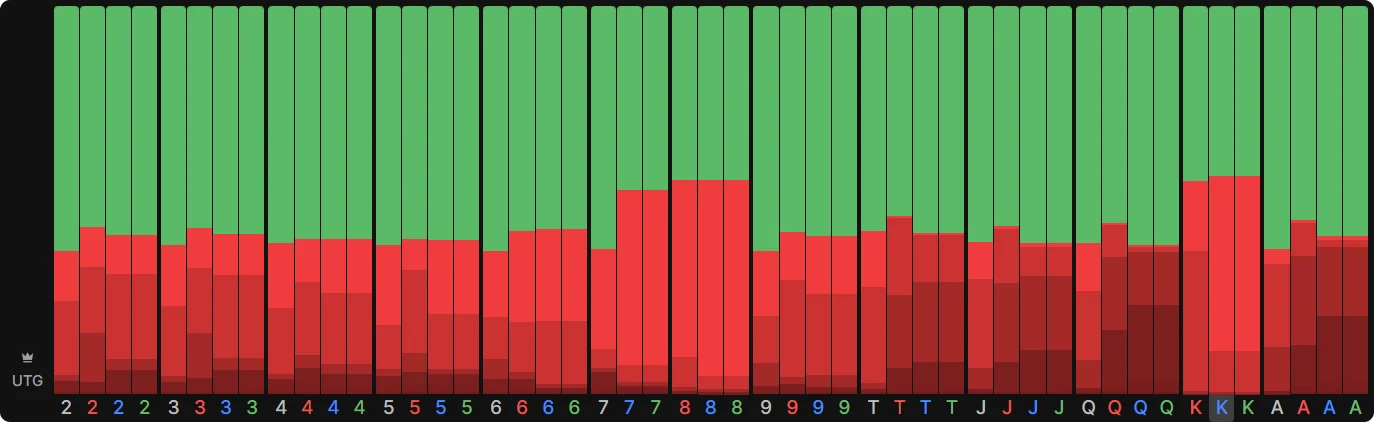
And here is a report summarizing the UTG strategy on all possible thorns if BB makes a check on them:
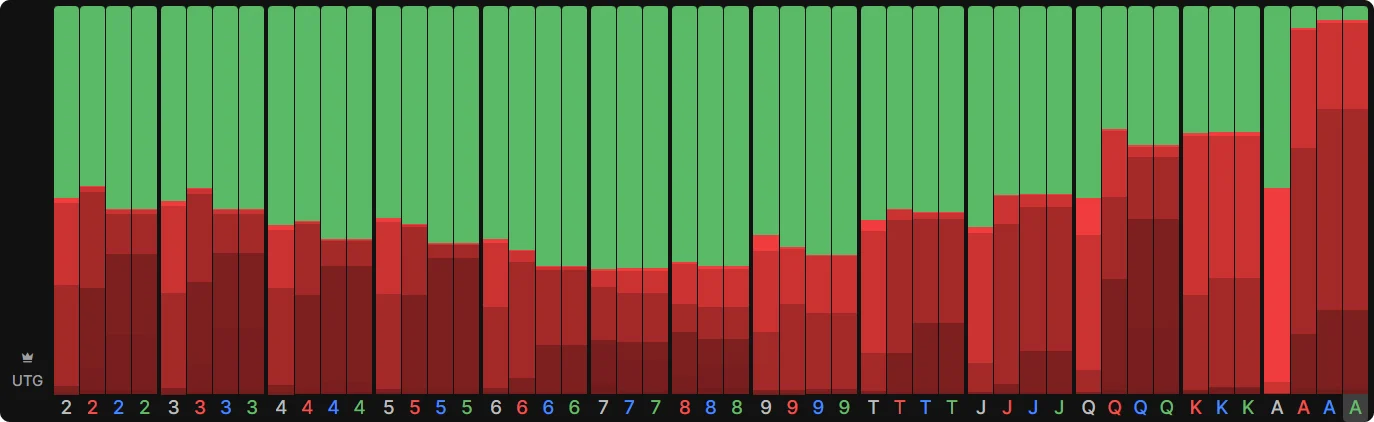
There are several regularities:
- UTG consistently uses lower bet on peak thorns, which negates its nuts edge, making many BB flushes possible. The only exception is
 the one that mates the board. UTG has more quads and full houses in the range, so it can do some overbetting on this map.
 - The situation with the cards that cover the streets looks similar, although their influence is less dramatic, because BB will have fewer combinations of streets. Fives are an exception because BB would fold 96o on the preflop and basically raise 96s on the flop, making straights possible but unlikely for him on these thorns.
- UTG has the highest bet frequency on non-peak thorns A, K, and Q. These cards do not make straights or flushes possible and increase UTG's equity more than BB, as UTG is more likely to have unpaired broadway cards. This correlates with a smaller sized bet, especially when an Ace lands. These cards raise the UTG equity so much that it actually runs out of good hands for the bluff balancing the overbet range, and it is then better to use a smaller size to make thinner valley bets with its numerous Ax and Kx hands.
- The most blank thorns are not peak cards that do not close the draw and do not improve odd hands in the UTG range. On these cards, UTG mainly makes a check or overbet.
- Lower board pairs 7 and 8 are not as good as K for UTG as BB is more likely to have thrips. Consequently, UTG rarely bets on these bet, although, as in the case of, its edge in the form of full house and quads still contributes to a small range of overbets.
BB almost always checks the turn after the flop check-call.
The only exceptions are the cards that we have already identified as creating new nut hands in the previously captured BB capped range:
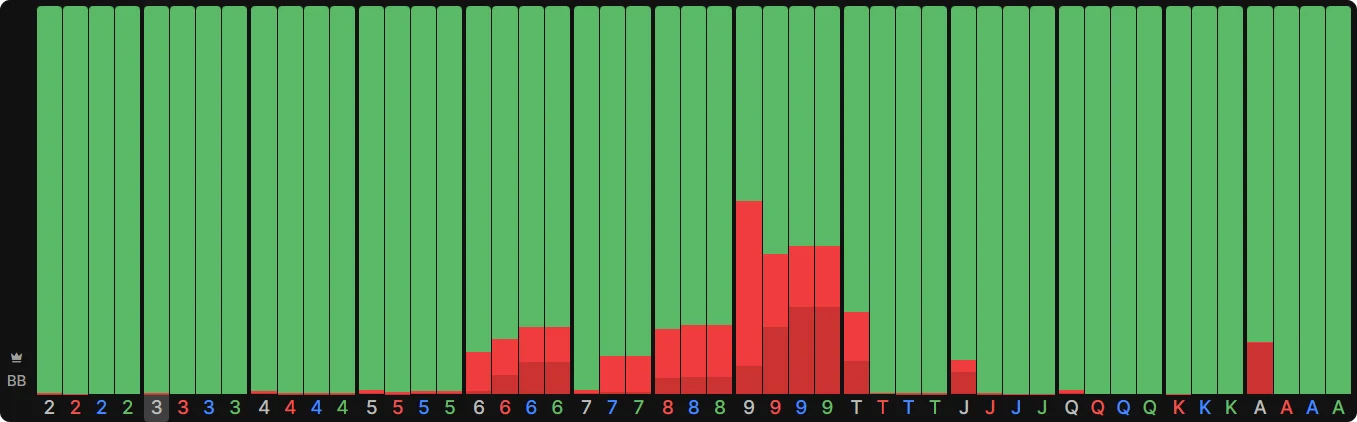
BB has some incentive to put in these cards precisely because they are bad for UTG.
4. When everyone check out the flop
Now think about what happens when UTG makes a check on the flop, what happens with about 25% of its range. It is important to note that although the UTG check range is somewhat weaker than its bet range, it is not that weak. In fact, UTG is motivated to bet on the flop with many of its weakest hands, which makes its check range quite linear.
Its check range is concentrated mainly around pair:
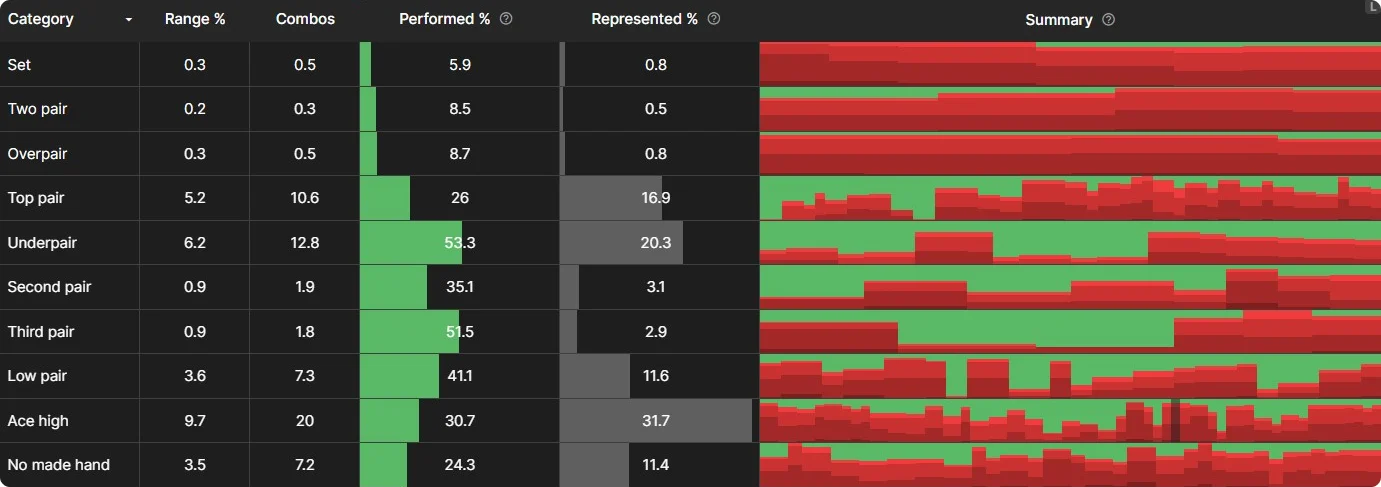
The preflop range of UTG is much stronger than that of BB, so despite the small weakening effect, it retains both the equity edge and some degree of nuts advantage after its check. This means that in general we should expect a low frequency of bet from BB on the turn and mostly small sizes.
Here is the report after the flop check, this time showing the strategy from BB's point of view:
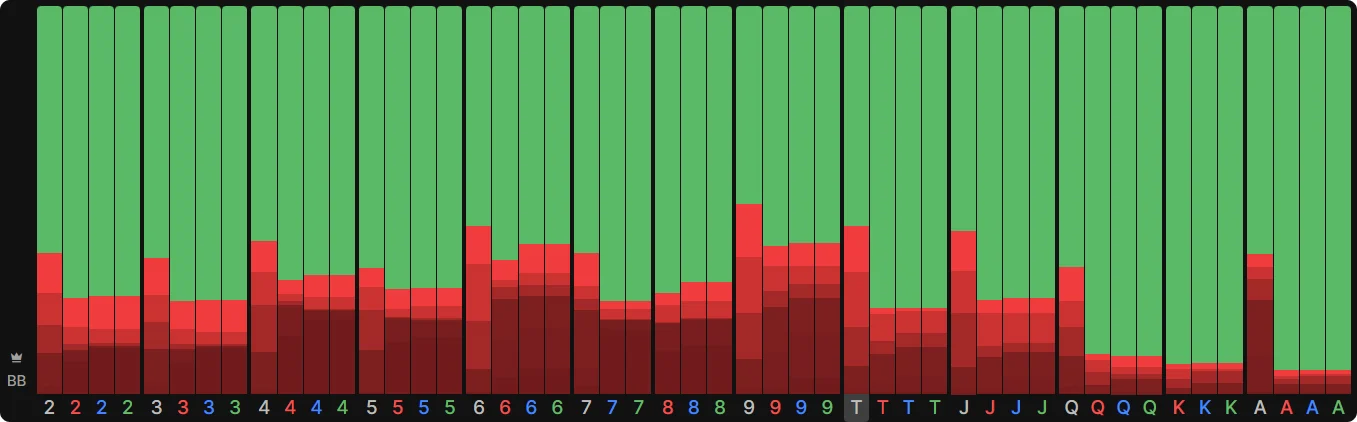
Indeed, the frequency of bet is low. The best prob beta BB cards, again, are the ones that change the texture of the board. They are especially good after the UTG checkback on the flop.
Action on the flop concentrates on opponent ranges and board maps that coordinate with those board ranges.
UTG had a lot of incentives to bet with their flush draw and straight draw on the flop, so it was less likely to have a flush or straight when those draw closed on the turn.
Here is a breakdown by types of draw in the UTG flop check range:
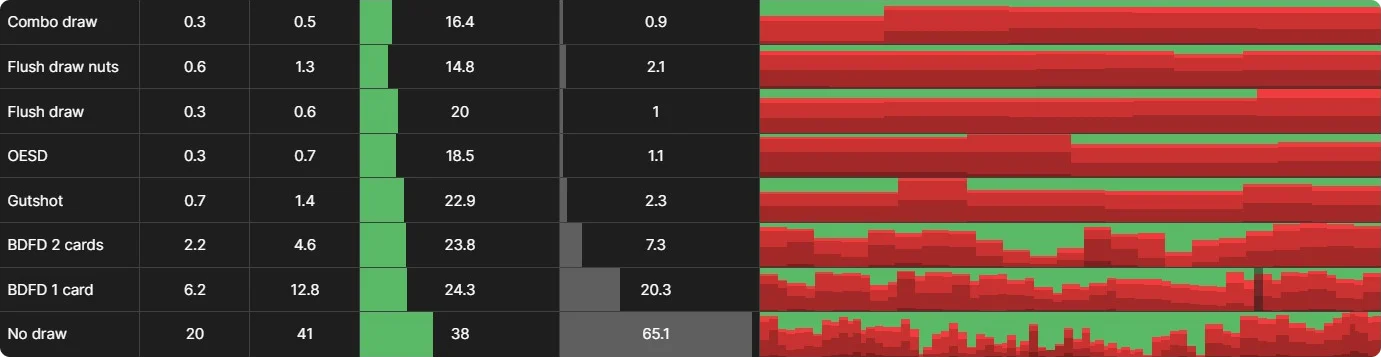
The rejection of the bet on the flop is a sign that UTG is unlikely to have a draw. The flop check from BB does not transmit the same information as it checks its entire range. Thus, after everyone has check the flop and the turn draw closes on the turn, BB gains an advantage in nuts combinations and can sometimes make an overbet. This is true even though UTG checks some draw on the flop because it doesn't checks often enough for BB to want to give up overbetting on those thorns. If BB checks a second time, we see mostly small bet from UTG, which is a consequence of its less nutritional range. The main exceptions are the broadway maps, which improve it the most by introducing some new nuts' hands into its previously trapped range.
5. Conclusion
Range differences are most pronounced in UTG versus BB oppositions (the flop in question is particularly good for UTG). These patterns are not always so clear and pronounced, but the basic principles should guide your assessment of the thorn map in any situation. Start with a clear understanding of how the equity and nuts' hands are distributed to the thorn map, and then consider how much the thorn turn changes these ratios.