


Translated with the help of AI. We apologize for any errors and would appreciate your help in correcting them.
Before this article, I recommend reading the article: What is balance and exploit in poker, which is more profitable?
This article demonstrates the basic bet of the game on all streets. Also later, an additional article will be published, which will tell about super small and very large sizing, from 1bb to 200% of the pot size (overbank). It is recommended to carefully study this article and even allocate strategic points to yourself in a special synopsis for regular repetition until these bet sizes become automatic for you.
Because the size of bet is an important strategic aspect of your game, which affects your winrate more seriously than many people think.
1. Preflop bet sizes
All preflop bets are quite standard and few people get confused in them. But still, look carefully, perhaps some nuances will seem interesting to you.
Open raises
- In stacks 85bb+ - 3bb;
- In stacks 55-85bb - 2.5bb;
- In stacks <55bb and all late stage regardless of stack - 2bb.
Many players do not bother and always raise 2bb, but the option above is preferable.
How to Play Open Raise on SB
- The value of the range (the top 25% of combinations in strength) is always raising 3.5 bb, with an exception in stacks <18 bb, here it is better to reduce sizing.
- Open the stack 18-32 bb in the entire range with 3.5 bb sizing. In this stack, it is important to reduce the desire of opponents to put Push on our raise.
- The 32 bb+ stack can be played with the standard raise sizing of any hand except the velly of the range value. And also to exclude hands that are better to play through the limp.
Isolation of limps from phishes
The actual topic for players is limits up to $33, since there are plenty of players using a wide limit strategy on these limits. In addition to the isolate, there are parts of the range that are more profitable to play Over Limp.

It is also important to understand what range we isolate at different positions. A basic understanding of this strategy can be obtained together with the charts from the video course “Optimal preflop bands. Level 1”. The data given in the article are obtained on the basis of the microlimit database references and the identification of the best strategy using the solver analysis of these indicators.
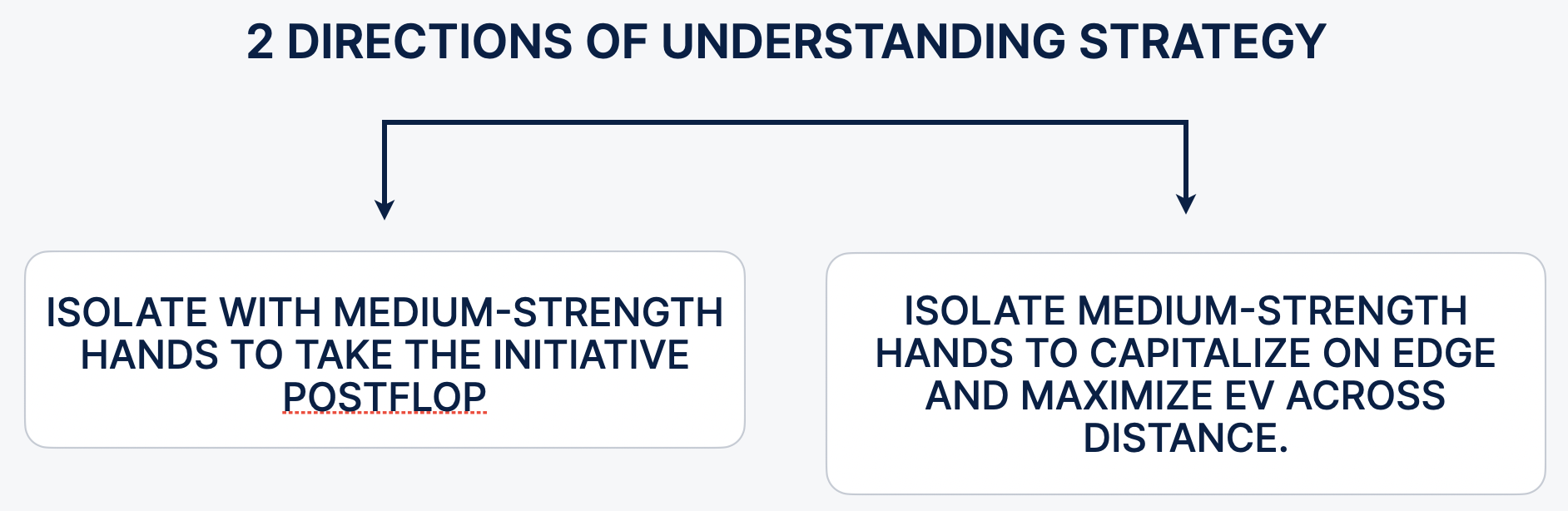
- Standard sizing isolate 3bb + 1bb for each additional limper
- The sizing value varies from 5bb to 8bb depending on the stack depth and can also be increased by +1bb for each additional limper
3-bet
- In the early stage in stacks >60bb size 3bet 4X + 1X for each color
- In the middle and late stages, 3.5x + 0.5-1X for each color
- In effective stacks <30bb, the number of 3-bets is greatly reduced, as direct 3-bet pushes on many hands become more profitable, and people actively begin to 4-bet push against us.
An exception can be considered 3-bet in Steal - Re-Steal situations and 3-bet in the ICM stage, where opponents have a much more expensive price of tournament life, and they have to become much more tight in defense against such 3-bets. In these cases, sizing from 4.5bb to 6bb can be used for 3bet.
4-bet
The 4-bet game is poorly developed at low limits because it is quite dispersive and requires courage. Nevertheless, the research data show that starting from the MP positions, 4-betas at low limits are very relevant. (But not the 4-bet push, they, on the contrary, are not relevant at all!)
What sizing to use for non-ol-in 4-betas on preflop:
- At position 1.8-2.5X
- Without 2.1-2.8X position
The smaller the effective stack, the less sizing can be used.
2. Post-flop bet sizes in MTT poker
When we place a bet during a post-flop game, we need to understand exactly the purpose of our bet, its meaning.
There are 4 main motivations for bet:
- Bet for protection (protect), which can also be called a thin value
- Semi-bluff bet with flash or straight draw
- Value Velju bet
- Bluff bet
It is these types of bet that will be considered later in the article. If you want to read more about this, we recommend the article - 4 types of post-flop games.
What bet sizes to use on the flop
- 30% (or 25%) - the main bluff bet on the flop
- 50% (or 55%) - mainly for velly and draw on the flop
- 70% (or 75%) - velly bet for dangerous board on the flop
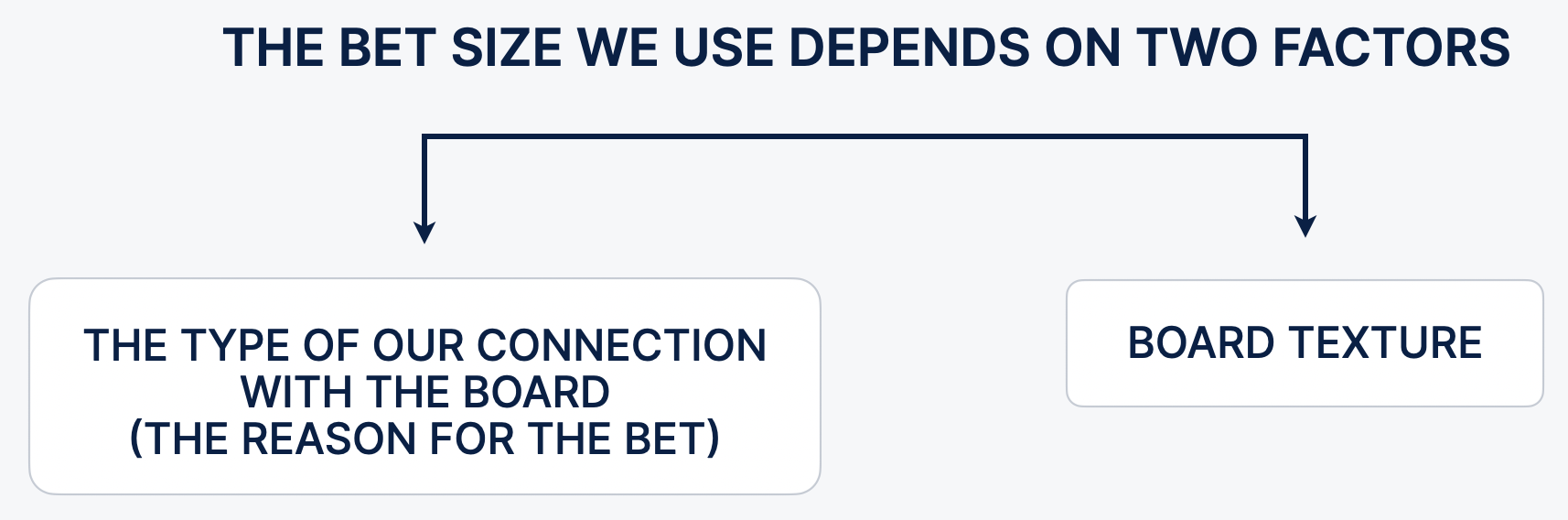
What bet to use on the flop on different board structures:
Dry with high top card Q+

 -
- 

 -
-


bluff bet - 30% pot
Value of the bet - 30% against reg players, 50% against weak
Protect bet - 30% of the pot
Bet on straight draw - 30% - 50% of the pot
Dry with low and medium high card J-

 -
-

bluff bet - 30% IP and 50% OOP
Value of the bet - 50% against reg players and 70% against weak
Protect bet - 50% of the pot
Bet on straight draw - 50% of the pot
Draw with high high card Q+

 -
- 

 -
-
bluff bet - 30%
Velju bet if 2 cards are low (A47s K62s) - 50%
Value of the bet if the senior + middle card (AQ7s QJ7s) is 70%
Protect bet - 30%
bet on straight and flush draw - 50%
Draw with low high card 8- -
- 
 -
-
as  a bluff is more profitable to play through OOP check-raise, read more in the article: playing OOP post-flop in tournament poker, profitable strategies.
Bluff IP bet - 30% of the pot
Value bet - 30% against agro-regs to provoke a raise, 50% against the rest and the check-raise strategy for the OOP value is also beneficial
Protect bet - 50% of the pot
Bet on straight and flush draw - 50% or check-raise OOP
Draw with medium high card 9-J
 -
- 
 -
-
In these OOP board, it is generally better to abandon the bet without additional equity and play check-fold.
Bluff IP bet - 30% of the pot
Value Velju bet - 70% of the pot
Protect bet - 30% or better to be protected through a check
Bet on straight and flush draw - 50%
Paired high board Q+ -
-  -
-
bluff bet OOP - 50% pot, IP - 30% pot
Value of the bet - 30% of the bank in dry, and 50% of the bank in draw board
Bet on straight - and flush draw - 50% pot
Protect bet - 30% of the pot
Paired low board J- -
-
bluff bet OOP - 70% of the pot without the 2nd barrel, IP - 30% of the pot. And you can also play check-raise as a bluff on small OOP backdoors.
Value of the bet - 30% of the bank in dry, and 50% of the bank in draw board
Bet on straight - and flush draw - 50% pot
Protect bet - 30% of the pot
High single-masted board 
-  -
-
bluff bet - 30% pot + 2 barrel + 3 barrel
Value of the bet - 50%-70% of the pot
Protect bet - 50% of the pot
Bet on nuts FD - 50% of the pot
What sizes of bet to use on the turn
I will give a simplified strategy of playing on the turn, because it is very effective in tournaments up to $55. Follow simple instructions and it will be easier for you to play your hands on the post-flop.
Bluff
If you put on the flop as a bluff 30% of the pot, then you can always continue to put on the bluff as a bluff on the turn 2nd barrel by sizing 70% of the pot.
Except for 2 situations:
- if the board mated on any card,
- and if the thorns closed at the same time (!) Street and flush draw.
In all other situations, you will at least place a bet near zero, and there will be no minus in the the long run. If you bet 50% on the flop, then the 2nd barrel can also be 50% or 70%. And if you put 70% of the bank on the flop as a bluff (these are just a few types of boards), then in these cases we give up on the turn, if we do not have additional equity.
Value
On the turn, you can bet from 50% to 150%. (There will be a separate article about big bet). Here I will talk about two principles of betting value.
- First, why do we want to collect vellya? value If we see a lot of top pair+ in the opponent's range, and we beat them, then we need to bet more than 70-90%. If we are more focused on collecting of value from middle pair, then it is better to put 50%-70%, because most often they simply do not want to pay more.
- And the second principle - who is our opponent? If this is a weak phone player who pulls anything to the river, then we'd better bet big 70%+ bet. If the opponent is a neat player, then 70% is the maximum, you can even bet a little less so as not to push him once again to fold his middle hands.
Protect
We most often protect our middle hands with small bets of 30% of the pot, sometimes 50% of the pot if there is a lot of draw, and we do not want to give them good chances. Large bet rates are not used for protection.
With draw
hands We try to maximize fold equity on the turn (in some cases it is better to play a check at all) and put at least 70% (and sometimes 80%, and 90% of the pot) if we are finally sure that we will not put the river.
A few special bet on the turn that breaks the general rules:
| % | Type of bet |
| 30% | delayed counterbet cbet in bluff as a bluff on the turn |
| 30% | value of cbet in a low SPR, when the river is SPR<1, in order to increase the likelihood of playing on the stack with an opponent |
| 120% | protection bet on a vulnerable velly (for example, low two pair on a shotboard) |
What bet sizes to use on the river
| Type of bet | |
| 30% | thin vellyu cbet when selecting from middle pair and worse |
| 30% | subtle bluff-bet with the complete absence of showdown velle even on a high card (with the intention of knocking out higher high cards and possibly lower opponent's pair) |
| 50% | standard value bet: collecting of value from middle pair and weak top pair |
| 70% | standard velu value bet for selection with top pairs |
| 120%+ | value bet with high strength hands in situations where the opponent also has a lot of strong hands (dopper+) |
| 120%+ | value bet in situations where such a size will look illogically large (create a polar range in the eyes of the opponent, and provoke it to open on bluff-catchers) |
Separately, it is worth noting that playing against weak players of the "telephone" warehouse, you can use increased bet on all streets. The ability to collect chips tightly, playing even all-in sized 2 and 3 pot, is a great strategy against weak players.
3. Which sizing to use in short stacks less than 25 BB
A decent number of hands a tournament poker player is forced to play in short stacks, so it is worth considering the features of the game in such banks.
Fast Play Strategy
This strategy involves quickly adding all the chips to the pot in order to prevent rivals from realize their equity. This should be done on vulnerable hands, especially low top pairs and low over pairs. You can also actively play draw hands. It implies the use of bet rates of 50%+ pot and setting all-in sized up to 1.3x of the pot.
Geometric strategy
This strategy involves calculating in your mind how the pot will increase after our bet. The goal is to play the whole stack using optimal sizing, so that on the river our all-in was approximately 50-60% of the pot, and it was difficult for the opponent to throw out his hands of medium strength.
Small bet strategy
This strategy is used with hands of medium strength and a thin vellya, with which we would not like to play on the stack, but we do not want to get rid of these hands either. Since opponents are more likely to attack our checks and try to knock us out of the bank, it is better to use protection pot control. Line: bet flop 30% of the pot, bet turn 30% of the pot, bet river 30% of the pot. In some situations, you can try using this line as a bluff. Especially if over-cards to the flop are opened on the turn/river. But I prefer the line with 2 barrels, where the second one is large 60-70%, even for playing in small stacks.
4. Adjustment of the bet size in a strong ICM
In a deep ICM environment, if the average stacks are between 25 and 40 bb (as is often the case at this stage), it makes sense to occasionally adjust the bet downward. Under these conditions, opponents begin to hide and are less inclined to wide bluffcatches and luz raises on the post-flop. You can use bet rates of 20-25% as a cbet in a bluff on the flop, 50-60% as a second barrel on the turn, which is slightly less than the standard values.
5. Conclusions
Understanding what size of bet to use while playing on all streets is an important part of your strategy. There are optimal bet values in terms of earnings due to fold equity during bluff and optimal bet rates for earning value. Departing from these values, you will collect less chips both at the expense of bluff and at the expense of vellya than you could value.
The flop is the beginning of your line on the post-flop, and the further scenario of the hand draw largely depends on the game on the flop.
This article details the concepts of bet ting on different flops. Copy them to yourself for repetition. On the turn and the river, there are more basic but very effective turn strategies. Remember and use them. See as many examples as possible of the use of different sizing during the debriefing of tournaments, which I regularly post.