


Translated with the help of AI. We apologize for any errors and would appreciate your help in correcting them.
Translated by order of the educational portal university.poker
Original source: GTO Wizard
This article was inspired by one of the subscribers who sent a question about a concept he called: Buying the Showdown. As he describes it, the idea is that after the counterbet of the flop, “put a small bet in a position with the middle of its range on the turn with the intention of playing a check-check on the river.” The argument in favor of this game is that it allows you to get additional protection for hands of medium strength, perhaps even collecting a thin vellya value. At the same time, we avoid colliding with a polarized rate on the river. The subscriber took the concept from Alex “Assassinato” Fitzgerald, but some coaches dismissed it as unbalanced and too vulnerable to check-raises.
This led me to two topics that I will address in this article:
- Is buying a showdown ever part of GTO strategies? If so, when exactly?
- Even if it's not part of the GTO, could this strategy be an exploit if you expect your villain won't check out often?
1. Theory
Usually the bet range becomes more polarized on the later streets. On the flop, medium strength hands can often justify a bet because they benefit enough from depriving the equity of the weakest hands in the opponent's range. After that, they are less motivated to continue betting on the turn. Partly because the villain already had the opportunity to fold weak hands, and because with one remaining street, any weak hands are significantly less likely to win the surrender. Usually the bet range becomes more polarized on the later streets. This is especially true for a player in position (IP) who has the ability to complete the action with a check. While medium strength hands may still benefit little from depriving an opponent's equity on the turn, this is usually not enough to justify the risk of exposing yourself to the raise.
Board: offsuited Q942
- Consider the example offered by the subscriber: BTN opens with J9s, BB collides. Board offsuit - Q942, depth 60bb. In MTT, the BTN strategy on the flop is the c-bet of the majority of its range with a small bet, either 20% or 33% of the pot.
Specifically with J9s, BTN mixes a check and a bet, but it's still mostly a bet, as is the case for weaker pair such as 98s and 33:
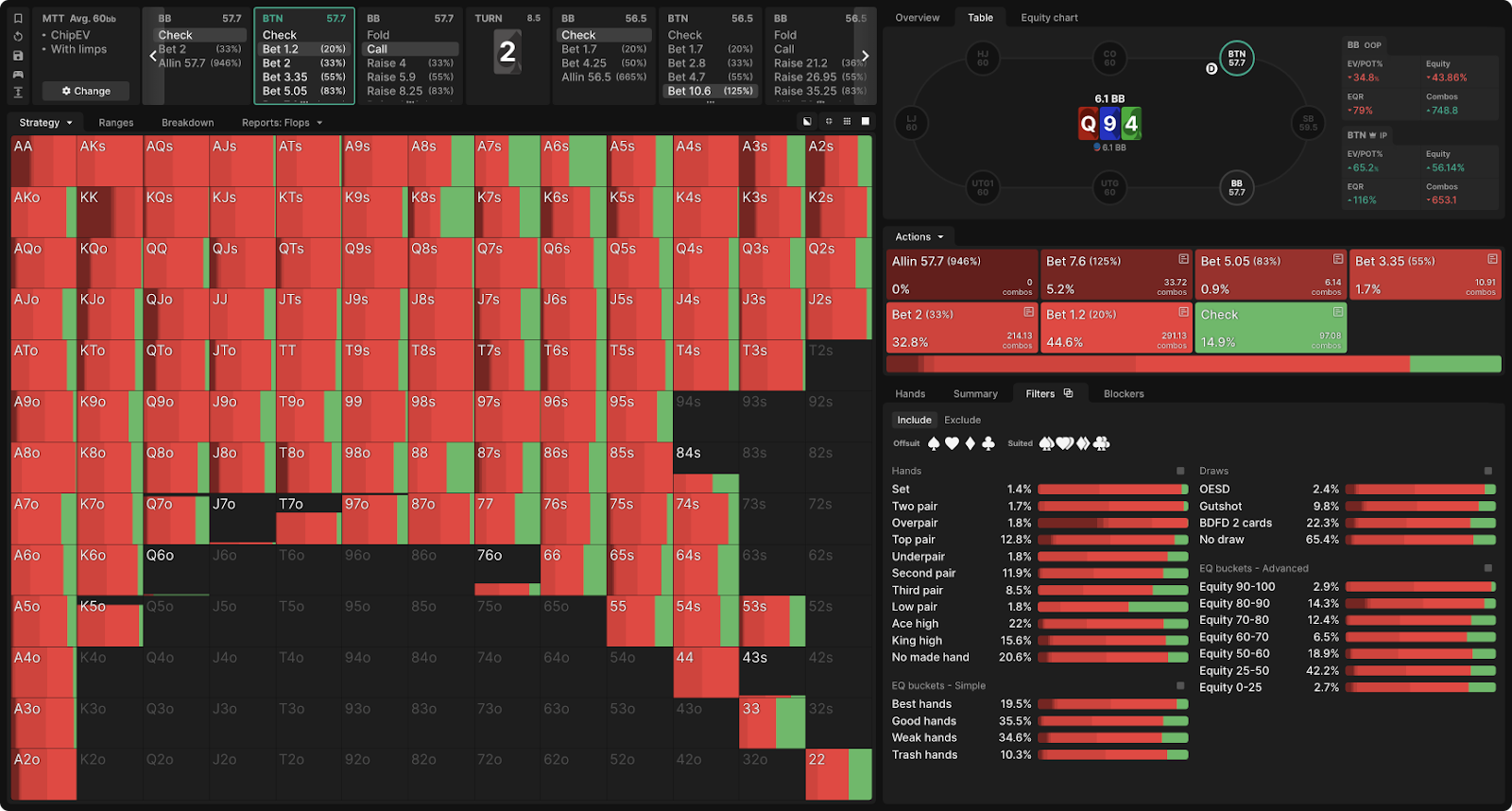
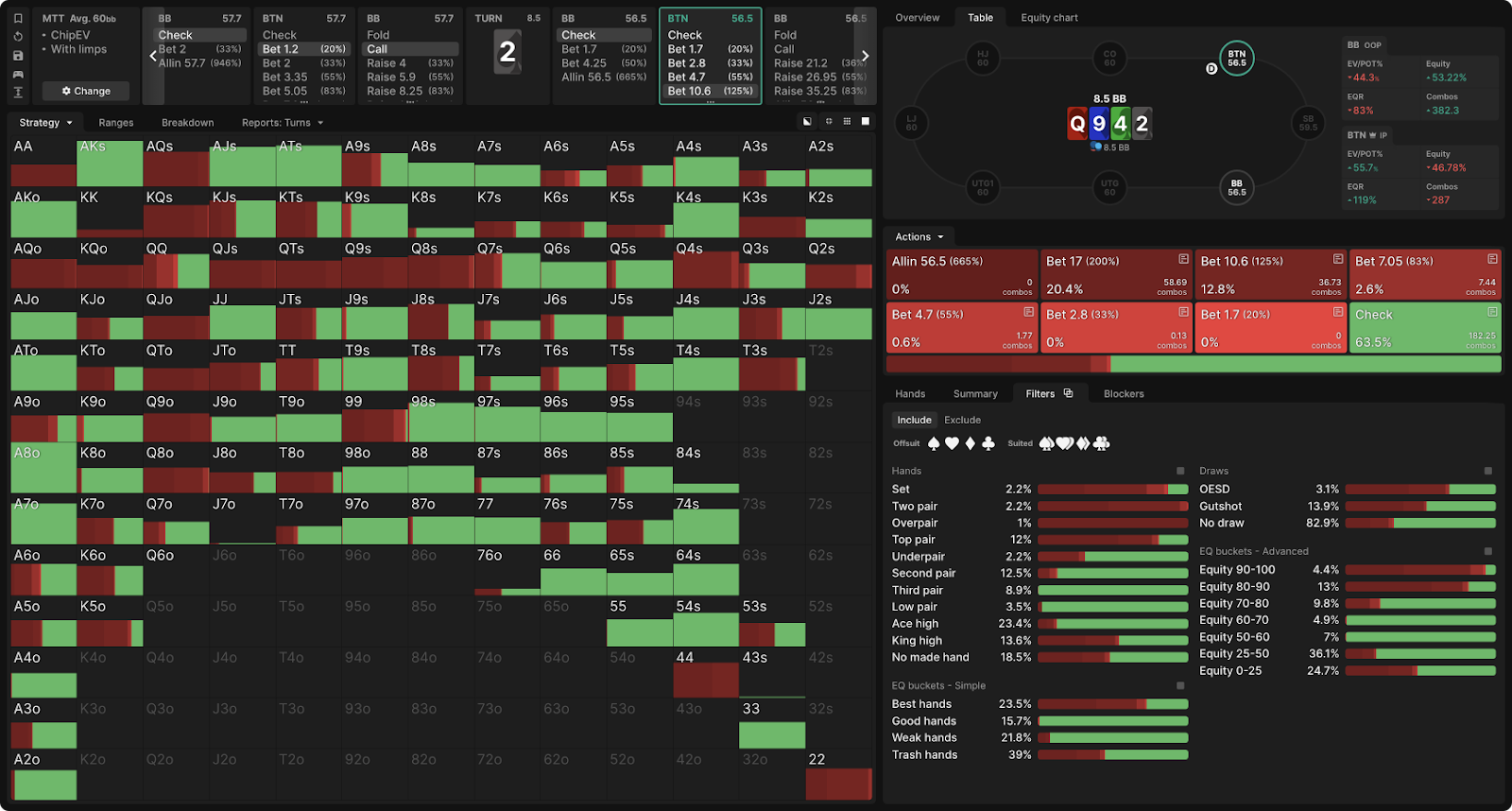
This is a bet on a thin vellya/protection value. Although they are not strong enough to play the big pot, these pair are often ahead. They can be colored with worse hands, and also benefit from depriving equity of BB's weakest hands, many of which contain at least one live overcard. After BTN made a small bet on the flop and received a blank turn, for example , the strategy on the turn changes significantly. He begins to set extremely polar, almost exclusively preferring overbets.
J9s and other weak pair no longer fall into this range of bet with any significant frequency:
2. dynamic board
In the example of a subscriber with J9 on a heterogeneous board Q942, J9s in BTN is actually not so vulnerable on the turn. Sometimes you can make hands with two overcards, such as AT or AJ, fall, but in general, this hand does not benefit so much from burning the equity of the opponent.
Board: 4448
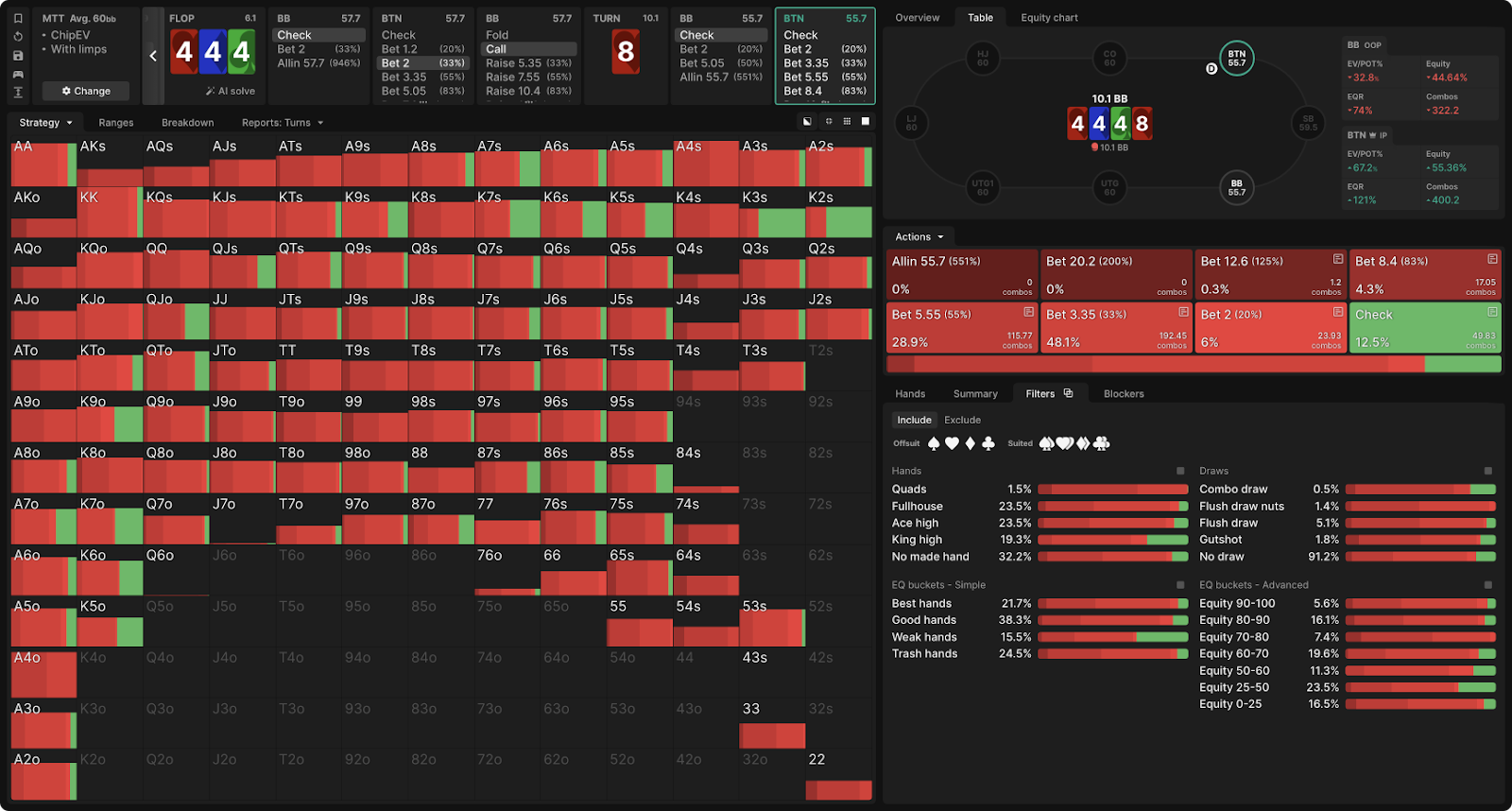
But what about the hands that are more vulnerable to the river? The type 4448 board is extremely dynamic, especially in the opposition of BTN against BB. Even after BB called the bet on the flop, both players have a wide range full of unpaired hands on the turn.
In this case, the middle part of the BTN range is much more vulnerable, and, as a result, its bet bet turn range becomes much wider and more linear, without those overbets that we saw on the Q942 board:
3. Small stacks (30bb)
It is overbettes that are the reason why BTN almost does not put J9 on Q942. J9 is a hand with a thin vellya, and the larger the bet size, the less likely it is to be colored by the hands against which J9 is ahead. Of course, you can bet a smaller bet with J9, but then the villain gets an incentive to raising small bet more often, so the solver would have to balance these bet with monsters who would be happy to provoke a check-raise. The problem is that then these strong hands would stop making overbettes, which is what the solver really wants. The fact that the solver does not do this means that such a compromise is not worth it.
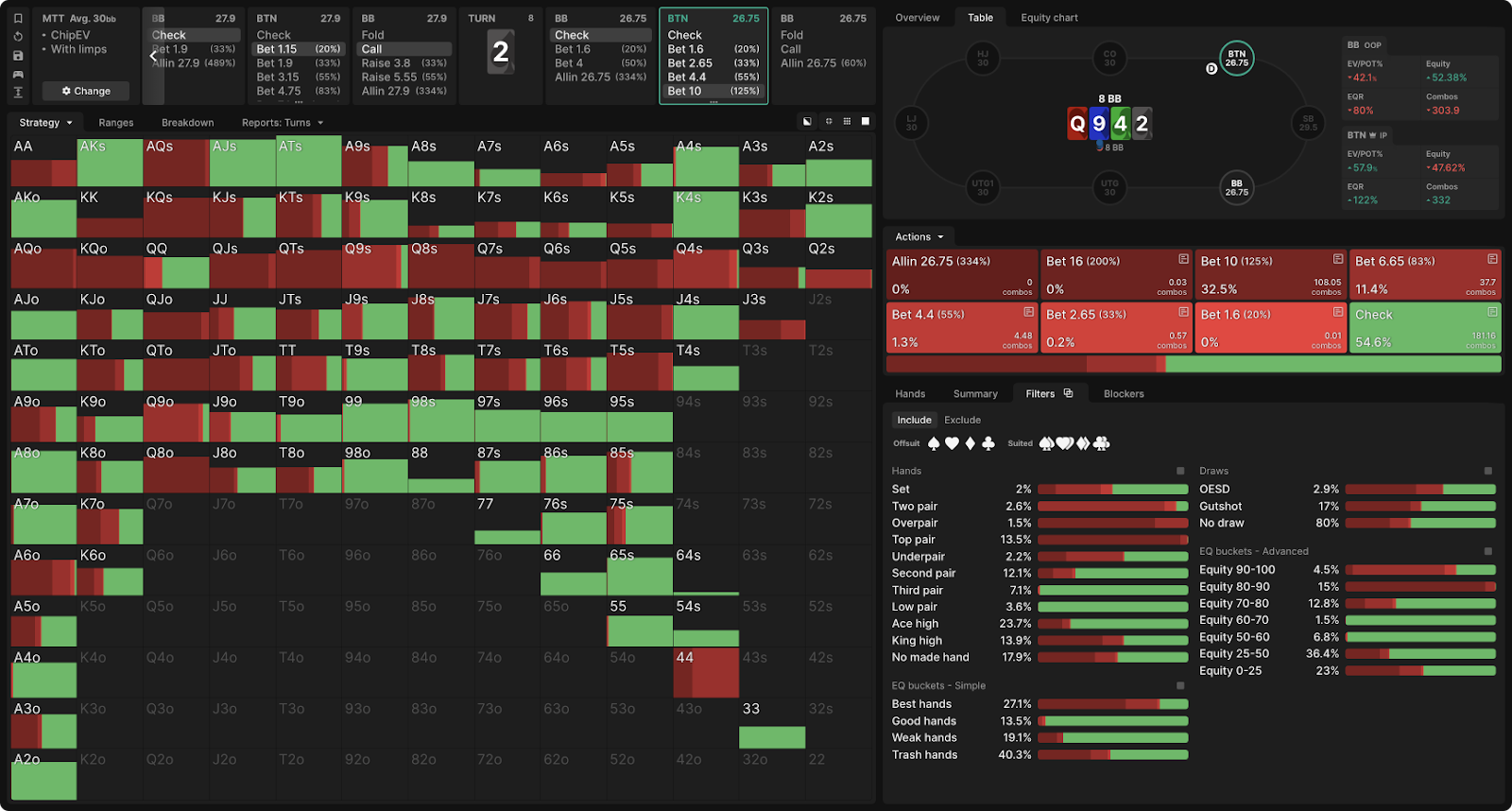
There are not many very strong hands and it is better to use them in the overbet range (which also allows you to add more bluff to this range) than in the small bet range as traps. But what if the stacks were smaller, so that BTN would have less incentive to overbet with its strongest hands? In the 30bb stacks, BTN still mostly makes overbets
on the turn, but no longer uses the size of 200% of the pot. However, he is much more likely to use the bet of 83% of the pot than at 60bb.
The two hands that appear most often in this range are J9 and K9!
4. Exploits
The subscriber's assumption (or rather, the coaches he consulted) was that the main risk when betting medium strength hands on the turn was the threat of a check-raise turn. We can test this by creating a custom solution in which BB never makes a check-raise on the turn. In this decision, I gave BTN the option to put 50% or 200% of the pot on the turn after the c-bet in 20% of the pot on the flop. The optimal (GTO) strategy shown on the right never uses a smaller bet size. However, when I locked in the BB strategy (nodelock function) so that it never raises a bet of 50% of the pot (and never makes a dock turn bet, which would otherwise be a way to compensate for the check-raise ban), BTN sometimes starts using this bet size. The hands that use it are mainly thin valley bets such as J9, K9 and TT. This strategy is shown on the left.
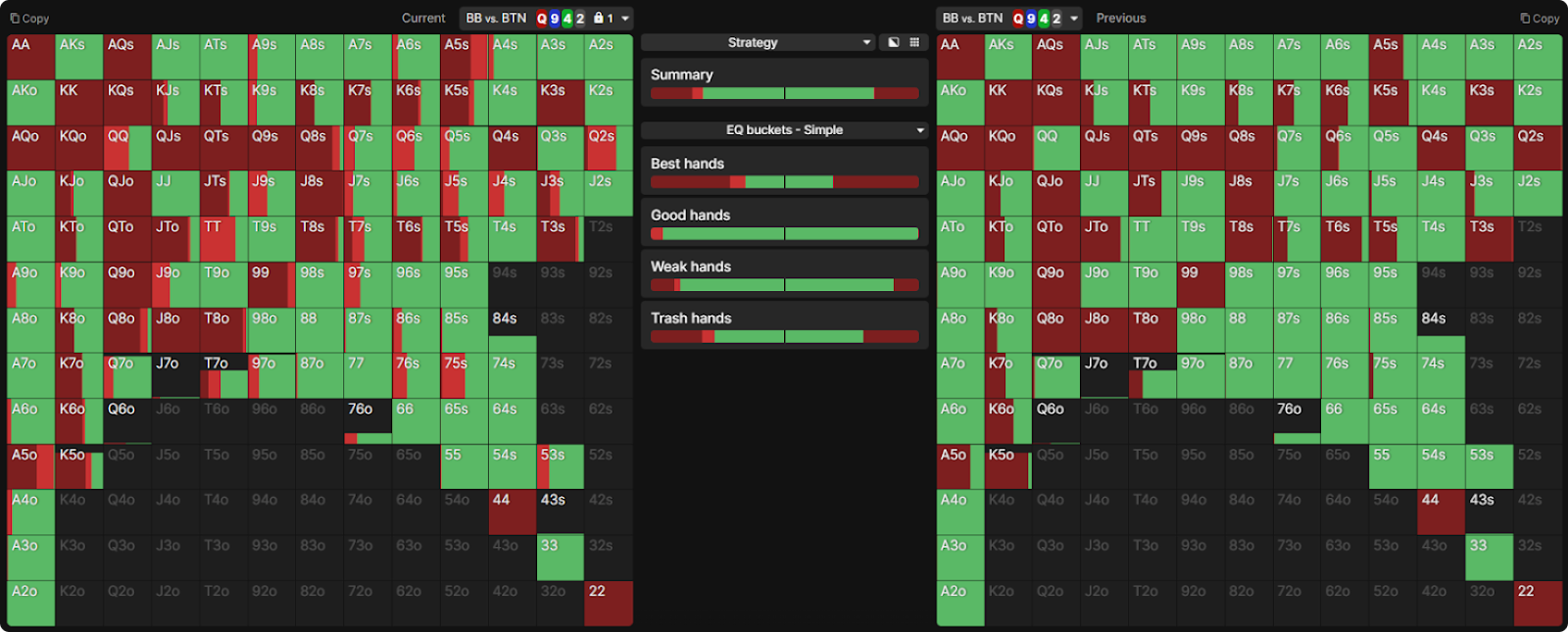
locked strategy (left) and unlocked (right)
It is important to note that these hands are not net bets anyway. This suggests that while the risk of a checkraise is a deterrent to the Buy Showdown strategy, there are other reasons why this strategy may be undesirable.
5. Conclusion
On most rivers, BTN will want to put another bet in the pot with J9 on the Q942 board. There are three ways to achieve this:
Put on the turn, wait for the river.
As we have discussed, this carries the risk of a check-raise. But there is also the benefit of depriving BB's weak hands of equity.
Wait for the turn, put it on the river (if the villain checks out).
This carries the risk of a bad river when J9 is no longer strong enough for Velu Beta. But on safe rivers, BB will be more inclined to call a bet after BTN has turn.
Wait for the turn, to call the bet on the river.
This can become uncomfortable if the BB bet is too big or the river is particularly dangerous. Nevertheless, in general, J9 receives a solid profitable call on the river after a check-back on the turn. Many hands that would previously call a bet on a turn will bet on the river themselves, and, of course, the check will also cause some bluff, from which BTN will be able to profit.
Once you determine that your hand after the flop is strong enough to put only one bet in the pot, then this bet will usually be more profitable if you check the turn and then call the bet on the river or bet on the river yourself. The reason for the check is not to get a cheap showdown, but rather that you want that bet to come in a different way.
If your hand after the flop is strong enough to put only one bet in the pot, then this bet is usually more profitable if you check the turn.
6. Unless...
The main exception to this rule is when your hand also benefits significantly from your opponent's folds, as is the case with the middle part of the BTN range in example 4448. The risk of a check-raise affects the BTN decision to some extent, but the desire to get equity from the folds is a stronger motivator. The question to ask yourself when considering a thin Vella bet on a turn is not so much "Can I buy a showdown?" as "How vulnerable is my hand?" The answer will often be that the hand is not vulnerable enough to give up the advantage of the check in order to force the opponent to place a bet with a weaker range on the river.