

Translated with the help of AI. We apologize for any errors and would appreciate your help in correcting them.
Translated by order of the educational portal university.poker
Original source: GTO Wizard

Many players underestimate the importance of optimal turn play.
The fight for the pot often ends on preflop. If the hand switches to the flop, then there are quite understandable strategies for playing various situations there. At the same time, it is often more clear on the river whether we are ahead or behind, and the player is less often required to make difficult decisions. Despite the fact that the turn in poker is an intermediate stage of distribution, it has a great influence on the final winrate.
1. What makes turn unique turn
Several factors distinguish the turn from other streets:
The value of the hands is more static than on the flop.
When you're ahead, you're more likely to stay ahead, and when you're behind, you're less likely to quit.
The value of the arms is more dynamic than on the river.
If another card comes, the hands can still change their value. This presents a dilemma: place a bet again to deprive the equity of an opponent (and possibly get a raise) or make a check and risk seeing a terrible river.
Low SPR.
If bets were made on the flop, the effective stack on the turn will be much smaller. Turn is often the moment when players decide whether to play on the stack.
Limited possibilities for bet.
After the turn, there is only one bet street left, which makes slow play more risky than on the flop. This is especially true if there was no activity on the flop.
As the pot gets bigger and the possibilities for bet get smaller, players are forced to play according to the class of their hand.
All this leads to the fact that the turn is played more "honestly" than the flop.
As the pot gets bigger and the possibilities for bet get smaller, players are forced to play according to the class of their hand, even at the risk of revealing what class of hand it is:
- Because less benefit can be derived from protection, medium strength hands have more incentive for the check to try to get to the autopsy cheaply.
- Strong hands have more incentives to increase the pot with big bet, as they will only have one additional opportunity to do so. Weak hands either make a big bluff or give up. With small bets, you have fewer opportunities to promote the pot, as is often the case with the flop.
- Draw make the most difficult decisions and often turn out to be indifferent in an equilibrium strategy. On the one hand, a semi-bluff is attractive, because in this case, fold equity is valued more than ever. However, the risk of getting a raise and losing your own equity pushes the check more.
2. How playing the turn in poker differs from playing the flop
Many players experience difficulties on the turn due to erroneous attempts to apply the heuristics obtained when playing the flop.
Flop is the most common street for bet, so it is more familiar. There are much fewer scenarios on the flop than on the turn, which makes them easier to group and study. But, as we have seen, thorn scenarios entail different range dynamics and incentives, which may make the optimal strategy look very different.
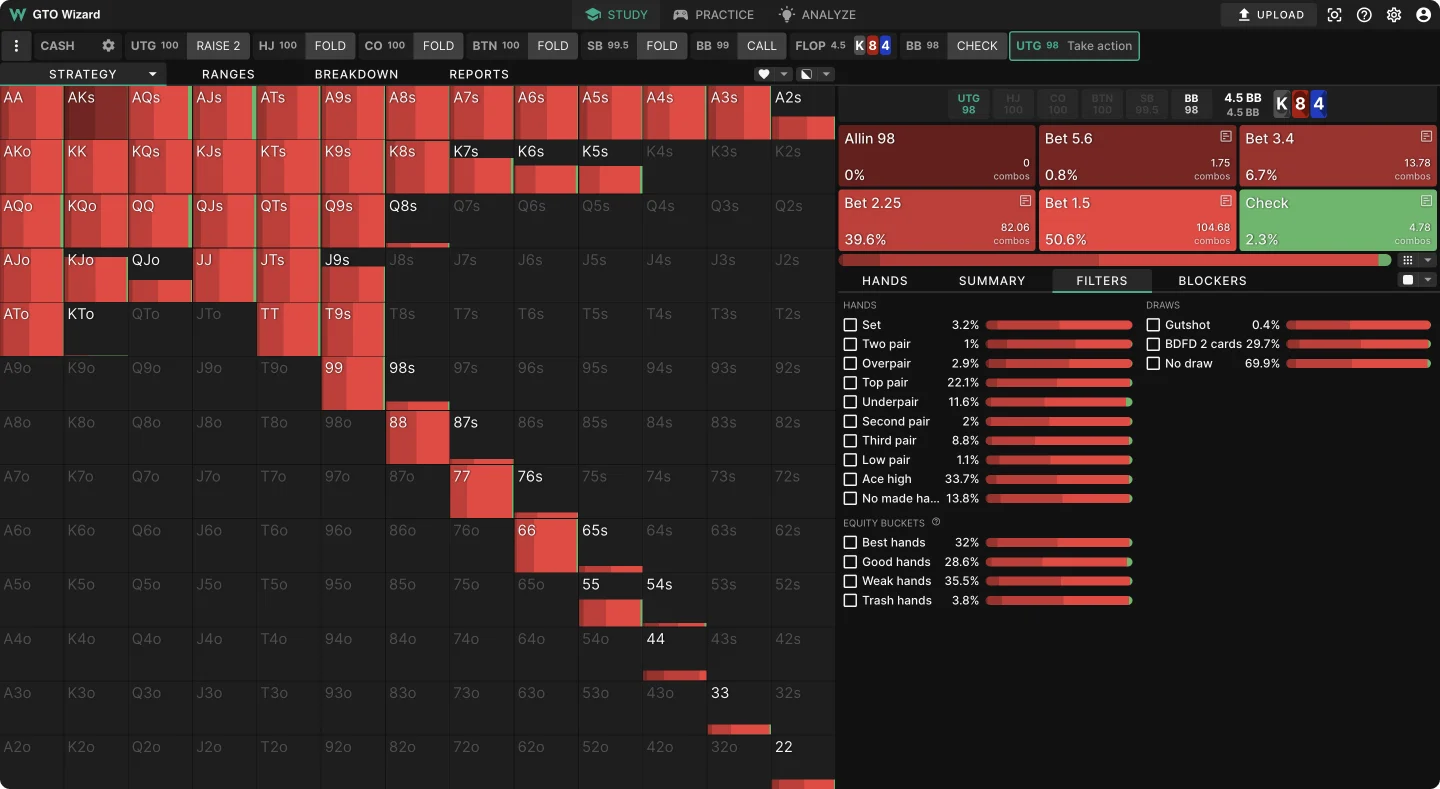
- Example: take the NL50 cache game at a depth of 100 BB on the


 UTG vs. BB board.
There is some separation between 33% and 50% bet sizes, but UTG mostly makes small bet sizes with its entire range:
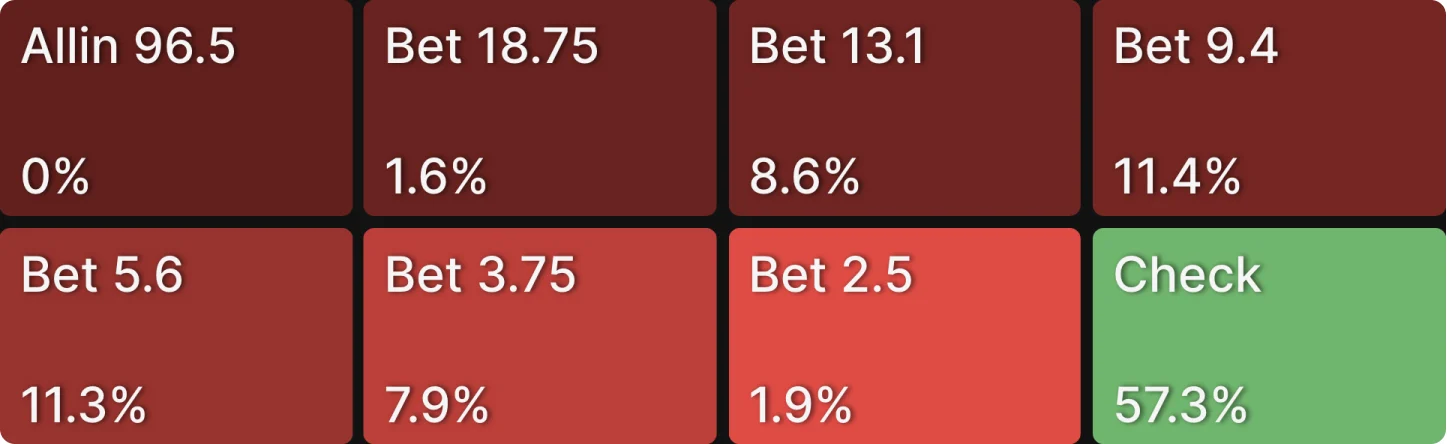
After BB checks and calls the continued bet of 33% of the bank, this strategy changes dramatically. On most thorns, the check is the most common UTG action. When he's not checks, he's mostly overbetting.
UTG strategy on the turn, after the call bet 33% pot on the board :
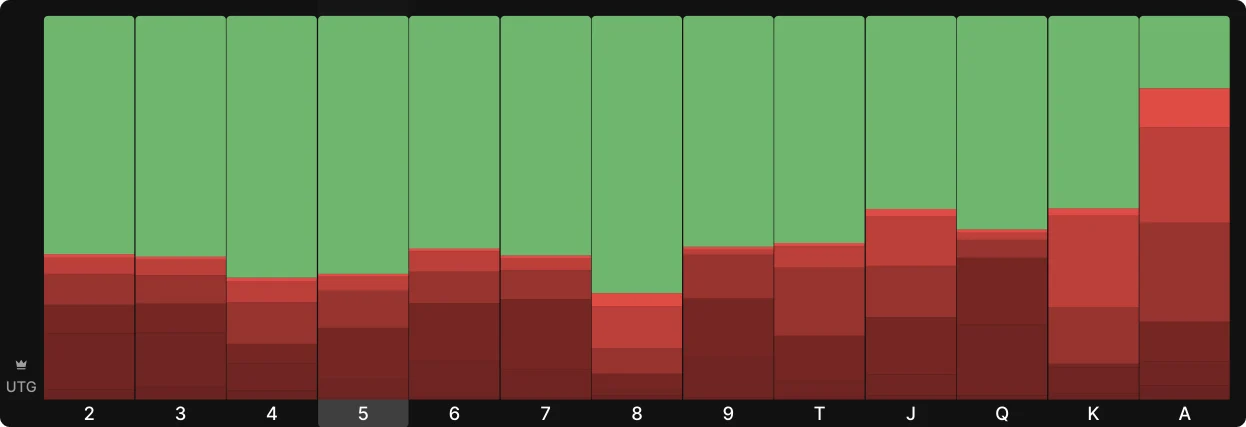
Several factors contribute to this contrast. On the flop, UTG enjoyed a large advantage in the range, which allowed even marginal hands to place bet without fear of colliding with a stronger hand. He could have included stronger hands in this small betting range because as two more streets remain to be played, it would later be possible to put together a big pot.
And with two cards and a lot of chips on the stack, he could bet with draw, planning to equalize the check-raise if necessary.
Everything changes on the turn. BB dumps all his weak hands and now has a stronger range on most thorns. This means that UTG can no longer place bet with impunity. His hands of medium strength have less incentive for bet: they have already received some protection on the flop and now, with only one card ahead, there is less danger of being outplayed. Strong UTG hands should start aggressively increasing the pot to compensate for this small bet on the flop.
This means that he can also place large bet with weak hands to maximize fold equity. He constantly makes bet with flush draw, but most of the check range consists of marginal draw, as well as marginal ready hands. These hands are more at risk of losing their equity and less interested in inflating the pot as fewer cards on the river can strengthen them well. Here is the same board after the continued bet of 33% of the pot and the turn .
.
Pay special attention to the hands that prefer either a bet or a check:
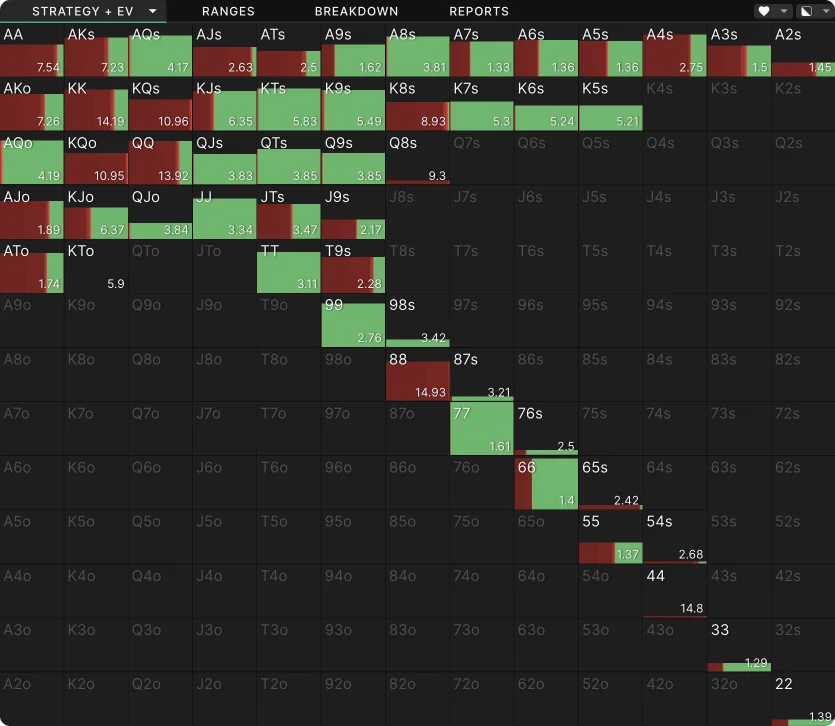
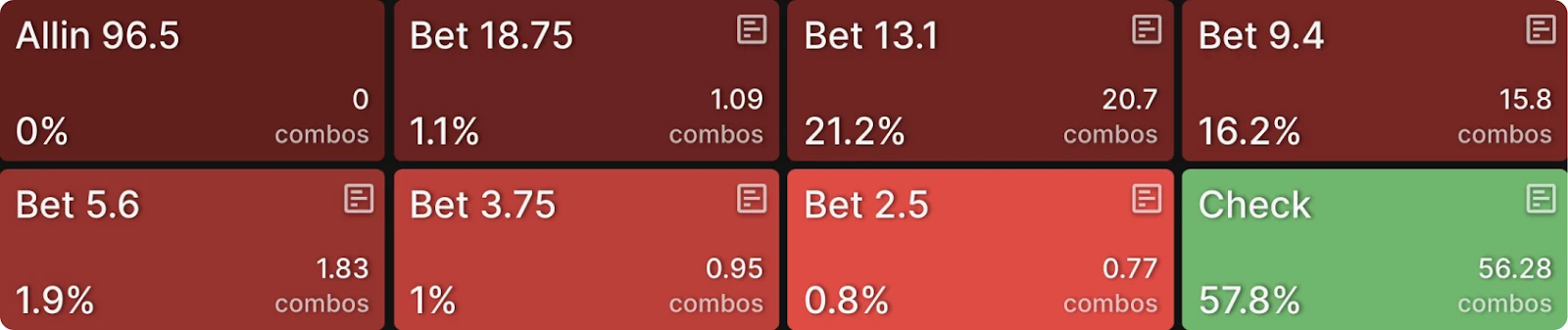
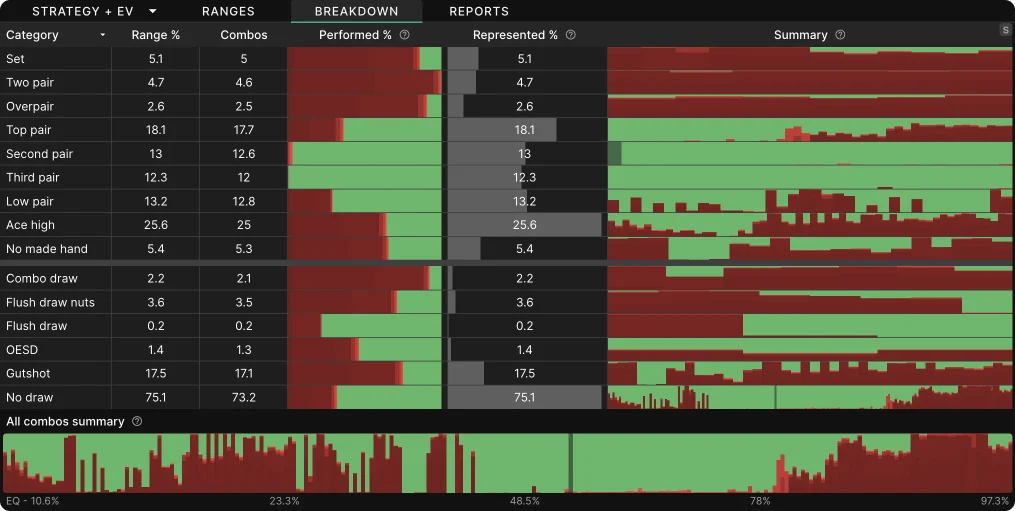
Having made a small bet on the flop with its entire range, UTG on this turn puts hardly 40% of its range, always for an amount exceeding the pot.
UTG clearly prefers a hand check with one pair, despite the draw. The third pair, the second pair and even the oldest pair are strictly waiting. Meanwhile, bets with two pairs and sets are made almost always bet, with the exception of KK and QQ. These hands block the opponent's hands with which he would be most likely to pay us large bet, and are especially resistant to being beaten, as some peak rivers will strengthen them to full house. Dro is more difficult to classify, since their strategy is less clear. A flush draw with a pair or even with an ace has some unimproved value at autopsy and therefore less incentive for bluff. But straight draw poorly blocks the range of the BB fold, which has many such pocket pair as JJ, TT and 99.
We see the same picture even on a very different turn map , which is one of the worst for UTG:
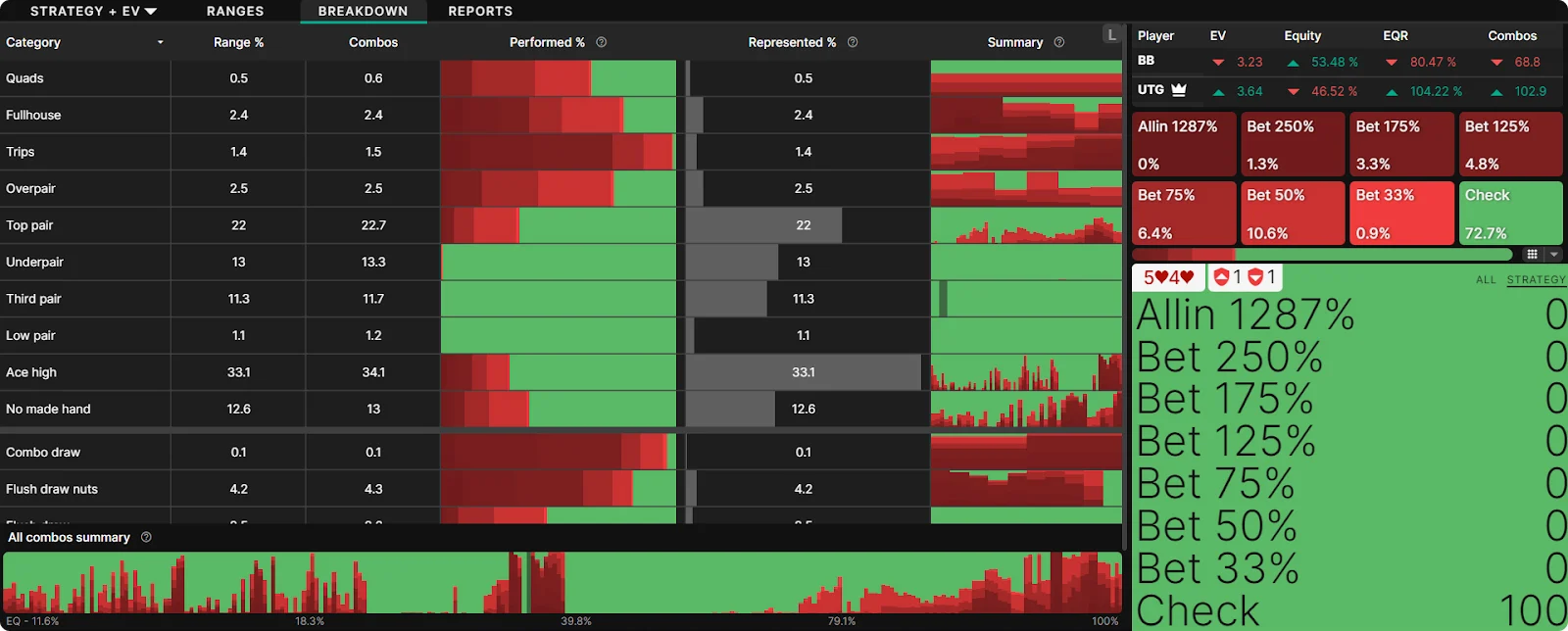
In general, UTG checks more hands, even if we take into account the fact that the optimal BB strategy involves a donk-bet range in which there are many strong hands. When he makes a bet, it is usually on a smaller size, most often half the pot.
However, the same pattern is observed:
- Strong hands constantly make bets, except for full houses and quads, which have a bad blocking effect.
- Hands of medium strength, including most top pairs, constantly make a check.
- Draw draws have mixed solutions: bet with flush draw are made more often than with straight draw.
3. Less profitable board
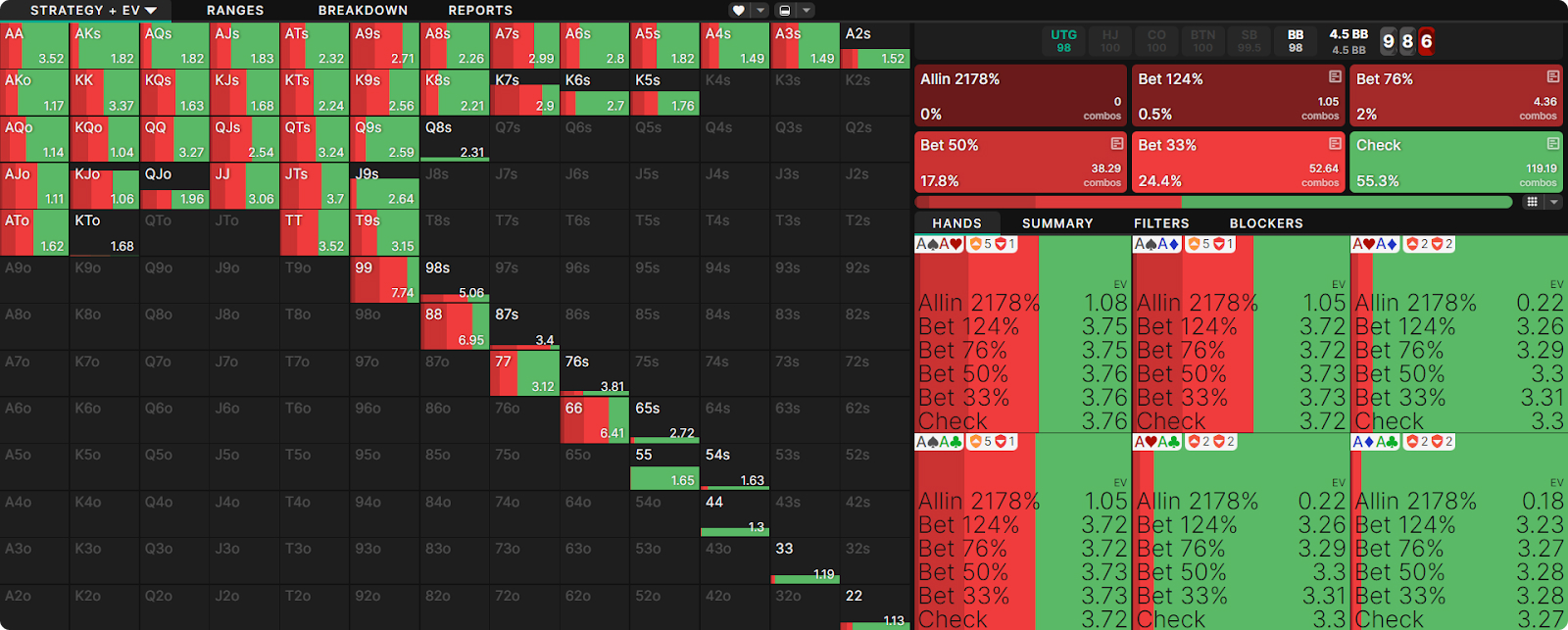
Flop K84 is especially good for UTG, so it can bet its entire range, but the same principles apply even after it has split its range, betting less frequently on less profitable flops.
- Example: on the flop,

 UTG puts less than half of its range, still preferring a small size:
On this board, it is more difficult to make generalizations on thorns, because the texture can change in different ways: overcards, sparks, flush draw and straight draw are possible.
But, with a few exceptions, we see a lower frequency of bet and larger sizes of bet, indicating more polar range:
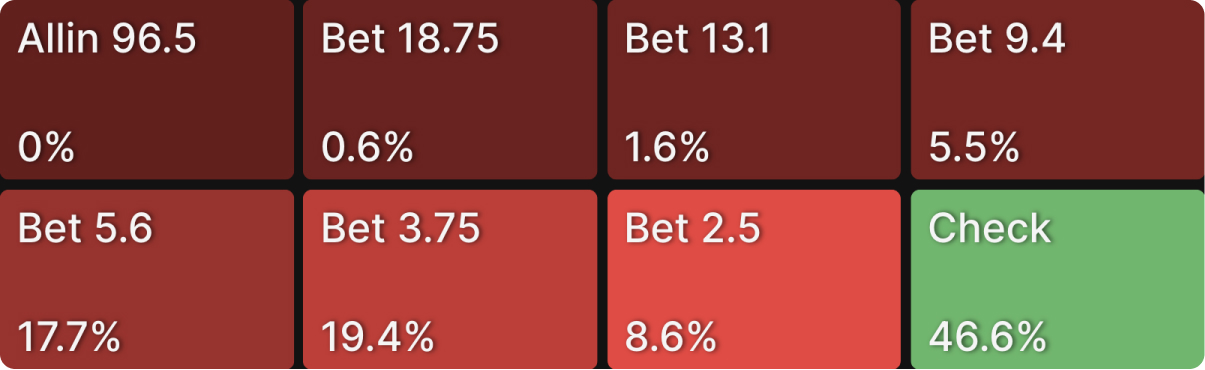
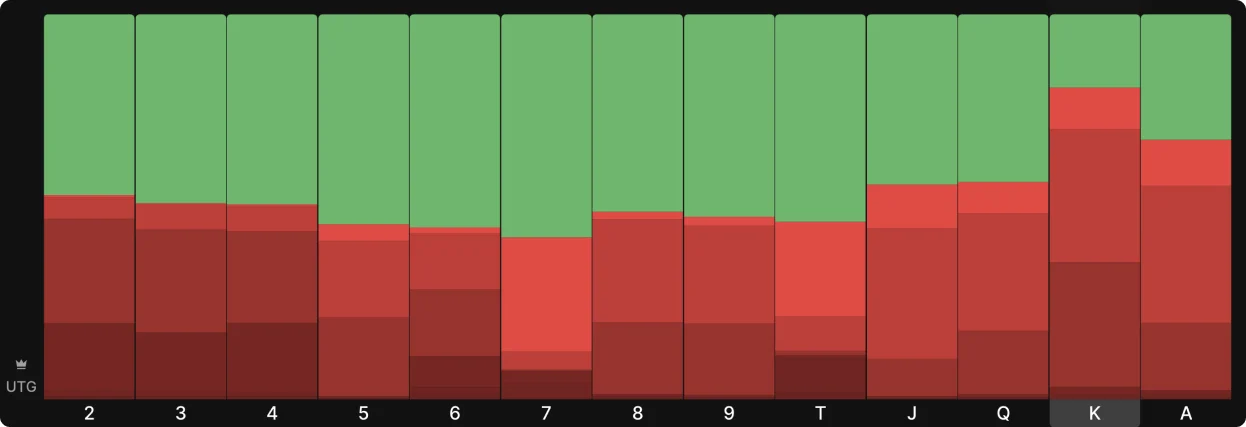
how BB called s-bet 33% of the pot on the flop 9♠8♠6♥
Notable exceptions here are the best and worst maps for UTG. Offsuit 7 is the worst because BB has more than 7-x in the range. Without the nutritional advantage, UTG cannot put pressure on BB's hands of medium strength with larger polar bet and therefore uses smaller bet. Reavers with aces and kings help UTG more often than BB, so UTG bets on them with more frequency.
4. Playing in smaller stacks
Although solver calculations may look very different with smaller stacks, the same principles apply here: strong hands inflate the bank, medium strength hands bluff or give up, and draw maneuver between fold equity and the realization of equity. What is changing is the composition of the classes of these hands and the importance of incentives for bet.
- The threshold of what is considered a strong hand is lowered because there are fewer chips (because of the short stacks) at risk with all-in.
- Bet sizes are smaller, because large bet sizes are not needed to stack-off to the river.
- Draw is less valuable as there are fewer bet chips left on the river.
Here is the same scenario for the board , but with effective stacks of 20bb. What changes did you notice?

The most common bet size for UTG is 50% pot, not overbet.
This is due to the fact that 50% of the pot will still allow him to comfortably push on the river when he wants to do so.Over pair bet more often.
With only 20 BB, hands like KT and KJ are strong enough to play on the stack and therefore no longer have to wait for pot control.The second pair makes bet more often.
Although these hands are mostly thrown away in the event of a raise, the smaller UTG bet size allows for more subtle bet for protection.Draw less often.
The potential reward for nuts on the river is much lower, which makes the draw draw less valuable.The top set is more often played by slow play slow play.
The main risk of nuts slouple is the inability to increase the pot. When the pot is already large compared to the efficient stack, there is more incentive to sloppy when you block the hands that are most likely to make you a profit.UTG bet more often.
The smaller size of the bet allows a less polar range of bets to be used, so UTG still focuses on the check in the middle of its range, but the middle has become smaller.
5. Conclusion
In different thorn scenarios, we see the appearance of the same patterns:
- The value of the hands is more clearly defined on the turn than on the flop, they have clearer incentives for bet and they are more clearly pursuing these incentives.
- On the turn, turn errors often occur due to the inability to assess how these stimuli differ from what they were on the flop, and sometimes from what they will be on the river.