


Translated with the help of AI. We apologize for any errors and would appreciate your help in correcting them.
Translated by order of the educational portal university.poker
Article by Andrew Brokos, original source: GTO Wizard
To properly evaluate your hand and determine if it is strong enough to bet or so weak that you need to think about bluffing, you need to synthesize information from two sources: open community cards and the actions of other players, which give a hint about the strength of their hands. Most players evaluate only community cards, ignoring the actions of other players, which leads to significant errors in situations where bet on the flop and turn were not made. In such scenarios, all players are likely to have rather weak range, which means you can bet pretty thinly. It also means that the rank of your odd hand is likely to make a difference in determining whether you should bluff.
In order to determine the correct strategy on the river in the banks, it is necessary to assess three factors:
- What was the distribution of equity on the flop? Whose range was stronger and by how much? Which player was more likely to have nuts?
- Who made the check on the flop and turn under the influence of this distribution?
- How did the turn and river maps affect this distribution?
In this article, we will look at two common head-up scenarios: a pre-flop racer with no position against the cold collar and a pre-flop racer with no position against the BB. From these examples, we will derive heuristics (thinking and playing techniques) that will also be useful in other scenarios. For example, the heads-up pot of 3-bettor in the anti-open-raiser position has a lot in common with the pre-flop-raiser against BB. But first, let's take a closer look at the factors listed above.
1. Distribution of equity on the flop
The basis for the distribution of equity on the flop is laid on the preflop. A player with a stronger range on the preflop will usually have a stronger range on the flop, although how much stronger it is depends on the cards on the flop. And if the equity of the opponents were close on the pre-flop, they would usually be close on the flop as well.
Equity distribution starts from preflop
The preflop racer has a much stronger range than the BB collier. It is so strong that even the best flops for BB only equalize it. This edge does not disappear even after the raiser checks on the flop and turn. The preflop aggressor will generally still have a stronger range on most rivers and will be able to bluff profitably with most cards, whereas BB should be more selective in its bluffing. An open racer without a position and a cold collar are much closer to each other in preflop equity, so the advantage in the range depends more on the texture of the flop.
2. Distribution of equity after 4 checks
Contrary to popular belief, a check is not a “slack.” Here, the check is the average or “compressed” range. The compressed range is such a capped and at the same time a Tight range in which there are no strongest hands. It consists mostly of medium strength arms, and is also known as the “depolarized” range. In this range, the likelihood of very strong hands is reduced, but the likelihood of very weak hands is also reduced. The hands with the most incentive for the check are the hands of medium strength, which have too much value at the autopsy to bluff, but not so much value that they would like to increase the pot.
A check is not a weakness
This is true for both players, but more so for the player in the position. The player outside the position has more incentives to check with strong hands, because his check does not complete the bidding on the current street. Thus, checks without a position in the early streets are more likely to be traps that failed to deliver a check-raise, whereas player checks in a position are more likely to be medium strength hands. However, unless the river map drastically changes the texture of the board, strong hands are unlikely for both players after the flop and turn check. This means that hands that were not strong enough for the Velho Beta on the early streets may be good for the Velho bet on the river. In fact, these checks on the earlier streets kind of “promoted” them, even if the turn and river cards did not do this (did not strengthen).
3. Rivers that change the distribution of equity
Neither player has much incentive to wait with strong hands. So the question to ask when a new card opens is how many hands that were marginal (and therefore good candidates for a check) on the previous street were improved by that new card. Of course, almost any card can contribute to a set or two pair from time to time, but that's not what we're talking about here. We are looking for outstanding, exceptional cards that will often contribute to the emergence of many new strong hands.
Overcards (especially aces) on the board are the most common example. Flash cards and sometimes street cards are also suitable. For our purposes, we are primarily interested in whether the river map disrupts the early dynamics of the range, as checks on the turn again narrow both players' turn ranges, even if the turn map has made it possible for some stronger hands to emerge. Since the player in the position has a narrower range after both players have check out the turn, it is he who usually benefits most from the river card, which improves many previously marginal hands.
4. Game against BB
The situation on the river after BB checks on the flop and turn, and the preflop raiser also makes a check twice, is very similar to the situation on the turn after both opponents have check the flop. The pre-flop riser tends to still have a stronger range, but also a more limited range, which encourages BB to make several polar bet and raises.
- For example, here is a graph of the distribution of equity CO vs BB in a single raise bank in 40bb stacks in MTT on the flop:


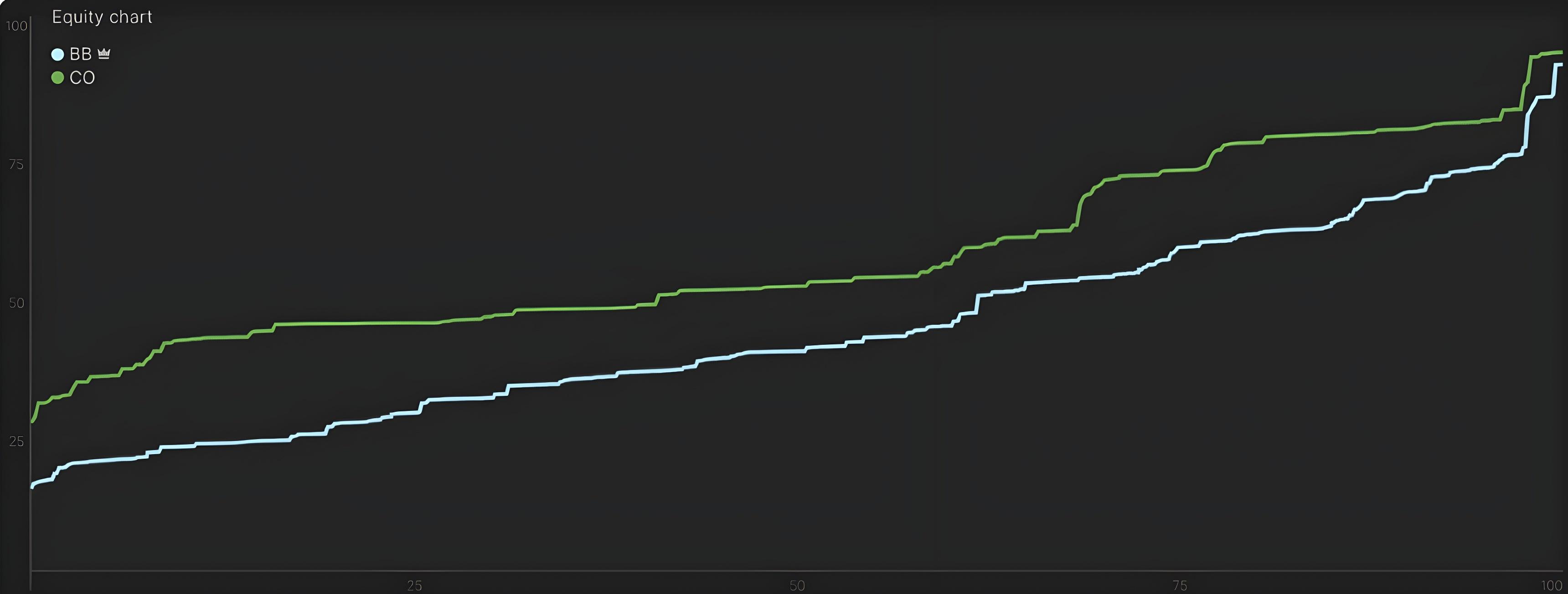
CO has not only 57% equity, but its range is stronger across the spectrum. His best hands are stronger than BB's best hands, his middle hands are stronger than BB's middle hands, even his worst hands are stronger than BB's worst hands.
If оpponents are both waiting for the flop and the turn comes out , this is how this distribution on the river will look like
  :
:
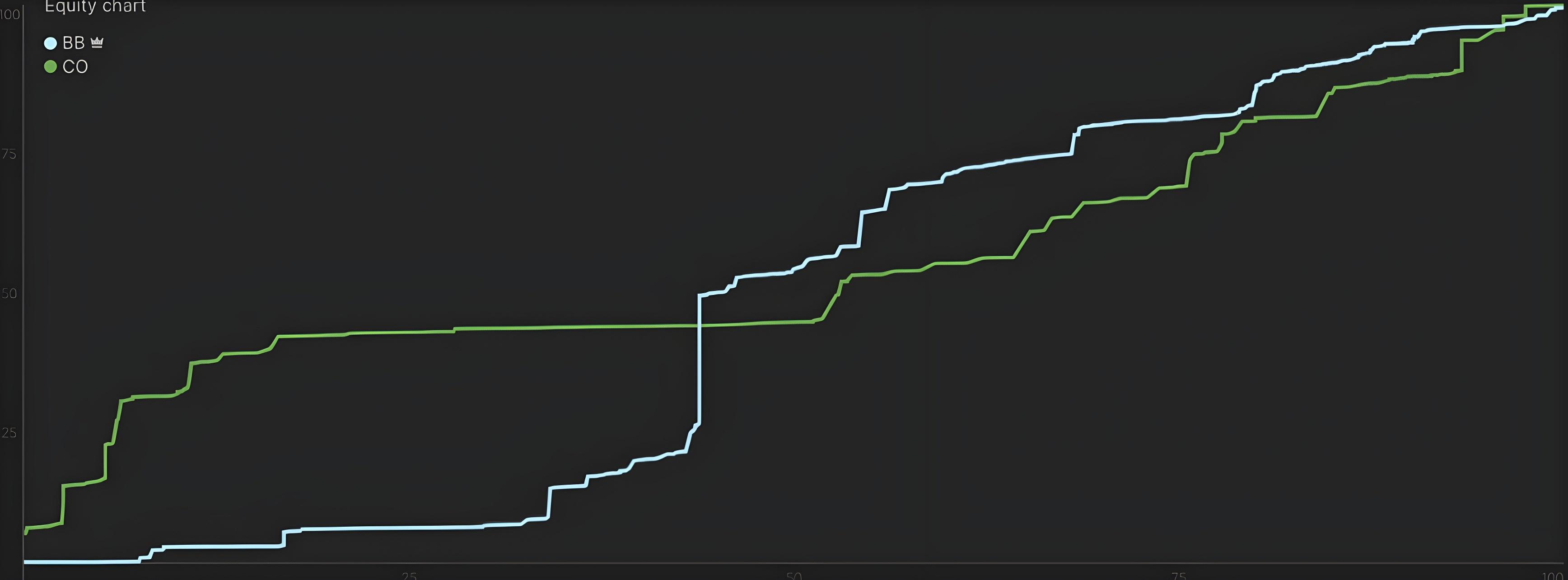
CO still has an equity edge of 53.5% equity. His weakest arms are now much stronger than BB's weakest arms, reflecting how little incentive he had to bluff on previous streets. However, at the top level in strong hands, BB now has the edge. That's why, with strong hands, he often waits on earlier checks. As a result, BB has a lot of checks (due to the fact that he has too many weak hands to bluff with everyone) and a lot of larger, polarized bet from about 40% of the best hands, as well as a small number of bluff.

After so many checks, these “roughly 40% best hands” include weak pair such as 53 placing bet bet of half the pot on the vellya. Thanks to the block-beta size in 16% of the pot, BB can even deliver with a pair of twos as a thin vellya! CO has few pair to cheat to the river, so it has to call many unpaired hands to keep BB indifferent to the bluff. From this graph, we can say that the bluff of any two cards is unprofitable for BB, because even his weakest hands combine bet and check. If bluff was profitable, they would always put their worst hands on it. We can also see BB waiting for some very strong hands as a trap, hoping to do a check-raise. “Very strong hands” doesn't mean nuts. Indeed, even two marginal pair such as T-2 or 6-2 are good enough to raise a velly value.
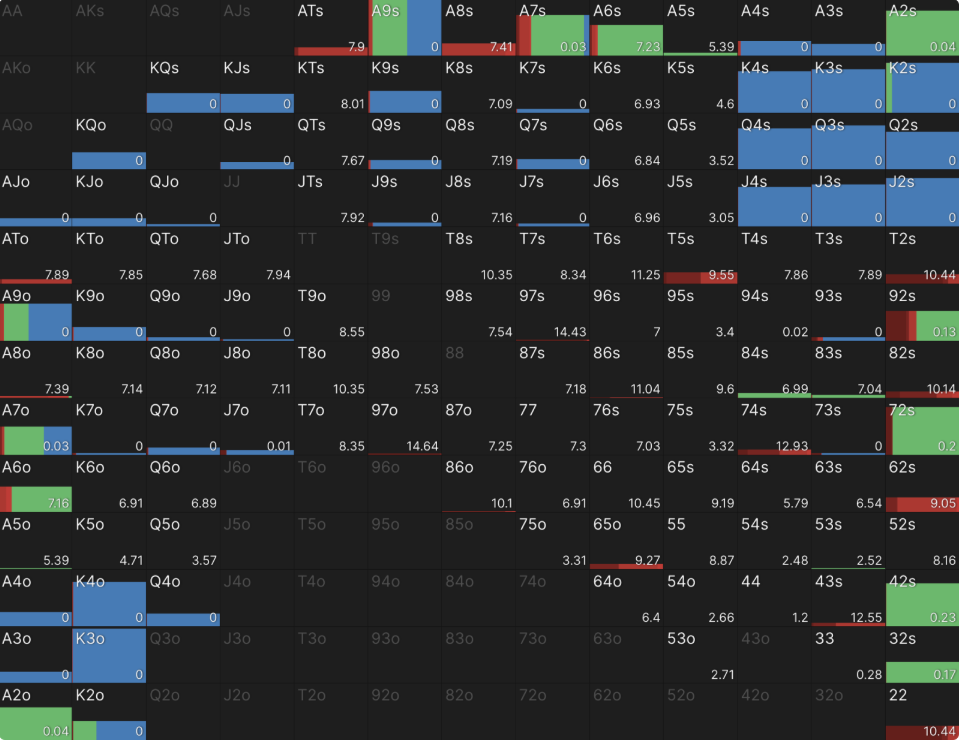
After such a large number of checks, you can expect that CO will be quite thinly vella-beta, after which he will have to call a check-raise with many hands with one pair so that BB remains indifferent to the bluff. Conversely, CO gets profitable bluff if BB checks for the third time. In the chart below, we can see that CO never checks with its worst hands.

In fact, he even bluff with strong hands like the A4, which in about half of the cases can count on winning the pot with a check. However, depending on the suits, he earns at least as much and sometimes more on the bluff. This does not depend on BB checks, but rather on the risk CO took when opening on preflop. After a failed 3bet and going heads-up against BB, CO has a significant equity advantage that they can “cash out” exactly once. This means he can bet at any time and expect BB to fold often enough to make a profit on any two cards. A preflop racer should never wait with a useless hand until showdown against a BB collier.
CO has a significant equity edge that they can “cash out” exactly once.
Such a bluff often makes a profit on the flop in the form of an extended bet, but this is not necessary: CO can also wait on the flop and bluff on the turn or wait on the flop and turn and bluff on the river! Thus, he should never check with a useless hand until the cards are opened. One bluff at any time is profitable. The exception is the case when CO barrelit with any two all streets, it is not very profitable as CO has been collated preflop. CO value value betting is actually less ambitious than BB bet.
This is due to the threat of check-raising and the lack of good candidates for bluff that could balance such a wide range of Velu Betas. Unlike BB, CO does not make a valley bet with a pair of twos or even a weak pair of fives. Although he can be called to worse with a hand, the value of his hand can also be reduced to 0 due to check-raising, so a free showdown is more attractive. BB's value bets are thinner because it doesn't have the ability to complete trades and get a free showdown. Check in any case can lead to the fact that he will be bet from a polarized range, plus he has more candidates for bluff due to a wider range on the preflop.
5. Openrazer vs. cold color
When the preflop raiser remains in the heads-up with cold color, the difference in equity on the preflop is not so significant, and on most flops their equity will be very close. In this example, CO makes a raise in the 40 bb stacks and button calls it.
They both wait for the flop  and turn
 , and then get the
  A-T-5 “rainbow” river sometimes perceived as a flop favoring the open raiser, but in this chart you can see that their range actually interacts with it in quite a similar way:
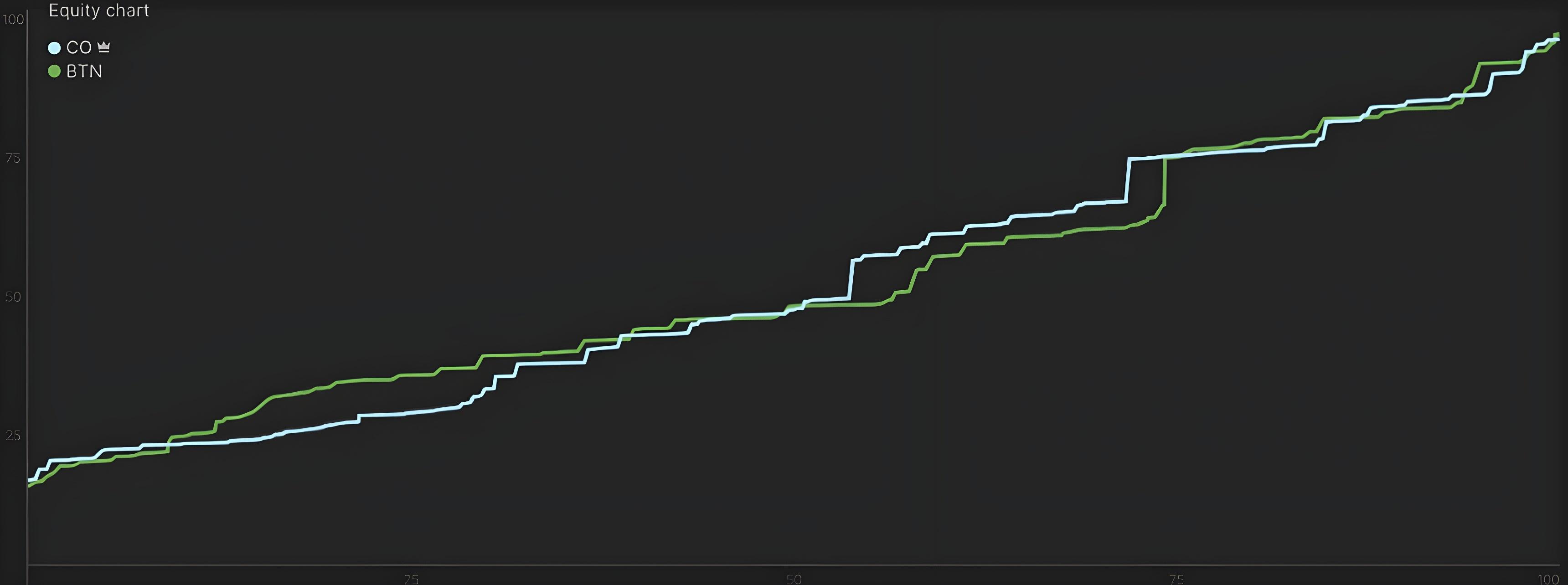
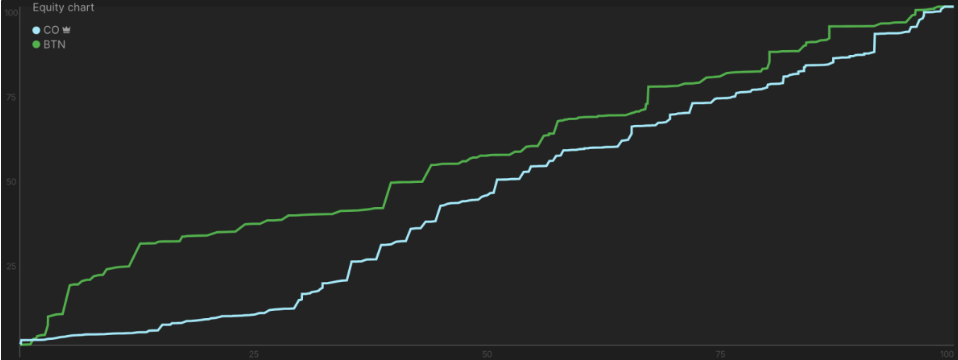
As we saw earlier, checks on early streets narrowed both players' range, but the effect becomes more dramatic for the player in position. When they reached the river after a fairly blank runout, CO now has a slightly stronger and more polar range.
His worst hands are weaker than BTN's worst hands, and his best hands are stronger than BTN's best hands:

This results in CO placing bet based on two considerations: a 77% bet targeting the 10th part of the BTN range and a 21% bet targeting the weaker pair. At the same time, he still needs to reserve a few strong hands for his check range. Most of his bluff is chosen arbitrarily from among the weakest hands and works equally well in any range. Ready-made hands, such as J-J and above, go to a larger bet range, while the valley part of the small bet range consists mainly of 10-x hands plus a few traps. The T-9 works especially well as a trap because it unlocks the Aces' hands that will raise the value.

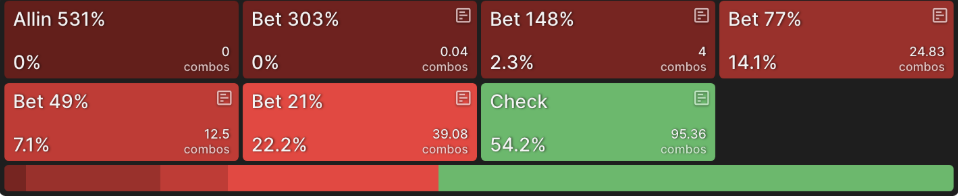
These two bet options correspond to places on the equity distribution chart (the previous chart with blue and green lines), where CO has an advantage on the plot of approximately 25-50% and 70-90%. Their range is more evenly matched in the remaining areas of 50-70% and at the highest level, so we do not see many middle bet or overbets from Co. T-9 and 9-9 are excellent candidates for check-raising, because they will unlock strong Ace's hands with which to bet and to call a raise. For check-raise bluff CO, 9 is very useful.
This move has two objectives:
- Check 9 makes sense at the initial stage, since it has a showdown vellyu in the check check script. Only after the BTN bet does the 9 pair lose enough equity at the autopsy to bluff with it.
- Blocking a 9 is extremely useful in a big bluff (check-raise-all-in of almost 250% of the pot). In order for Button to have a monster arm, he would either have to catch it on the river or wait on the flop and turn. He had very little incentive for such a check, so the only hands they would like to equate the raise with are the T-9 and 9-9, and both of them improved on the river. At the same time, if you yourself have a 9, the likelihood of improving the BTN on the river is significantly reduced, and, therefore, the likelihood that you will be called is also reduced.
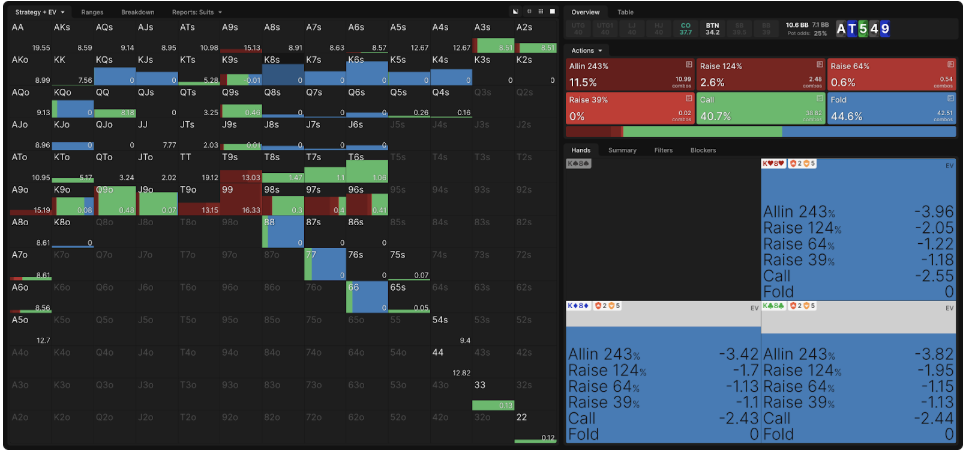
As in the previous scenario, the player in the position puts not so subtly on the value as his villain. While CO as a whole still puts or checks with Q-9 and J-9, and BTN strictly checks these hands.
6. Playing on a dynamic river
All of the above suggests a relatively blank river.
- For example, the river
 will be much more profitable for BTN
As a result, CO invests less money in the pot. Basically, he checks or puts block-bet and almost never puts more than half of the pot.

BTN bets more frequently and on average bet larger bets.
In the graph below, you can see how a small bet is preferred as a thin vellya bet, stronger hands mostly prefer a larger one, and the strongest hands that unlock CO checkraises make small bet as a trap.
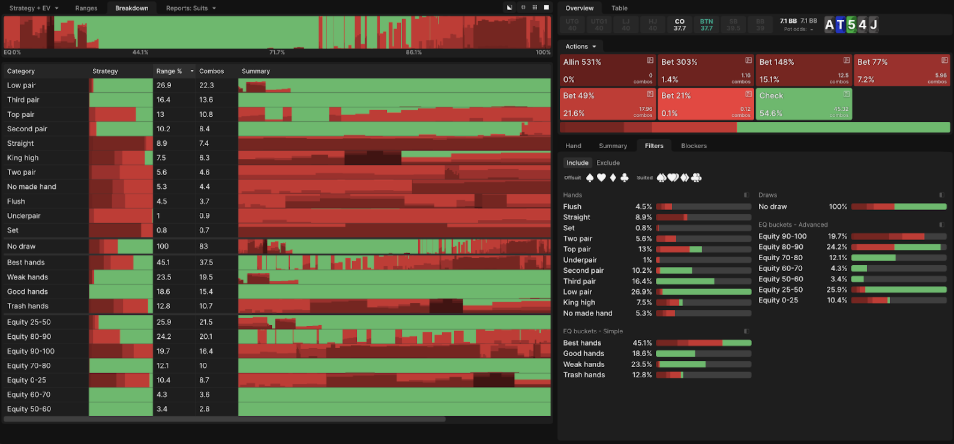
When you're bluffing with a showdown valley, either play big or go home.
(go BIG or go HOME - a catch phrase in poker)
7. Conclusion
Similar considerations apply to bluff: you have to be careful to determine which are your weakest hands. Since no one shows much strength, the best unpaired hands often have significant value at autopsy and thus become poor candidates for bluff.
While with the worst odd hands, it is advantageous to bluff even with a small sizing, since it is enough to force them to fold only the worst hands of your opponent to achieve their goals. If you're going to bluff with stronger hands, it should be a medium or even big bet, especially if your own range is less than your opponent's.