


Translated by order of the educational portal university.poker
Original source: GTO Wizard
At the beginning of the 20th century, the Italian economist Vilfredo Pareto noticed a curious pattern when studying land ownership in Italy. He found that about 80% of the land is owned by only 20% of the population. This observation prompted him to further research, and it soon became clear that the open Pareto principle manifested itself in many other areas of life and business.
1. Pareto Principle
The Pareto Principle, or the 80/20 Rule, is an economic theory that only when you learn about it will you begin to notice in all areas of life, including poker.
The principle states: Approximately 80% of the results are due to 20% of the causes.
Since the discovery of the Pareto Principle, countless cases of 80/20 distribution have been identified, including:
- In languages: 20% of the most commonly used words make up 80% of all words encountered.
- Microsoft reported that 80% of bugs and crashes in Windows and Office are caused by only 20% of bugs.
- In the US, about 20% of patients consume 80% of hospital resources.
- 80% of environmental pollution comes from 20% of all factories.
- A friend of mine, who owns a restaurant, said that 75% of the ordered dishes are burgers, although they make up only 20% of its menu.
The allocation does not have to be strictly 80/20 and the total amount does not have to be exactly 100%. There are other ratios, such as 75/25 or even 90/10. The Pareto principle is most often manifested in those areas where the result depends on previous actions. In such cases, we observe an uneven distribution.
- For example, the accumulation of wealth is a dependent process: a person starting with a lot of money can invest in his education, which increases his future income.
Additional funds will allow him to receive more favorable banking conditions, and so on. But tossing a coin is an independent process. The outcome of the next roll does not depend on the previous one, so over time, the results will obey the normal distribution, and not the Pareto principle.

→ The under-invested in Fat Tail
→ Most people focus their time, energy and attention here
→ Normal distribution aka Bell Curve
Entrepreneurs, analysts, and business gurus use the Pareto principle to identify and exploit uneven distributions.
- For example, if a business owner finds that 80% of their revenue comes from just 20% of customers (such as middle-class men in their 40s), they can focus marketing on that audience, as they have already shown a willingness to buy. If 80% of your productivity falls on the first 20% of the working day, it is logical to plan the most important tasks for the morning.
Pareto principle in poker
In poker, you can find many examples of uneven distribution:
- Approximately 80% of your profit is likely to come from 20% of your opponents – namely, recreational players.
- Poker rooms published statistics that only about 15% of players are positive, which is also an example of a not very clear division of 80 to 20.
Approximately 5% of all players are “big winners”, and only 1% of them earn serious money depending on their bet. This is an uneven distribution within an even more uneven distribution, in another uneven distribution… Over the years of observation, it turns out that 80% of the rake generates 15% of the players. These are the players who win on large volumes, not those who regularly deposit and lose (most likely, they contribute more than 80% of all money to the ecosystem). I've seen these statistics directly from online poker operators, but you can see something similar if you look at the winners and losers in your hand database. If you have a large database of hands, you will also notice that the bulk of your profit will come from 20% of your hands (i.e. 20% of the strongest hands in the game) (e.g. UTG opening range). Within this range, the top 20% of these hands (e.g. JJ+, AJs+, AQo+) will make the most profit.
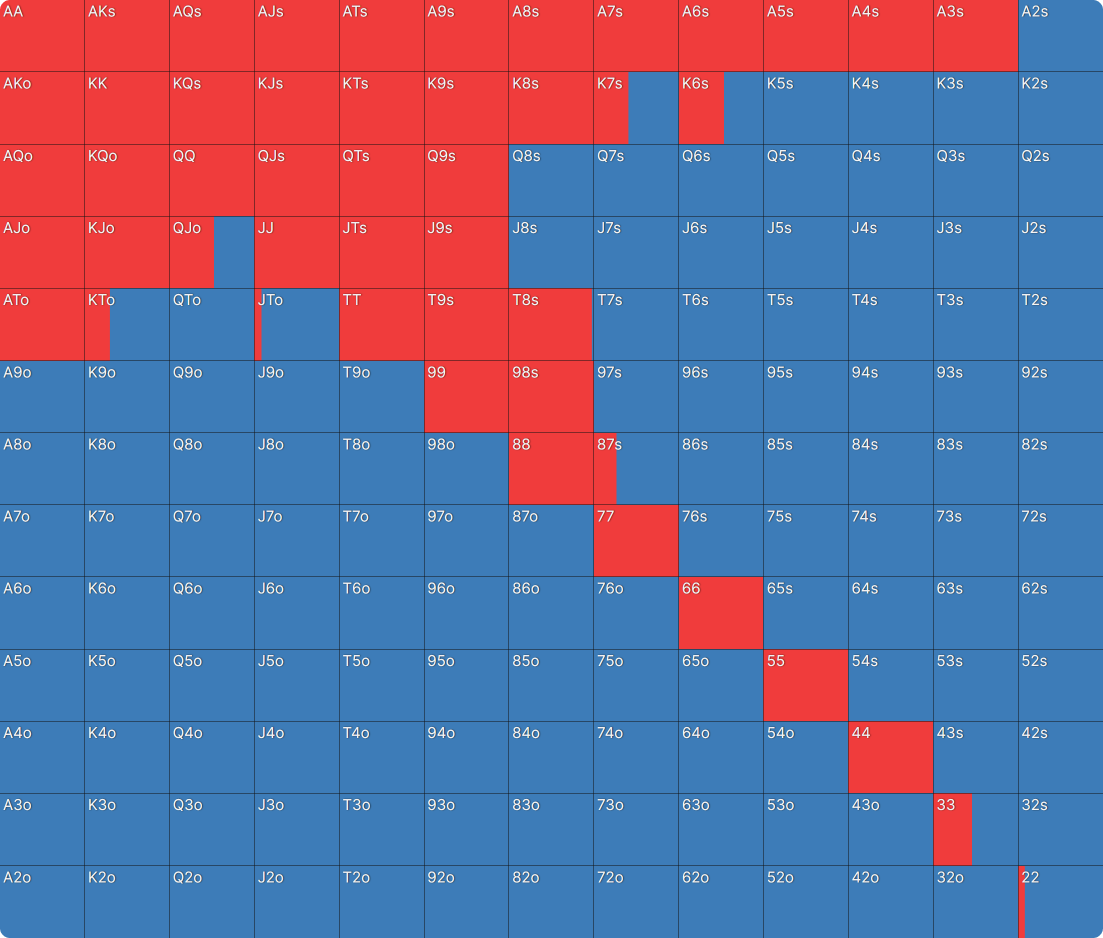


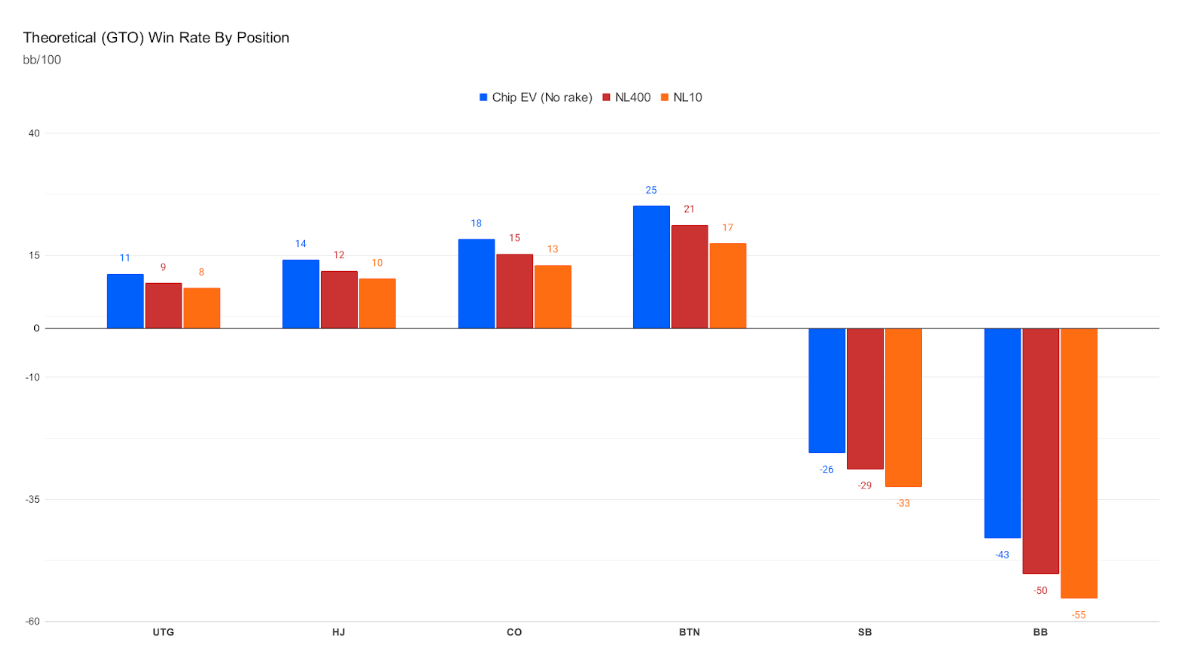
In order to understand how uneven and shifted to the top this distribution is, it is enough just to look at the EV of the hands in the GTO Wizard for the aforementioned range. In the above example, AA yields an average of 10.05bb, while a hand like K8s yields only 0.01bb. If you look at your large database of hands, you will notice that AA brings you much more, then KK and so on. A very small number of hands make up the bulk of your profits. Another reliable uneven distribution can be found if we consider your profit by position.
For example, you are likely to lose money from blinds, while BTN and CO positions are likely to make up the bulk of your profits.
The Pareto principle gave me a reason to share, perhaps, my favorite video from Tombos21. In this video, he shares his Spot Matrix, an incredibly useful tool. It shows the most important post-flop scenarios that need to be explored in order. This is based on both the frequency of their occurrence and the average size of the pot.
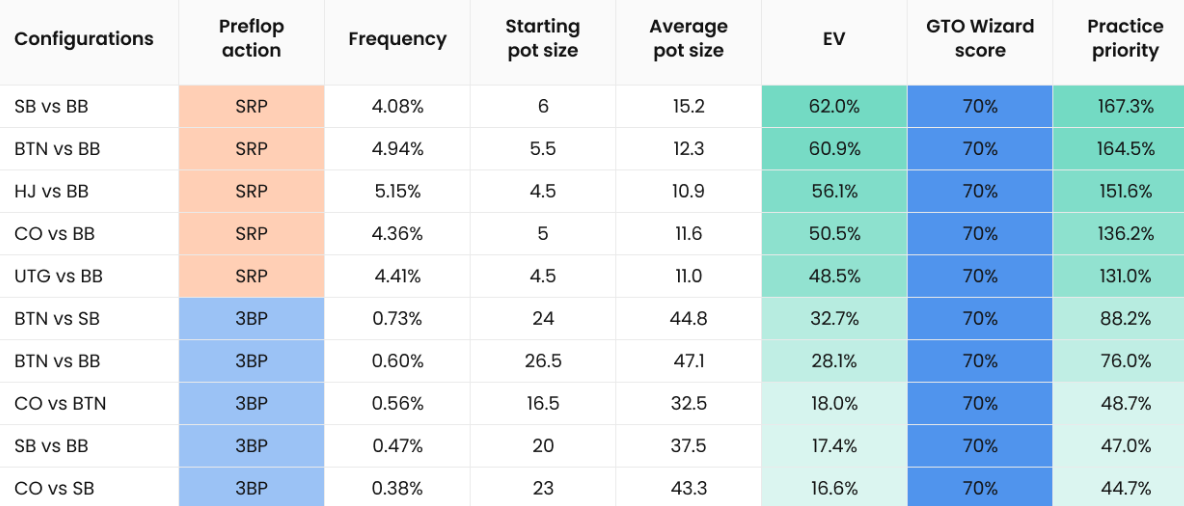
- Example from the video: SB vs BB in single-raise sweat is the most valuable situation in poker, because there are often situations in the tournament when there are no early and even middle positions, but there are always SB and BB. That is, it is in these positions that important single-raise sweats will often unfold, and therefore it is worth paying more attention to these situations. The idea is to raise your GTO Wizard rating for this situation and then move on to the next one, which will be BTN vs BB.
If you're not sure where to start, the most common situations in this table are a great place to start. It is tempting to study the UTG vs UTG1 situation in a 3-bet pot where you have recently received a cooler, but such hands are rare and often played by themselves. It will be much more useful to know how to play the second pair on the K82 flop in the BTN vs BB situation in the SRP, because there will be many similar situations on the tables, and the lessons from this game can be applied in real practice. The situations listed in the table account for 32.74% of all heads-up poker situations. However, single-raise sweats against BB account for 22% of the total number of heads-up situations, and they are all prioritized in the table. This looks like a Pareto distribution. 22% of heads-up poker positions make up the most important area to study. Going forward, WB vs. BB is the number one priority in training, and this situation is 20% of the SRP vs. BB subgroup. The Pareto distribution within the Pareto distribution...
Thus, you can use the Pareto principle in poker by training the single-raise potts against the BB.
2. The Principle of Matthew
A relative of the Pareto principle is the principle of Matthew or the principle of cumulative advantage. This is the tendency for success to lead to greater success. Hence the famous saying “the rich get richer and the poor get poorer.” The name comes from Matthew 25:29:
For to everyone who has will be given, and there will be a surplus, but from the one who does not have, even what he has will be taken away.
The principle of Matthew explains PKO tournaments through the principle of “preferential attachment”, where wealth is distributed depending on how much a person already has. We've all seen real examples of this. Rich people can often borrow money at low interest rates, and their wealth increases with compound interest. The poor, on the contrary, are considered higher risks on loans and, as a result, can borrow money only at inflated interest rates. They often find themselves on the negative side of compound interest because they are in debt. Simply put, Matthew's principle explains “favorable” and “unfavorable” cycles.
Matthew's Principle of Poker
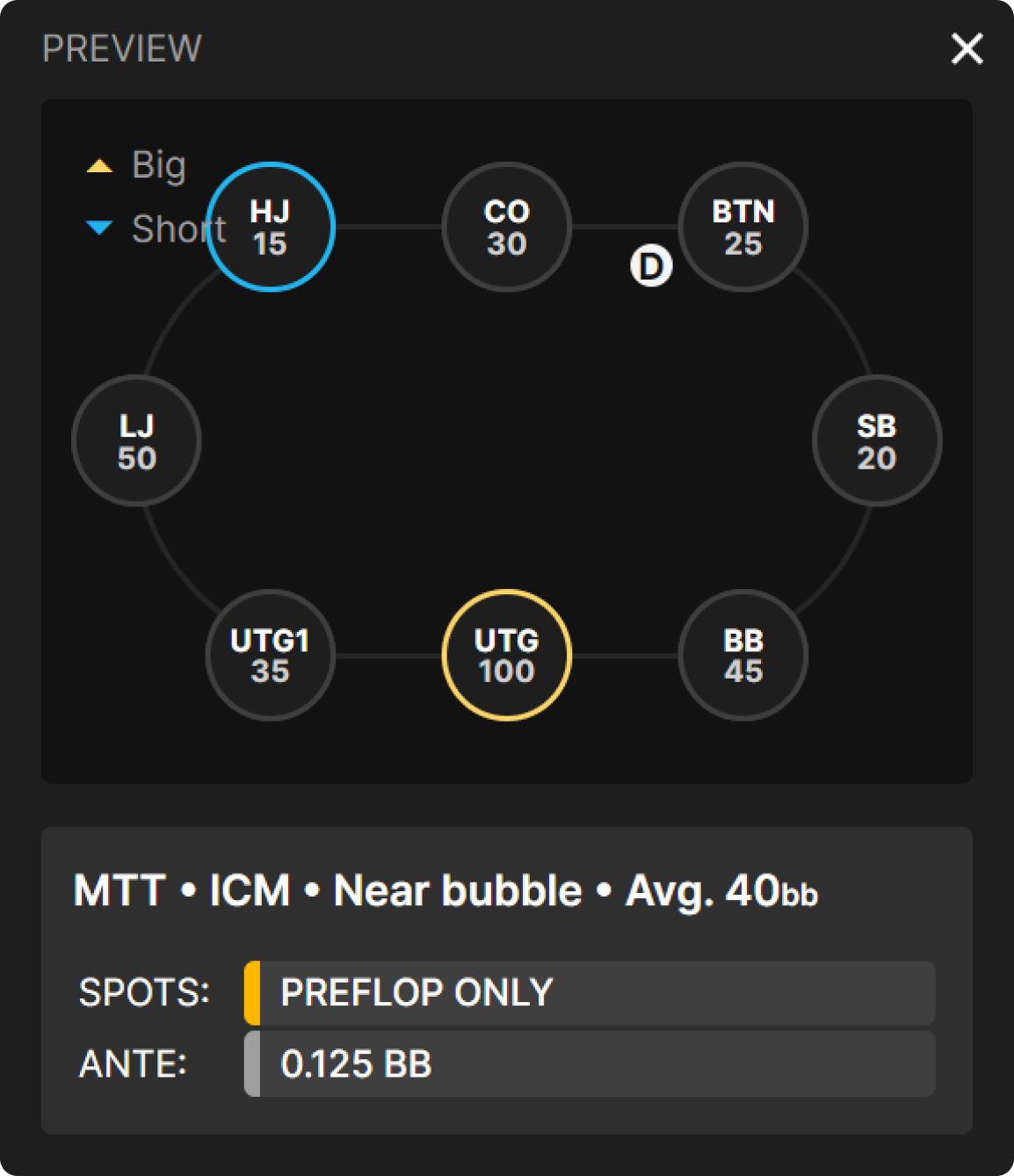
We see many examples of Matthew's principle in poker. In particular, the best players in the world play at Triton tournaments, where there are more recreational players. The best of them are even invited to Pro/Am (professional/amateur) games, where 50/50 amateurs and professionals. The level difference between a player in a Triton tournament and a professional playing in $5k tournaments may be small, but the earning potential is much higher for players like Stephen Chidwick. The opposite of this is micro bets, which are difficult to get out of because the rake is high and there is not enough money to justify expensive training courses or tools. There is also a version of Matthew's principle in the game itself, which is manifested in the ICM advantage of the chip leader. Consider these three situations around bubble when the average stack size is 40bb. Let's focus on how changing the UTG stack size affects its opening strategy.
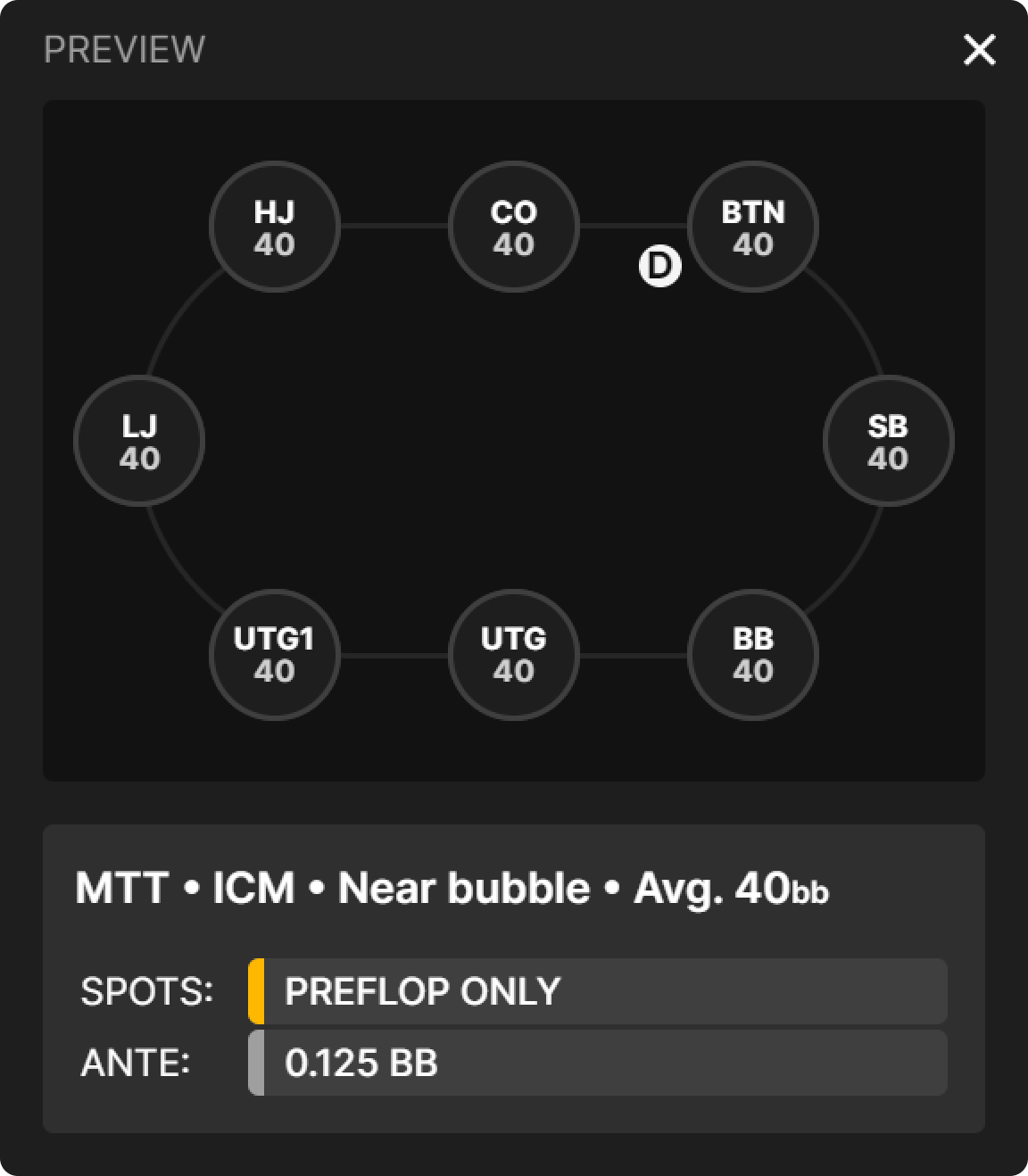

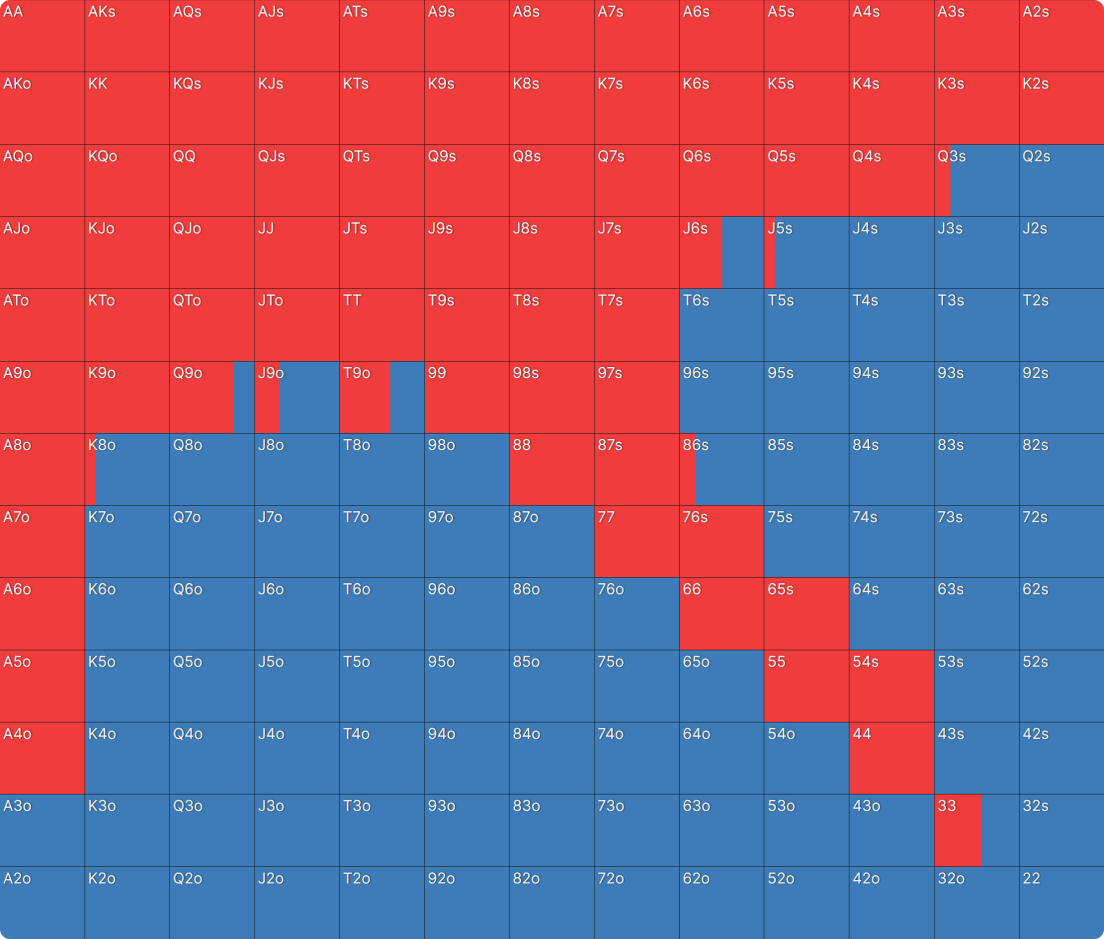
In the first situation, each player has 40bb. This is the UTG opening range:


This is also a prebubble situation with an average stack of 40bb, but UTG now has 100bb:

And finally, another bubble situation with an average 40bb stack, but now UTG is a short 16bb stack:

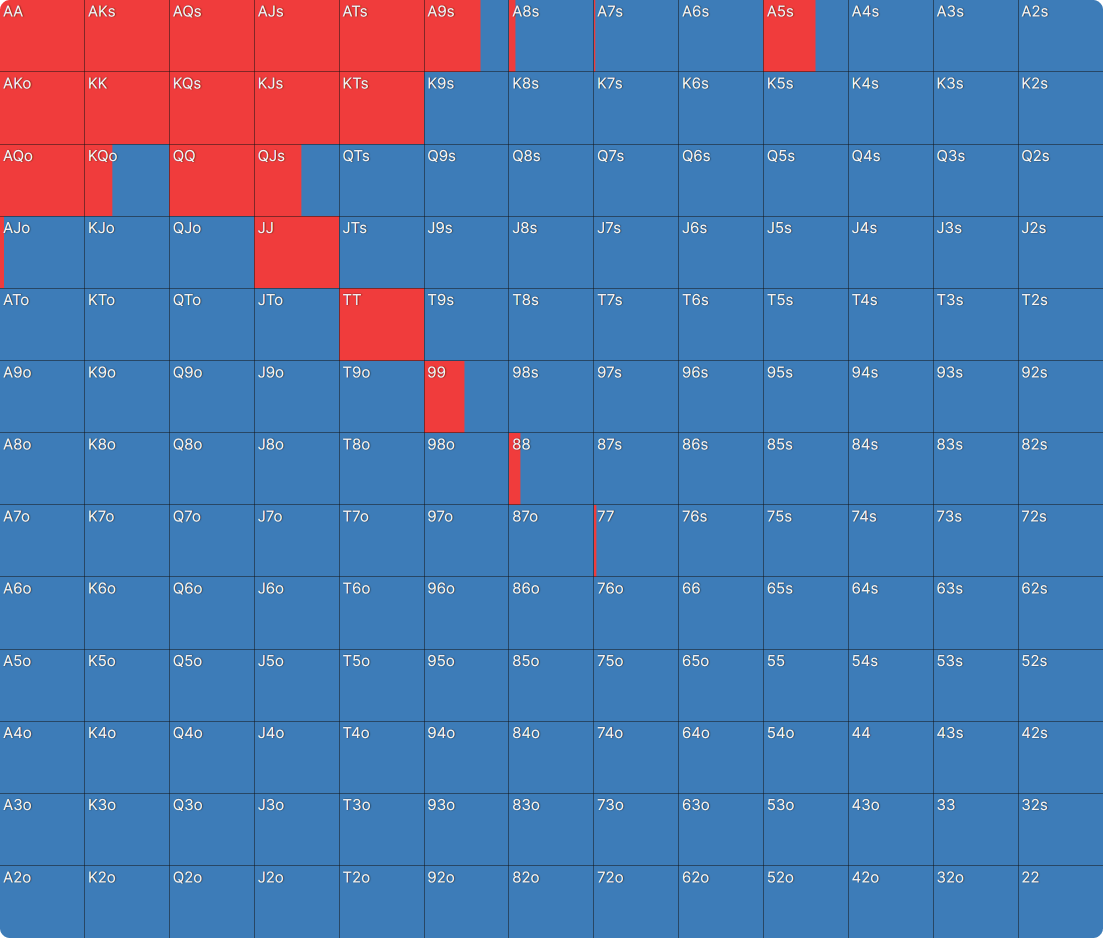
If we consider the opening range, when everyone has exactly 40bb, as the “base” range, then, as you can see, being a chip leader, you can play a lot more hands with profit compared to this base range. We increase the range from 16.5% of the hands to 35.8%, which is more than twice the base range. The chip leader can open from an early position using a range more similar to the range of the middle position. Similarly, being limited to a short stack, the UTG can only cast 7.4% of the hands — less than half the base range. This is not a perfect example, because the stacks of other players also affect the strategy. But in general, in tournaments, the presence of a large number of chips leads to even more chips.
The chip leader gets a cumulative advantage, and the short stack, on the contrary, faces cumulative difficulties.
3. Conclusion
The Pareto principle states that most of the results are created by a small part of the actions. The principle of Matthew explains how an advantage leads to an even greater advantage, which is why a small group of people gets most of all the results. The common denominator of both principles is the uneven distribution of results. If each event is independent of the previous one (for example, flipping a coin), then the results will have a normal distribution. If the next action depends on the previous one, then the distribution will be uneven.
Pareto principle in poker
From a poker perspective, the Pareto Principle clearly shows that some aspects of the game are much more important to learn than others. For example, prioritizing the study of single-raise sweats SB vs BB will do more good than parsing rare 3-bet sweats UTG vs UTG1.
Matthew's Principle of Poker
The Matthew Principle, among other things, explains why some players succeed quickly while others get stuck in place. In poker, success usually leads to even greater success: access to larger and softer games, more learning opportunities, backing, and backing contracts. If you have a large base of hands, try looking for your own examples of Pareto distribution. Once you become aware of this principle, you will notice it everywhere. It's like seeing The Matrix in the real world.