


Translated with the help of AI. We apologize for any errors and would appreciate your help in correcting them.
In today's article, we will look at the confrontation of the Big Blind (BB) against Button button. BB vs BU is the most common and important spot in poker. This is where the lion's share of the total winrate lies. When playing in the big blind, we lose the most money compared to playing in other positions. Our global goal of playing on BB is to lose as few chips as possible, since it will still not be possible to earn on this position. That is, in fact, it turns out some kind of confrontation between two polar positions: the most profitable versus the most unprofitable. Nevertheless, the player on the BB has the possibility of an interesting counterplay. We will talk about them today.
1. Main preflop exploit BB vs BU
We start implementing our maximum exploit plan BB vs BU from preflop, which in itself is quite logical. Against Button, the most profitable (but not the most obvious for many) is 3-bet on a really wide range! I like something around 18-20%. Now let's think about what such a range can be made of.
I note that the greater the percentage of hands you put in the range, the more opportunities for variability in its filling.
- A little more detail: when I need to throw a couple of percent to the range valley 3bet (which is less than 5%)
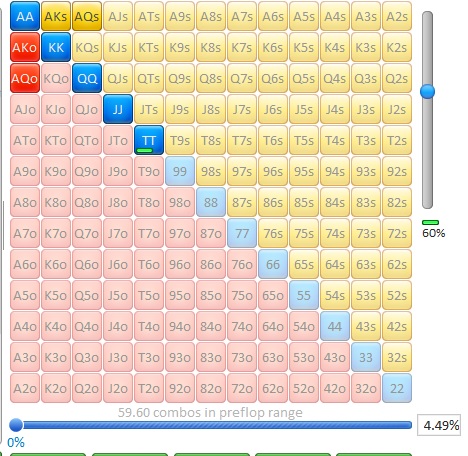
It is enough to add some part of the hands with blockers on Ah and Kh, which will work effectively.
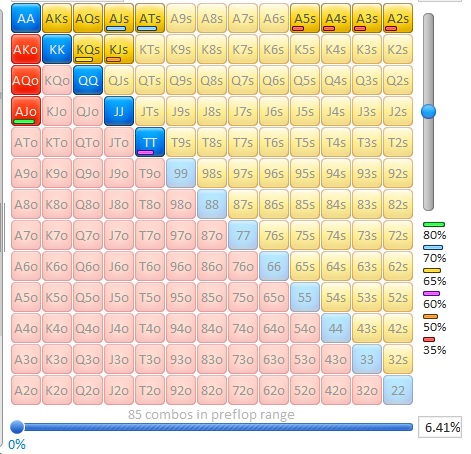
But it's different when we want to add 14-15%! The task is serious and, obviously, it is not necessary to expand the range solely at the expense of Ah and Kh hands; in our range there will be, as they say, a little bit of everything.
For clarity, let's highlight some groups:
- Hands with blockers.
- Crafty and offsuited broadway.
- Pocket pair (almost everything from small to premium).
- Connectors (preferably suited).
Now let's take a look at what we got.
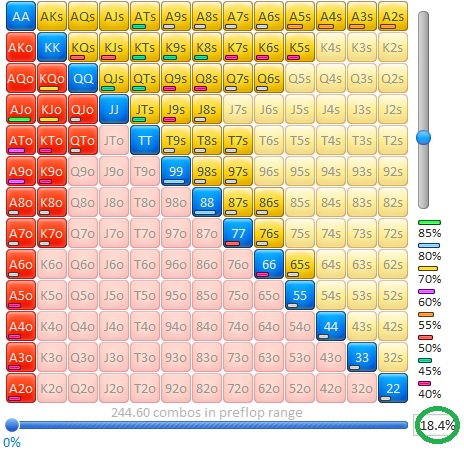
Many players do not want to 3 bet on such a wide range. As a coach, I would like to dwell on this in more detail. There are some fairly ingrained opinions that I will try to refute.
- Opinion No.1: A lot of hands on BB, we will just play a call, it is profitable, that is, in terms of chances. Rebuttal: We will never win a call hand here and now, as a call never generates fold equity for your opponent. Of course, the call option in the model of my understanding of the game does not disappear anywhere, even with a high percentage of 3bet, you will still defend most of the hands in this way.
- Opinion #2: If you 3 bet too often, it will create problems and generally reduce the expected value from the game.
Rebuttal: It is important to understand what position you are 3-betting against.
See how the opening ranges grow (as a percentage):
- EP 12-16%
- MP 17-22%
- CO 32-36%
Smoothly expanding range.. a-ha, it's up to the button!
- BU 55-60%
I think now all the questions will disappear. Such a wide range of 3 bet should also be widely used, and it will be profitable.
2. Positional edge
Obviously, in the situation we are interested in (BB vs BU), we will never have a positional advantage over our opponent. Therefore, we most often want to 3 bet with a fairly hard sizing, about 3.7 to 4 times the size of the open rate. In very deep stacks, you can even choose 4.5-x and 5-x sizing. Thus, BU, which already opens extremely wide, will not be able to profitably protect a huge number of hands against us. Those spots in which we will have to play post-flop, we will have a fairly standard model of the game with the initiative and the advantage of the aggressor on our side, that is, play from c-bet most boards and continue to barrel turn or give up depending on the released runouts.
3. The main ideas of post-flop
Let's take a look at an ordinary razhennyi pot and talk a little about our prospects in it from the BB side. I would like to focus the readers' attention on the drawing lines. A line usually implies a certain set/sequence of actions. That is, just cbet is not a line from the word at all.
- A line is a bet flop and a bet thorn.
- A line is a bet/check/bet or bet/bet/bet.
And when you play a raise/check on the flop, it's definitely a line too. Let's talk about this in more detail.
Suitable checkraise board BB vs BU
There are several types of boards that are great for possible BB check-raises. When I talk about a suitable board, I mean a board in which your opponent will not have a visual advantage over you, and even better if you have this edge. In other words, we want to drive to the board, which in general will suit us well (on the big blind). Let's look at 3 types of such board.
Low structured board
- As an example, let's take a board:


On such a board, with our check-raise, we will be able to represent a lot of things! In the cold call range, BB has both very strong ready-made hands (small sets, many doppers and a nutshell straight with a hand of 6-4) and draw hands of various strengths (from A-2 and A-4 gatshots to strong Ax-type combo draws in clubs).
Paired board
Here I would like to draw attention to several nuances. In fact, a paired board can be both dry and highly structured.
- For example: let's compare the board.


 and
and 


In the first case, we are dealing with a very dry board. There are no street and flash-forming combinations, there are no draw textures. Also, always pay attention to which card has paired and how many such cards are in your opponent's range as well as yours. For example, the button has fewer twos than cards of a higher denomination (for example, sevens, eights or nines).
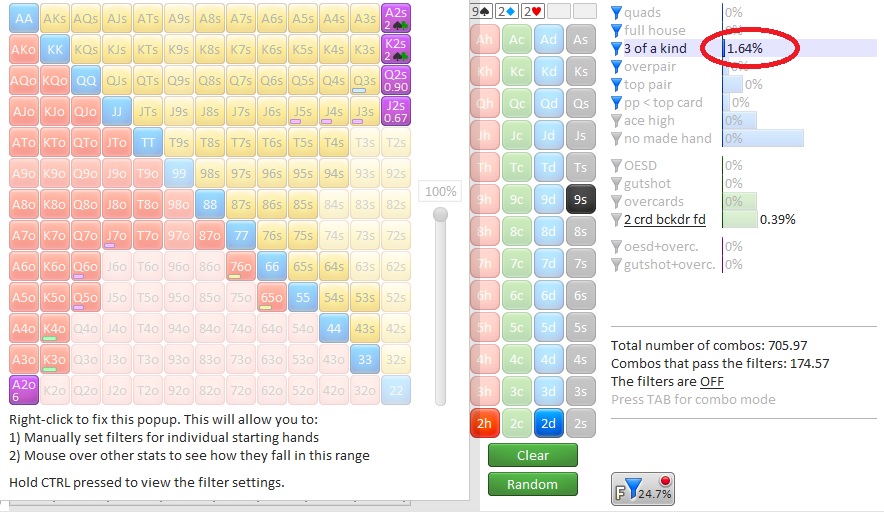
You, on the contrary, can represent virtually any potential thrips with your check-raise, simply because BB protects any two master cards trips. The second type of board is radically different. We have a paired and well-structured board, suitable for a huge number of draw hands. This is, so to speak, a double-edged board, where both your range and Button's range fall well visually.
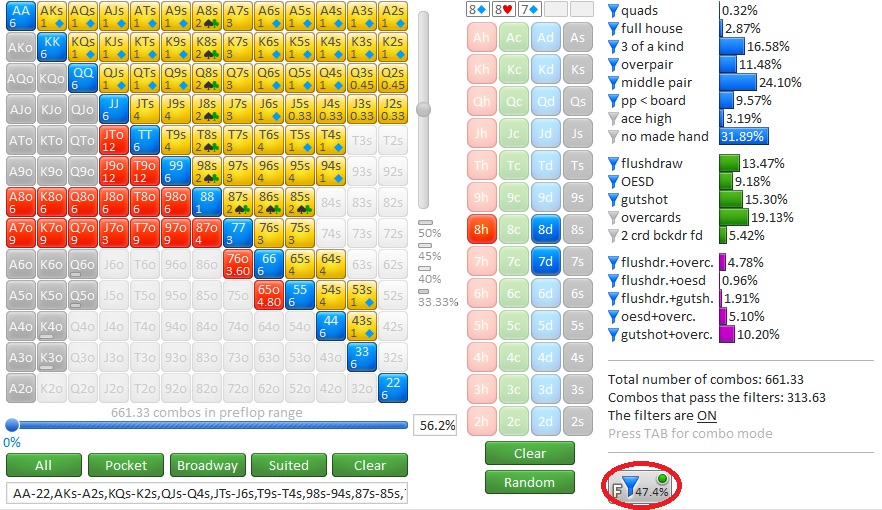
As can be seen from my illustration above, Button clings to such a board in more than 47% of cases, and this despite the fact that I removed from the possible range of his protection against check-raising with BB all over cards (of course those that do not contain flush draw) and backdoor flush draw. However, when playing in the depth of 40 bb+, even such hands may not fold on the check-raise. Therefore, I like the check-raise on the board from the first example much more. Yes, in modern realities, button, having over cards to the “rainbow” board also may not fold. But in most cases, without increasing in strength, it will be easy to give up. This is also important to understand when planning a check-raise on the flop. We quite often want to put, as I call it, a control finishing for most thorns.
Dry board, two low cards + one high
First of all, I would like to start with the nuances, and there are several of them. First, this type of board I want to check-raise with a certain weight, since if we check-raise always, in the aggregate we will have too high a percentage of check-raise, which may affect the effectiveness of this technique as a whole. Now let's consider technically such board. The most suitable board is a dry Q-high board.
- Let's take this texture as an example:

As a rule, after waiting on such a board, we will always receive a traditional small cbet from Button. Let's see how the range of its opening gets into such a board. At first sight in the opening, Button has quite a few Q-x hands as can be seen from the illustration below.
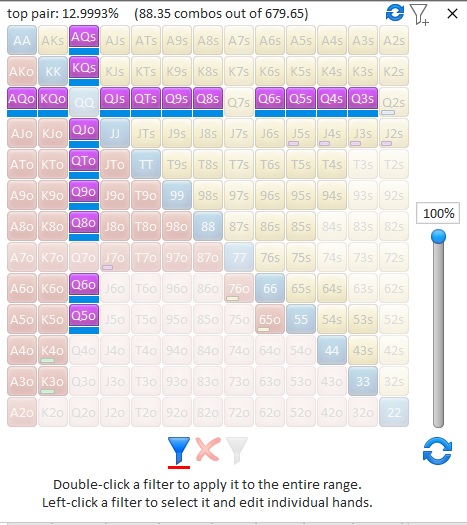
But. Given the overall percentage of its discovery – it's just a drop in the bucket! We will put all the sets, dopers, over pair, top and middle pair and over cards in his range of protection against our check-raise, which, by the way, will be limited only to combos with the AK hand and even after all this, it is 34.6% in total.
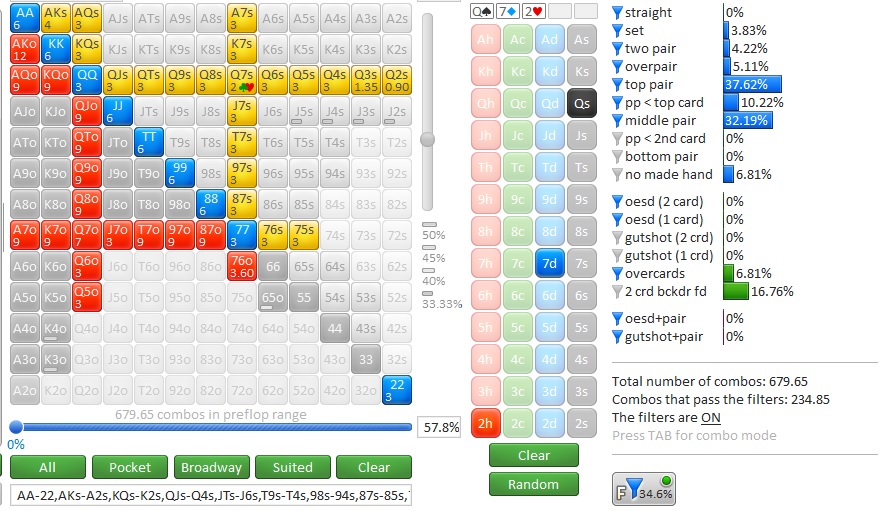
An exceptionally wonderful move! Now let's see what changes there will be if we put a king instead of a Queens in a similar board.
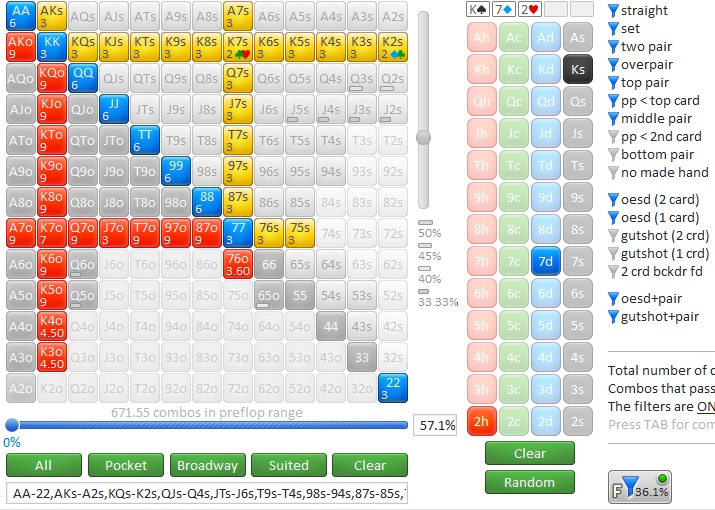
36.1%! This very slight change in hitting the board is due only to the fact that Kx hands are slightly larger in this button opening range. And still a lot of hands do not get into such textures. And here's an example with an ace.
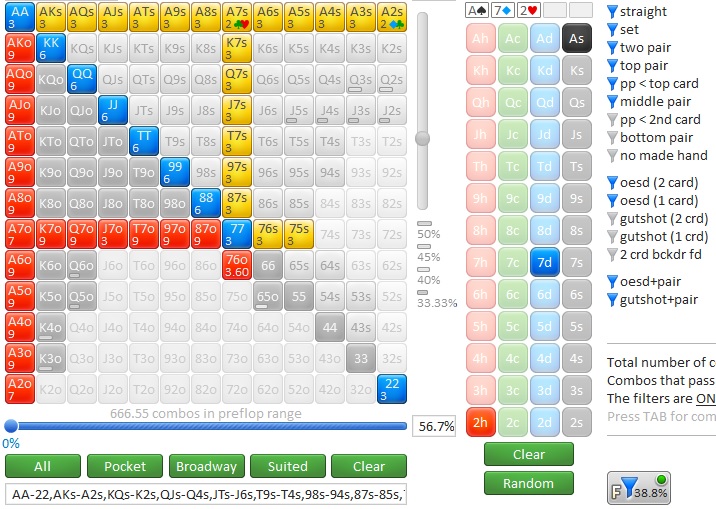
It is possible that many people will be skeptical about the option of check-raising on the A-high board. Of course, button doesn't just have a lot of hands, he has them all. However, what do our metrics tell us? That's right, 38.8% of hands that are willing to resist in response to a check-raise from BB. The main idea of check-raising on such boards is not that Button does not have the highest card in the range that forms the top pair on such boards. The idea is that in addition, its range is extremely wide, which means that it can be perfectly exploited, which is what this article is devoted to.
Which hands should be played with check-raise against Button button
Now that we've talked about the appropriate flop textures, let's think about which hands we want to check-raise? Of course, I want to consider situations when we do not have nuts. With nuts, we will also check-raise, while protecting ourselves from possible crossings and getting worse off our hands.
The most important thing I would like to convey is that I will rarely check out on a suitable board with absolute air. That is, I still want to have some equity to improve my hand.
Let me give you some examples for a better understanding.
- Board:

Perfect check-raise with a hand 
 We have a gutshot, as well as a backdoor flush draw to the worm. Also, the worm ace plays like a nuts flush draw blocker.
- Board:


Let's say we check-raise with a small pocket pair of type 5-5. This is an example of a hand with a very low equity, but we actually have a ready hand, and with our check-raise we simply protect our “pocket”. In the case of a call from an opponent, about once in 20 we will collect a set, and in 9.1% we will see either a four or a six, which will give us an additional equity in the form of a gatshot. In cases when button has an inconvenient stack (say 20-25 bb) and the matter will occur in the late stage of the tournament, you can check-raise the opponent even with full air, since fold equity in such situations is often much higher than in the early stages of the tournament. Actually, a big percentage of the opponent's folds will compensate for the lack of live equity in your hand.
Thorn donk as an alternative to flop check-raise
The full line of the draw is as follows: you are on the BB cbet cbet check/collite from Button on the flop and donkeys on the turn. This newfangled trend appeared not so long ago, and from my observations I can say that at the moment the field has no "immunity" to such a wave. Let's look a little deeper. Let's go back to the example above.
- On the board , we have all the prerequisites for a profitable check-raise.
However, let's consider another possible branch of the giveaway: you just call. Now think about how many runouts you can use to make a great donk of a thorn? There are a lot of them. This is any Paired board, any flash card, as well as 4, 6 and 8 cards, which give four cards to the straight. That's as many as 26 runouts! However, you can go even further and add any 2 or 9, since these cards do not particularly enhance the button range, which counterbet the flop.
In some cases, they will certainly suit our opponent, for example, any 2 in the example above will close the gutshot for the A-4 hand, but it should be understood that such hands are also in our check/call range on BB. So, it turns out that we have more than half of the deck perfectly suited for such a heap! Of course, the question arises, and what to do if there is a completely inappropriate runout for the Don on the thorns, such as non-flash A or K? The answer is obvious: just give up, go to the check/fold. Your game should be not only aggressive, but also thoughtful, and your active actions are used when they are technically beneficial.
4. Conclusion
In this article, we saw how many possibilities a technically competent game on the big blind against Button can contain, although at first glance you would never think of it. I wish you success at the tables and not only in the New Year!