

Translated with the help of AI. We apologize for any errors and would appreciate your help in correcting them.
Translated by order of the educational portal university.poker
Article by Barry Carter, original source: GTO Wizard
Progressive Knockout (PKO) tournaments are much harder than traditional MTTs. The fact that players are interested in making highly dispersed decisions for the sake of receiving rewards often hides how complex these decisions can be. One area where players have difficulty in this regard are multipots. In tournaments like this, where there are a few big rewards at stake, it is often right to place bet that seems wild, whereas in normal tournament formats it would be unprofitable.
1. How much we can expand to win multiple rewards
Most of the equity in PKO tournaments comes from multipots, where you have the potential to win multiple rewards (bounty) and/or many chips. Unlike regular MTTs, where pots are usually played one-on-one, in many handings of knockout tournaments, three or more players voluntarily deposit chips into the pot. Probably the best way to illustrate this idea would be this, perhaps, interesting moment in PKO tournaments — the very first hand. The first hand in a progressive knock-out tournament is unique because it is the only time all players cover for each other. Thus, everyone can win someone else's reward, and theoretically everyone can win all the rewards at the same time. If you have read our article about the Bubble Factor, you should be familiar with this image, which represents the Bubble Factor and the Risk Premiums of everyone who is in PKO in the first hand.
The
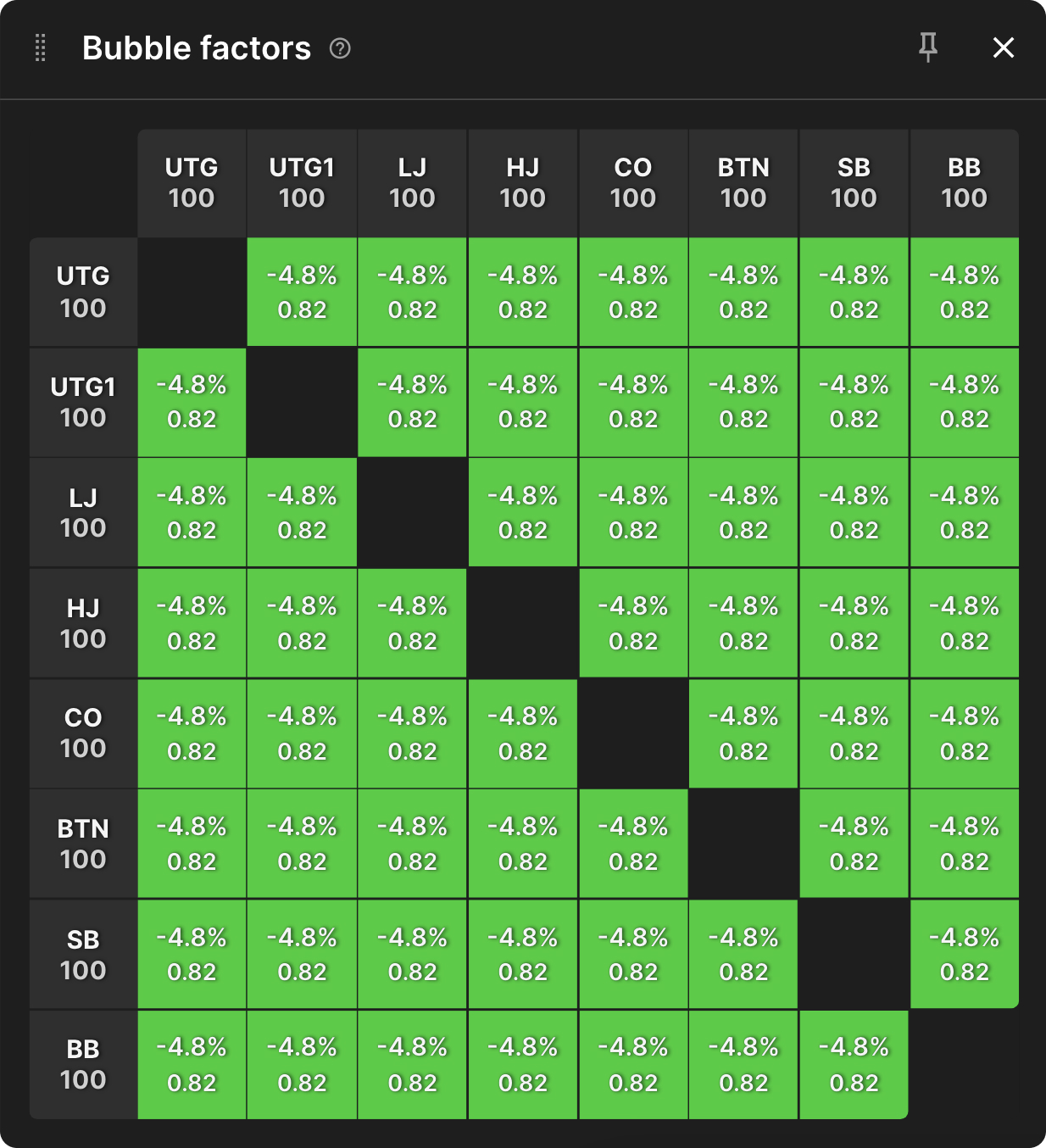
bubble factor does not fall below 1 in normal MTTs and the risk premium is never negative except in PKO tournaments. From a layman's point of view, this means that you are often interested in investing your money more widely than the odds of the ChipEV pot model in PKO dictate.
This is because you win four types of equity when you knock out a player in PKO:
- You win prizes according to the payout structure of the tournament, as in regular MTTs.
- You make an immediate profit by winning a reward.
- You increase the future of equity in the form of an increase in the reward for your own head (which you can realize only by winning the tournament).
- You win equity in the future because you increase your chances of getting more rewards by covering other players.

Since the benefit of winning a hand in PKO is greater compared to regular “vanilla” tournaments, you have an incentive to play more loose, especially in multipots, where there is a chance to win several rewards. We can demonstrate this with a simple example. This is SNG's first non-PKO hand with six players. Everyone starts with 10 BB, 1st place gets $66.66, and 2nd place - $33.34.
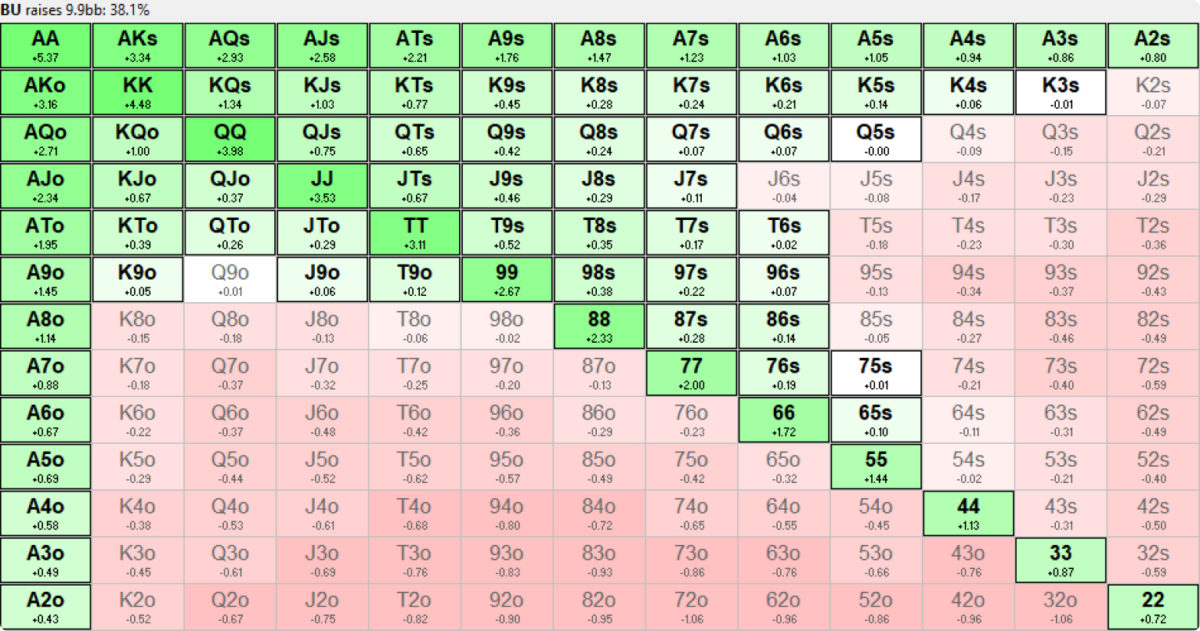
BTN fires 38.1% of hands with the following range:
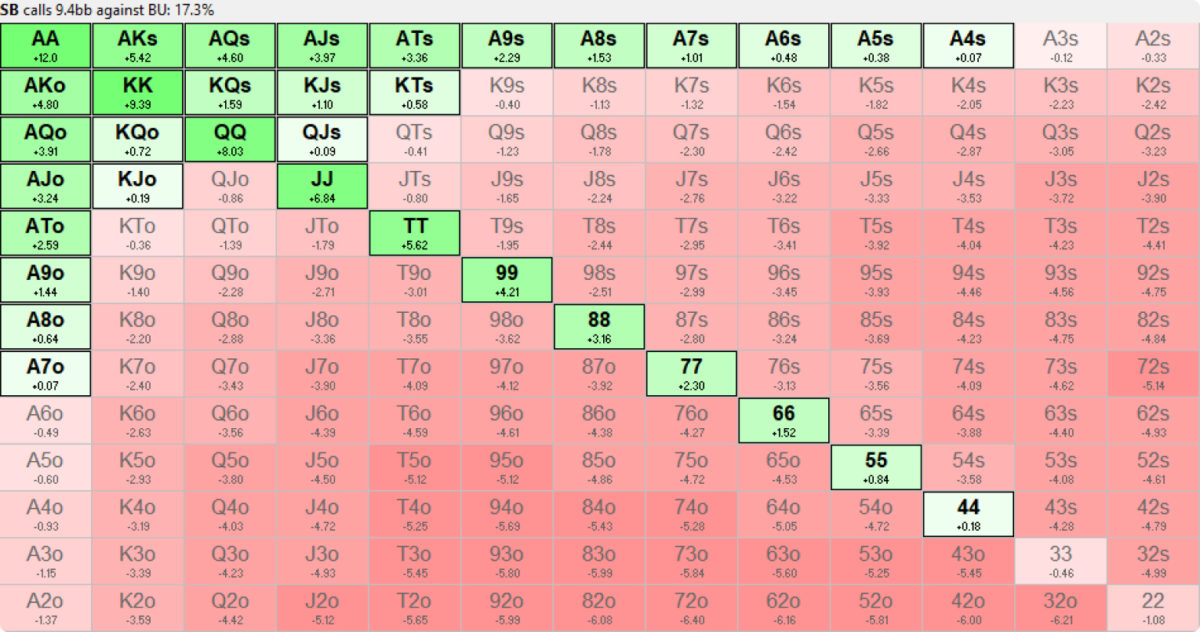
When BTN goes all-in, SB collides with 17.3% of hands with this range:
When SB is colliding, BB makes an overcall with only 6.1% of the hands, with this range:
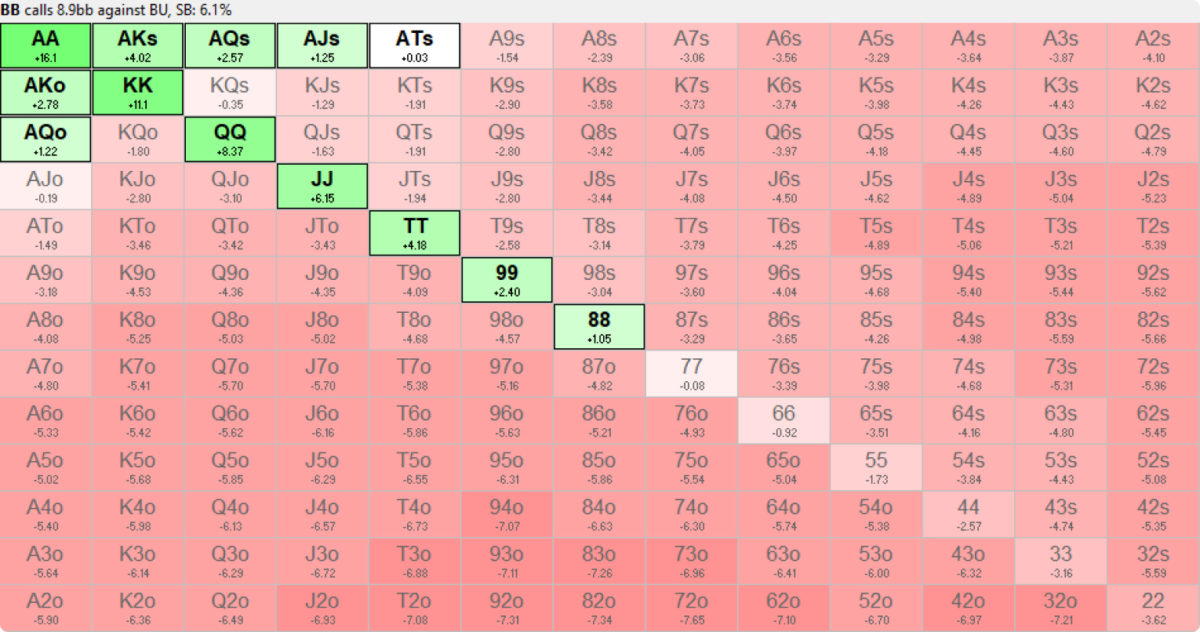
Not surprisingly, SB calls much more tight than BTN, and BB calls much more tight than SB calls. Let's now change the payout structure to PKO SNG. 1st place gets $33.33, 2nd place gets $16.67, and everyone gets a progressive reward of $8.33. The tournament starts with 10 BB starting stacks and let's go back to BTN again.
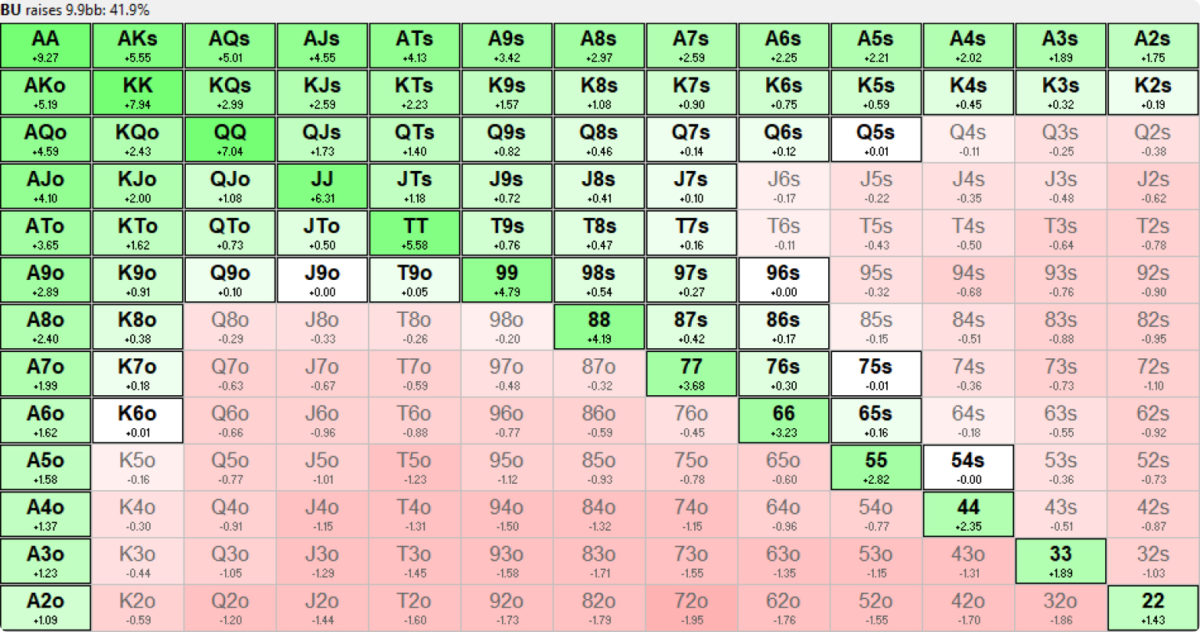
BTN fires 41.9% of hands with the following range:
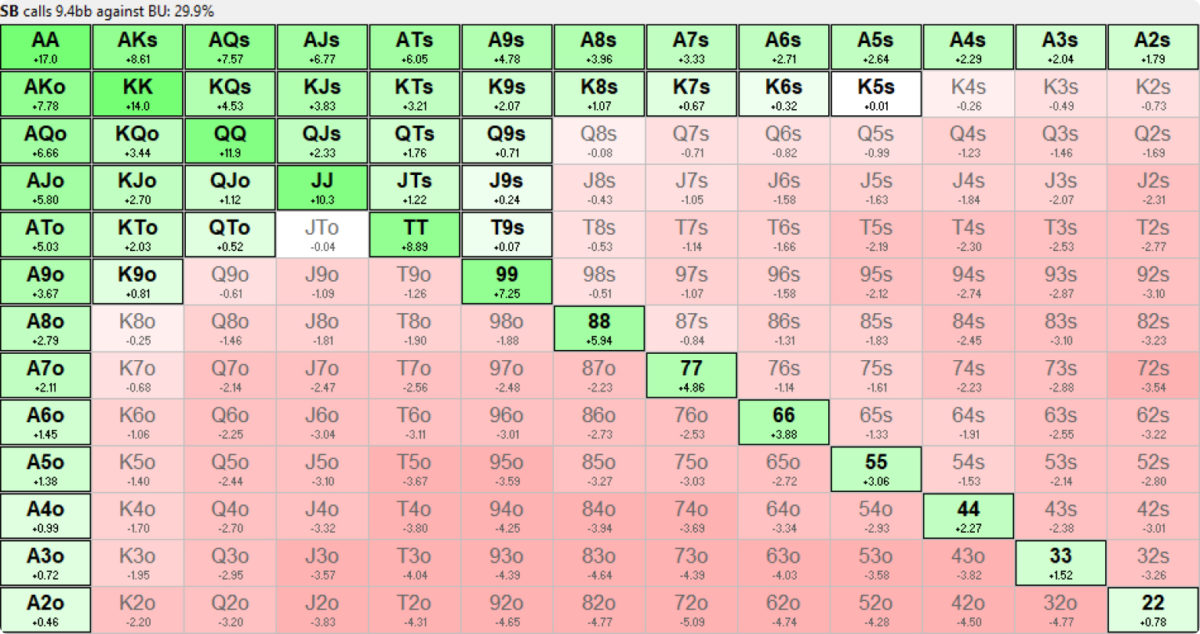
SB collates 29.9% of hands with the following range:
Finally, when both BTN and SB all-ins go, BB makes an over-call of 27.3% of hands with this range:
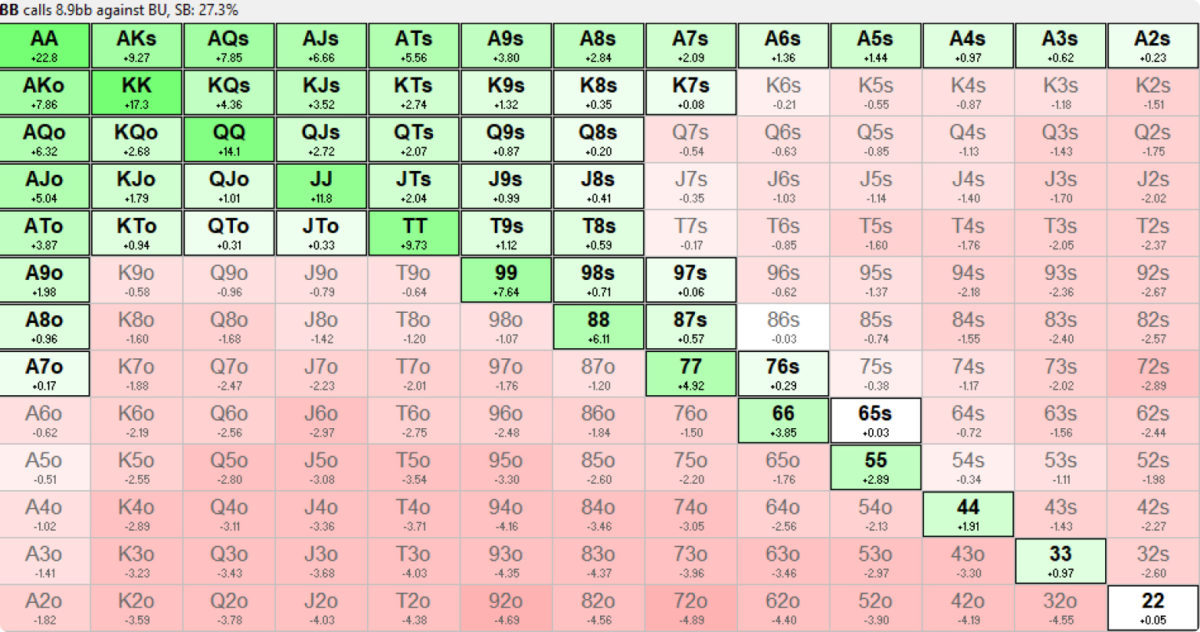
The most obvious thing to note is that the range is much wider. BTN scares a little wider in the PKO example. SB collicates with twice as many hands as SB in the example without PKO. The BB makes an overcall with six times more hands than the BB in the no PKO example. Another thing to note is that BB is collation as broad as SB after SB has collation. This is because in regular MTTs the range becomes more secretive when multiple players go all-in due to ICM, but the prospect of winning multiple rewards means that it is possible to call much wider.
These examples highlight some important knowledge about multipots in PKO
- Range in multipot all-in banks becomes wider, more loose, not more tight.
- The more players you cover with your stack, the wider your range should be.
- It is important to understand which hands play well in multipots in PKO tournaments.
PKO is such a complex beast that it can never be truly calculated.
The solutions available in the GTOWizard PKO database are just sample examples. You should not try to remember them, because one small change of variables (increase or decrease of one stack, increase or decrease of one bounty) can completely change the strategy. Instead, try to analyze them yourself and try to extract a deeper understanding of the essence.
2. Which hands play well in multipots
Once you understand how much wider you are able to call PKO, the next important skill set is to understand the types of hands that play well in the multipot. Earlier this year, I won the PKO leaderboard by knock-out count, and I attribute my success solely to understanding which hands work best in multipots (and, of course, win well!). We know that certain classes of hands are better played in multipots in the ChipEV model, for example, suited connectors, but what if we also take into account ICM factors related to rewards and payouts?
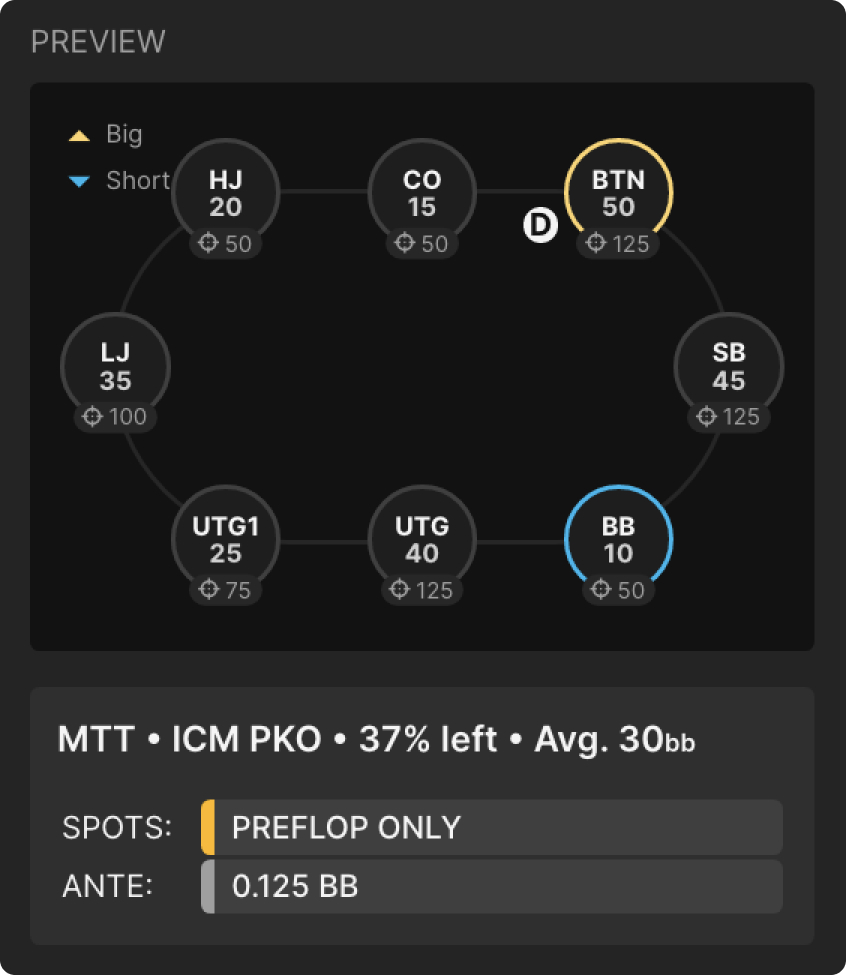
- In this example, UTG (the third largest stack) opens, and CO (bounty $50) pushes 15 BB. Everyone folds to BB, which has 10 BB and bounty $50.
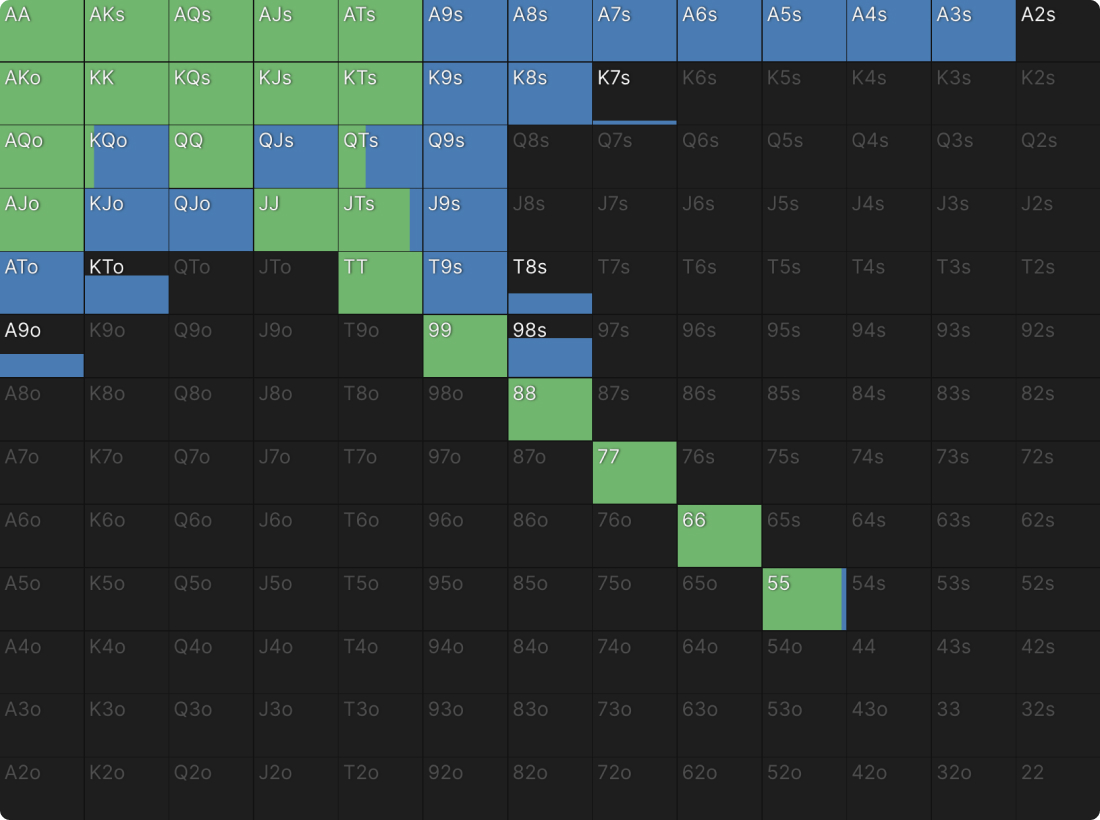
First, let's look at the call range for UTG if BB falls off.
Here's what the range looks like to win 13 BB and also a $50 bounty:
Now let's see what UTG will do if BB with 10 big blinds also goes all-in.
Which means they play for two bounty and an extra 23 BB:
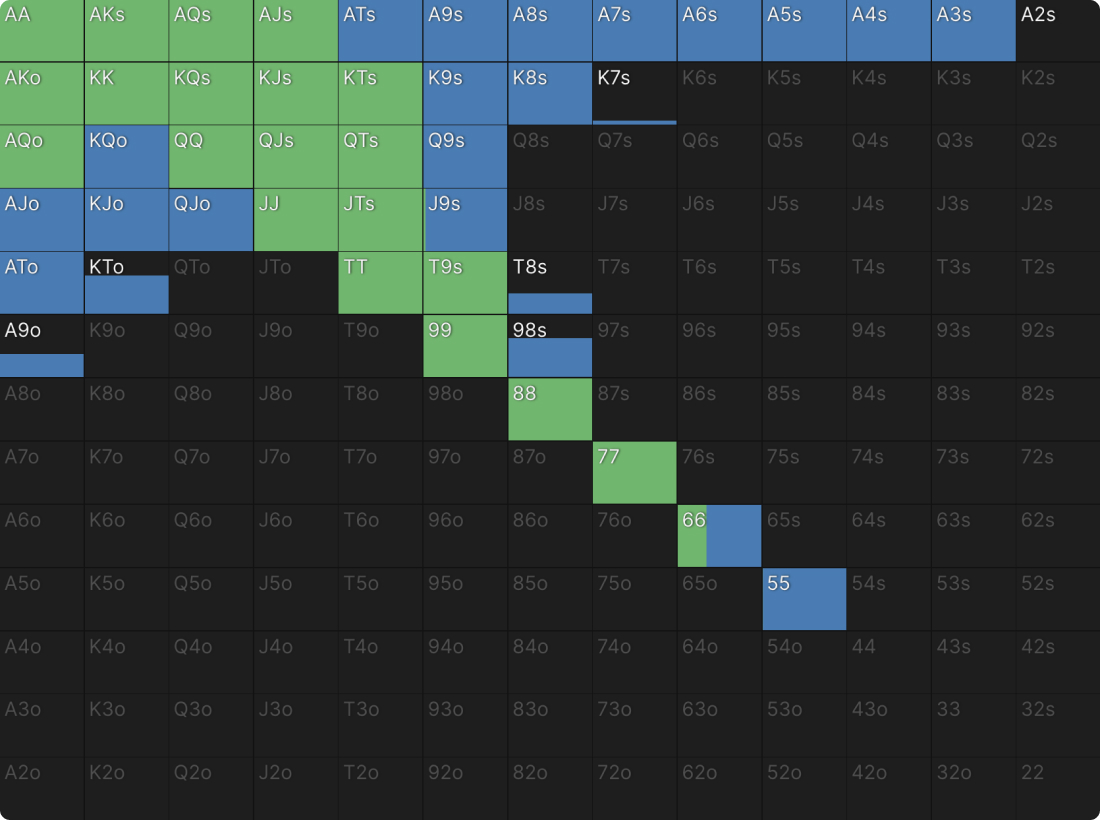
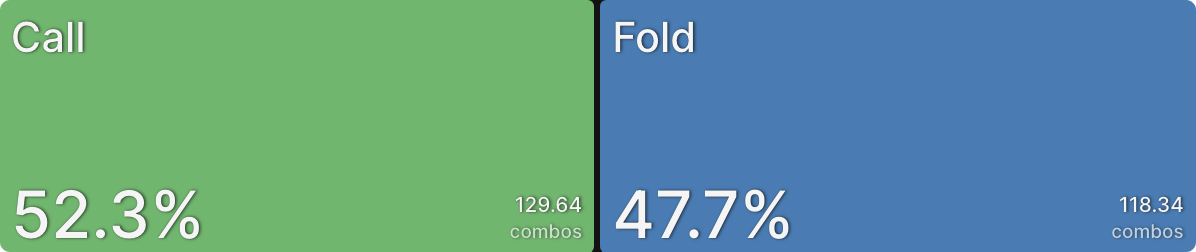
This is a little more of a Tight range, but UTG still collides almost half the time. Look at the call range, what do you see? With almost the same percentage of hands as in the previous example, the shape of the range changed. The weakest arms were removed from the previous range, but some arms were added. AJo, ATs, KQo, and 55 no longer collide, but curiously, QJs, QTs (with greater frequency), and T9s were added to the call range. The overall range has decreased, but certain hand classes have been added due to it being a multipot. QJs and T9s seem much “weaker” than AJo and ATs, but not in multipots with ICM pressure and knockout rewards.
You will very often notice that in PKO, unlike regular tournaments, suited broadway hands become more valuable.
These hands work well in these spots because they are quite resistant against the few wide ranges you encounter in PKO.
- A hand like QJs is often good when it is a single pair.
- It blocks strong hands like AQ/QQ/JJ.
- She can pick up a strong hand such as a straight or flush when she is behind.
In the example, we looked at the estimated GTO range. You can expect the range of your opponents to be much wider in the real PKOs you play in. Then the suited broadway arms will be even stronger in them. This is because your hand will work well not only for the above reasons, but also in addition: sometimes it won't even need to improve. Maybe not with QJs, but quite often it happens that you put up a stack-off with a hand like KTs and find yourself playing against K9s and JTo. More often it happens when you have the shortest stack in the hand, when you are a player who can not win bounty. Players will call you much wider to win bounty when it doesn't cost them relatively much. That is why in such situations you will often see hands like KQs-JTs, but not hands like 54s or 87s. Small suited connectors work well in sweats with a deep stack in position, but not when all the money has gone yet on preflop.
3. You cover a player with a bounty, but you are covered by another player
The most difficult situation in PKO is when a player with a short stack pushes from an early position, and you have a medium stack. Sure, you want to win the bounty, but you're also afraid that the larger stack that's between you will want to outrun you.
The general advice here is:
- Ring your strongest hands, such as AA (as traps).
- Collead hands that play well in multipots, such as KJs (and sometimes collead if you're bullied).
- Shoot strong hands that don't play well in a multipot like AKo (to try to put 1 on 1).
- Call other profitable hands, but dump them on 3-bet.
- In this example, UTG1 triggered 18 BB jammed. CO has a 66 BB stack, but there are a few players left behind that cover both UTG1 and Co.
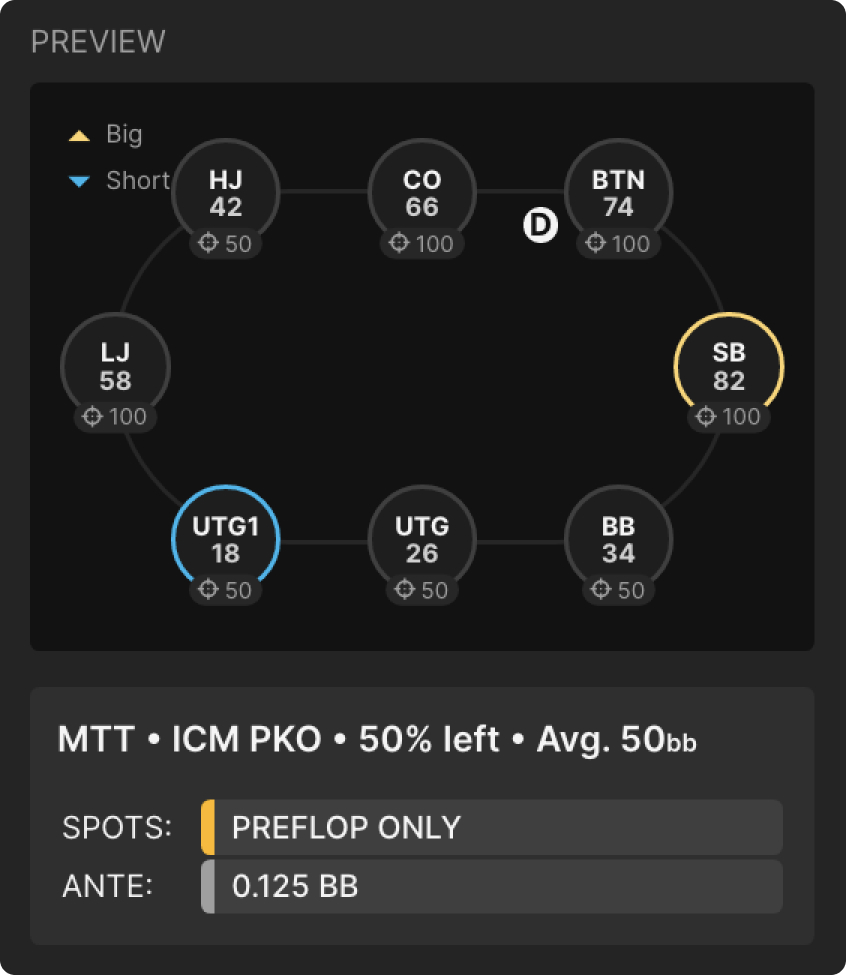
Here's how they respond:
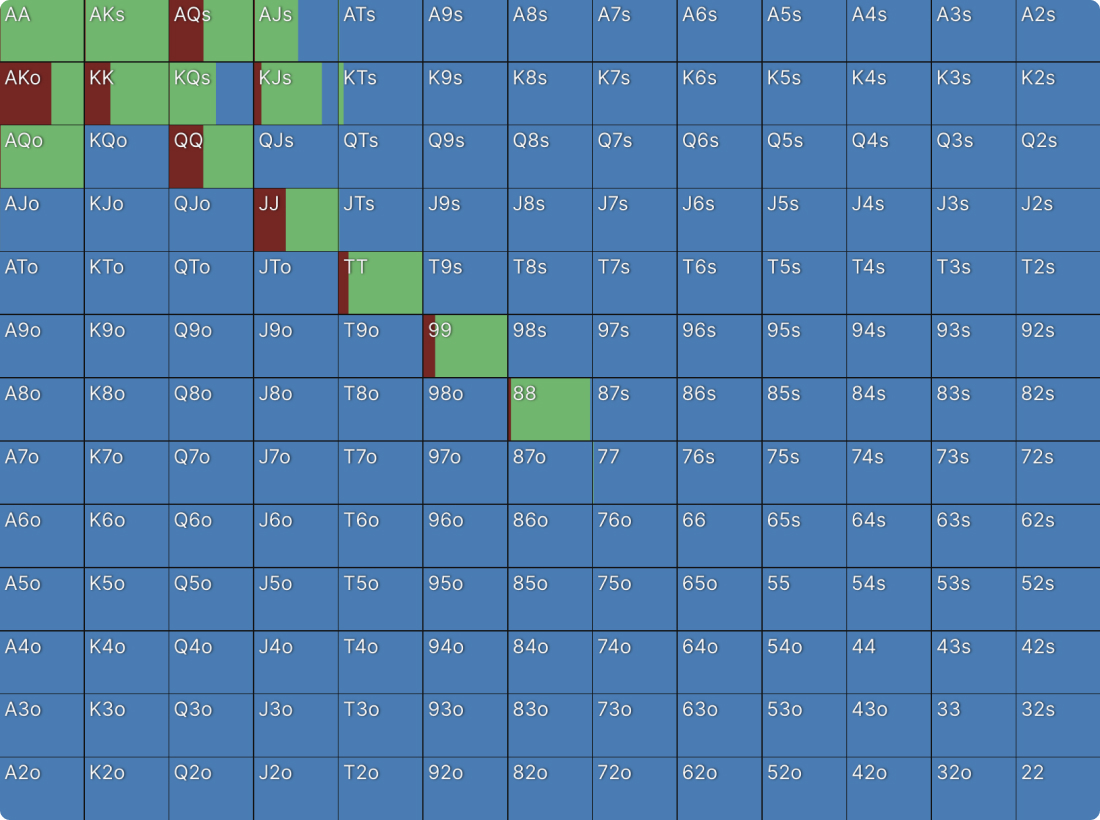
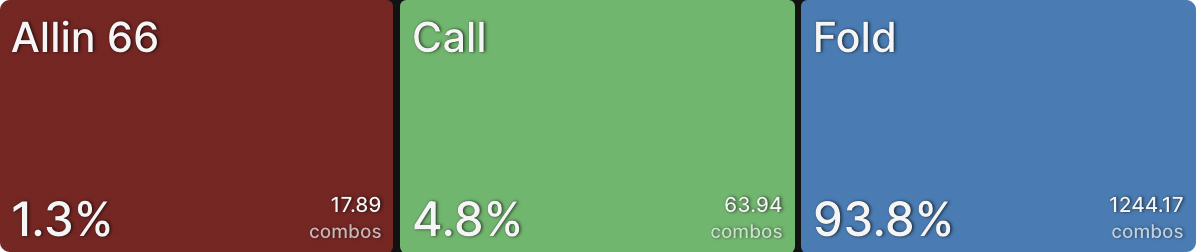
As you can see, the strongest hands, such as AA and KK, set a trap (more often they just call). Suited broadway arms like KJs and KTs just collide because they work well in multipots. AK and AQs go all-in, as do a bit of JJ and TT, because they are very strong hands, but they play best against one opponent. Hands like 99 and 88 are strong enough to call, but they will fall if a big stack comes into play.
This is what the CO response would look like if an SB with 82 BB were to bully:
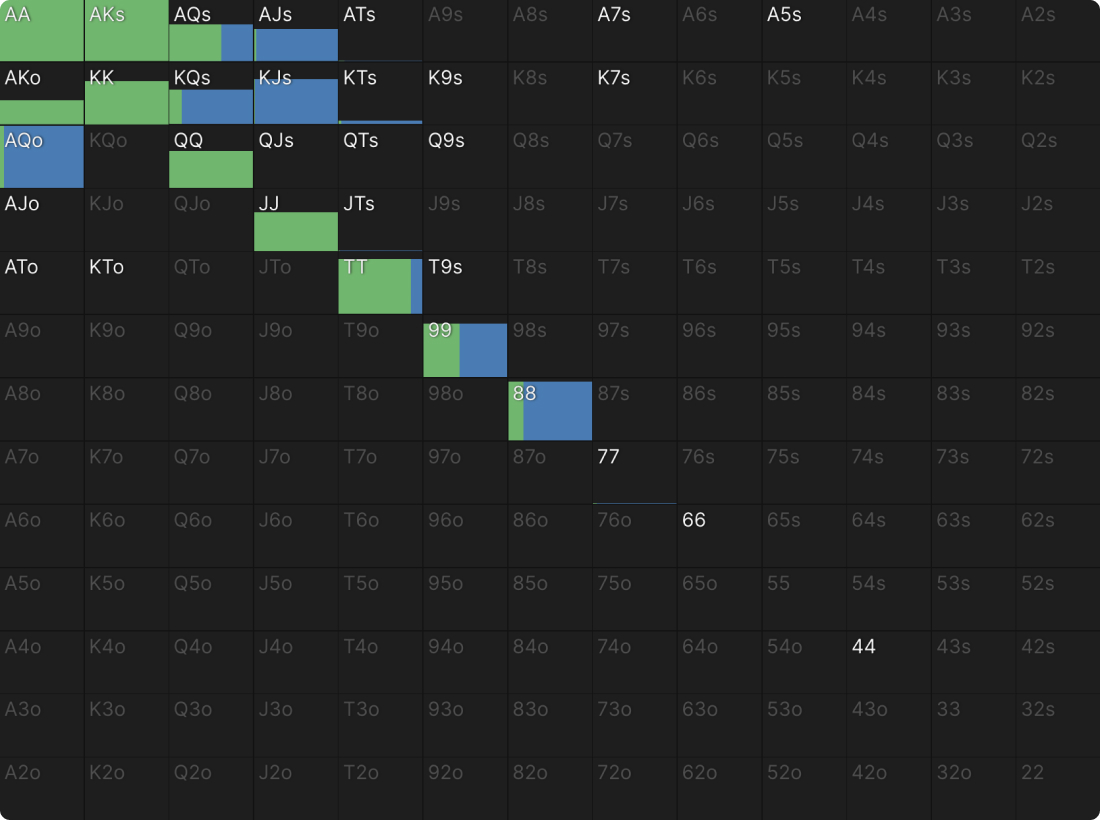
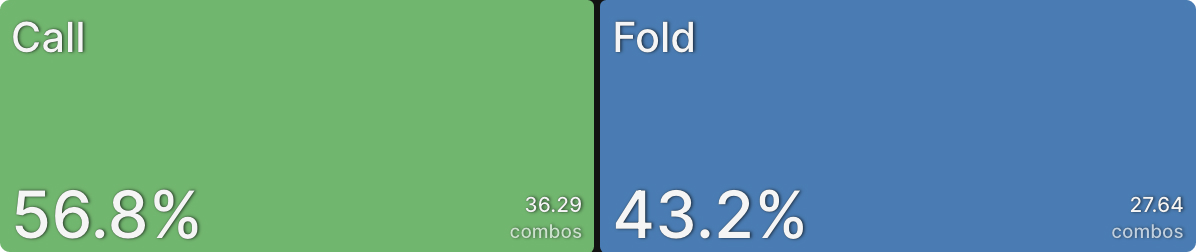
4. Short stack game
If you have a very short stack or a huge reward for your head, then suited broadway hands are your best weapon. You should assume that you will be equalized by several players, so you need a hand that will withstand the “family” pot (when the whole table is in the game).
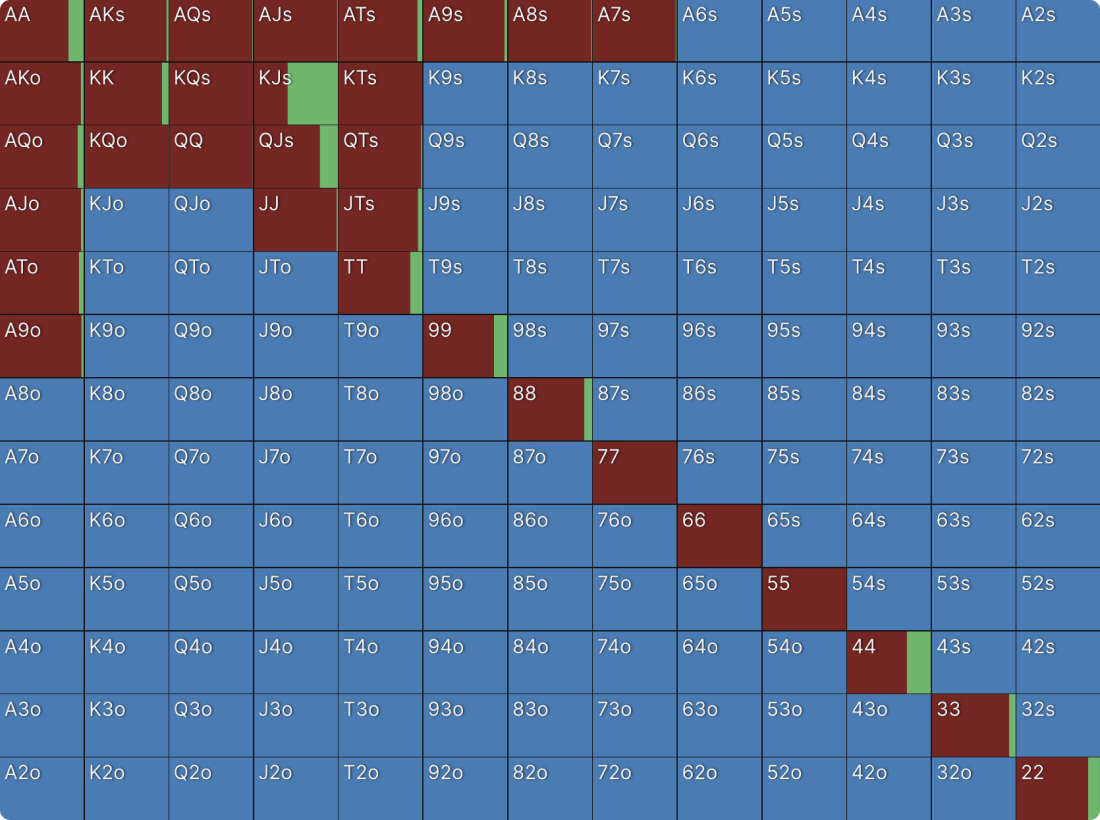
- In this example, everyone was rolled to CO with a 15 bounty stack and a $50 bounty.
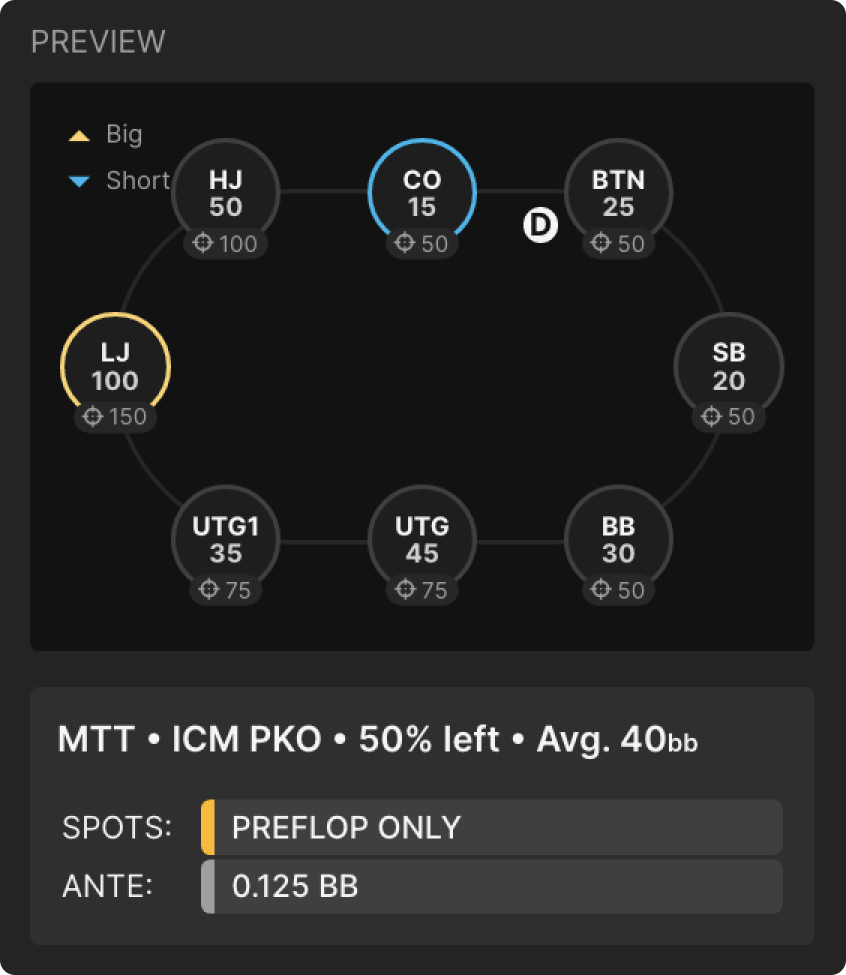
His GTO strategy looks like this:
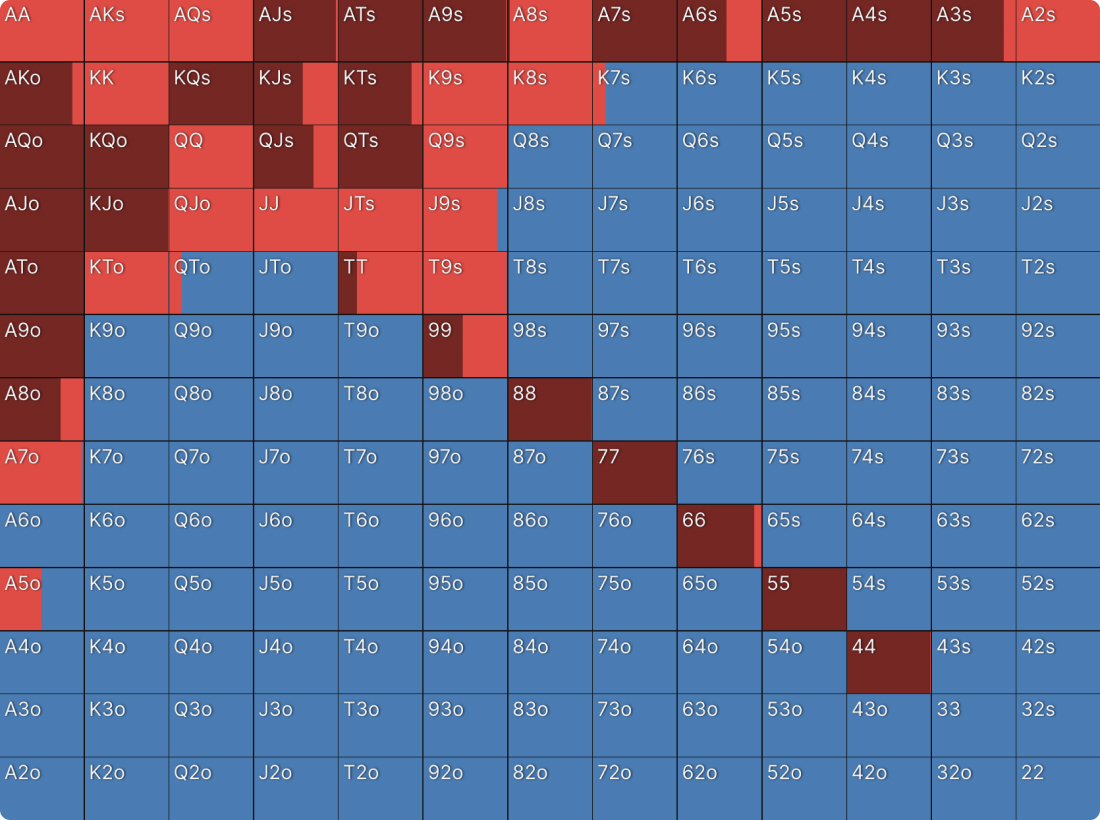
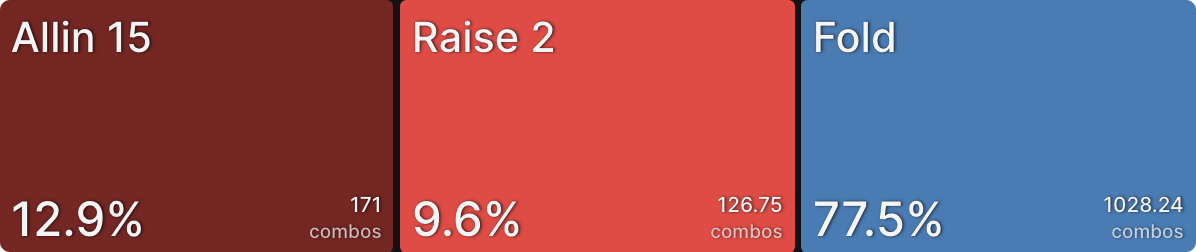
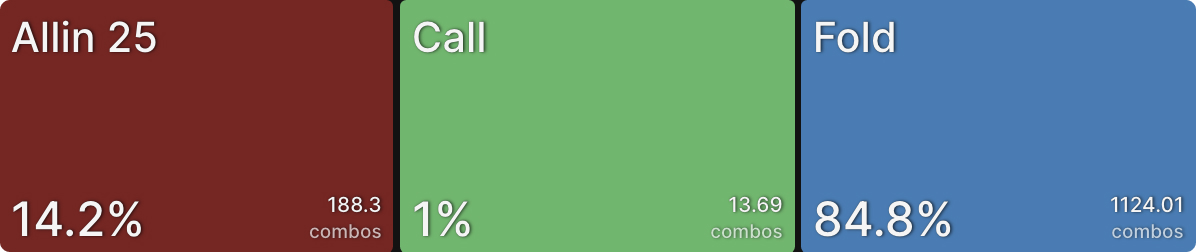
He opens 2 BBs of his strongest hands to provoke action, and the weakest hands make bet/fold. Small pockets are swollen, because such hands do not implement post-flop equity well. The push also has the best handy Ax hands and broadway.
Here's how BTN responds to Push:
Then, if the small blind falls off, here's how the big blind will react:
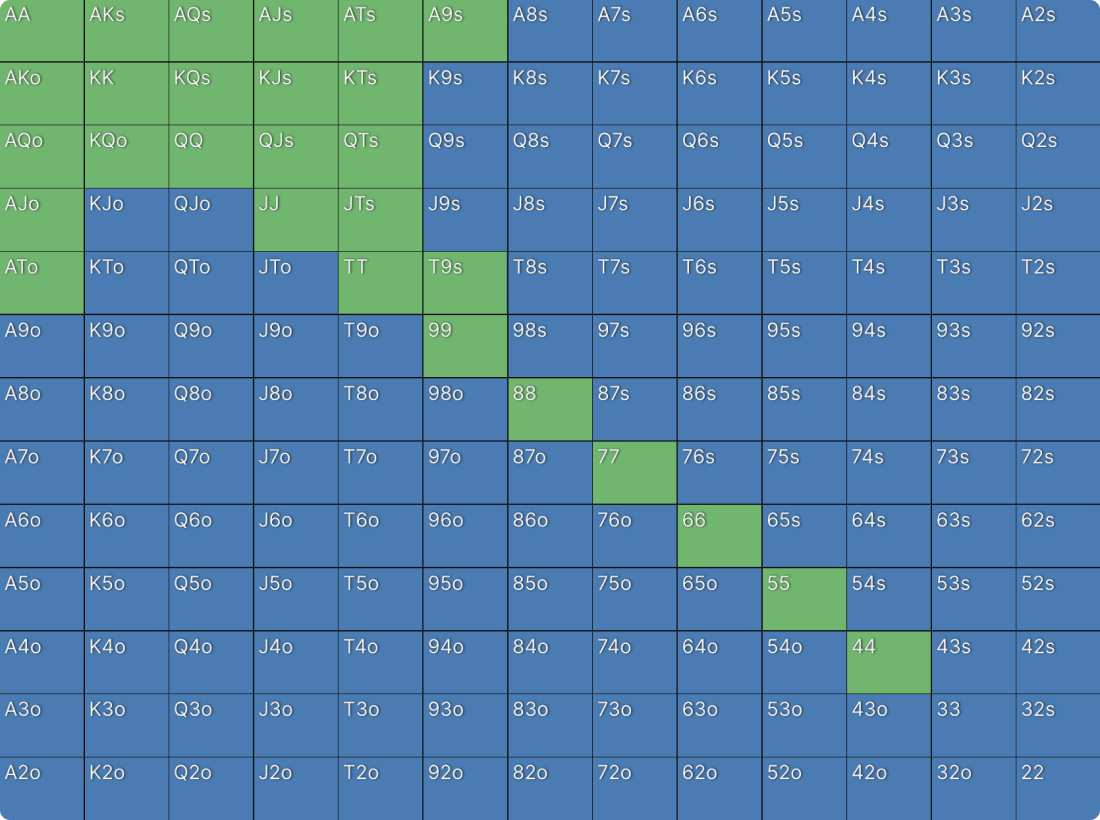
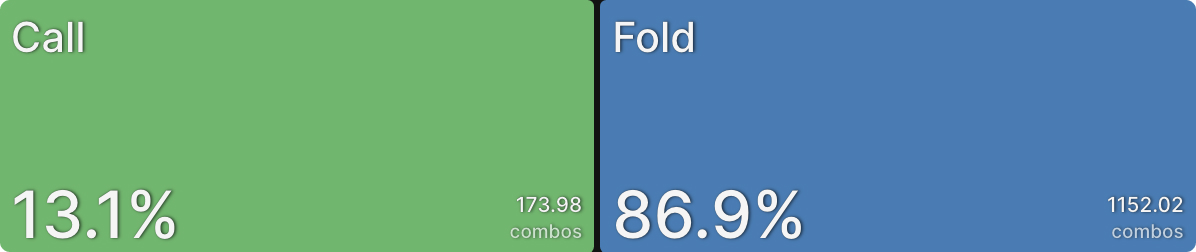
Let's get back to what we talked about earlier about suited broadway hands. Did you realize how well hands like KTs or QJs can play against these two ranges? Often, QJs are enough to pair up against the combined call range to get ahead. There are even some situations when such a "weak" hand as QJs can be ahead of, say, BTN with JTs and BB with T9s. Let's not forget that these are GTO range. In most real PKO tournaments, you can see a much wider call range in similar situations, which makes the suited broadway arms even stronger.
Short stack exploit
If you have a short stack and you have a hand that plays well one-on-one, but not in a multipot, there is an exploit that will help you avoid a multipot draw. If, for example, you have 10 BB with pocket sixes. Instead of all-in, make a raise almost to all-in, for example, 9.5 BB. You have the same fold equity in both situations, and you will never fall off again. However, this forces your opponents to place an extra bet to claim your bounty.
They will either have to make a rerace on the preflop, or, at a minimum, make a bet after the flop. A player with an average stack who wants to get a reward for you will think twice about a rerace if there is still a player behind the game who covers it and has not yet said his word. If a big stack makes a 3-bet to isolate you, or makes a bet after the flop, the rest of the players are more likely to get out of the way. This is called “fold equity theft” from other players, because in a similar way you can use the stacks of other players at the table to play heads-up sweat with your hand.
5. Conclusion
The difficulty of PKO is that this format is unlikely to ever really be calculated. This also means that you will see large discrepancies in GTOs compared to traditional MTTs. PKOs attract recreational players who love to play for the bounty. This is especially felt in multipots, where several rewards are at stake. As a result, the range is usually much wider than the GTO range for PKO.
Key takeaways: When the bounty is large enough and the range is wide enough, there are situations in PKO when it is correct to call 100% of the hands. Broadway hands are good for winning multiple awards, especially in real PKOs.
You can really win a pot even without improving a hand with hands like KJs just by picking one pair. Often this is enough, because you block some of the strongest hands and can collect a monster on the river.
- The more players you cover in the pot, the wider your range in PKO may be.
- Suited broadway arms work well in PKO multipots.
- When playing with a short stack, if you bet an amount that is almost equal to the all-bank, but slightly less (and then call if you are slashed), you increase your chances of playing in the pot 1 by 1 using the stacks of other players.
Barry Carter has been writing about poker for 16 years.
He is the co-author of six poker books, including Mind Playing Poker, Poker Strategy: A Book on ICM, and GTO Poker in Plain Words.