


Translated with the help of AI. We apologize for any errors and would appreciate your help in correcting them.
Before reading this material, be sure to read the article: What is the ICM factor, bubble factor, FGS factor in tournament poker?
As I have already written, the ICM factor and the rest resulting from it introduce an element of higher mathematics into the strategy of the game, which makes tournament poker more interesting and exciting. Unlike most other disciplines, in a tournament game it is not enough for us to have a positive chip-ev expected value to make the optimal decision at the table. This opens a bottomless hole for theories of calculations and ideas, which has no limit so far, this issue will still develop and evolve in the world of poker strategy. This is the second article on the topic of ICM, and in it we will talk about preflop exhibitions. The 3rd article on this topic is also planned, do not miss it!

1. Playing preflop ALL-IN
The factor of tournament life is very important, when we play to the full stack and risk flying out of the tournament, it is not enough for us to have some minimum plus on chip-ev.
Rule: raise the winrate of exposures does not lead to a linear increase in profit.
This means that there are many situations in tournament poker where all-in will bring some chip gain and increase the winrate at the the long run, but in terms of profit will be a negative solution.
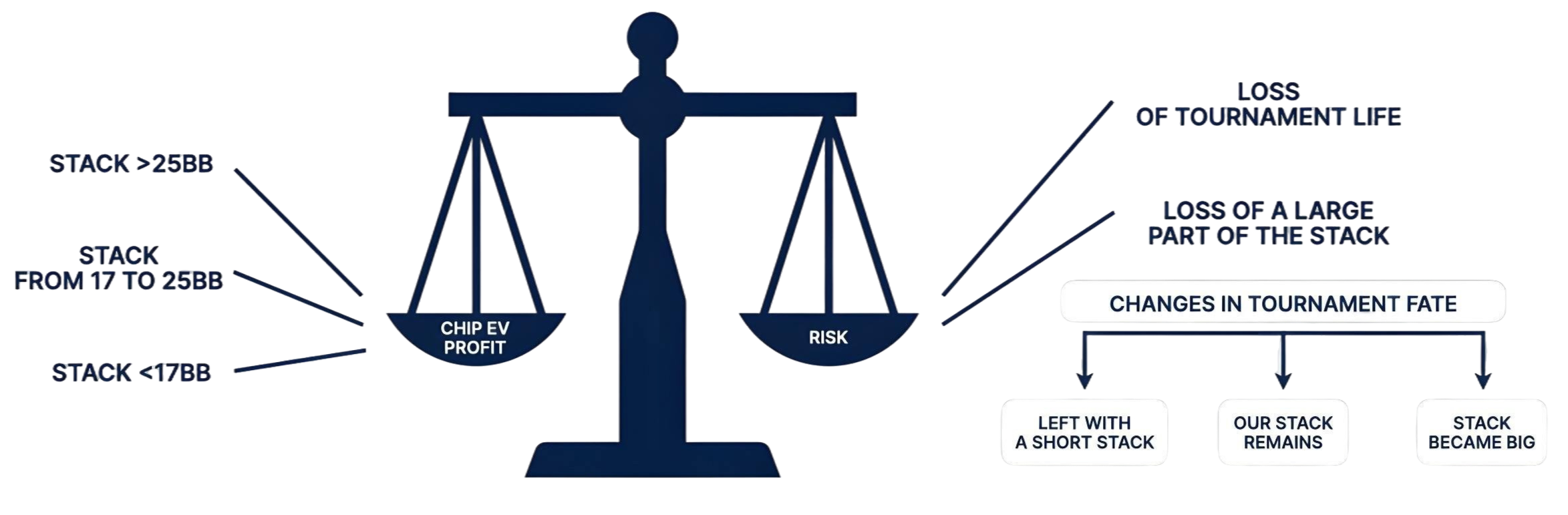
It can be seen from the figure that when making a decision that may cost tournament life or even a significant part of our stack, it is worth considering not only profits, but also risks. I call it tournament fate: how will the tournament develop if we lose the stack now? How much % will our situation worsen? And if I win as many chips, how much does this improve my position in the tournament?
- For example, losing 30bb with a 42bb stack is not the same as losing 30bb on a 67bb stack.
In the first case, our position in the tournament and the likelihood of its ending in the foreseeable future is much higher than in the second, and therefore the necessary value of the net profit for this risk (the first bowl of the scales) has lower values than in the second case. This is interesting considering that we play for the same pot, in the same tournament, with the same player, but in the case where we have 42bb, the range of our game will be different. Already only on the basis of further tournament fate or the FGS factor, as it is commonly called in poker.
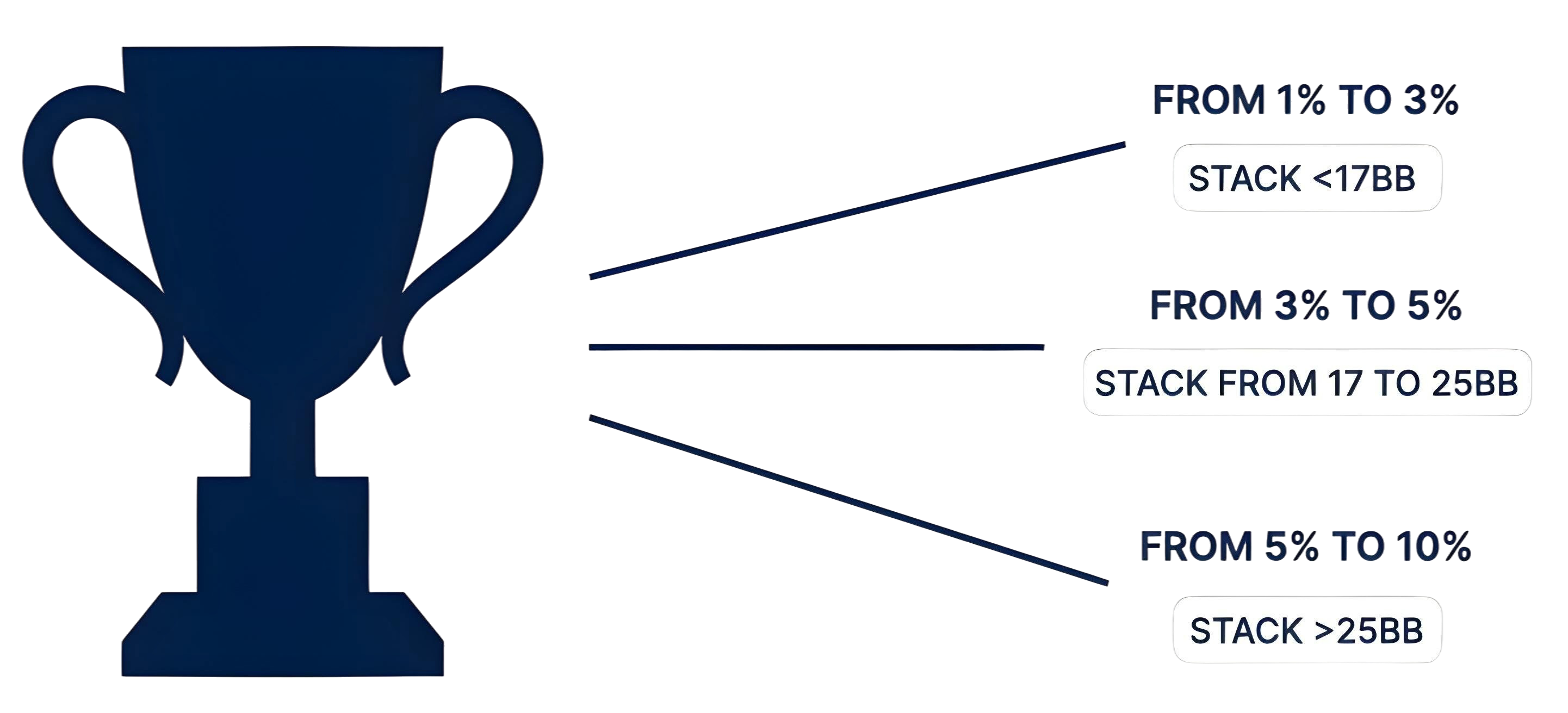
In this figure, we see that the profit we get in chip-ev depends on the depth of our stack. The larger our stack, the greater the winrate we have at a the long run and the less our variance in cooler and coinflip situations.
In our calculations of the profitability of bids, we take into account the factor of the future profitability of this stack and the exposure to its variance and thus get an increase in the risk premium as the stack grows.
Simplistically, it looks like this: in a short stack < 17bb, 1-3% of profit is enough for us when billing, on average from 17 to 25bb we take already 3-5%, and in a larger stack >25% we take from 5% to 10%, depending on the situation. This % markup is required when calculating in calculators, for example, ICMIZER3 has a special EDGE window where this markup is indicated in the number of chips. The markup is the percentage of profit (or its equivalent in chips) that is added to the zero waiting point so that the plus of the action is considered from this new point. If we make an increase of +5%, then when playing +2% on chip-ev, the game is considered negative.
Detailed table of ICM allowances for preflop bills without knock-out.
Stack | Exposure |
| Final Stages |
<10bb | 1% | 2% | 3% |
11 | 2% | 3% | 5% |
17 | 3% | 4% | 6% |
23 | 5% | 6% | 8% |
28 | 5% | 7% | 10% |
36bb+ | 6% | 8% | 10%+ |
This table roughly shows the dependence of the increase in ICM on the tournament stage and on the increase in the stack in which we play on the stack. This table does not take into account some factors, such as the distribution of chips between players in the late stage, the structure of the tournament, and so on. These factors can also exert their influence, so in many ways the use of the allowance is a rather intuitive ability. In this article, I showed the fundamental feature of the mathematical world in tournament poker, but this is only the foundation and other concepts will be built on top of it, the most important of which is the game with knockouts, which will be analyzed in a separate article.