

Translated with the help of AI. We apologize for any errors and would appreciate your help in correcting them.
Translated by order of the educational portal university.poker
Original source: GTO Wizard
Nut draw — ideal hands for aggressive play through bet and raises. They give us fold equity (when the opponent drops his hand), sometimes forcing opponents to fold even strong hands, and at the same time retain the chance to win large pots if opponents decide to continue the hand. But at the same time, solvers do not always play nut draw aggressively.
- For example, in the depth of 100bb, when CO vs BB in the single-raise pot on the flop


 , CO makes cbet with nut flush draw only 69% of the time:
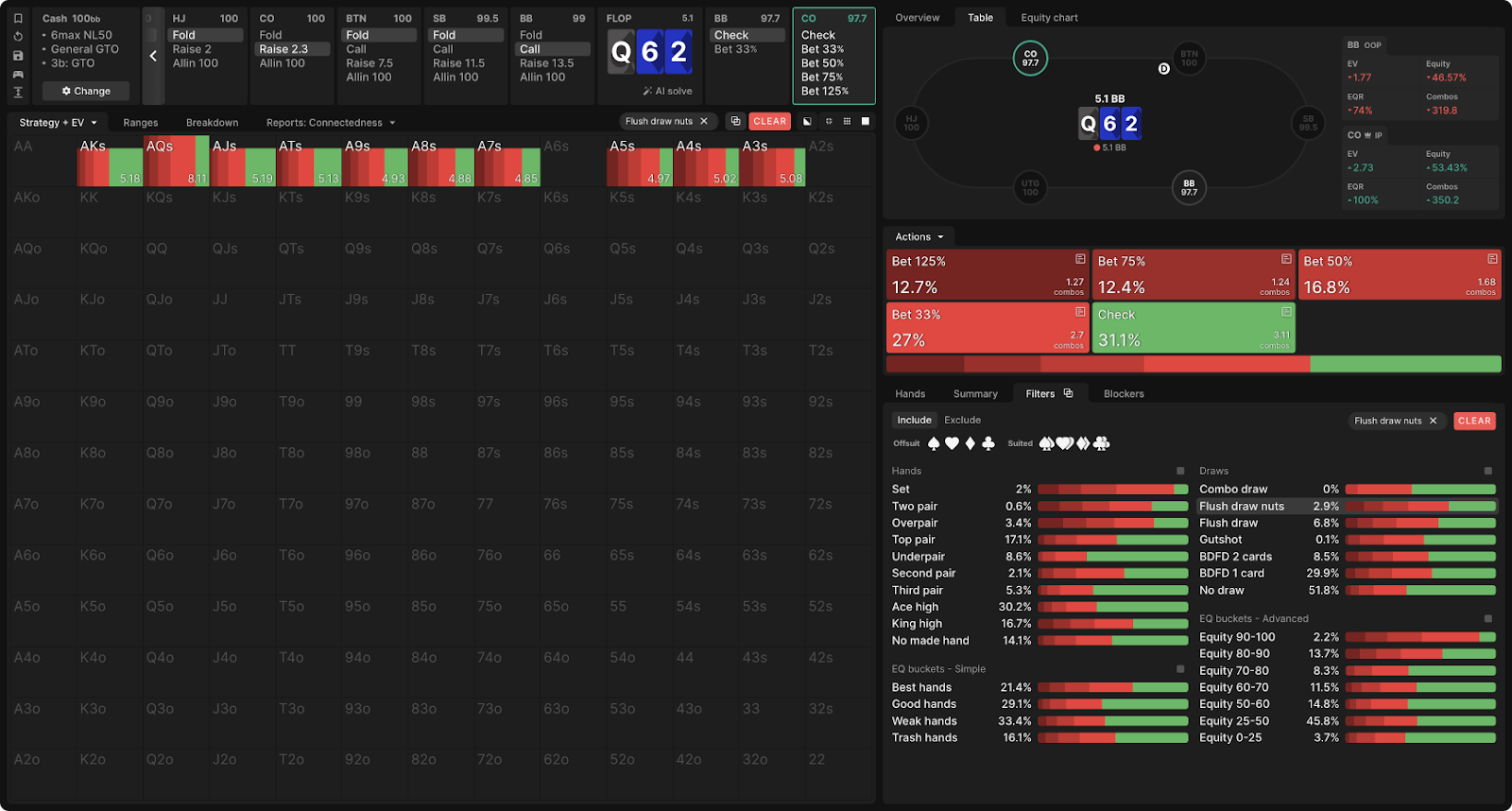
Despite the obvious edge of counter-bet with nut flush draw, solvers do not always bet. The total frequency of counterbets for the entire CO range on the flop is only 49%, and the nuts flush draw is played more aggressively (69%) compared to the middle hand of the range. However, cbet is not always placed with any of these hands, when this bet is made — all four possible bet sizes are used.
1. What's happening here
Here is an example of a hand from personal experience to understand the logic.
At that time, I was still poorly versed in game theory, balance and exploit, but I had already begun to understand an important idea: if everyone expects that you will always bet with flush draw, then оpponents will not attach importance to the situation when you collect flush on the turn after the check on the flop. This creates an incentive to check some flush draw in order to later win on the skepticism of opponents. The history of the giveaway may seem confusing, since it is played in the “Ante Up” format, which is practically not used now.
The essence of the distribution is as follows: I was a preflop aggressor in the position with 
 on the flop
 . I made a checkback on the flop, and on the turn came
 , which gave me a flush. Villain check again, I put, he made a raise, leaving a stack the size of a bank, and I called. On the river came out
 , the villain went all-in and showed
 , investing about four times more pot, already being "dead".

Then I wrote in my blog: "It's good to be able to collect flush on the turn when you are waiting on the flop."
A more general principle of poker strategy works here: it is dangerous to limit your range. Villain, who can collect nuts himself and knows that you will rarely have a nut hand, can make large bet in the polar range (with very strong and very weak hands), turning even your strong hands into bluffcatchers. The deeper the stacks, the more dangerous this situation is. It's not a hard-and-fast rule. There is no need to completely rebuild your game on the flop due to the risk that a third flash card or pair card will be released on the next streets. But in standard situations, for example, when the third flash card comes out on the turn, solvers usually mix Nat draw for all possible actions. Of course, solvers don't “plan ahead” the way people do. They do not “think” in the usual sense at all (as far as we know).
They simply maximize EV by responding to stimuli and eliminating potential faces through which it can be exploited.
When the solver distributes the same hand among several actions, it means that the EV for all these actions is in equilibrium. If you always started betting with your nuts flush draw in this situation, the opponent would be able to exploit this by making large bet bets in those branches of the decision tree where you do not have nuts. That is why sometimes you need to leave nuts on these branches to avoid exploitation.
2. Conduct an experiment
To test and analyze this idea, we will use strategy blocking (nodelocking). We will also simplify the decision tree by focusing on whether to place a bet rather than its size.
When using a single bet size, CO makes a cbet 70% of the time on the board, with 76% of its Nat flush draw included in the bet strategy, confirming their higher than average value for the bet:
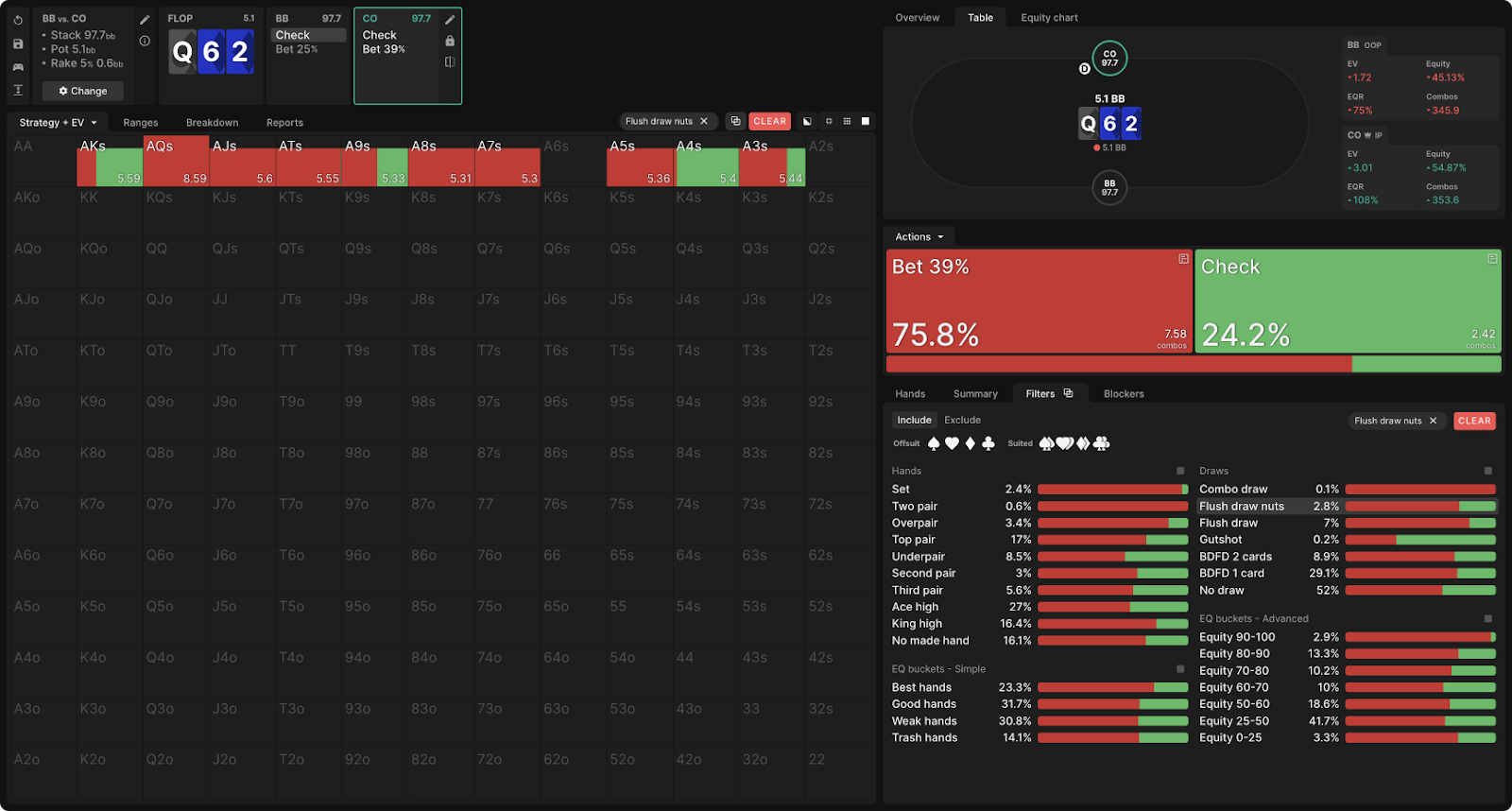

Solver now shows a preference for some combinations over others, albeit a minor one. So,  EV is about 6bb/100 as a net bet.
 EV has the same bet and check, so the solver mixes both options:
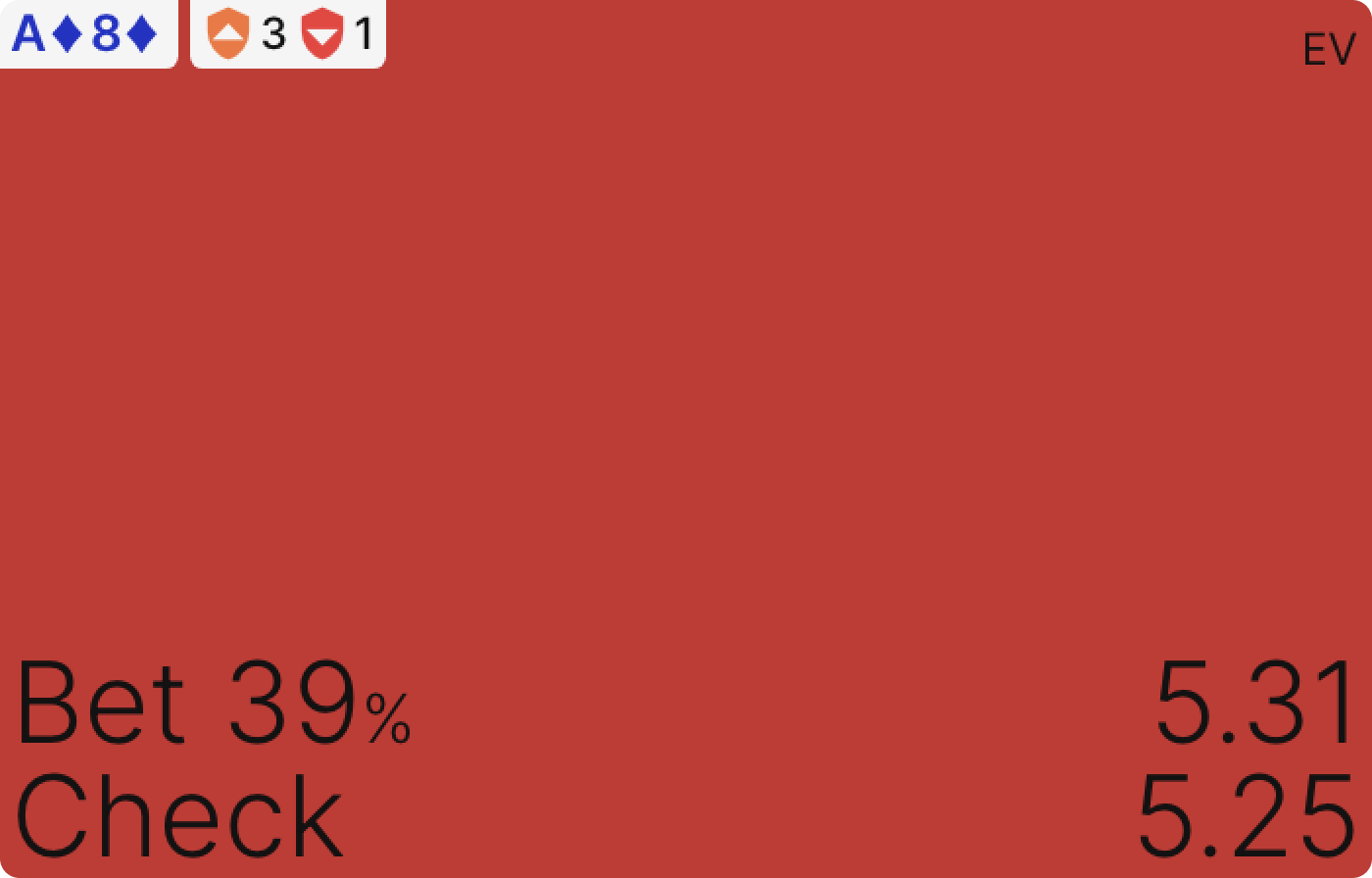
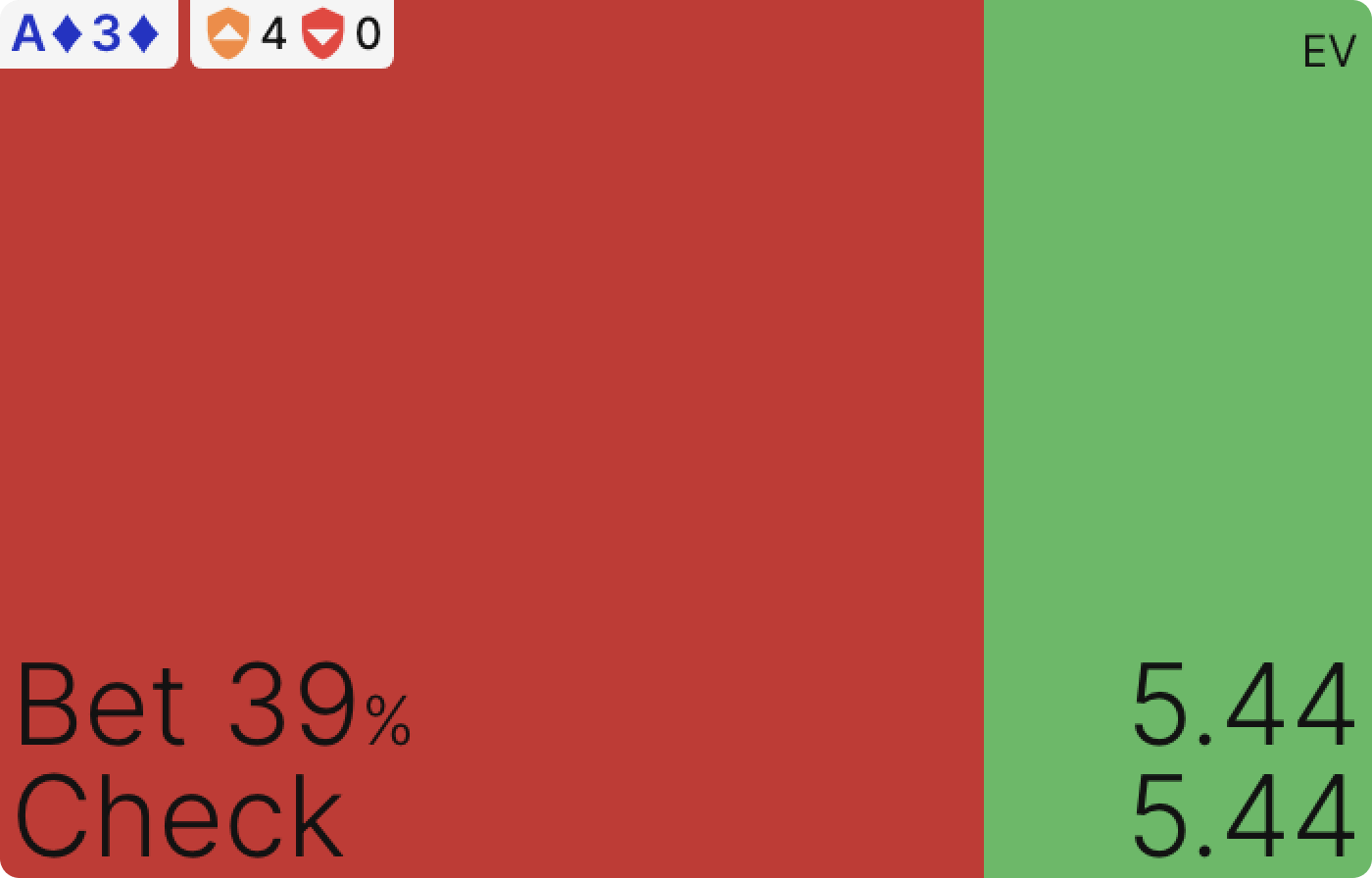
 — one of the nuts flush draw combinations, in which the equilibrium strategy involves a mixed game, including part of the checks. But if you block a net bet for CO with, then the solver compensates for this with more frequent checks for other mixed strategies, such as AK, AT, A4, and A3.
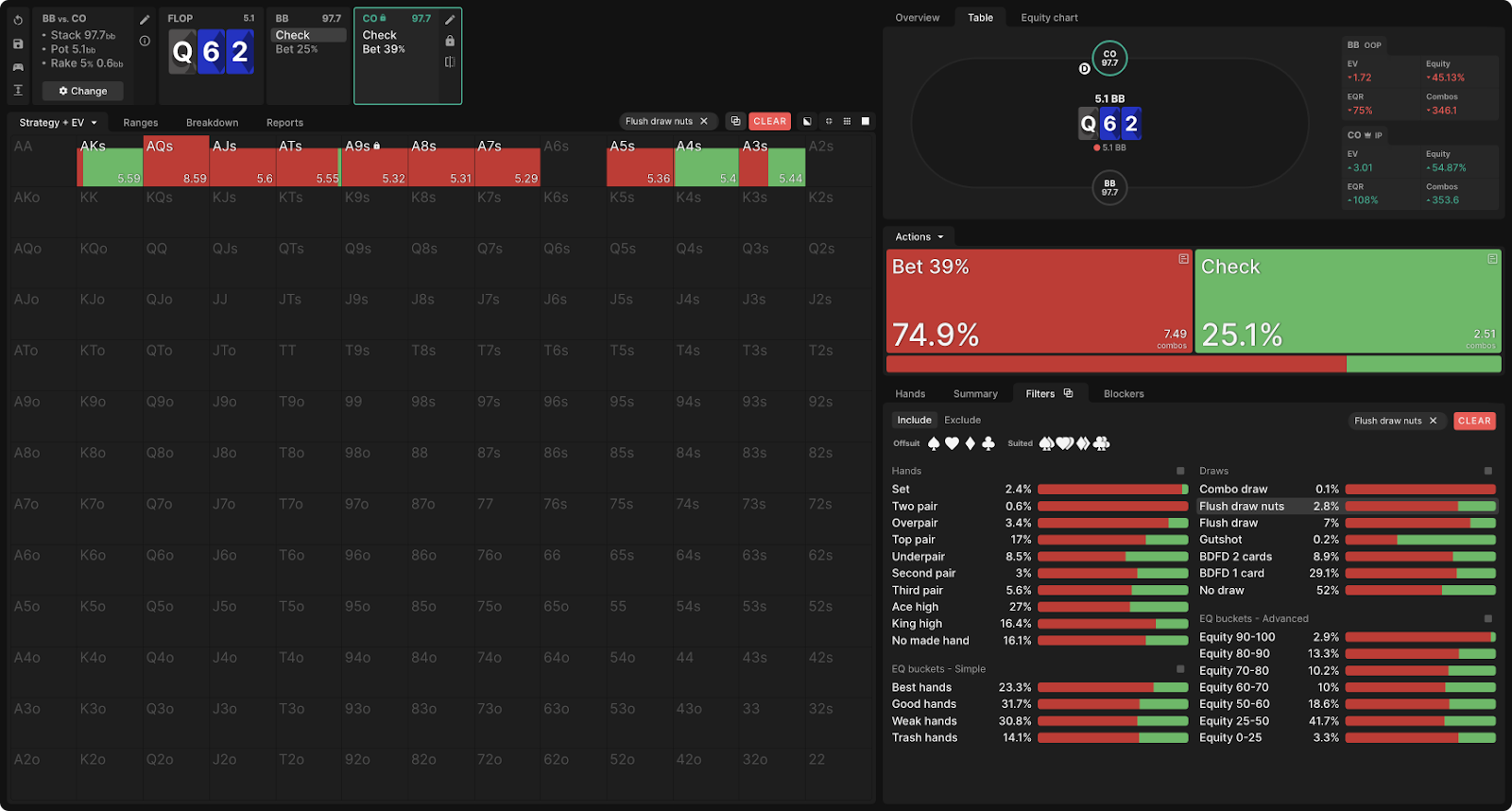
When locked, both as net bet  and which used to be net bets, start to include a portion of the checks to compensate:
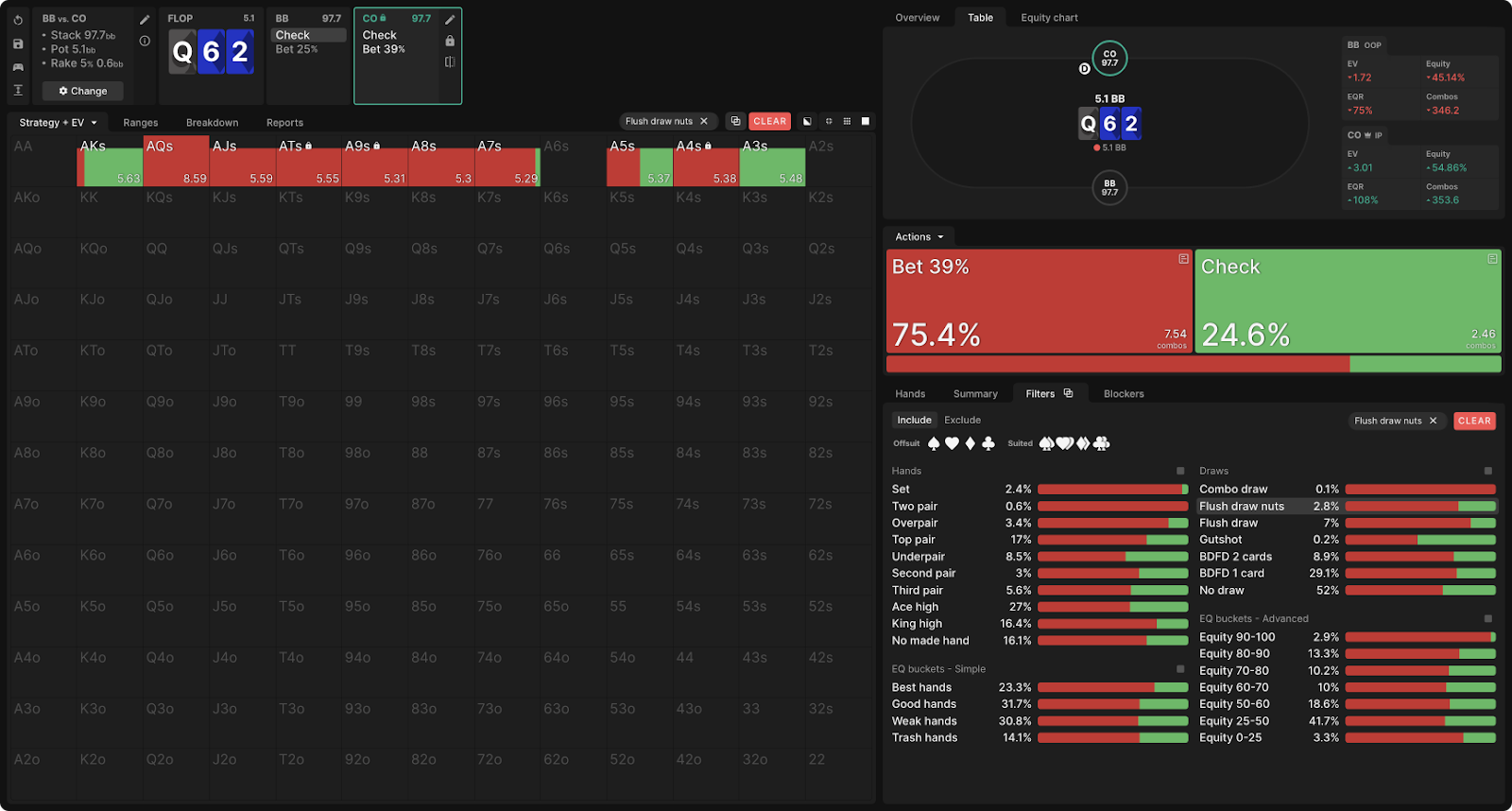
Note that the frequency of CO checks remains relatively stable, despite the fact that we are blocking more and more nodes as net bet. Even the overall EV remains unchanged, although CO is now forced to play “less optimal” with more combinations.
Maintaining the correct frequency of nats hands in each branch of the decision tree is more important than selecting a specific action for a specific combination.
Solver chooses a bet for some combinations for a number of reasons, but apart from the hand  (which is also a top pair), these reasons are not particularly significant. Some combination may block BB folds slightly less or have slightly more outs per pair. In the presence of computing power, the solver uses these small differences to determine which combinations to bet and which to check. However, these are only minor differences, and the method of choosing bet for each hand is not so important.
The main idea here is that the optimal CO strategy assumes the presence of some nuts flush draw both in the bet range and in the check range, and maintaining the desired nuts draw frequency in each of them is more important than choosing a specific action for a particular combination. Computers can make extremely precise distinctions, but the player can make choices heuristically — for example, put hands with a high kicker and check with a lower one, or accidentally wait 25% of the time with all combinations.
3. Note on the use of filters
This principle applies to any flop where CO has a significant check range. I chose the flop Q62 specifically, since CO does not have a flush draw on this board, which would be a combo draw at the same time. But on the board of the QT2 type, the filter for nut flush draw would not include hands of the  and type. And if you add a filter for combo draw, he would take these two hands, but at the same time he would not include other non-natty combo draws. Therefore, it is important to use filters with caution so that all the combinations you need get there.
4. Playing on the turn that closes the flush
If everyone has waited for the flop.
The following report shows the BB bet strategy on all turn cards after the CO check on the flop. Note that the thorn cards that make up the diamond flush tend to use rarer, larger bet sizes:
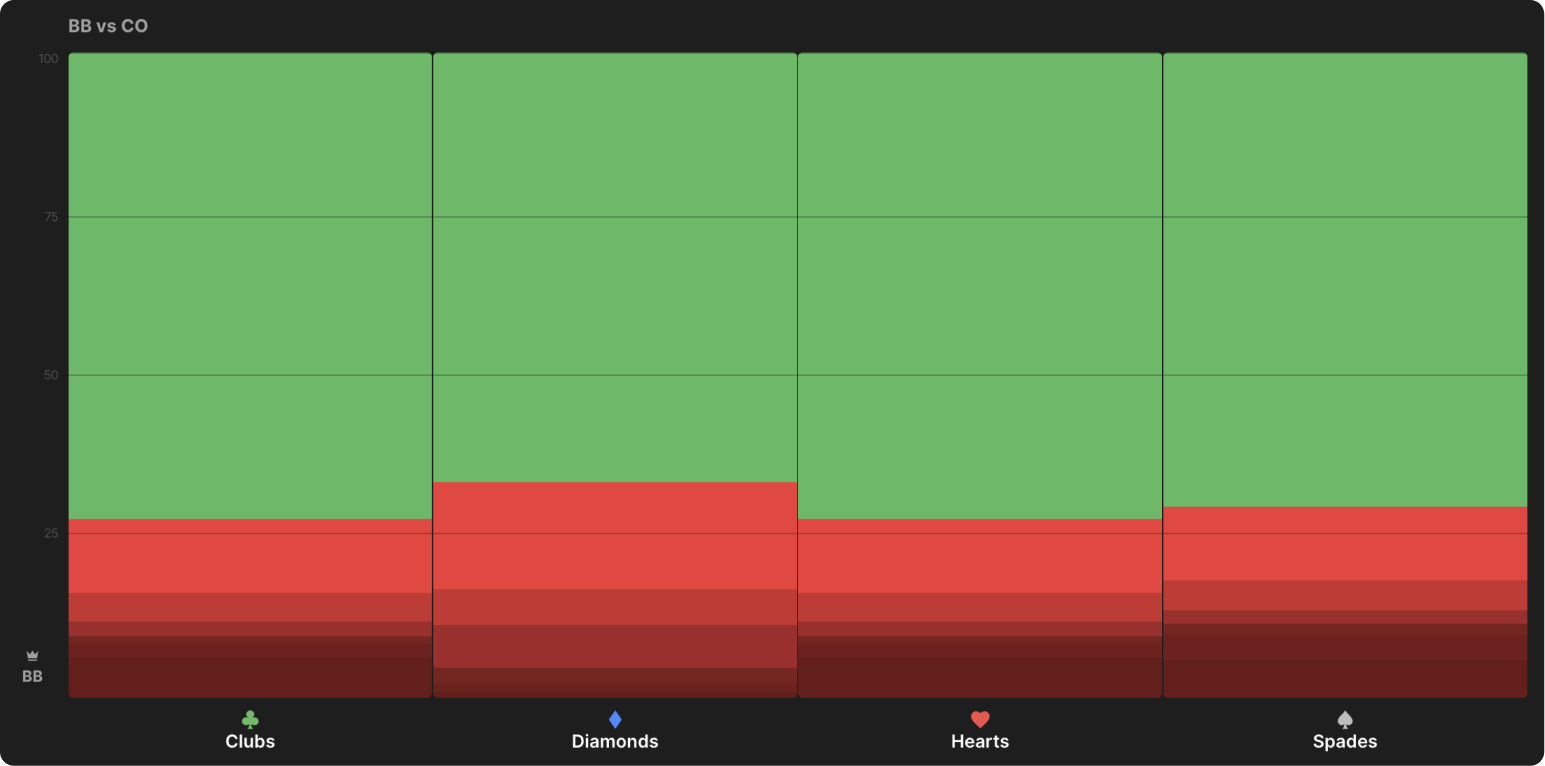
We can't run reports with custom solutions, but we can choose, for example, a tambourine and compare strategies to see what will change due to more frequent CO bet with flush draw on the flop. We will also change the parameters of our custom solution, since it is assumed that overbets will be a more important part of the BB strategy when CO has a range dripping. Instead of automatically determining the bet sizes, I set fixed bet bet options for both players: 25%, 67% and 200% of the pot on the turn and river.
The equilibrium strategy does not imply too much BB turn bet :

When we locked that the catoff will always put all its nut flush draw on the flop, then on the BB turn it will be necessary to put large, if the CO did not put the flop:

It is important to remember that a catoff can still have flushes as it compensates for bet with strong flush draw frequent checks with weaker flush draw. Therefore, a player on the big blind can bet aggressively, even if the CO has a decent number of flushes.
When the catoff is forced to put all their flush draw on the flop, the BB can exert strong pressure on the flop closing thorns if the CO has checked the flop:

flush draw on flop)
5. Conclusion
Bet on all flush draw on the flop is not always bad. Against rivals who rarely check raises, it may be right to put the entire range, even in situations where a balanced strategy involves a lot of checks. But this is a choice, and it is worth making, understanding the risks and benefits.
How can your оpponents use your choice against you? Do you think they will really take steps to do that?
Perhaps they will try to overplay you too hard, which will allow you to go the other way and start counter-exploiting them. The better you understand balanced solutions, not only how they look, but also why, the better you can evaluate the available options and choose the one that will bring the best result against a particular opponent.