

Translated with the help of AI. We apologize for any errors and would appreciate your help in correcting them.
Translated by order of the educational portal university.poker
Original source: GTO Wizard
“He always has something!” is a common half-joking expression in poker describing the tendency of a certain type of player to never bluff. It is used whenever a seemingly passive player commits uncharacteristic aggressive acts. Let's dive into the mind of artificial intelligence (AI) using the opponent's range lock function and see what the solver will do when an opponent who “always has something” plays aggressively.
1. GTO vs. never bluffing opponent
As an example, we will consider the preflop bands when playing UTG against BTN in effective 60 bb stacks, in single-raise pot, where BTN is not 3-betyl preflop. Then enter this into the AI configured to use the automatic bet size option (the best option if you are new to this particular situation or blocking ranges in general).
Flop: 


Here are the preflop range:
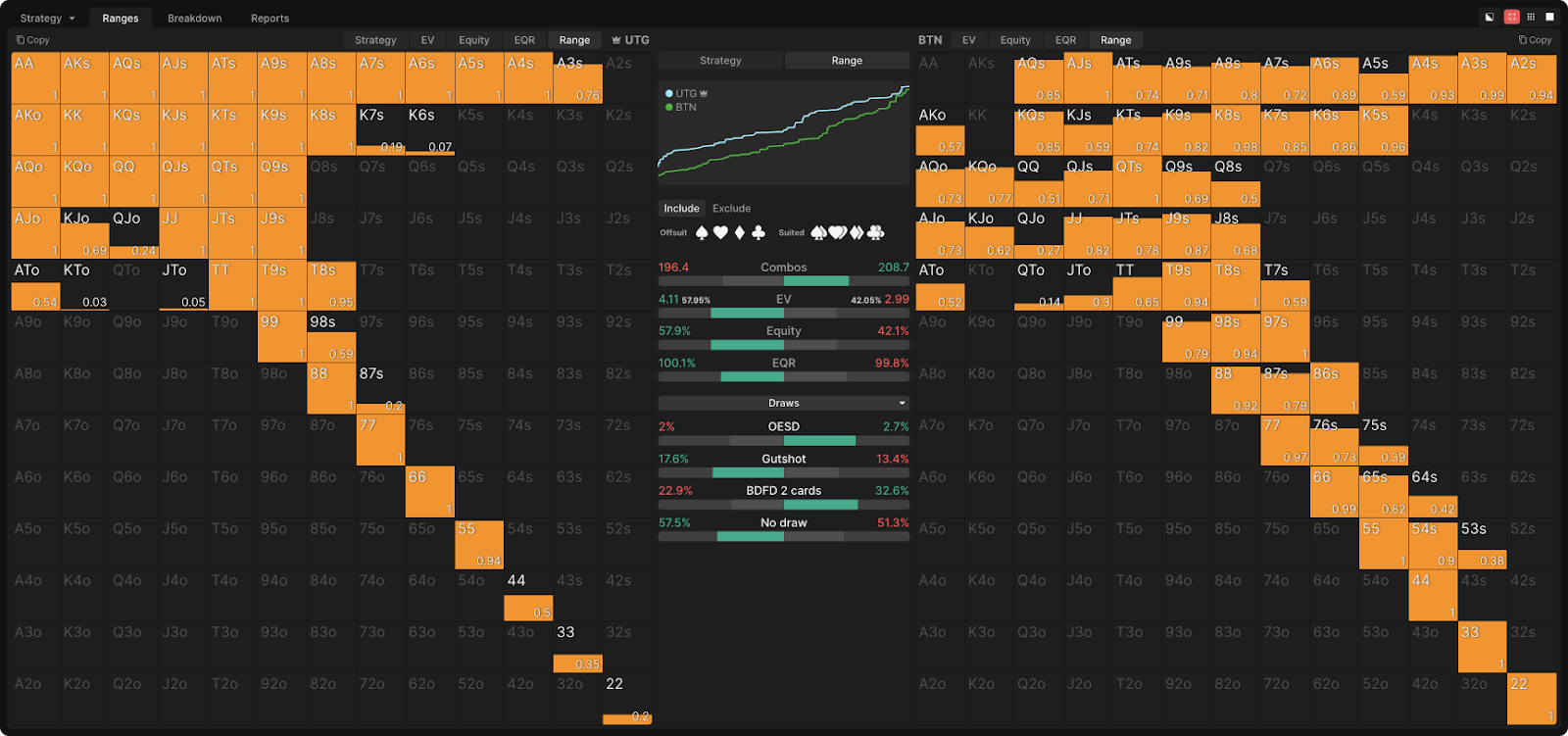
In this example, UTG bets in 67% of cases 39% of the pot (we will consider its bet range a little later).
BTN responds as follows:
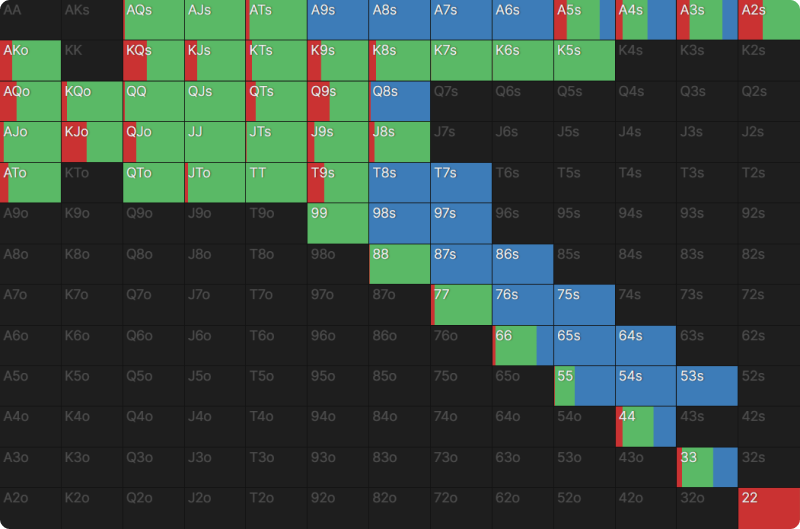

The raise range is 10% hands, the valley hands are mostly top pair or better. Bluff - mainly semi-bluff hands, such as QT for double-sided straight (OESD) or hands of the type 
 (gutshot with backdoor flush draw). There are also such hands as
 , which have both a backdoor flush and a backdoor street draw with an overcard. You can also include such ready-made hands as 44 and 33, which make a bet in a bluff as a bluff, because they can be to call hands worse (different draw), while they will never be happy that they will be equalized. But what if our opponent never bluffs in such villain situations? He can bluff when UTG checks out, but will never raising UTG counterbets.
Using the node blocking function, we change the BTN response:
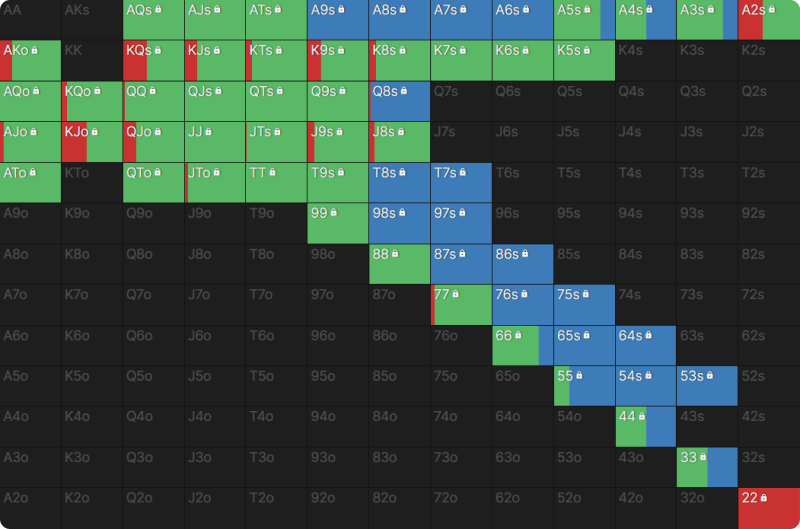

We have almost the same percentage of sequels. However, all the hands that we referred to as bluff have now turned into callas. In practice, if we do not think that our villain often bluffs, we can reasonably assume that he does not bluff with small pocket pairs or ace-high. Also, he will not raising hands like J9s, which are just a second pair with a weak kicker and a weak backdoor straight draw. You can experiment with this type of player yourself in any solver, but to make the most accurate comparison, let's take the same value range, but without bluff. The adjustments made by the solver emphasize several reliable heuristics that are well applicable against players who do not bluff.
2. Be more aggressive
One of the most interesting features of blocking nodes is that sometimes adjusting to the face of an opponent occurs on an earlier branch of the game tree, rather than on the one where he has faces. This is common when a player doesn't have a bluff. If we return to the flop, we will see the first big adjustment using the "Compare nodes" function.
Here's what UTG does at the start of the hand:
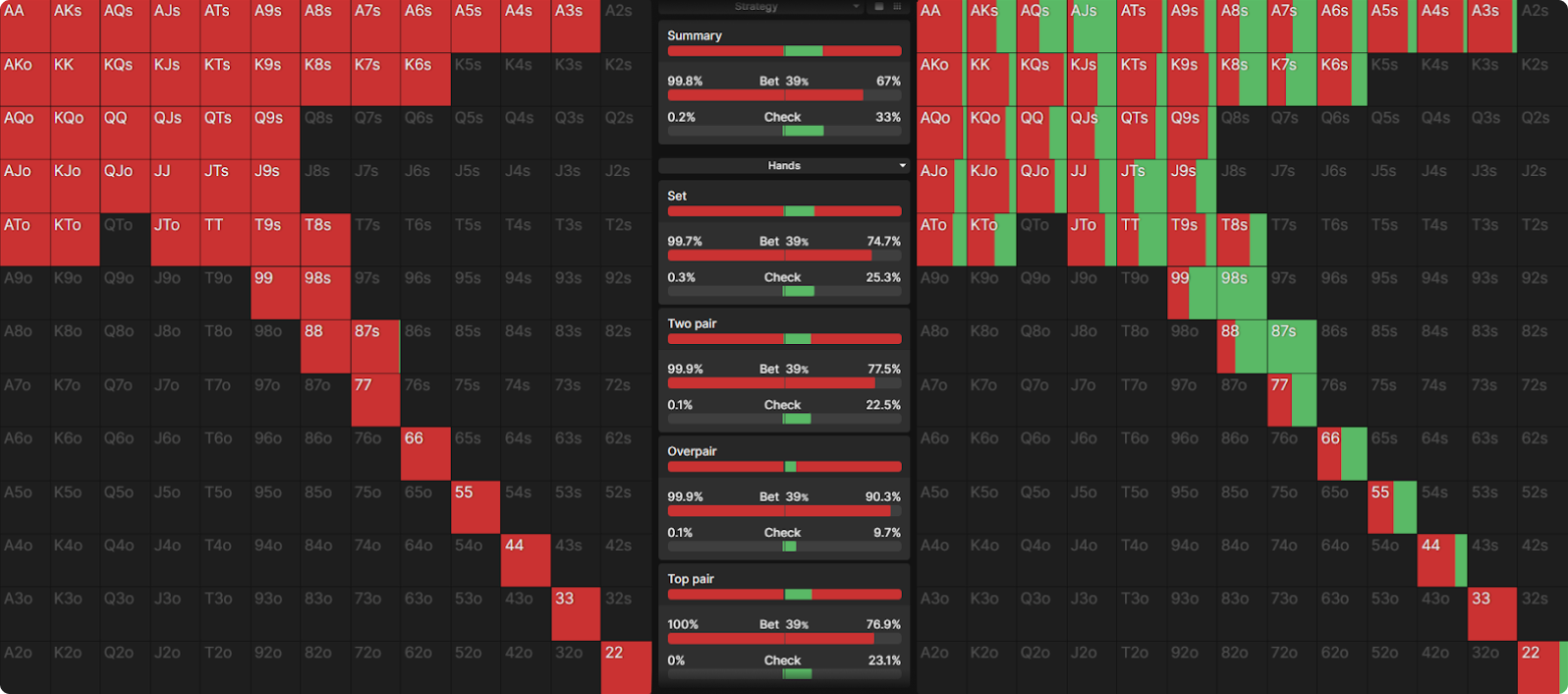
In the standard TRP solution, UTG has the edge in terms of range, but is out of position, so it does not make a cbet with its entire range, but only in 67% of cases (right picture). But when BTN does not bluff (left picture), UTG increases the frequency of bet from 67% to 100%.
Solvers hate it when they have to reset their equity after a raise. They like to place bet in situations where they don't expect to get raises often.
It may seem counterintuitive to bet more often when the opponent's raise range is much stronger (as in our example without bluff). But we're not trying to raise; we're targeting the rest of the button range, which is colliding or folding. In this respect, it is much easier to play against a player who is not bluff ing. They are more passive in the rest of their range, and when they raise, we can be almost sure that we are usually beaten. And this allows you to leave the distribution cheaply. If you experiment with dynamic or fixed bet sizes, you may also find that the solver prefers larger bets for the same reason.
3. Pass more on their aggression
This adjusting, which most thinking players have always used against players who do not have a bluff range, even before the era of solvers. It goes without saying that if your villain never bluffs, they have a very strong range, and as a result, you will also need a stronger than normal range to continue.
Given the BTN raise, compare the UTG reaction with the fixed and conventional range on the same flop:
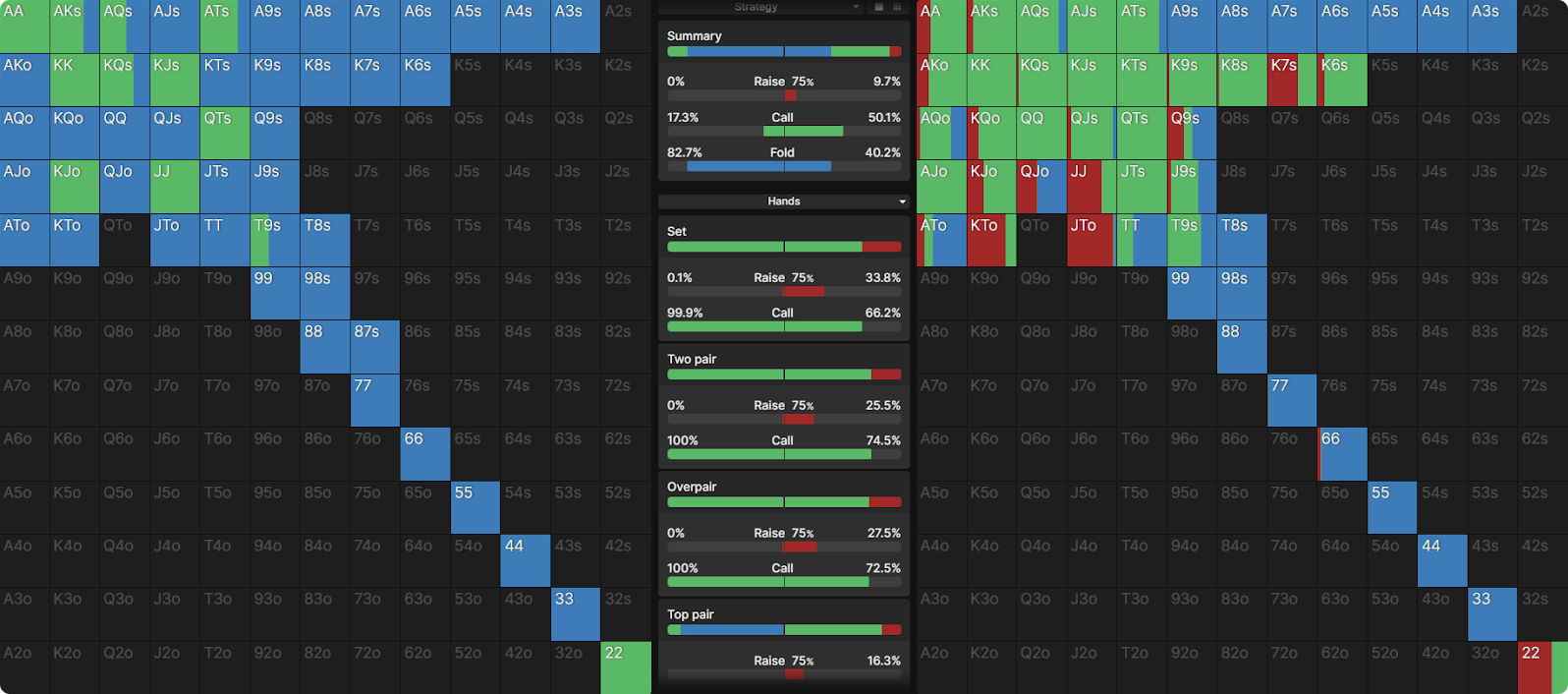
In the GTO variant (right), we fold 40% of the time. But in this node-locked version (left), we fold 82% of the time. Our hands, which we would classify as “bluff-catchers,” become useless against players who don't bluff. So we're dropping twice as many hands compared to the GTO example. Here we can drop very strong hands like KTs and QQ because they usually won't be in front.
4. Opportunity for improvement becomes more important
We drop very strong ready hands because our villain never bluff, but we still continue with a few unprepared hands that can beat many of the opponent's hands. As you can see below, we sometimes collide with AQ, AT, QT, and T9.
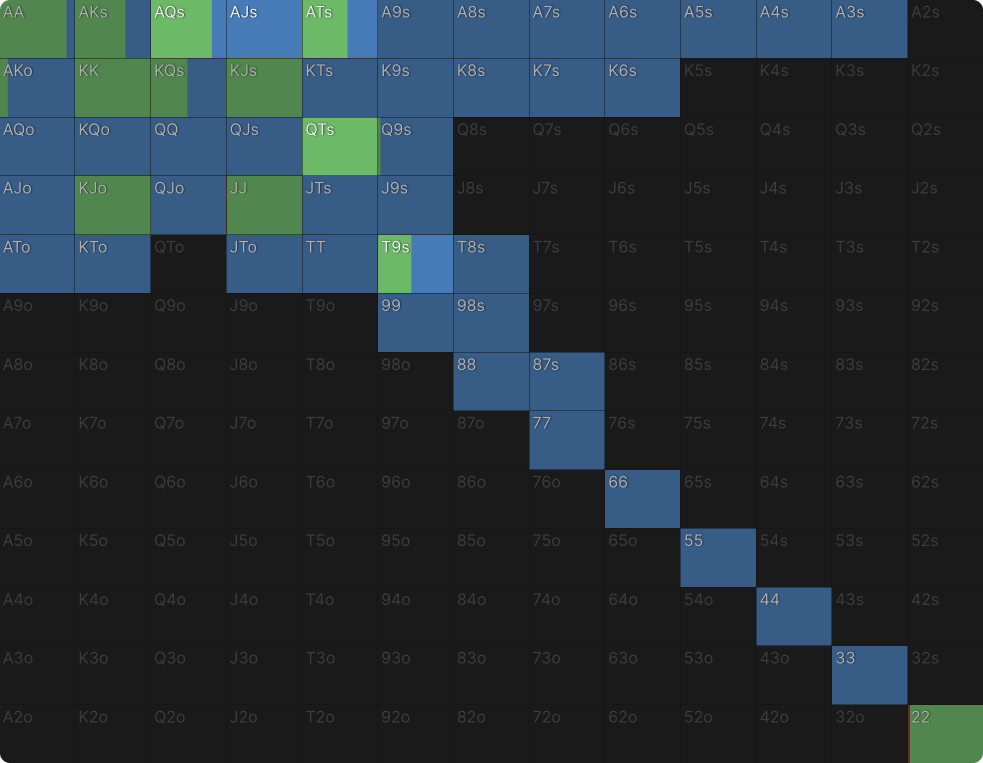

Why do we call QT but reset QQ? Because such hands can make a very strong velly range and win a lot of chips. The second mentioned edge refers to the concept of assumed odds. All these hands can make up a straight, and in the case of AT and AQ, they can also make up the best top pair. Except 
 : these suited hands are reset because they have no backdoor flush draw on the board without spades.
5. Raise less often (or not at all)
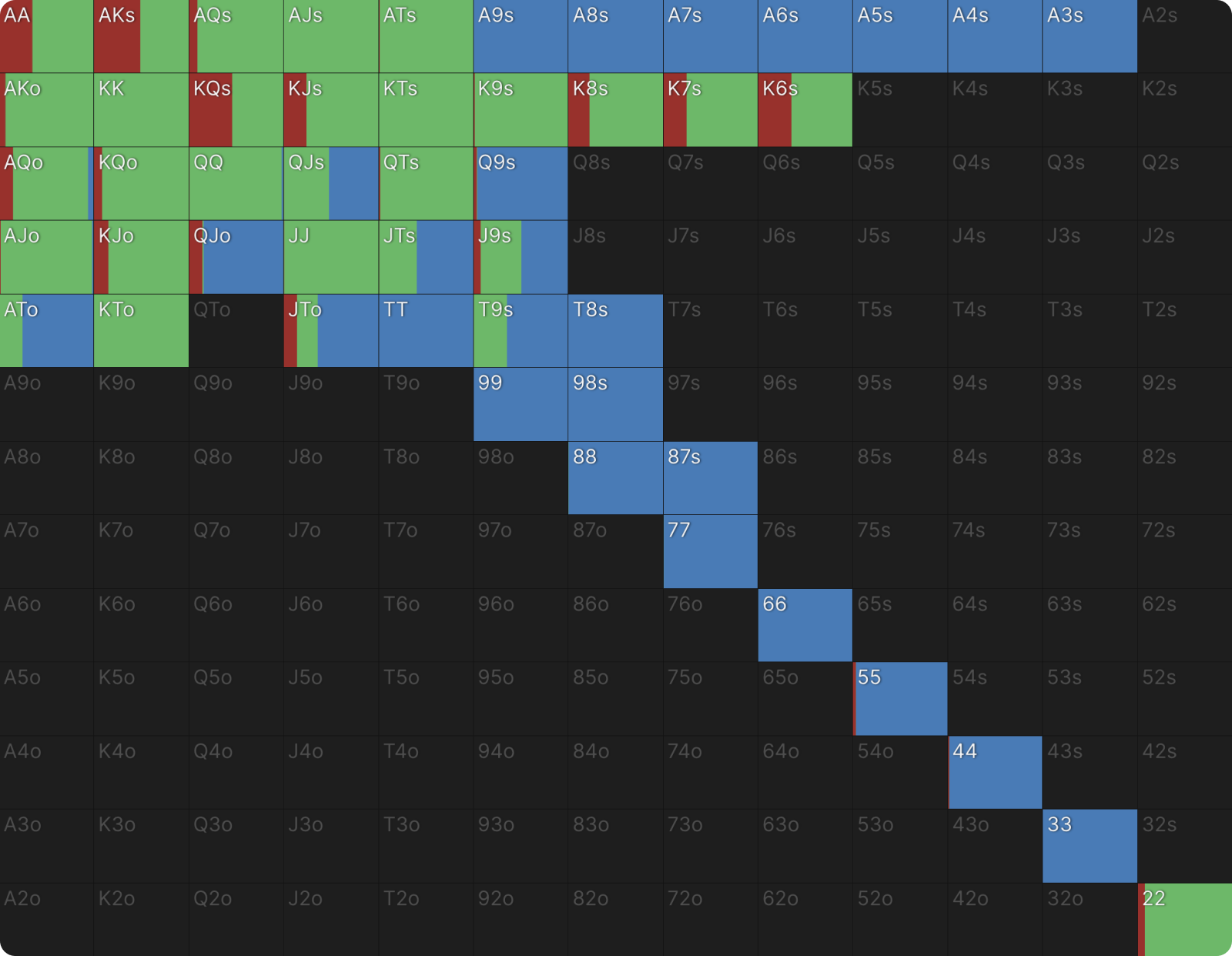
You probably noticed in the GTO variant that BTN has a range of 3bet, which includes both bluff (such as ATo, Q9s and 66) and velu combinations (22, JJ, AA, AKo, KJo and KTo).
Here is the GTO solution:

In the solution with blocking of nodes of this range, there is no 3bet. We call our best hands and drop the rest.
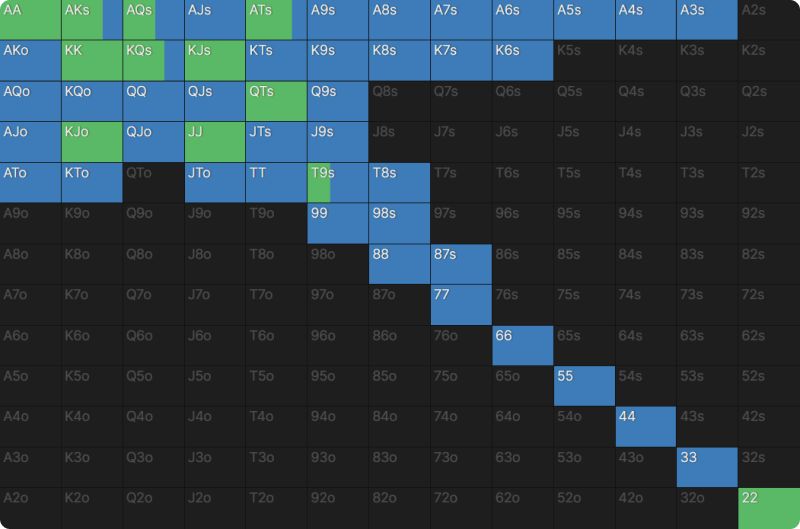

We know that our opponent has a big velly range, and he will most likely continue to put on subsequent streets, so we allow him to do this when we have a strong hand. When we have a draw (for example, QT), we do not want to make a bet, because we will never get a fold (i.e. we do not have fold equity), and our hand wants to see the next card as cheaply as possible. One of the important considerations with blocking nodes is that once you have changed a part of the game tree, the solver will work as perfectly as possible on all the other nodes.
Therefore, if we fixed an additional node to strengthen the 3bet UTG range with a top pair with a top kicker or better, the button would fold a few very strong hands:
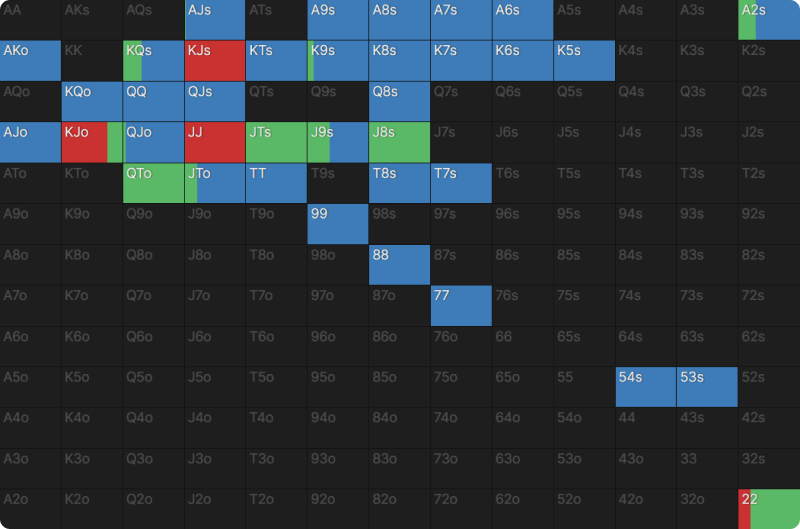

On such a 3-bet BTN, there will simply be dropping hands such as AK and KQ, from which under other conditions we would expect to see a call. In practice, if you suspect that your villain, who never bluff, also never folds, you may be better off placing a bet with strong hands before a turn card comes along that can scare/slow him down. But here we are just calling, because there is a high probability of seeing further bet on the turn and the river from him.
This is another recurring lesson from blocking nodes: if your villain makes some mistake, let them keep doing it.
It is much better to allow him to continue “watering” with a very transparent range and pay you on several streets than to give him the opportunity to fold the cards. Solvers usually keep the opponent in the part of the game tree where he makes mistakes, rather than displacing him from there.
6. Conclusion
The common denominator of all these tweaks is the following conclusion: when your opponent does not have a bluff, it is unbalanced.
In response, you also become unbalanced. You can bet more often, knowing that such an opponent is less likely to bluff in you, but you drop all your bluff-catchers when aggressive actions are taken against you. You no longer need a bluff to balance your Velha hands, and you can just play the best hands in your range.