

Translated with the help of AI. We apologize for any errors and would appreciate your help in correcting them.
Translated by order of the educational portal university.poker
Original source: GTO Wizard
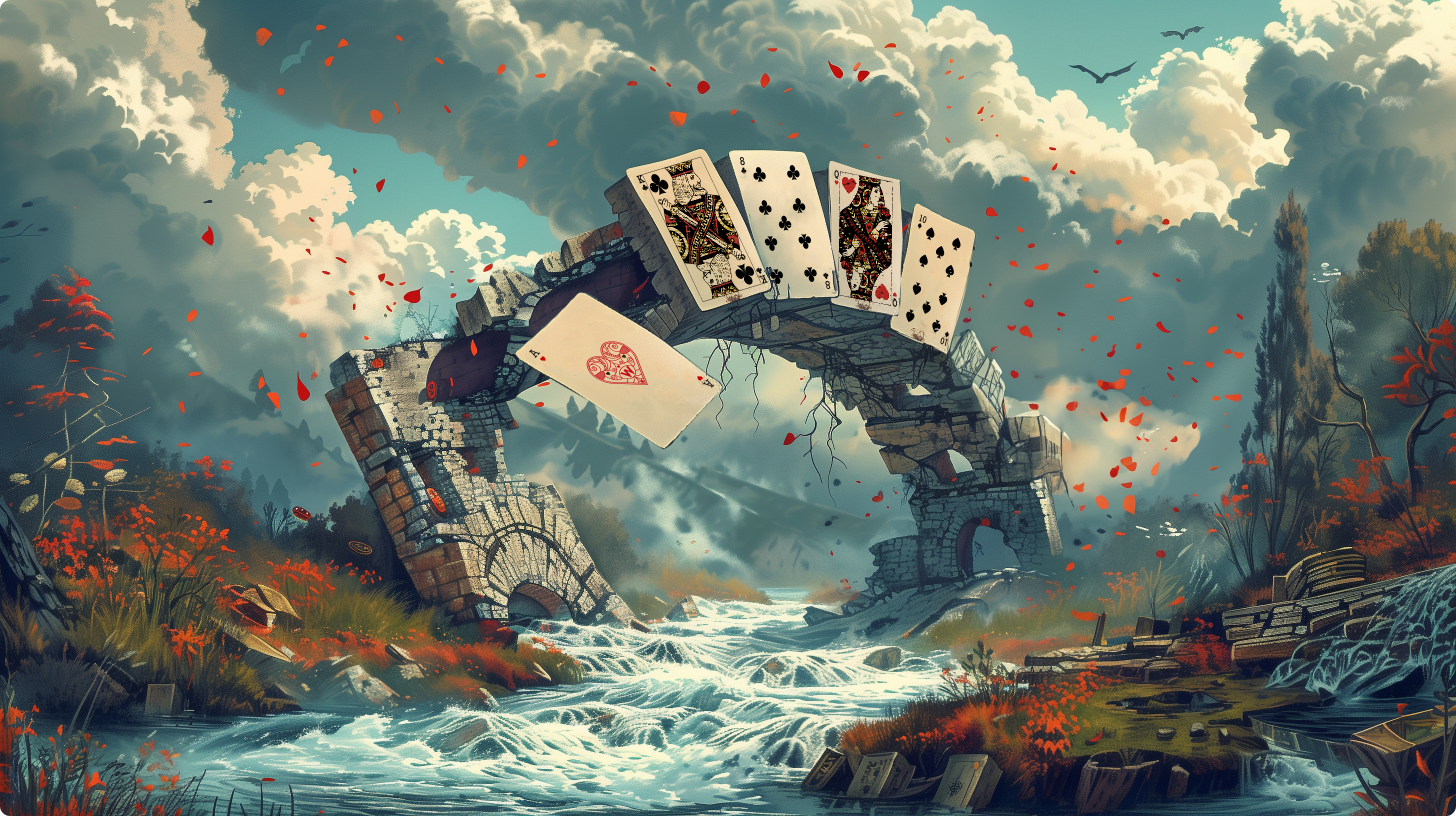
Playing without a position (OOP) is always difficult.
It carries a fundamental inconvenience: you have to act on every street without knowing what your opponent will do, while he makes his decisions already having information about your actions. This disadvantage becomes especially noticeable on dynamic rivers. When the final board card opens up the possibility of new monsters, it simultaneously devalues previously strong combinations. The hands with which you actively increased the pot on the flop and turn may suddenly prefer a cheap showdown.
But to achieve this cheap showdown, you will have to check or make a small bet, which can give your intention to the opponent. In return, he will be able to make a bet or raise with a polarized range, leaving you with a difficult choice. Game theory does not offer a magical solution to this problem. Solvers also lose money without a position, just like regular players. But they lose the lowest possible amount, as they balance their range and minimize the leakage of information by their actions. We will learn the key principles to minimize information leaks and improve your game without a position.
1. Prevention is better than cure
The best way to deal with difficult situations is to avoid them. If you anticipate a difficult spot, the best way to minimize the damage is to keep the pot small.
How do Solvers avoid problematic situations?
Narrow opening range from early position (EP)
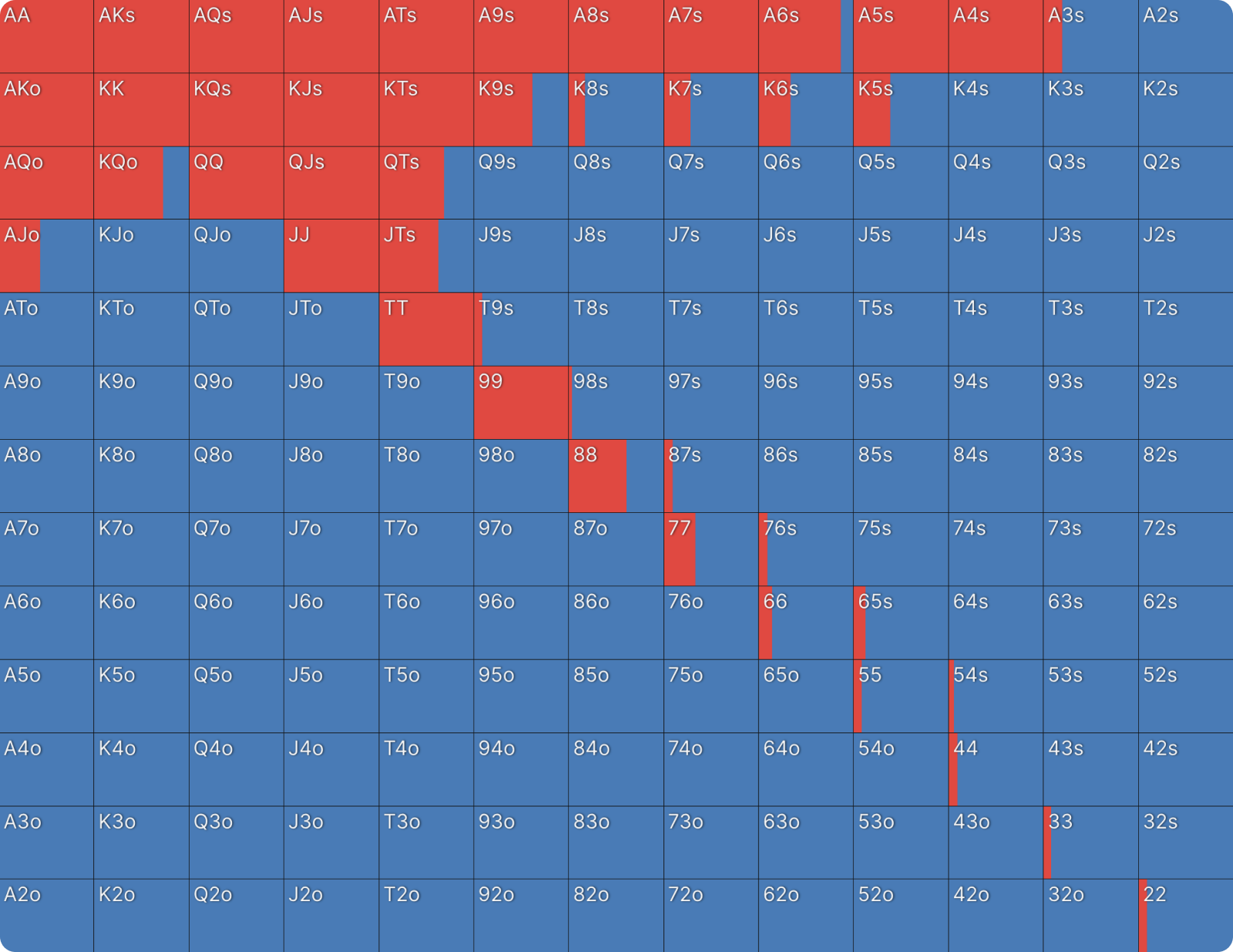
Solvers open with a narrow range from an early position, focusing on suited hands. One of the most vulnerable combinations to bad river cards is hands with one pair. Suited starting hands, of course, also often turn into one pair, but at least they have a chance to collect flush. Here is an example of the UTG opening range for a cash game at a depth of 100bb at a 9-max table.
He demonstrates how solvers prefer to open only the best offsuited hands, but at the same time they are quite liberal about monomastics (and to a lesser extent — about connectors):

Rare call of open raises in early positions
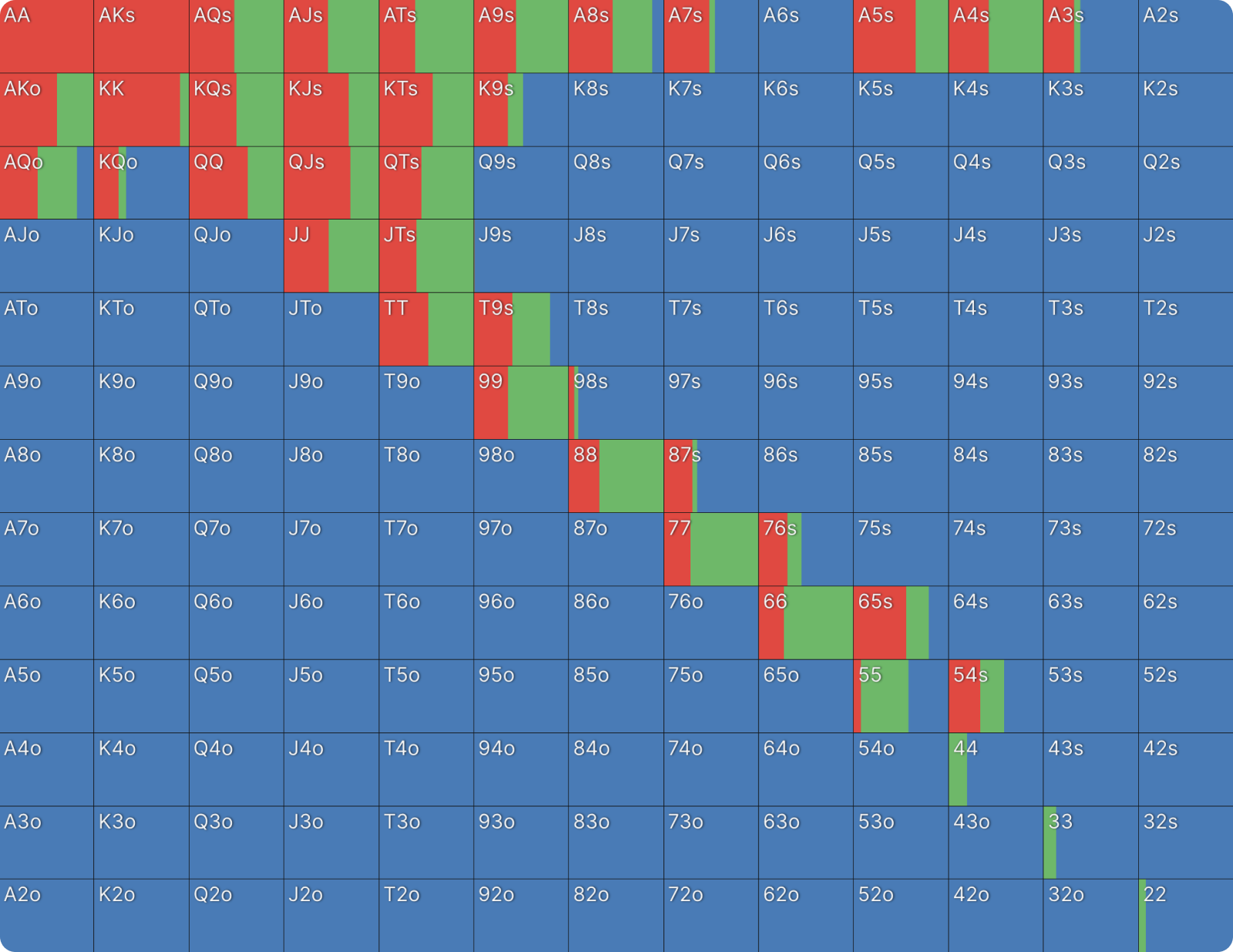
Solvers rarely call open raises of early positions. In the no-flop, no-drop structure, this stimulates an aggressive 3-bet. But even in a game without rake, solvers rarely answer a call in early positions and prefer suited hands, if they call. Calls allow players with a more advantageous position to make a Squeeze or call after you, forcing you to play without a position after the flop.
- For example, HJ 's strategy against LJ 2bb's open-raise in a rake-less cash game in the depth of 100bb:
Rare counter bet with no position c-bet
C-bet without position (OOP) is much less common.
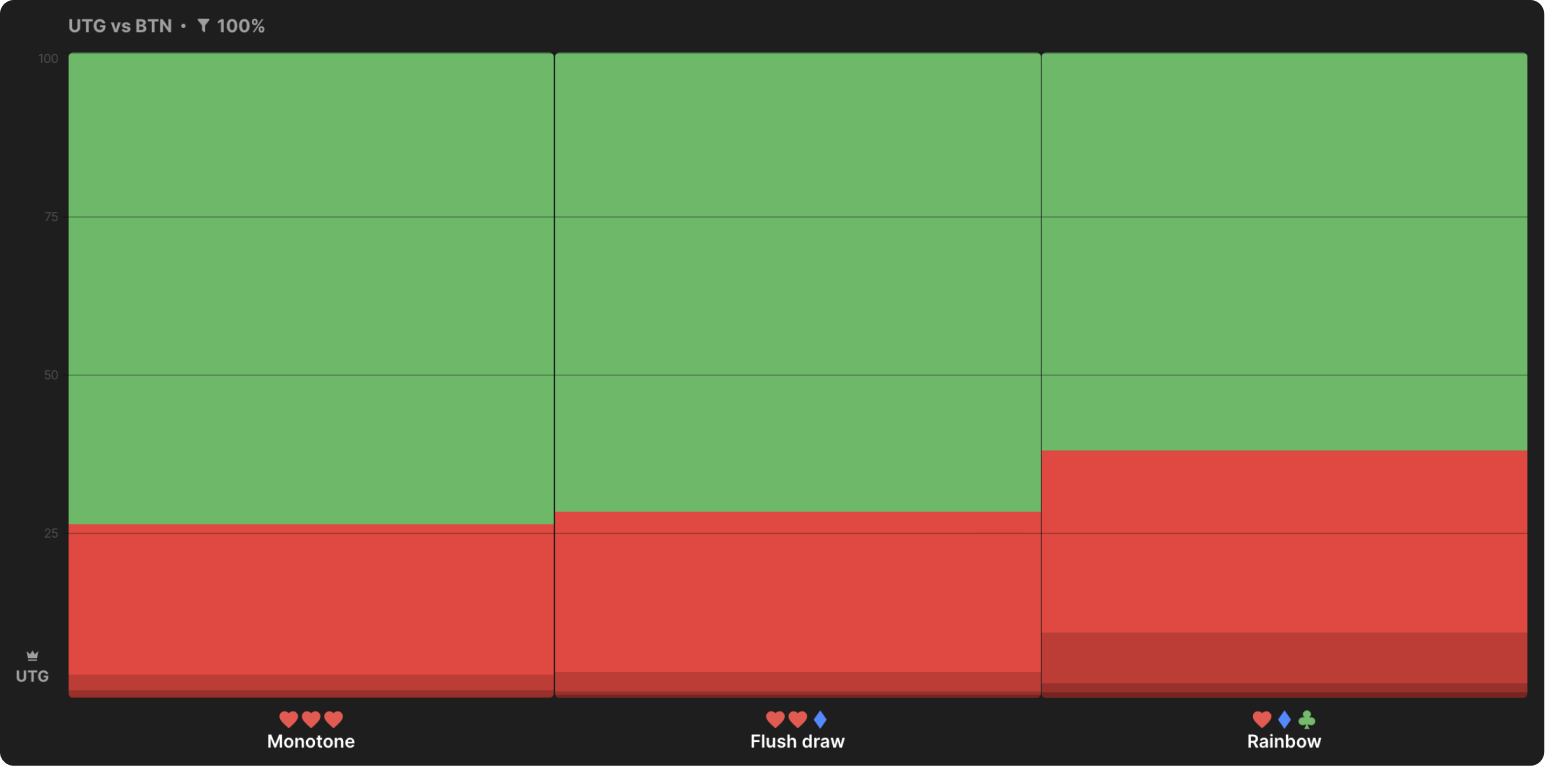
In this case, LJ vs. BTN on the flop in a Single Raise pot (SRP), LJ makes a c-bet in fewer cases, and this most often occurs on less connected flops:

When a player out of position encounters a dynamic board texture, even a strong hand on the flop can be jeopardized by the changing situation on the following streets. If the texture of the board will strengthen the opponent, it becomes more dangerous to inflate the pot, even if the hand seems strong.
Having a flush draw on the flop has the same but less dramatic effect.
Solver approaches clearly favor counterbets on safer board textures:
Increased 3-bet out of position
3-bets without a position are often larger in order to increase the likelihood of taking the pot to the flop and minimize complex decisions on the streets.
- For example, against opening with UTG in 2bb in depth 100bb 6-max cash game solver chooses 3-bet of size 7,5bb on Button, 10bb on SB and 12bb on BB.
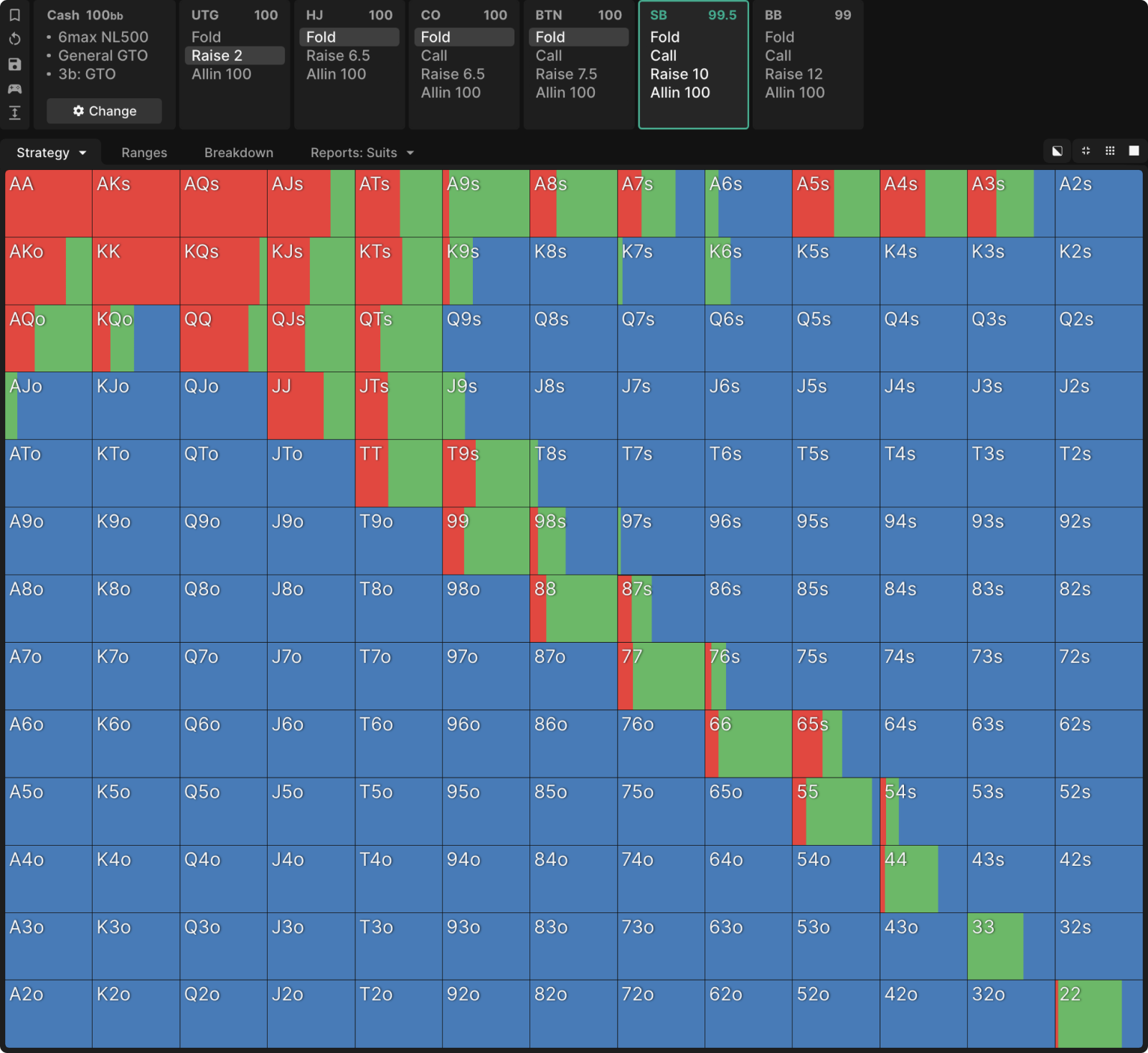
Increasing the size of 3bet also reduces the SPR (stack-to-bank ratio), except for post-flop decision making and gives you the opportunity to stack-off with weaker hands to the river. Despite this, the solver continues to give preference to single-masted hands in 3-betas, since they have great potential for strengthening on the post-flop.
2. Exit to the river
Don't you think it's strange that this article about complex solutions on the river has so far discussed only solutions on preflop and flop? It's no coincidence! You should think of building your range on the early streets as the foundation on which your subsequent decisions will be based on the subsequent streets. If you build a flimsy foundation that is skewed and shaky on many rivers, then of course it will collapse. The following is a tip on how to make the most out of a bad situation on the river, assuming you get there with the right range. If your range is skewed — if you have too many weak or middle hands and not enough nuts - it will not be enough to help you out.
Range on early streets is the foundation for subsequent decisions on late streets.
This hand begins with the player on the UTG playing in a one-raise pot (SRP) one-on-one against the BTN in the MTT in the depth of 100 bb. On the flop

 , UTG makes a cbet of 33% pot, as does the solver with 72% of its range (this is a particularly suitable flop for UTG). Then he continues with a rate of 83% of the pot on the turn
  and leaves the river
 , covering both gatshots from the flop and the backdoor flash draw. It's not necessarily a nightmare, as long as you approach the river with a reasonable range and play it right.
Solver expects that UTG will have a significant edge in equity and quite well realize it (104%):
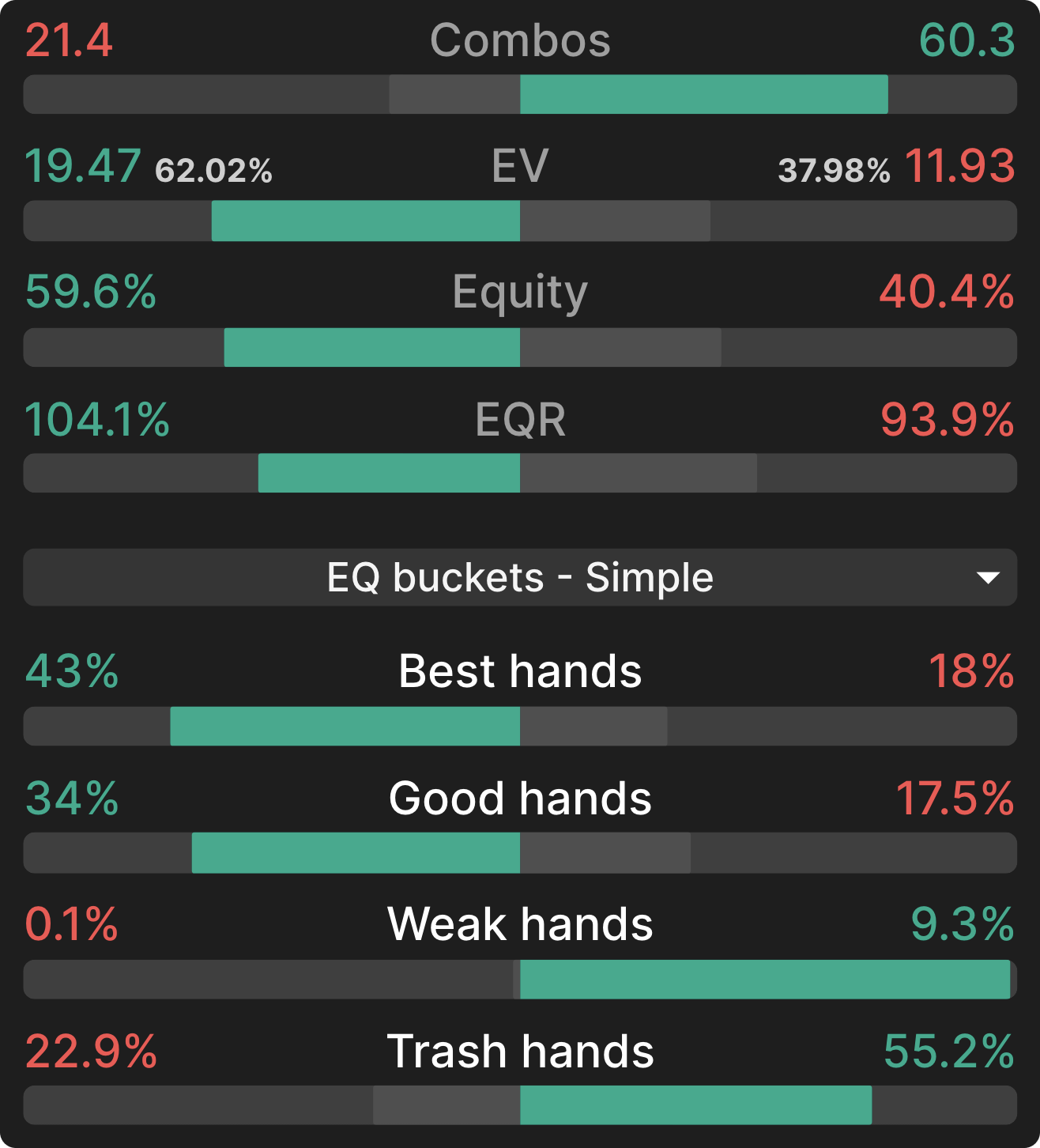
This edge is mainly maintained due to the high equity and advantage on the nuts that UTG had after the actions on the turn. Some other rivers are even more favorable, for example,  with 113.7% EQR and completely neutral
  with 110.9% EQR. But some parts of the UTG range suffer, as they are no longer as strong as they used to be. This applies not only to hands like AK and AA, but even sets!
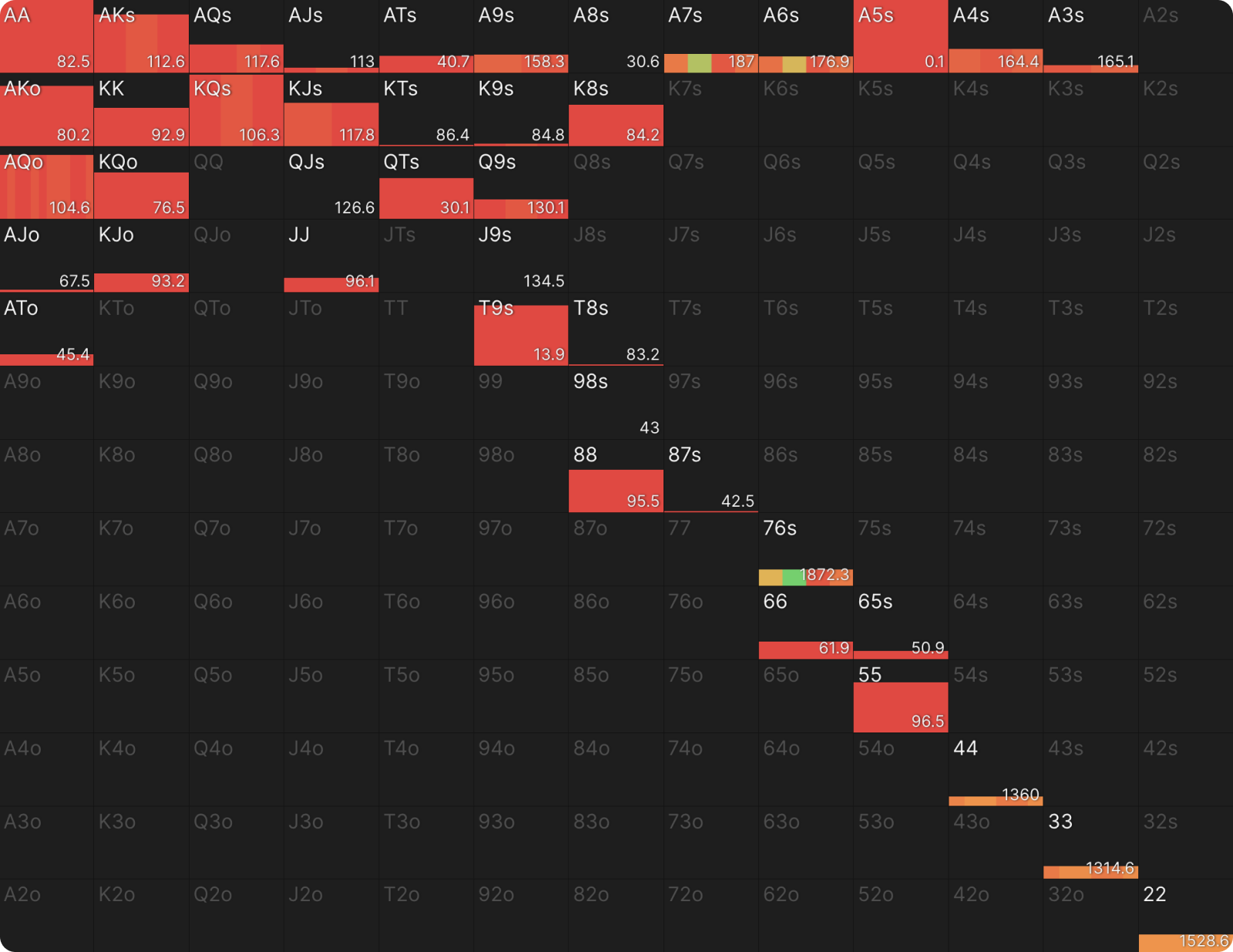
These equity realization metrics are a best-case scenario. They depend on the exact balance to avoid excessive vulnerability at any stage of the game tree. This includes the “check” and “bet 10% pot” lines, which are particularly difficult to balance and which are often rightly perceived as weak. Since this is such a complex situation, it will be more difficult for us mere mortals to reach the theoretical EV solver. But we can approach it using concepts based on solver strategies.
3. Don't give up
It's easy (and right) to imagine all the ways this river map could help your opponent. But remember, your villain thinks the same about you. Your range for bet on flop and turn should consist mainly of strong ready-made hands and strong draw, so that on the river that completes all obvious draw, it will be difficult to find weak hands for bluff. If you still have such a hand, use it!

Solver puts only his weakest hands, which indicates that they are profitable, not zero-sum. The only weak hands he mixes into checks are those that have a small showdown velle or blockers on the opponent's fold range (usually both, as the middle pair forms an important part of the fold range).
4. Set traps
Did you notice in the Manhattan chart above that there are also a lot of checks and small bet at the top of the Hero range? This is important! You will often wait and place small blocking bet with obviously vulnerable hands, creating an incentive for the opponent to attack with large bets and raises. This, in turn, encourages you to add Nutritional Hands to these range to benefit from such enemy aggression.
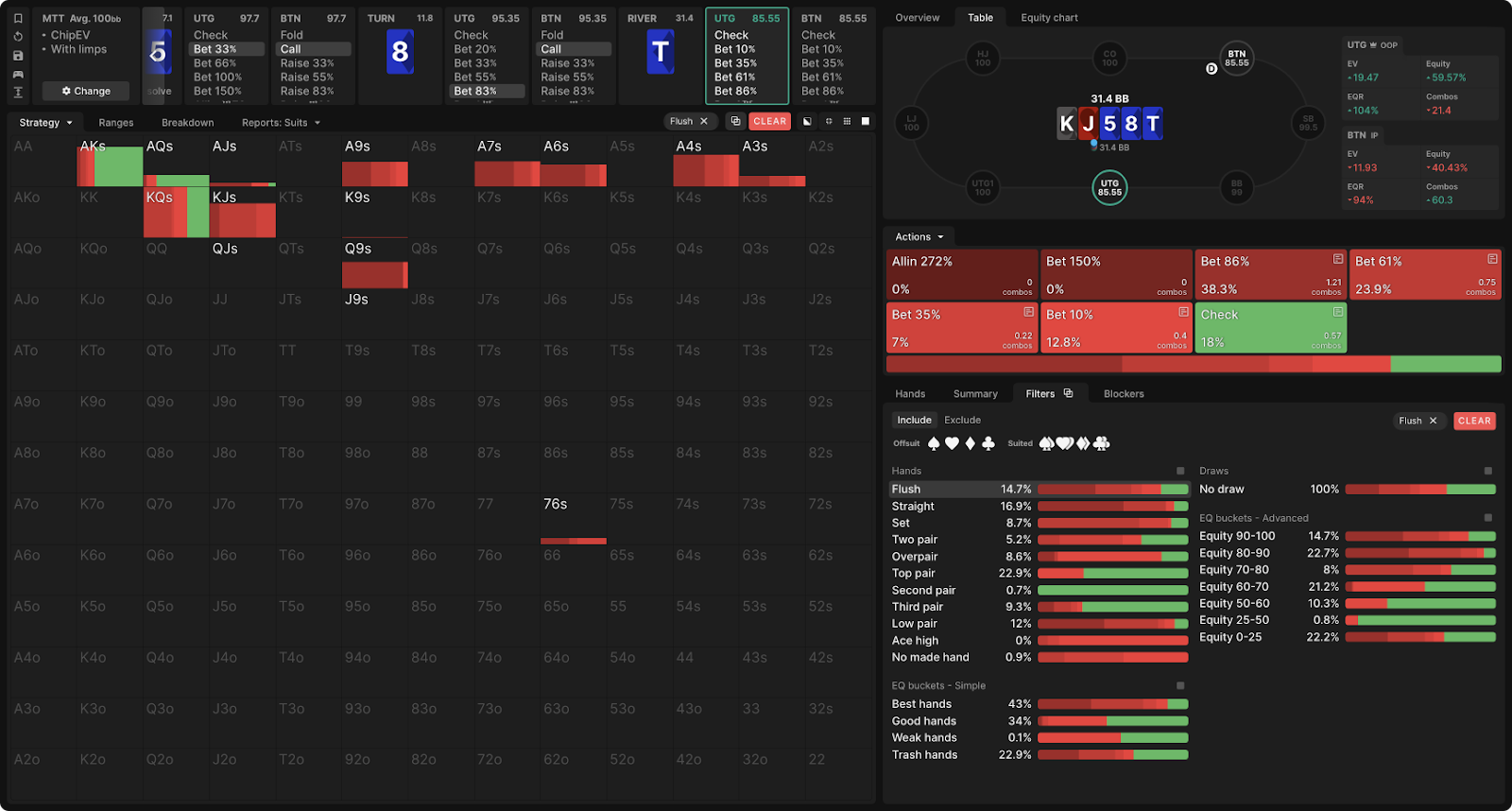
The best traps block the hands that could call a big bet.
Solver distributes flushes throughout its range (the largest bet sizes are not used by any hand). But this distribution is not accidental. Some hands are better for bet, others for traps. The best traps are the hands that block the opponent's call range, consisting mainly of K-x and large diamond cards. Such hands are less likely to be colored with a large bet, so they are more likely to wait or make a small bet.
5. Do not place too large
A large UTG bet on the turn was made in order to prepare large polar bet on the river. On the neutral river, overbettes occupy a significant part of their strategy. This is due to the fact that the BTN range is mainly dropped after the call on the flop and turn, and the neutral river does not change this. However, this river is not neutral. It unlocks the BTN range, turning a sufficient number of draw and medium strength hands into monsters, so that UTG no longer has such an advantage in nats that it would encourage large polar bets. Therefore, the largest bet size that is used is 86% of the pot, despite the fact that almost 3x of the pot remains in effective stacks.
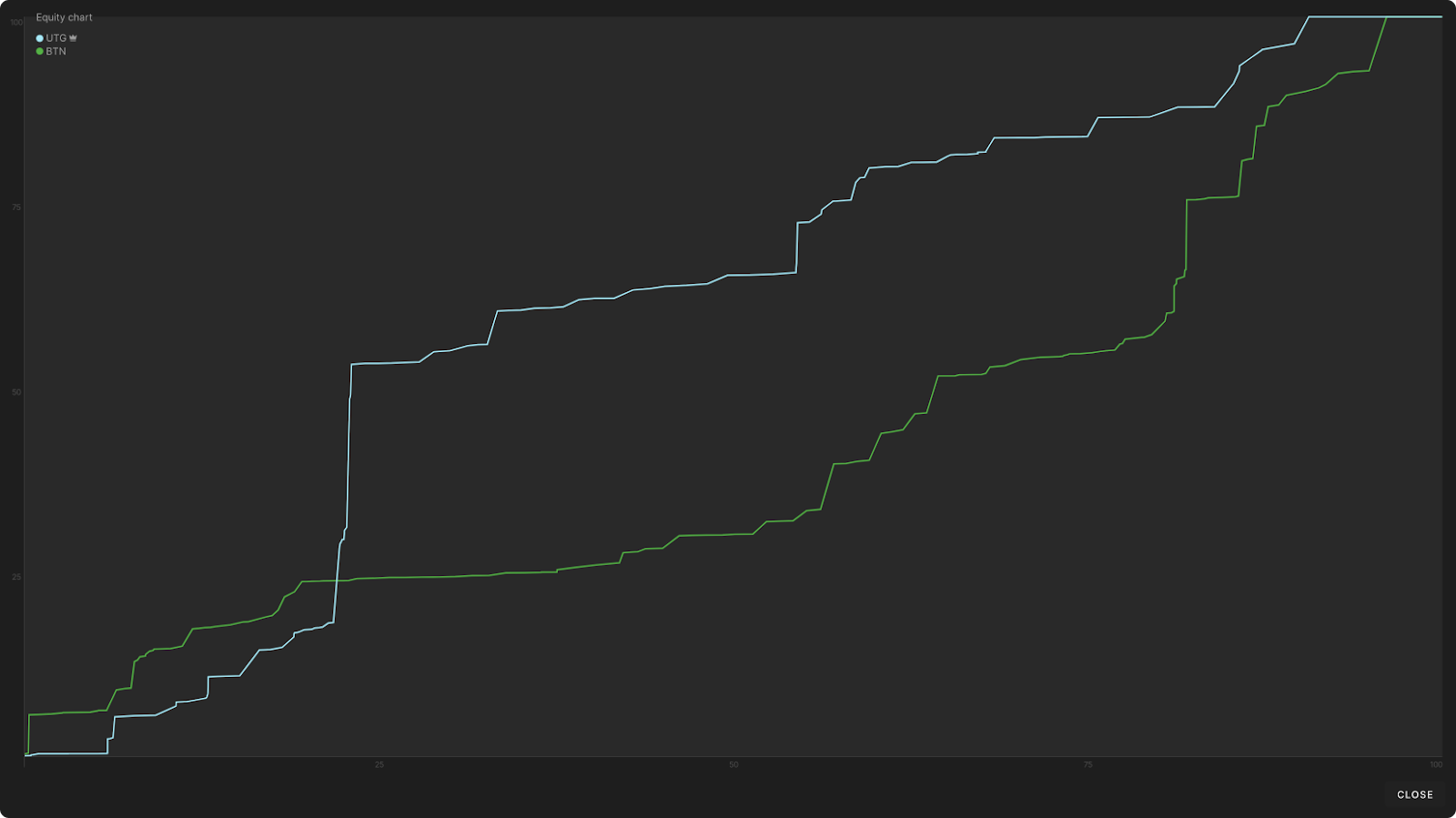
The biggest edge of UTG is in the middle of the equity distribution, so it focuses its attacks on that range through mid-size bet, even if it has nuts.
6. A check is not a delivery
When a “scary” card lands on the river, you will often find yourself in awkward and uncomfortable situations. This is what makes such cards scary. Some of your hands will under-realize their equity, which means that you will occasionally drop a winning hand or make a call while behind. But breathe out, all is not lost. Your villain opponent won't always attack your checks and blockbets with large betas or raises. He doesn't know if you're waiting to fall, call, or even make a raise. Sometimes the opponent may have a slightly weaker hand of medium strength, and he will be pleased if he can get to the autopsy with you cheaply. This is the main value of the receipt. Since you are waiting for some nuts' hands to raise the value, you can also check-raise some bluff.
It is quite easy to find them:
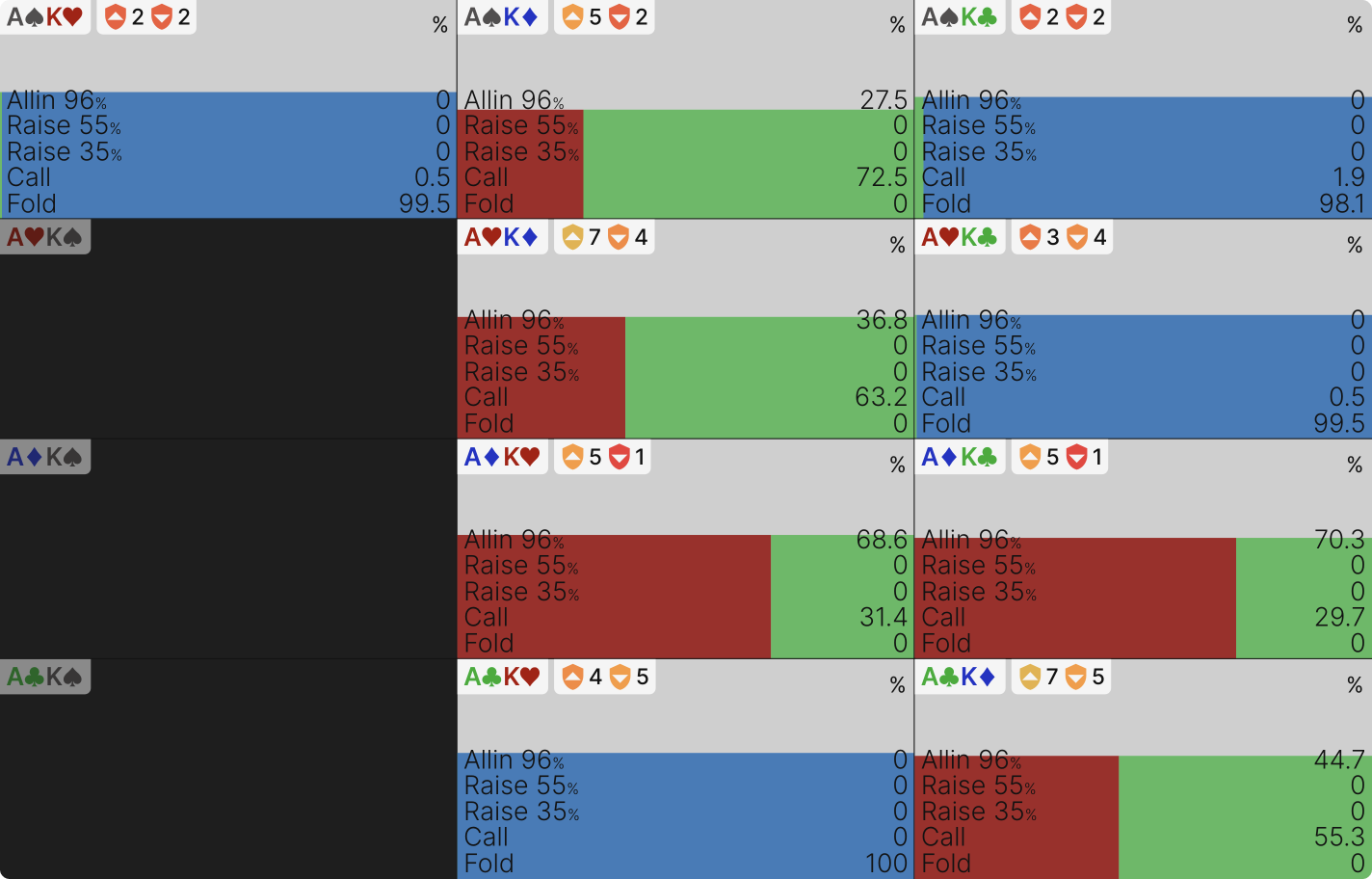
When you wait for AK, it doesn't necessarily mean you're going to bluff. Your hand has a showdown velle, and sometimes you'll win the pot if you get to the autopsy. Only if your villain bet, your hand loses its value. Even then, if you have a diamond suit card, your hand becomes a candidate for a call to beat bluff, or a raise to knock out two pair or sets (its thinner valleys).
7. Block bet is practically a check... or not
Check or bet of 10% of the pot is almost the same here. Both options add very little money to the pot, and your villain should react to them in the same way: put or raising approximately the same hands to the same size and call most of the hands that he would simply check in response. Everything said above about which hands to check and how to react to a bet applies to blocking bets as well. When you are in a position, the situation changes because the bet opens the action again and raises you, whereas the check guarantees you a showdown. Outside the position, your blocking bet range should theoretically be slightly stronger than the check range, but this is an insignificant difference. Unless your villain is coping with one of these situations worse than the other. Here we go to the exploit territory, so be careful.
If you can predict an opponent's reaction in one of the following exploited areas, you can adjust your range to increase profits:
Excessive fold on small bet.
This does not necessarily mean that the villain has good hands. Some players are just much more willing to bet than raise. If they don't bluff, they'll fold too much because they won't have “anything good” often enough. This means that you should shift your weak hands to the small bet range to benefit from these folds, and also set traps with strong hands through the check, not through the blocking bet.
Insufficient fold on small bet.
Even getting 11:1 odds, sometimes it's right to fall. However, some players cannot accept this because of their ego. These players perceive a small bet as a personal insult and begin to call and raising too aggressively. Exploit this by never bluffing with such a line, adding more nut traps to the blocking bet range and catching bluff more often if they do.
Failure to use fine valu raise.
Your opponent does not need to have a flush to raising your blocking bet. Two pair is quite enough, just as they would be enough for a valley bet after your check. Against players who don't raise without nats or almost nats, a blocking bet is preferable to a check with all your average hands. This allows you to squeeze a little more value when you are ahead, while you are less likely to face difficult decisions when raising (not necessarily because the decision becomes easier — your opponent's raising range may still leave you facing a call dilemma — but because such players are raising less often).
8. Conclusion
Playing without a position is always difficult, even if you are a solver. It is especially difficult when the texture of the board changes dramatically, devaluing some of your hands and reinforcing others. The first step is to exhale and remind yourself that this card can be scary for your opponent as well. Then reconsider the value of your hand.
Play with the hand you have now, not the one on the previous street.
If your hand is now closer to the bottom of your range, it may be time for a bluff. If she still has a showdown veil, start with a check, but stay open to the possibility of turning it into a bluff as a bluff if the villain bets. There's not much you can do to save EVs from previously strong hands. Sometimes they will get into difficult situations, no matter how you play. What you can do is remember: when you have a monster, how easily you could end up with a more marginal hand and how nervous you would be in this situation. Remember that in such a situation you would make a check or a blocking bet and how much you would hate the raise from the opponent after that. Then consider using the same trap line with your nuts hand.