

Translated with the help of AI. We apologize for any errors and would appreciate your help in correcting them.

Translated by order of the educational portal university.poker
Article by Andrew Brokos, original source: GTO Wizard
You should always keep in mind that the game against the cold call in the position is radically different – and much more difficult – than the game against the cold call from the blinds. You should not expect to have the same range advantage you would have against a blinds' edge. Depending on your position and the position of the colleague, you may not have an equity advantage at all, and the lack of a position puts you at a disadvantage. Thanks to new features that allow you to solve problems using custom preflop ranges, we can now consider this scenario in greater detail. In particular, we will consider cases where the cold call range is wider and weaker than that of a standard solver.
Such overly loose opponents are often found in live tournaments and online MTTs at micro and middle limits.
So it's helpful to think about how you can tweak your game to take advantage of their mistakes. In the examples below, we will look at two such offsuited flops 

 -
- 
 and with flush draw - to see how our strategy changes when playing against too loose calls. These exploits will not be based on any further assumptions about how the opponent will play the post-flop villain. If we knew, for example, that they would also play too loose on the post-flop, we would have additional opportunities for exploitation, but now we will focus only on exploiting their too wide range on the pre-flop.
1. Who makes a profit
First, it's important to note that being too loose to your left isn't necessarily good for you. Although their loose calla are errors that can result in the loss of their EV relative to an equilibrium strategy, you are not the primary beneficiary of these errors. In short,
these calls can result in loss of EV for both the original racer and the collier. The main beneficiaries of this mistake are the rest of the players still in the pot.
When they wake up with hands strong enough to raise, they win more chips on average, as the collier very rarely has a hand strong enough to hold a 3-bet. Even if they stubbornly call again, they will invest a lot of money in the pot with a too weak range. Thus, the loose cold-color takes the EV from the original racer, but gives an even larger amount of EV to the players behind it. One of the most important techniques worth mentioning here (although we won't go into it in detail now) is narrowing your opening range when there is such a player behind you.
This is especially important if this player is on the button, where he is likely to make a call. This is only true if the player has a position on you. If they're in the blinds, you don't really care about their loose call. Indeed, you are likely to profit from them. But when they have a position, you should fold some of the weakest hands that you would otherwise open with a razor from your seat. These weak hands will be ineffective if a loose player sits behind you. Your compensation for this will consist of greater gains with your strongest hands, which will profit from these puddle callas.
For comparison: the following experiments do not make any changes to the range of the original racer. But it is worth bearing in mind that when you find yourself in a similar situation, you should usually open a little more tight when there is such a player behind you.
2. Speculator
In this experiment, we explore how to play against a hypothetical opponent named Speculator. He likes to get strong hands and win big pots and is willing to pay too much for this privilege.
The speculator refers to poker as a slot machine.
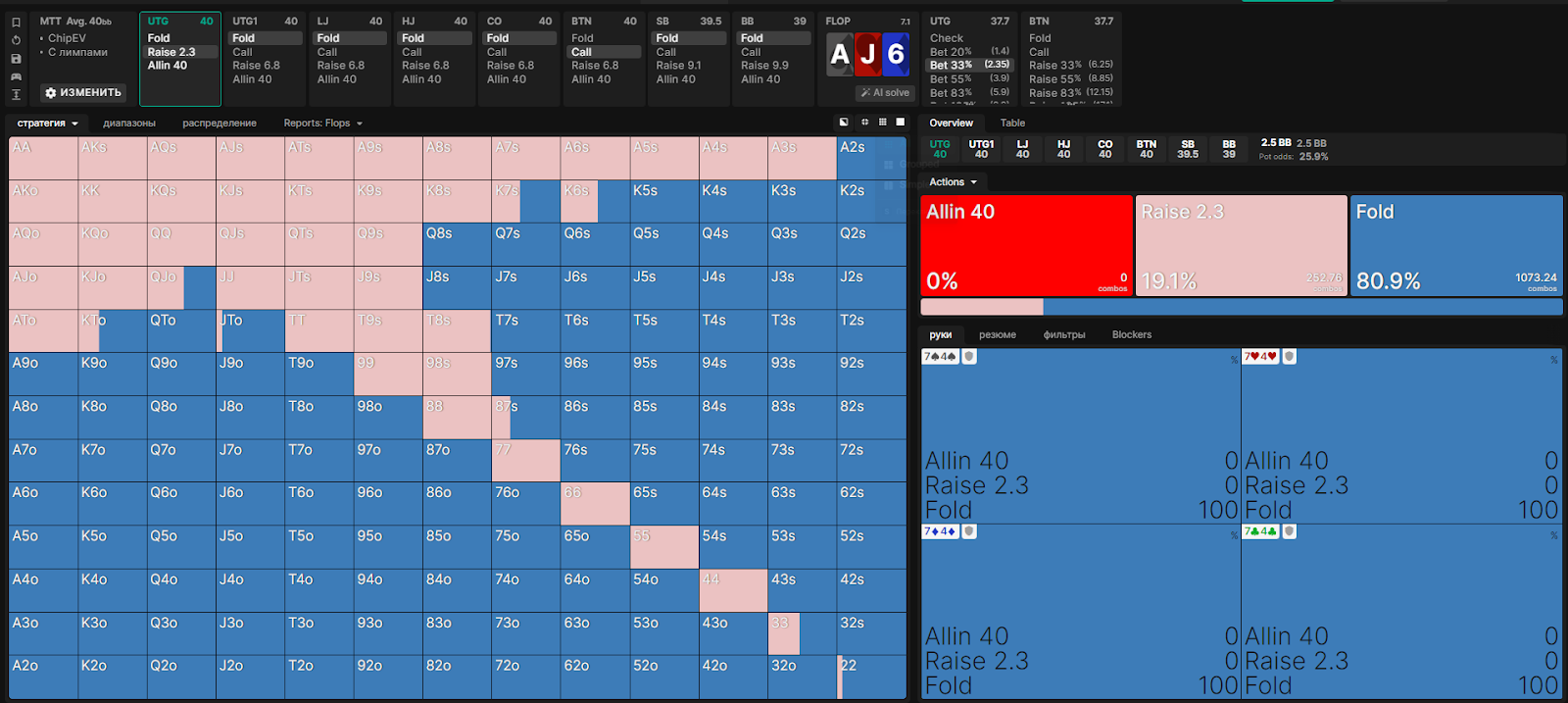
First, let's look at the GTO Wizard strategy in the ChipEV environment for a 2.3 BB call from UTG on a button in 40 bb stacks.
It has a lot of older cards, pocket pair, suited aces and suited connectors, as well as slightly weaker suited hands:
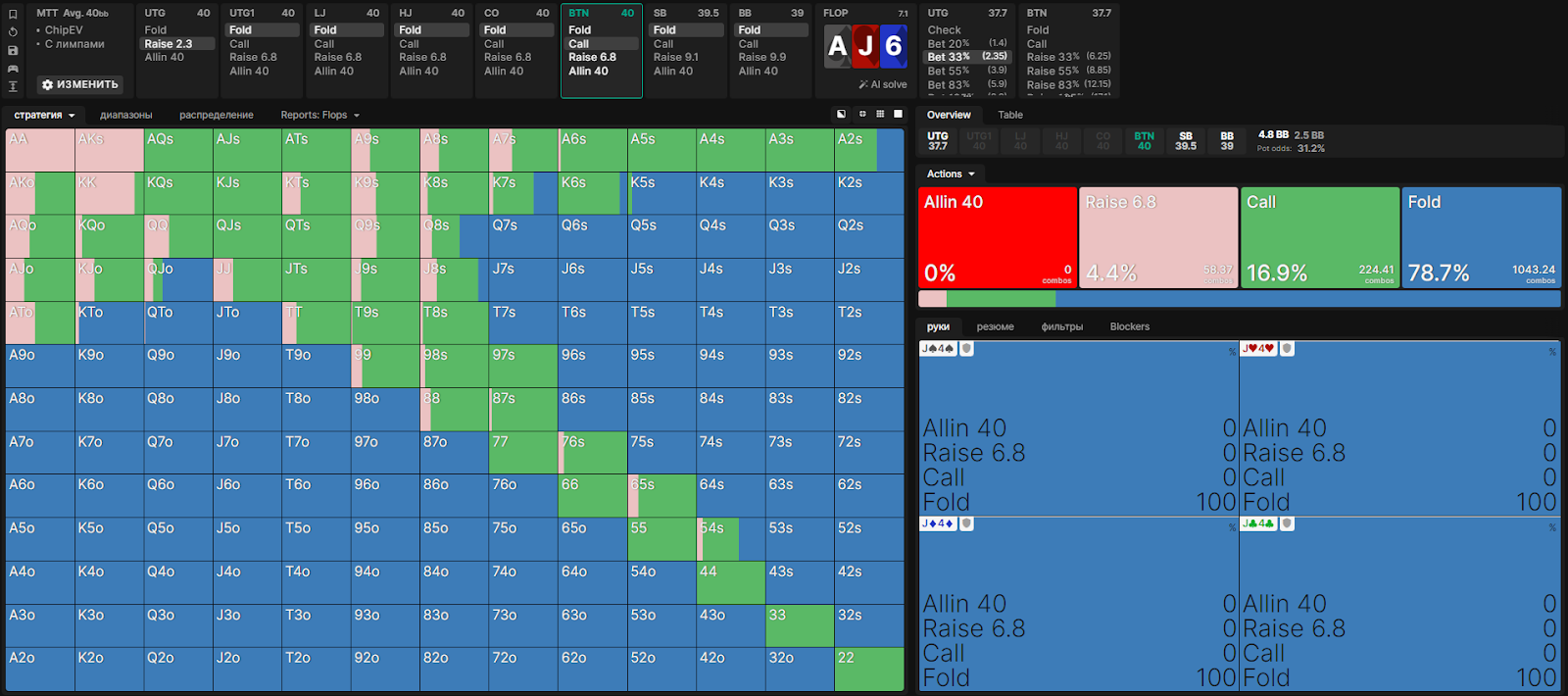

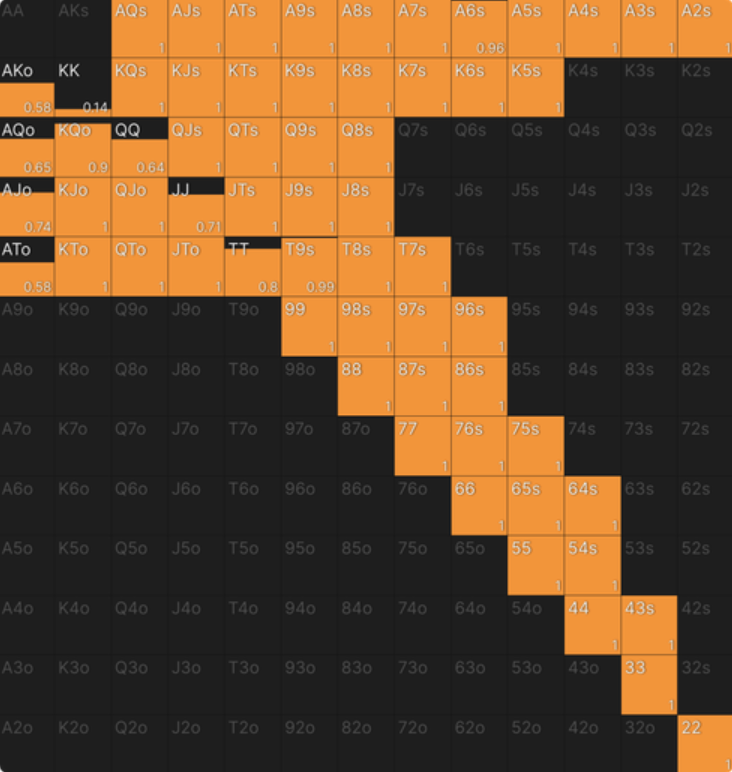
But for the Speculator in this example, we will expand the range by about 40%, adding some weaker hands with the potential of straight and flush (for example, T7s, 43s) and other offsuited broadway hands.
We will also turn some of the most speculative hands (e.g. Q9s, K7s), in which callas and raises are equilibrium mixed, into pure callas:
3. Playing against a speculator on a non-dynamic flop
- First, we will look at how to exploit the Speculator on the flop:
Bank 7.1 BB (8 players ante * 1/8 BB + 0.5 BB + 1 BB + 2.3 BB raise UTG + 2.3 BB call BTN)
The balanced GTO Wizard strategy for a player on UTG is a mixture of checks and small continued bet, with the checks coming mainly from medium strength hands and hands that have not fully entered the flop:
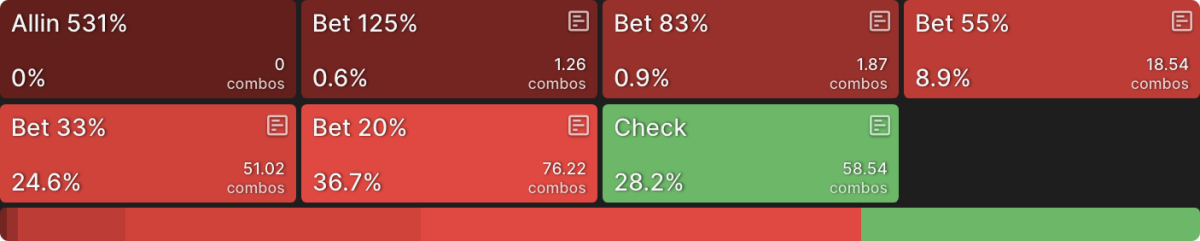
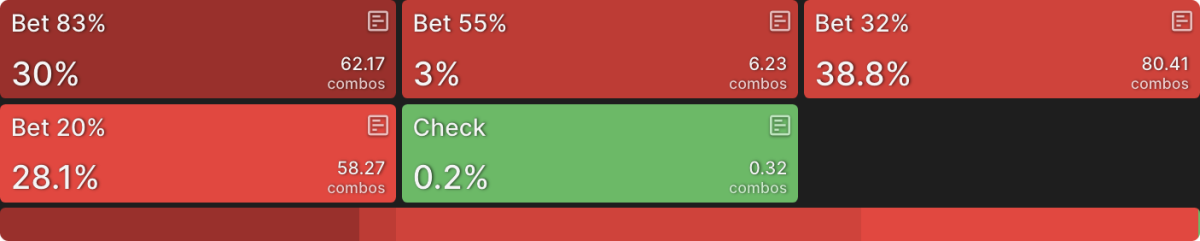
But against the Speculator, GTO Wizard never makes a check and largely uses a bet of 83% of the pot, which is not used at all in the equilibrium strategy:
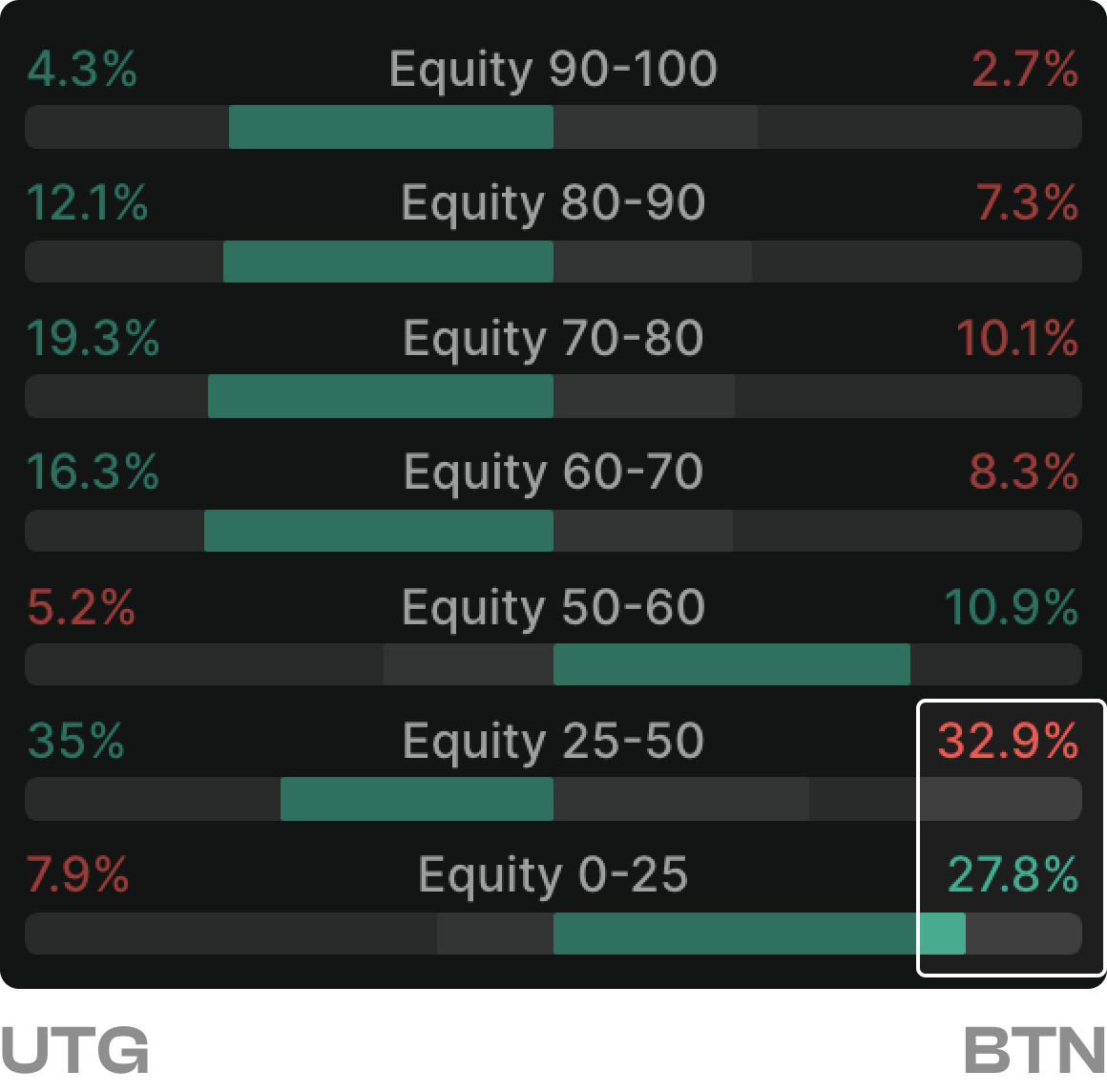
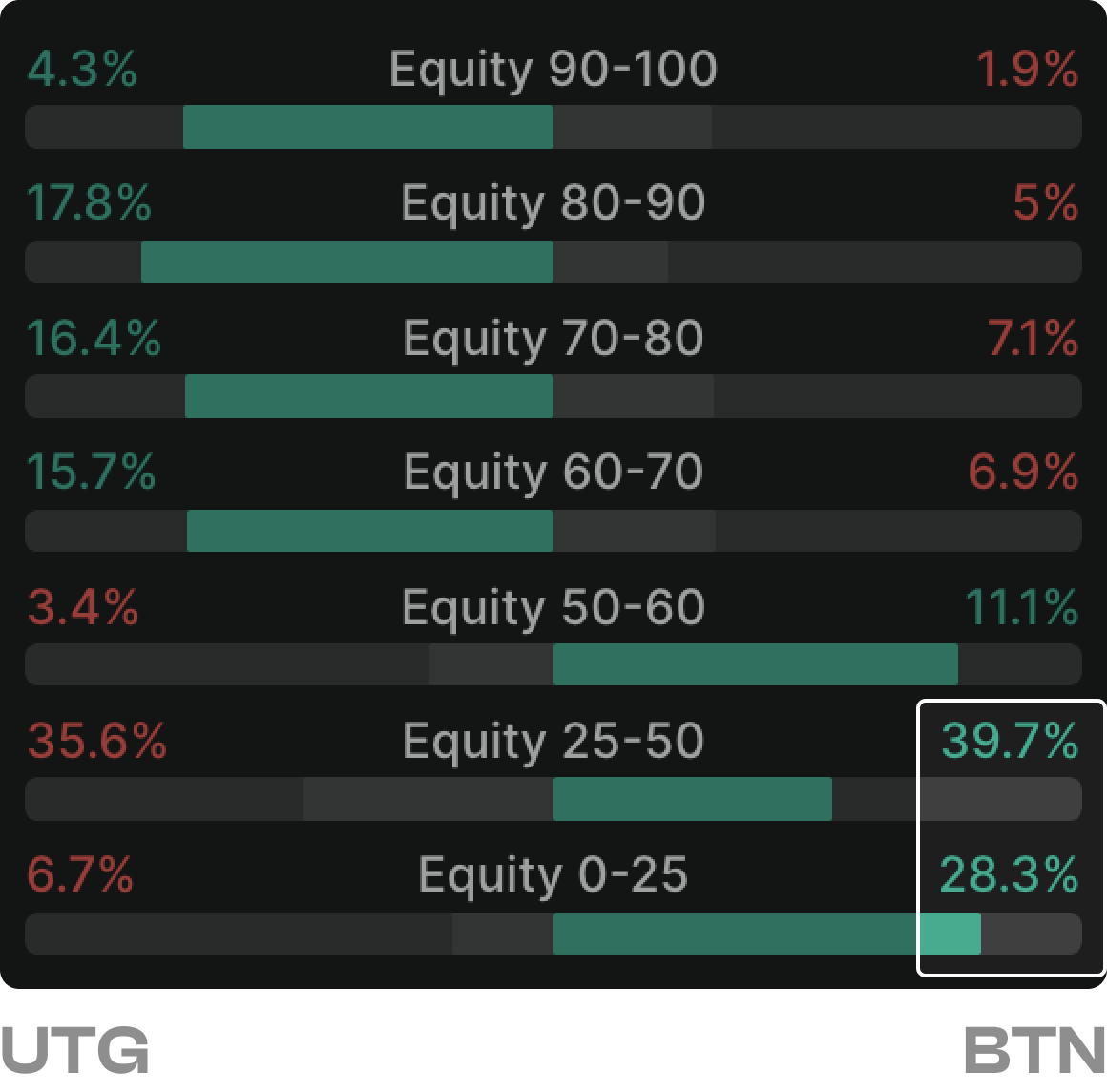
As can be seen from the comparison below, the speculator's preflop loose calls blur his range on the flop due to the large number of hands with low equity. Many hands with low suited combinations miss completely, and even when they fall into the flop, they are more likely to make a second or third pair. On the left, we see the equity forces for UTG versus the equilibrium range of the BTN call.
- On the right we see the distribution of UTG forces against the range of the Speculator's call on the board:

There are three main changes in their equilibrium strategy:
- Weak hands like the K9s and 98s, which were among the most frequent UTG checks in equilibrium, are starting to make bet. They often prefer a larger bet size, as with a stake they will have little equity, no matter what size of bet they choose, and so they will prefer to get the maximum fold equity.
- UTG makes bigger bets with their strongest hands: AK, AQ and 66 (JJ continues to make small bet as a trap because it unlocks the BTN raise range). Entering the flop with a wider range, BTN continues to drag even a larger bet, allowing the strongest UTG hands to get more value.
- UTG makes more bet on blocking/defending with medium strength hands such as 99, TT and weak Ax. These small bet denies some Kx and Qx equity, and they are colored by pocket pair, 6x and gutshot. UTG also includes several pitfalls in this small range of bet, notably JJ and AA, as well as a few weak Axes to benefit from BTN's incentive to twist it.
4. Play against the Speculator on a dynamic flop.
is not the flop you hope to see when a player in the cold-call position cold-calls your open-raise. The equilibrium strategy for UTG involves a lot of checks, often with the intention of fold ing the cards. When UTG makes a bet, it is mainly with strong but vulnerable overpairs, various draw and backdoor draw. Against the Speculator, the equity UTG is slightly higher: 51.4% compared to 50.5% against the equilibrium call range.
However, GTO Wizard advises a higher check frequency – 82.5% instead of 68.3% – against such an unbalanced player:
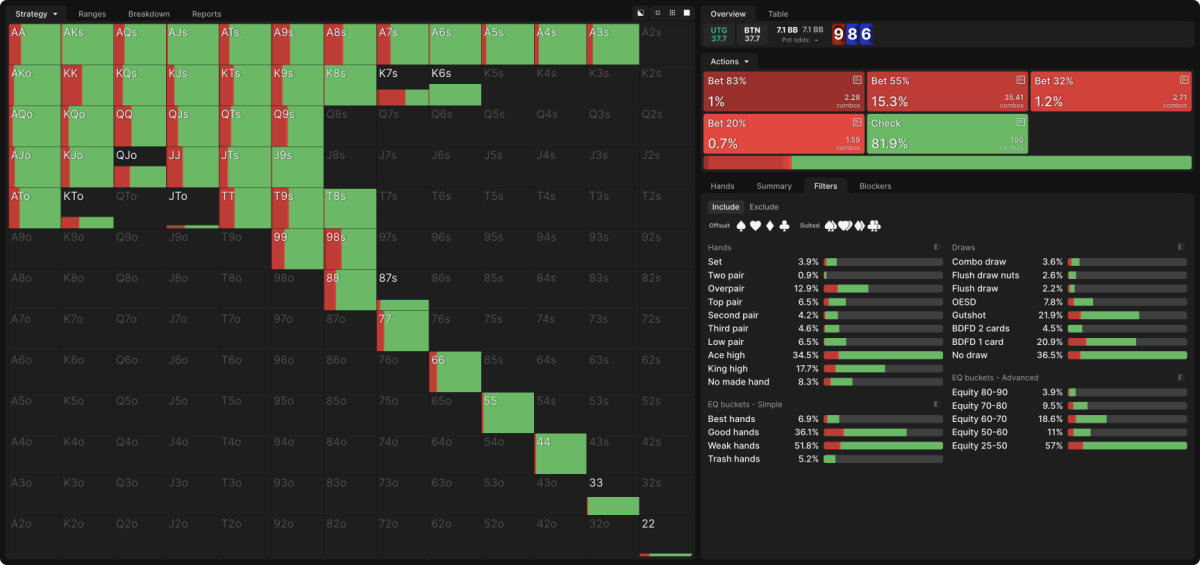
GTO Wizard also expects UTG to win about 10% less on average than against the more secretive BTN collier. So what's going on?
UTG has more equity, but it is in the hands that are good, but not directly super, and which will be difficult to implement.
It's just an incredibly good flop for the Speculator. His speculations paid off in the form of many monsters with flop and draw with great equity. Despite the fact that many weak hands dilute his range (as in the case of the board ), now he has not only the fact that nuts can form, so he is also in a position on the UTG. As mentioned earlier, UTG has more equity, but this equity is in the hands of good, but not premium ones, who will find it difficult to implement it on this dynamic board, so you should not increase the pot. If UTG does place a bet, it will do so with the same hands as in the equilibrium solution: with strong but vulnerable pairs and nut draw.
5. Game against China
This strategy remains roughly the same even against an absurdly wide range of calls.
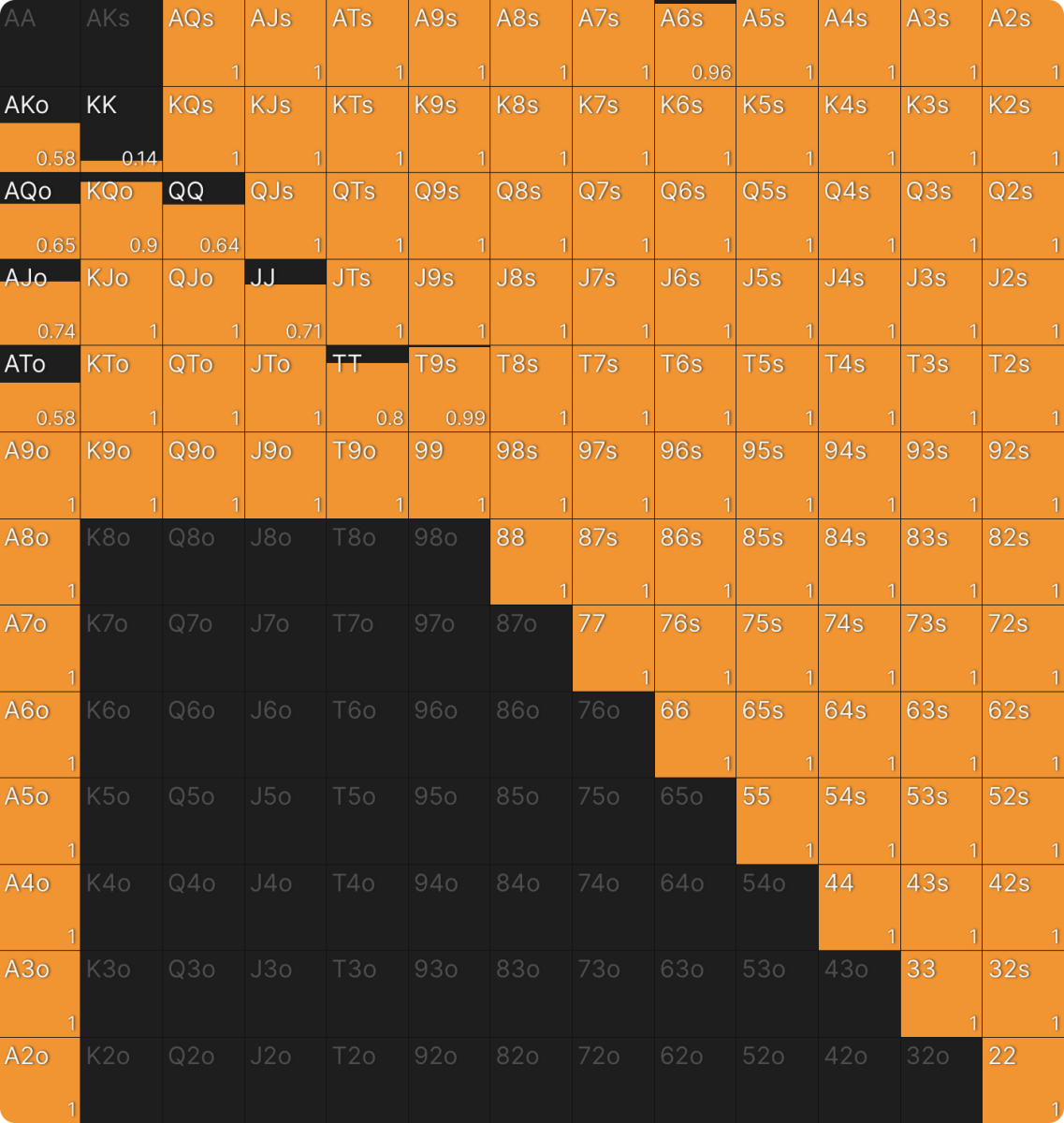
Here's a whale that collides on a preflop with any one-sided hand, any two cards 9 and up, and any ace:
UTG is still basically checks relying on the same types of hands when making a bet:
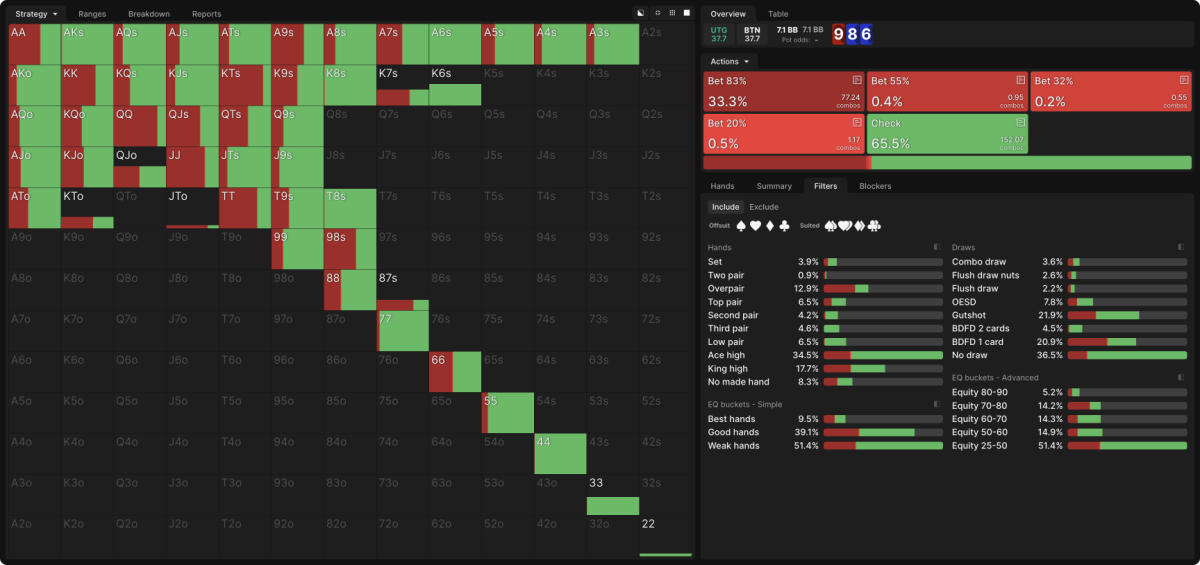
The main difference from equilibrium is not a higher frequency of bet, but a larger size.
Something similar happens on the UTG flop more widely uses the bet rate of 83% of the pot, as well as 20% of the pot:
What we practically do not see here at all is the bet rate of 33% of the pot. Keith's range is full of useless hands that have little incentive to keep playing even with a tiny 20% bet. Here, UTG has two different strategies: it makes big bet with a polar range (strong A-x hands and 66 per value, undercards to J as the main bluff) and small bet with a linear range consisting of hands with a thin value and a bluff with a high equity (KQ here is not just a gutshot, but often two overcards to a pocket pair of Keith).
6. Conclusion
Your opponent's mistakes are not necessarily your gain.
In a multiway bank, the villain may make a mistake that will cost you both money in favor of other players. This is what happens when a player cold-calls your open-raise in an extended-range position. In the case of the Speculator, many of his calls did not go too far beyond the equilibrium call range. At the same time, if there is no threat from blinds in the form of an overcall or tribet for such a player, then he can play quite well against you in the heads-up pot position. Whether or not you'll benefit from his puddle call depends a lot on the flop. On a flop that benefits you, such as AJ6r, you can bet more and more often to deprive the equity of its many weak hands.
On less profitable flops, you may have to give up even more often than against a more secretive player. This is not the case in extreme cases. A player like whale, who collegues too loosely, will have many weak hands regardless of the flop. Some flops are still better for you than others, but even on the worst flops you can bet bigger and/or more often and count on an average larger pot share than against a more secretive opponent. Of course, players who are too loose on the preflop may well make mistakes after the flop as well. The more you can anticipate and exploit these mistakes, the more you will benefit from playing against them, even without a position and on bad flops.