


Translated with the help of AI. We apologize for any errors and would appreciate your help in correcting them.
Translated by order of the educational portal university.poker
Original source: GTO Wizard

A lot of cognitive biases, mental models and heuristics that I'm going to discuss in the context of tools like the GTO Wizard affect our perception of poker. Much has already been written about how distortions directly affect the game of poker. In particular, the player's error (Gambler's Fallacy) and the survivor's error (Survivor Bias) — both of these distortions are widespread in a game where variance plays a large role. However, much less attention is paid to the distortions that affect the study of poker. Today I'm starting a series focusing on one of the most famous and perhaps most damaging distortions that can affect the use of poker learning tools - Confirmation Bias.
Confirmatory bias is our tendency to pay attention to information that fits our pre-existing beliefs and to ignore or underestimate information that doesn't.
- A simple example: if you believe that Donald Trump should be president, then most likely you will be looking for news on channels like Fox. If you think Trump is evil, you'll probably be looking for information on CNN. In both cases, the likelihood that you will come across information that challenges your point of view is very small.
Confirmatory distortion is also quite common in poker, especially when it comes to variance. If you are in downswing or even consider yourself a loser, you will most likely remember those three times when you were “moved” (cooler) in one session, and forget about those three times when you yourself moved someone else. You can even tell yourself that you “deserve” to be on the good side of these coolers because you were unlucky before. In this article, we will look at the same dynamics of confirmatory distortion, but in the context of using tools such as the GTO Wizard to learn the game.
1. Confirmatory distortion and study of poker
- Let's look at an example from one hand that I recently played.
At the beginning of the tournament with an effective 50bb stack, I opened with a BTN 
 . The big blind (BB) called, and the flop came

 , which BB checked. I felt that even though the 6 and 3 favored BB, it was a good board for the bet because I had stronger hands in the range with Q-x and all sets. Also, I expected BB to rake hands like AQ, QQ, 66, and 33 on the preflop, both in GTO and in the real game.
I decided to bet half a sweat, although I knew that, according to my research, a smaller bet would be more appropriate. In retrospect, I think my instinct was, “It's a dynamic flop, bet more,” although in reality no draw would drop its hand on any of these bet. Bet led to a fold, and I marked this hand to remember to return to it later in the GTO Wizard when I train.
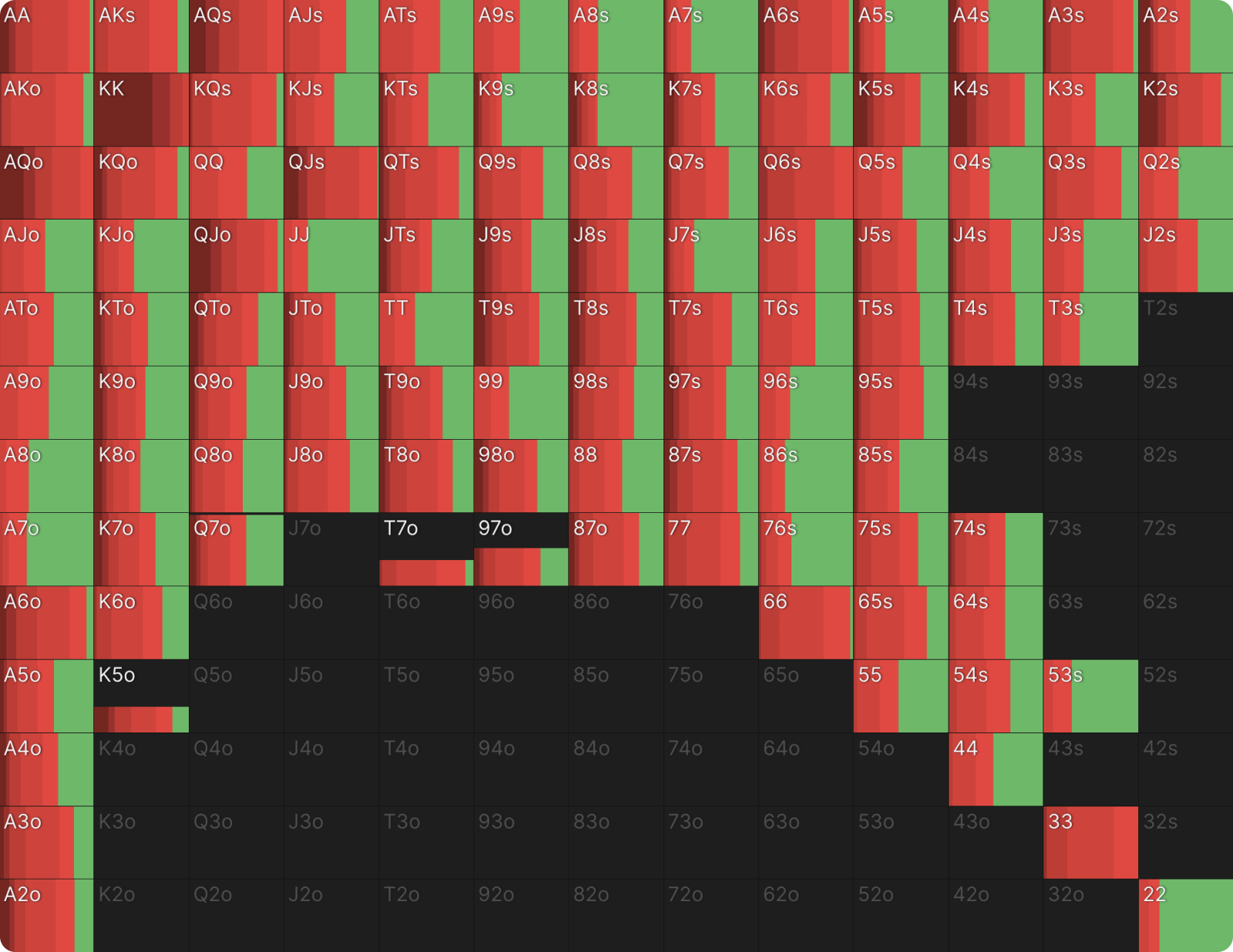


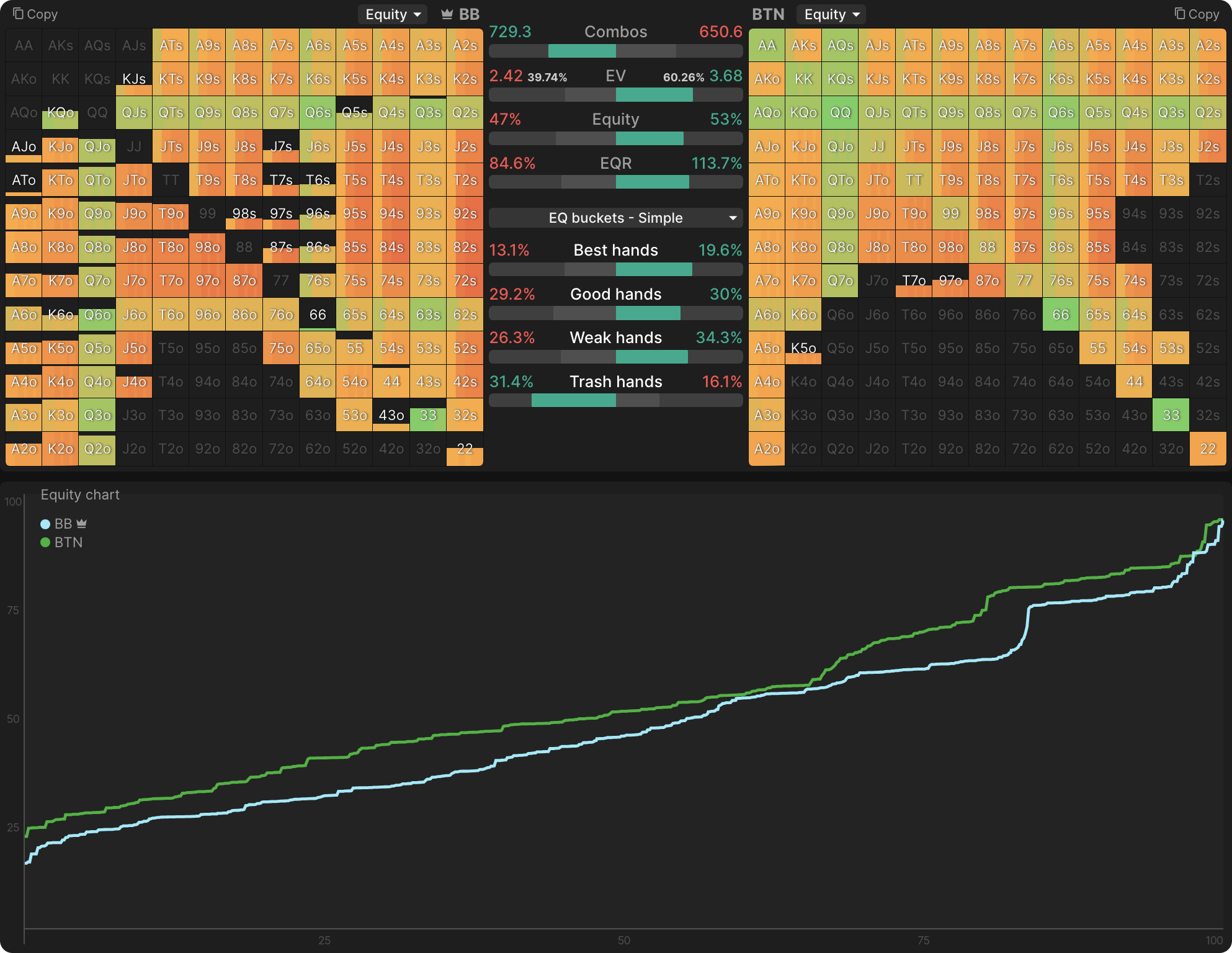
Firstly, the bet itself is a relatively frequent phenomenon for this flop: we bet about 63% of the time, and we wait for 37%. BTN has a slight advantage in the edge (53%), and as I said, we have more “best hands”, but it's very close:
Solver's solution is to use a mixture of different bet sizes. Although two smaller bet sizes are preferred, we have hands that bet about 50% of the sweat, and — one of them. At this stage, I could proudly protrude my chest and declare that I played the hand correctly, and then move on to the next one. This is what some players do when they work with poker solutions — they "check the line" of the hand and go further without delving into the analysis.
However, on closer inspection, you can see how often my hand uses each bet size:
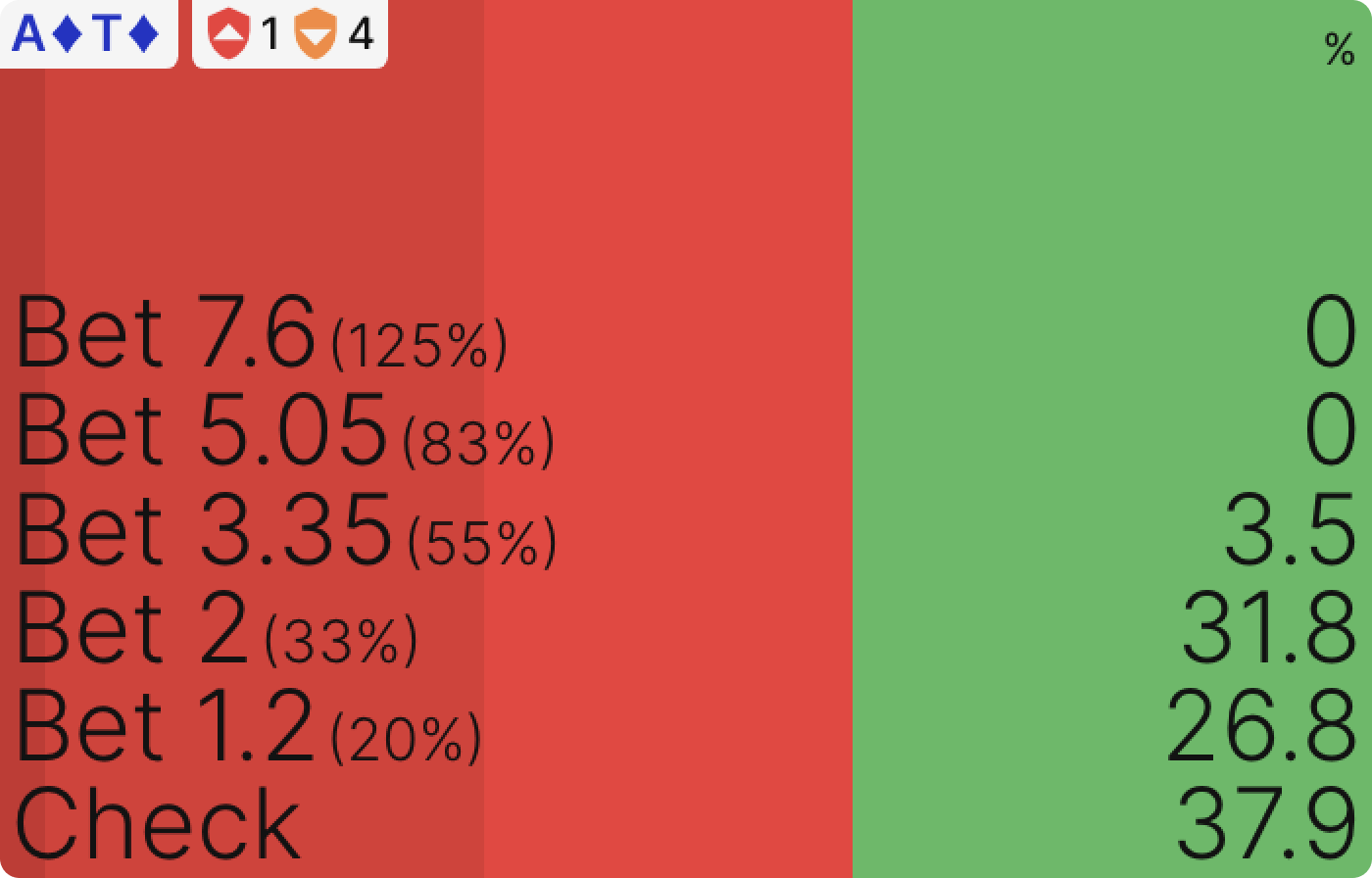
My hand uses a half sweat bet only 3.5% of the time. Here, the confirming distortion can fully take over. I could continue to claim that I played the hand right and move on. This was indeed “GTO approved”. If I were an experienced user, I could even say to myself, “Yes, this is a low-frequency action, but I knew it and did it to balance my middle bet.” This is an insidious aspect of confirmatory distortion: motivated reasoning and protection of identity as the main motivation. I could be so motivated to defend my identity that I would no longer question the low frequency.
In fact, I can decide, looking back, that I knew it was a low-frequency move, and since I managed to find it despite this rarity, it makes me even smarter. In fact, I should investigate this situation in more detail. An important question to ask yourself is: why is the prevailing bet size between 20% and 33%, and this is the size that is used 58.6% of the time with this particular combination? There are also mixed bet sizes across the range. We also have medium (55%) and high (83%) bet, there is even overbet (125%). And instead of focusing on a rare move, it is more useful to consider why there is a mixture of bet sizes and which hands each of them prefers.
2. Small bet
The "Grouped" filter allows us to group bet sizes into abstract categories (Small/middle/Large bet or overbet). If we hover over the icon in the upper right corner of the Small bet group, we can see a breakdown of the bet range by hand classes.
Breakdown of the Small bet group range (bet 20% and bet 33%):
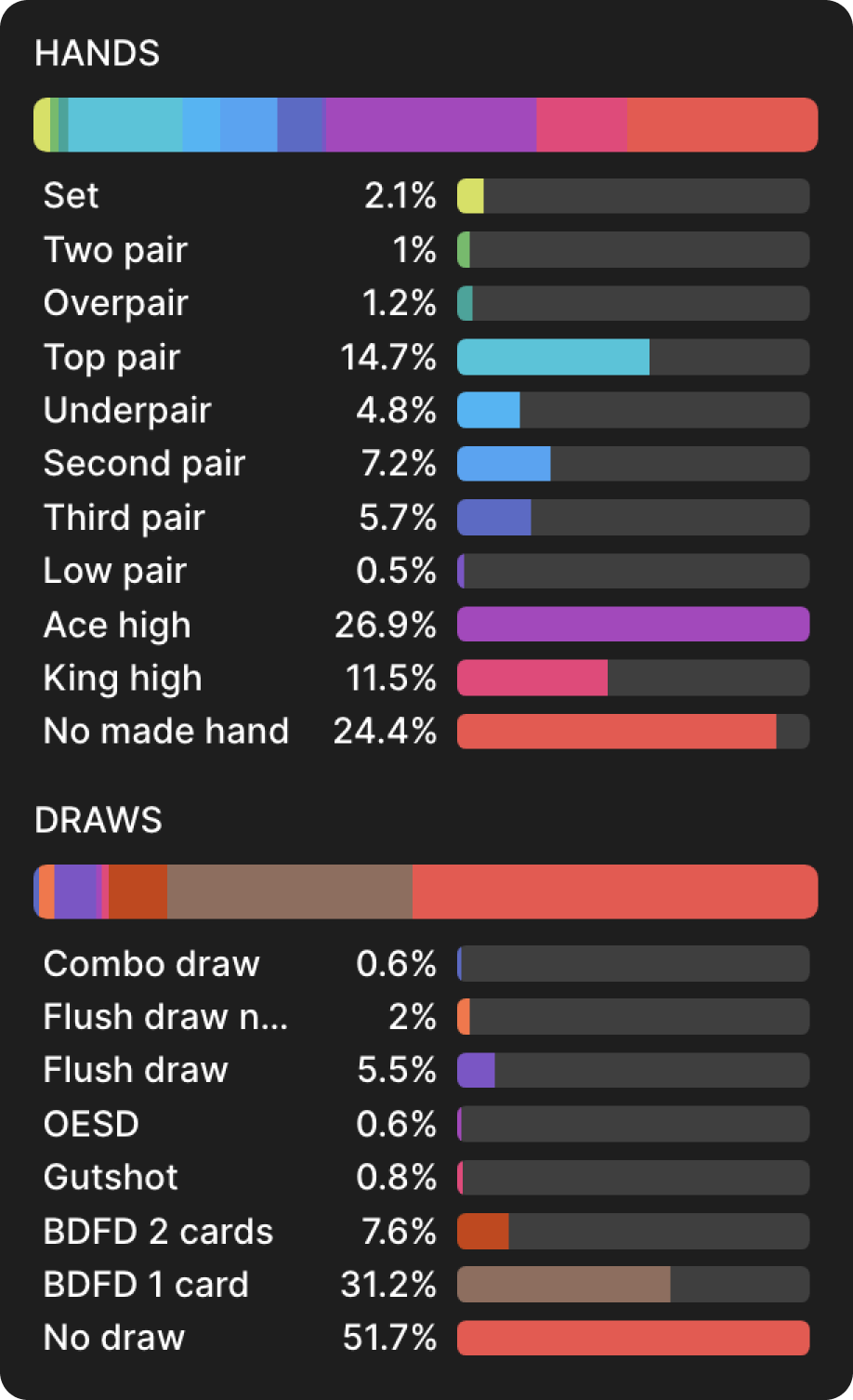
Small bet, for example, is mainly used by hands, which I would call the middle part of the range. Basically, this bet size is used by hands from the top pair to the third pair. And the main bluff in this sizing seems to be A-x. My interpretation of this is as follows: we bet a small bet with weaker hands of our range so that sufficiently weak hands can call and make this move profitable. These hands are in the middle of our range. A small bet, therefore, allows us to velyubet more often. We then defend this part of the range with strong hands such as sets. We bluff from the A's because this hand is still ahead of some draw that can call, and will often continue to be ahead if an ace falls out on the later streets. A-x without additional draw has about 50% equity, so when we are “spun” (i.e. the opponent makes a raise) - this is an easy fold.
3. Average bet
Compare this to the average bet range:
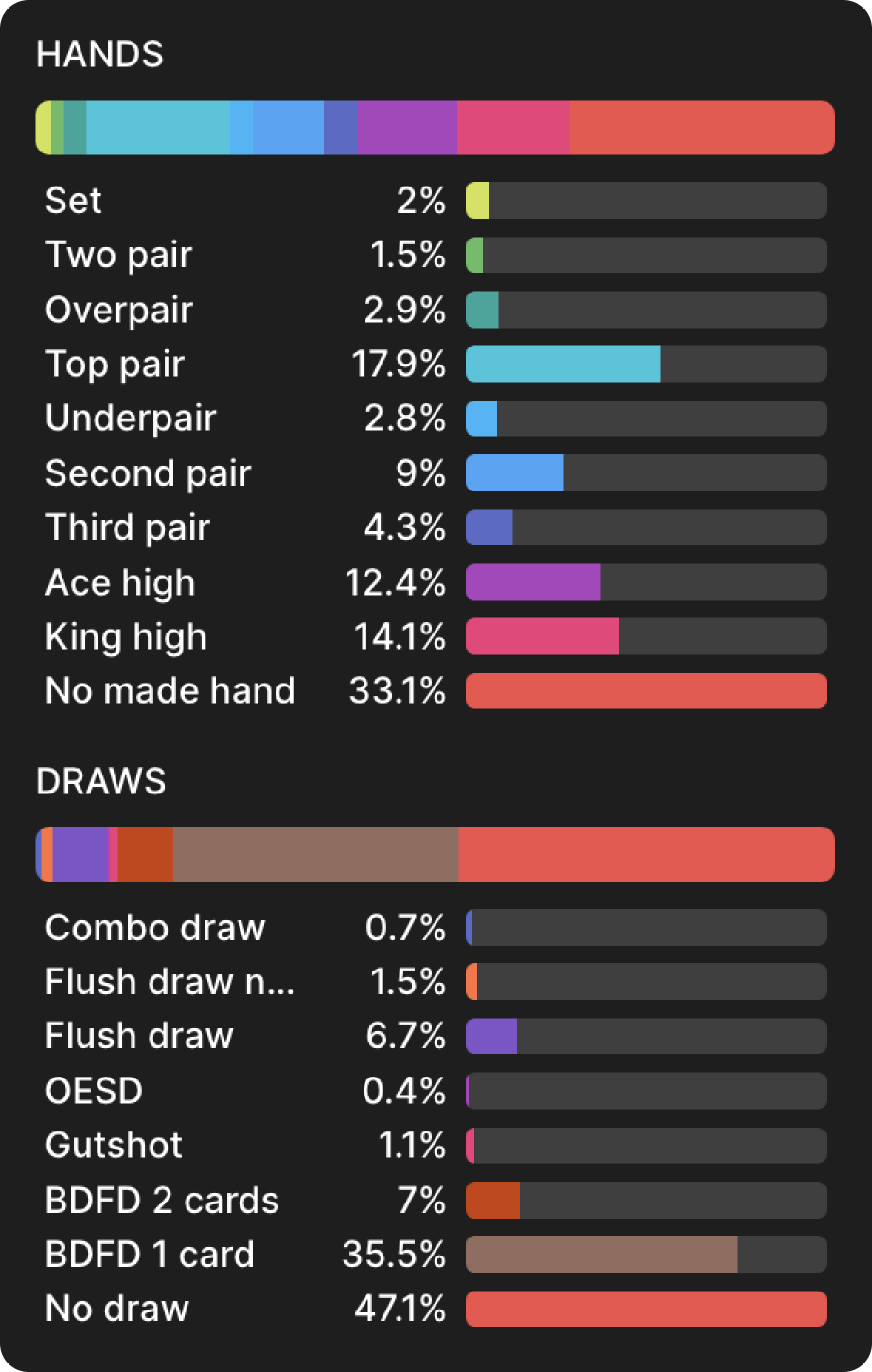
The top pair is a proportionally larger part of the value of the range here. K-x and backdoor flush draw are the main bluff. K-x is bluff, probably because our target is A-x. We will never force a couple to fold their hand, but we can force a lot of A-x to fold, which makes a bet with K-x a successful bluff.
4. overbet
Finally, we consider the composition of the overbet range, which is 5.6% of the strategy for the entire range. We skipped the “Bet Large” group because it is too small a part (3.7%) of the range strategy, and we get a brighter contrast by looking at the more distant parts of the bet spectrum.
Breakdown of the overbet group range (bet 125%):
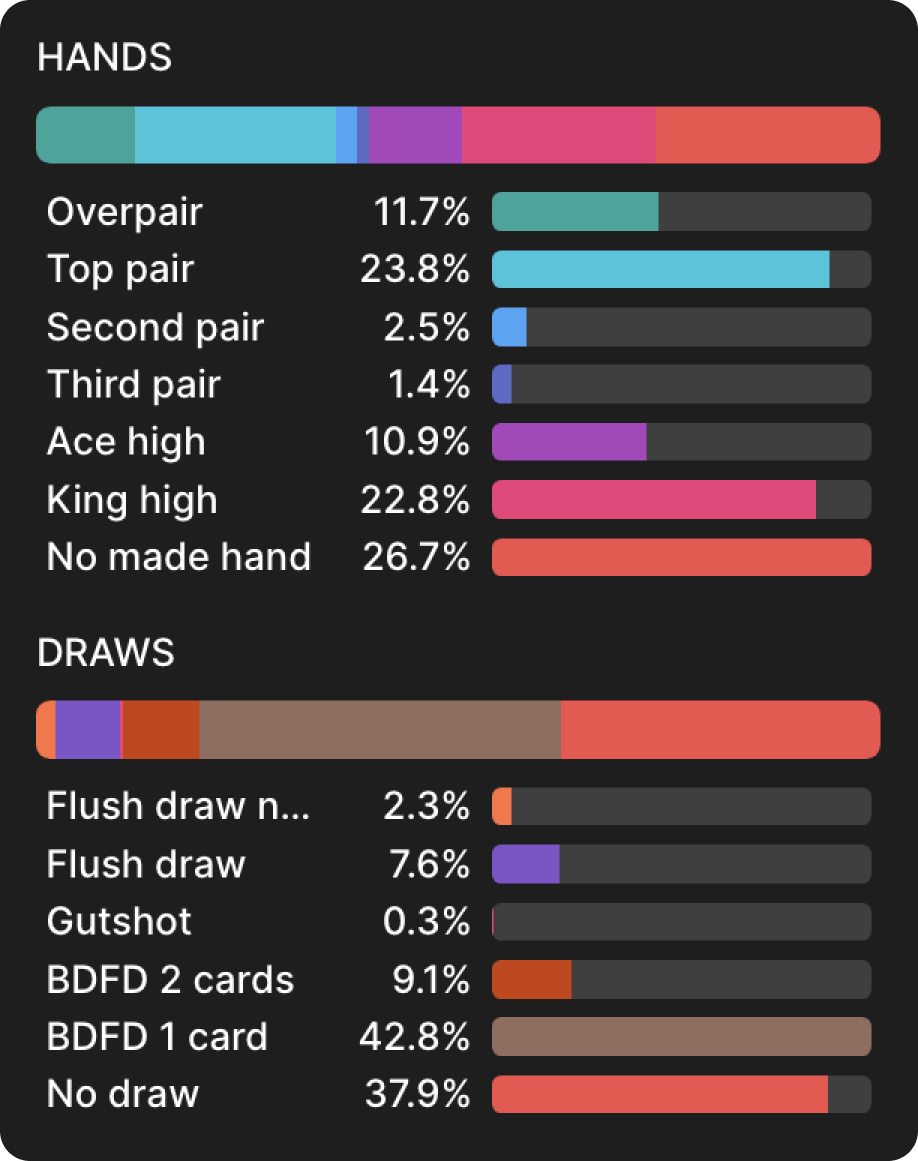
Overpairs and top pair make up the bulk of the value of the range. We never use overbet for two pair or stronger hands as we do with other bets. This is a classic polarized bet range: we place a big bet with hands that are usually in front and that need protection. K-x is the main bluff. Again, it is chosen for the same reason as in the case of the average bet: to force A-x to fold, and also because this hand blocks KQo in the big blind range. Returning to our particular hand, it obviously makes sense to include it in our average bet range. We need to have A-x when an ace falls on a turn or a river turn.
Also, this hand can make a backdoor street. It blocks QT, A6, A3, T6 and T3, which are in the BB range. We also do not block flush draw, which is useful when the turn and the river do not give anything useful, and we are looking for bluff on the river. In practice, however, our hand works better as a bluff for a smaller bet size. It is ahead of the draw that collide, deprives the equity of the weak unpaired hands that will drop, and is strong enough to continue when the ace falls on the turn. Finally, it has only 50% equity, so it's a pretty easy fold if we get a check-raised (the fold will be harder when we put a bet in 55% sweat).
Reverse effect
But wait. What if I told you that players in my games are very likely to call and never drop on such a small bet? Well, we can use the artificial intelligence (AI) of the GTO Wizard and block such “sticky” behavior to see what the optimal response to it will be.
Let's block BB's strategy so that he never dumps A-x, K-x, or any backdoor draw on a small bet:
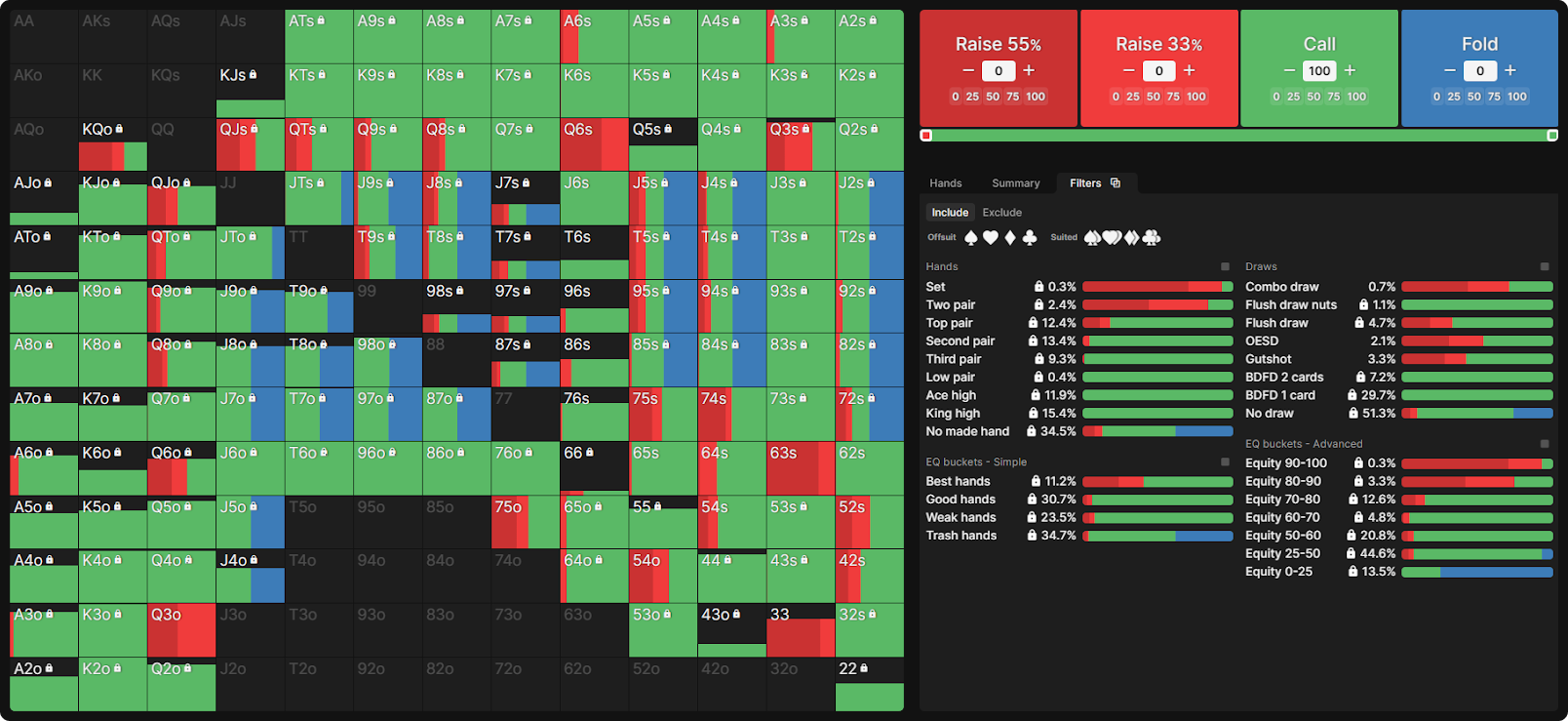
Here's how BTN adjusts its c-bet strategy:
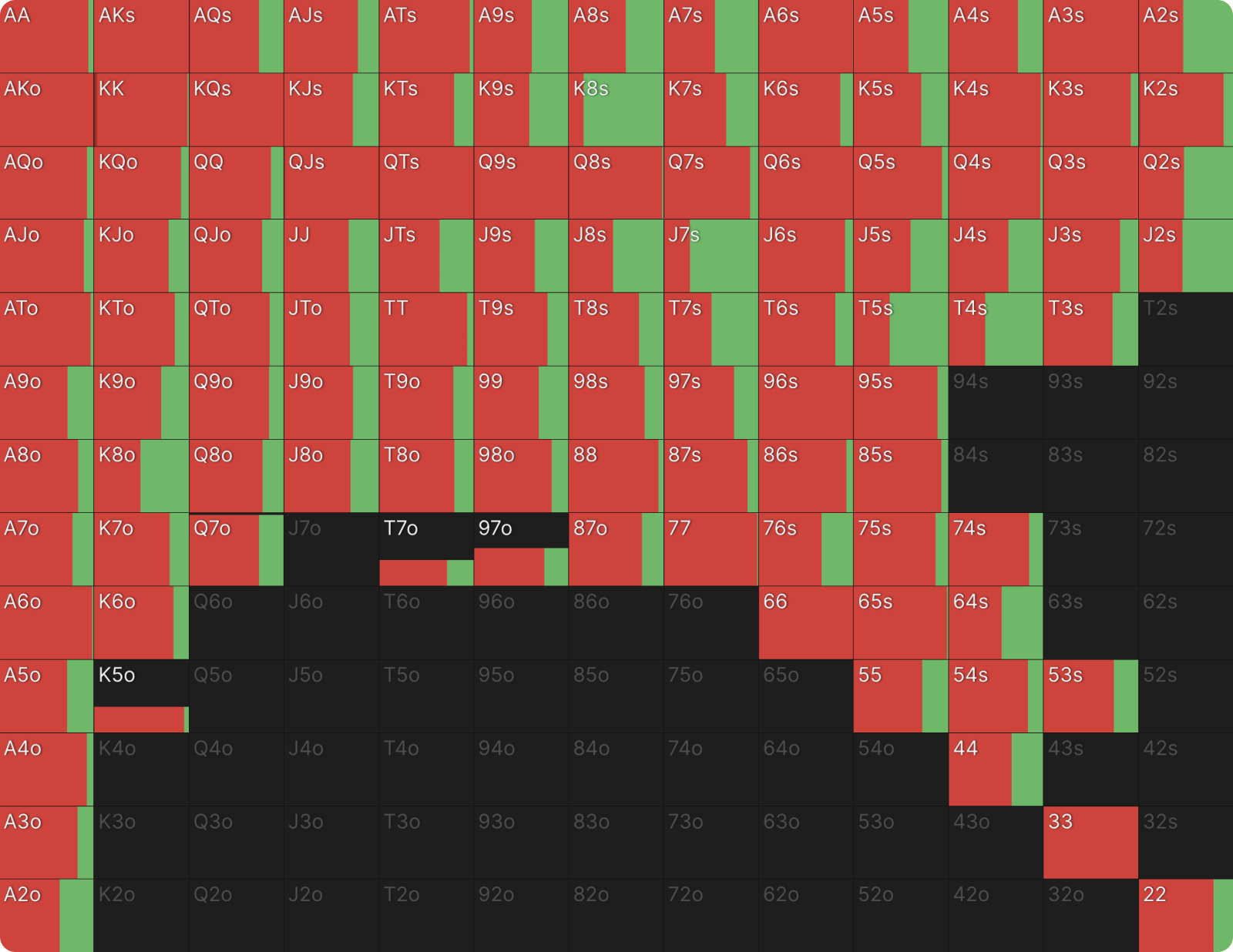

Oh, it looks like things didn't go as planned. Now we have stopped using the average bet size in this situation, and in fact, we exclusively use the small 33% bet to use what our villain will never dump, making thin value betas with a wider range. In fact, I wanted to say that players in my games will take advantage of such a small bet, often raising it.
Here's what they'll actually do when faced with a small counterbet:
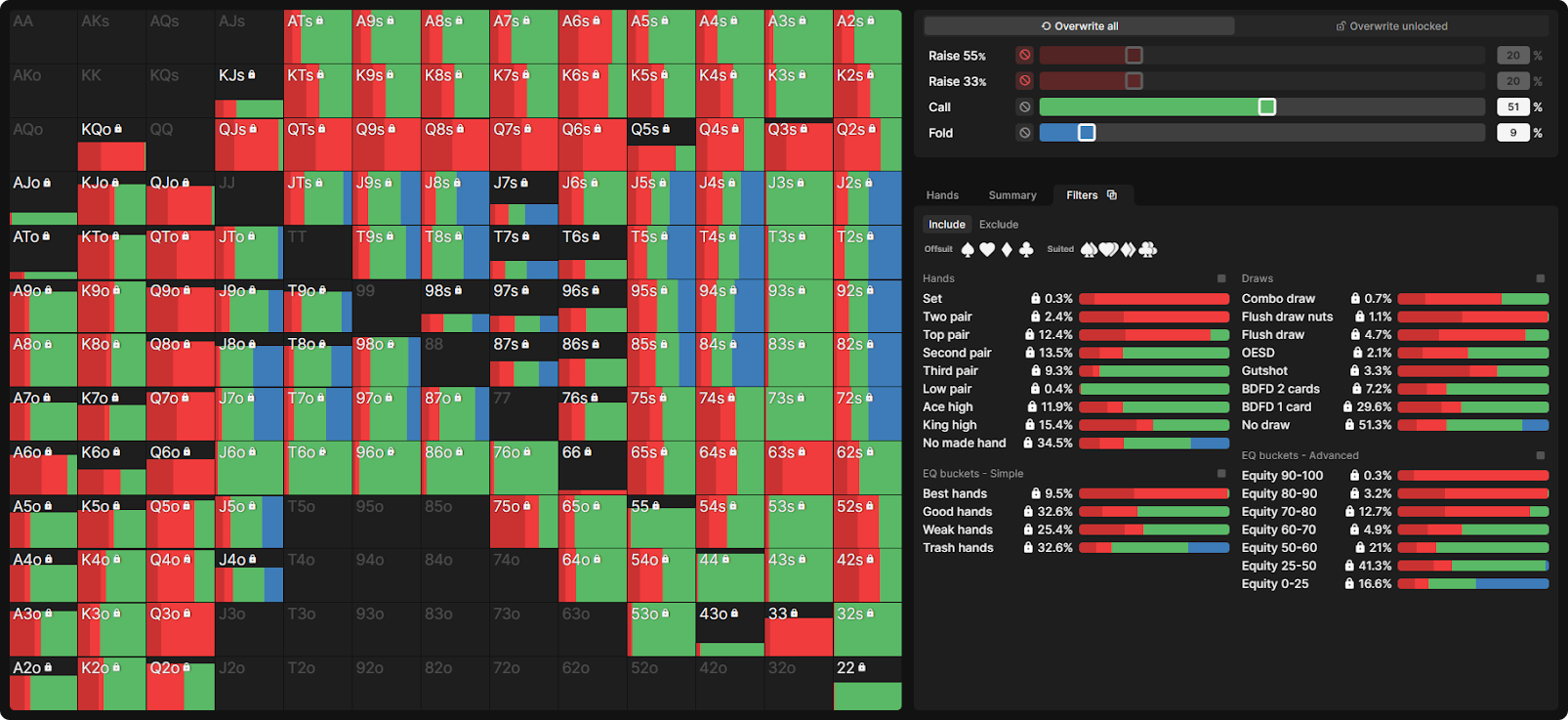
Against excessive aggression, I will have to adjust as follows:
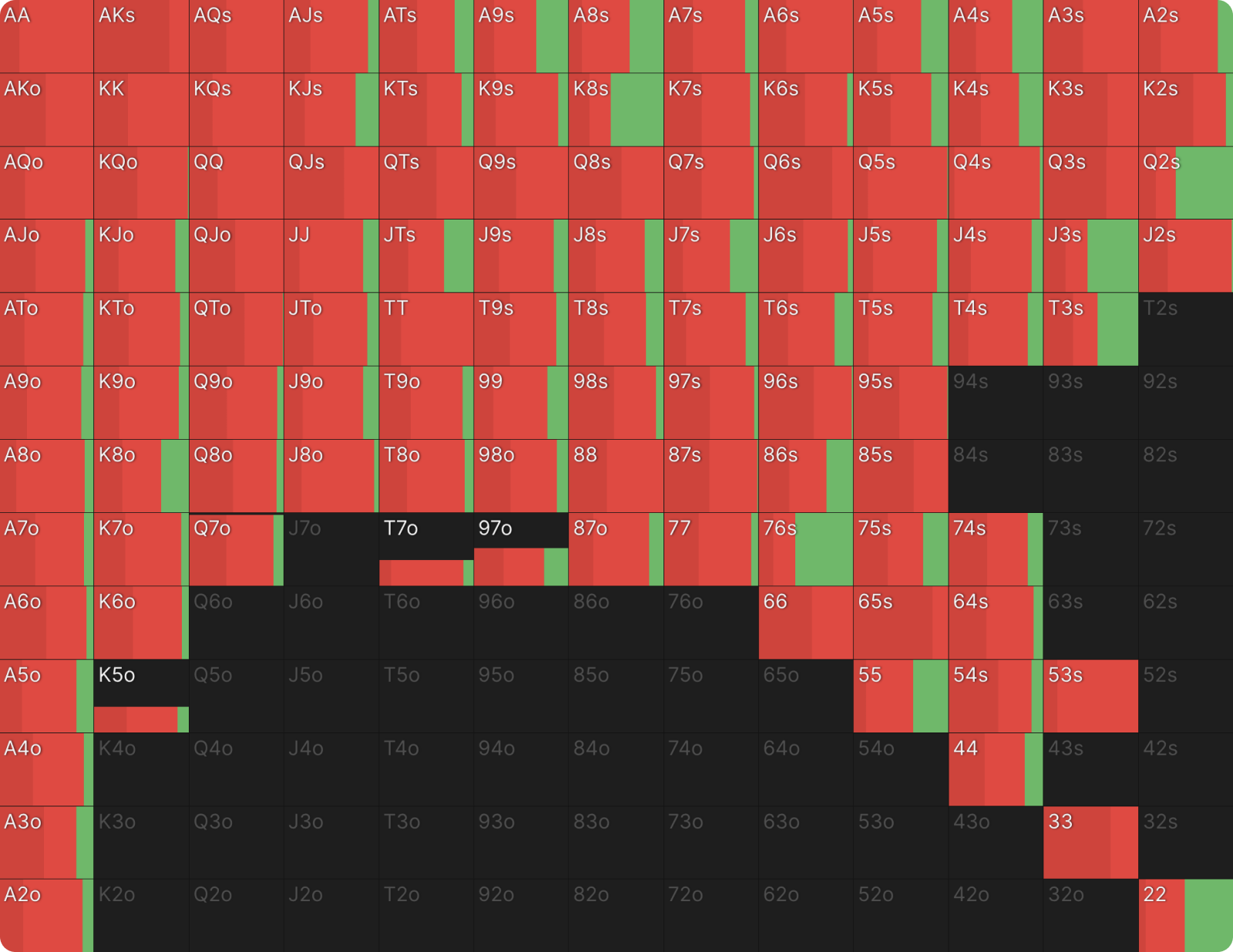

Oh, it happened again. We bet even more often, while introducing a new, even smaller bet size. It seems that provoking a frequent check-raise is good for us.
In fact, I wanted to say that opponents will not only “spin” us more often when we bet a small bet, but they will also refold on a bet of 56% of sweat:
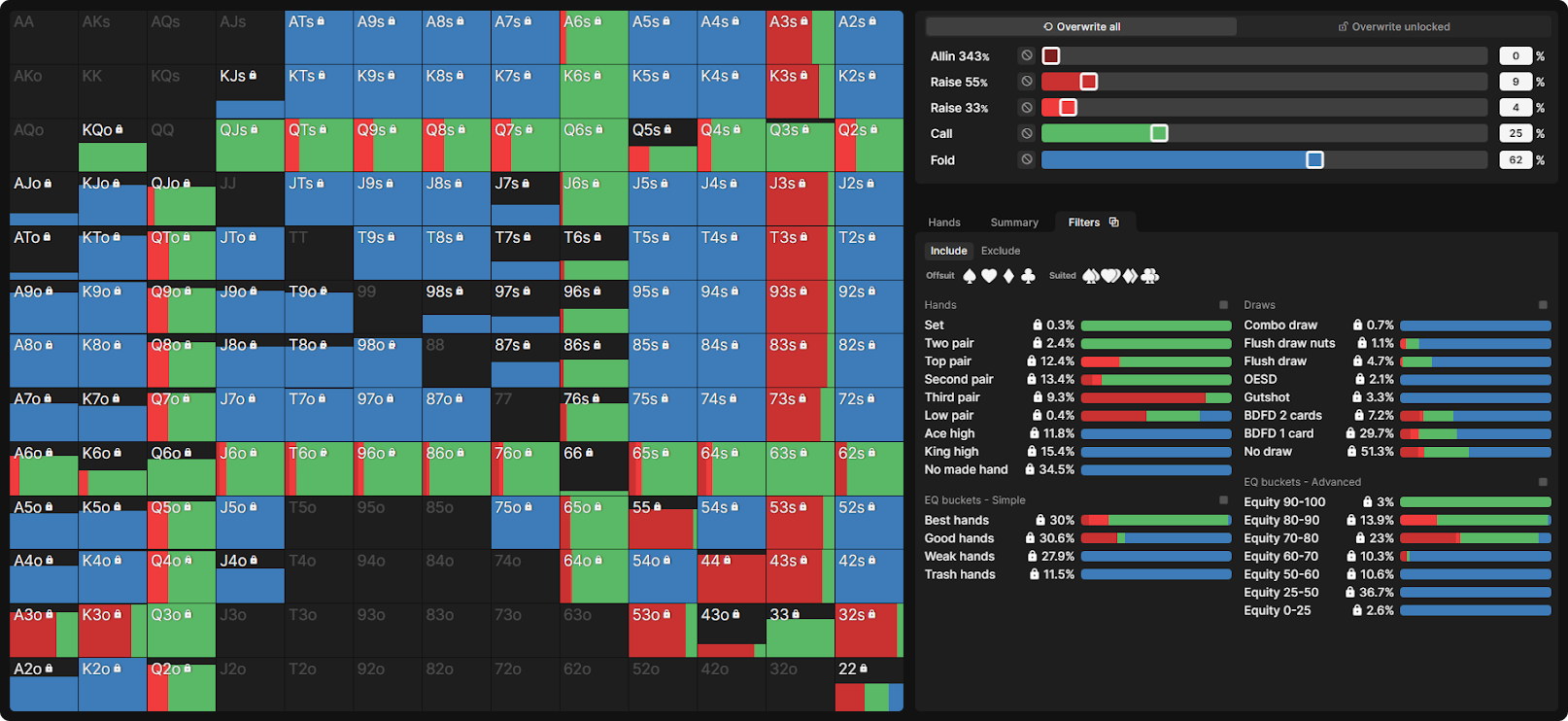
This is what our new adjusting looks like:
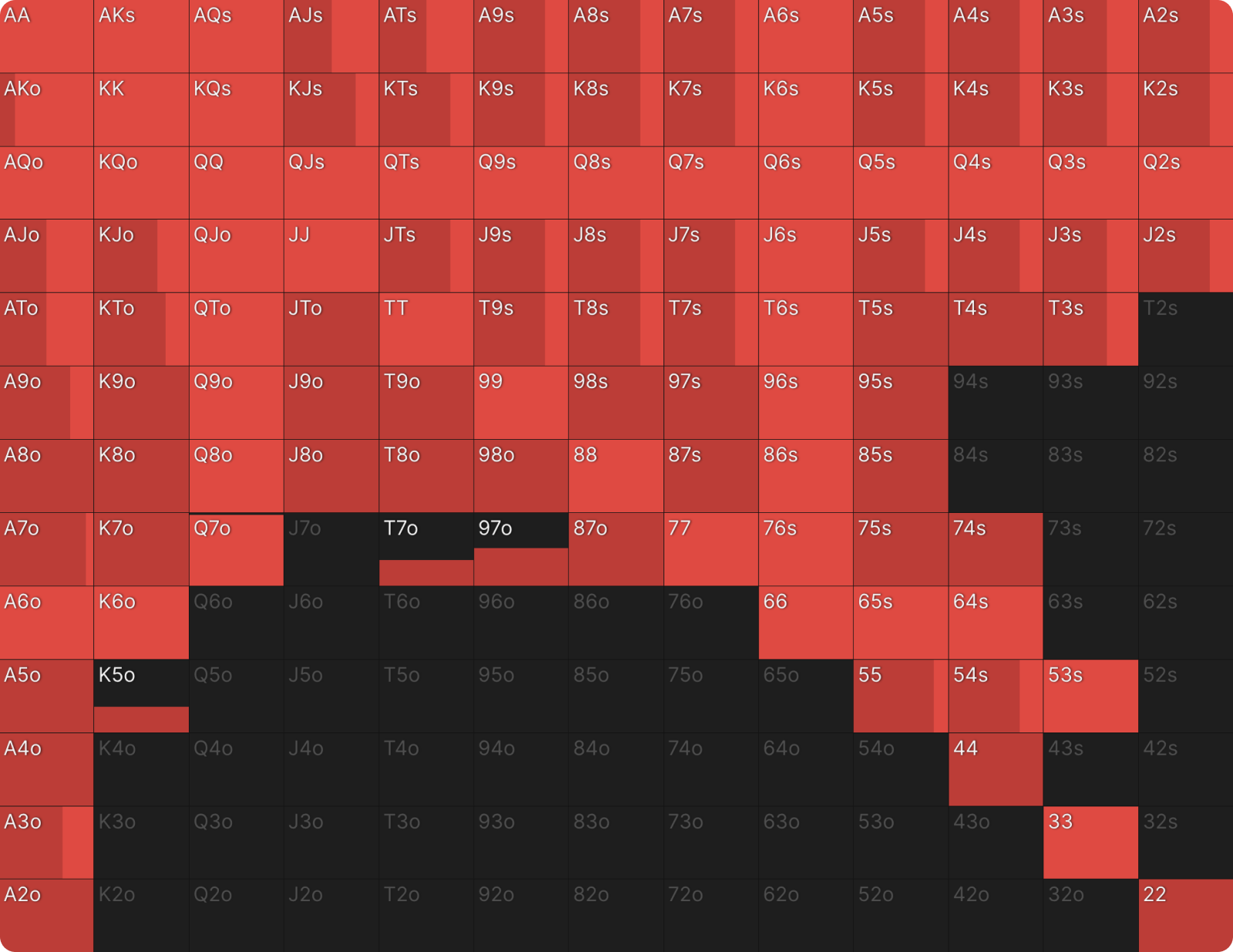

when he sees s-bet 33% of the pot and too secret when he sees s-bet 56% of the pot)
Whew, we finally got there. Sorry for trying to make a joke. What I have tried to show above is the second aspect of confirmation cognitive bias, which is perhaps even more damaging: the reverse effect. This is a situation where presenting conflicting information actually reinforces our original position rather than changing it. The effect of the reverse result is especially noticeable in the era of "fake news" and social networks. Very often, people are faced with evidence that their “side” was wrong on some issue, and this seems to further strengthen their beliefs. For example, the news that Trump did something terrible or was acquitted of a case will not change the opinion of Fox or CNN viewers on this issue.
The reverse effect is manifested when a person becomes more confident in their initial position when faced with conflicting information, instead of changing their point of view.
I think that the reverse effect can also be a problem when using the GTO Wizard. First, we can completely reject the findings because “no one plays GTO in real life.” We can also tirelessly hammer (i.e. block) decisions so that they correspond to our worldview, and “prove” to ourselves that we are right.
5. Conclusion
In the hand described above, I was lucky: I used it as a starting point to discuss Cognitive Confirmation Distortion, so it was easy for me to spot my own biases during the study. This is perhaps the most important way to deal with biases in general: to recognize that we have them. Cognitive confirmation bias often manifests itself because our beliefs are tied to our identity. Whether it is our political identity or simply our identity as competent poker players, it is natural to feel threatened or hurt when we are contradicted. We need to separate the results of the solver decision from our poker identity. It is much more rewarding to develop the identity of a “poker learner” rather than a “poker winner” when we are working with learning tools that can often surprise us.
Think of learning to play poker as an adventure, not a way to prove yourself right.
It is also very useful to approach the conclusions of the solver with the intention of examining not only the specific hand you have encountered. When you study how your entire range should be played, as well as how your villain played in light of what is theoretically optimal for him. This should reduce the need to validate one's identity as the situation becomes less personal. It's less about what you've done with your hand and more about what each player has to do with all their hands.