

Translated with the help of AI. We apologize for any errors and would appreciate your help in correcting them.
Translated by order of the educational portal university.poker
Original source: GTO Wizard

- Which hand is better on the flop


 :
:

 or
or 
 ?
?
Okay, I admit I didn't provide enough information to answer this question. Let's say we have a depth of 100bb in MTT in single raise sweat, and the tournament has just started, so we use ChipEV range. Katoff (SO) has just made a c-bet of 33% of the pot with CTO on the flop, and button (BTN) has worm 76. Who has more EV? Perhaps you have come to the conclusion that I would not have asked this question if the answer had not been “76”. Despite the fact that this is "only" a draw, its EV is 5.81 bb, and the CTO's EV is 5.36 bb. It's not just a function of position. CTs on BTN have almost the same EV (5.36 bb).
In other words, even in the same position and with the same rate, the draw works better than the "ready" hand. This depends on the depth of the stack, since the CP is, of course, a hand with a higher equity (approximately 63% when playing one-on-one). And the difference in equity against the range is even more significant. In CO, the CT hand has about 75% equity against the BTN bet range, while 76s has only about 40% equity against the CO bet range. If there were no more bet opportunities, you would, of course, prefer the top couple.
- In our example, it benefits from “visibility”. In the sense that a player with 76 is more likely to know whether he has the best hand, which will allow him to better realize his equity through valu-bets or bluff.
A bet with CT hates making such bets: because he does not have such “visibility”, and he will have to make difficult decisions on future streets. On empty thorns, he will have to choose whether to bet (to collect the value from many weaker hands in the opponent's range), risking falling into stronger hands against which he is far behind.
When the draw closes, he will often face big bets and be forced to make no-win decisions: bluff or surrender. Underlining this point, KT's EV will improve by more than 10%, from 5.36 bb to 5.99 bb if we put them  instead. Diamond gives more than just flush draw. It is also a blocker that makes velly value bets and bluff ketch more profitable on a three-boom board. Even
  increases EV to 5.42 bb.
1. What's your kicker?
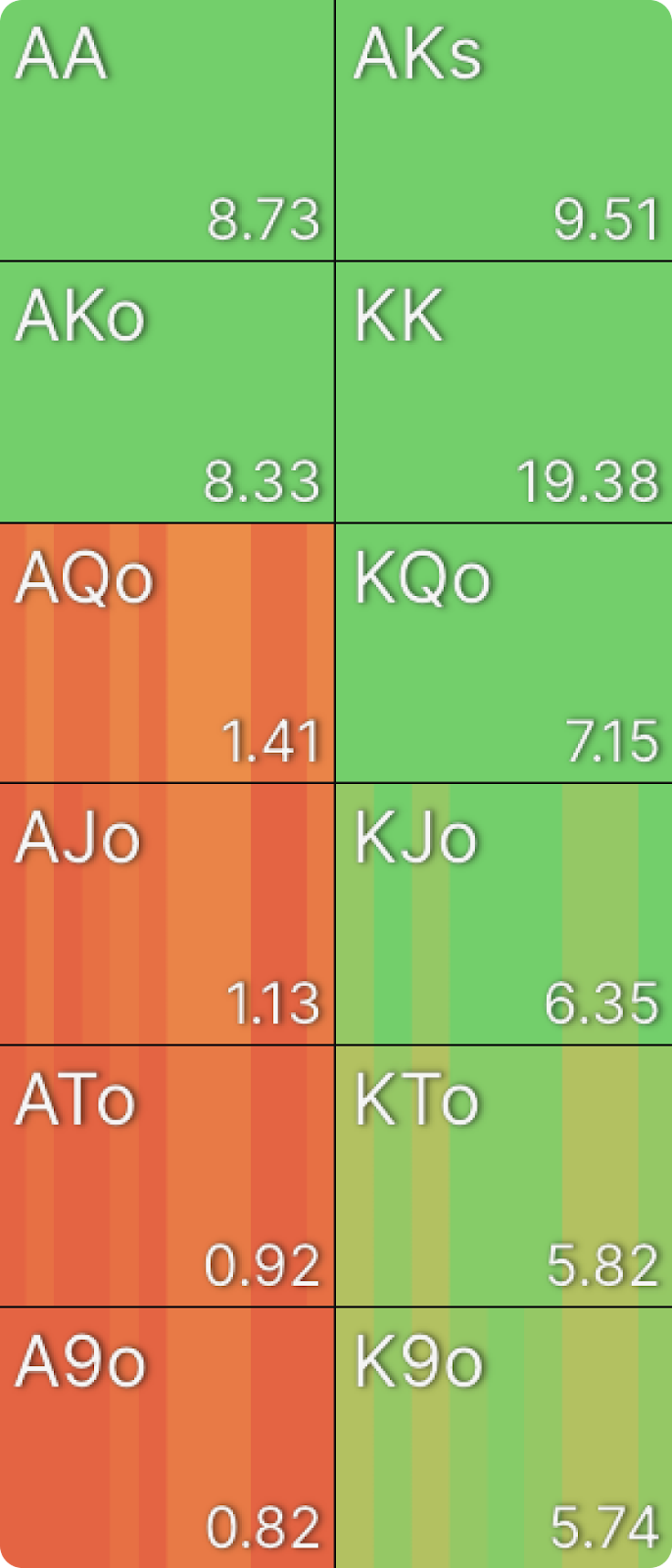
What really improves EV top pairs is the presence of a stronger kicker. This image shows the EV values for Co.
Here we see that KT is not much better than K9, but further the situation is impressive:
- KJ shows about 0.5bb better than KT,
- KQ is still 0.8bb better,
- AK adds another 1.2bb on top of that! (Clearly, suits also matter, but the overall trend remains the same.)
In the older pair, the kicker's strength grows nonlinearly.
The fact that the best hands are better is clear and so. An older pair with a stronger kicker is worth disproportionately better than one with a smaller kicker.
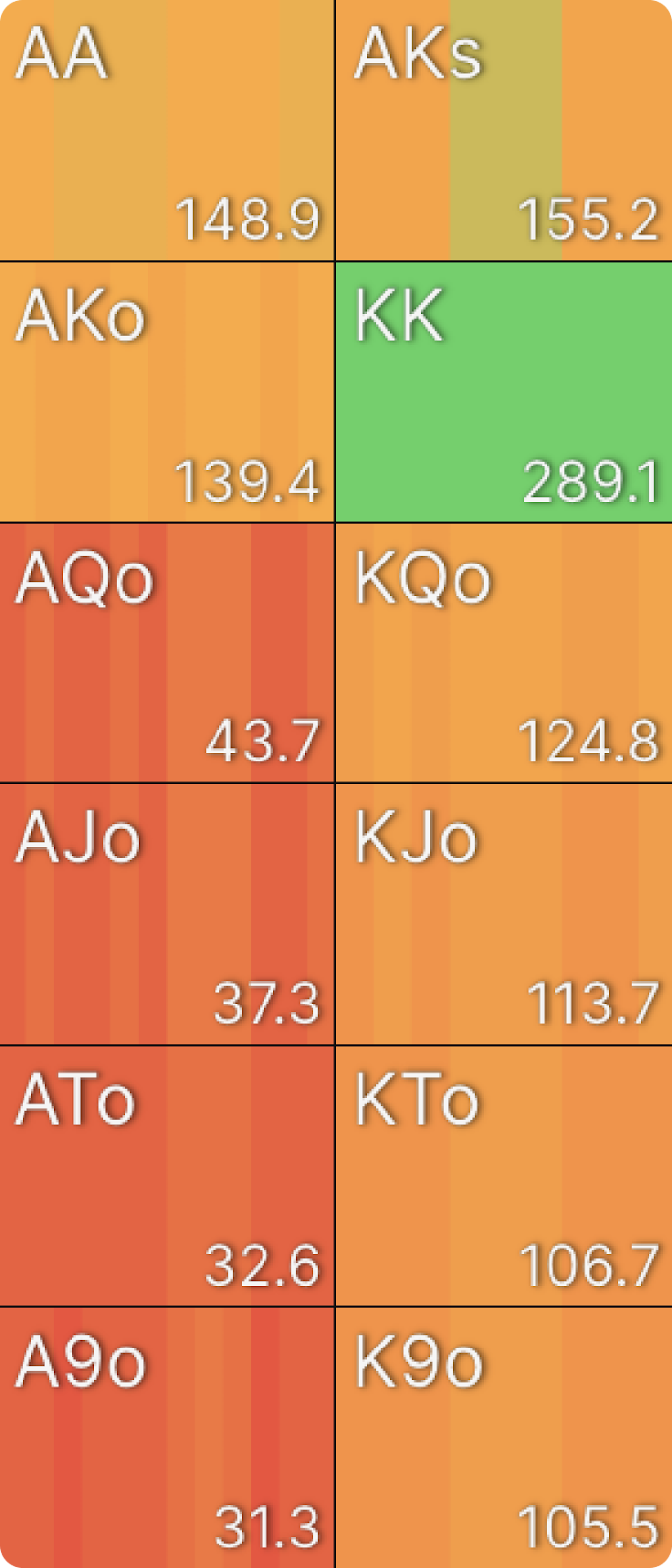
Both of these hands have more equity and implement it better. But all these hands with top pairs will have the same difficulty compared to the draw in the BTN range. On the flop, they will not benefit much from increasing the pot against the hands.
For the AK and KQ hand COs, the difference is that they will benefit from an increase in the pot versus part of the K-x BTN pot range. K9 and CT hands often win the pot, whether they place a bet or a check, but are unlikely to win more as the pot increases.
The profit received by AK and KQ over their equity comes primarily not from draw in the BTN range, but from dominant pair. The fact that there is so much draw on this board largely explains why CO does not make cbet often, only in about 30% of cases.
Let's see how our hands ( KTo and 76s ) behave on various thorns after the counterbet in the amount of 33% of the pot from Co. For comparison, here is a chart showing the corresponding indicators on the flop:

2. blank turn
A modest ready hand can be considered as a draw on a blank turn.

A modest ready hand such as a CT scan can be seen in part as a “draw” on an empty turn. Even though the CT doesn't improve in strength, it gets a lot of EV when the draw doesn't close. Part of this increase in EV is also due to the fact that the pot is larger than it was on the flop, but even as a percentage of the bank's equity CT turn is  larger than on the flop. However, it still does not realize its equity excessively.
The threat of investing money being “behind” remains significant, and on many rivers we will have to make difficult decisions. Indeed, even a check and receiving a bet of 20% of the bank lead to a slight decrease in the pot's share. Against larger bets, CT bet behaves much worse. Blank thorns are, of course, bad for draw. They lose their equity, but they can be realized beyond measure because of their ability to bluff or velya-beta on the river. Indeed, it retains most of its EV even with a turn bet of 200% of the pot, while falling to 0 EV and becoming indifferent between call and fold.
3. Flash Intern 

Diamond is bad for both of these hands, but even worse for the worms 76, since this hand loses not only most of its equity, but also its over-implementation, which was discussed above. Yes, she can bluff as a flush, but she no longer has nut draw. Two outs on the straight are spoiled by the fact that they will make four Diamonds on the board, which is a disaster, but even on the river, the  risk of a flush reduces the enemy's incentive to pay with the worst card.
Meanwhile, CT has a good showdown valley as long as the pot remains small. Its EV begins to fall at bets or raises.
4. Worm turn 

cT is good for the same reasons as . This will not improve many hands that have not yet been ahead, although the second draw on the board will lead to more difficult situations on the river. For the Worm 76 flush draw, of course, good news, but any turn that does not make it a straight represents a net loss of share of the pot. The fact that even one of the best thorn maps that is not a straight leads to a loss of the bank's share shows how much this hand depends on drawing up a straight for its EV.
5. turn 

A third pair appears for the 76s. In fact, it's not as good as flush draw. This is a blow to equity and is extremely difficult to implement. If this hand does not collect on the river straight, it will face valley stakes from many of the best hands, as well as bluffs from most of the worst hands, which will bury its EV under a bunch of win-win decisions.
Equity on the straight is low, but it is implemented very well. The equity for reaching the pair is higher, but significantly worse.
An EQR of 80-90% is misleading because this hand actually has two different sources of equity. There's equity on straight and there's equity on steam. For CT, this is a fairly neutral map. It presents several new threats in the form of strips and two pair, but also eliminates the most immediate threat of flush draw.
6. turn

The emergence of nuts is great, extremely good for equity and its implementation. This is also a good map for CT. Straights make up a very small part of the BTN range (which is why the reward for composing them is so high). doesn't improve any hand to a flush and doesn't give as many two pair as it does, so it's actually a pretty neutral CT turn.
7. Chasing outs and implied odds
Finally, we come back to the board .
Suppose you are on BTN, and CO puts you a continued bet sized at 200% of the pot. Which hand would you prefer:

 or ?
or ?
Q7 has 9 outs per flush and 35% equity, while 76 has eight outs per straight, two of which are spoiled by a possible flush, and only 23.4% equity. However, I would not ask if the answer was obvious. actually has 0 EV, which makes it indifferent to the call or fold, whereas the worms 76 have an EV of 4.38 bb.
The hand with the Q7 diamond faces the same problem as on the diamond river: it is a strong hand, but not a nuts. BTN has too many flush draw to call all of them at this price. Such a strategy can be used by an opponent who will simply make a check-fold on the diamond river, since BTN will not have enough hands for bluff to balance all their flushes.
BTN never resets a flush draw with a senior ace or king in response to that bet, nor does it ever reset a combo draw.
But flushes with older ladies and jacks are indifferent to call and fold. A is a clean fold, although its equity is even better than itss. As we saw on the turn, 76 realize equity well precisely because the two-way straight draw makes up a much smaller part of the BTN range than flushes on the diamond river.
This hand performs a function that few others can, namely the creation of a monster on a relatively innocuous river map. It also allows you to bluff on diamond rivers when other times it is difficult to find suitable hands for the bluff. Such bluff is not very profitable in an equilibrium strategy, bringing about 1% of the pot, but they have +EV, which is not always true for bluff on the river.
8. Conclusion
But once they hit the bank, it will be difficult for them to invest more money as a big favorite, and this is very important in deep stack scenarios. Since there is still a lot of money to bet, the value of a hand is not determined by its rank, but by the fact that it is “best in class”. On the flop with the elder king, SO has many hands with top pairs, and the best of them earn disproportionately more than the worst. BTN's diamond rivers have a lot of flushes, and the best ones earn disproportionately more than the worst ones. Thus, in deep stack scenarios, a draw to rare monsters may cost more than a draw with higher-ranking but more common cards. They can even cost more than ready-made hands.