


Translated with the help of AI. We apologize for any errors and would appreciate your help in correcting them.
Translated by order of the educational portal university.poker
Original source: GTO Wizard

Suppose a player named Paul plays a cash game with a stack of 200 BB half and opens 
 on SB. BB calls, and comes out on the flop

 . Here he may be tempted to make a cbet of 75% of the pot, since the bet allows him to "attack the flush draw on a dynamic board" and "protect his hand from possible straight draw".
Both his hand does not block. In addition, he cannot allow an opponent to make a check in response and let him see a “free card”, which can be an unpleasant thorn, for example,  or
or .
.
However, half may be surprised to realize that this hand is close to a clean check according to the calculations of the solver, but the bet of 75% of the pot brings a loss of about 7% of the pot in anticipation. In this article, we delve into this scenario and take a closer look at how and when not to bet for protection. We will also learn how the concept of protection affects the trends and the amount of bet associated with the counter-bet strategy on the flop.
1. When not to defend
So where does the logic break down in the above situation? Although BB defends against Paul's bet of 75% of the pot with flush draw and straight draw lagging behind in net equity, these draw have a relatively high EV because of their perceived odds: they may try to collect equity with AA when they hit, or bluff AA when they don't. When BB calls, and Paul's aces get a “scary” runout, they often become just a bluffcatcher with zero EV in the pot, which he so actively dispersed. That is, he actually loses all the money that he invested in the pot before.
This is far from ideal when he has a hand with such a high powerful equity on such a terrible flop. The absence of blockers further aggravates the situation: when half makes a counter bet of 4,5bb in a pot of 6bb, his expected value with a stake is 11,19bb. Since this number is barely larger than the initial pot size plus the counter beta size, its hand gets only a little more equity when BB makes a call, compared to the fold. In other words, the EV change of collet aces is 6.69 bb, whereas the EV change of BB fold is 6bb.
Fold is almost as good as a call, which highlights how poorly this hand performs as a Velu Beta. There is another hidden edge of the check: when half checks without a position, BB is not guaranteed to make a check in return. Since this board texture is relatively advantageous for his opponent's range, it will strike with hands such as 
 and
and
 , which are almost dead against his particular hand, but at the same time will throw off 75% of the pot bet.
In general, a bet gets more equity when a dead hand calls it, as opposed to when a hand with live outs calls it. This explains why c-bet on the board is more acceptable. When the board is drier, BB is required to defend with more hands of the “no pair and no draw” (“static equity”) type, mainly with backdoor overcards. On the board, 37% of these hands continue to see the c-bet 75% of the pot, and only 22% of these hands can continue. For AA, the call from KQ on the flop is much better than the call from 76 on the flop.
Excessive concern for protection can come at a high cost. On the board, the GTO c-bet strategy shows 2.77 bb in expected equity. Imagine that half Paul makes too many c-bet with overpairs (which “need protection”) and too few with straights, sets and pairs+draw (which “do not need protection”).
If we test this strategy in a solver, we find that it has only 2.7 bb and thus can be exploited by about 0.07 bb (7bb/100):
Paul's c-bet range is relatively capted and too shifted towards overpairs, which are too weak to stack-off stack for a pot of 200bb.
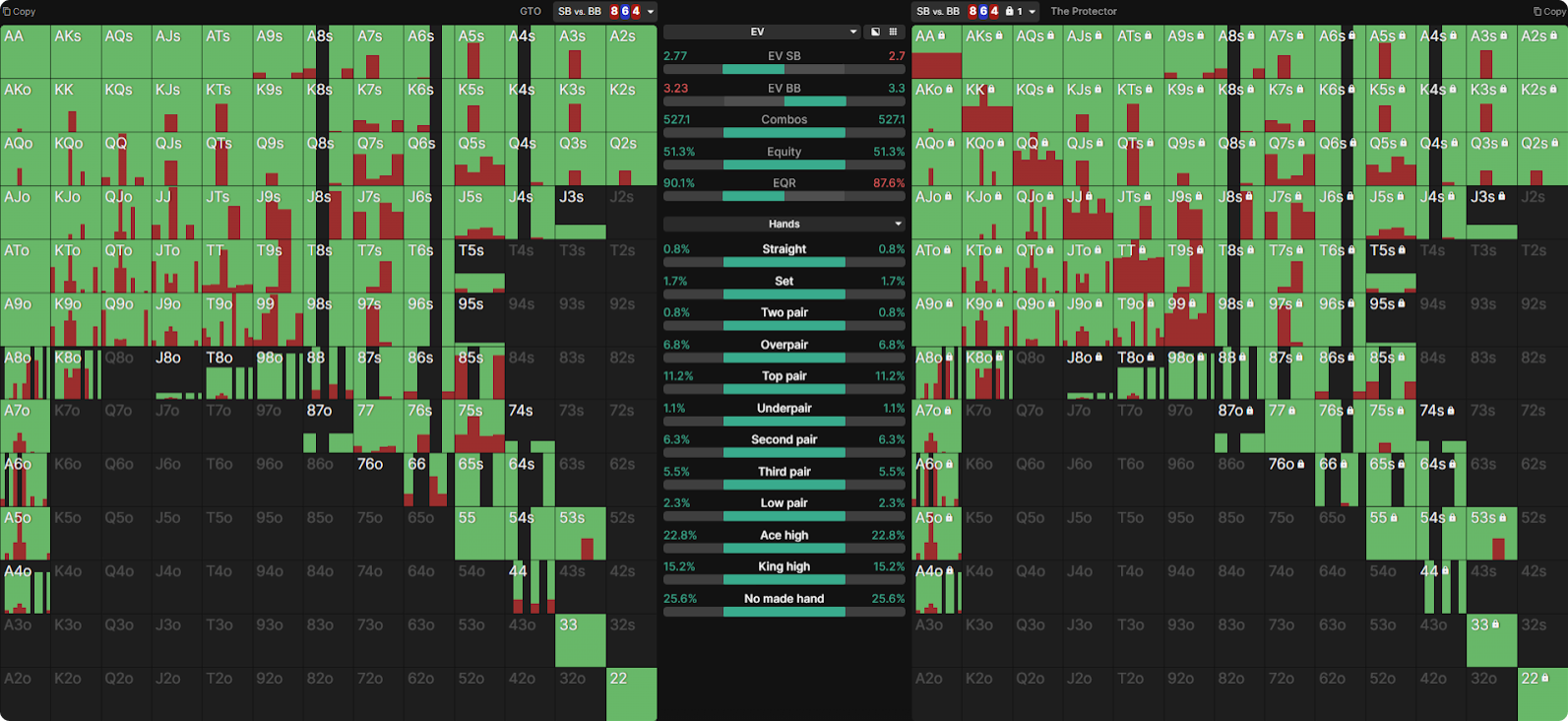
This vulnerability in the SB range allows BB to attack, increasing the frequency of raises from 5% to 21% — always raises with two pairs or better and adding the necessary bluff:
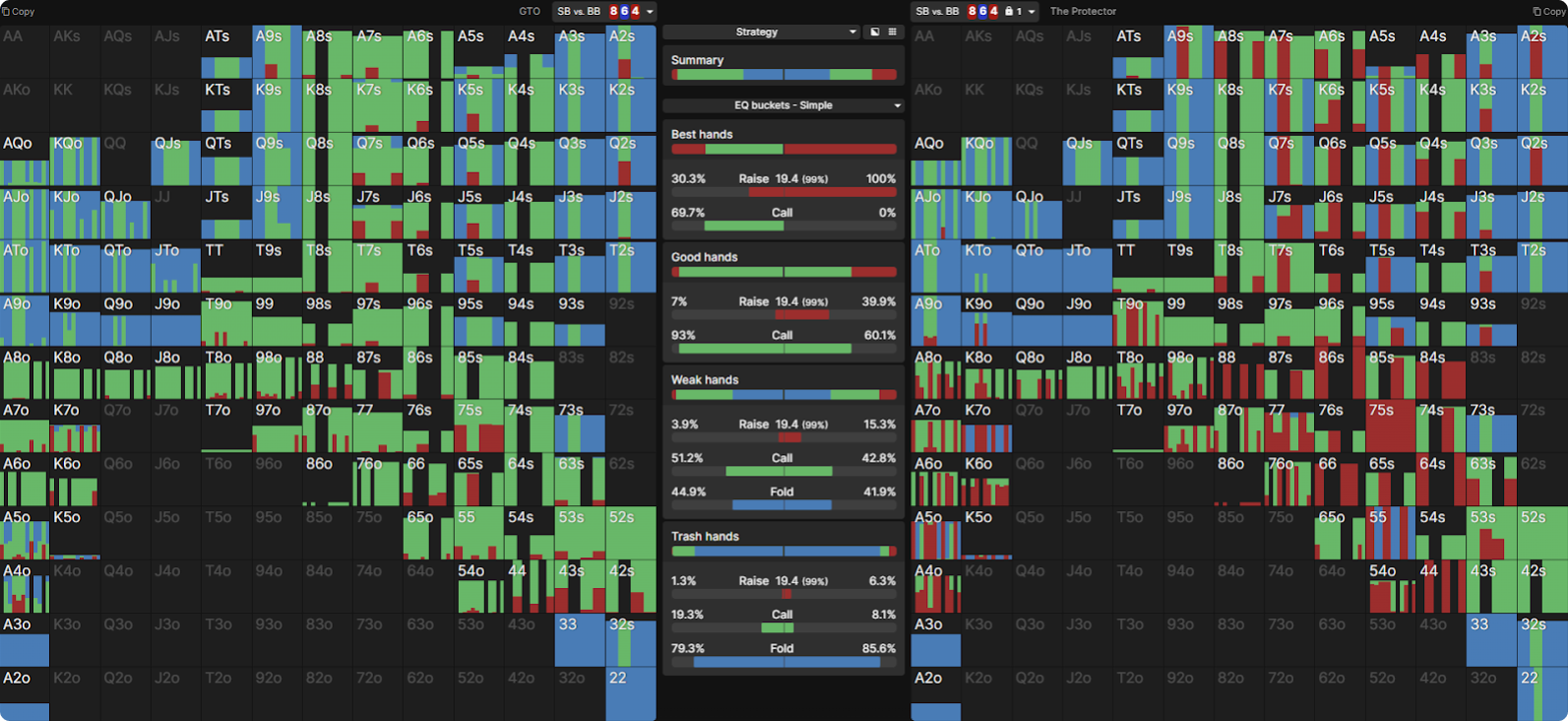
In fact, a much more reliable strategy for Paul would be to check his entire range. It has no positional advantage and the BB range is strong not only in terms of its overall equity but also strong hands (two + pair). This strategy gets 2.75 bb equity, which is much closer to GTO (and may even surpass it).
2. When to protect your hand
- In poker, betas and raises get an EV, prompting low equity hands to call and high equity hands to drop.
As we have established, it is unwise to develop a counter-bet strategy on the flop in order to select with draw with high equity. Rather, the main purpose of bet ting with the velly value of the hands should be to receive calls from the hands that are closest to “drawing dead”. On the other hand, the purpose of bet ting with bluffs should be to force the fold to drop as much as possible by the value of the opponent's hands.
When thin vale hands can also bluff and deprive the equity of another part of the defender's range (including gatshots, overcards, backdoors, etc.), we can bet with them “for protection”.
- Example: Consider the counter-beta strategy of BTN vs. BB on the flop
 in single raise sweat. Note that BB continues to preflop with almost every mixed (and same-label) hand with a 9 or higher. BB comes on the flop with over 100 king to nine combinations, which is almost 30% of the range.
As a result, BTN is strongly motivated to make a small bet with 8x to force fold these hands (which have up to 6 outs) and collect the velly from the hands of type 77–33 (which have a maximum of 2 outs):
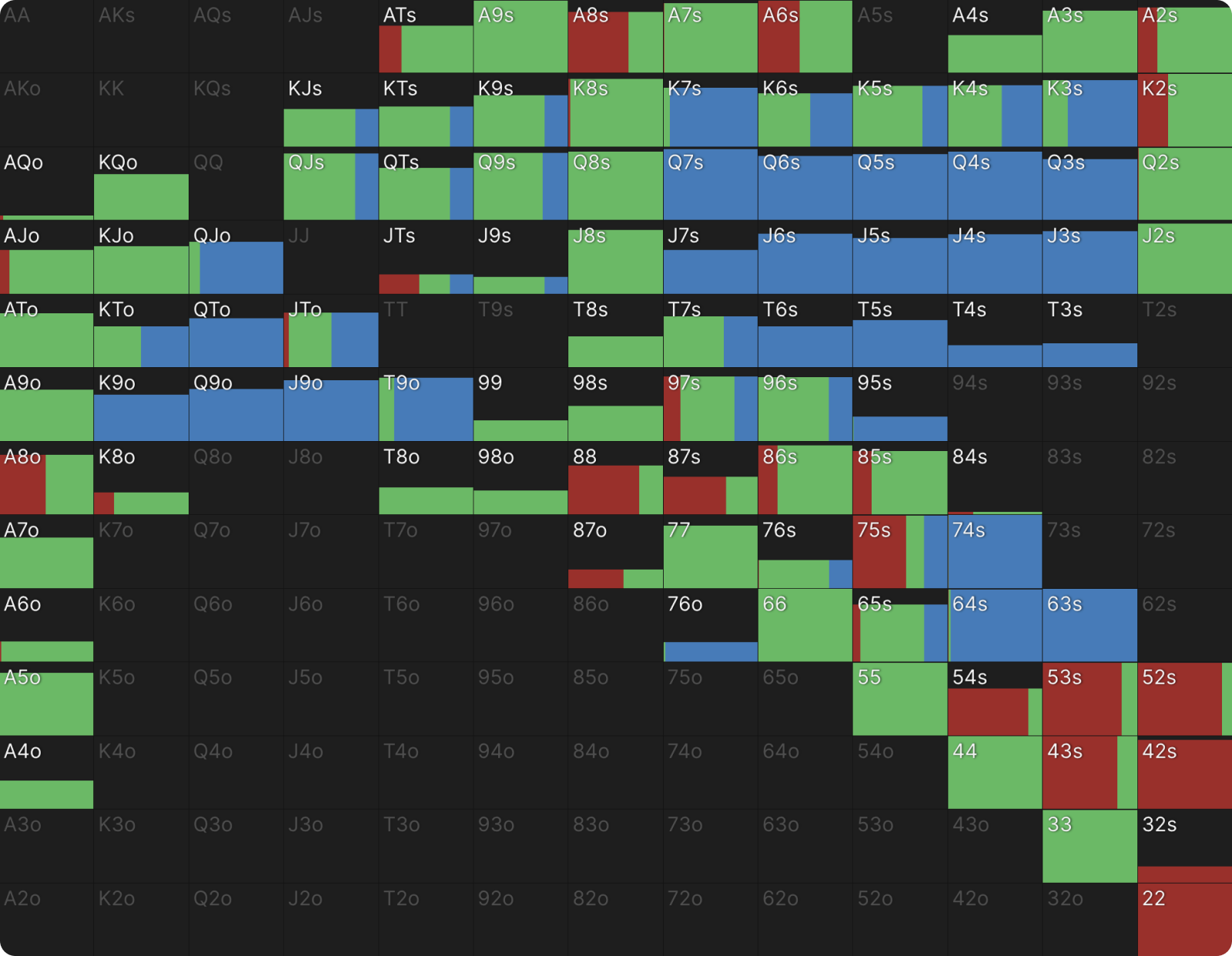

While a big bet can make you fold even more hands with overcards. Increasing sizing with 8x arms protects against a stronger range with Ax, where these arms may have problems colliding. If BTN uses a counter-beta strategy with one sized 33% of the pot, it will be able to place bet with 8x hands more than 70% of the time. If we force the BTN to use 75% c-bet with the same frequency as the smaller size (plug the strategy in the solver), it will lose 6bb/100 of the expected value by the velly.
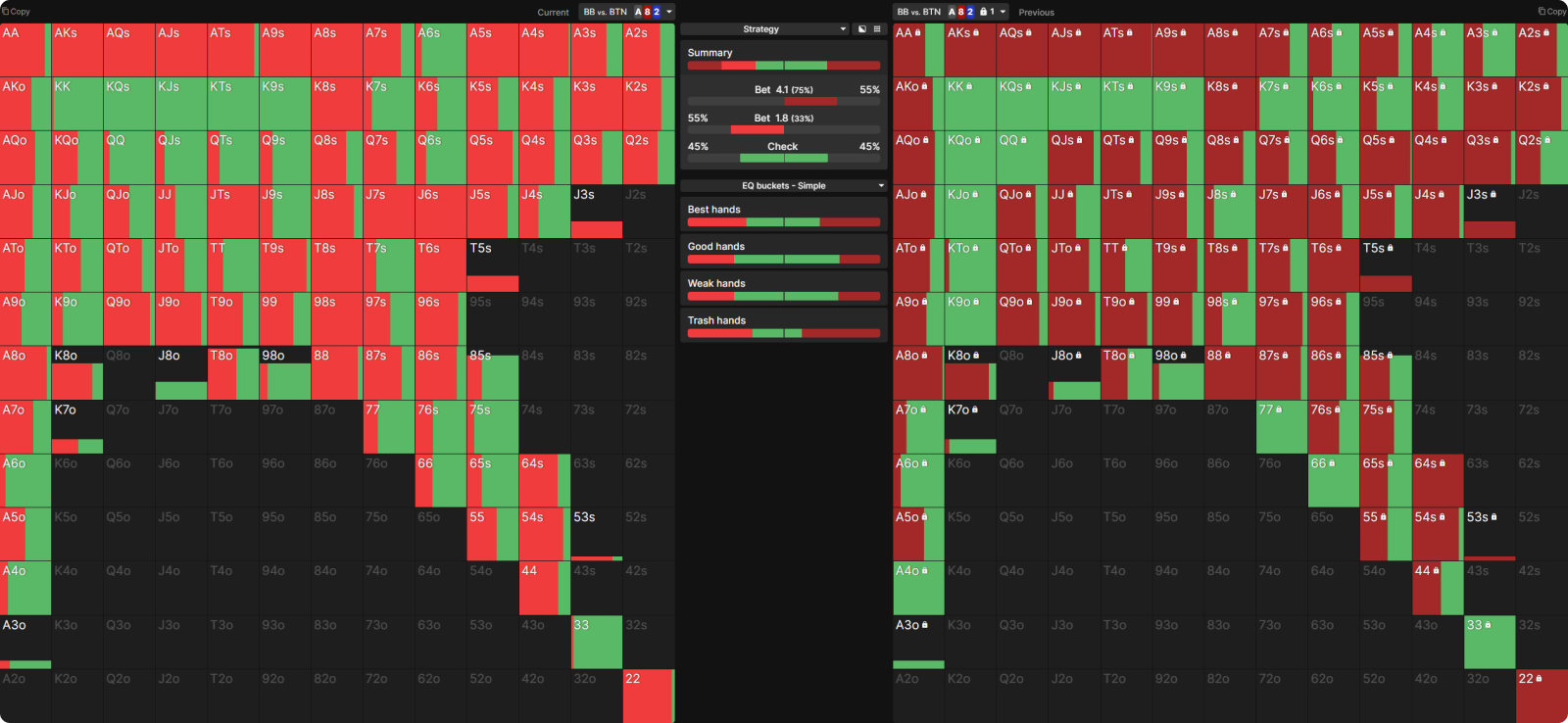
When a thin velly has an incentive to place bet for protection, it is necessary to use smaller sizes to allow these hands to place bet more often.
In the next section, we will take a closer look at the relationship between protection and the frequencies/dimensions with which cbet should be made on the flop.
3. Frequencies and dimensions
Using the Aggregate Reports function, let's look at the c-bet BTN vs BB strategies in the single raise sweat, where the AX2 table is offsuited, and X is a map between K and 3:
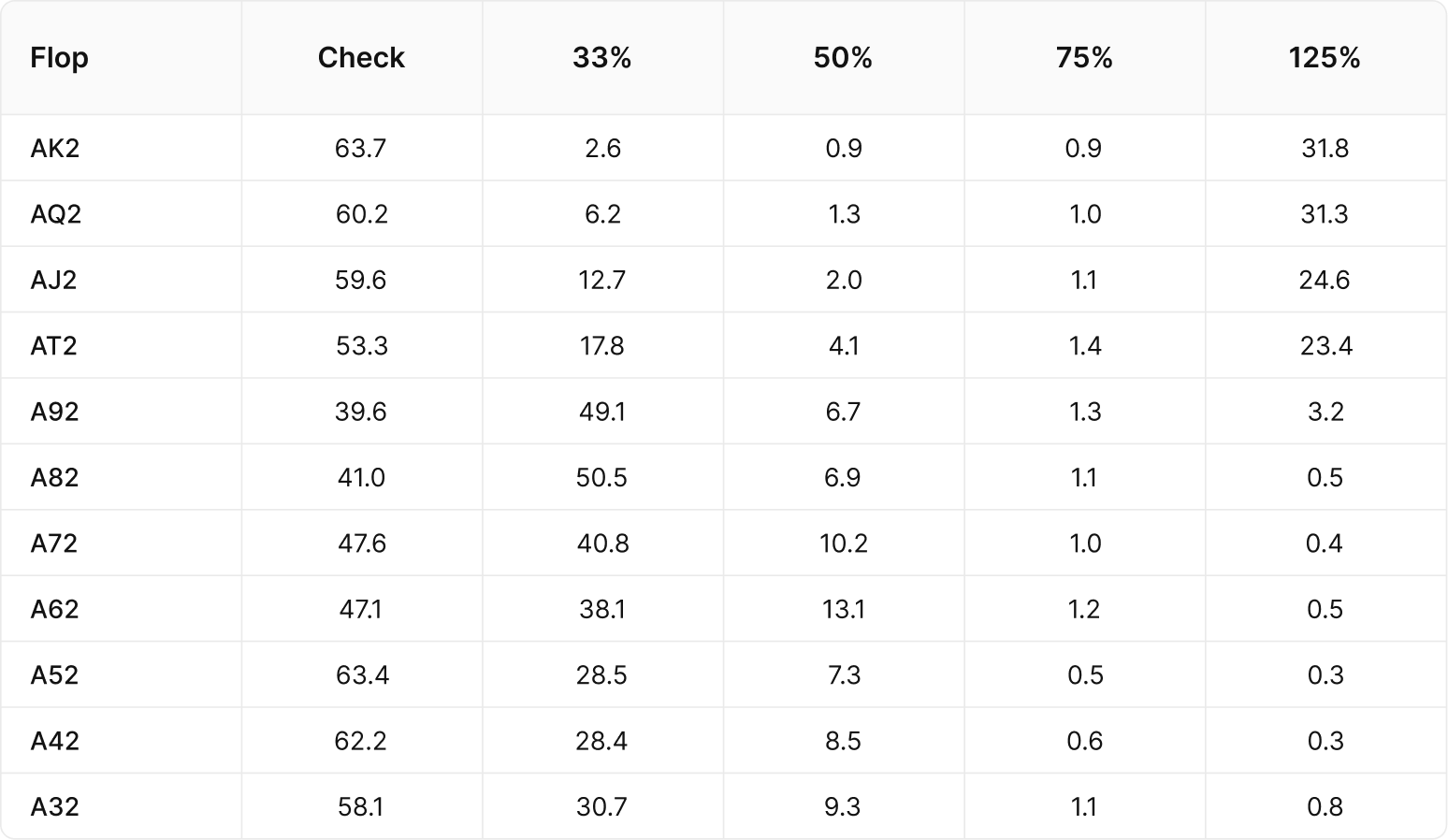
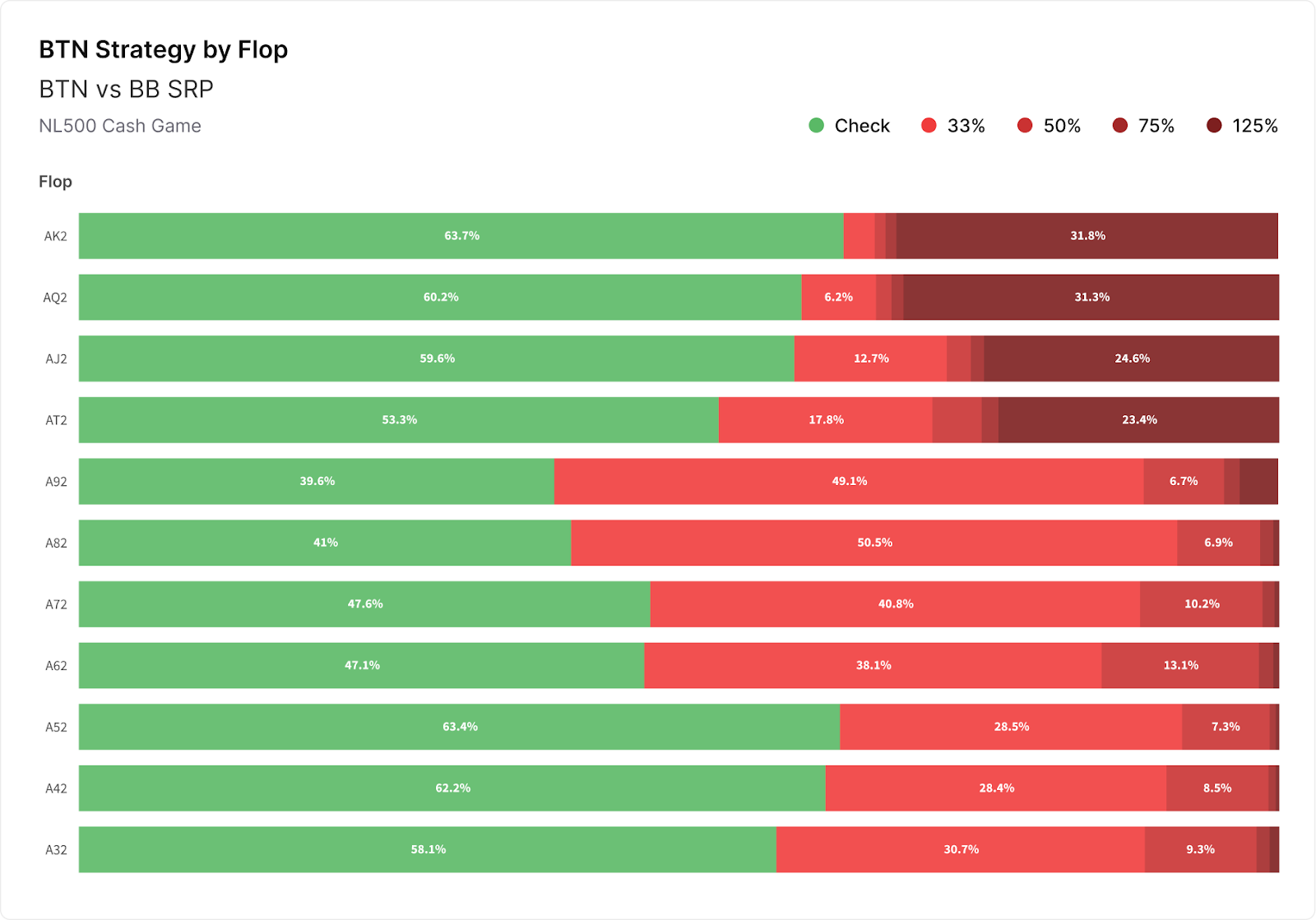
We can observe a clear separation: the basic BTN bet is 125% when X is a broadway card, and 33% otherwise. In the first case, the overcards to the second pair are smaller, and the presence of Broadway gatshots (of which BB has all offsuited combinations) reduces the equity of ready-made BTN hands. Consequently, BTN is reluctant to make a defensive bet with the second pair, so it is better to make a larger cbet with a polarized range consisting mainly of good top pairs and bluff. As an added bonus, this overbet makes many broadway gatshots indifferent to call and pass. When bluffing, there are more overcards to the second pair, and BTN tends to place a defensive bet with the second pair and underpairs, so the prevailing sizing decreases.
4. Conclusion
Strong draw on the flop has a high EV (often larger than many ready-made hands) and will always continue to face most “standard” c-bet sizes. When doing a cbet on the flop, don't focus on the strength of those hands.
Instead, think about the following heuristics:
- When you are out of position and you do not have a significant advantage in the range, make a check more often.
- Hands that can turn into effective nuts for the river have a high EV/EQR (equity and its realize), even compared to more ready-made hands. (The category of “effective nuts” strongly depends on the depth of the stack.)
- If your thin Velu bets will mainly knock out dominant hands, getting a call from a draw with high equity and better, then you have less incentive to make thin bet bets. In such situations, you should choose a more polarized bet strategy.
- Pay attention to the fold equity value. It's not just about how often your villain will drop, it's also about the type of hands they drop.
- Pay attention to the offsuited hands in both ranges, since each such hand represents 12 combinations.
- If your delicate Velu Beta will force you to drop your hands with more outs against you, then you have more incentives to force your opponent to drop. Consider small bet with a wide range.
- Bet more often with hands that are likely to remain vellu beta/raises rather than turn into bluffetchers on future streets. These hands are often said to have “high equity retention” or “robust equity.”
- When gatshots make up most of your opponent's range, overbet causes them to be indifferent to the continuation of the game.