


Translated with the help of AI. We apologize for any errors and would appreciate your help in correcting them.
3-bet on preflop is a powerful weapon that is necessarily included in the arsenal of a poker player of any game limit. Someone uses it more often, someone less often, but in general, the field has long appreciated the power of 3bet, and players are using it more and more often. Therefore, along with the inclusion of 3bet in his arsenal of preflop games, a modern poker player must work out an effective defense strategy against 3bet. Let's talk today about how to properly respond to opponents' 3-bet and how to build an effective defense against them, adjusting their range and combining various counter-measures suitable for specific situations.
1. Factors to consider when protecting against 3bet
So, you opened with a raise and got a 3-bet. To begin with, let's say a few words about what you need to pay attention to when thinking about your reaction to 3-bet.
Mutual positioning
As in poker in general, in 3-bet banks, an important factor determining the further game is the position of you and your opponent. If you are in a position (for example, you opened from the button and got a 3-bet from the small blind), you can consider a call with a much wider range than in a situation where the opponent is in a position on you. It is much easier for you to implement your equity on the post-flop and come up with some plus bluff for polarization of the value part of the range.
If you are going to defend against 3bet without a position, which will be most often, try to correctly assess the style of the opponent.
Realize equity without a post-flop position in a 3-bet pot strongly depends on the aggressiveness of the opponent. If the villain passively and accurately plays post-flop, then it will be easier for us to bring out our calls on playable hands of medium strength. If the opponent is aggressive, he will squeeze out our equity on the post-flop or reduce our game to big variance. We will have to defend ourselves against such rivals already.
Effective Stack Size
As the size of the effective stack decreases, we have fewer options for responding to the opponent's 3-bet. The usual reaction to 3-bet in short stacks will be either Push (all-in) or fold. On the contrary, in large stacks we are able to call more, we have protection options such as pocket pair (22-77) in stacks >50 bb, suited connectors (89s-TJs) in stacks >40 bb. In shorter stacks, both the "pockets" and connectors on the 3-bet should be reset . The 4-beta game is also highly dependent on the effective stack. In the 23-35 bb stack, we have 4-bet Push in the bluff, but there is no simple 4-bet (not all-in) because there is not enough depth for it.
True, 4-bet Push at limits up to $33 is used much less than at $44+ limits, so copying this part of the high limit strategy for playing at a lower level is a mistake that I very often see in my students. The specifics of playing at a low limit are such that a weakly plus and strongly dispersive decision to put 4-bet Push on A2s +, on 22-99 and on other bluff-equity hands becomes irrelevant, because bluff 3-bet for your opponents will be much less than at high and middle limits. Also, do not forget that our оpponents perfectly give away chips in other situations, and we do not need to earn any crumbs of EV, rocking the dispersion with pushes.
Also, a call to a 3-bet pot at low limits is more profitable than at middle and high ones due to the fact that our оpponents play much worse post-flop in a 3-bet pot: they pay our value better, and make it easier for us to realize equity of middle hands. In the 36-50 bb stack, we have a slightly increased call range in the 3-bet pot. It is also possible to put 4-bet (not all-in) in a bluff as a bluff. Against 3-bet 6 bb, we put 12-15 bb as a bluff. But the range of 4-bet push even at middle and high stakes is greatly reduced due to the fact that the ratio of risk to profit begins to fall rapidly. In the 50 bb+ stack, we further expand the range of call protection against 3bet and the range of 4bet (not all-in) disappears altogether, leaving only the velly value. The specifics of the game through open-raise and subsequent protection with both call and 4-bet are described in detail in our charts.

Further growth of protection against 3bet does not occur with an increase in the stack, on the contrary, in stacks above 90 bb, the range may even decrease slightly along the edges, due to the greater danger of giving decent pots under dominate in pairs and a more complex post-flop game, especially against aggressive opponents.
Sizing 3bet
An important point that players often do not pay enough attention to is the sizing of the opponent's 3bet. As shown by the researchers of large databases played by players of various limits, any deviation from the standard 3bet size (x2.5 - x3.5) shifts the 3bet range towards the velly value. If you see a sizing of 4.5 bb or 9 bb, the range of call and 4beta should be reduced.
This is logical for increased sizing, but few apply the same logic against reduced sizing of 3bet, because in this case we can watch the flop relatively cheaply. In many such situations, players catch some matches or draw on the flop and fully pay for the AA of the opponent, which, in fact, is the calculation. That is, if you opened and got a very big (x4 or more) or very small (x2 or x2,2) 3-bet, this in the overwhelming majority of cases indicates that the opponent has cards related to the premium vela of part of his range. Stay alert!
Opponent statistics
Useful information to make a decision about our reaction to 3-bet can be provided by the opponent's game statistics, which are provided to us by trackers such as Holdem Manager and Hand2Note. If the opponent has a 3bet indicator of 2-5% for a sufficiently decent number of hands, then his 3bet range with a big probability consists only of a velly-ruk. Against such an opponent, you need to be ready to fold most of your starters, and carefully choose your hands for the call so as not to fall under dominate.
You should prefer hands with nuts potential and good playability, such as pocket pairs 22-88 (on a set velya), and good connectors to collect straights, flushes and doppers. But these hands need to be easily fold ed if the nut combination could not be assembled. Conversely, an opponent with a 3-beta of 9-10% or more probably has in its 3bet range both high pair and other strong hands, and medium cards ("broadways", connectors), which are both more vulnerable to 4-beta bluffing, and may be weaker than your combination in the post-flop game. Against these opponents, the specifics of our defense will be different. We can do both loose 4-beta pushes and just 4-beta (not all-in). Also, on the post-flop in 3-bet pot, we can play more widely to open the opponent's bet, catch his bluff.
In addition to analyzing the opponent's game statistics at the table, do not forget to also watch the showdowns of your opponents; the cards shown at the showdown often say more than the statistics in numbers. Timely notes that the opponent can 3 bet in a bluff as a bluff or on a weakened range can greatly facilitate your decision in the future.
Hand strength and playability on a post-flop
Faced with the 3-bet on preflop, it is necessary not only to assess the current situation, but also to think about the possible development of events on the following streets. When choosing the hands with which you are going to call to 3-bet, evaluate not only the position (your and the opponent's), the size of the 3bet and the size of the effective stack, but also the playability of your hand on the post-flop, as well as the possibility of being under the dominate of the opponent's hand.
- For example, if you opened from the middle position and received a 3-bet from the small blind, then it will be much more profitable to call with JTs than with ATo, despite the fact that the second combination is formally stronger. However, ATO has significantly worse playability due to the variety and incoherence of cards.
In this case, the ace in this combination is likely to be dominated by the ace of the opponent with a higher kicker, since in many cases the 3bet range of the opponent contains a significant number of AJ+ cards.
Example of protection against 3bet in all 3 ways
The screenshot shows the range of protection on MP2 in stacks 33-49 bb against 3bet.
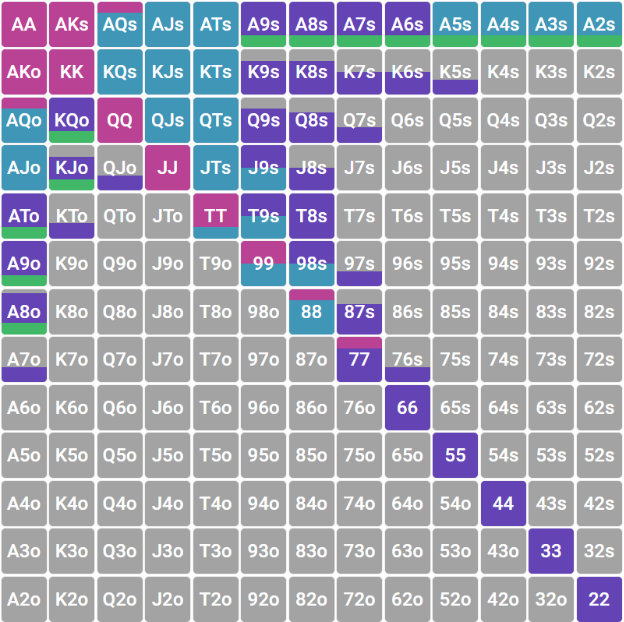
- As you can see in the screenshot of the range, we have JJ+ AKo+ in 4-bet Push for Velje value. In the 4-bet Push, 99-TT is often used for protection, and rarely AQ and 77-88.
- Call against 3bet we can play all the suited "broadway", AJo+, 88-TT (in those cases when we do not want to push them), and A2s-A5s, as the best of the suited dominant Ah.
- 4-bet (not all-in) as a bluff we can do on A8o-ATo, A2s-A9s, KJo-KQo.
- The rest of the hands are just playing fold against 3bet and nothing else.
2. Some tips on playing postflop in 3-bet banks, like caller, working exploits at low limits
The call in the 3-bet pot is played against a strong, linear range in which there are many strong hands with high cards. Usually, this range is dropped from the bottom (that is, there are almost never any small cards in it), so low and medium boards without high cards are usually poorly suited to it, and they can be resisted in any way. How to play medium pocket pair after call 3bet (6 tips). Play draw is most often reduced to an aggressive line if the board is low, and to a passive one if there are high Q+ cards. Monster-draw can be played on the stack, but weak lower flush draw, especially in the later positions of the game, where the opponent in the 3bet range has many master cards stronger than ours, can be played through the raise on the flop and, having received a re-raise or Push, - throw away.
Look carefully at the size of the opponent's counter beta sizing.
- Low sizing of the counter-beta (especially in a dynamic board containing a large number of draw) can indicate the weakness of the opponent.
- Large bet (especially at low limits) in most cases are made on the velly, against them it is better to raising only strong combinations or strong draw, and to refuse the raise as a bluff.
Of course, there are bluff in all sizing, but here the matter is in the ratio of the value to the bluff and the costs that we need to incur, in relation to the size of the pot, if we decide to play a call or raise against a large bet. For example, against a bet of 50%+, it is better to immediately fold any hand with equity worse than the top pair. If the villain refuses the counter-beta, it usually strongly dribbles (limits) the opponent on the vellya. Be prepared to seize the initiative and make a bet to put pressure on the opponent's range.
Of course, sometimes you will run into slow play, especially on dry boards, but in practice you will often see check-fold even in the most unexpected situations. If you are in an opponent's position, more often use floating on board that do not fit the opponent's 3bet range, since the low limits field as a whole makes the 2nd barrel much smaller than it should, and this strategy will become quite effective. It is especially good if you at the same time have at least some (albeit weak) equity, for example, a backdoor on a straight + over-card.
3. Conclusions
3bet protection is an important part of a poker player's strategy.
- Few people do it well enough. This is probably one of the most ambiguous parts of the preflop strategy. The thing is that small mistakes in the post-flop draw can bring a whole block of hands (for example, suited connectors) to negative call protection.
- In fact, all but easily played pocket pair (and then the upper ones - 88-TT - are often played poorly, worse than the lower ones, due to the same errors on the post-flop) and some upper equity hands in the range, such as AQ and AJs, are played by the majority most often around zero or a weak plus. That is, there is no real winrate-forming dependence on broad protection against 3bet. This is done more for the image than for earnings.
- In this regard, my advice for all weak minds: play "nitovo" against 3bet. As they say "pass - fold the money saved", once again you doubt - drop your hand. Winrate -220 bb/100 with a pass is not so bad compared to situations where players allow themselves excessive freedoms in the 3-beta sweat and lose large stacks.
- To successfully defend against 3bet, a poker player must first develop the skill of thinking in ranges, work out his strategy and protection range and strictly adhere to them, closely monitor the sizing of 3bet and subsequent opponents' bet. And also to be very disciplined. Discipline is very important in this part of the strategy.