


Translated with the help of AI. We apologize for any errors and would appreciate your help in correcting them.
In fact, when everyone folds up to you, and you just deliver 0.5 blinds on the small blind, this is a complete, that is, in simpler terms, a limp on SB. I also want to note at once that at microlimits (below $5) you can simplify your strategy by completely replacing it with the usual open raises of increased sizing 3.2-3.7 bb. The field on these limits is very weak and will not be able to provide you with strong resistance.
1. Features of the SB position (small blind) in an unopened pot
First of all, I would like to note a few important differences between the small blind and others.
- Only on SB can we accumulate quite widely, benefiting from this.
- When we open with a normal SB raise, we often want to use inflated open-raise sizing. The big blind is defended very widely (usually 80-90% of all starting hands), knowing that we play a wide range as well. If we start opening with a regular min-raise, BB will get a unique opportunity to defend with absolutely any hand, and we will never have a positional advantage on the post-flop. Hence the idea of open raises from 3 to 3.5 bb.
- The SB position is absolutely unique in that it is the only position at the table in which you never have a post-flop position on anyone.
As we can see, in general, the position of the small blind is one of the most inconvenient.
What winrate metrics should you strive for? Top players bring the game on the small blind to an insignificant plus, playing with winrates from about 3 to 6 bb/100. Indicators above are already extremely rare. In general, if you play the small blind at zero or even a small minus (roughly in the range of +3bb/100 to -6bb/100), you have no problem playing on the SB. However, most players will perform worse. And now let's see what can be done to improve the quality of our game on SB.
2. Where does the idea of a kit come from?
And if it makes sense to compliment at all, you ask? We are well aware that any raise always at a the long run generates a certain percentage of fold equity, and the raise does not generate it at all. In order to understand the essence of the kit, let's consider all its possible branches. After all, in fact, we are not interested in what he compiles himself, but what will follow after him.
Line limp / call
I prefer to play this line against lusovo-aggressive guys with hands that have good playability on the post-flop.
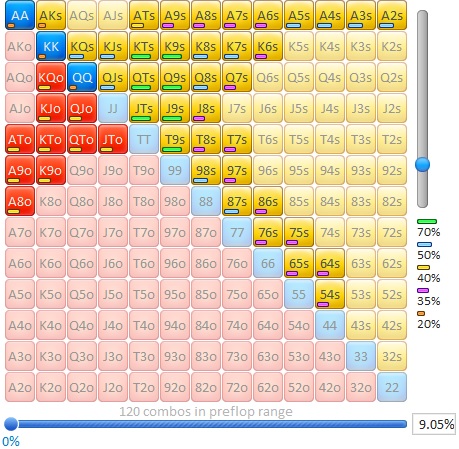

The basic idea of the kit here is very simple: it extinguishes the probable preflop aggression on the part of your opponent, that is, the kit will avoid 3bet from the big blind. It will also allow you to play against a weaker and vulnerable range with a fairly good hand, since the range of isolate from the big blind will be much weaker than the range of its 3bet. It is worth noting that in some cases against super-aggressive opponents, you can add a small percentage of a premium hand to your range, thereby setting a trap for a post-flop draw. I used a very small weighting of 20%, as I don't want to resort to sloppy too often.
Limp / re-raise line
I want to use this line in 40bb+ stacks and again against lousy-aggressive opponents. Suppose we complete, get a standard isolate of 3.2-3.5 bb, and do an unexpected twist to 9-10 bb. In order to truly appreciate this movement, let's look at the range of isolates from the big blind.
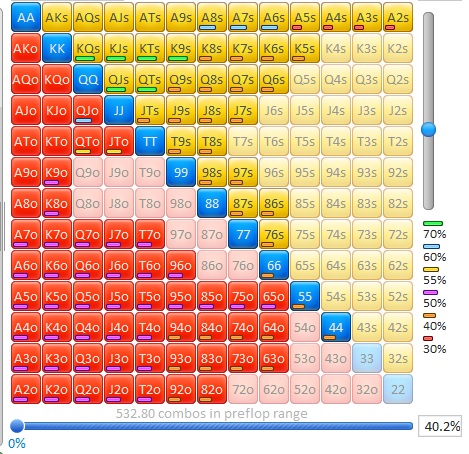
When compiling this range, I relied on some middle ground and got a 40% range.
Below are the main ideas on which this range is built:
- The top of the range isolates on the value.
- Hands such as KTs QTs J9s 98s and the like have good post-flop playability, so they will look great in both isolate and check.
- Absolute garbage of type 82о, 93о, T4o, on the contrary, has very dubious prospects and an extremely low implementation coefficient on further streets, so many reg players add these hands with a certain weight to the isolate range, trying to pick up the pot here and now.
It is worth noting here that many reg players and just aggressive players isolate even wider, with about 50-55% of hands. Even a quick glance at such a range, we understand how vulnerable it is to a sudden counterattack from SB. However, more experienced opponents still have a theoretical opportunity to overplay you on the post-flop. We must also adequately assess the strength of our fold equity, which will always be higher when playing in shallow stacks than when playing at the beginning of the tournament, when the stacks are still deep. Therefore, I don't want to use this line too often in the early stages of the tournament. There is something that makes sense to save, as they say, for a while.
Limp / Push line
This is real gold! Decoration of your game in any dipran, or even better at the final table of any tournament.
For the profitability of this heap, several conditions must be met, namely:
- Aggressive villain on BB.
- The effective stack depth is in the range of 18-26 blinds.
- Suitable hand.
Now let's think about filling our range, as this can significantly increase your EV in such drives.
4 groups of hands are ideal for us:
- Any broadway.
- Both small and medium pocket pair.
- Any Ah hands.
- Suited connectors and happers.
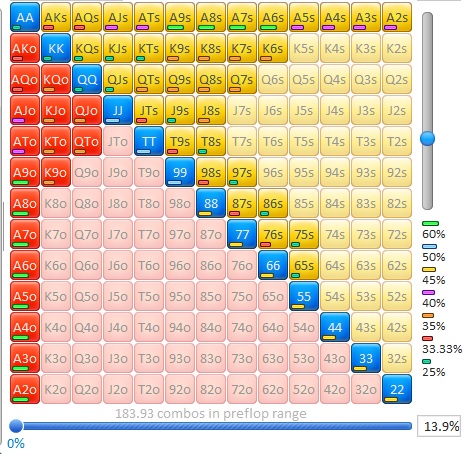
Hands from the first and third groups have a good potential for implementation on the post-flop. That is, we select certain types of hands that can stand well at the autopsy in cases where we receive a call from an opponent. But the hands from the second and fourth groups just have certain problems with postflop. To understand this better, it is enough to simulate a simple situation. Suppose you complete with pocket 44, get isolate and just call. In most cases, you will see three overcards on the flop to your pocket pair, with which you can hardly walk to the showdown now. Such unplayability is demonstrated on the post-flop and Ax hands, especially the offsuited A2o-A8o. However, with all these hands, we can get an easy and profitable draw option by playing them along the limp/Push line, since they will generally stand very well against the range of your rivals on the big blind.
You can see and see for yourself how well this line works in practice in general. This is a very fresh final at Poker, which we managed to win thanks to such draw lines.
Limp / fold line
It exists in theory, but as for me, it does not make sense in practice. If you get an 82o garbage hand, it's okay to just roll it up. In the event that a nit turns out to be on the big blind, we can simply open any hand with an open-raise, since against this type of players we will make great money on their re-fold.
Exception: We want to use the limp + cbet line 1 blind on the flop against the amateur who covers us in the later stages of the tournament. The idea is that such opponents do not throw anything at the raise, but at the same time do not apply insulation widely, and surrender well to the minimum bet if they are not in the flop.
It turns out that we still get a good profit without risking a significant part of the stack. This will be especially true in dipranes, where we are very much pressured by the FGS factor, since we have a serious advantage over the field, that is, our chips increase in price even more compared to the usual ICMmodel.
3. In which cases it makes no sense to add
Should never be pitted against thread players. As mentioned above, we will make great money against them on their tendency to reflag. Therefore, compiling in such spots will be devoid of any meaning. Also, it is not worth picking up on amateurs in general, if we cover them. By making a raise, we will be able to put additional pressure on the post-flop, and they will not be able to play optimally, which will bring us extra EV. Of course, we want through raise to realize ICM pressure on opponents who understand this.
4. Conclusion
- In this article, we have considered all possible branches of the kit.
- I hope you will find useful information for yourself, and your game on the small blind will become more thoughtful and completely unpredictable for your opponents!