


Translated with the help of AI. We apologize for any errors and would appreciate your help in correcting them.
Translated by order of the educational portal university.poker
Article author: JonnyLaw, original source: GTO Wizard
Playing Button presents many unique opportunities in tournaments of any format, especially in PKO (progressive knock-out tournaments).
In addition to the advantage of constantly having a position on the post-flop, we also have the opportunity to play our widest range against the blinds when it comes to the RKO format. In this article, we will look at how other players' coverage and other players' coverage of us affects our range on Button preflop in PKO.

1. Comparison of RFI ranges
As a starting point, it is important to understand the impact of the tournament stage and stack depth on our opening range. Both the risk premium and the size of the bounty will affect how wide the optimal button opening range will be. Let's start our exploration by looking at a few of Button's ranges at different stack depths and at different stages of the tournament button. Note that these examples are taken from the 8-max table solution library, so the average stack size of the entire table is 40 bb, not just BU-SB-BB.
For our purposes, we have excluded these previous positions as we discuss Button's RFI range button. Н3 40 bb medium stack, 50% of the field left:
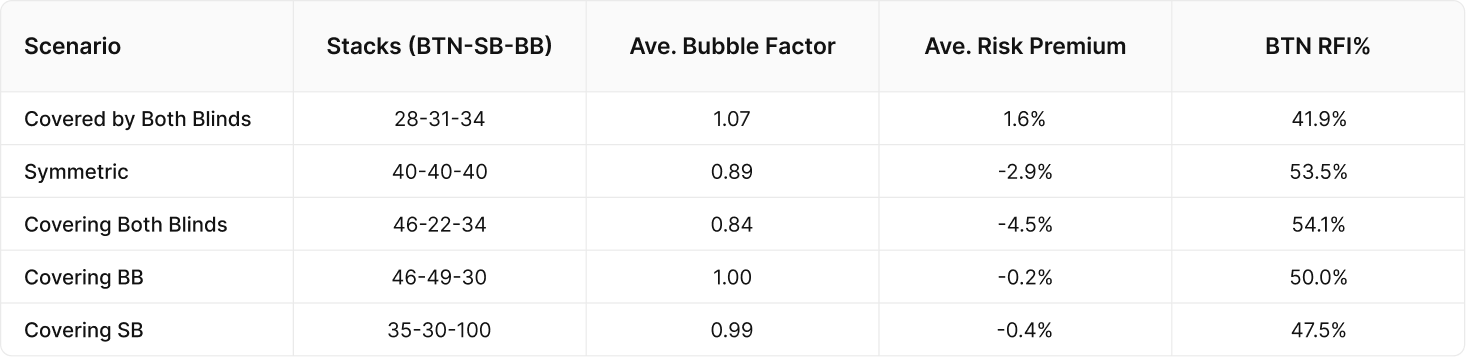
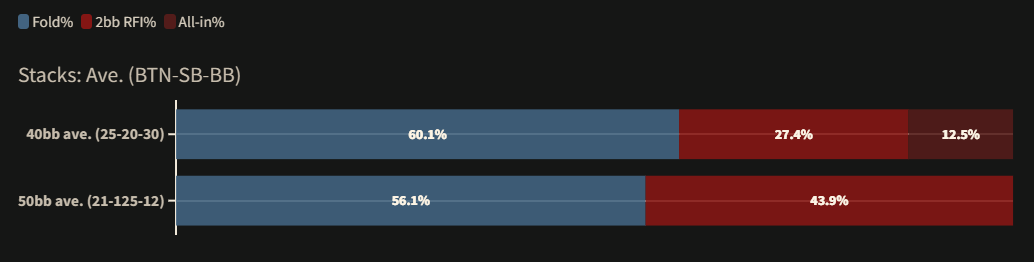
In the following graph, Button's opening frequency is compared to the average of the risk premium when playing against SB and BB:
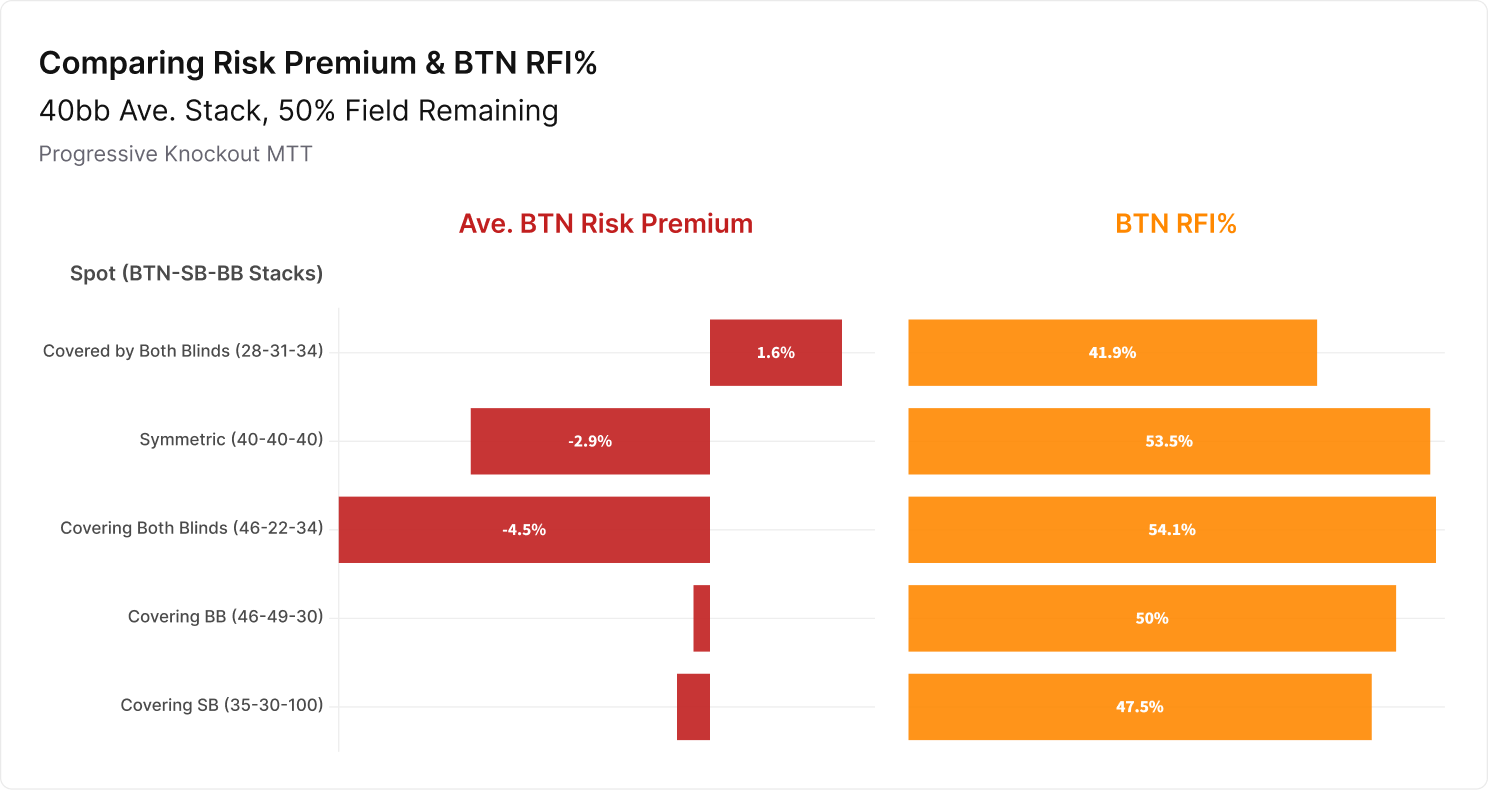
Based on these examples, we can immediately see some interesting trends for Button: button
- Play the smallest number of hands when covered with both blinds, relative to equal stacks. (11.6% decrease in VPIP).
- Also, play fewer hands when covered with at least one of the blinds, compared to equal stacks. (3.5-6% reduction in VPIP).
- The button range increases only slightly — by 0.6% – when covering both blinds relative to the scenario with equal stacks.
The conclusion will be as follows: In the early and middle stages of the tournament, the fact that button is covered with blinds has a much greater impact on its range than the fact that button itself covers blinds compared to the situation in equal stacks.
For comparison, let's see how the middle stack depth and the overall tournament stage affect our range.
Below is a table similar to the one above, but at a stack depth of 30 bb near the bubble when the ICM pressure is high. H3 Depth 30 bb, about a dough:
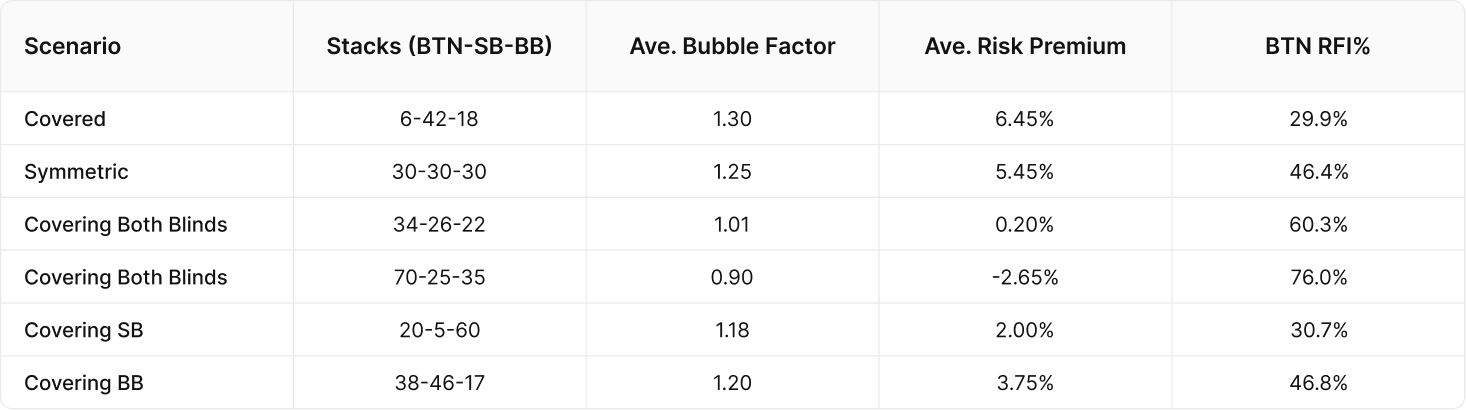
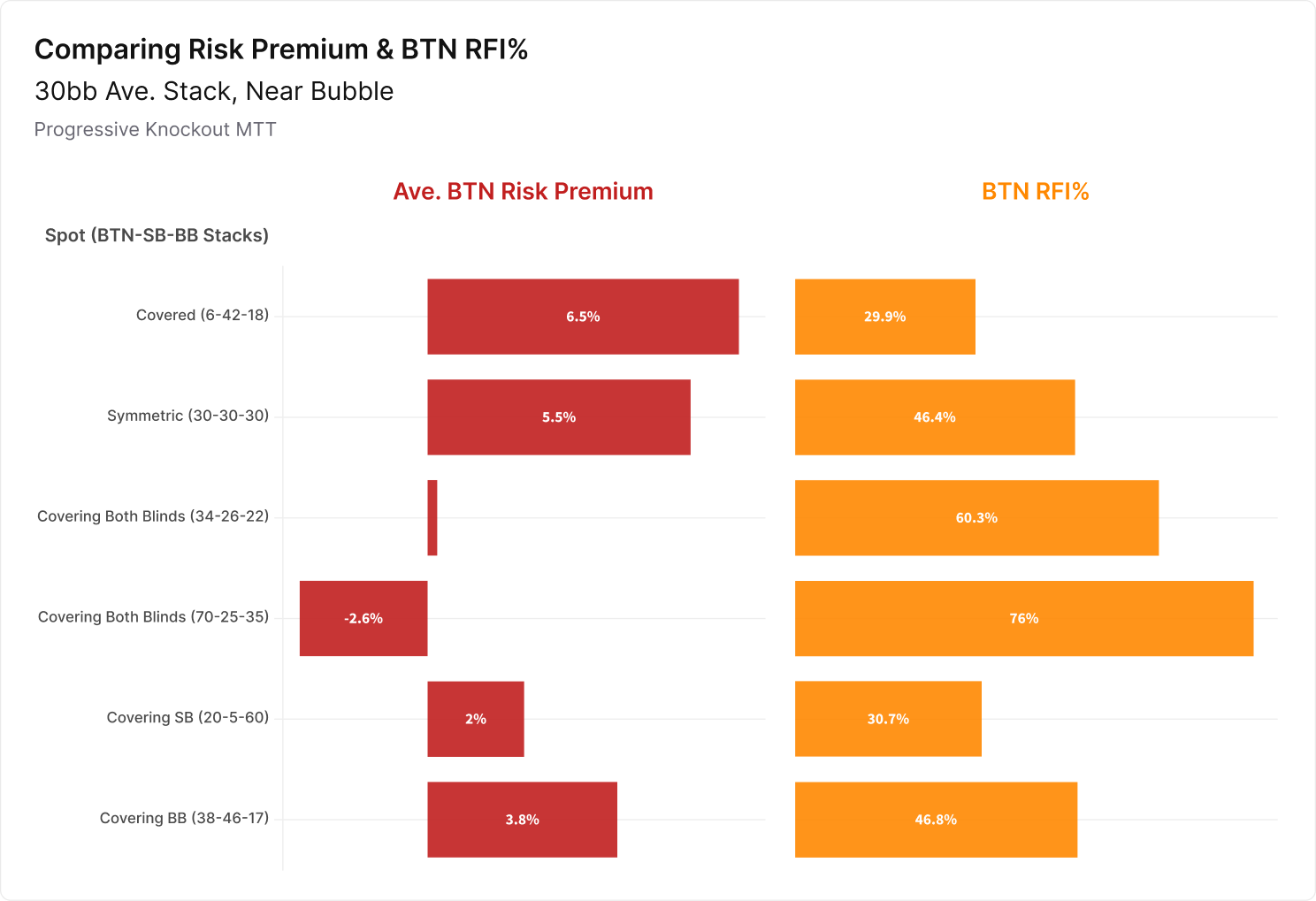
If we compare this situation with the previous example, we see the following:
- The total opening range with equal (symmetrical) stacks, when we have a shorter stack and we are closer to the bubble, decreases by 7.1%. While it's intuitive that we play fewer hands around the bubble, it's worth noting how significant this influence is in PKO.
- Button now plays significantly more hands, covering both blinds, with his range expanding as their chip advantage increases.
- When Button moves from equal stacks to covered with both blinds, we see a rather narrow range, which is also intuitive, since we already play fewer hands at this stage in such stacks.
- Button still plays quite a few hands, even if it covers only the big blind and not the small blind, unlike the reverse scenario (when it covers SB but not BB).
The key takeaway from these two examples is this: In PKO tournaments, Button's opening range mainly depends on his advantage in the risk premium. Covering both blinds allows him to gain bounty and apply ICM pressure.
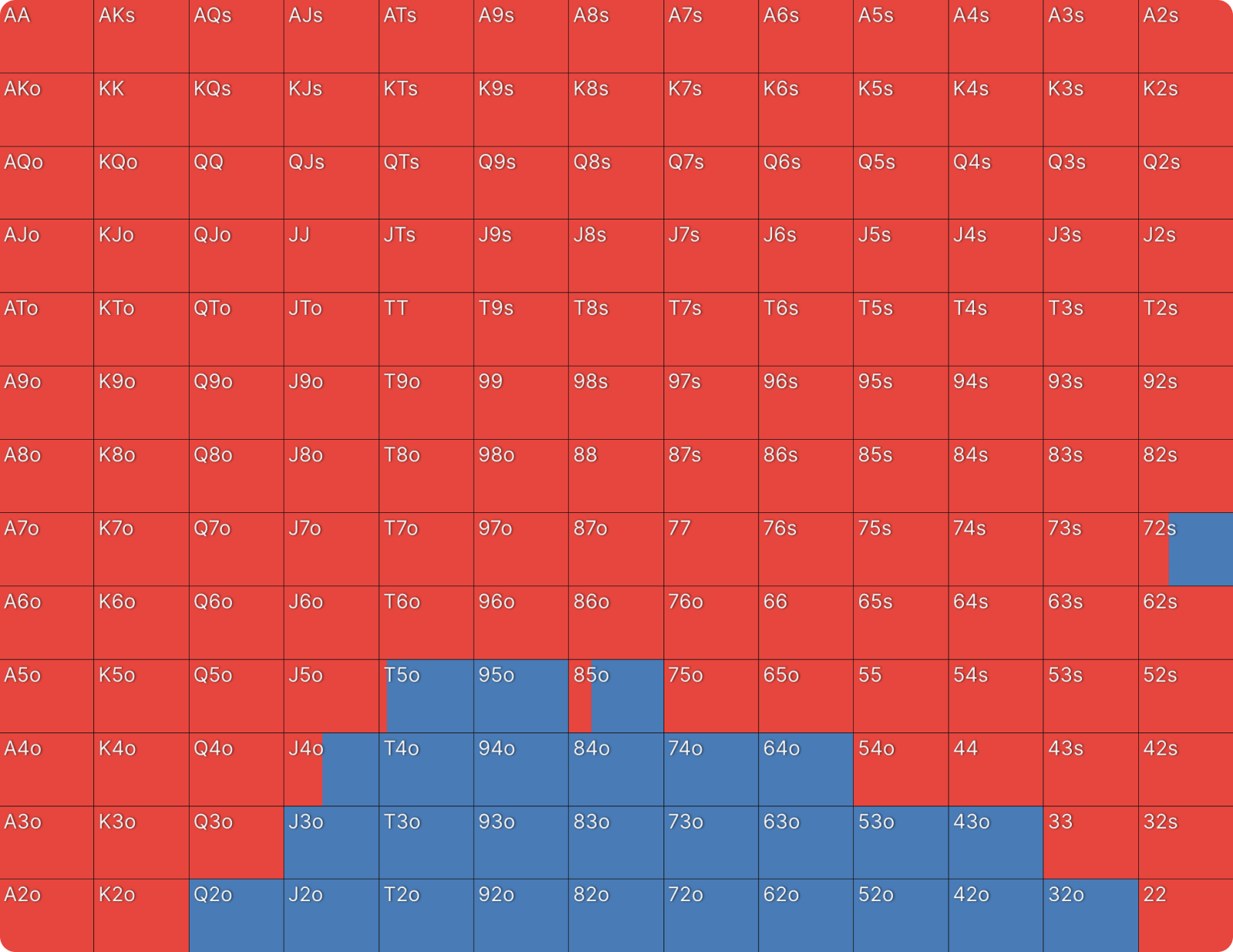
For reference, here is what the RFI range of 76% looks like, which we have in the previous example, where on the bubble at Button the button stack is 70 bb against 25 and 35 bb at the blinds:

Adding all-ins to RFI range
Now that we've seen a few examples of our opening ranges in the PKO tournament with Button, let's find out when we can consider pushing.
Again, we'll compare similar tournament stages and stack sizes. All-in frequencies:
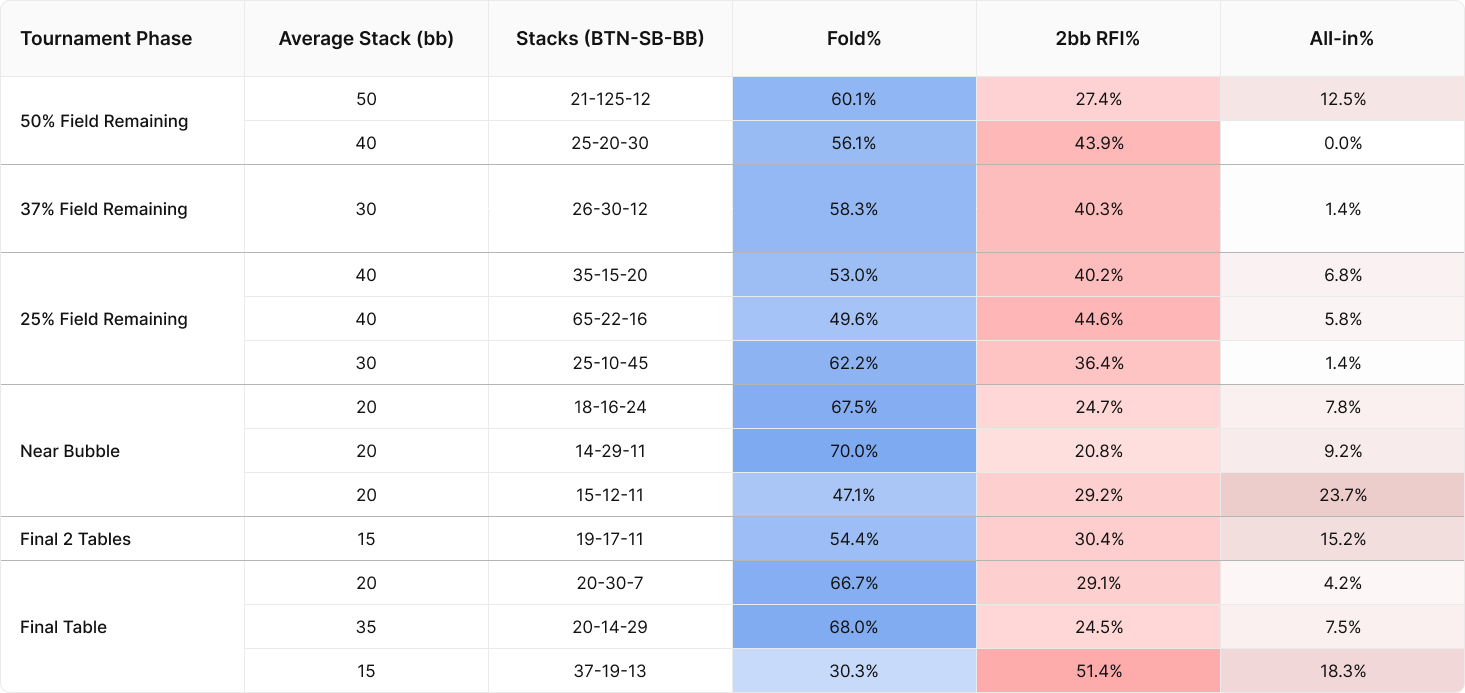
The following interactive chart shows how your strategy changes with stack depth.
You can filter the tournament phase:
50%
37%

25%
Near Bubble
Prefinal

Final table
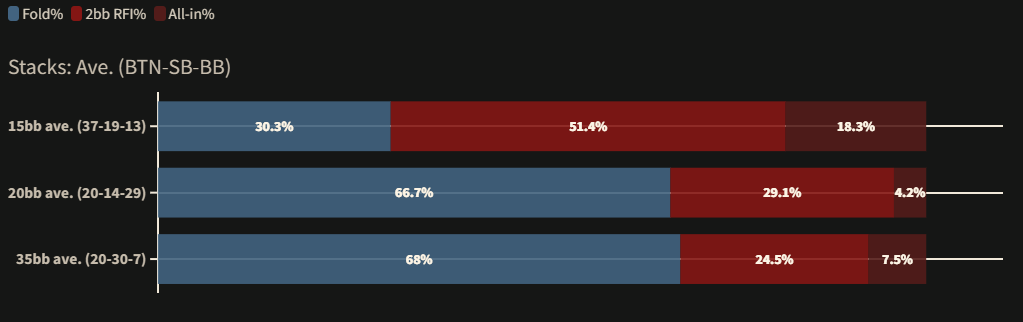
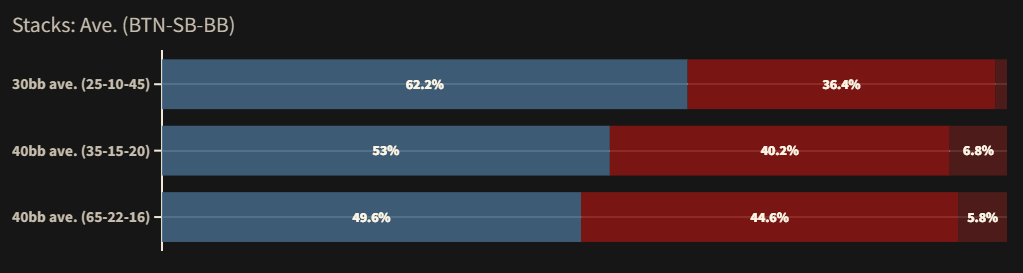
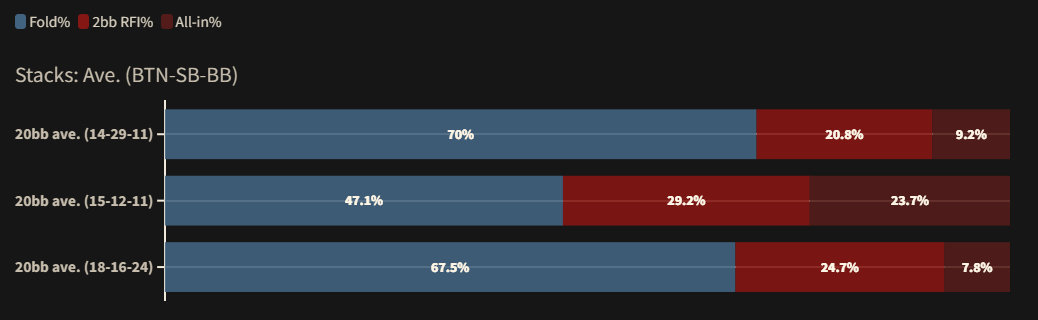
Looking at these solutions, we see:
- Except for the first option "50% of the field left", Button uses the open Push only when he or one of the blinds has a stack of 20 bb or less.
- When a button has more than 20 bb and is covered by one or more players, it has virtually no push unless its stack is well below average.
- When all three positions are close in chips and Button covers both, then he pushes more often, because the blinds face a very high risk premium.
2. All-in range
Now that we've looked at all-in frequencies, let's see how to build our all-in range.
Below are three examples of how the all-in range expands, i.e. we see where the expansion begins and how it continues:
- All-in range 1–10%
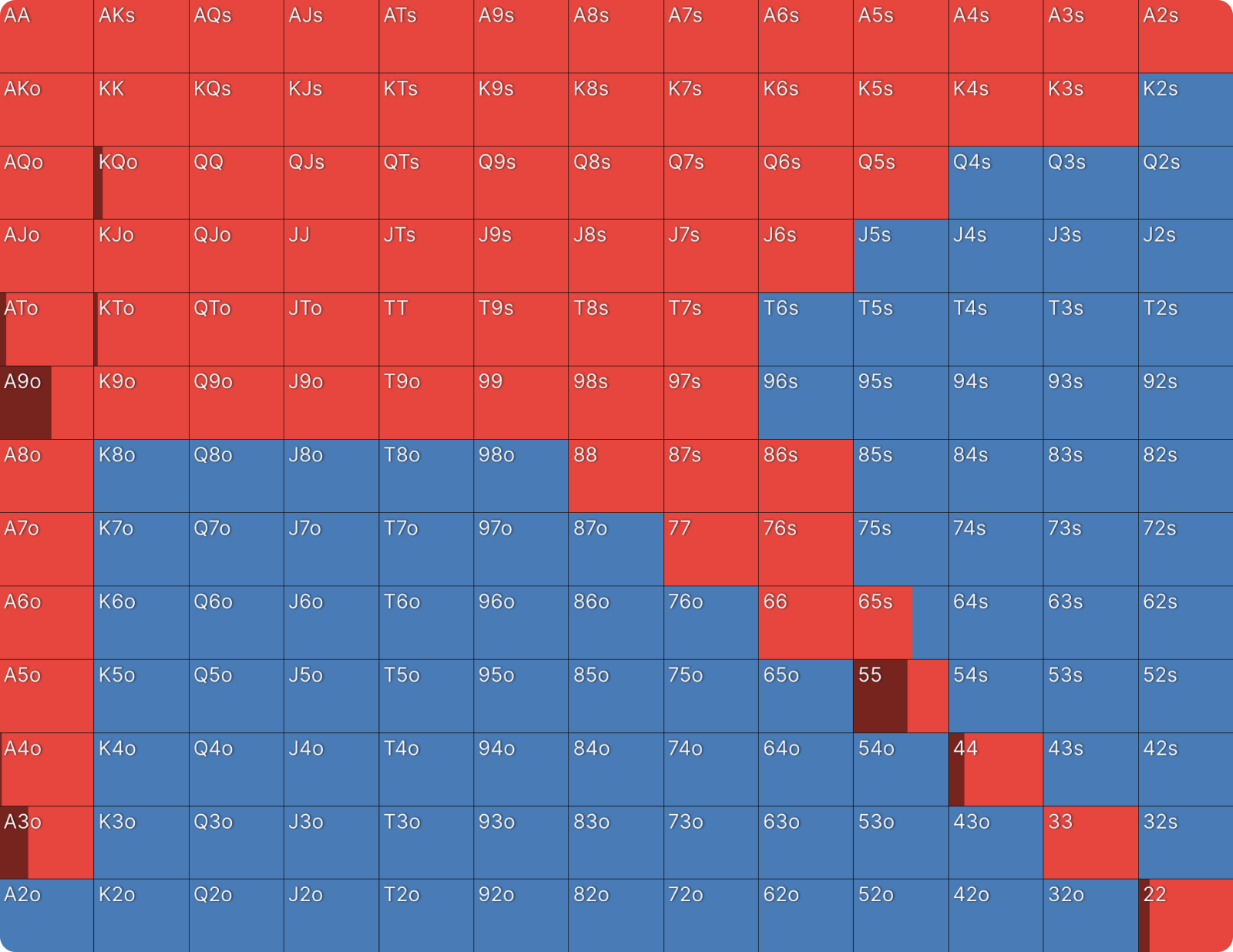
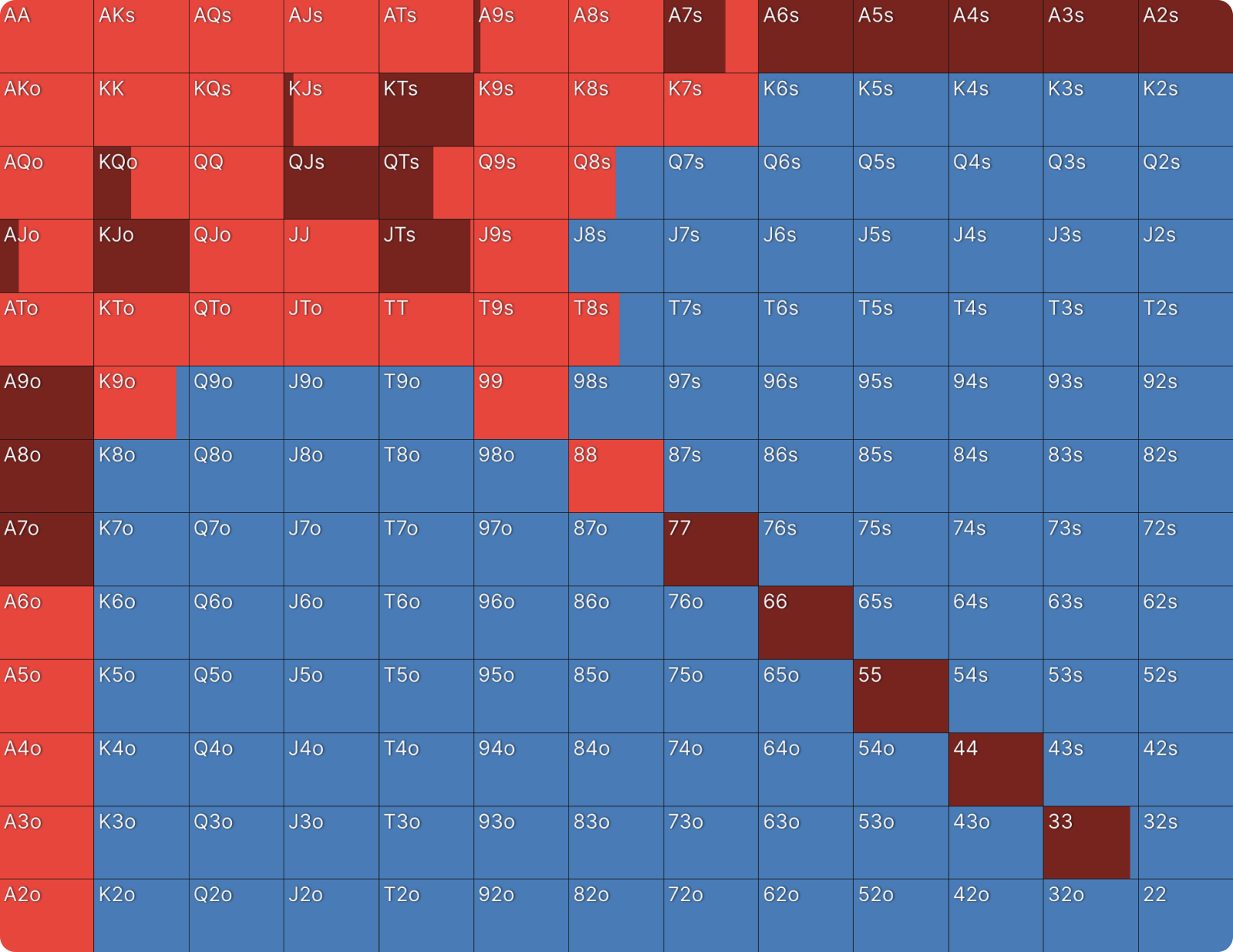
We see that our all-in range begins to grow with A9o and 55 and further expands due to suited aces, pockets 33–77, some suited 10-x and then with medium offsuited Aces-x hands.
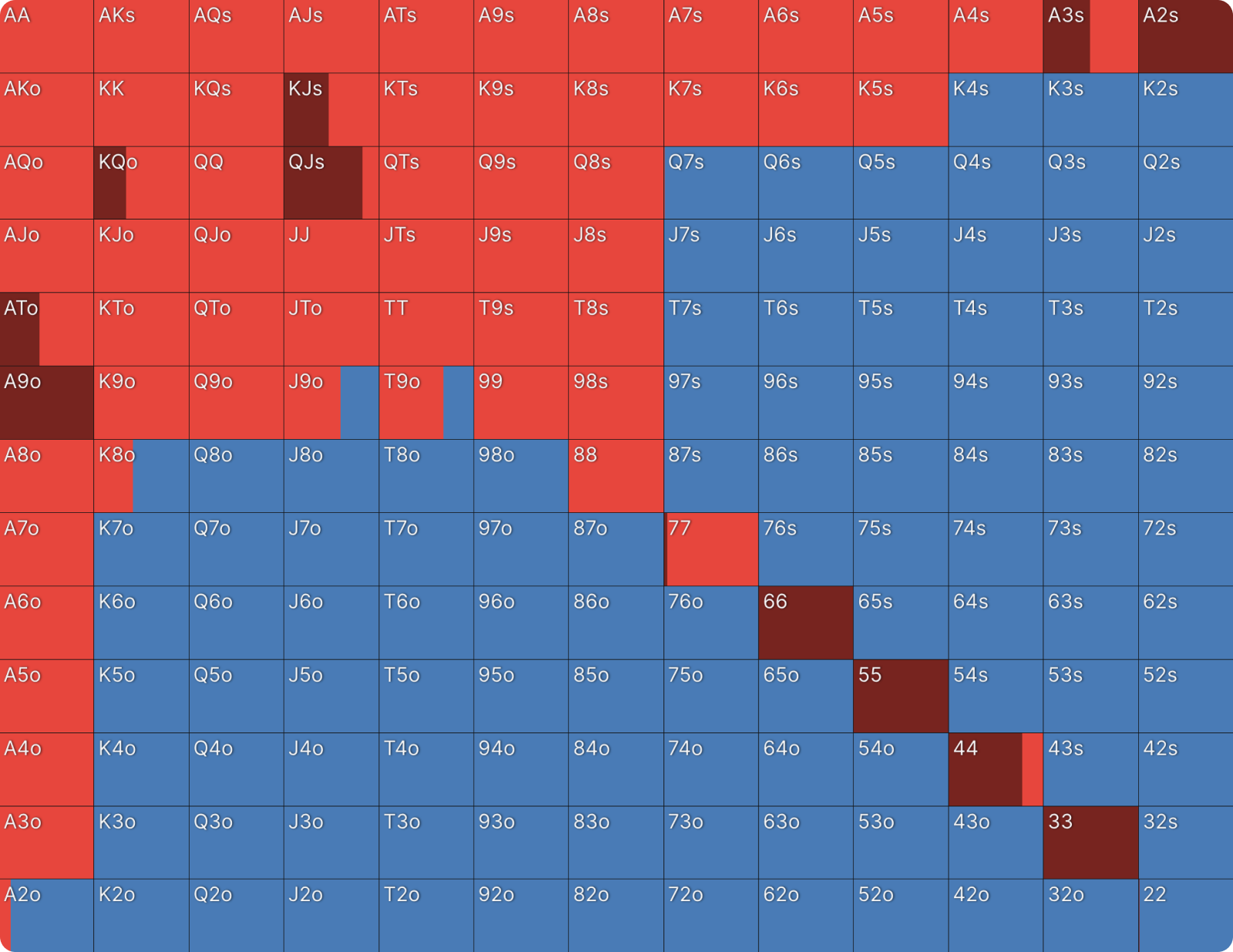
- 10%+ all-in range
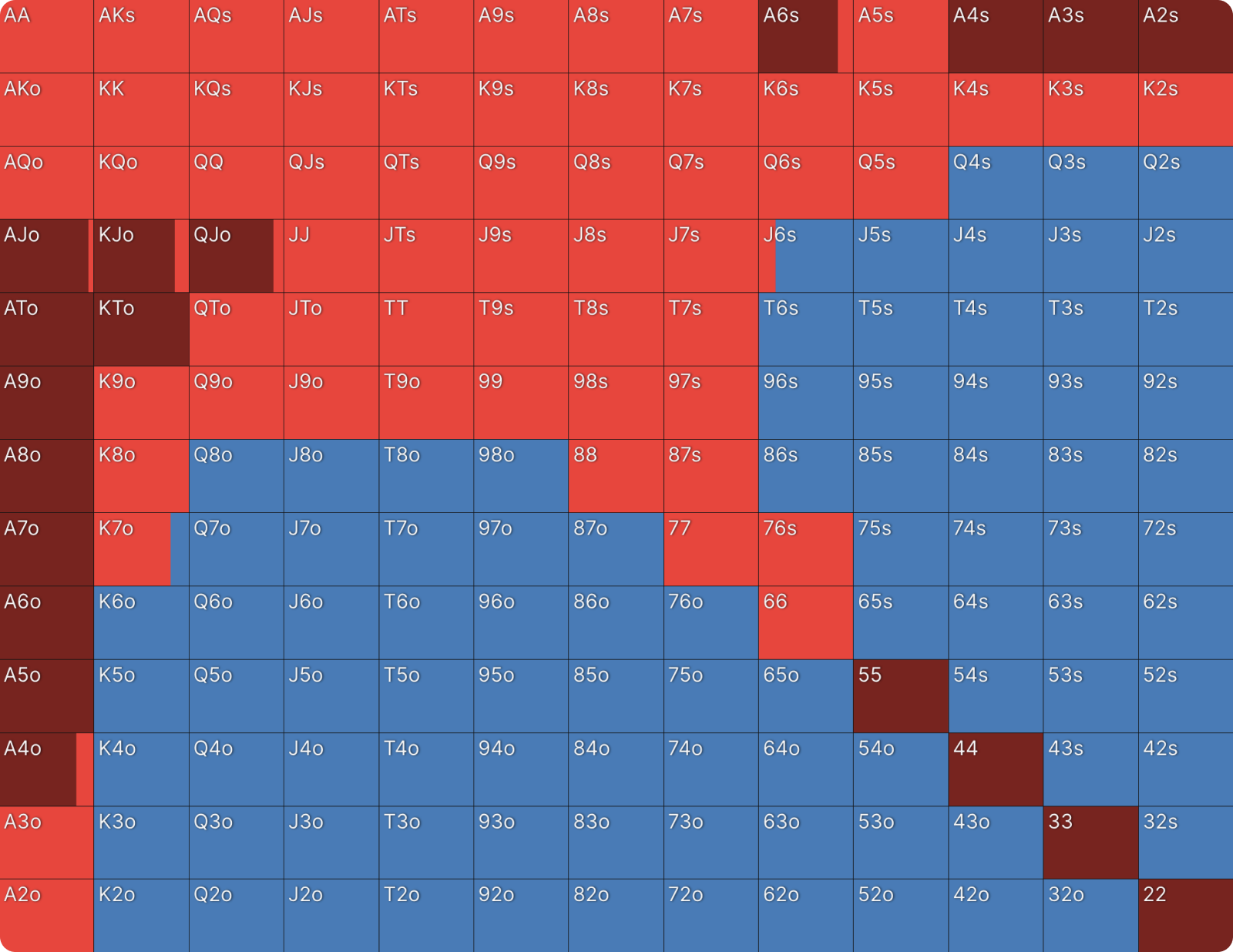
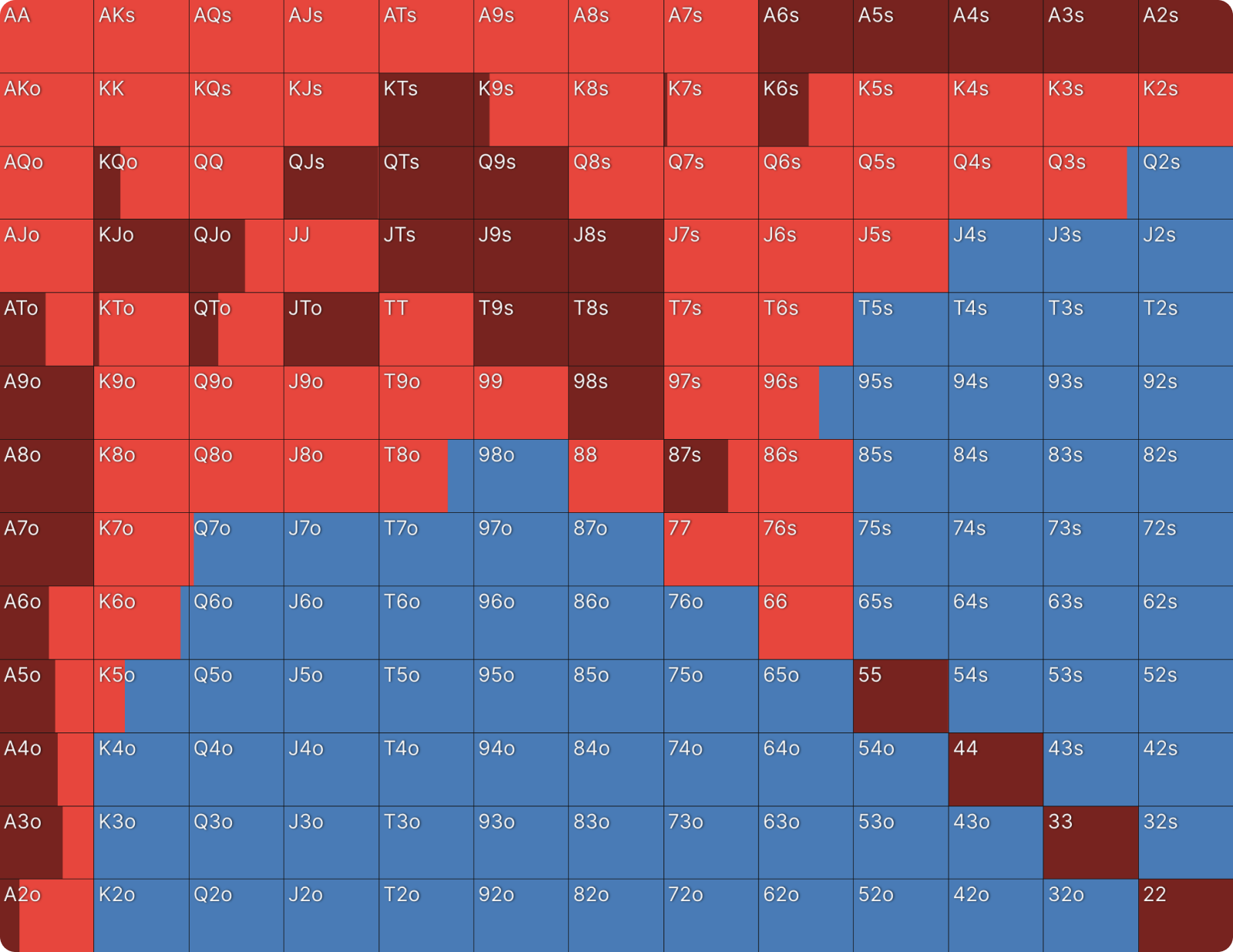
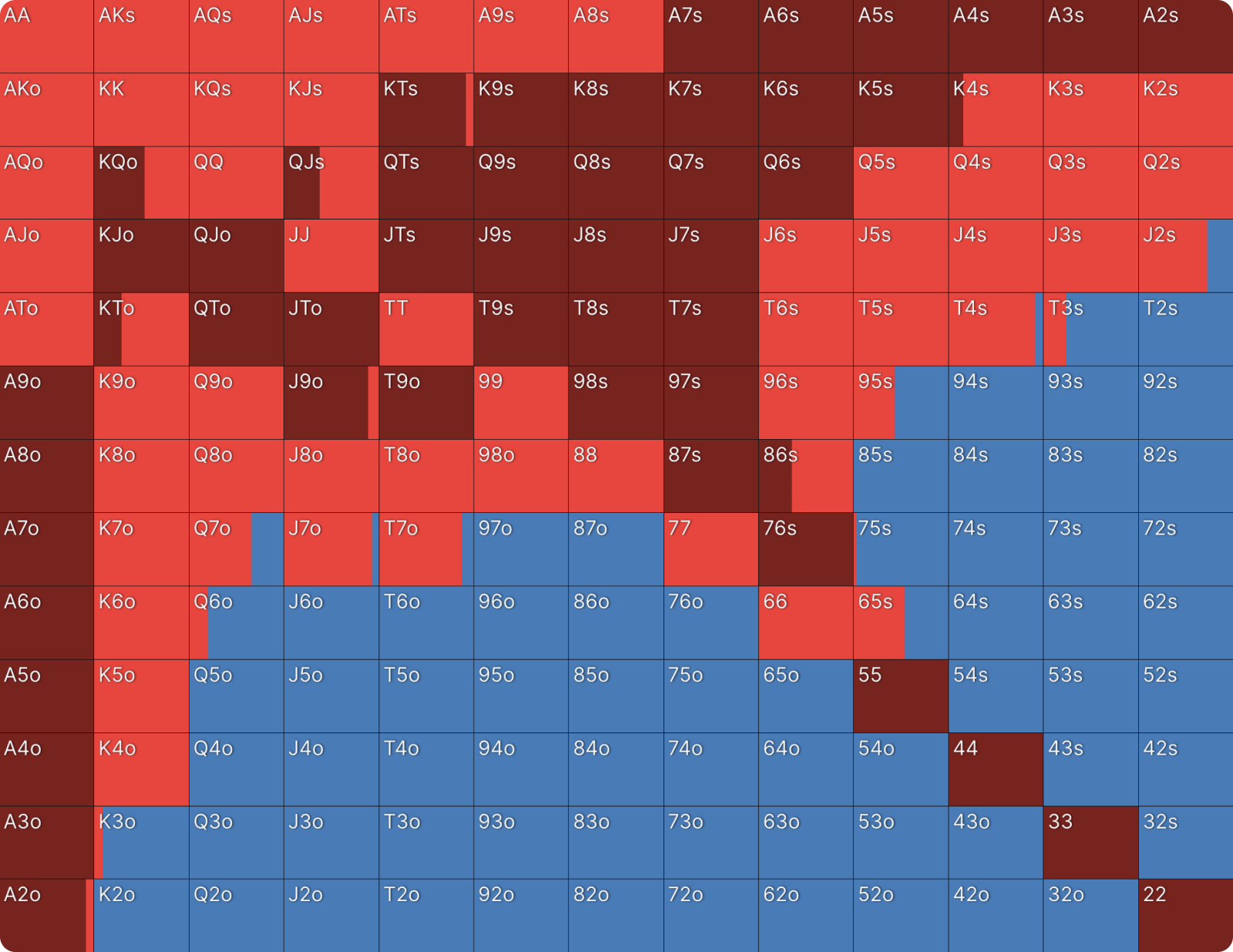
As we further expand our range, we see the addition of more offsuited aces, as well as our younger pair and any aces like A2-A5. In the widest range of Button (covering both blinds near the dough), we see the addition of several suited hands, as well as several offsuited connectors. It is important to note that most of our strongest hands prefer to open the game not all-in, because we want our opponents to stay in the game with a relatively wide range when we are ahead. Hands that are not so strong go all-in because they want to maximize the realization of their equity (in addition, they are tempted by the opportunity to get a bounty).
3. Conclusion
Playing Button provides the most opportunities in PKO, but requires some dexterity in determining when to expand our range and when to narrow it, as well as when to use all-ins and how to build that range.
We have seen that due to the influence of stack size in PKO:
- In the early and middle stages of the tournament, covering your opponents has a much greater impact on your range than when you cover your opponents yourself.
- The more Button has a edge in chips over the blinds, the more hands he plays.
- Button uses open-push only if he or one of the players on the blinds has a stack of 20 bb or less.
- All-in range expands as the risk premium increases as Button covers both blinds.