


Translated with the help of AI. We apologize for any errors and would appreciate your help in correcting them.

Translated by order of the educational portal university.poker
Author: Tombos21, Original Source: GTO Wizard
Please note that some sites, such as Pokerstars, host PKO tournaments where 2/3 or even the entire prize pool is set aside for bounty prizes. In this article, we will consider only standard tournaments, where half of the prize pool goes as a reward for knocking out. The reward effect creates additional adjustments to our game strategy. PKO tournaments tend to be more active as players are interested in knocking out their opponents to earn rewards rather than just trying to survive and advance in the tournament. This format also encourages players with a chip advantage to play aggressively against shorter stacks as they can earn extra money beyond the in-game chips.
1. Solutions for PKO tournaments from GTO Wizard
In our article, we will look at the following structure:
- Field for 200 players (parsing for 1000 people will appear soon)
- Buy-in $200: $100 in the prize pool, $100 in the bounty pool.
- 8 players at the table
- Ante 0.125BB from each player
Place Prize (%) Prize ($)
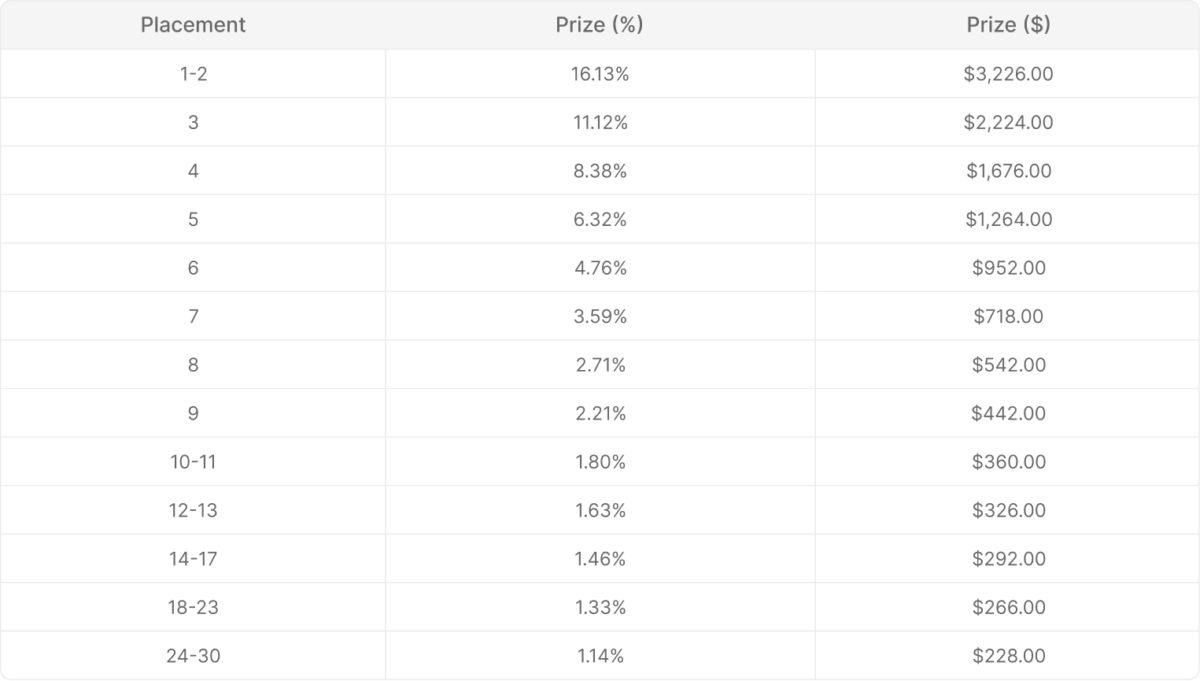
Let's look at the table when the tournament just started. Each player starts the tournament with 100 big blinds (BB) in their stack.
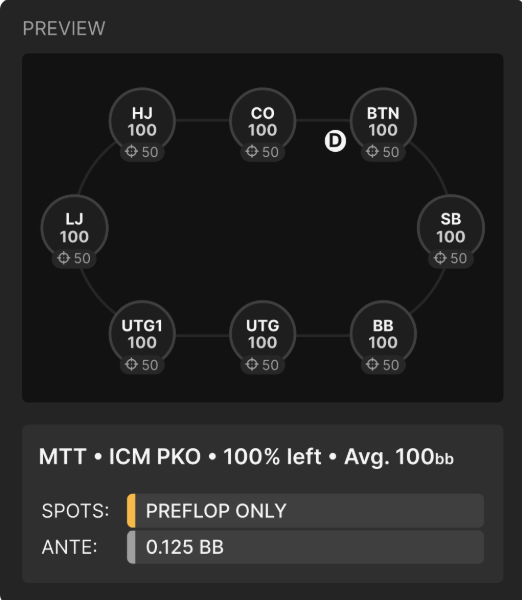
Each player starts with a total reward of $100:
- $50 is immediately taken by the player when knocking out an opponent.
- Another $50 is added to the reward for his head.
The rewards displayed under each player show how much money can be immediately received. GTO Wizard offers solutions for many stages of the tournament, including various stack depths.
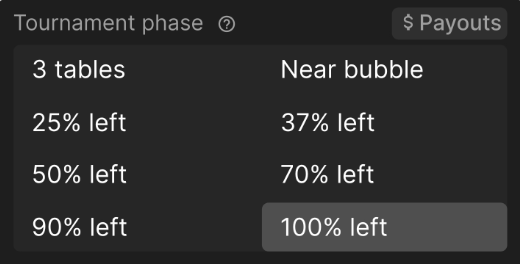
But this is just the beginning! GTO Wizard intend to add many more PKO solutions to cover more tightly the later stages of the tournaments, places at the final tables and a wider range of reward distribution! Obviously, it is impossible to simulate all possible scenarios of PKO tournaments. However, these solutions allow you to study how strategies should change throughout the tournament, and how players' rewards and coverage affect the optimal game. Understanding these general ideas is more important than remembering decisions for specific situations, as it allows players to adapt to changing conditions and make better decisions in the tournament!
2. ICM vs Chip EV
Generally speaking, the chip EV is a poor indicator of stack value in PKO tournaments. Traditional chip EV calculations are based on the proportion of chips you control in a tournament.
We can model the value of the stack as follows:
- Chip EV Stack = Share of chips (remaining bounty fund + remaining prize fund)
- Where “Chip Share” is the percentage of chips you control in a tournament.
This simplified calculation assumes that if you control 10% of the chips, you should win 10% of the remaining prize money in the tournament. But, as we have shown before, this is an erroneous assumption. ICM has a significant impact on your results even in the early stages of the tournament. This is where ICM comes into play as it is a more accurate way to determine stack value in tournaments, especially PKO tournaments. When calculating the ICM, it is taken into account how often the player will occupy different final places, for example, 1st, 2nd, 3rd, etc., and the cost of chips is adjusted accordingly.
Moreover, the calculation of the solver includes:
- ICM,
- position,
- structure of prizes,
- distribution of payments,
- strategies of players,
- covered players,
- implementation of equity on post-flop equity.
And many other factors to determine the true value of a stack in a PKO tournament. For this reason, our PKO simulators use ICM calculations at all stages of the tournament and take into account the true value of the stack, including the above factors.
3. Strength of bounty
Many players tend to view bounty solely in terms of cash reward for winning a hand versus a shorter stack. However, this is the wrong point of view. When pitting yourself against a player you cover, you need to consider the value of the reward relative to the value of the chips you control in the tournament.
The conversion factor of bounty to chips is called “bounty power”. PKO experts use this factor to convert a dollar reward into the value of chips. The bounty power converts $1 bounty into big blinds.
Multiply the size of the bounty by its power factor to determine the approximate value of this reward in the big blinds. This is added to the reward when calculating the pot odds to determine the billing thresholds.
Bounty strength = Total number of chips in the game / (Remaining prize pool + Remaining bounty fund)
- The total number of chips in the game can be found by multiplying the average stack by the number of remaining players (or the total number of players x starting stack)
- The remaining prize fund can be found by deducting the prizes already paid from the starting prize fund. (This happens after the bubble).
- The remaining pool of rewards can be determined using simulation. But you can approximate it by the formula: Starting pool of rewards – ($50 x number of retired players).
In our example, the head is given $50. Before we proceed, it is important to recognize that this is based on the chip EV calculation, and therefore the strength of the bounty tends to become less accurate with the growth of the ICM factor.
4. Example of a tournament for 200 people PKO 8-max
Instead of calculating it yourself, you can simply refer to this table to see the strength of the bounty at different stages of the tournament.
Here are the bounty strength calculations for PKO 8-max for 200 people:
Solution Remaining Average Total Remaining Strength
players stack chips in game fund bounty prize fund bounty
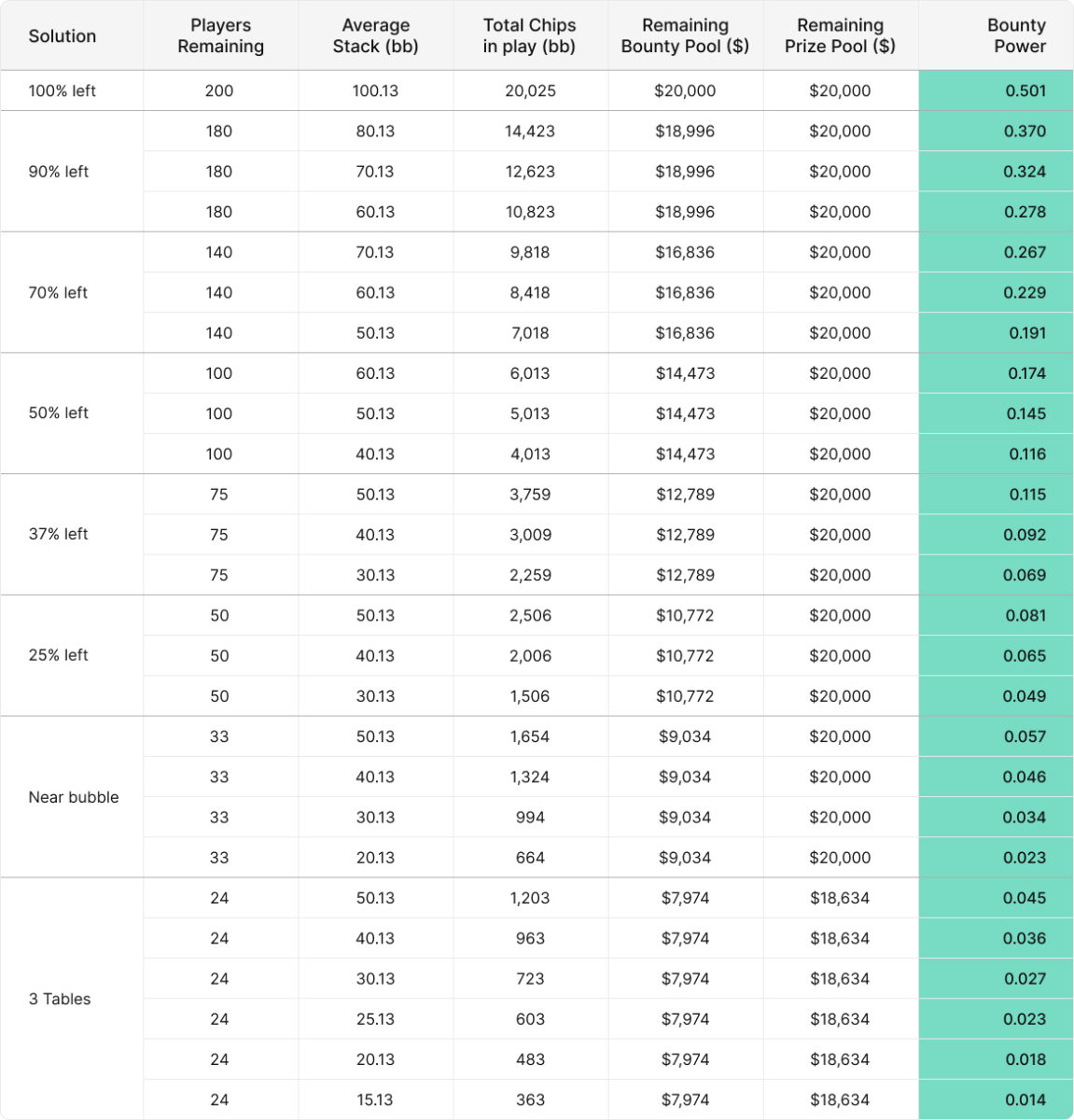
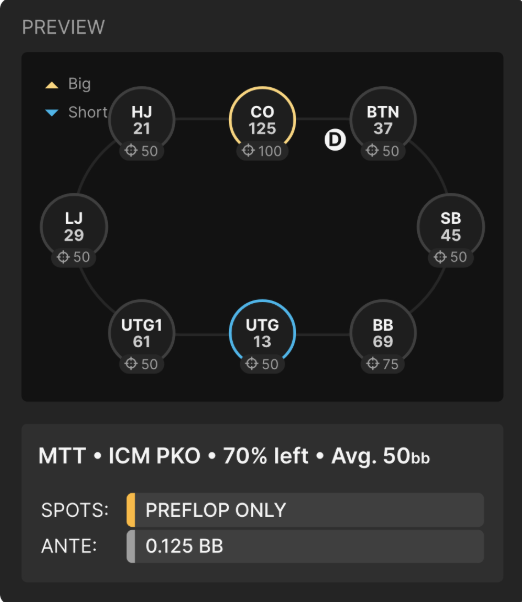
Note that the value of the bounty decreases compared to the value of the big blinds as the tournament progresses, and the chips become more valuable. And this is despite the fact that the middle reward tends to increase in the later stages of the PKO tournament. Let's see how you can take into account the bounty strength when calculating the pot odds. Let's say you play PKO and 70% of the field is left. I chose this spot because our simplified chip EV model will be more accurate in the early stages of the tournament. The average stack is 50BB. Hiro has a comfortable 69BB stack on the big blind.
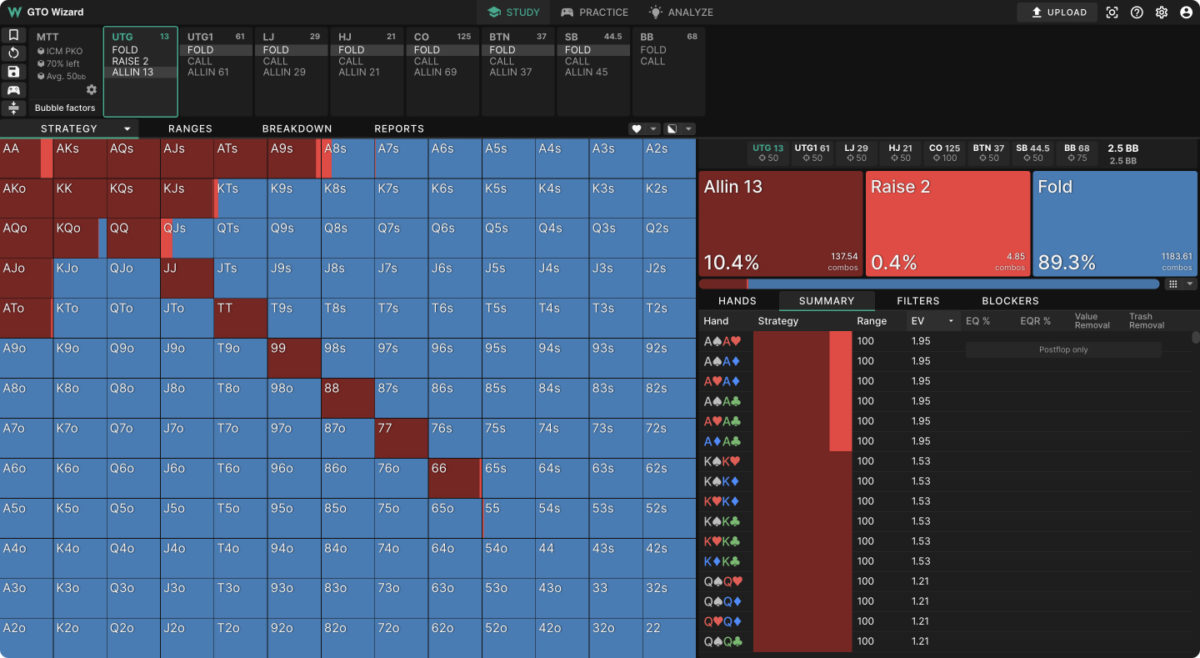
UTG fires 13ВВ with the following range:
Call amount = 12BB
Post-call pot = 13 + 13 + 1.5 = 27.5 BB
Thus: our pot odds are 12/27.5 = 43.6%. Therefore, if there were no reward, we would call any hand with at least such equity.
The standard pot odds formula is simple:
Required equity for call = amount for call / pot after call
Call amount = 12BB
Post-call pot = 13 + 13 + 1.5 = 27.5 BB
Thus: our pot chances are 12/27.5 = 43.6%. Therefore, if there were no reward, we would call any hand with at least such equity.
The $50 UTG bounty is converted to 50 * 0.191 = 9.55 BB. Let's add it to the reward:
Required equity for call = 12 / (27.5 + 9.55) = 32.4%.
Thus: BB is able to call any hand with such an equity against the UTG push range.
Then our range will look like this:
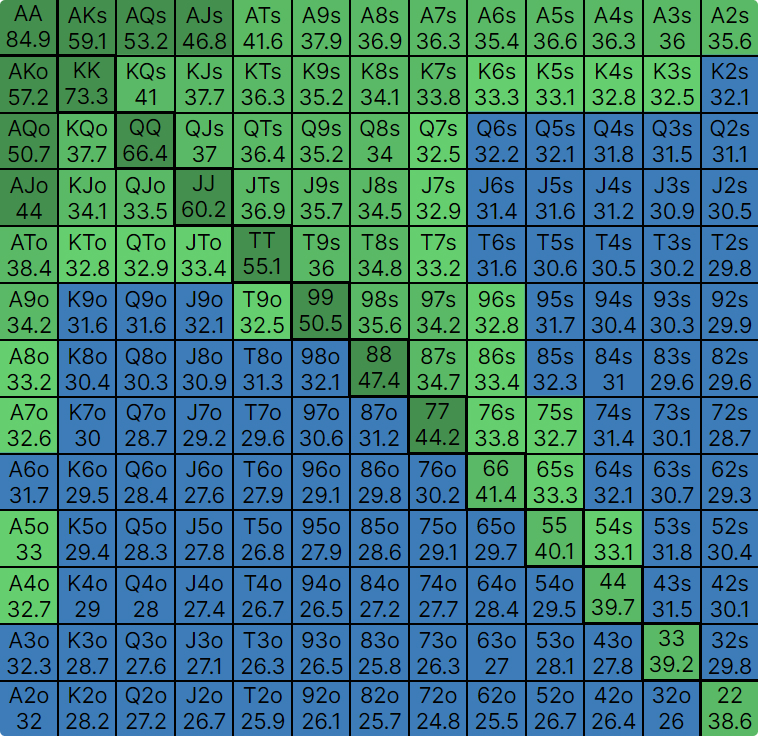
Hands with equity of more than 43% are shown in dark green, hands with equity of more than 32.4% are shown in light green. See how much wider ours become for exhibits when it comes to head rewards! These range are not as accurate because this calculator does not take into account the grouping effect that distorts the deck. But for our purposes, this is quite acceptable.
Here is the GTO strategy for BB considering ICM, rewards and grouping:
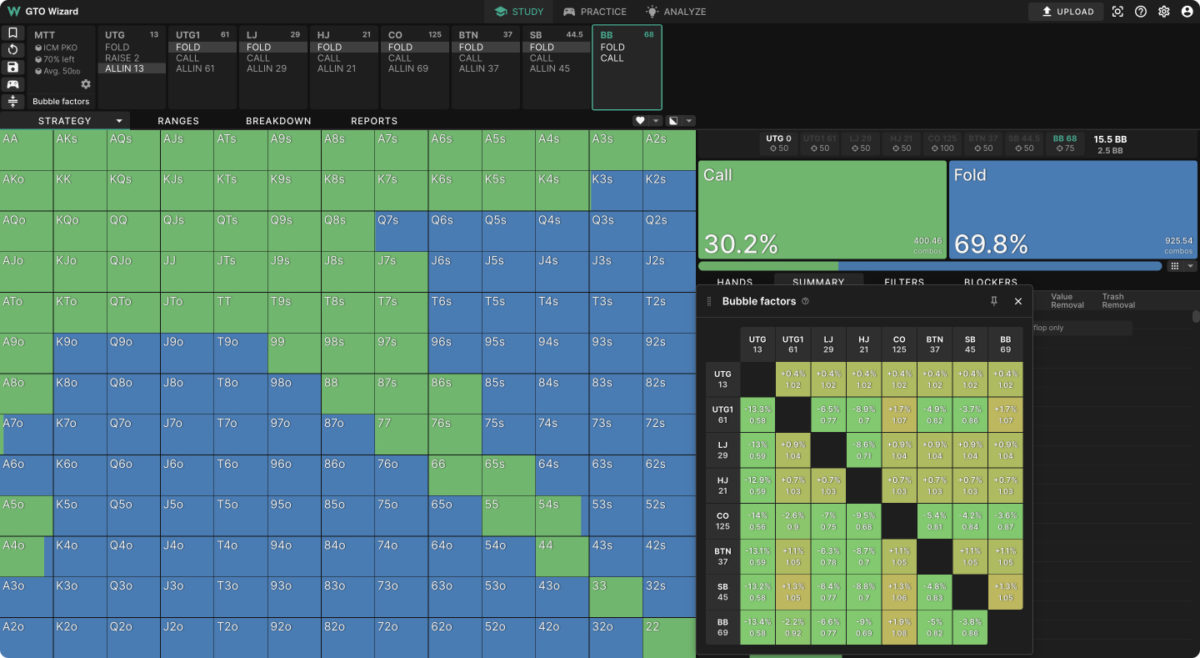
Please note that we call any hand with an equity of at least ~33%. The hands of type A4o, A7o, Q7s and 54s are on the border between the fold and the call.
5. bubble factor in PKO
Let's take a look at the situation in the GTO Wizard to better understand how to read its decisions in PKO:
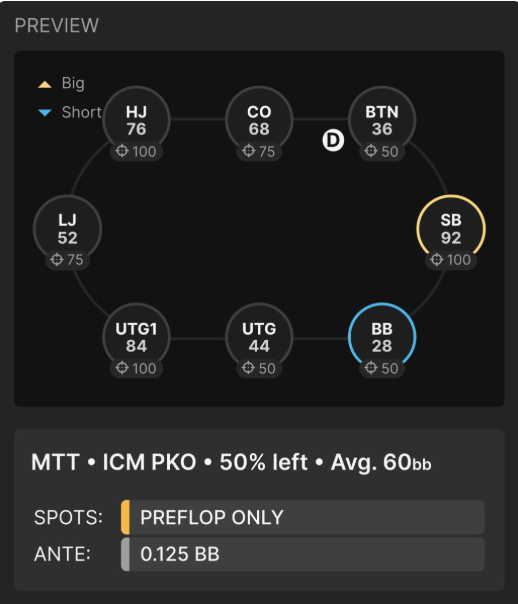
- 50% of the field left (100 players)
- The average stack is 60 BB
The stacks and rewards are as follows:
Let's start by learning the bubble factor. The bubble factor in MTT measures how much more a loss hurts you than a win. It is a measure of survival pressure and a valuable tool for understanding ICM spot.
Here are the bubble factors for this scenario:
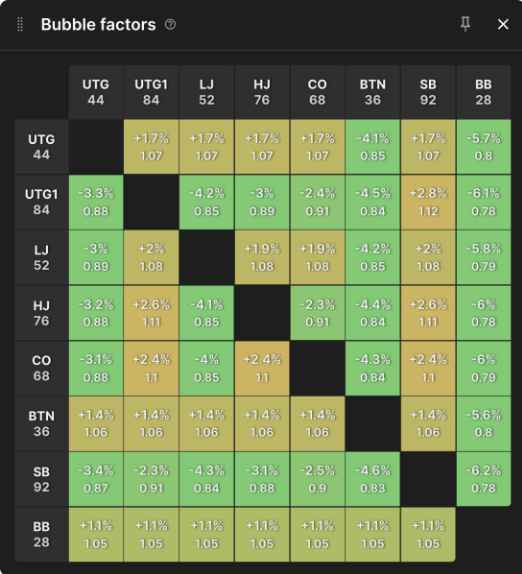
At PKO tournaments, sometimes something interesting happens: the bubble coefficient can be less than 1! This corresponds to a negative risk premium. The calculation A in the chip EV model of the bubble factor (BF) always has a value equal to 1.
- A positive risk premium indicates that losses hurt more than profits help.
- A negative risk premium indicates that the winnings help more than the losses hurt.
In other words, in some positions in PKO there is an incentive to play even wider than in the chipEV model! Risk premiums in ICM conditions in PKO are usually lower than in similar classical tournaments without bounty. Okay, but how will this affect the strategy? Let's say everyone folds to a player on BTN who has a 36 BB stack and a $50 reward for his head.
It opens 2.1 BB:
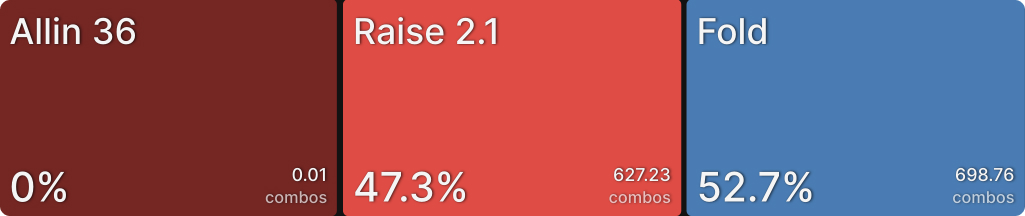
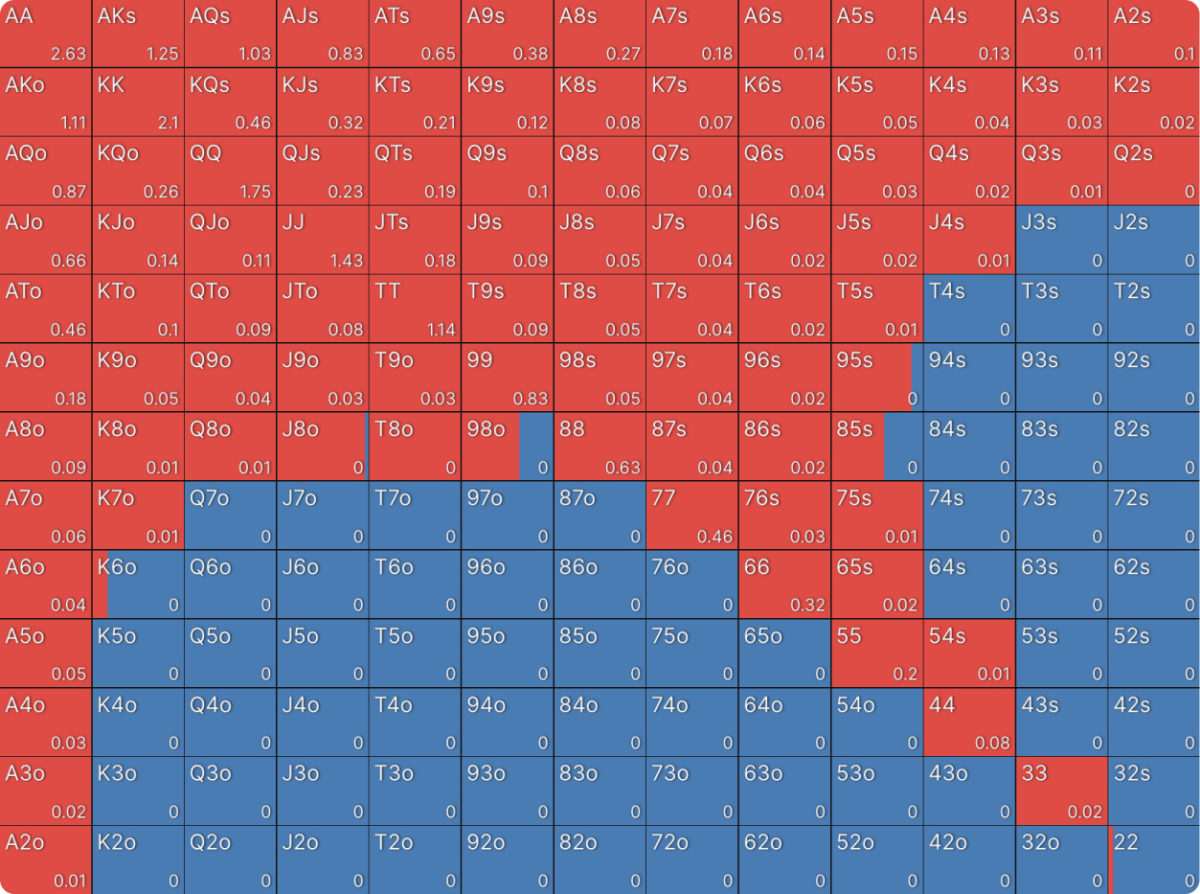
Note that the EV here is not measured in dollars, but as a percentage change from the table value. It means that BTN expects to earn 2.63% more by this action than in a standard situation without bounty when opening with this hand.
Actions on the small blind (SB).
SB
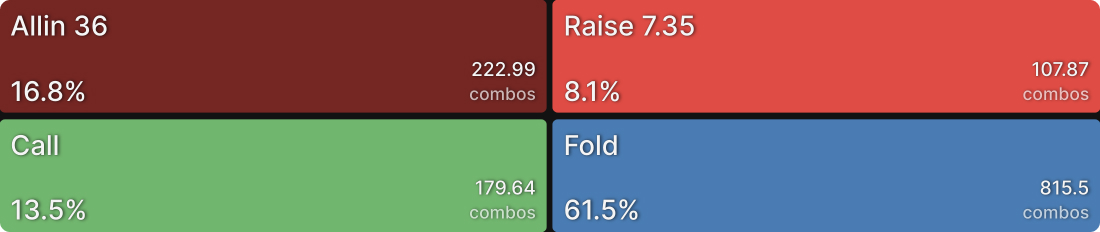
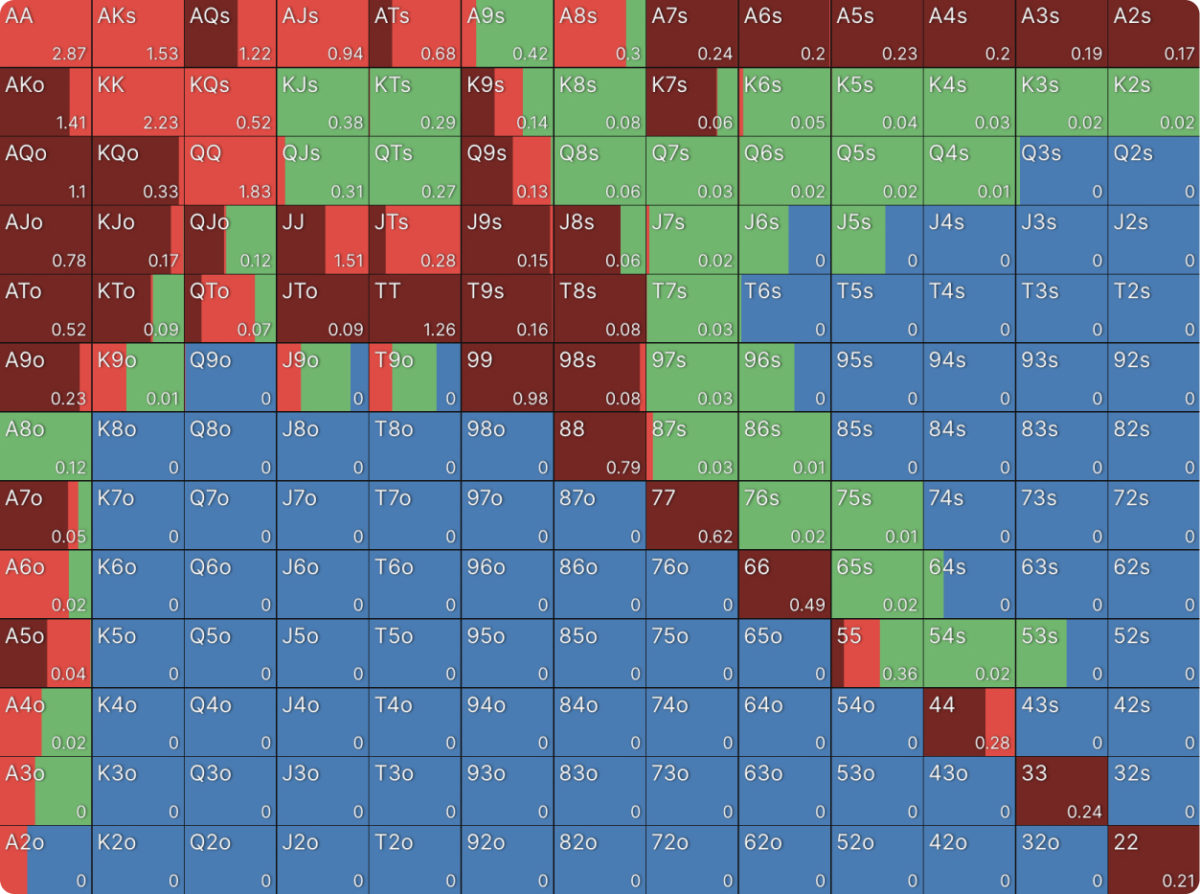
has the largest stack (92 BB) at the table covering both BTN and BB. This encourages him to play very aggressively with a wide range of hands. We see SB pushing a lot of hands trying to get more rewards! SB's aggressive strategy can be explained by the fact that he is the chip leader at this table and only needs to risk about a third of his stack to cover any of the remaining players. In addition, BTN and BB should play carefully due to pressure from ICM. We see this reflected in the bubble factor. SB has a negative risk premium (-4.6%) against BTN and a negative risk premium against BB (-6.2%). This means SB actually has more incentive to play the pots against both remaining players!
Learn more:
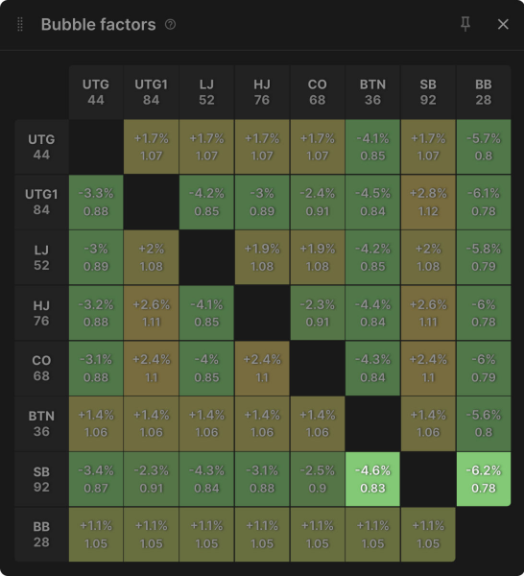
Conversely, BTN and BB receive a positive risk premium, indicating that they need to play more cautiously against SB and against each other, as chip losses hurt more than wins help.
6. Summary
- The stack cost in knockout tournaments is roughly equal to the proportion of chips you control divided by the total remaining prize pool (bounty + regular prizes).
- The ratio of the total number of chips in the game to the total remaining prize pool can be used to convert the relative value of bounty into chips or big blinds.
- PKO experts use the bounty coefficient to convert the bounty into chips, and then include it in the pot odds calculation to approximate the effective thresholds for bills.
- Knockout tournaments sometimes have a negative risk premium. If the reward is large enough and you cover the opponent, sometimes the winnings outweigh the losses from losing the stack against that player. This contrasts sharply with most tournament formats that have a positive risk premium.