


Translated with the help of AI. We apologize for any errors and would appreciate your help in correcting them.
Translated by order of the educational portal university.poker
Original source: GTO Wizard

Solver solutions do not contain much in terms of explicit instructions for responding to limes. This is because players are generally not motivated to limit from any position other than SB, and even when this is the case, the range with which the solver will limit is very different from those used by amateur players and sometimes even professionals who have not studied these spots. However, with the help of individual solutions, we can really determine how the solver will play on the post-flop against the limp-color. And dispel some common misconceptions along the way.
1. What the Limp Call range looks like
To a greater extent, the range of a limp call strongly depends on a particular player. The player who is limping and calling a raise is almost certainly playing sub-optimally, so there is no standard lim-call line. By observing some players, you can predict how their game will deviate from the optimal one. (We also recommend that you study the article "5 types of poker players and how to play against them" presented on our website - editorial note).
Common types of lim-colors
Extremely loose
passive These are amateur players who treat poker like blackjack. They don't think about concepts like equity denial or SPR. They just want to see the flops and try to collect their hand. They will limit anything from offsuited Broadway maps to pocket pair and random suited hands. However, even they usually have a fold range, so the worst hands can still be ignored in their range. You can raise most aggressively against these limpers.
Speculators
These players make a clear distinction between “rake hands” and “speculative hands.” They are more likely than other types of opponents to raising their stronger hands, especially large pair and offsuited broadway cards. When they are limp-collated, this most often happens with small pairs or suited connectors in search of very specific flops. You can raising aggressively against these limpers as they rarely have strong hands, but on a post-flop you should proceed with caution on boards that are most likely suitable for them.
Extreme nits of nits
are rather secretive-passive than lusovo-passive and to some extent are not prone to risk.
They can limp-collect hands like AKo based on the theory that it is a “giveaway hand” or with KK or QQ, waiting to see if an ace comes on the flop before investing more chips. Raise against these players is less attractive, especially because they are more likely than others to be lim-raised (because their lima range contains a lot of strong hands).
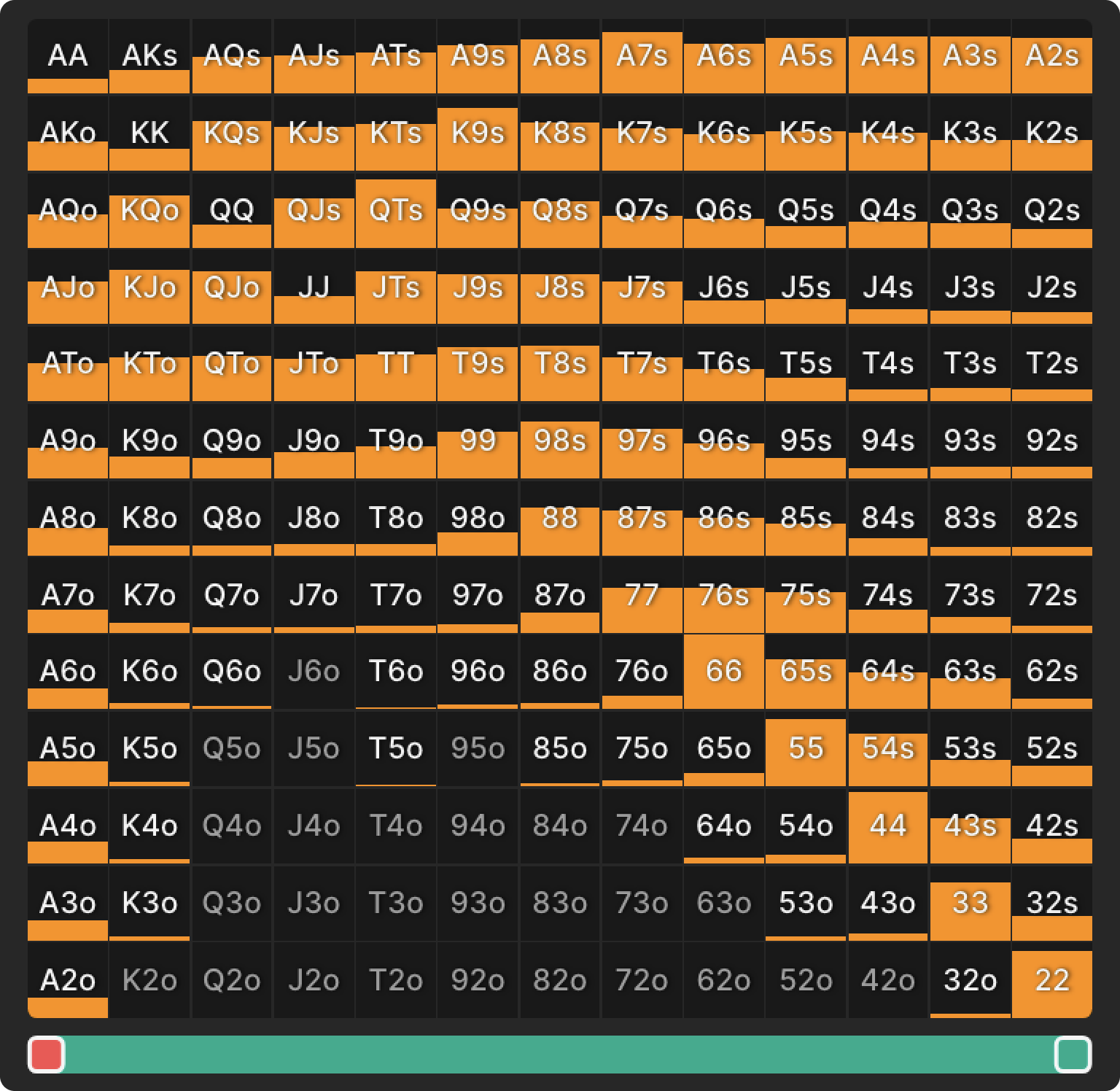
- Example: for our examples here we will assign a limp-call range based on empirical data. Although it includes many types of hands, it is nonetheless shifted towards suited hands, Broadway cards, and Ace-x cards, which corresponds to several of the player types discussed above.

2. To raise or not to raise
When one or more players are limping in front of you, it is a good rule to play strictly according to the raise or fold strategy, unless you are on Button or on one of the blinds. Without a post-flop position guarantee, you should basically fight for a pot with strong pot hands that want to immediately increase the pot where you will benefit from denying equity to opponents or at least take a higher price from players after you. In fact, one of the biggest risks of an overlimp when you're not on the BTN is that a player with a position on you will raise and punish you along with the rest of the limpers.
With the limpers in front of you, play strictly according to the raise or fold strategy, if you are not on BTN or are not on one of the blinds.
Do not raise (overlimp)
When you are on BTN, the overlimp is worth considering. By risking just one big blind, you don't have to be an equity favorite to enter the pot. You only need to realize your share of equity, which should be easy to do in a position if you choose the right type of hands for the limp. The best candidates are the hands that are not strong enough for the raise, but will perform well in a multiway bank with a high SPR. This includes small pair, small suited and bound cards, and perhaps even some of the best unbound suited hands such as Q6s and offsuited bound cards such as 98o. The weaker your competitors are, the more you can get.
Raising (isolate)
We will not consider limp banks here because they are not very amenable to solver analysis, but it is worth noting that the BTN isolate range used in the following scenarios assumes that you will also have an overlimp range. If you were playing strictly a raise or fold scenario, a few extra hands (such as T8s, 87s, and 55s) could be considered for inclusion in the raise range.
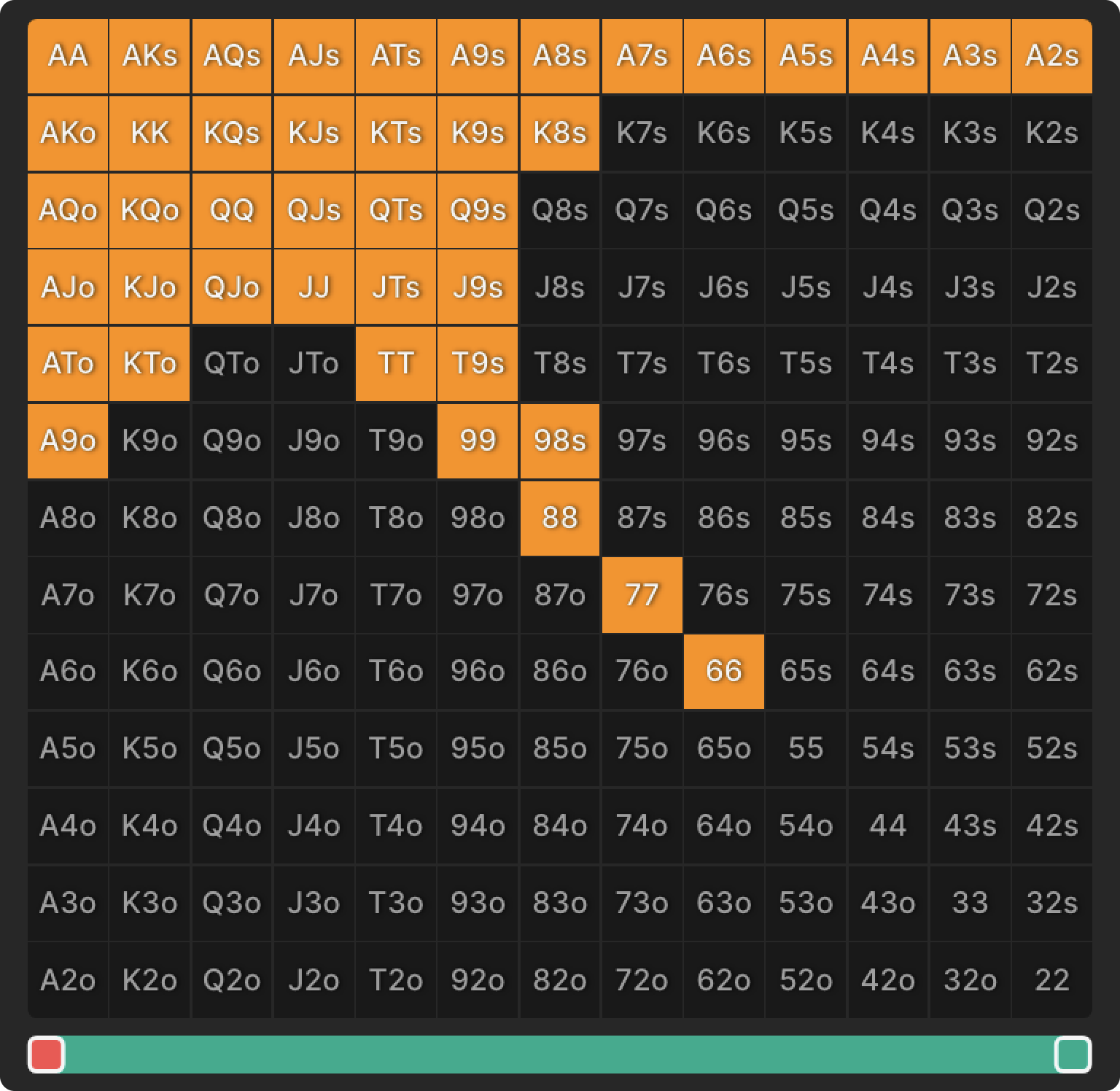
This range is designed for a good game with a lower SPR, to have a good equity against wide ranges of lim-call and, in particular, to dominate these ranges. Normally you might think of the A9 as an easily dominant hand, but against an opponent playing with any ace and many of the worst 9-x, you're more likely to dominate them. In addition, the position is a useful tool for bluff, squeezing fine value, controlling the bank and avoiding some second hand pot.
Underestimate your limits of what you consider the value of the hand.
Aggression actually exploits loose-passive opponents in two ways:
- Their willingness to make a call with weak hands makes bets and raises with low equity less profitable. However, this increases the value of bet and raises with high equity hands. And since the wider call range is the weaker call range, more hands will have good equity against them. This means that you can lower your threshold for what is considered a “hand with a velly”, especially when you are in a value position.
- Aggression also exploits passivity. You can place bet and raises on a thin vellya without worrying about bluff raises that can knock you out of the winning hand. Passive opponents may not even raising their strong hands, which gives you more opportunities to realize the equity and value of your position on future streets. In fact, when you raise with CO or BTN against limpers, you profit not only from the weak ranges of the limpers themselves, but also from the passivity of players who have not yet acted, who could exploit you by aggressively making 3-bets, but are afraid to do so.
You gain much more from the lushness of your opponents when you are in a position.
I have emphasized the position a few times because you gain a lot more from the slackness of the opponents when you are in the position. First, a call with weak hands is most often correct when you are in a position. At the very least, pocketing opponents' calls will be a less costly mistake if they play in a position against you on future streets. Preflop or postflop in multiway banks, you are not necessarily the beneficiary of the lushness of opponents when you are without a position. When you raise from an early position and the villain makes a bad call in the middle position, he often transfers the EV from himself and from you to players who have not yet made a move, whose strong hands will benefit from weak hands in the pot. The best way for them to profit from this scenario is to squish aggressively, so, again, you can benefit from their excessive passivity.
3. Worst nightmare flop
Medium bound board is likely to improve a variety of speculative hands in a typical limp call range. In 

 the worst-case scenario, it's actually not that bad. And yes, this is the worst-case scenario. On more connected BTNs
  will also get a few straights on the flop and more sets. And the limper has more misses, because this board is lower.
Medium bound board is more likely to improve the limp call range.
Even on such a terrible flop, the limper does not have the equity advantage that BTN had on the preflop, it only partially catches up. At the top of the range, he has a nuts edge thanks to combinations such as 85s, 53s, and 44. But he also has a lot of very weak hands, which highlights an important point: a player who plays a lot of weak hands on the preflop will also often get weak combinations on the flop, even on the best flops for him. For every 85s, there will be K2s and several QTo combinations. Very loose players sometimes get successful flops with incredible straights and two pairs with hands that you did not expect to see, but much more often they completely miss the flop or fall only into weak combinations like the lower pair or gatshots.
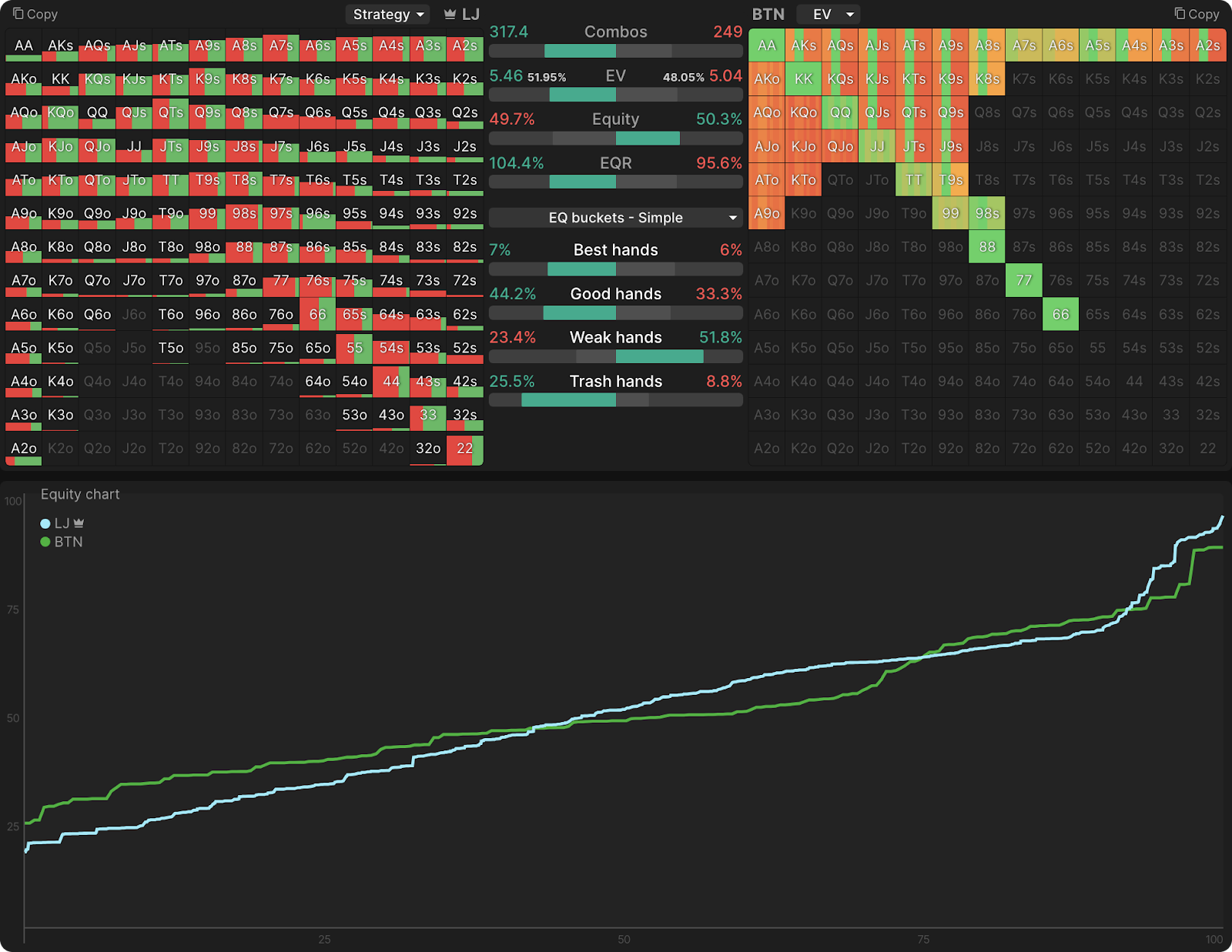
It is important to remember that despite the speculator's preference for one-sided cards, they get flush draw on the flop only 8% of the time. Most hands are not suited, but even with suited cards, the match in suit on the flop occurs in less than 25% of cases. Open Straight Draw (OESD) is slightly more common — at about 12% — in its range. These risks are real and give some incentive for a bet on the flop, but collecting of value with draw is not such a strategic necessity, as sometimes it seems.
Collecting of value with draw is not a mandatory strategic necessity.
In fact, BTN makes a check more than half the time, including some overpairs:
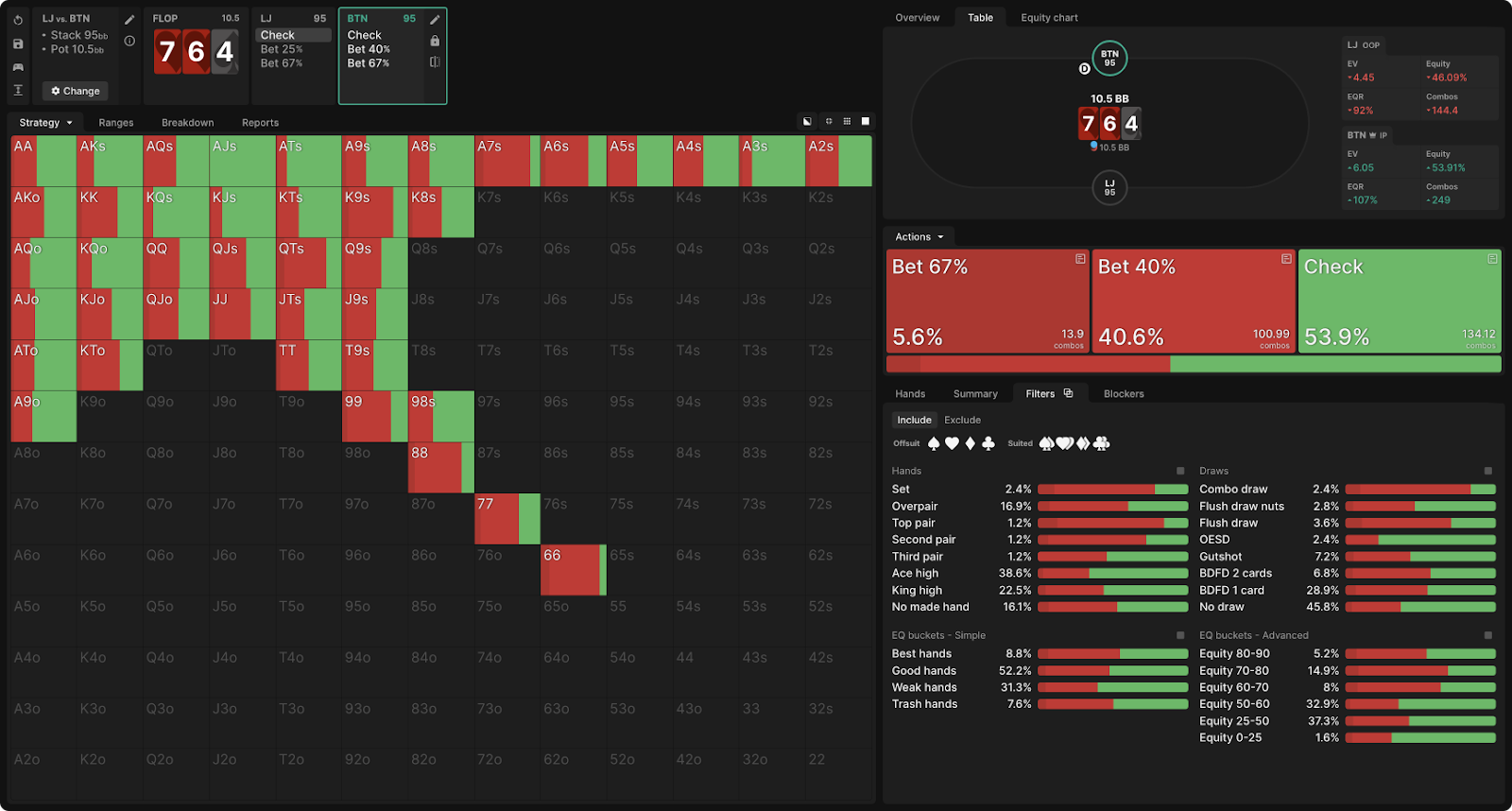
Blank checks are all unpaired overcards, especially those that don't have backdoor draw. These are great examples of hands that want to preserve equity without exposing themselves to check-raise and leave the pot small. With a BTN-type arm
 , he can feel much better on the turn
 after a flop check than if he had put it on himself. BTN also chooses a small bet size here, as its edge is at the bottom of the equity distribution, not at the top.
A small bet takes away the equity from a large number of weak limper hands, without risking creating too large a bank against the strong pot hands of the opponent. However, the main reason for BTN checks is rather the risk of a check-raise than the danger of colliding with strong hands. Having a position and 50% equity, an increase in the pot with a full range does not pose a problem if it can realize this equity. Against more passive opponents who do not check-raise for the sake of subtle gain or with weak draw, a bet with a wider range becomes more attractive.
4. Dynamic flop
Changing one card on the flop to exclude the possibility of a straight (and some draw) and adding more pair to the BTN range significantly changes the dynamics. BTN  has 56% equity and a stronger range overall.
This allows him to make cbets more often and sometimes use larger bet:
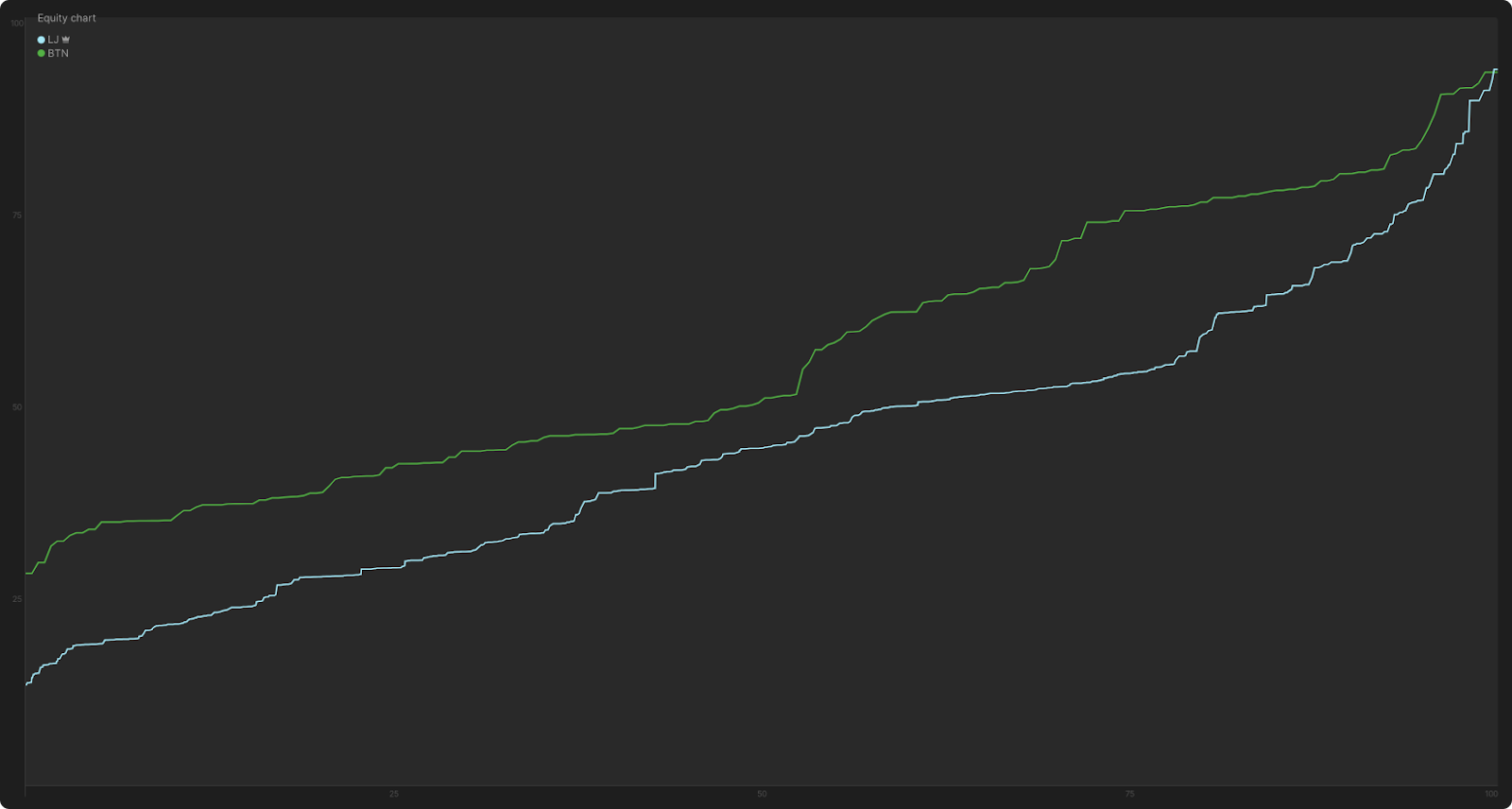
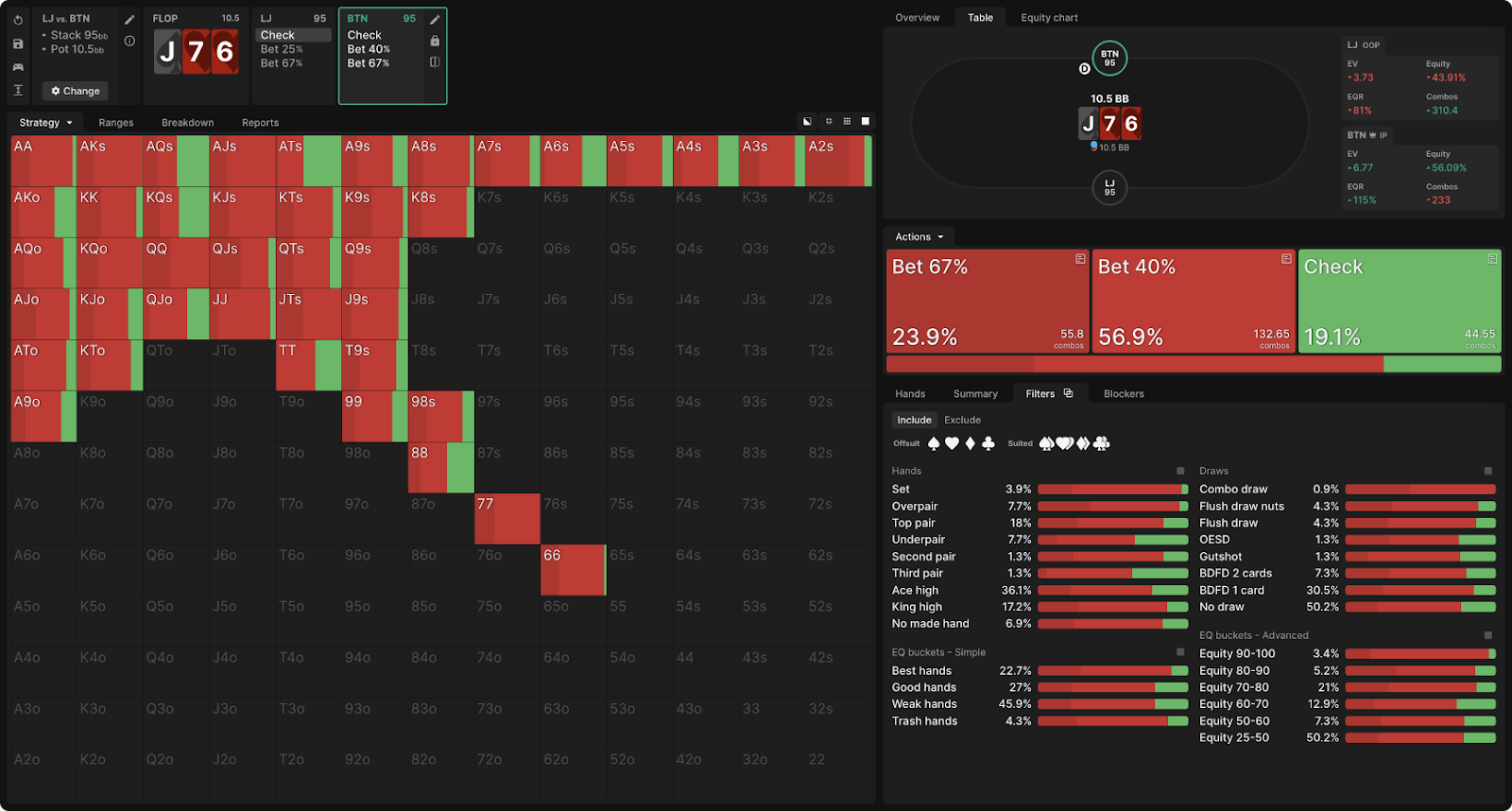
Each hand in the BTN range is vulnerable to draw and/or overcard. Even if a bad card on the turn does not cost them a whole pot, it can reduce the opportunity to win additional chips from hands that would pay a bet on the flop. Therefore, there is very little sloping here, most checks are made with hands, such as medium pair, which benefit the least from folds, they are more vulnerable to check-raises and do not want to play a large pot. Against opponents who do not check-raise aggressively enough, this strategy can be simplified to full-range bet, while you can make large bet with stronger hands.
5. flop with ace
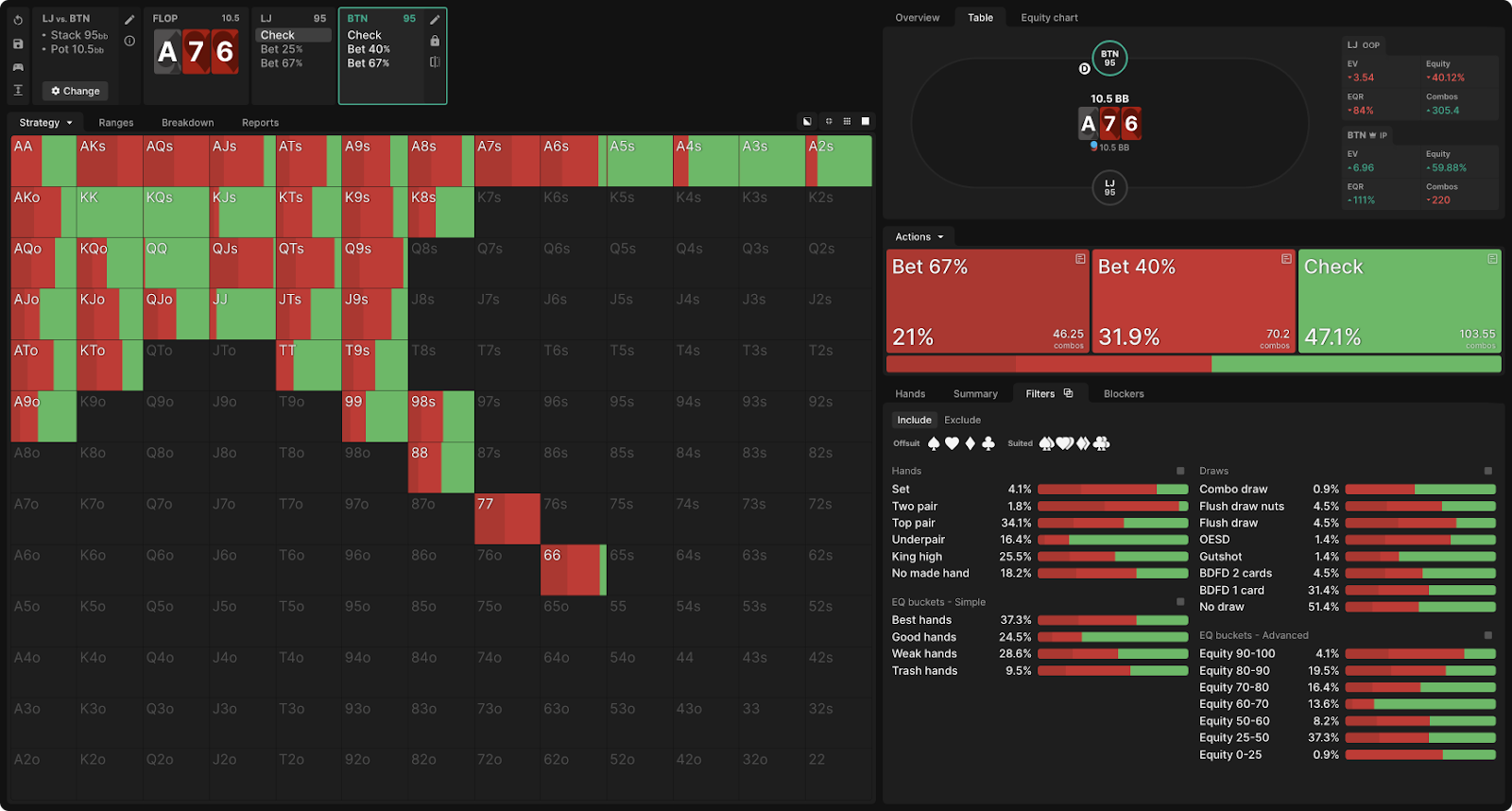
Despite the even greater edge of the range with almost 60% equity, BTN is less likely to make a cbet on  the flop than on the h. This is because BTN has more hands with moderate, relatively static equity, such as pocket kings, ladies, and weak ace combinations. These hands do not particularly benefit from fold equity and do not seek to inflate the pot against the strong hands of the limper.
Although bet for protection against draw is useful, the risk of investing chips in disadvantageous situations is high. When BTN doesn't have an ace, the limper has a top pair or better about 22% of the time. If the limper continues to check in on the next streets, weak combinations with the ace may be suitable for Velu-bets on the turn and river, while pocket pair will more often check out before the showdown. Since there are many hands with an ace in the limper range, blocking these hands significantly increases the strength of our hand.
6. Conclusion
As with the BB game against the collier, the aggressor in the position starts with a significant range advantage against the pocket limper. This is true even if the aggressor itself raises a relatively wide range (if this range is built around strong hands working well at a low SPR).
There are no flops that greatly improve the range of the pocket limper.
- The maximum that such players achieve on their best flops is equity alignment, which forces the aggressor to enter a range of checks, especially when raises from the limper side are made only with especially strong hits on the board. On most flops, with the exception of the most coordinated, the aggressor can safely make cbets to collect value and take equity from the limper.
- More static flops also contribute to the appearance of checks — not because of a lack of equity, but because some hands simply do not benefit enough from the bet to justify the risks. This is especially true on ace flops, where both ranges are saturated with ace combinations.