

Translated with the help of AI. We apologize for any errors and would appreciate your help in correcting them.
Translated by order of the educational portal university.poker
Original source: GTO Wizard
Recently, I was shown this exciting PKO hand from the GTO Wizard library. Someone asked me if it was true because it had a very unexpected range.
Layout on preflop:
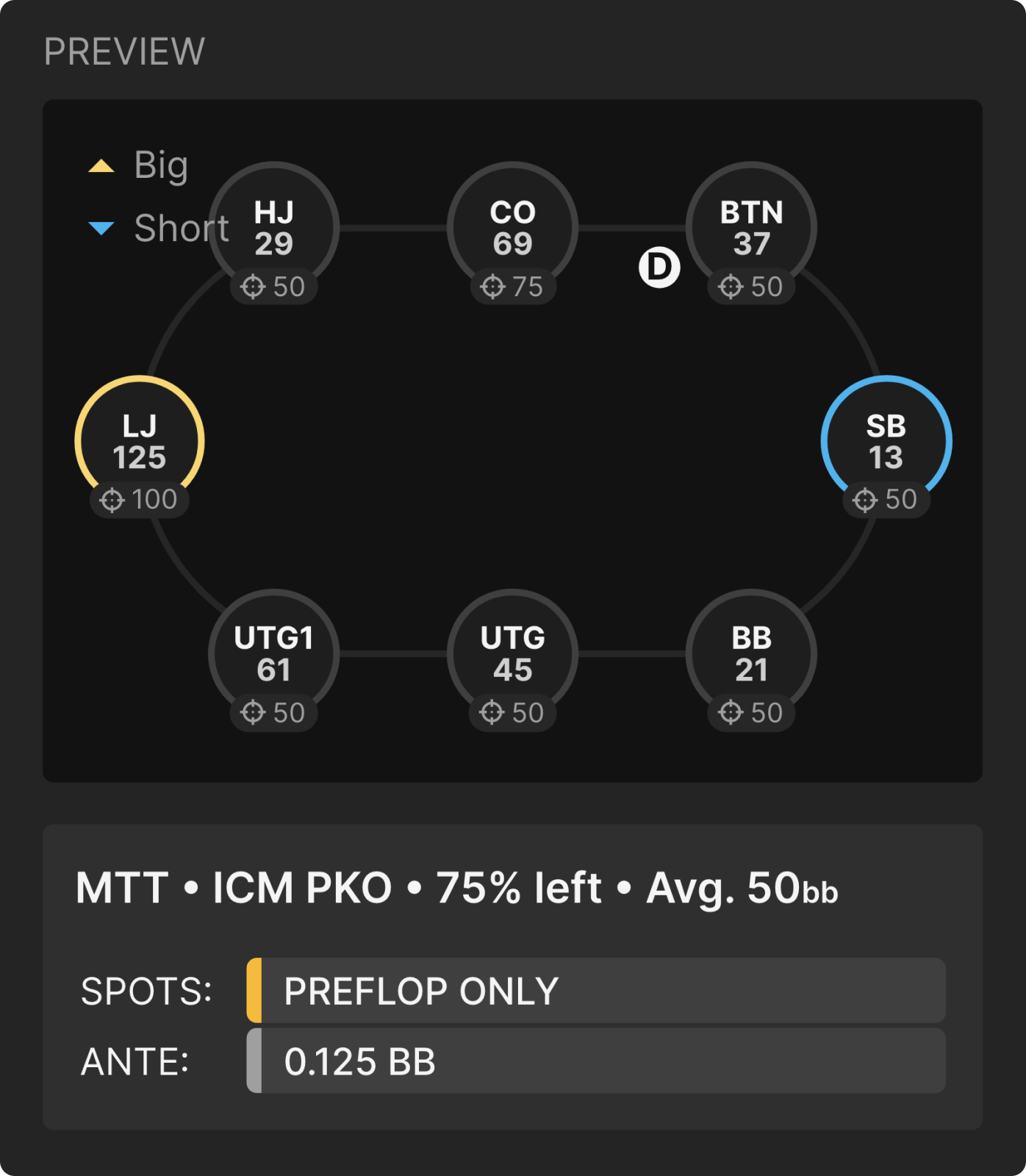
75% of the field remained in this tournament. Everyone folds to CO, whose stack is 69bb and bounty is $75. BTN has 37bb, SB has 13bb and BB has 21bb. All these CO players have bounty $50.
CO opens with this range:
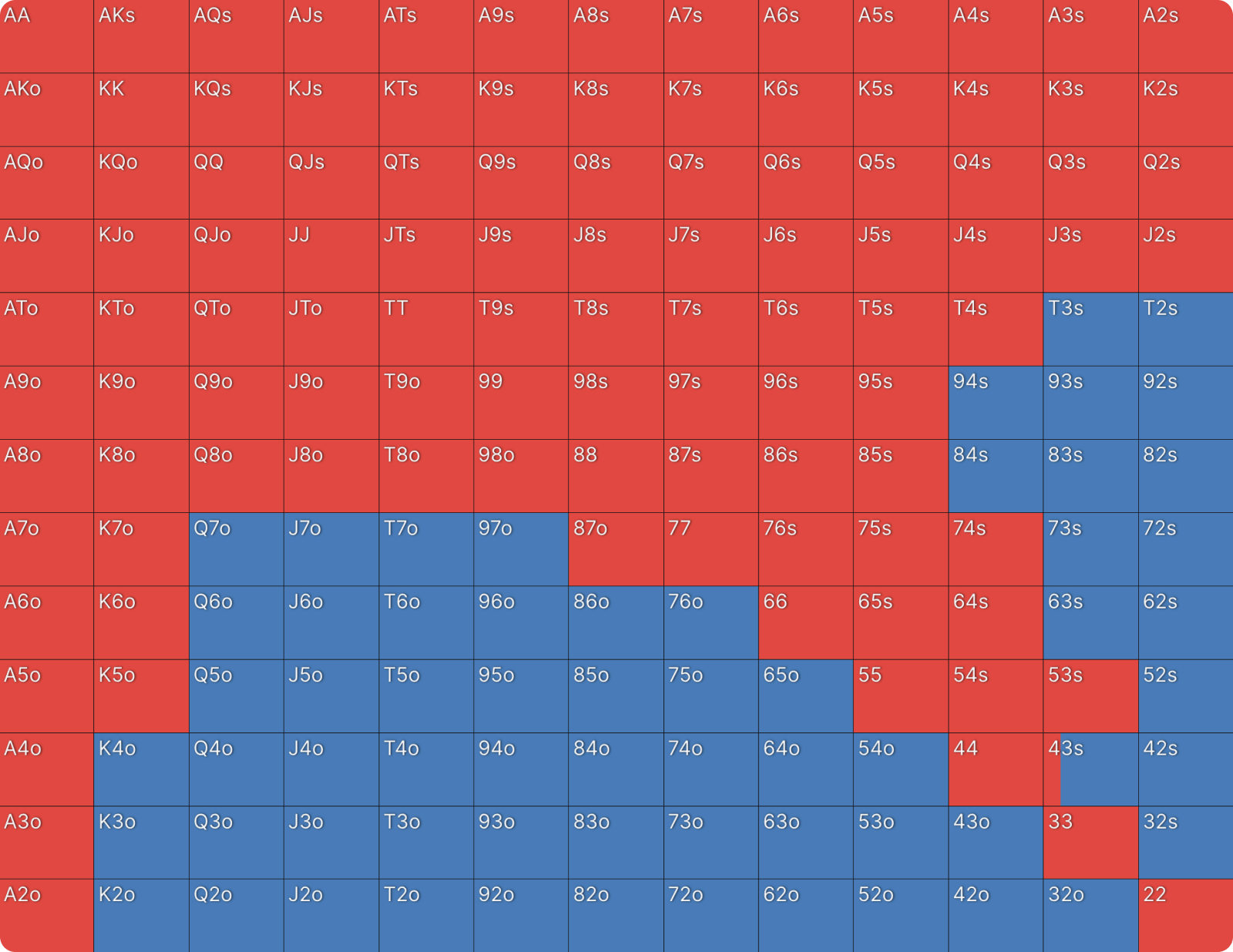

So far so good. But this BTN response is unusual:
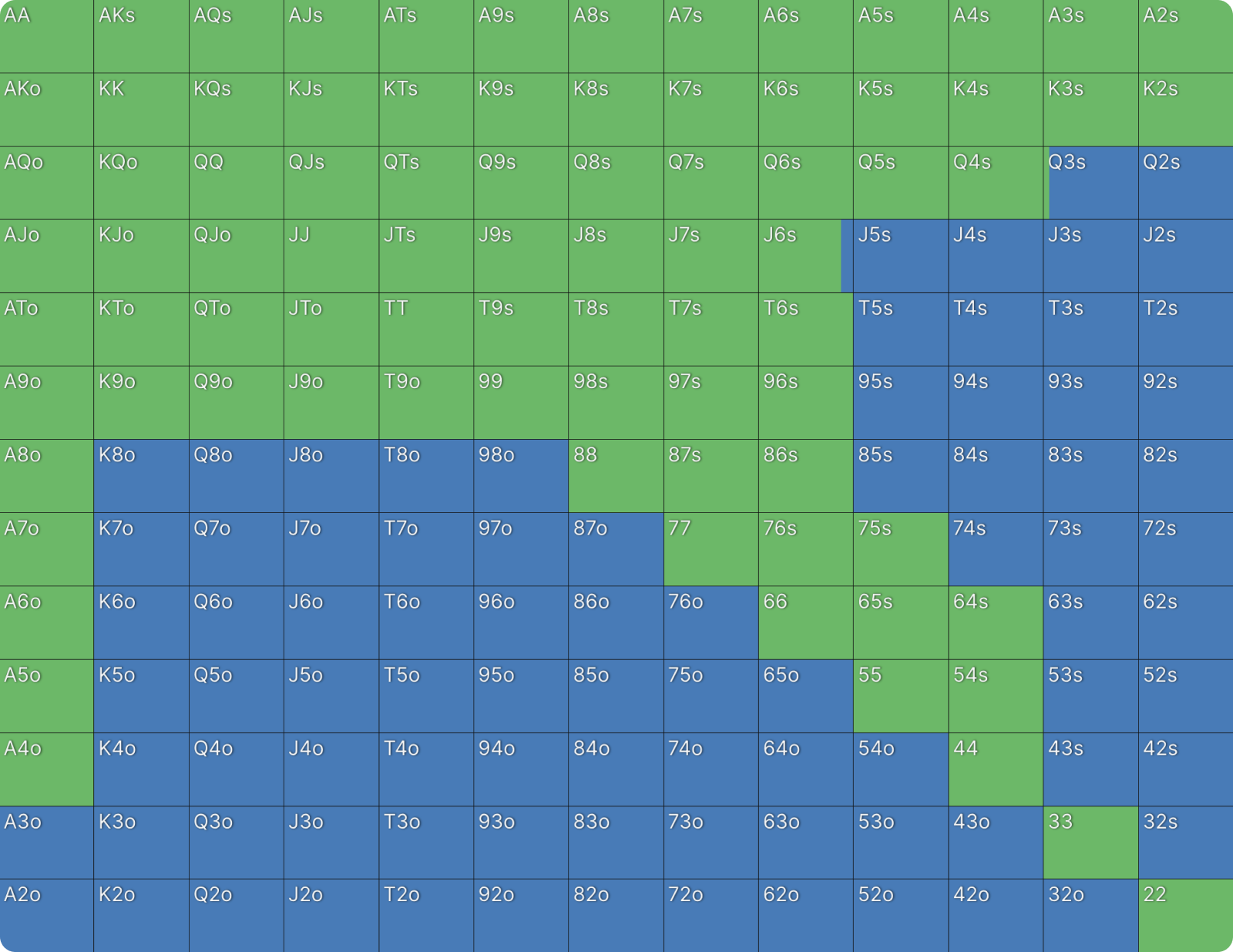

This is not some error or glitch in the color settings for bet in GTO Wizard. BTN continues 39% of the hands and when it does, it only calls and does not raise. I've never seen a clean flat range like this before, but I've seen very similar range in PKO before. Once you understand the format well, this range will become clear to you. The range shape looks like the opening range if BTN opened first. It is rare to see such linear flat range in any format. It is always useful to compare PKO range with their closest equivalent ChipEV.
Here is BTN's response to the discovery of CO in depth 35bb:

The overall shape of the continuation range is similar, but it is much wider in PKO. BTN continues here with 27.6% of hands compared to 39% of hands in PKO, which is not a big surprise. However, in a scenario without PKO, there is a significant 3bet range. All large overpairs are 3-betas to some extent, as is AK. Velu hands are balanced by a set of bluff hands, which gives us good clues for most flops.
1. Pay attention to who you cover at PKO
Answering the question of why BTN is only calling reveals perhaps the most important strategic adjustment in PKO tournaments. Understanding who you're covering is the most important factor in progressive knockout tournaments.
How often you enter the pot, what you open, charge and/or call pot with should be determined by how the players you cover might react. All this is due to the bounty and the opportunity to take it away.
You should always pay attention to who you cover at PKO. If you are not covering many players right now, it may be right to deviate from the GTO and take additional risk to cover more people in the future. If you are covering many at the table, such as a table chip leader, it may be right to skip some hands so as not to lose this edge.
As we have discussed in other articles, when you win bounty, you win 4 types of equity:
- Potential future of equity from winning more bounty as you will cover more people at the table;
- Equity for winning the opponent's bounty;
- Potential future equity from winning your own bounty if you win the entire tournament;
- Part of the ICM equity from the payout for prizes.
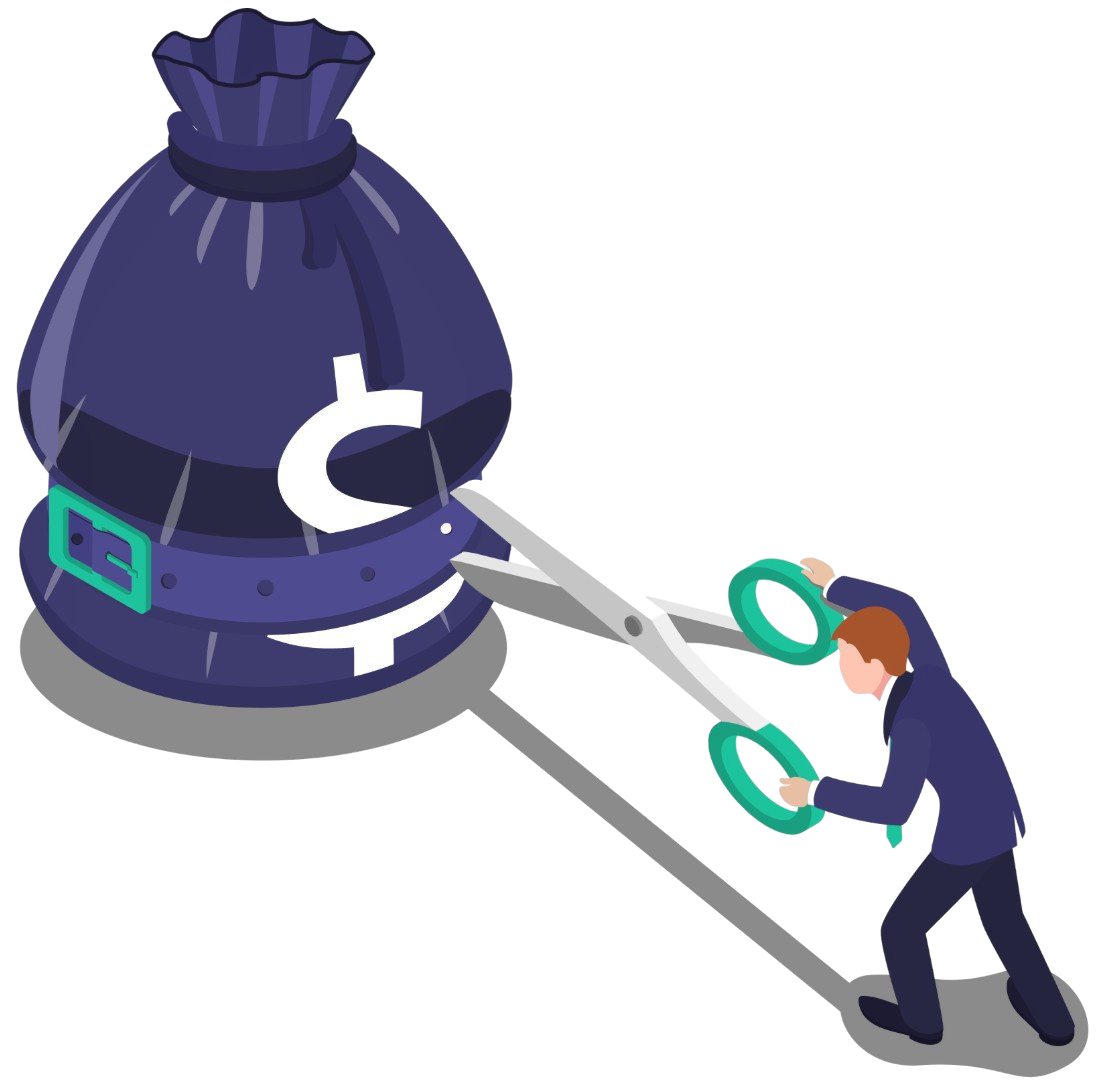
Winning a bounty is much more valuable than winning a big pot. In most cases, winning a bounty is preferable even than winning a pot several times larger, but without a bounty.

Especially in the early stages, before ICM becomes a significant factor in PKO, bounty is worth a lot. In terms of immediately realized equity, they usually cost at least 25% of your buy-in. This demonstrates the bubble factor in PKO, which typically starts at less than 1, which you would never see in a regular MTT. Given this, why is BTN so flat-collite in this example?
2. Adjust to the bounty you can win
CO covers BTN, so BTN can't win the CO bounty of $75 in this hand. However, BTN covers both SB and BB. BTN can win both of these rewards, and he doesn't even have to risk all his chips in the process.
Layout on preflop:
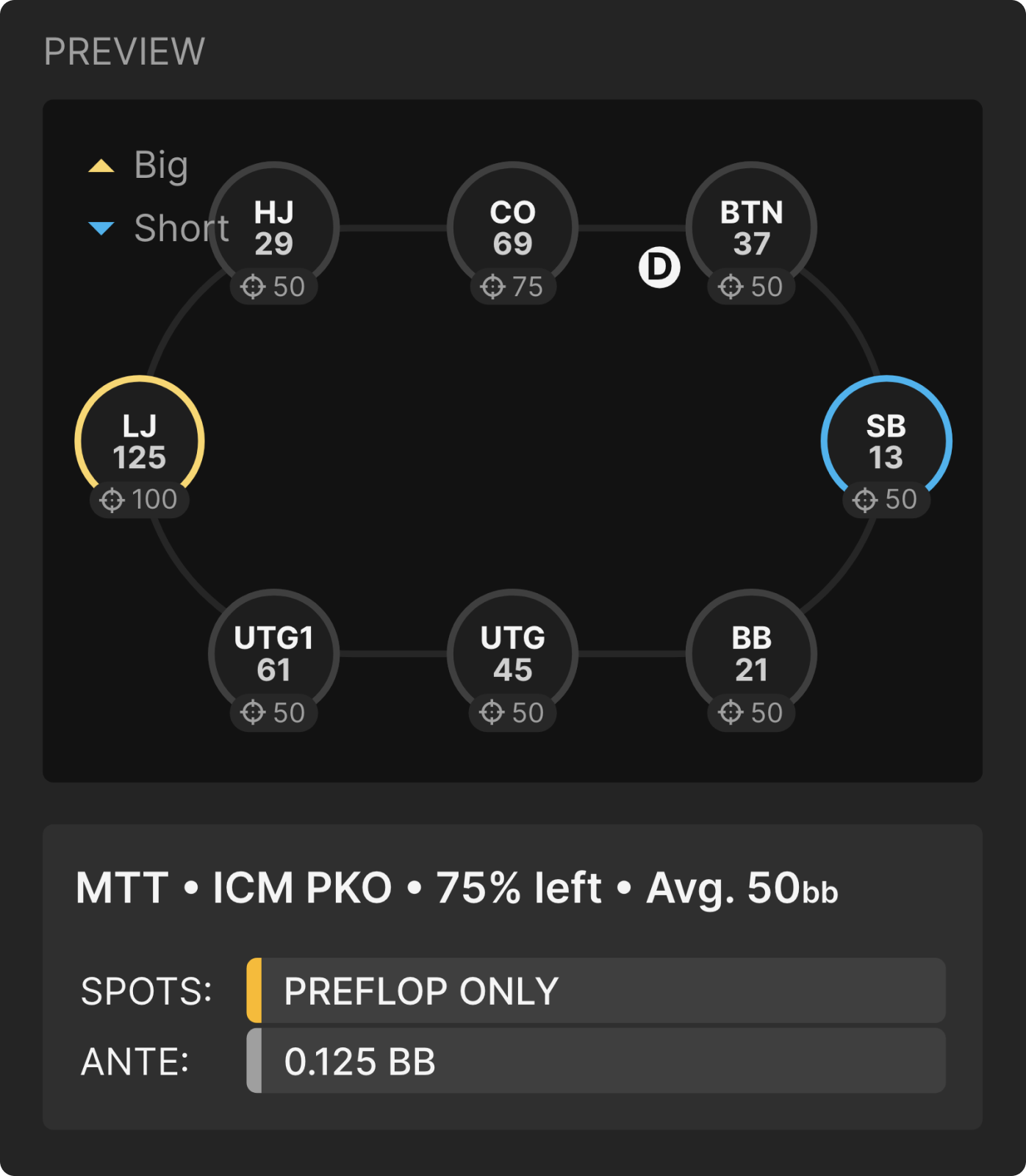
It would be very nice to double up against Co. This would put BTN in second place for chips at the table. But there is also the LJ chip leader, which covers many with comfort. LJ has to play very loose and aggressive at this table, which makes it difficult to win bounty for those with a big stack. Instead of doubling, the best result for BTN would be to win one (or two) bounty! Suppose BTN does 3-bet in this situation, SB and BB will be motivated to fold frequently. However, when BTN makes a flat call, the blinds get the best price to continue.
Indeed, look at SB's reaction to the BU flat call:

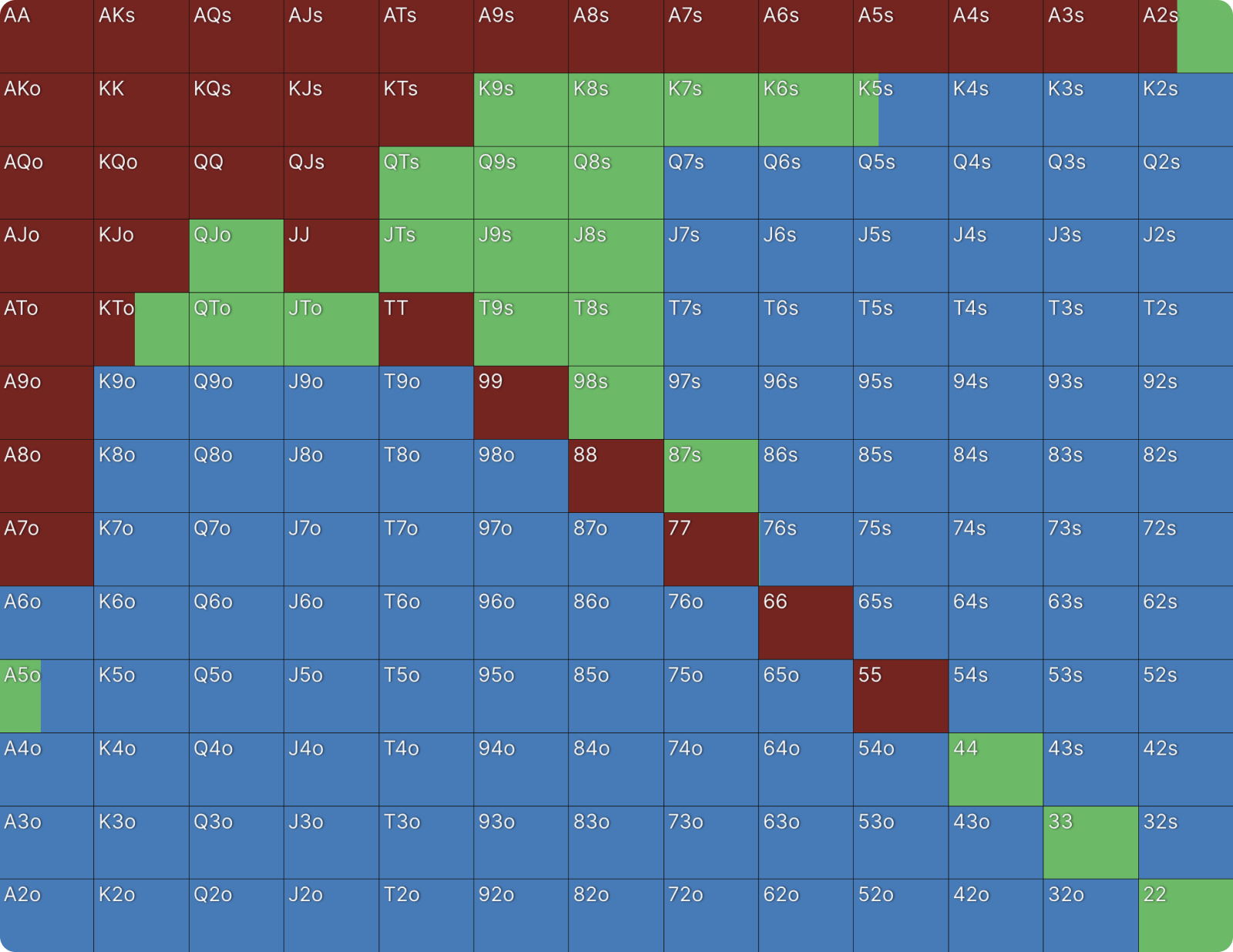
Against 3bet Button SB will fold 86.9% of the time and against flat only 72.8% of the time. SB has only 13bb, so it would be easy for Button to call such a Push when taking into account the bounty, assuming that everyone else will fold.
SB props all-in -in
However, another important factor in this giveaway is that BB covers SB. BB has the second largest stack (between BNT, SB and BB) so SB is his only chance at the bounty right now.
When SB goes all-in, this is how BB reacts:
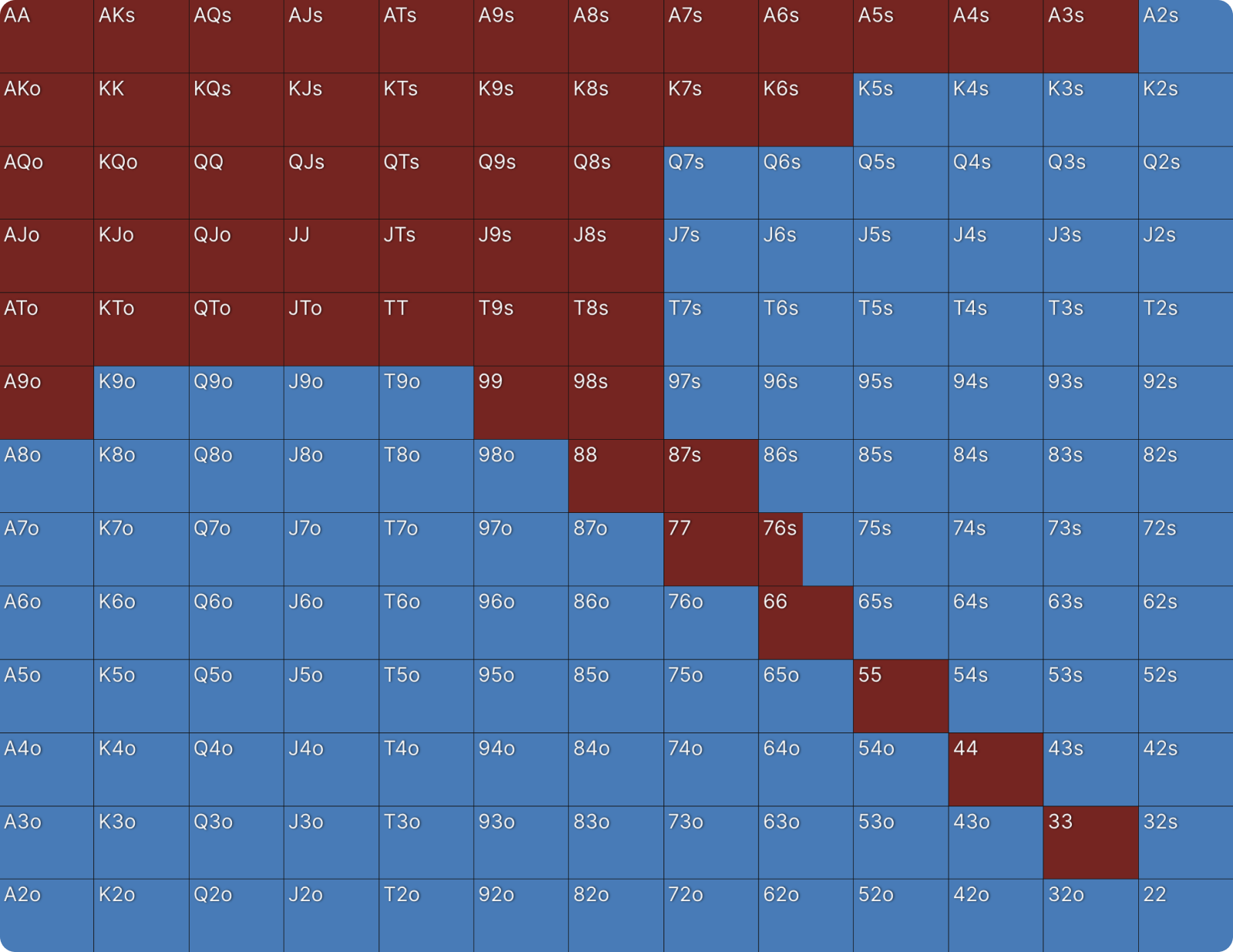

This is a very wide range for a squeeze call. It demonstrates what we discussed in our article on multiway sweat strategy in PKO. Range becomes wider, not narrower. This is because of the bounty, especially when there is a chance to get several bounty. Also keep in mind that the CO and BTN range were originally wide. The BB range here is mostly suited high cards. They play very well against three opponents. Note that hands like the A8o and 22 choose the fold, but all the suited high cards that can make up straight, flush, and good hands with one pair go on a bounty hunt.
When BB also goes all-in, CO acts as follows:

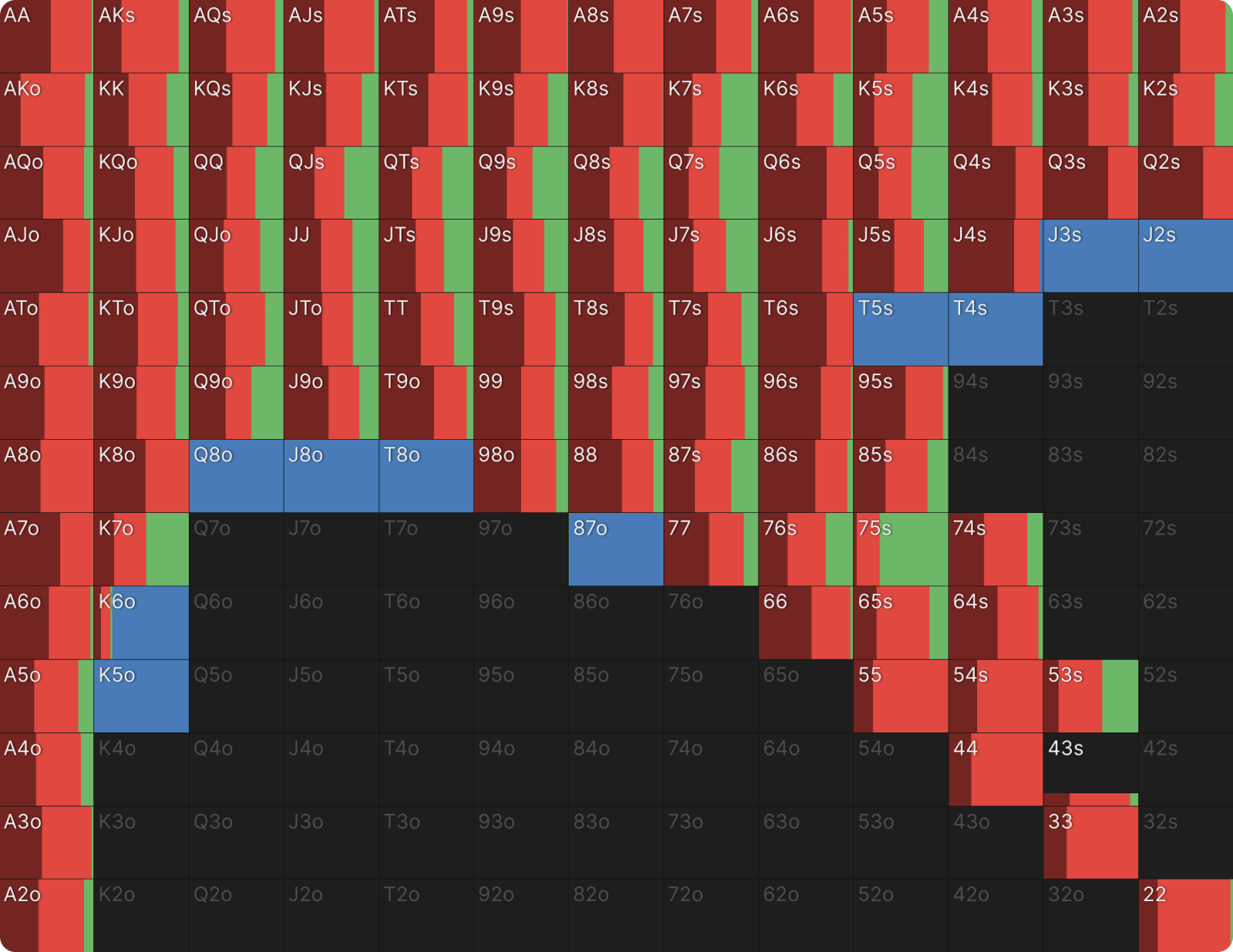

They force BTN to go all-in with most of their range, dropping only really weak hands that aren't as good at multiway:

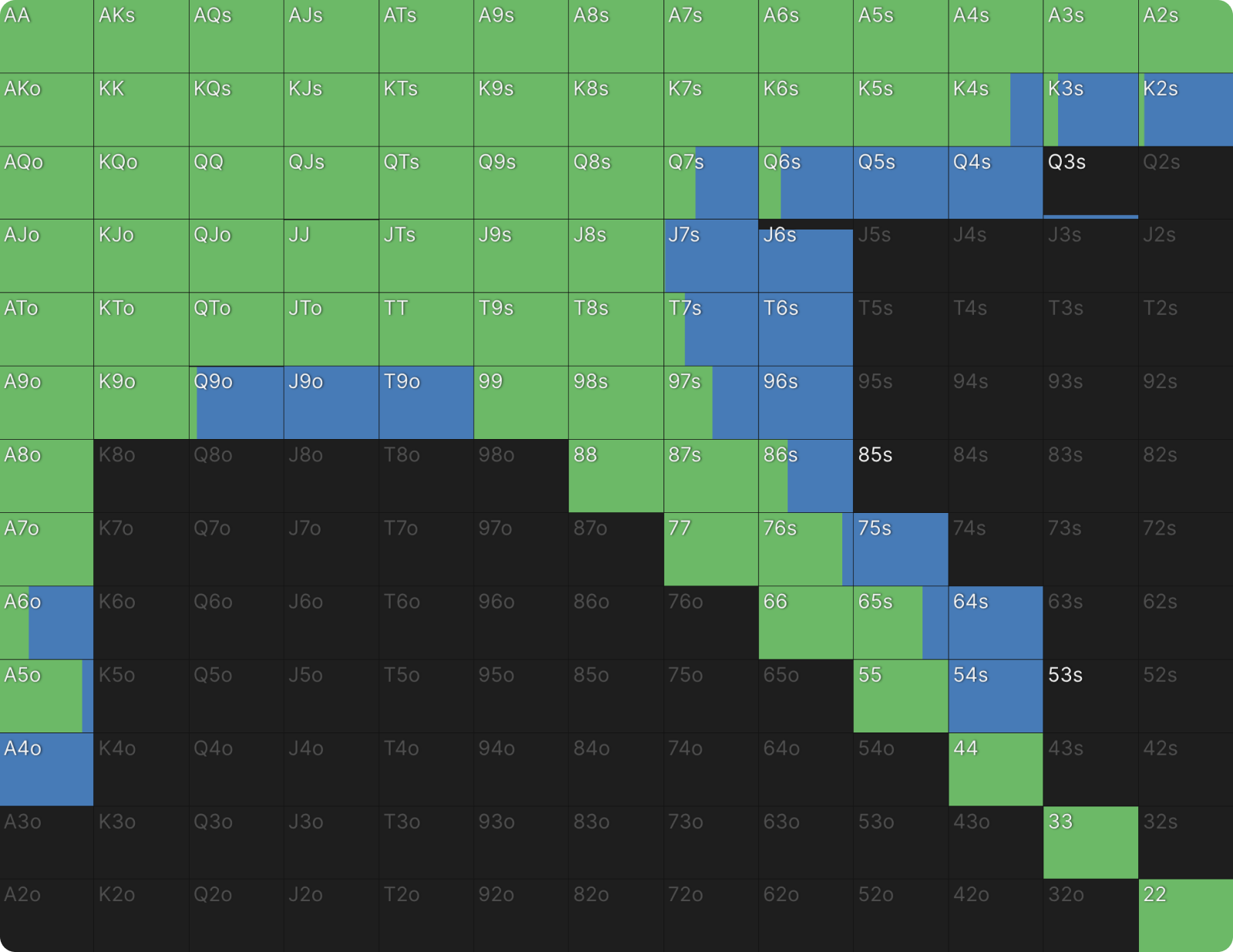
BTN uses flat call 77.6% of the time. It is important to note that the structure of this range is focused on hands that are effective against wide ranges in multiway sweats. This mainly applies to suited Broadway hands, which can retain the advantage of being in the same pair, they also have some outs when facing monsters in opponents. For newcomers to PKO, understanding this call range can be challenging, as it is one aspect that makes PKO a very dynamic format. Being able to understand situations where you find yourself in a multiway and collide with hands like Q9s is a key skill. Thus, the PKO format is not particularly suitable for fearful players.
SB Overcollite
Let's change the course of the current hand and see what happens if the WB makes an overcall instead of a raise. Then this will be the answer of the BB:

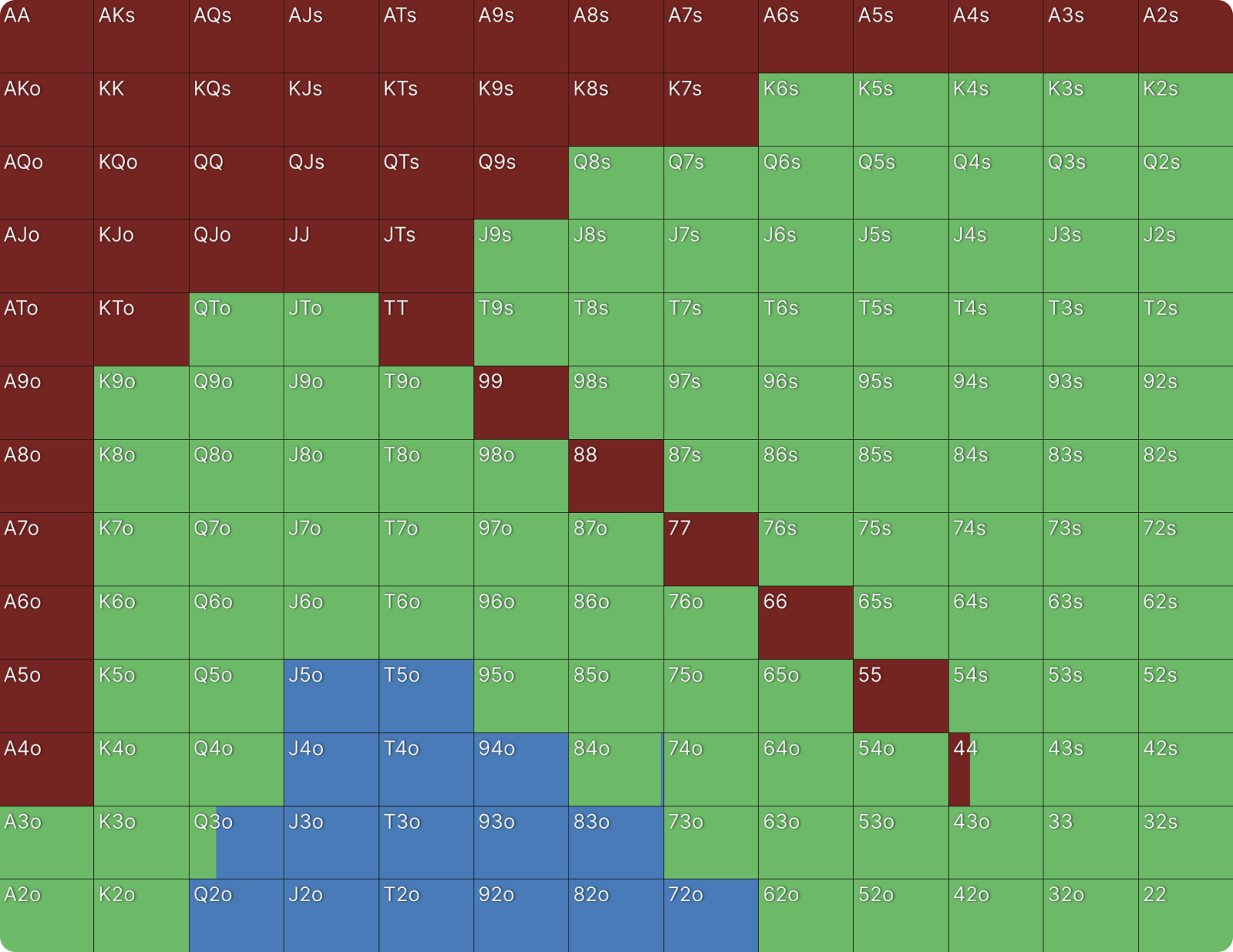
He continues the game with almost 100% of his hands. Its push range is almost identical to that of the last example. If this happens, BTN will have a very advantageous situation. Now he finds himself in a post-flop position with a positional advantage against four very wide ranges with two possible bounty, and it only takes a little more than a sized pot bet to get them into the game.
SB Foldit
Even if SB resets, BB continues to act as follows:

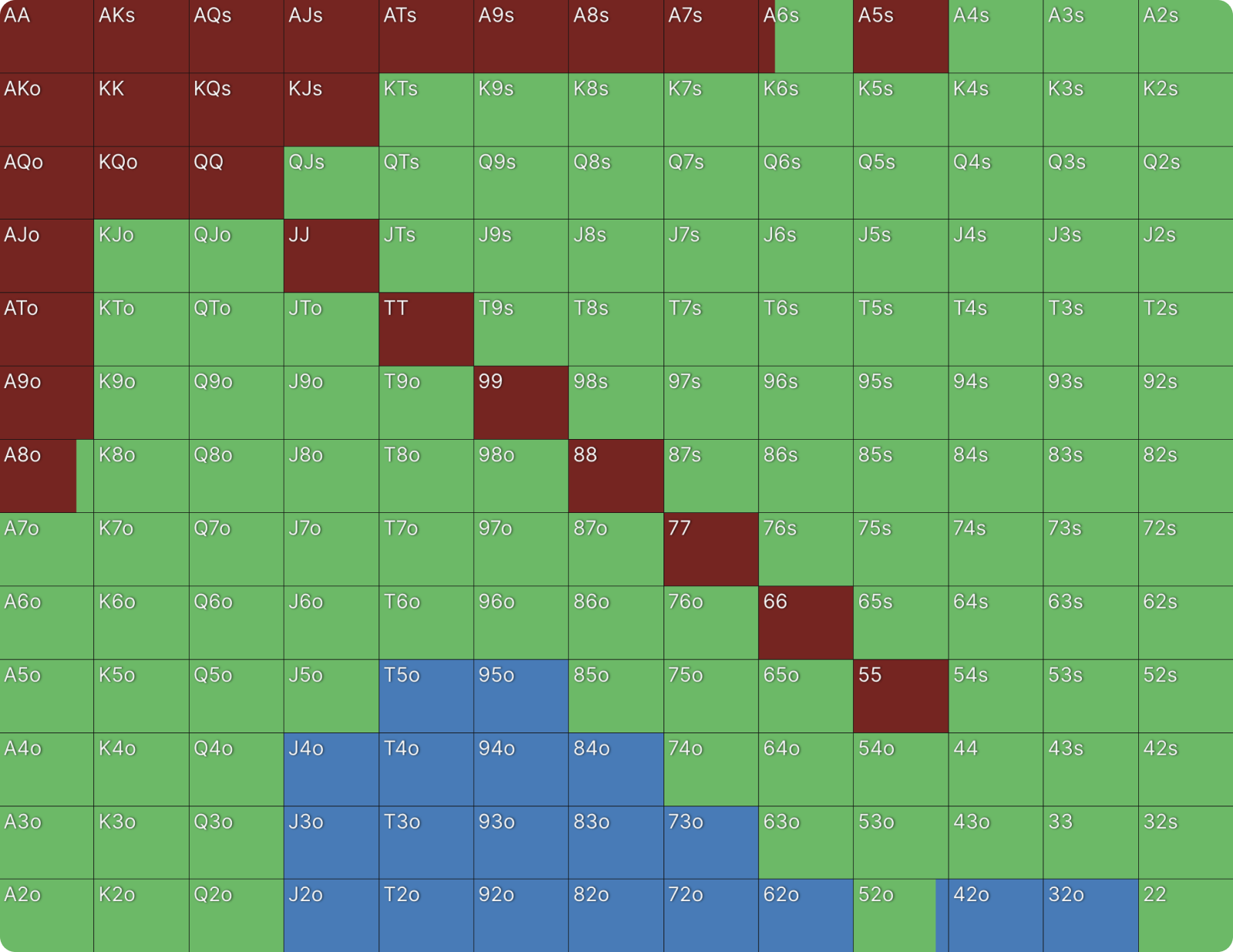
BB continues almost as often, though he can't win the pot. This is because the CO and BTN range is so wide that it becomes very profitable for him to continue, especially when he completes preflop trading in this situation.
What happens when SB drops and BB is pushed? This is the CO reaction:

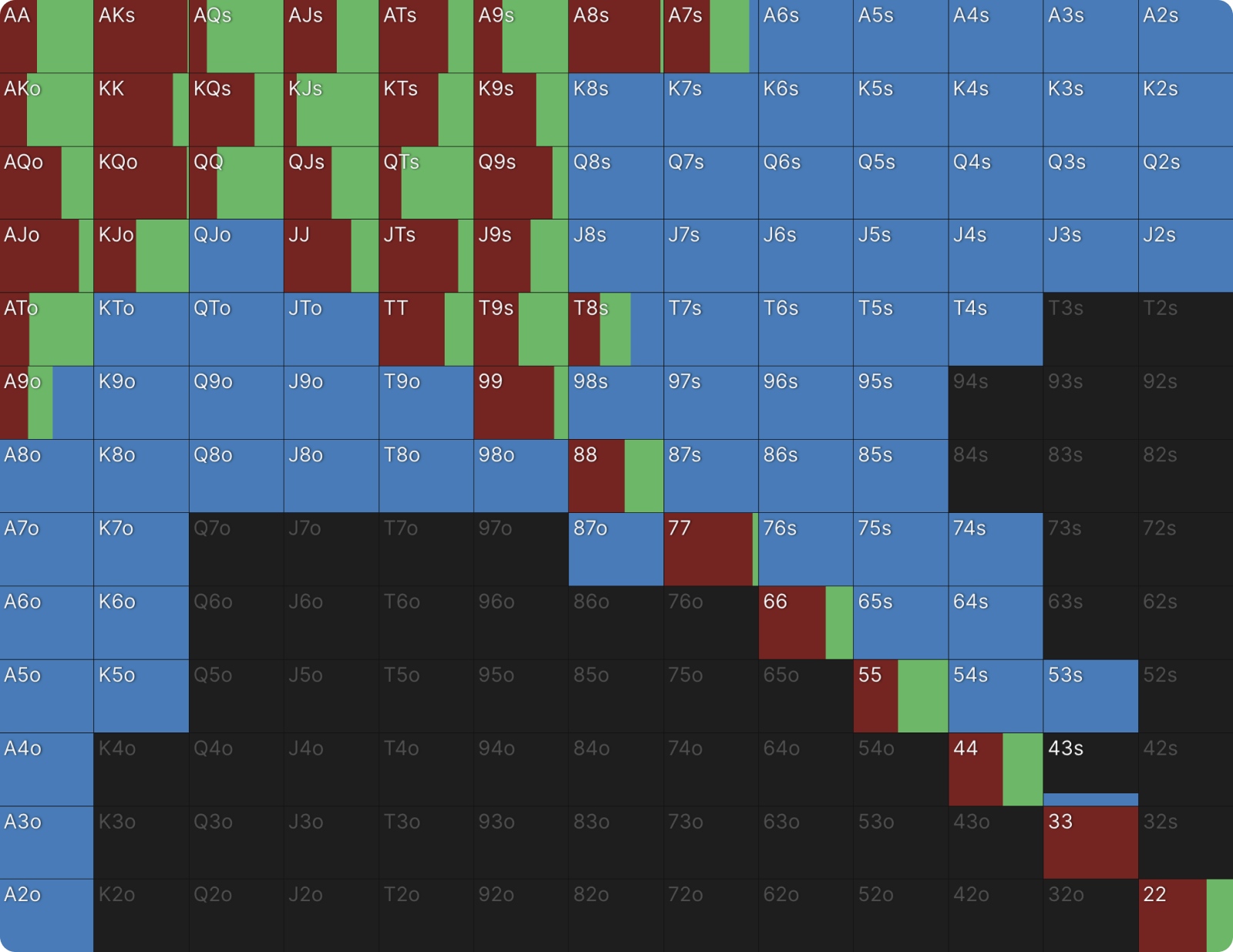
CO continues to play quite often, but now much more tight, since there are only two, not three, bounty that he can win.
When CO goes all-in, BTN responds like this:

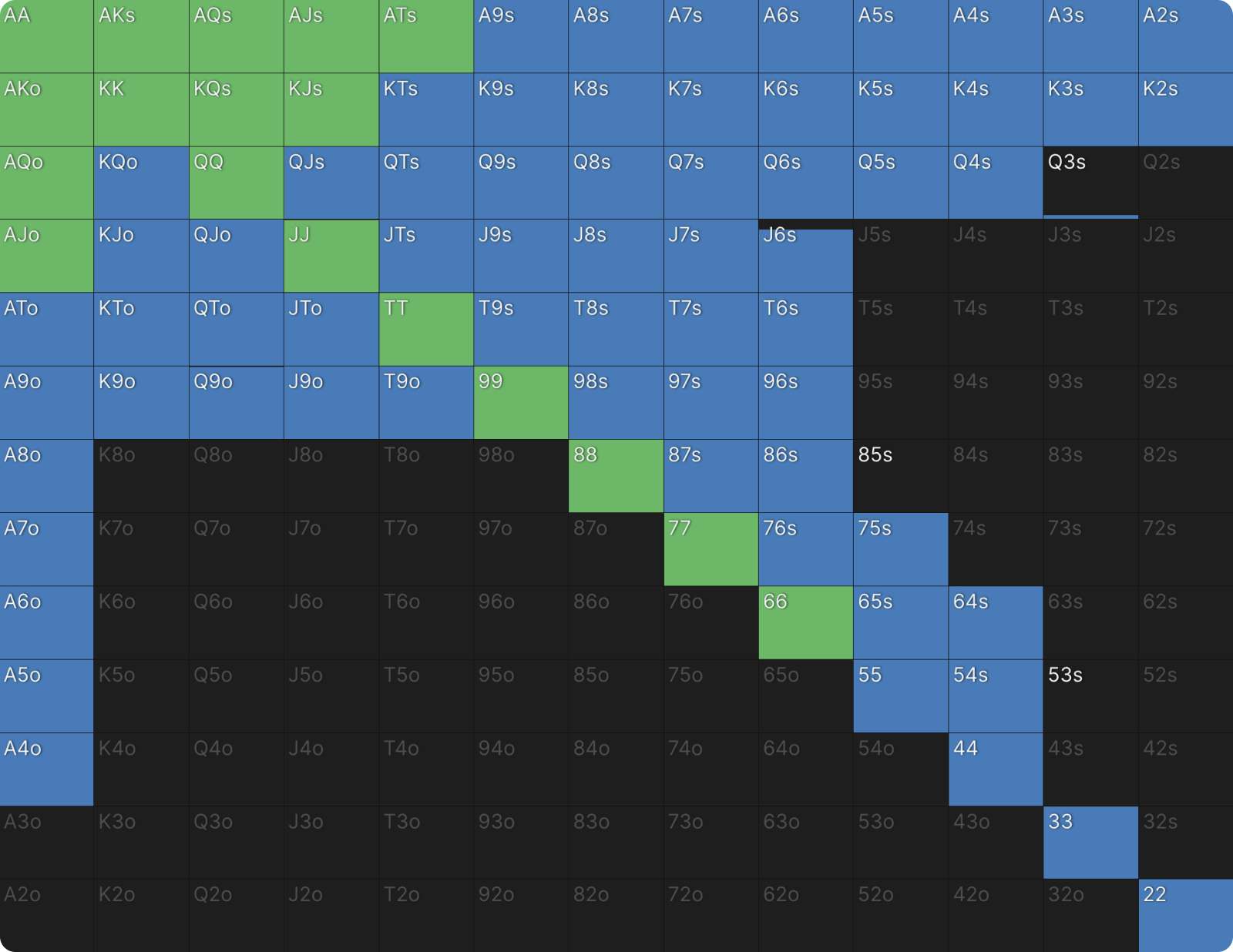
Similarly, the BTN resets much more in this example. The prospect of risking his tournament life for just one bounty shifted him to the fold most of the time. When CO is calling instead of pushing, it's just a formality, BTN pushes exactly the same range, and then CO is calling.
3. Conclusion
The most important thought in PKO, especially at the start, is how many players you cover. Always know in each hand how many players you can win bounty, and how many you can win. Also pay attention to where they are at the table. The player you cover sitting next to you is worth a lot more than the player you cover four positions further away.
- In the example we analyzed in this article, there was an ideal situation for BTN, which led to a situation where it exclusively only flat-collites its entire range. It was at the beginning of the tournament, so the bounty was worth the most (in terms of equity). The chip-leader on LJ pulled back from the giveaway, which means CO has become the actual chip-leader. The CO with the next largest stack was in a late position, so it could open a very wide range.
Our hero was on BTN, which means he always has a post-flop position. It covered both blinds except Co. A simple flat increases the likelihood that SB will enter the pot and eventually bring their bounty into play. Three reasons to make a call instead of a raise. SB had a short stack, so he had a normal situation for a Squeeze Push after a BTN flat call, and his bounty was immediately brought into play.
SB was the only bounty that could win BB (which also has a short stack). Remove one or two of these variables from the equation, and BTN probably wouldn't play like that, collation across its entire range. Multiway banks are very profitable in PKO when you cover multiple players, even if you are covered yourself. The usual reaction in online tournaments is a lot of isolation raises from covering players who are trying to win one bounty without any resistance.
CONCLUSION: The main takeaway here is perhaps that passive play may be preferable to aggressive PKO play, where it may induce opponents you cover and from whom you can win bounty to enter the pot after you, instead of isolating them.