

Translated with the help of AI. We apologize for any errors and would appreciate your help in correcting them.
Translated by order of the educational portal university.poker
Article by Barry Carter, original source: GTO Wizard
The most inefficient way to use a tool like the GTO Wizard is to simply check how a particular hand should play out in a given situation to see if you've played it optimally. Modern poker theory is based on the game of the whole range, rather than individual hands. This is a fundamental shift in approach to the game that every poker player must experience personally in order to achieve a deeper understanding. However, there are times when focusing on a particular hand gives us a lot of useful information. After analyzing your overall range, certain hands that somehow deviate from the general trend may stand out in the process of parsing the hand.
Such hands are called “outlier hands”. The most interesting thing is to find out why the solver played a certain hand differently than most others. Below are a few examples from my personal study where such stabbing hands taught me important lessons. However, be careful: in almost every case, I have seen examples where, in a slightly altered situation, the same category of hands was played in the opposite way. Therefore, it is not necessary to apply these conclusions in a template way. The main goal of this article is to encourage players to pay more attention to knocking out hands in the range, because they are always learning something.
1. Limp range
- Let's start with a simple example. I was analyzing the pre-flop ranges for the 25bb stack and noticed the following opening strategy for the Button (BTN) position:
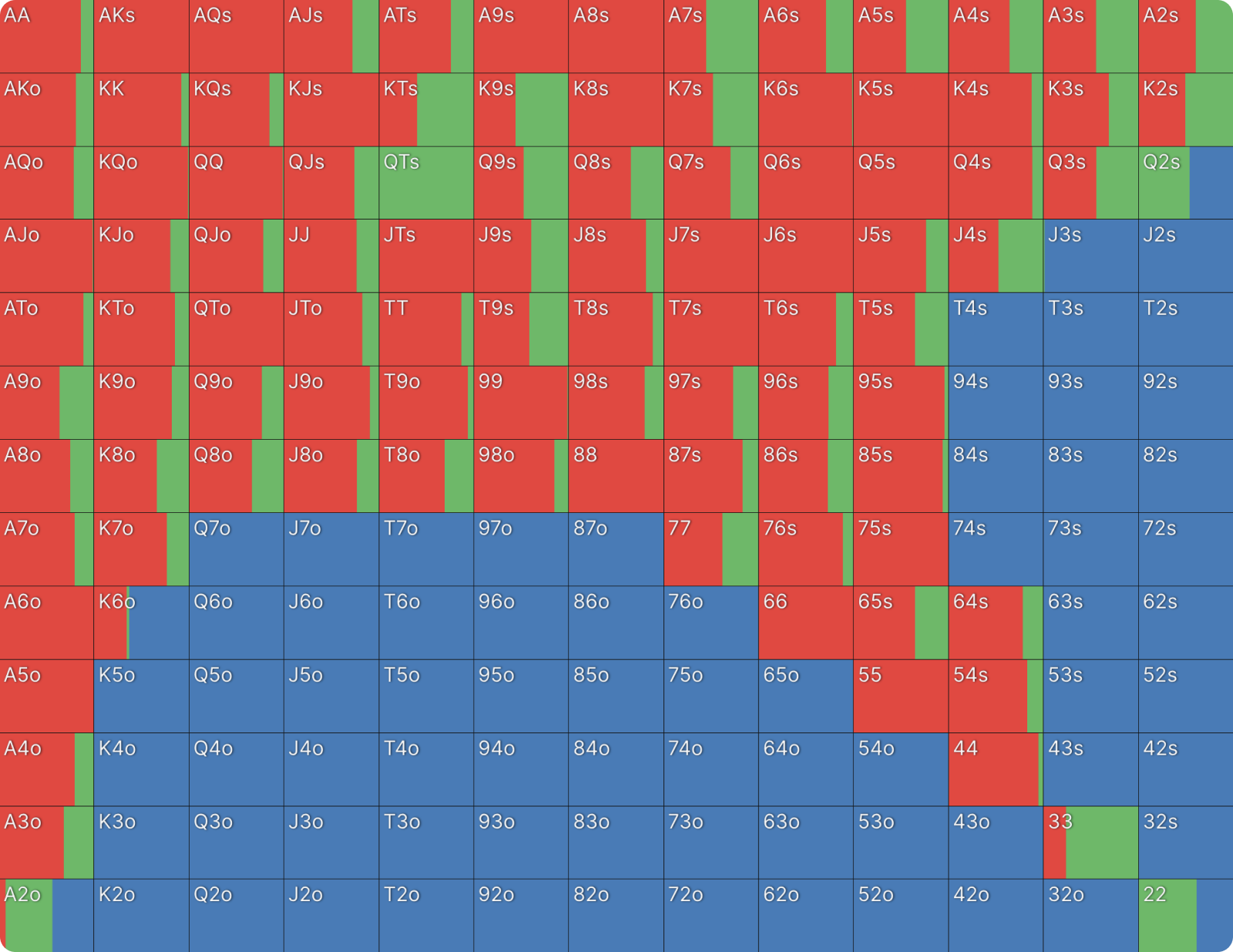

Solver is starting to use a limp strategy for BTN in the depth of 25bb, but basically the range consists of raises. Many hands are played through a clean raise, and the limps are represented by mixes, with one exception. The knockout hand here is QTs, which is played through a clean limp. This becomes even more interesting when you consider that in the same position at stack 20bb and below, QTs is one of the main push arms. My understanding of the reasons why QTs are always limp is this: firstly, this hand is well played multiway in position.
When we are limping, the small blind (SB) often calls, and the big blind (BB) often waits for checks. QTs are ahead of most call and check ranges. This hand will often receive profitable draw on the flop, which can be used for bluff or sequel, and if it collects one pair, it usually means that it is ahead. In addition, QTs are profitable for a call against the raise of one of the blinds (but not against the push, since QTs almost always fold against the all-in).
Here's how SB responds to the limp from BTN:
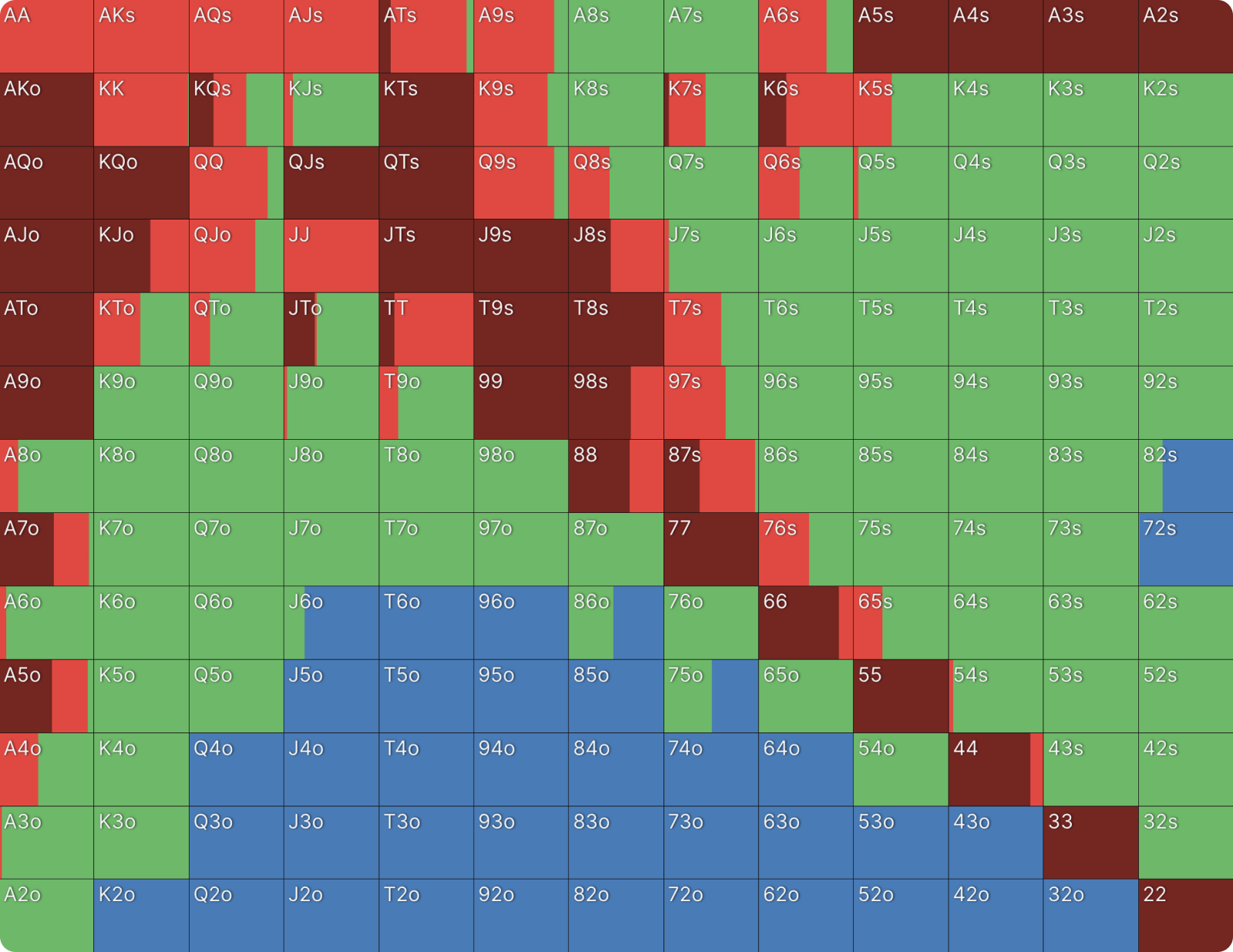
As you can see, QTs dominate over the SB call range. When the BTN opens, the SB folds most of the hands against which the QTs are in a good position. There are few hands for a call against which QTs are ahead, with almost everything that comes up beats QTs.
Here's how SB responds to BTN's open-raise:
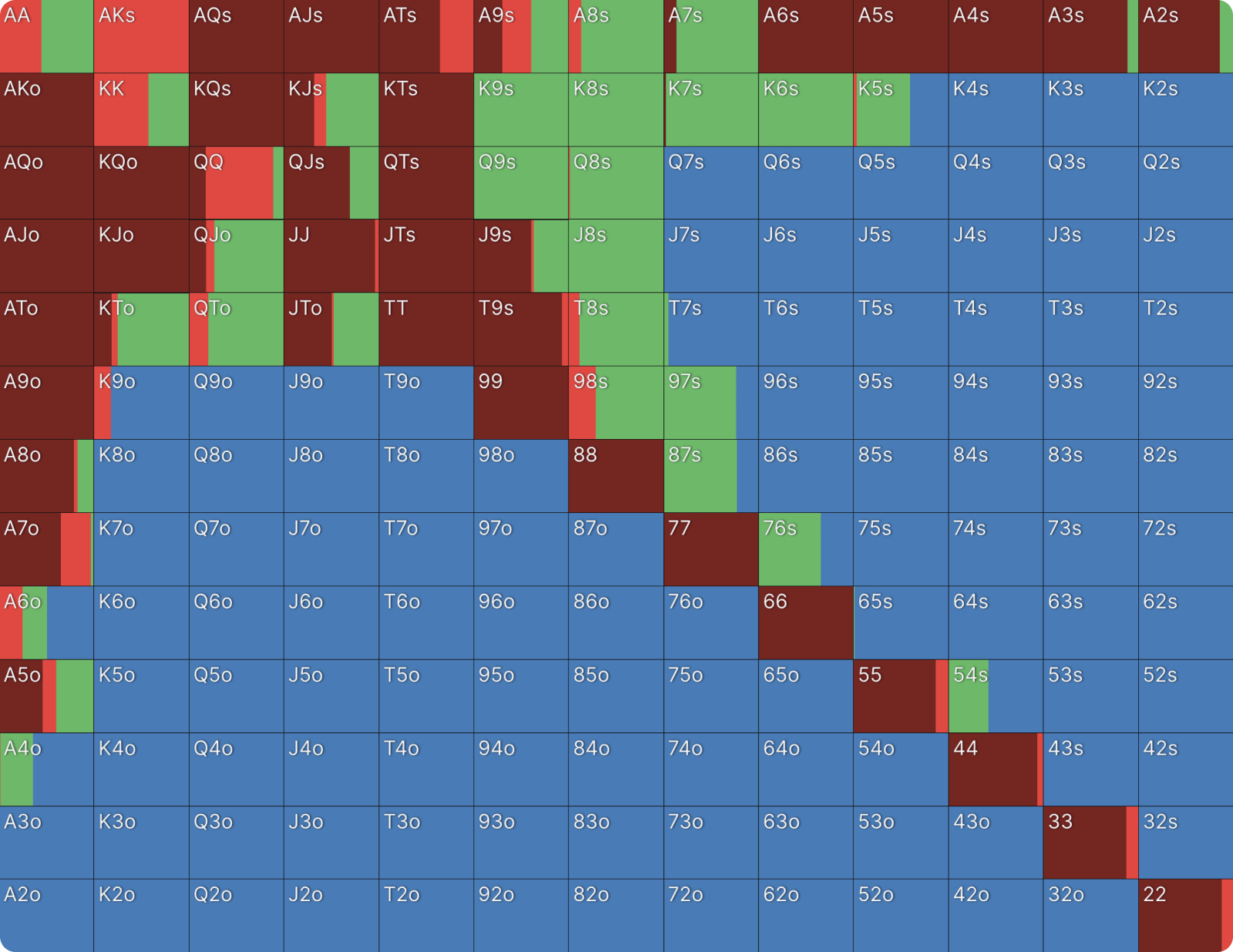
When SB folds
If SB folds, BB collides with a very wide range, many hands of which QTs dominate. Therefore, it seems to me that limiting QTs is necessary first of all in order to leave the BB range wide. My lesson from this beating hand is that QTs teaches us what a limp range should look like. Of course, it is important to have a mix of hands in the limping range. But the key takeaway is this:
We choose limp hands in such a way that they can play well against a wide range, in position, and don't force stronger hands to fold if we decide to do a raise.
2. ICM and fold equity
- Another preflop example. This is a bubble situation where everyone has exactly 30bb stacks. It's not exactly a realistic situation, but it still highlights something interesting.
Here is the UTG opening range:
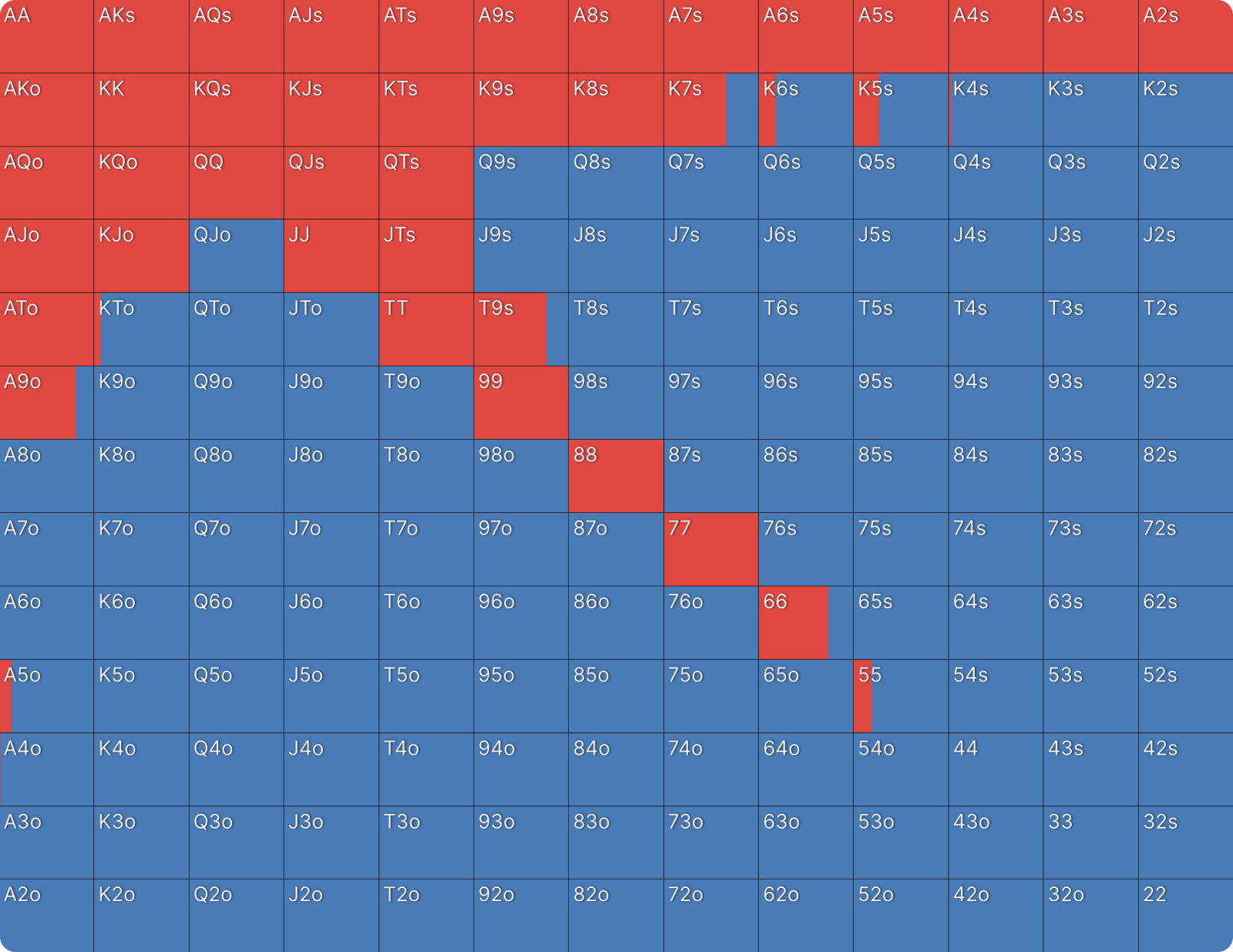
And here's how UTG1 responds to open-raise:
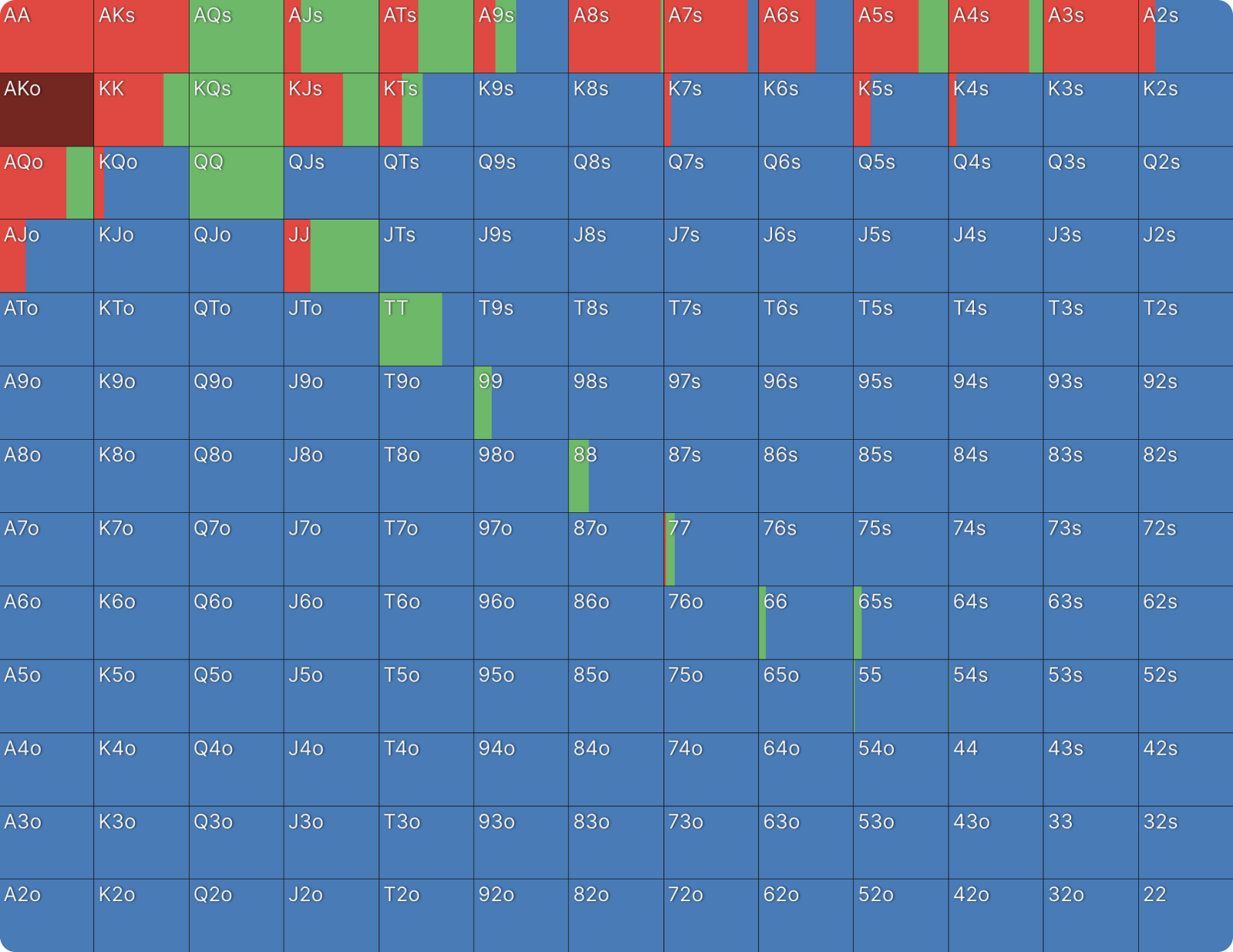
The knocking out hand here is quite obvious: the only hand that goes to all-in is AKo. Usually, when we see a small push range within a wider range, we see that both the arm value and the bluff are present in it, and they are played at a lower frequency to balance the range. In this example, it is not entirely clear whether AKo is seen as a value hand, or as a bluff. To understand why this hand is knocked out, let's look at the answer to this Push.
Here's how the LJ responds:
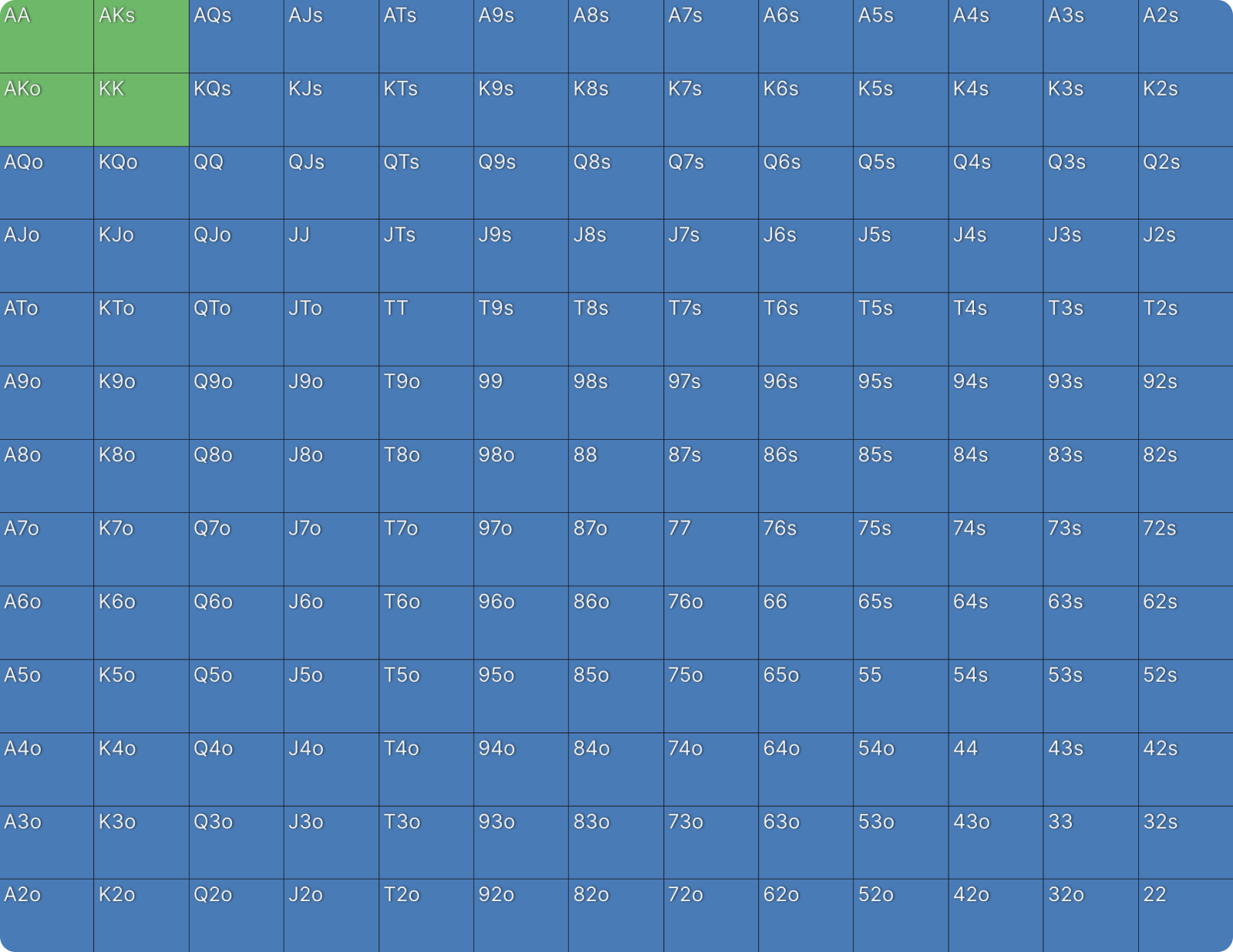
Spoiler alert: All other players then have the same call range until the move returns to the open raiser (UTG), which responds like this:
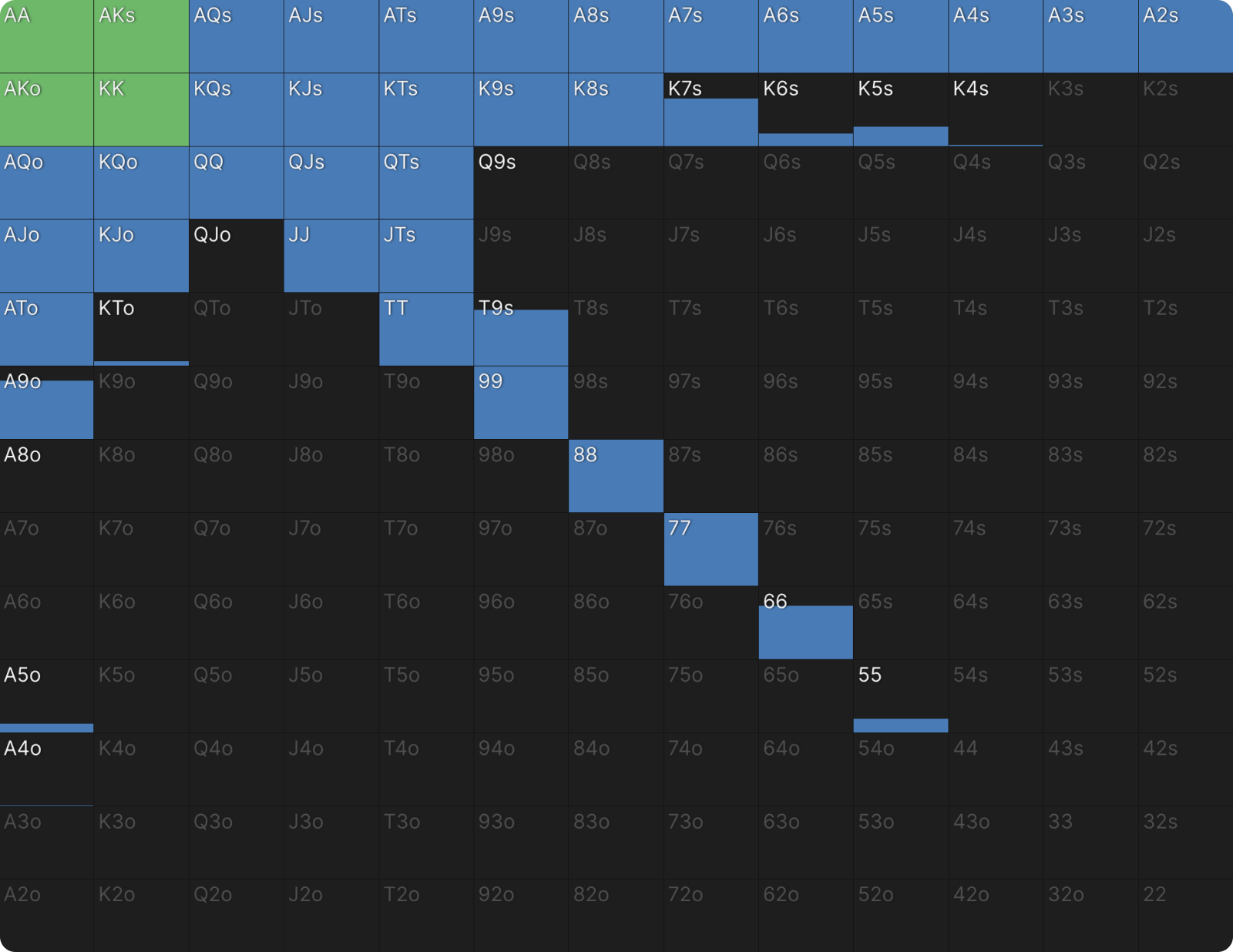
Although it closes the action, the call range remains the same. If you understand the bubble factor, you probably already know why. In order to call on a bubble, especially when all stacks are the same, you need a very strong hand. Here, players must have KK+ or AK to go all-in; even QQ is a fold. The reason AKo always goes all-in is that this hand strongly blocks a very narrow call range. There are six combinations of AA and KK, and sixteen combinations of AK.
However, when we have AK, there are only three combinations of AA and KK and nine combinations of AK that an opponent may have. Thus, we almost halve the number of hand combinations that can call us. Let's return to the question of whether AKo is a bluff or a vale value. In fact, this is a bluff, because when we are called, we either share the pot or are strongly behind. This example highlights the importance of blockers in poker, especially in situations with narrow ranges (in this case, a super narrow range for a call).
It also provides an important conclusion related to ICM:
When the impact of ICM is great, the most important form of equity is fold equity.
We prefer opponents to drop the hands we dominate, like AQo, instead of taking risks and letting them drag us down on a bubble.
3. Unblockers
- Consider another example. Effective stacks are 50bb. UTG makes an open-raise, HJ calls. Flop comes out J42 offsuited, UTG checks.
HJ's actions are as follows:
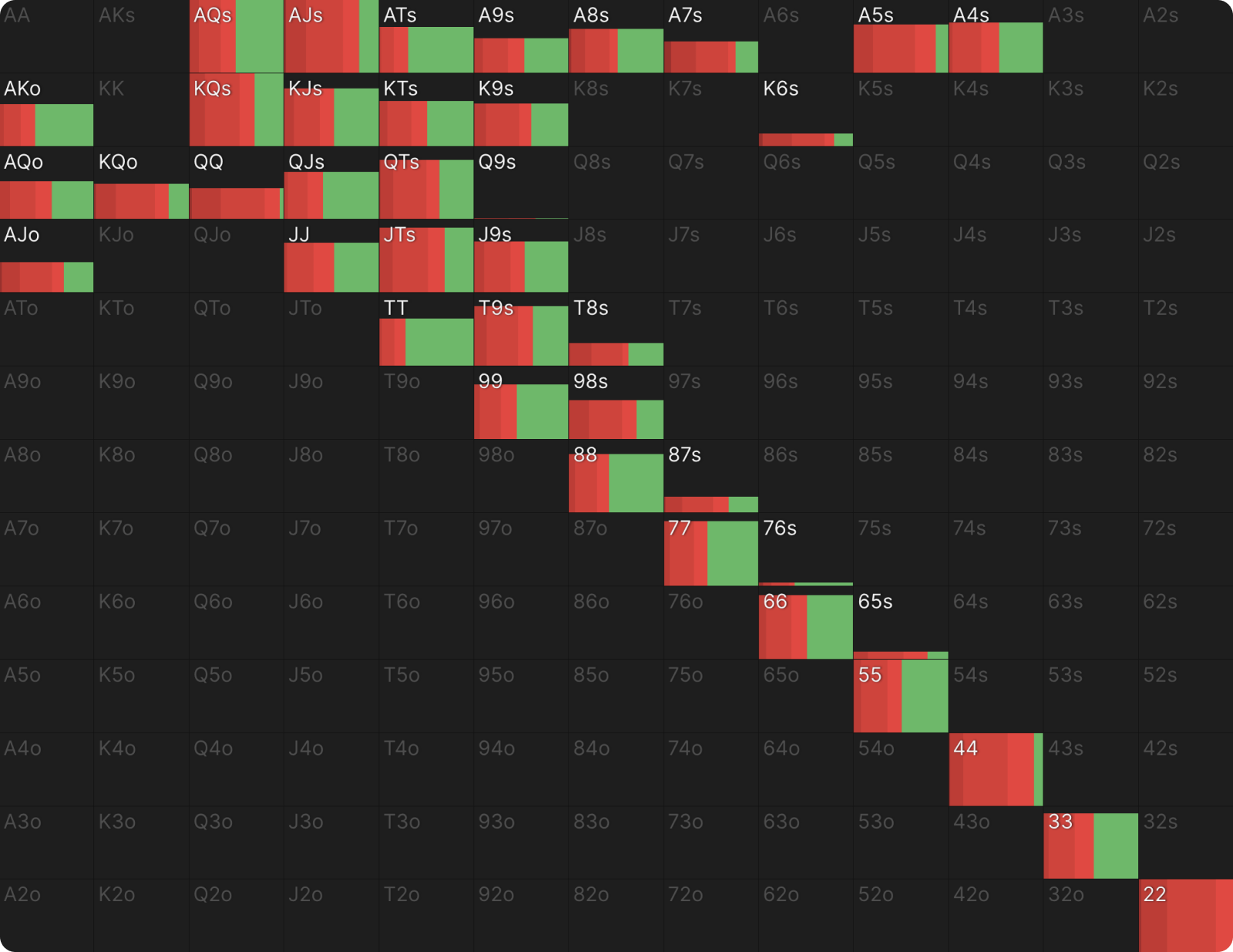
In this range, almost every hand alternates checks and bet. While HJ has a range advantage on this edge, UTG has, among other things, all the overpairs and sets in the check range. The two hands that stand out as being knocked out are QQ and 22, which are almost always put.
With QQ, everything is due to the fact that I have developed a reliable heuristic after analyzing many similar situations. Overpairs, which are the older hands on most boards, are usually placed with the highest frequency. If different bet sizes are used, it is these hands that are more likely to choose larger sizes.
This happens for many reasons, but the main one, as I assume, is that overpairs do not block the call range and win more by investing in the bank right now. QQ often puts because it does not block hands with a jack (J-x), with the exception of QJs that will to call. These arms make up a significant portion of the UTG range. The top pair is also ready to invest more chips in the bank through raise. QQ aims to put money into the pot as soon as possible before an ace, king, queen or another jack comes out, which can slow down the action.
22
22 is also high-frequency for similar reasons. The set of twos is one of the strongest possible combinations, and he wants the pot to increase. Moreover, 22 does not block potential calls. 22, like QQ, targets hands with a jack (J-x) that it does not block. The same applies to overpairs. You can see further evidence of why QQ and 22 are placed more often than other hands by looking at other combinations in this range.
- For example, JJ (top set) alternates bet and check. JJ does not block overpairs against which he wants to get action, but blocks a significant amount of J-x that could call.
4. Underpairs
TT makes the fewest bet in this range. It can also be considered a “knockout hand”, because it often checks, more than other hands. This is also due to the fact that TT does not block the call range, but obviously it does not want J-x to enter the pot. Each pair smaller than TT bet with a higher frequency. The reason is that although TT beats on this board with J-x-type hands, it is still strong on its own. If TT bet, she is often colored by J-x, but she will also knock out the hands she wins.
However, by checking in, TT can not only catch a bluff on the next street, but also call to a thin value hand that is weaker than it.
Pair 99 to 55 are much more likely to bet because they get more protection benefit than TT. TT also benefits from sweat control by waiting behind (though I'm not sure if that's what the solver means). There are three exceptions in this range: QQ and 22 always, and TT very rarely. The reason for all three hands is that they do not block J-x, which makes up the bulk of the call range. QQ and 22 really want J-x to participate in the pot, but TT doesn't want that.
Bet on mixing ranges (Merge Bet)
- In this example, at a depth of 50bb, the UTG opened and the UTG1 called.
The flop is out:


Here's how UTG plays on this flop:
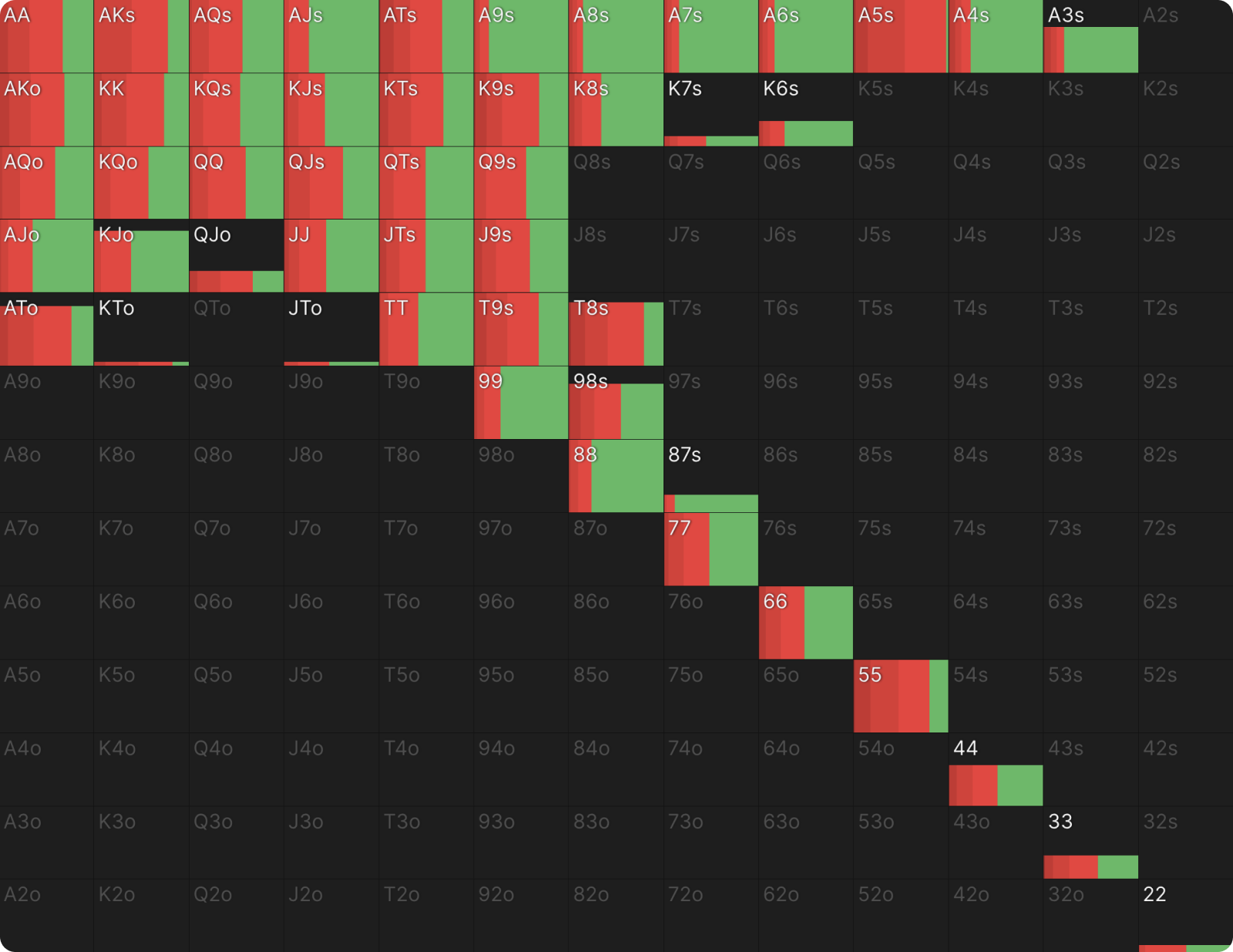
As before, all hands mix bet in this situation. This flop probably fits both ranges. UTG1 is in position, and there is a chance that it already has a flush. Therefore, a bet with each hand can always be very expensive. However, there is one hand that puts 100% of the time is the A5s. A5s is a bottom pair with a top kicker, without flush draw. Why does this hand always bet? She doesn't have a lot of showdown velle, and as a bluff she doesn't have flush draw as a safety net. This is a classic bet of mixing ranges with a hand, which at the same time can make the hands call worse, and the best hands fold.
Let's take a look at what happens when A5s bets 20% of the pot:
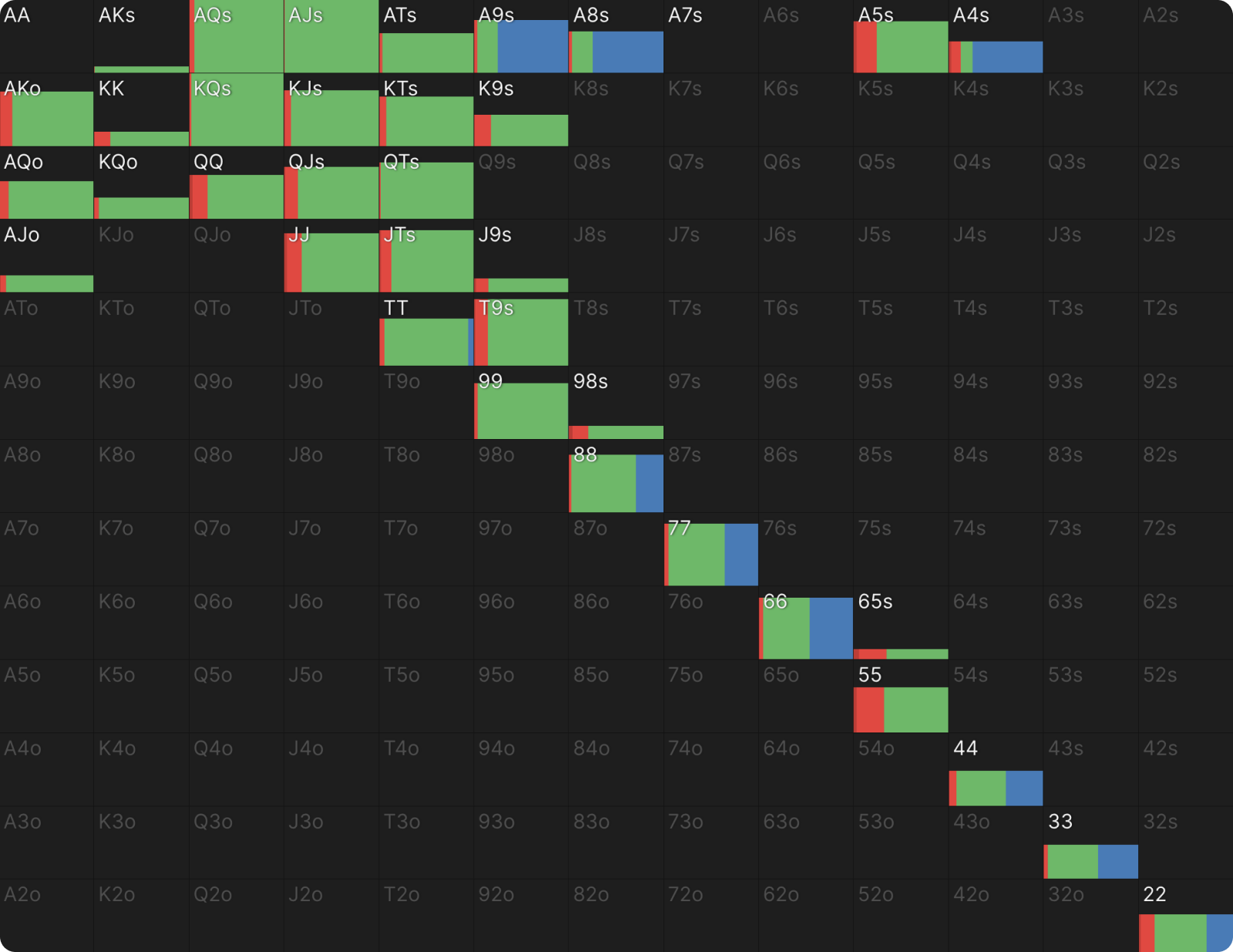
First, we can force better hands to fold. We make 88, 77 and 66 fold them sometimes if they don't have the hearts. Second, there are the worst hands that call. 44–22 everyone call if they have a worm. 65s call too, and all the odd Broadway hands too (even without the hearts). KTs and K9s, by the way, call everything together, regardless of suit. Our hand has a certain equity thanks to blockers. We block 55, AA, AQ and AJ that beat us. Also, our hand can strengthen against stronger hands with one pair — we can collect two pair or trips.
In general, our range has the following characteristics:
- 51.3% equity;
- 00.9% realization of equity (EQR);
- brings an average of 3.67 big blinds (bb).
However, specifically for A5s, the following indicators:
- 32.1% equity;
- 36.6% EQR;
- brings an average of 0.83 bb.
With such an equity, we are definitely not "married" to this hand. The best outcome for us is to deliver and pick up the pot right now. However, if we are raided, we can easily fold. We don't have enough equity to continue and we are either far behind or our villain has plenty of outs to overtake us. The analysis of this outgoing hand would either introduce you to the concept of “merge bet” if you were unaware of it, or reinforce your understanding if you are already familiar with the concept.
5. Conclusion
All the examples in this article were random findings that I made by studying completely different things. They aroused my interest, and I decided to explore them. I'm not sure that “digging” into the findings of solvers in order to find knockout hands is the best way to spend your time. However, it seems to me that if you managed to find such an example, it is worth studying it. In my experience, if one hand stands out strongly against the rest of the range, a lot of useful lessons can be learned from its analysis.
What we learned from these examples:
- We got an idea of what types of hands are ideal for limps on the final tables of PKO tournaments (for example, QTs).
- We saw how important blockers and fold equity are on a bubble, as AKo has always pushed.
- We learned that if we don't block the call range, we should bet with our Velha hands more often. And if we block, it is better to catch bluff more often.
- Finally, we studied the ideal types of hands for merge bet on seemingly “dangerous” boards.
In conclusion, I want to note that I did not understand all this myself. Some of these examples (especially the last one) I discussed with my coach Dara O'Kearny. Outstretched arms are a great reason to ask for a second opinion, as they often provoke interesting discussions. You can discuss such cases with your poker mentor. Or why not post them on your social media the next time you spot an unusual hand in range?