


Translated with the help of AI. We apologize for any errors and would appreciate your help in correcting them.
Translated by order of the educational portal university.poker
Original source: GTO Wizard
To catch a bluff means to call an opponent's bet with a modest hand, with which you expect to win only if your villain bluff. Against a balanced bet strategy, bluffing (i.e. catching a bluff) is likely to be a break-even action, but in most situations it will not bring significant profits at a distance the long run.
Bluff detection is not a key factor in making a profit.
In high-stakes poker, especially in No-Limit Hold 'em and Pot-Limit Omaha, it is more important to avoid situations where you have to make difficult decisions with bluff catchers. If the choice between a call and a fold does not seem obvious, then their expected value (EV) is about the same. In this case, your hand does not give a real advantage, regardless of the decision made.
In this article, we will find out:
- why catching a bluff isn't so appealing,
- how to make decisions when you find yourself in a difficult situation,
- and how not to be in a difficult situation at all.
1. When catching a bluff is useless
You may have heard of the simple AKQ game, also known as the Clairvoyance Game. In this minimalist variant of poker, each of the two players is dealt one card from a deck containing an ace, a king, and a queen. Before the hand, they make an ante and can place bet, as in regular poker. The winner in the showdown is the owner of the highest card. Since the strength of the hand in this game remains unchanged throughout the hand, it simulates the situation on the river in Hold 'em. By analyzing the mechanics of catching a bluff and assessing how profitable or risky it is to use this technique, we can better understand the opening strategy in real poker hands. Then, moving in the opposite direction, consider catching a bluff on earlier streets.
Before we break down the strategy, let's look at the possible solutions for each of the cards in the AKQ game:
Queen is the weakest card that can't win at autopsy. To call her is pointless, because she has no chance to win. The player has only two options: try to take the pot with a bluff or simply surrender if the opponent's bet leaves him with such a choice.
The ace is an absolute nuts. In a position, it is always worth playing aggressively, making a bet. However, without a position, the situation becomes more interesting: you can bet, hoping that the villain will pay with a bluff catcher, or wait, hoping to provoke him into a bluff.
- The king is a classic bluff catcher. This does not mean that you necessarily need to call him, but this option is considered if there is a chance to pick up the pot. However, making a bet with the king is a mistake. Villain will never drop an ace, and will hardly equal a lady. As a result, the bet simply does not make sense.
Thus, with the king, you have the only correct action – a check. If it occurs in a position, the situation is extremely simple: you go to the autopsy and see if your assumption turned out to be correct. If the check goes out of position, there are two possible outcomes: either the villain will also wait (and then the king always wins, since the ace would not play the check), or he will bet, and you will have to make a difficult decision about the stake. The main thing to understand is that there is no one right decision: to bluff with a lady or with a king. The optimal (GTO) strategy involves a mixed approach for both hands. However, with the king everything is unambiguous: it should always be cheated and, if necessary, called to maintain the minimum frequency of protection (MDF) — a balance in which the villain cannot exploit you with frequent bluffs.
An optimal GTO strategy alone does not guarantee profit. In some cases, it is even unprofitable!
It is important to understand that such calls are not automatically profitable. Moreover, in some scenarios, they can lead to losses. Their effectiveness depends entirely on the frequency of the opponent's bluff. If he bluff too often, your call will be profitable. If he does not bluff enough, you will lose money on these calls, but compensate for this by winning in those hands where you reveal his bluff.
The optimal frequency of GTO calls makes sense only when you do not have information about the opponent's strategy.
When you combine calls and folds, their EV should be the same, and since the EV of the fold is always $0 (in a chip EV environment), the EV of the call is the same with the right balance. This is the key reason why catching bluff does not bring additional profit: even if your villain bluff exactly as the theory prescribes, and you perfectly determine the frequency of the call, your winnings will not be higher than with a simple fold.
2. Catching bluff on the river
In real-world Hold 'em distributions, this concept is best seen on the river. 

 Consider the situation: BB calls the raise from UTG in a cash game (100 BB stack), then plays a check-call against the 76% pot rate on the flop. The turn is
  followed by another check-call, but already against the bet of 125% of the pot. Finally, on the river, he checks
  again and faces all-in in more than 200% of the pot.
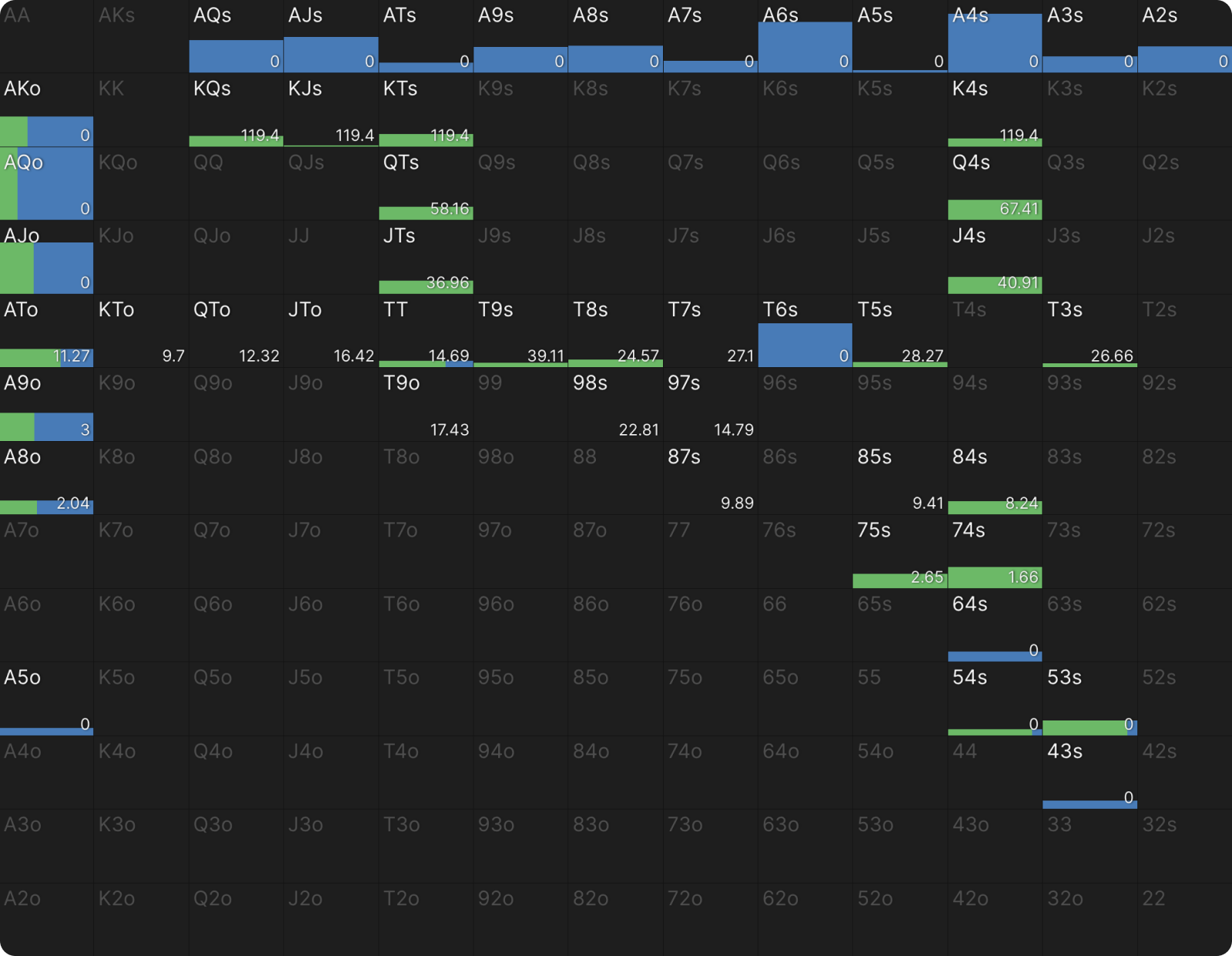
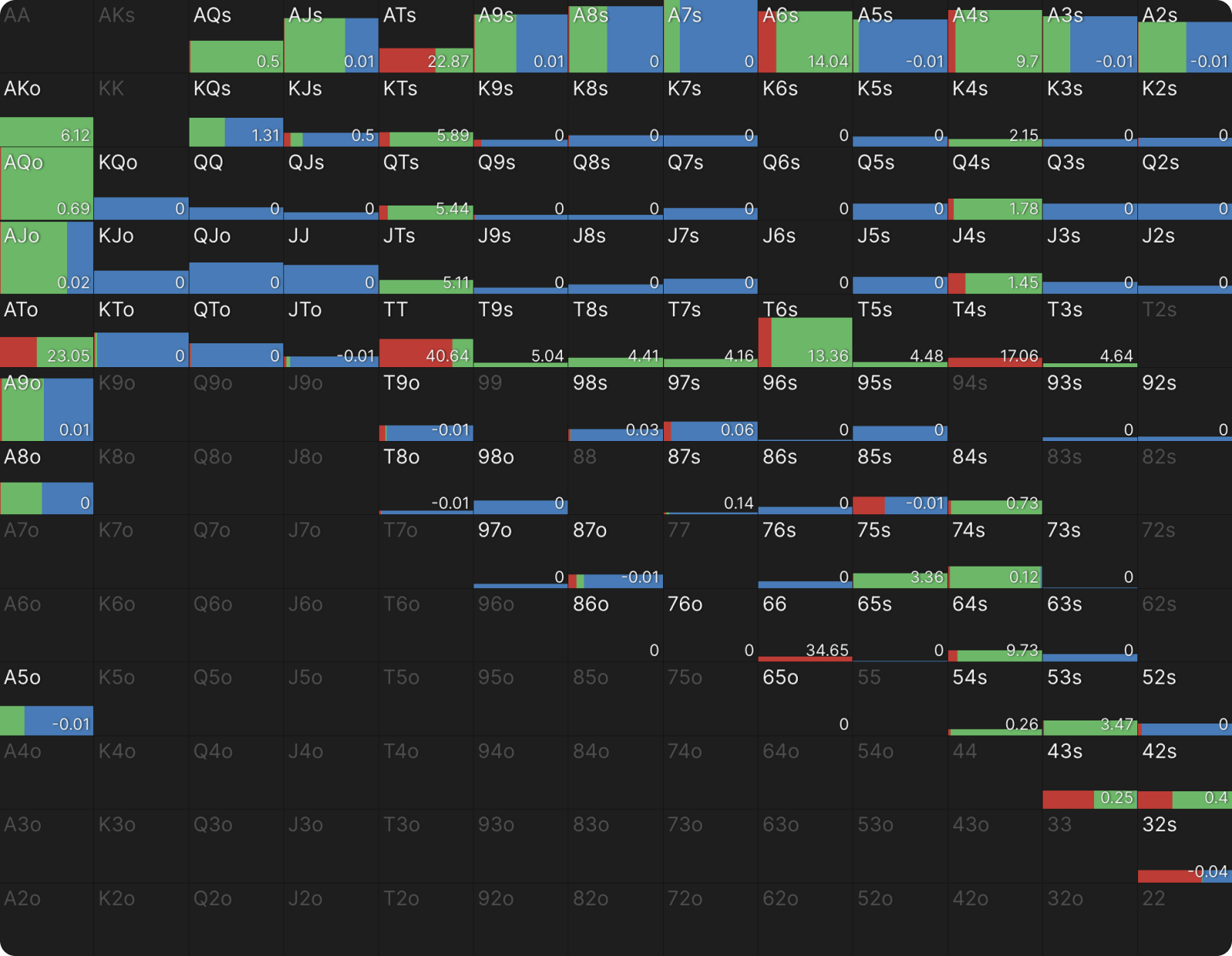
In this grid, the hands are displayed in three versions: completely green (always call), completely blue (always reset) or a combination of blue and green (sometimes call, sometimes folds).
This “sometimes” can mean one of two things:
- The decision depends on the suit of the hand.
- The hand is in a state of indifference between the call and the fold — similar to the king in AKQ.
Pure callas are those hands that make a profit. Plus bluff catchers are most often represented by flushes, for example, T9s and T8s, which make up a flush, and not just a second pair. At the same time, T6s, forming two pair, is an unconditional fold.
Some hands do not stand out so clearly on the net, but they also have clear draw strategies.
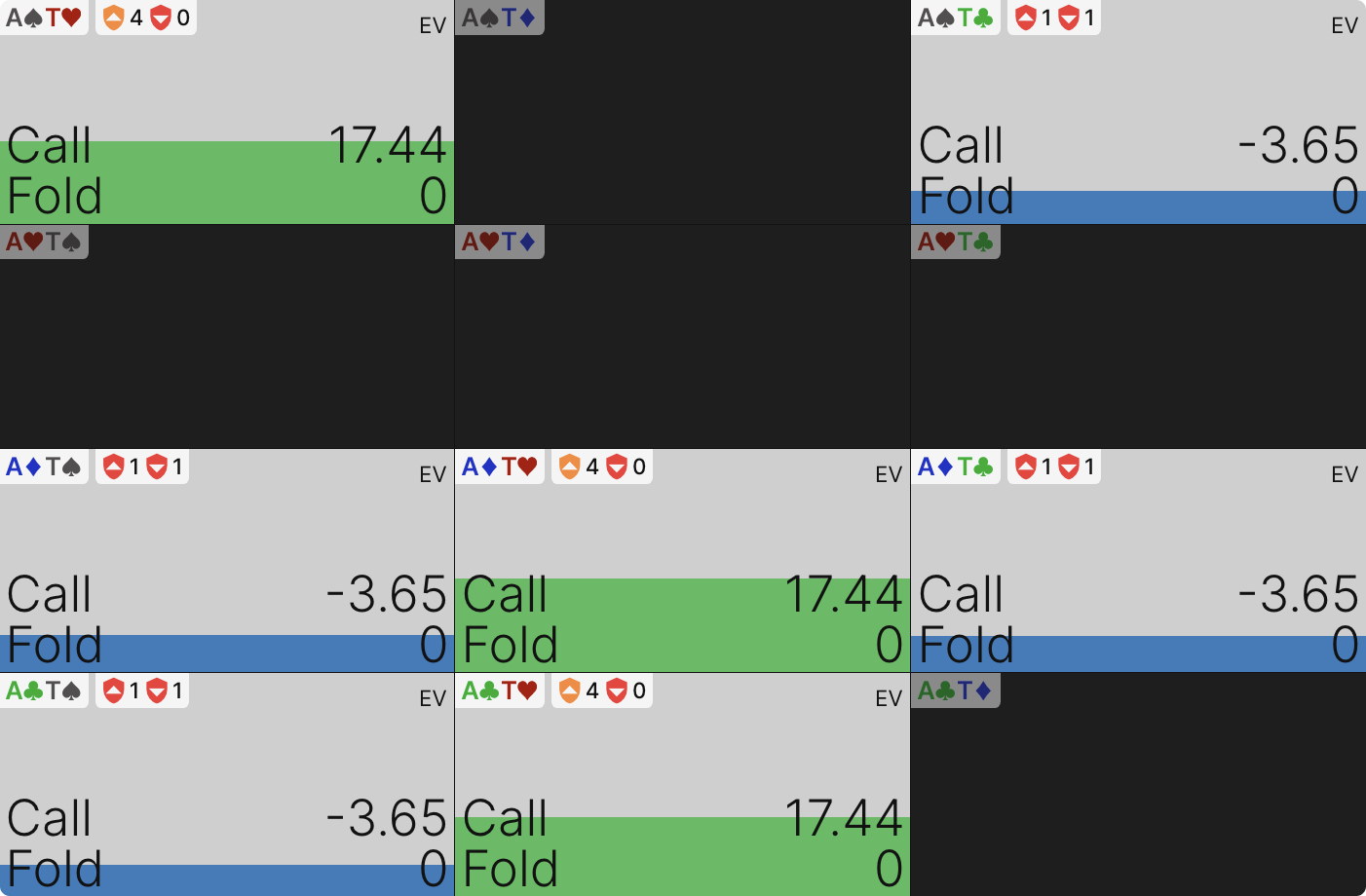
For example, A9 and AT without a worm always fold, while with a worm they always call.
However, this is not true for all A-x hands.  AQ always resets without, but with a heartbroken lady it is already indifferent to a call or a pass:
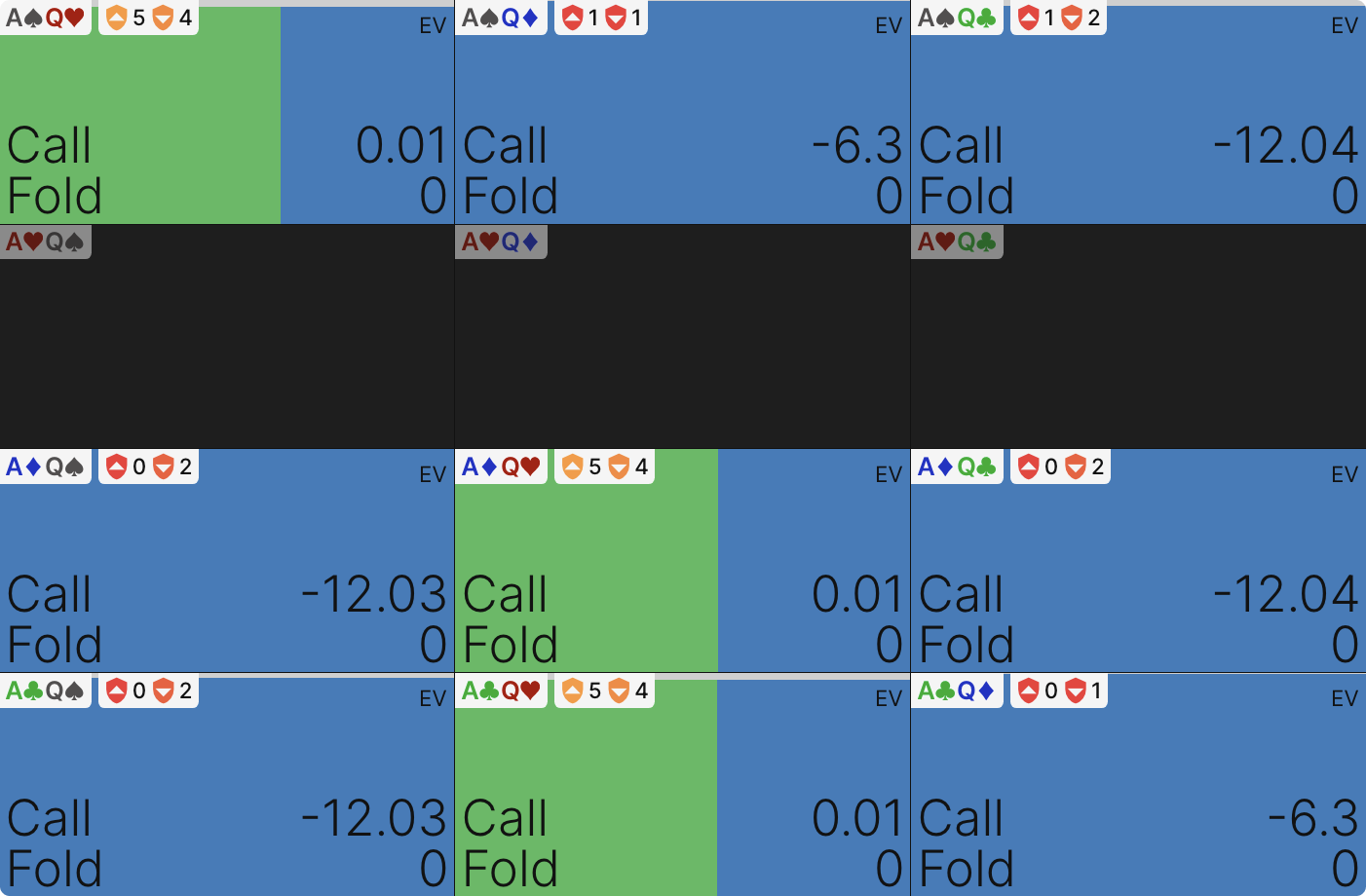
In the grid above, you can see that the call has an EV of 0.01, but this is only a small error in the calculations. If the call really brought at least minimal profit compared to the fold, the solver would choose it in 100% of cases. Moreover, not all bluff flashes turn out to be profitable for catching a bluff.
For example, take a look at a strategy for 
 :
:
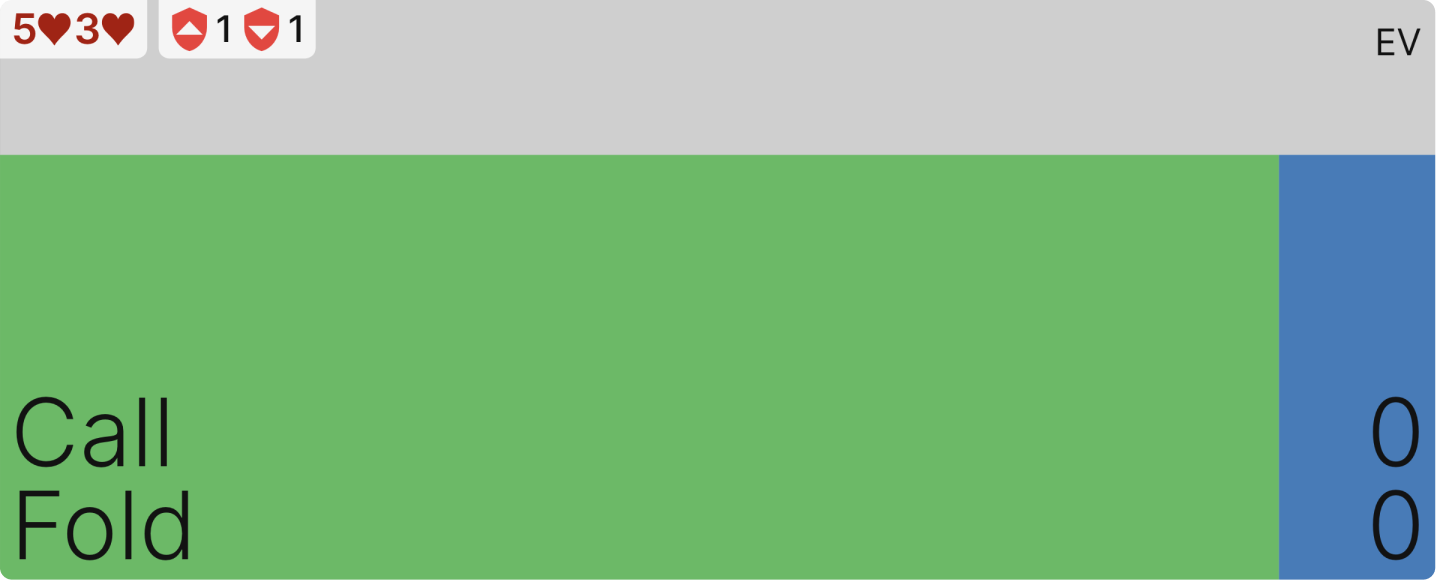
Not every flush is good for catching a bluff.
What's going on here? Why does the solver sometimes drop two pair or even a flush, but at the same time collide with the top pair? Let's figure it out.
3. When to catch a bluff
There are three key factors that can make a call on the river not just break-even, but really profitable:
- You call not only bluff, but also some profitable bet from the opponent. In such cases, your hand is not even technically a pure bluff catcher.

 For example, when you collide with, you do not have an absolute nuts, but on average this call will be positive, because you win not only against bluff, but also against random weaker flushes.
 - You block more valu hand than bluff. When UTG goes all-in, its range usually consists of flushes and bluff. That is why a top pair can be no worse for a call than two pair, set or even a weak flush. All these hands hit bluff equally well and lose to strong flushes.
 However, if you have, for example,, you have valuable information: you know exactly what the villain cannot have
  . But he doesn't know that! This means that it will bluff more often than if it were possible in its range. As a result, you get additional profit, since you are less likely to encounter Velha combinations.
 - Villain bluffs too often bluff. In order for your bluff-catchers to be on the verge of payback, the frequency of opponent's bluff must match the offered pot odds. If he bluff more often than necessary, any bluff-catchers become a little more profitable. If, on the contrary, he does not bluff enough, catching a bluff becomes unprofitable.
The third point is exploitative in nature, since it is based on assumptions about the opponent's strategy. If your guess is correct, you will be able to earn more than using a non-exploitable GTO call strategy. But if you are wrong, the consequences can be much more unpleasant.
It is not always possible to accurately predict the frequency of an opponent's bluff, but if possible, this factor may outweigh the first two. When your opponent does not bluff enough, you lose money not only on calls with marginal bluff-catchers, but even on those that block strong valley combinations or, at first glance, beat part of his valley range.
This is due to the fact that even with the perfect bluff-catcher against a balanced bluffing opponent, your benefit will be small.
At best, the EV of such a call is only a small fraction of the bet you pay. Also, even if your hand meets the key criteria of a bluff catcher, it doesn't guarantee a profit. For example, in our parsing, AQ with on the final board partially collides, and partially resets, despite the fact that it blocks some of the valley combinations. One of the reasons why AQ c partially collates and partially resets is that it blocks not only the Velho hands, but also some of the potential UTG bluff. In the GTO bluff strategy, blockers are quite common and have a moderate impact, so the equilibrium approach makes call with them indifferent, and without them, it tends to fold.
4. Catching a bluff before the river
The main difference between real poker and the AKQ model is that the strength of the hand changes on every street. On the preflop and flop, it is critical to consider whether your hand can strengthen to the nuts combination, and not just act as a bluff catcher. This principle echoes the idea of avoiding difficult marginal decisions when you have to choose between a call and a fold. You don't need the king in AKQ — you need the Ace. Sometimes, in pursuit of nuts gain, you stay with the King, and then it is important to make the most of this situation. However, the opportunity to improve to the nuts may be more valuable than the bluff-catcher himself. Can this hand become a nuts
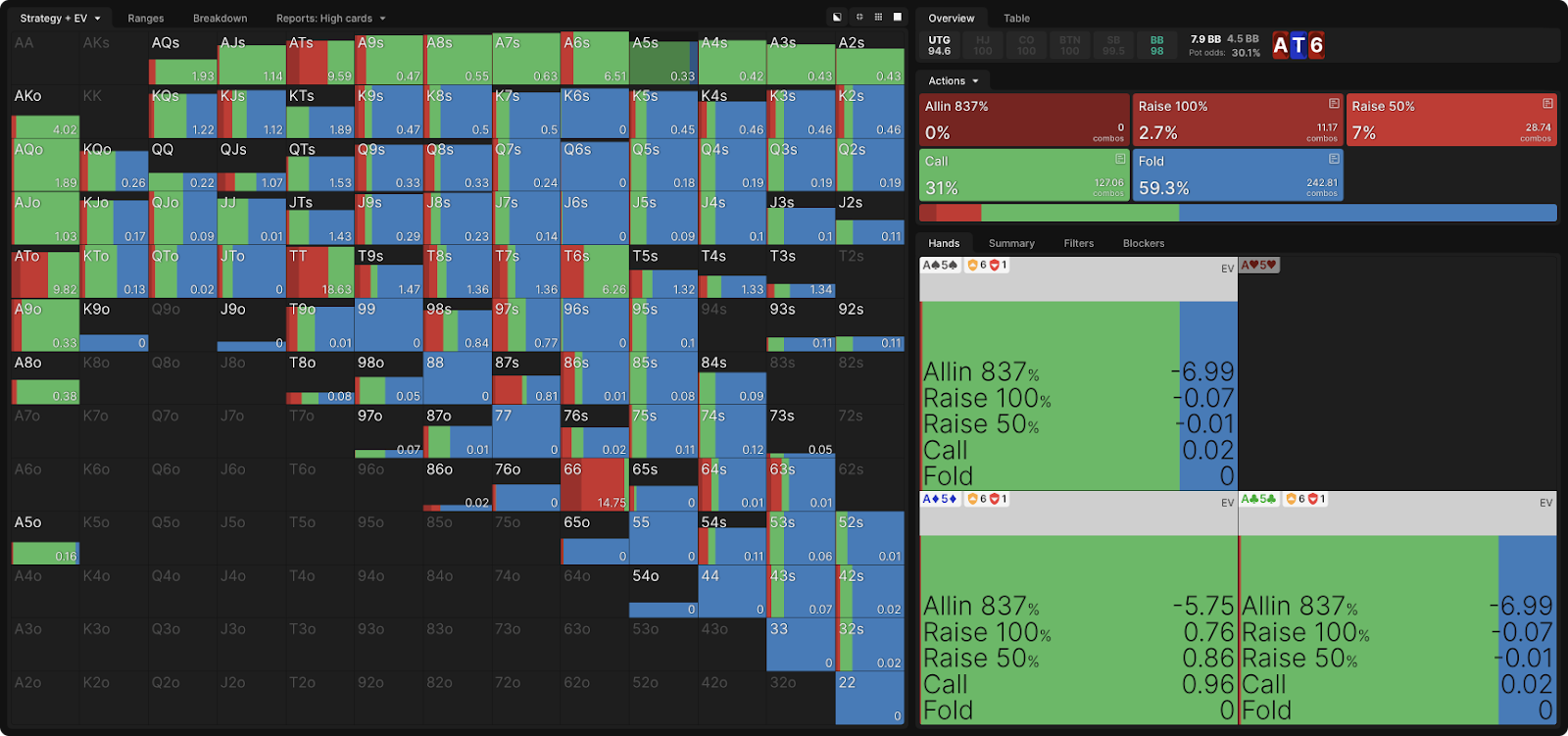
An example of such a strategy is the protection of BB on the turn after the 125% pot rate on the board
:
Apart from AQ and AK, which can beat some Velho hands, the rest of the combinations with the top pair remain indifferent between the call and the fold. Interestingly, the nuts flush draw without additional outs for gain is often reset — unless it has an additional straight draw. However, weaker flush draw such as and always continue the game.
Despite their lower relative equity and less successful blockers compared to the A9, these hands either call or raise. None of these actions — not just draw, not the ability to catch bluff — in itself does not make the call profitable. But the combination of a possible improvement to a flush or opening win with a top pair that remains the best justifies the continuation. In fact, BB begins to reset even the older pair on the flop, if it does not have a significant re-draw that enhances the prospects of the hand.
For example, A5 becomes indifferent to a call against a 76% pot rate if it does not have a backdoor flush draw.
You may already be intuitively familiar with this concept. Imagine that you are sitting on a button and encountering a UTG raise. Which hand would you prefer to call 87s or K7o? If it was all-in, the choice might change, but with deep stacks, the 87s look much more attractive. Although the K7o is nominally stronger on the preflop, this hand rarely turns into a powerful combination. Most often, she will either not cling to the flop at all, or find herself in an uncomfortable position with a younger couple or a top couple and a weak kicker. On the other hand, the 87s may start out as a weaker hand, but its ability to strengthen to a straight or flush makes it much more promising for a post-flop draw.
It's never too early to dump an older couple
This principle also works when playing on the post-flop. The more chips you have on the stack, the more important it is to look not only at the current strength of the hand, but also at its potential on the following streets.
It is never too late to fold the top pair — after all, poker does not give prizes for leadership on the flop.
5. Practice

What makes these cards good for a call?
Let's start with a general understanding of call frequency. This largely depends on the size of the bet relative to the pot — the smaller the bet, the wider it is worth defending. The dynamic of the ranges also plays an important role: if your actions on the early streets left you with a weaker range than your opponent, it is wiser to reset more often. Do not forget about operational factors — if the opponent rarely bluff, the frequency of folds should increase.
Identify the hands you never drop.
This includes combinations that can beat at least some of the opponent's Velu-bets, as well as nuts' draw. However, draw alone may not be enough if the bet is too high. These hands can be used to both call and raising — both options effectively resist bluffs.Add additional bluffcatting candidates.
If the first groups of hands are not enough to achieve the optimal call frequency, pick up additional bluff catchers. The most valuable hands for this are those that block strong combinations of the opponent or may intensify on the following streets. Ideally, they should combine both.Check your intuition.
Before making a final decision, ask yourself: why is this hand suitable for a call? The answer must be specific. A phrase like “villain may be bluff” is not good — it explains why you should generally have a call range, but does not give an understanding of whether your particular hand is included in it.
6. Planning ahead

The intuitive check described earlier is especially useful because it helps not only in the current draw, but also in future bluff catching situations. When deciding why you are colliding on the turn, you think in advance about the strategy on the river.
When you realize the reasons for the call on the turn, you simultaneously build a plan of action on the river.
Let's look at the board again . Calling on the turn with , you count on one of two outcomes:
- Boost on the river. The best option is to collect a flush, but even the exit of the Queens or tens will give you additional equity to continue the game.
- Check of the opponent. If the opponent decides to check the beehind, you will have chances to win even without gaining.
However, if the river does not strengthen your hand, and the villain continues aggression, the call loses its meaning — you have to reset it. Yes, there is a possibility that your opponent is bluff ing. But you have other hands in the range that are better suited to catching bluff — those that have strengthened on the river or have stronger blockers.
The task of this particular hand is not to catch bluff, but to avoid Velju-bets, resetting in a timely manner.
Let's take a hand 
 on the board . Why do you decide to call a bet on the flop? If your answer is “because I have a top pair”, it does not provide useful information. This approach does not help you plan your next game.
You're actually calling because:
- On the turn, you may have a flush draw.
- The villain can play a check, giving you the opportunity to see the river for free.
- His bet on the turn may be small enough for your blocker to matter.
If none of these conditions works, for example, the opponent makes an overbet, then you have to fold, even if there is a chance that he is bluff.
One way to catch a bluff is to answer the bluff yourself.
Let's look at another example: on the same flop. Why does such a hand call a bet?
- First of all, in the hope of gaining on the turn. A worm card would be ideal, but even a second pair or straight draw can provide enough equity to proceed.
- If there is no gain, there is a chance that the villain will play a check on the turn, which will open the opportunity either to see the river for free or to bluff himself.
That's right — sometimes the best way to catch a bluff is to set the bluff yourself. This can be an immediate raise or a call to pick up the bank later if a suitable opportunity arises. This approach explains why a strong draw with the potential of a bluff is preferable to a marginal ready hand that is practically useless except for passively catching a bluff on late streets. If you do not have the opportunity to retaliate, your “plan” loses value. Draw at least gives you a chance to put together a strong combination.
7. Conclusion
Catching a bluff isn't just a matter of arm strength. The only reason a hand can be considered “too strong for a fold” is if there are Velu Betas in the opponent's range that it can beat. If his range is strictly polarized (that is, you lose to all his valley hands and beat all his bluff), then your top pair works as a bluffcatcher in the same way as sets. On the river, blockers are key: it is important what combinations you close or vice versa allow the opponent to have in his range. Before the river, the main factor is the potential of your hand to strengthen.
Sometimes draw hands are even preferable to top pairs, as they give a chance to collect nuts and avoid difficult decisions. But no theoretical concepts will replace the understanding of the situation. Before analyzing blockers or calculating the frequency of protection, ask yourself the main question: is it really worth catching a bluff in this spot against this opponent? Even in the best cases, the expected value from such calls is rarely high, and in the worst cases, you can simply burn chips, calling large bet with dubious bluff-catchers. Without caution, any knowledge of blockers and the operational game is easily turned into excuses for imprudent decisions. The call should be reasonable, and not chosen just because "it's a pity to fold".