

Translated with the help of AI. We apologize for any errors and would appreciate your help in correcting them.
Today we will look at one of the most difficult techniques in no-limit hold 'em, namely, we will talk about a triple barrel. The focus of our attention will be exclusively on single-pots, that is, one-on-one draws. And I suggest starting with a thin vellya value.
1. The art of the third barrel - fine vellya on the river value
River is a street where most players try to play carefully, and sometimes even too much. Therefore, the saying that the clearing does not bluff the river is as old as the world. I would also add that he does not get the value of the velya.
- For example, if we take those spots in which we play in a position, very often there is an intuitive desire to play a comfortable checkback with a good hand, such as TPTK (top pair with a top kicker) on the river. Sometimes it will be right, and sometimes it won't.
Let's take a closer look at this situation.
- Middle stage of the tournament, effective stack 45 bb.
- Hiro opens with an MP with a min-raise

 hand and gets a call from the big blind (BB). There is an unknown player on the BB.
 - Flop


- BB check, and Hiro puts the c-bet 30%.
- Villain call opponent
- Turn

- Check from BB, and Hiro puts the second barrel at 60%. The big blind is colliding again.
- River comes out

- Again a check from BB.
- What are Hiro's actions?
Take a break from reading for a moment and think about how you would play in such a hand. In order to correctly assess the situation, it is necessary to analyze which hands in the range of the opponent are more: those that you beat, or those that will beat your hand? Let's conduct a detailed analysis of the situation, for which we will analyze each street of the post-flop in detail.
On the flop from the most obvious BB will call to:
- with any flush draw;
- with gatshots (which are few, something in the format of 45s or 24s);
- with all top and middle pairs;
- possibly with some weight with third pairs.
There are very few sets, since we will obviously get 3-bet on the preflop from AA and often from 99. As you can see, even on a board with an ace, the call range is quite wide.
I
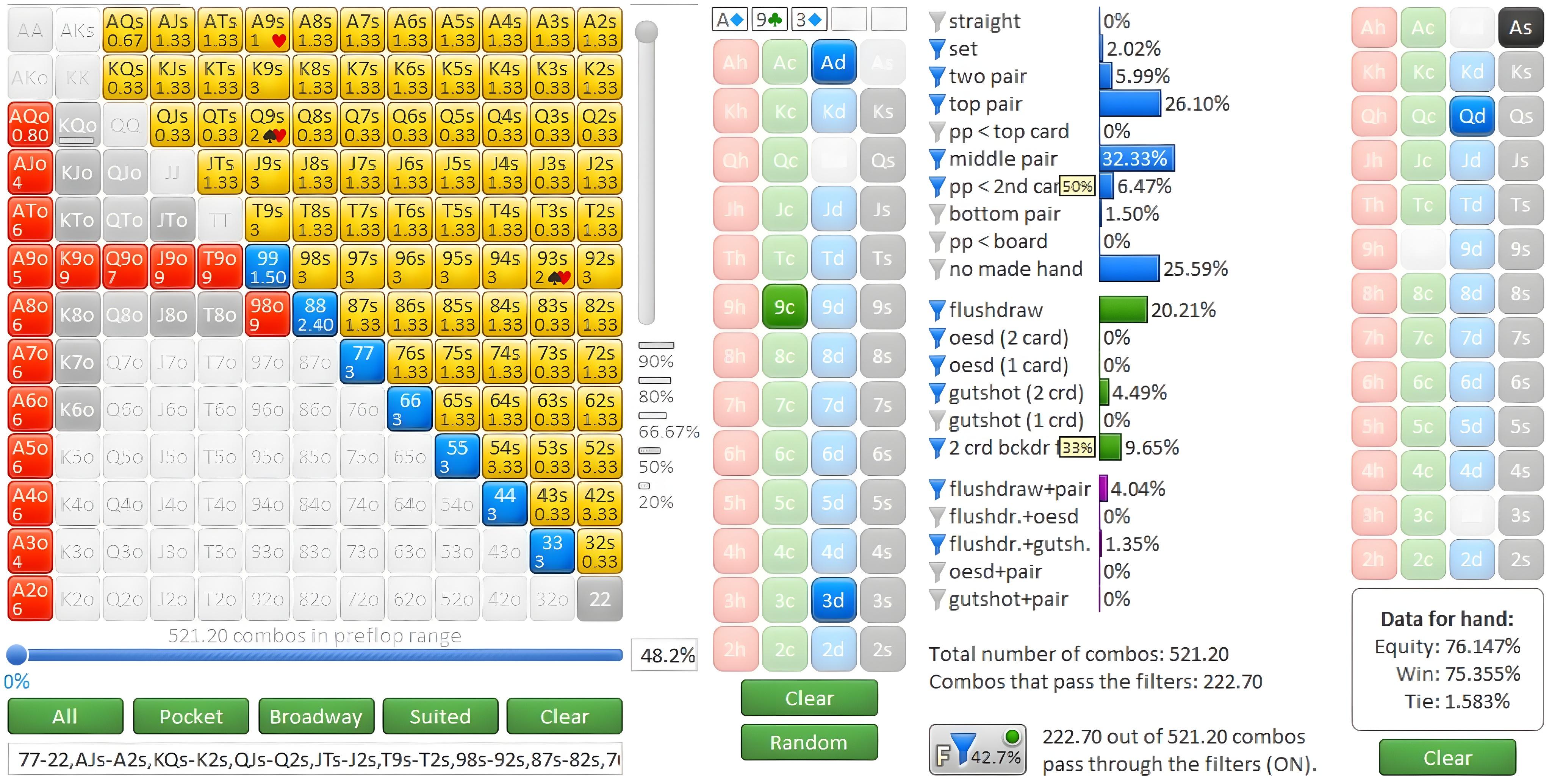
also put backdoor flush draw in the BB range with some weight, although I do not consider the idea of a call with such hands promising, but this is also quite common in the field. The moment of truth comes at a turn! After the exit, the board acquires a strongly woody texture. This is an extremely important nuance that we will actively use in cases when we have to decide whether or not to put a triple barrel in a bluff as a bluff. Now let me explain. When you put a second barrel on such boards and get just a call from an opponent, his range drips on almost all nuts (such as dopers and sets). For more details, see the screenshot below.

On such wood boards, the field will almost never play nuts with a call. In the vast majority of cases with nuts, we will see a check-raise for thorns. Thus, the BB range to the river will consist mainly of top pairs, second pair and various flush draw, which did not reach and remained air. Therefore, extract value with a small size (30-35% of the pot) will be very positive. Basically, we want to get extract value from weaker hands here. It will work great against the field, since most amateurs have big problems with the folds of top pairs, especially if they are with aces.
2. Triple barrel as a bluff
Of course, we want to have excellent bluff in the bet - bet - bet line! As a rule, these are large bluff that require the largest possible investment from us and quite often the river bet will be all-in for you. Because of this, a triple barrel is associated with quite high risks with a polar outcome: you either get a big stack or fly out of the tournament. From all of the above, an important conclusion should be drawn:
It is necessary to learn how to recognize profitable situations well in order to make such an expensive technique as a triple barrel as effective as possible.
Example 1
I propose to consider a few fresh examples, these are hands that I have played recently. Below you see an example of a hand from a tournament with a progressive knockout in the PokerDom room.
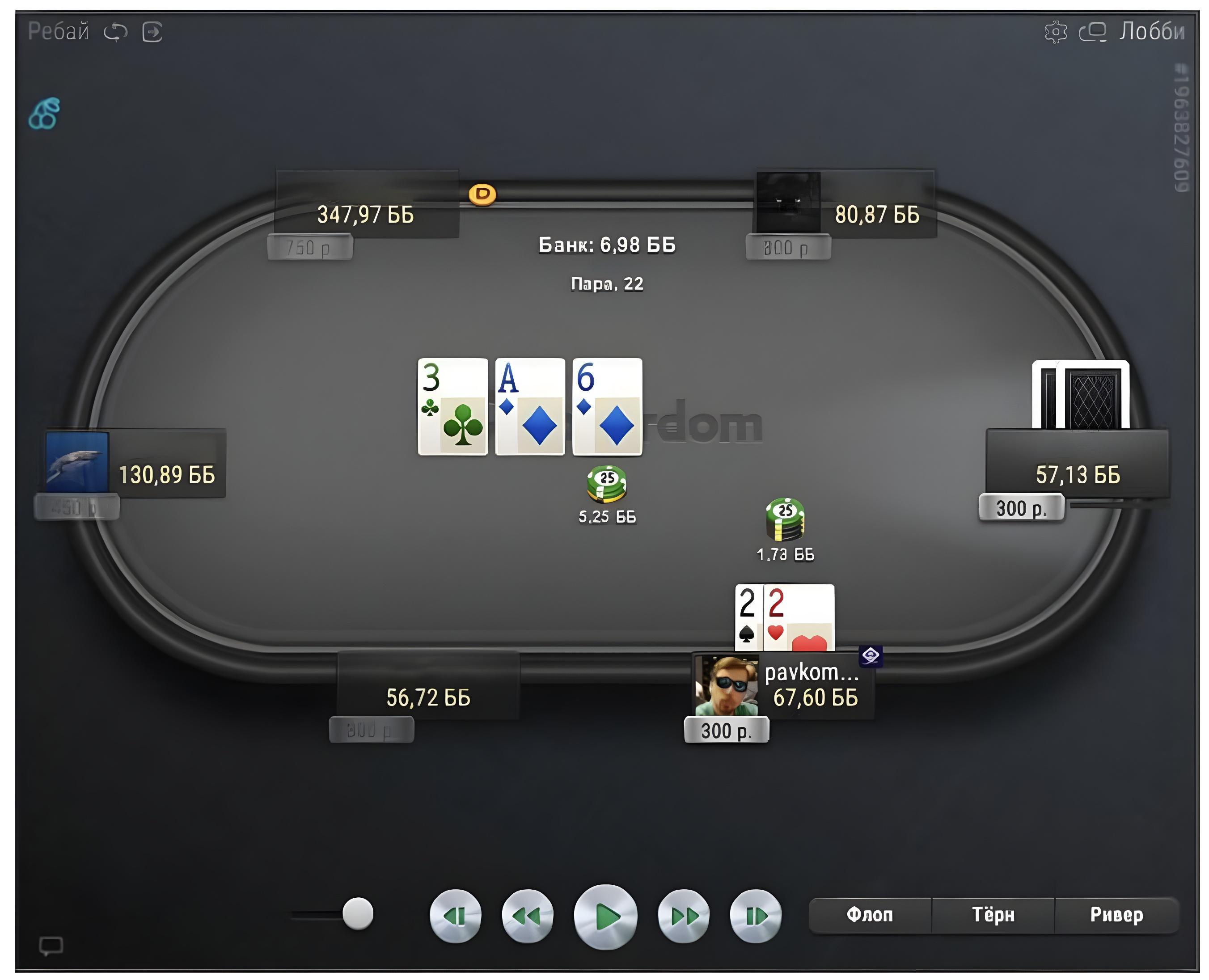
I opened with an MP (in this example we are playing at a 6-max table, so forget the early positions) with 
 and got a cold-call from the BB. The flop with A came out, and I played standardly through a small c-bet. My villain equalized, and we went to the turn.

In fact, many players think about whether to put the third barrel only on the river, but this is not always true. In some spots, the issue of triple barring is solved already on the turn, and I will try to explain this through a specific example. As we can see, it opened on the  turn, and for us it is a great runout to put the second bet.
The whole question is only in sizing, and this is important! When I want to play two barrels, I usually use a small flop size (30-35% of the bank) and a large bet of thorns (60-70%).
Of course, there are certain exceptions, for example, if an ace comes out on the turn, we can supply less (about half a sweat), and still get a good fold equity simply because such a card always enhances the aggressor's range preflop. So most often I will bet a small bet on the flop and a large one on the turn, as I wrote above. But!
If I want to play three barrels, I will often underestimate the sizing on the thorns.
I will bet the c-bet of the turn from about 40 to 50% of the pot to pull the opponent onto the river with the widest possible range. That's how I see my opponent's range in this hand, or rather the part of the range that will call my bet on the turn. In the calculations below, I focus primarily on the lusovo-passive field of the Poker House, and, as practice shows, these calculations work well.
So, putting a small sizing of the second barrel, we often get a call:
- from all flush draw, both with and without coincidence,
- from 6 hands,
- from any Ah hand,
- with a certain weight, I allow a call from 3 hands.
Opponent's pocket pair of 5-5, 7-7, 8-8, 9-9, T-T types will be less frequent, since even in a very passive Poker House field this hand goes into 3-bet much more often than it is played through call. We will also be pecked by a double-sided straight draw (type 45). Never throw a king who has reached the turn (by the way, I admit the presence here not only
 , but also, since the check/call flop on the backdoors is a typical line of play on the flop for many players, so such hands as
 ,
, , are quite likely).
We do not really put some nuts in the range of the opponent's call, since he will want to play a larger pot with nuts and most of such hands will be taken to the check/raise of the thorn. But even if you lay with a small weight hands such as sets (33, 66) and dopers (A3 and A6, masters K3, K6 are possible), very often we will see with them the donk of the river from the opponent, as otherwise he will rarely have the opportunity to get something on the river extract value. Thus, after the troika on the river and the opponent's check, our move is loaded and ready to fire!
As I said above, I try to make a decision already on the thorns, whether I will put all three streets or limit myself to two. But in some situations, we still have to see the river first and only then make a decision.
Example 2
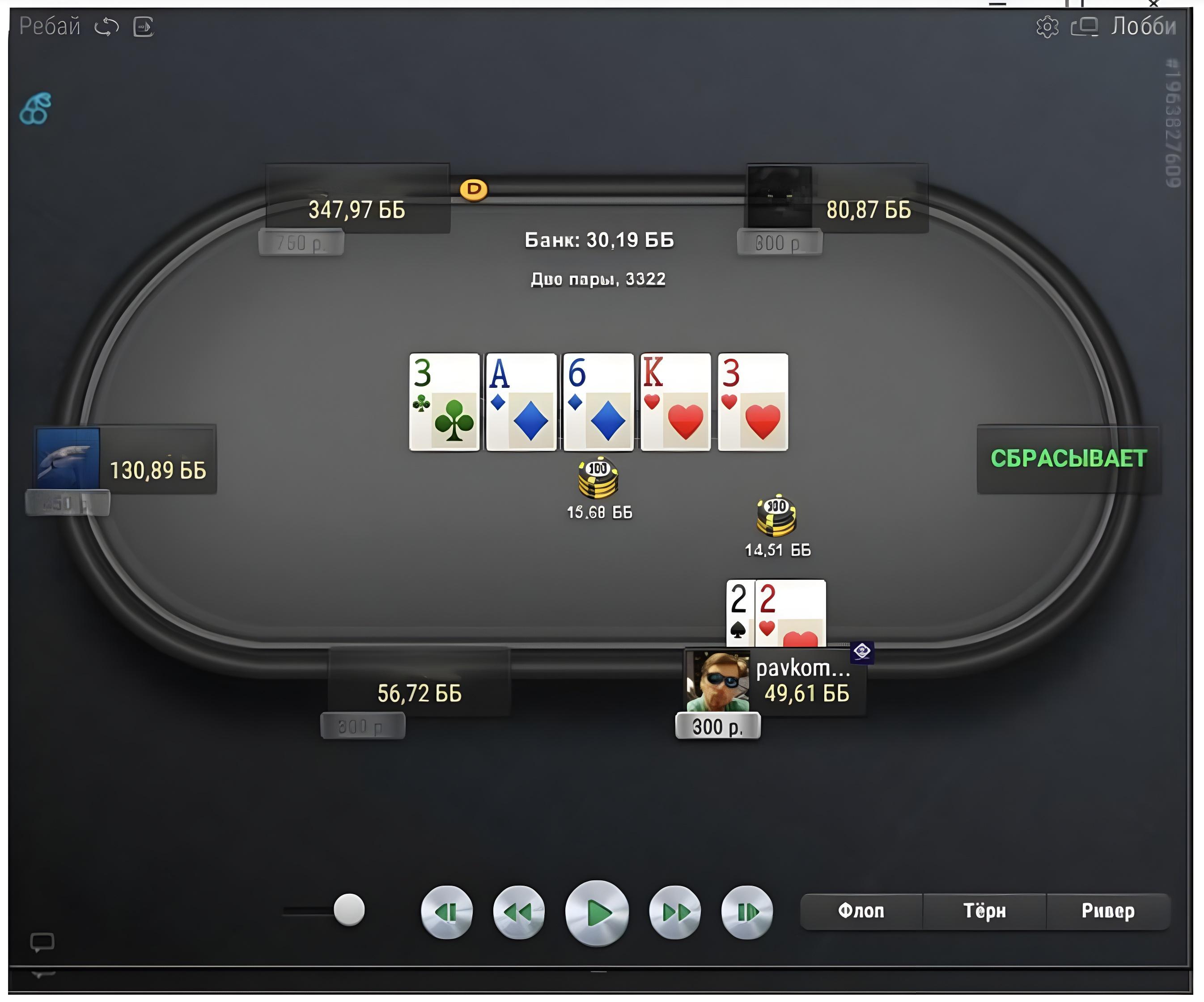
The figure below is another example of a hand played at the Poker House.
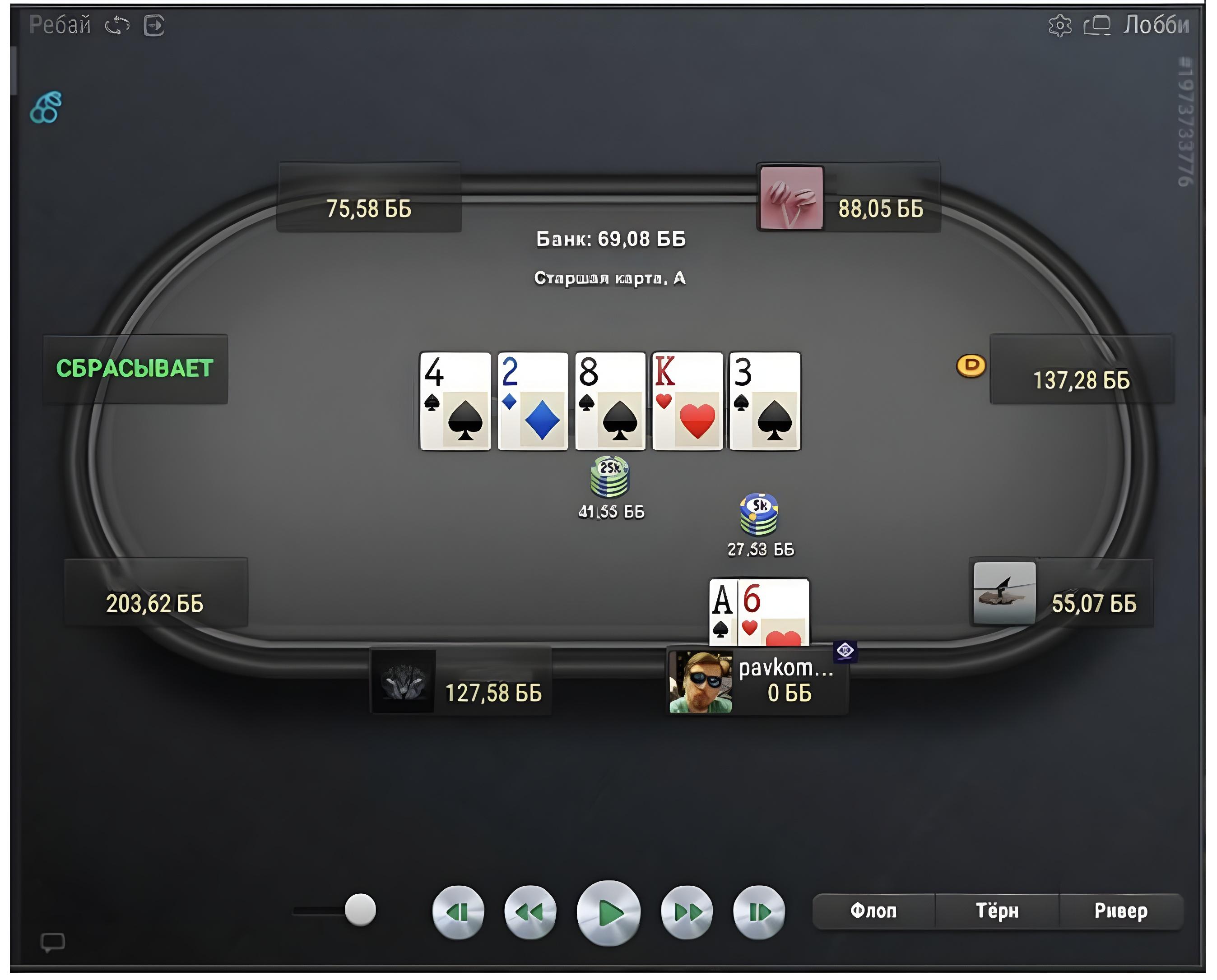
The screenshot shows only the final result, and I will tell you more about the streets. Let's start with the fact that this is 3-bet pot. Choosing a hand for 3bet with BB at first glance may seem a little strange, but it is quite possible to protect weak offsuited aces both through call and through 3-bet. Since our hand is not very good for postflop, we want to at least in some cases take it to 3-bet to generate some fold equity already on preflop. Villain equalizes, and a low structured board opens to us.
In general, this is a good board for us, since the 3-bet-call range of our opponent clings weakly to such a board. Here we already have a plan for the game: this is a standard c-bet on the flop (about 30%) and a tight bet on the turn (60-65%) if we get a call on the flop. In fact, especially in the Poker House, we will get a call on such a flop board quite often. There will be a lot of weak and middle pocket pair in the range of the enemy, who do not like to fold in almost any depth of the stacks on the preflop. Also, very often we will be beaten by overcards to the board: that is, any Ah hands and “Broadways”. Thorn comes , and this is a great map for the second barrel.
We will easily knock out with this bet all Ah better than our hands, which do not have a match on the board, and also very often go to the fold hands of type A4 and A2, which have a weak pair. A couple of years ago, I would have confidently argued that most of the pockets (6-6, 7-7, 9-9, etc.) would be thrown at a bet of 60% with big frequency, but in modern realities, these hands will often win to the river. Given that our bet on thorns will force you to throw away quite a few fold hands, it is quite possible to complete barreling in this hand and go along the river in a check/fold against those hands that we could not knock out on the previous streets. However, an extremely interesting map appeared on the river -  .
.
According to my observations, the field is afraid of flash cards more often than it should be. Here ours acquires a hidden power: it perfectly blocks all arrived nut flushes in the ranger of the opponent. Here is an example of a distribution in which the decision to go triple barreling was made only on the river. After all, now all those pocket pair that could not be sent to the fold earlier will be easily thrown on my all-in on the river! Also, given the strong split of 3-bet preflop at the Poker House, we will often knock out 8-9, 7-9, A-8, etc. hands on the river. These hands, which received the status of top pair on the flop and the second pair on the turn, turn into a rather weak hand with which it will be very difficult to open my call all-in, practically playing on the stack.
3. Situations unsuitable for triple barreling
Now consider the situations that I have classified as unfavorable in order to play through triple barreling.
Inappropriate villain.
This is a significant argument. Even in cases where, from a technical point of view, the move is completely justified, if the player has a "calling-station" label, I'd rather lose a small pot, but give up the idea of bluffing on all streets in such a character.
Early stage of the tournament.
This factor is not as important as the previous one. However, the general trends of the field should be taken into account: amateurs tend to call in borderline situations much more widely in the early stages of the tournament than in the late ones, when ICM pressure increases. That is, at the beginning of the tournament, you can find a suitable situation for triple barreling, but in general there will be much less of them.
Win the maximum of your bluff in the later stages of the tournament is one of the theorems of successful poker, and I advise you to think about it more often.
“Blind War”.
It's a little more complicated here, and in my opinion there is no one right solution.
I can say from my own experience that playing on the small blind (MB) against the big one maximally good fold equity I manage to create on the turn, but not on the river. The reason lies in the fact that most often the BB is ready to chip off MB counterbets over a very wide range. Also, a lot will depend on both the opponent and your sizing. In general, it is possible to find suitable spots here if desired. However, if you are just starting to integrate a triple barrel into your game, it is better to start with simpler situations. For example, you can use this technique against a cold-color on BB. And do it by playing almost any position except the small blind.
Texture of the board.
There are certain textures of board, on which it will not be profitable for us to bluff into three streets. Examples include paired board (Paired board on the flop or on the turn), as well as a monotonous board (all three cards on the flop of the same suit).
4. Conclusion
The reception we have put together today can be incredibly profitable, and the more examples you analyze on this topic, the sooner you will learn to recognize suitable situations during your sessions. Triple barreling will help you knock out of the hand a lot of hands of opponents to whom you would lose at the autopsy. And he will do it with surgical precision.