


Translated with the help of AI. We apologize for any errors and would appreciate your help in correcting them.
Before reading the material, we recommend reading the article: Mathematics of bluff. What is fold equity, break-even point and bluff profitability formula.
This article provides an overview of the 2 main factors that make up the profitability of a bluff game on post-flop. Also, 7 additional factors will be described in the next article. More detailed information on the mathematics of bluff can be obtained from the free video course “Basics of preflop and postflop games” by fulfilling the conditions for obtaining it on our website. (the conditions are in the description of the course)
1. Structure of the board and subsequent exit woundouts
The most important factor affecting the amount of fold equity, because it has a direct relationship with the range of the opponent.
Different types of structures are possible on the flop:
- By card seniority - high
 +, middle
  -
-  or low board, where all cards
  -
- - With flush draw


 , multicolored
 or single suit


- Coordinated

 or not
- Paired


Thus, the type of structure directly correlates with the frequency of hitting the opponent's range.
On some boards, the villain clings to the board very well (65%+ of the range have some clues), and on some of them he gets very rarely (30% or less). This will most directly affect your fold equity, because most opponents will not resist on hands that do not have at least some equity opportunities to continue the draw.
Changing the structure of the board at the exit of ranauts on the following streets
Further, it is possible to change the original structure of the board on the flop when the following cards on the turn and river are released, which may be:
- Blank card (does not affect the structure change in any way);
- Closed flush or flush draw became possible;
- Closed straight or straight draw became possible;
- An overcard to the flop has been issued;
- Over-card to the middle card of the flop has been issued;
- The board mated (the second card of the same value came out).
When changing the structure of the board on the turn and river, there is a change in the probability of hitting the opponent's range in this board, sufficient to continue the draw.
 -
-
- For example:
the output of the spark of the middle board pair is one of the worst options for continuing the bluff on our part. Because the middle part of the range of the flop opponent (the middle pair of the flop) has become stronger, and now we can not count on fold from this type of hands.
Also, the output of subsequent woundouts affects our ability to image a strong hand, which directly affects the desire of the opponent to part with his weak or middle hand.
- 
- For example:
the exit of the top card to the bluff is traditionally considered the best option for continuing the bluff. It becomes much more difficult for an opponent to stay in the draw for a coincidence at 7 or 4, and this plays into our bluff.
For a more detailed acquaintance with which structures are better or worse suited for c-bet bluffing on the flop (categories of structures) and to find out which ranauts are good neutral and bad for continuing bluff, we recommend purchasing section 8 from the “Easy Postflop” video course.

You can also get it for free by accumulating a sufficient number of U-points on our website: Website Loyalty Program.
2. Distribution of the range by types of hitting the board
Range of the opponent in any pot consists of different variants of starting cards.
Conventionally, you can divide all the options for hitting the opponent's cards on the board into several types:
- Empty hands – there are no clues to the structure of the board.
- Nut hits – invulnerable part of the range, strong hits on the board, with which the opponent is ready to play on the stack almost always (top pair with nut kicker and older)
- Good hands are a weakly vulnerable part of the range, strong hits that the opponent will pull to the river and will often want to open with them (top pairs, best medium pair).
- Middle hands are a vulnerable part of the range that the villain always pulls the turn and often to the river (middle pair).
- Weak hands are the vulnerable part of the range that the opponent either pulls to the turnbuckle or turns into a bluff (weak pair, backdoor flush draw and gatshots, good over-cards).
- Draw hands – flush or straight draw combinations. Most opponents pull to the river or play an aggressive semi-bluff.
All types of hitting the board can be considered as a percentage on different types of boards.
The figure below shows the distribution of hand options by equity.
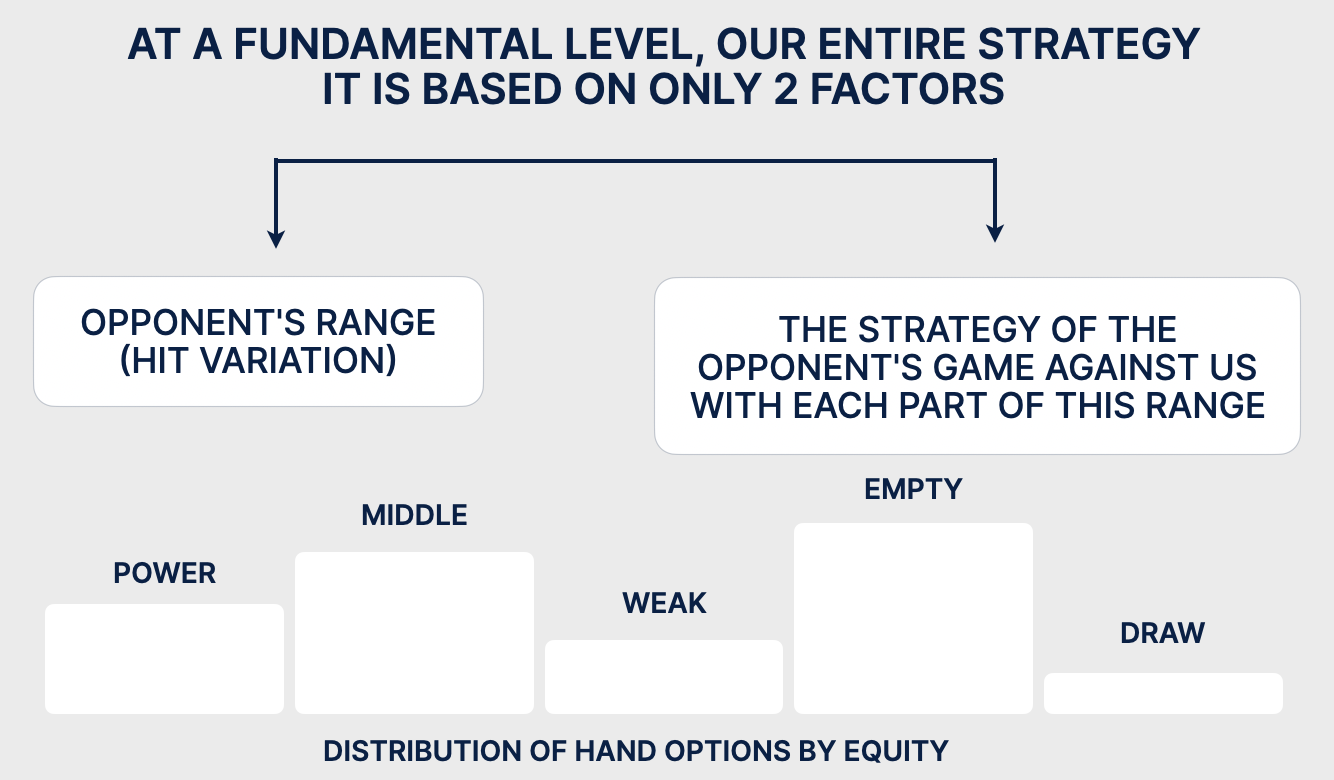
Thus, we can represent the approximate % of the vulnerable part of the opponent's range to understand how our bluff will be profitable on each of the betting streets.
Field fold vs barreling trend
- On the first bet or raise, they throw out empty hands and some of the weak hands.
- The second bet is thrown – weak hands and part of the middle hands.
- On the third bet, bet is thrown – middle hands and part of good hands and draw hands that are not closed.
In my video course on post-flop, I showed 6 main categories of boards with similar characteristics of fold equity on the streets, based on the materials of this article, researches of the field game and my own calculations in special calculators (solvers). This is done to create a simple and understandable structure for understanding the bluff game on post-flop. My unique coaching development, which is not found anywhere else. It has already been tested in the practice of students who bought a video course and has proven its effectiveness in the ability to give a fast boost to this area of the game, thanks to its simple unique form of presentation of the material.
That is why the course is called “Easy post-flop”, because the whole course is created in a specially designed simple form of presentation and explanation of the material. This not only makes the course rich in useful strategic information, but also greatly affects the rate of students' assimilation of information and helps to quickly bring the knowledge to the game strategic skill. Information on post-flop bluff can be found in section 9 of the video course, which can be purchased separately or received for exp points for free: What are U-points?