


Translated with the help of AI. We apologize for any errors and would appreciate your help in correcting them.
In this article, MTT coach Alexey Exan13 will talk about seven additional factors of profitability of bluff in poker.
1. sizing used
The size of the bet has a direct impact on the opponent's desire to fold a hand. Usually the logic is straightforward: the larger the bet, the easier it is for the opponent to part with their hands of the middle and weak category, but there are exceptions. Consequently, the larger the bet size used, the more fold equity is generated in action. When the bet increases, your bluff becomes more expensive. We remind you of the bluff break-even point and its direct dependence on the bet size.
For more information, see the table:
The amount of the bet as a percentage of the pot | Break-even point |
25% | 20% |
30% | 23% |
44% | 31% |
50% | 33% |
70% | 41% |
85% | 46% |
100% | 50% |
120% | 54% |
150% | 60% |
The table below shows the calculations of break-even points depending on the value of the opponent's bet and the size of our raise:
Reise bluff size | Break-even point vs 33% bet | Break-even point vs 50% bet | Break-even point vs 67% bet |
x2.5 | ~40% | ~45% | ~50% |
x3 | ~43% | ~50% | ~55% |
x4 | ~50% | ~57% | ~62% |
There is no direct correlation between the profitability of the bluff and the increase in the bet size.
Let's explain this with an example:
Example: board XXX
- You make a bet of 35% and generate 50% fold equity. Profit = 24% pot
- You make a bet of 50% and generate 55% fold equity. Profit = 22% pot
It can be seen from this example that the growth of fold equity does not always mean an increase in profits.
Here it is necessary that an increase in bluff investment leads to an increase in fold equity by a value greater than:
Bet | Instead of | Increase Required |
50% | 30% | > 10% |
70% | 50% | > 8% |
70% | 30% | >18% |
120% | 70% | >13% |
It turns out that the use of a larger sizing for bluff should be justified by the corresponding growth of fold equity.
2. Opponent range
The opponent's range can vary greatly in different game situations and, its content affects the number of fold equity even within the same flop in different situations. Conventionally, you can divide all the range of the opponent's passive game into 3 types.
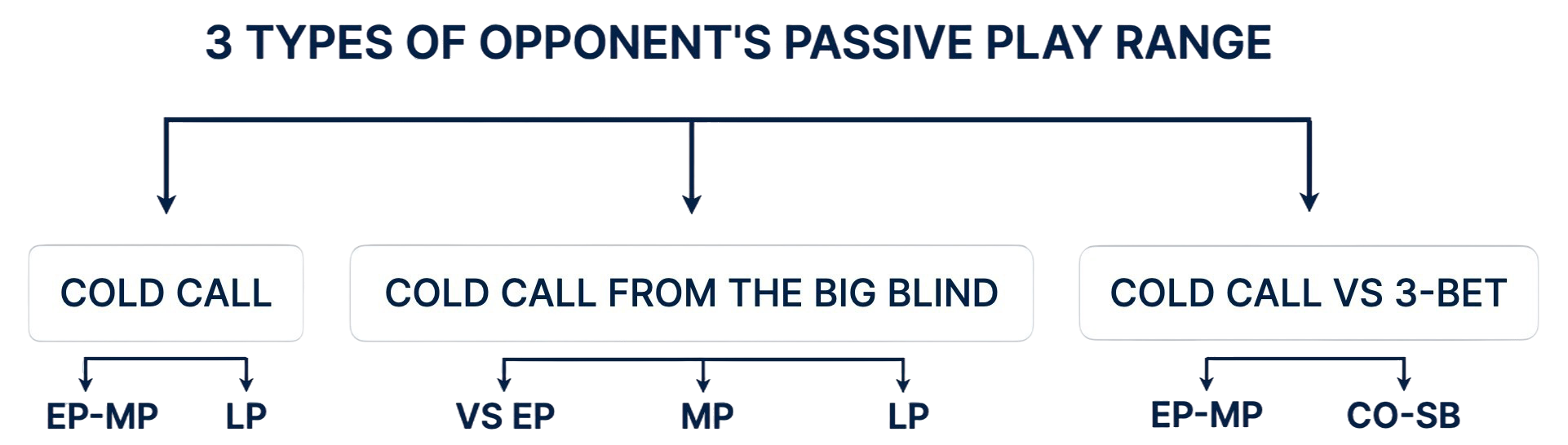
You need to understand the ranges of the opponent, what are their main differences in terms of bluff against them on the post-flop. Detailed information on this topic is covered in the eighth section of the “Easy Postflop” video course, which can be purchased separately from the entire course. Or get it for U-points for free.

Range in the eyes of the opponent — your image
This parameter depends on:
- Positions.
- Game actions (raise, 3-bet, etc.)
- Statistics.
- The size of the bet.
The earlier the opening position or the position of 3bet, the stronger the range your opponents set for you.
+ You generate additional fold equity based on how opponents see the strength of your hand.
- It is difficult to get paid with premium hands.
The more loose your RFI and 3-bet, the less fold equity you generate by your aggressive actions.
+ Good for increasing the profit of velly ranges.
- Bad for bluff bands. Opponents can call you open more loose.
If you understand your image well, you can use it to increase the winrate. Many players do not display statistics - this is a mistake. You need to see your image, understand how your оpponents see you.
3. Features of the field and the type of opponent
It is necessary to take into account the peculiarities of the field in which you play and specifically the player against whom you are in the hand.
Playing field
The playing field may differ:
- In different poker rooms (features of the room, the possibility of using HUD, etc.);
- At different limits (abi5, abi15, abi40, abi60, abi100);
- In different types of tournaments (knockouts, turbos, kilopolyans, the ability to do re-entry)
Opponents
Recall their basic characteristics:
- Calling-station - low desire to fold weak hands. Bluff against them more carefully and collect the vellya very tightly.
- Nits and weak reg players - they throw out weak hands on the flop and turn faster than others. On the river, the range is stronger than others, but the fold will not always be smaller.
- Reg players - more balanced range. Throw less on the flop and turn. On the river, they often throw, adapting to the fact that the field as a whole does not bluff (they know how to make a strong fold).
- Maniacs - actively bluff against your bet. They know how to call open. It is better to slouple and bluff less against them.
Read more about the types of opponents in the article: 5 types of opponents in poker
4. Blocker factor
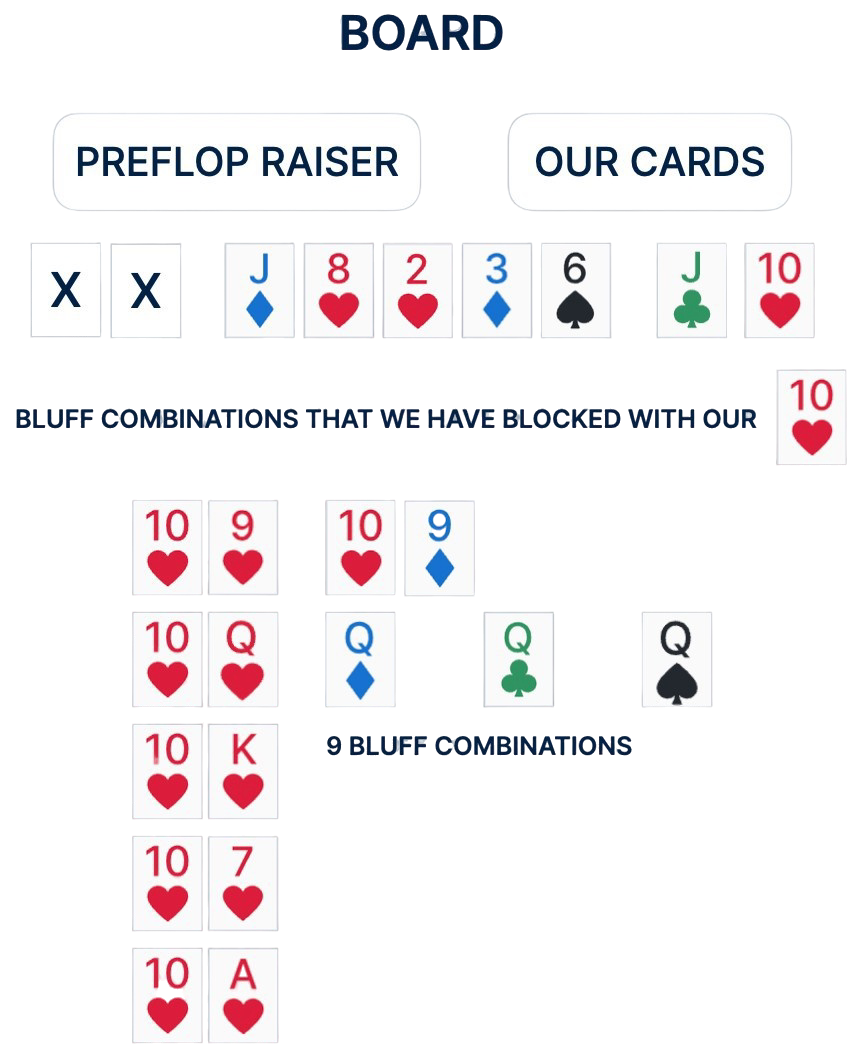
When bluffing against a strong opponent, the blocker factor is of great importance, since a bluff without blockers can lead the draw line to minus.
But when playing low and medium limits, the blocker factor is often overestimated. Due to the fact that opponents do not play post-flop well, often a bluff on either hand will give an acceptable profit. Choosing only bluff hands with blockers can miss a lot of profits. More detailed information on the topic of blockers is described in the eighth section of the “Easy Postflop” video course, which can be purchased separately from the entire course if necessary. Or get it for U-points for free.

5. Opponent statistics
Below are the factors that make it possible to see the opponent's statistics.
Fold on c-bet flop\turn
Usually in MTT, the sample is rarely sufficient to accurately determine the fold on the turn and river against c-bet. A turnstile requires at least 3,000 hands, while a river requires at least 7,000.
- If the opponent throws a lot on the flop (>50%), then on the turn the fold will be underestimated.
- If little is thrown out on the flop (<45%), then on the turn the fold will often be overestimated.
W$SD (no small pot)
Studying the frequency of victories of the opponent at the showdown, we can conclude with what ranges he opens.
- W$SD (no small pot) – if the indicator is >60%, the opponent rarely catches bluff and strongly trusts betas on the river.
- If <50%he likes to call out bluff (and bluffs more himself).
Postflop aggression factor
Aggression <1
The villain plays very passively. This is a "calling-station" and you have less fold equity against it.
Aggression 1 to 3
Play as standard. bet and raises of these opponents have more or less balanced value of velly and bluff in the range.
Aggression from 3, at least 200+ hands
Opponent is prone to bluffs. There will be less fold equity against him, since bluffing players know how to lay a bluff to their rivals as well
6. ICM pressure
In conditions of deep ICM, especially in kilopoles and against weak rivals, you can use a psychological edge or a stack edge.
- Psychological edge
This is your experience and fearlessness. You can afford to play aggressively and take risks when your opponents are very attached to this tournament and therefore will throw more fold at your aggressive actions. - Edge on the stack
If you have a big stack in the late stage of the tournament, especially the chip table stack, and many opponents have medium and short stacks, you can take on the role of setting the dynamics. Most opponents will choose to just wait for the hand without putting any pressure on you.
If you want to understand the topic of bluff very well, study the following materials: fold equity in poker and mathematics of bluff, 2 main factors influencing the profitability of bluff in poker