


Translated with the help of AI. We apologize for any errors and would appreciate your help in correcting them.
Translated by order of the educational portal university.poker
Original source: GTO Wizard

Tournament poker is about accuracy. Cash games, in which stacks are typically counted in the hundreds of big blinds, are more lenient to small changes in raise size on preflop or call ranges. It is possible to compensate for the difference later. In tournaments, savvy opponents will accurately calculate the size of their 3-bets, adapting to stack positions and sizes to force you to make the most difficult decisions.
- Example: when you encounter a 3-bet with a stack of only 20 or 25 BB, it is tempting to use only a “Push or fold” strategy. Strong opponents will fight this with tiny 3-bets, which will allow them to profit from your folds, losing quite a bit if you bet 4-bet - all-in.
These tiny 3-bets pose a new dilemma:
- Should you accept a clearly unattractive call and game offer without a post-flop position against a strong range, relying on the bank's attractive odds? pot
- And if so, how should you play post-flop to get the most out of the situation?
The answer, of course, will depend on the flop. In this article, we will look at the various flop textures that will help you navigate the difficulties encountered when playing with a weak (relatively) range without a post-flop position in 3-bet cans and short stacks.
1. Evaluation of 3bet preflop range in short stacks 18-28 bb
When the raiser is in position, the strategy for the 3-bet pots bears some resemblance to the strategy for the single-raise pots between the preflop raiser in position (PFR) and the player on the big blind (BB). A player doing a 3-bet takes more risk on a pre-flop, especially when they are in an early position. Not only does he raise with a strong opening range, but he also has to worry that some players behind him may have monsters in their hand.
He needs a strong hand for 3bet, and if he sees a one-on-one flop against the original racer, it will be great luck. His reward is the edge in equity and the edge in nuts combinations on the post-flop. With such shallow stacks, he can view his overpairs as nuts even on scary flops that would otherwise favor the collier of this 3bet. As for the collier, he plays the role of BB in the single-raise pot.
He starts with a strong range as he opened from an early position, but compared to the range of the player who made the 3-bet, he doesn't need a strong hand for the call. He acts, knowing that everyone else has folds, he closes trades on preflop and gets much better chances for call than his opponent when raising. This means that the colliding player must expect to be at a disadvantage after the flop. He should expect to check-fold often. He will have to make difficult decisions about whether to continue betting on the bet on the flop and if so, whether to do it with a raise or a call. All this is a disadvantage of playing without a position.
His goal is to get the most out of a bad situation, rather than inventing the super-favorable bet that the opponent has in the position.
When you are out of position and calling a 3-bet, you should expect to find yourself at a disadvantage after the flop. Your goal is to get the most out of a bad situation.
Our examples are taken from the scenarios for MTT in the depth of 25 bb and the remaining 50% of the field. UTG opens with a bet of 2 bb, UTG+1 3-bet with a bet of 5 bb, and the move again goes to UTG. This is still a kind of golden mean, where ICM is already beginning to slowly influence, but UTG still has a call range. If 25% of the field remained, then for UTG the answer is almost exclusively Push or fold. It is worth clarifying that GTO Wizard is still able to take into account the ICM factor only on preflop. Therefore, if we take into account the ICM factor, then on the post-flop we would see either a more secretive or more aggressive game than the solutions offered by the solver.
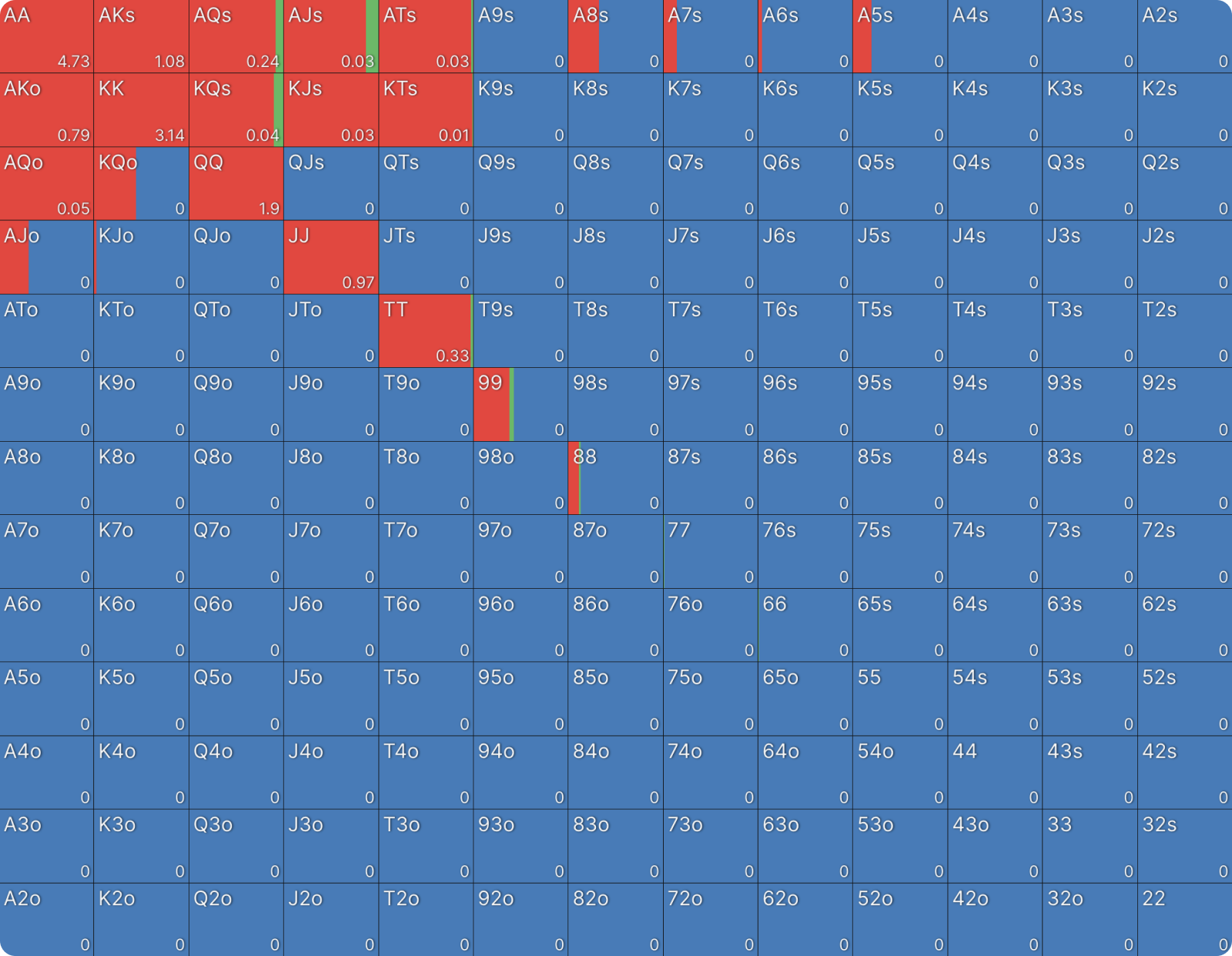
The 3bet UTG+1 range is extremely strong and consists almost exclusively of the best Broadway hands and pocket pair:
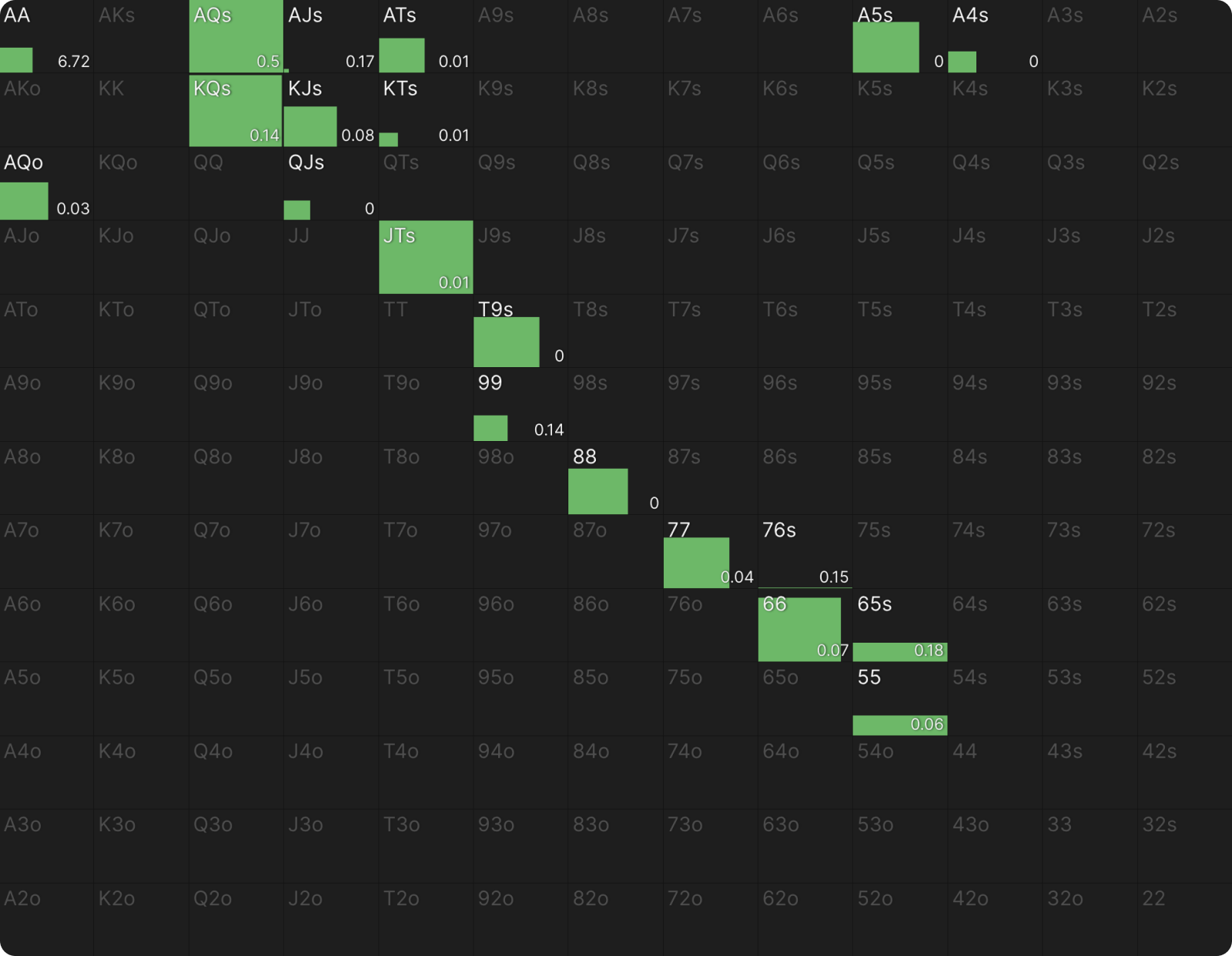
The UTG call range is modest and droopy. It consists almost exclusively of hands that are not strong enough to push, and which collide only because of the attractive pot odds (9.5:3):
2. realize and deny equity

There is very little room for manoeuvre in such shallow stacks. When UTG has a strong hand, he basically just wants to pick up the preflop pot. The big pot (relative to the stack size) encourages strong hands like KK and AK to focus on denying the 20-25% equity of small 3-bits of UTG+1, rather than trying to make even more money in the pot through a call. Even AA 4-betit more often than it calls. The closest to the traps are AQ and KQ, which can neither fold these dominant hands nor get a call from any of the hands they dominate. Realize equity without a position is always a challenge, and this is another reason why UTG prefers to 4-bet even with its best hands.
The essence of his strategy is the interaction between pocket pairs and suited Broadway hands:
- When low cards come on the flop, UTG will actively play pair to compensate for the weakness of not very strong “Broadways”.
- When large cards land on the flop, pocket pair are among his worst hands, and he will mostly bluff or discard them, and his “Broadways” will play hard.
The essence of the UTG call strategy occurs mainly in the interaction between its pocket pairs and suited Broadway hands.
UTG also pays special attention to denying the equity of the opponent and selling its equity on post-flop, especially on more dynamic board. When on the flop he gets a hand strong enough to play on the stack, he basically checks it out. Because of the very low SPR (effective stack-to-bank ratio), this includes hands that can easily be dominate by a stronger UTG+1 range. Playing with a dropped range is never fun because there is no way to avoid hitting the top of your opponent's range. The only thing you can hope for is to limit the profitability of the lower part of its range. This way you will not be able to reset the top of your own range.
Dynamic flop
On the flop, 

 UTG actually has the edge at the very top level of equity distribution, and dock betas play an important role in its strategy:
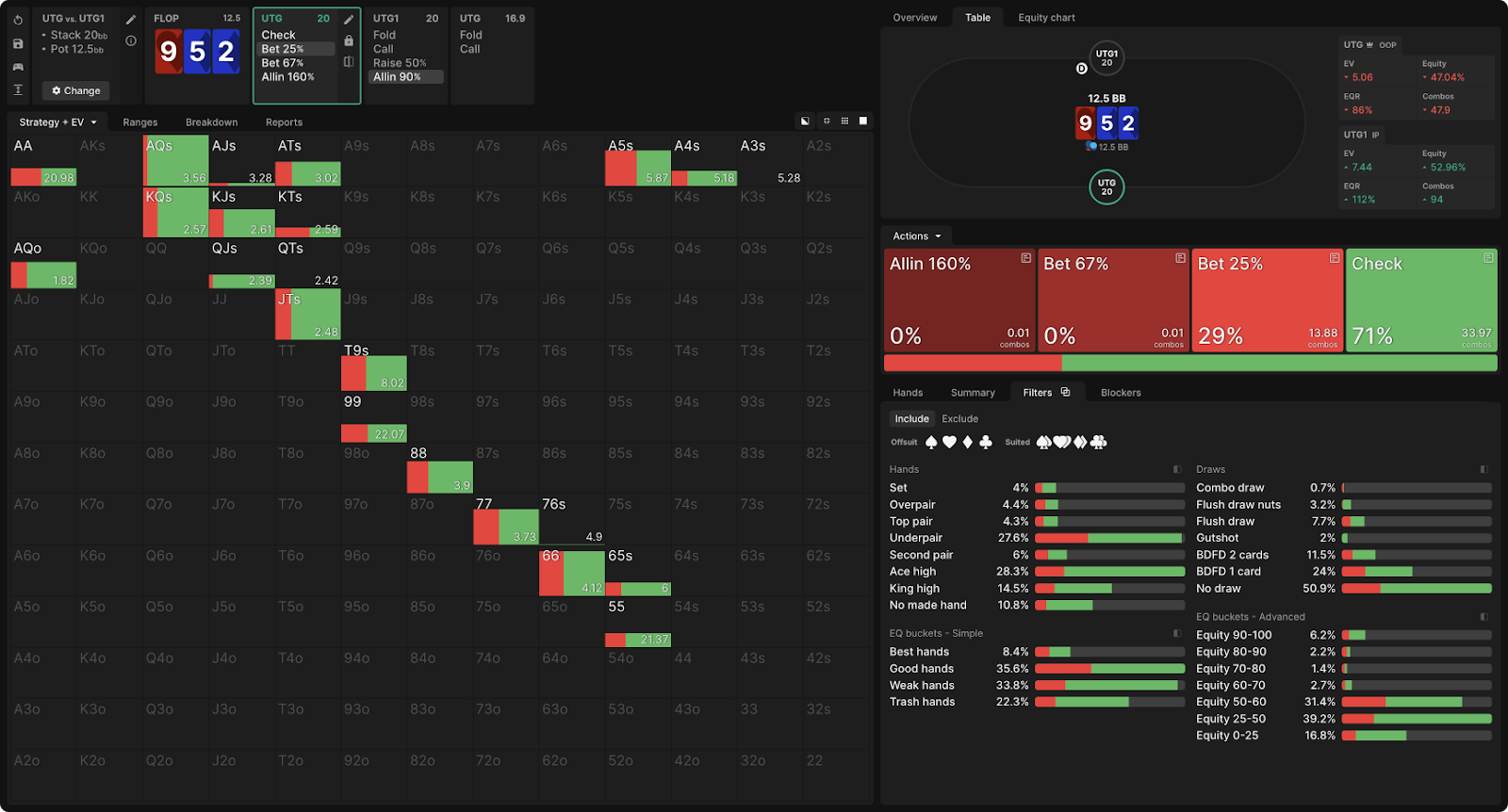
The choice of hands with which to place a bet is not as arbitrary as it seems. With 99 UTG puts the top set without the Diamonds, but checks when he has it. As for the other pocket pair that don't have sets on the flop, they prefer to bet when they have a diamond.
As explained above, the pair is mainly put on the stack, if UTG+1 pushes on the bet, also make overcards with flush draw:
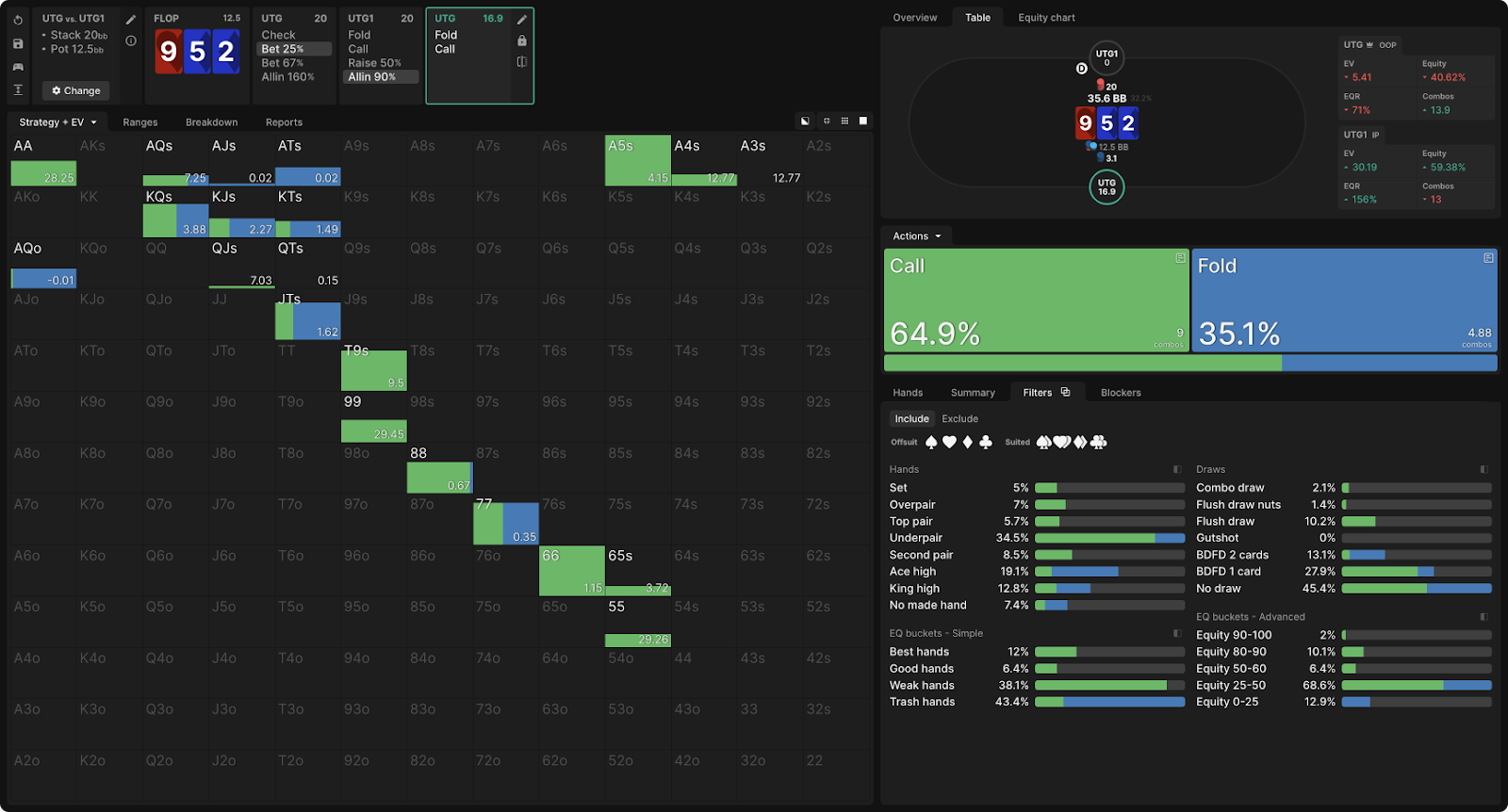

This flop is almost completely out of range for both players. Pocket pair are not very good, but they are the best you have, and if you are not going to dump them, then this is a good way to pick up the jar immediately early pot.
These same hands are candidates for check-raise, with the exception of sets that only play slow play when checking, since they are much less exposed to danger than pocket pair, which lose value on late streets.
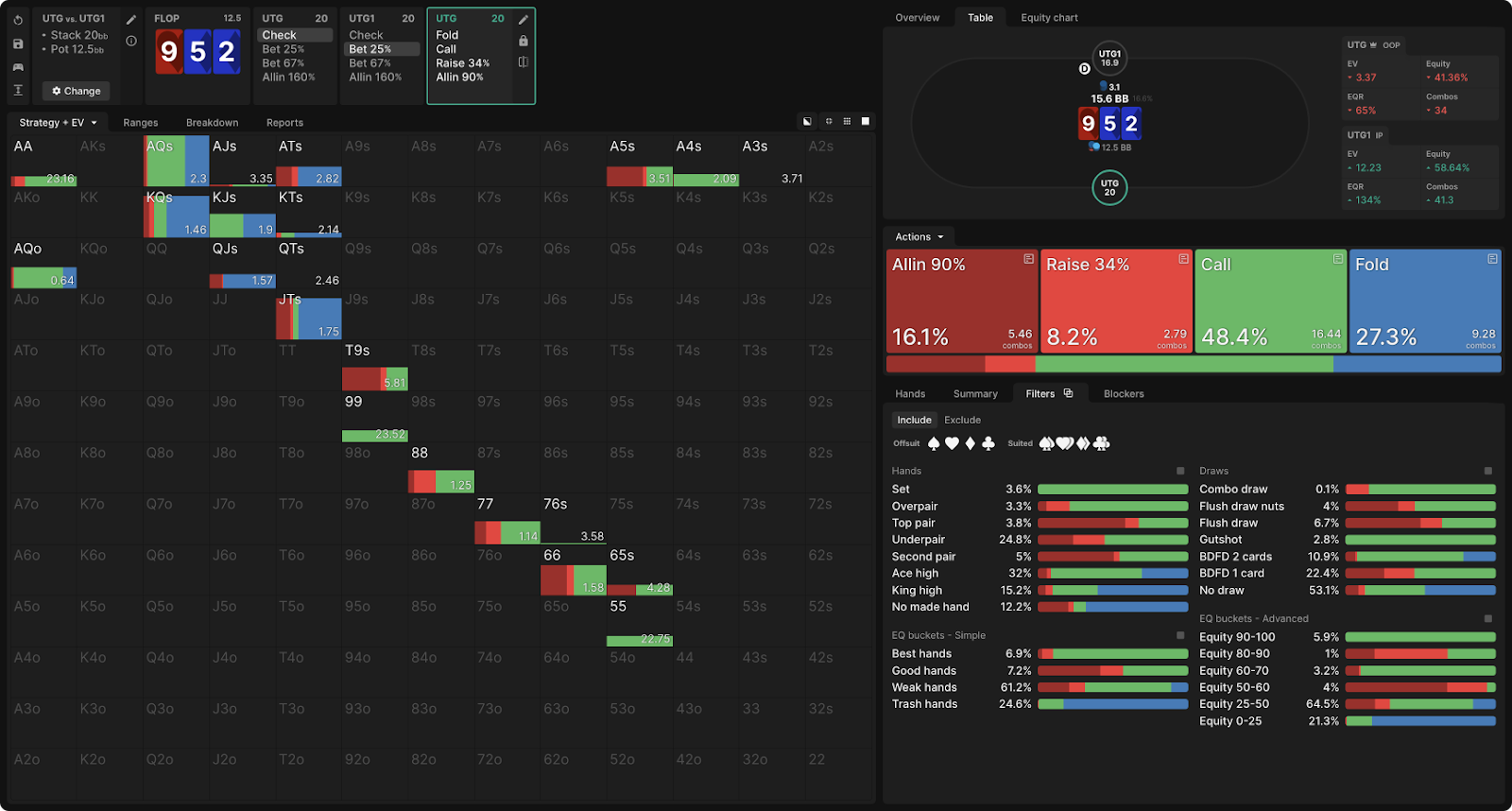
From the point of view of the solver, it is quite possible to make either check-push or donk-bet and call with 66, despite the fact that our opponent's range is saturated with overpairs. This is a consequence of the very low SPR and the fact that this flop does not fit almost all the odd hands of both players. Pocket pair is not very good, but they are perhaps the best that is on this board, and if you are not going to reset them, then you can pick up the pot here and now. The more cards you get, the more likely you are to be overbought or bluffed.
Moderately dynamic board
Replacing 2 with Q makes the board somewhat less dynamic. Both players have a lot of KQ and AQ, which are much less vulnerable to overcards than they are on the 952 board. Both players also have a lot of Broadway straight draw, which seem to pose a real threat due to the size of the pot.
If you find yourself in a pot the size of your stack, that's nothing to worry about.
On the flop, the  distribution of equity is about the same as on . The board with the lady is less dynamic, and UTG+1 has more of the best hands in the range. At the same time, UTG no longer has an incentive to make donk-bet. He's still an aggressive checkout, but on this board his best hands are the stronger AQs and AAs. They balance this with large draw, mainly gutshot+flush draw (sometimes with a live overcard), because with such small stacks there is not much room for pure bluff. As far as they are, now this role is played by small pair. Now that the board interacts so well with the Broadway part of their range, small pair are among the worst hands, resigned to either a fold or a bluff, unless they also have a backdoor flush draw.
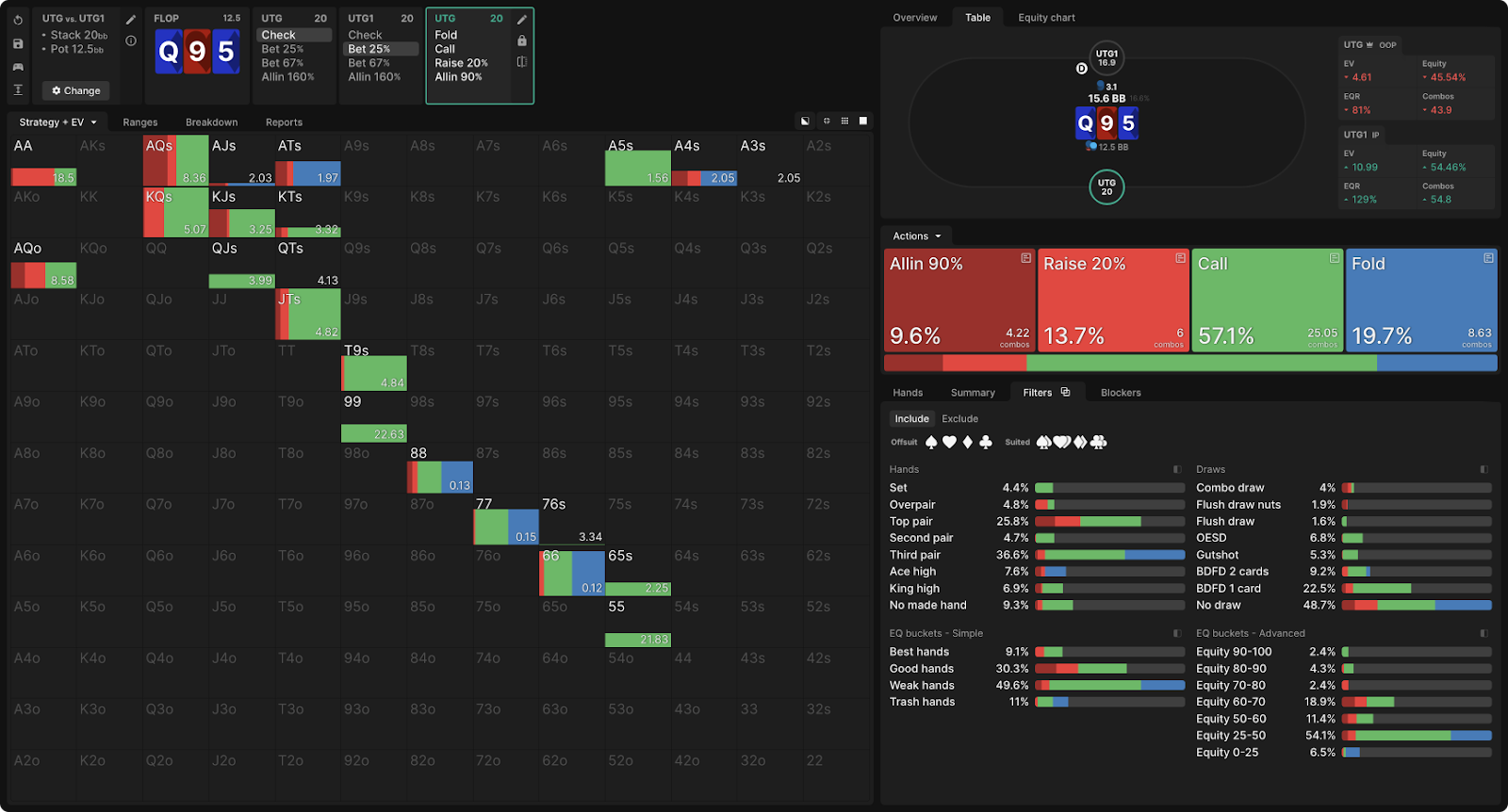
There aren't many traps here either:
- AA is a net raise;
- AQ — high-frequency raise.
The only clean traps are the sets, which make up a very small portion of the UTG range. KQ mainly serves as a bluffcatcher as it is less strong to go all-in on the flop and less vulnerable to being run over by the KJ or KT it dominates.
Static board
If you replace Q with an ace of the third suit, it will be very cool for UTG+1. On the first two flops we looked at, he had about 53% equity, but he  had 61% equity. Despite this, UTG has an advantage (6% > 0%) in terms of the best hands (top 10% of the equity range). For visual confirmation, look at two pair and stronger combinations in both ranges, such as AA, 99, 55 and A5s.
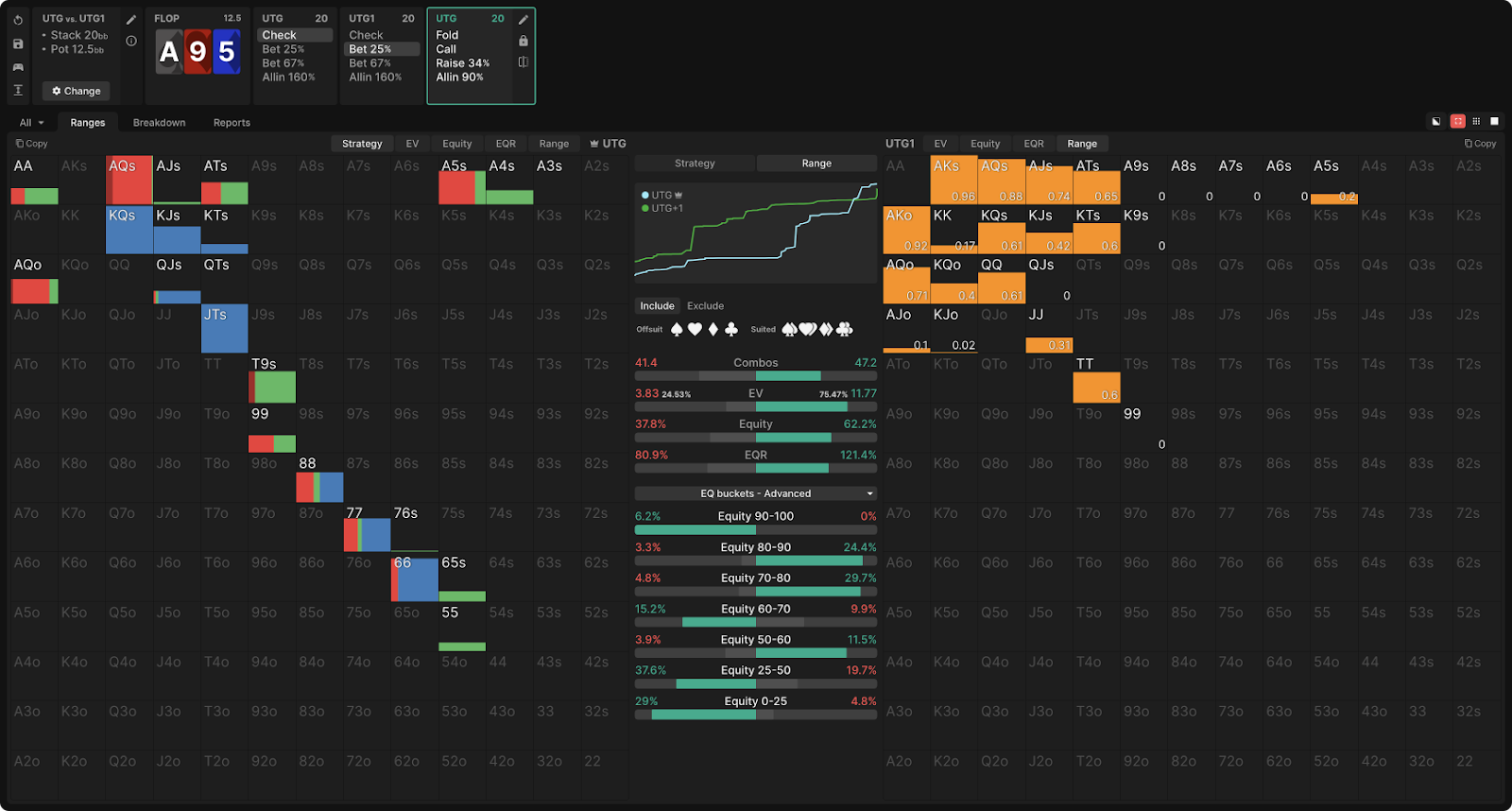
A player making a 3-bet doesn't have many hands to bluff with on this flop.
As a result, UTG responds to a cbet of 25% of the bank with a surprisingly aggressive strategy for such a static board. He check-raises most of his best hands along with pocket pairs, which is essentially a complete bluff. They have 0 EV and he is indifferent to the fold.
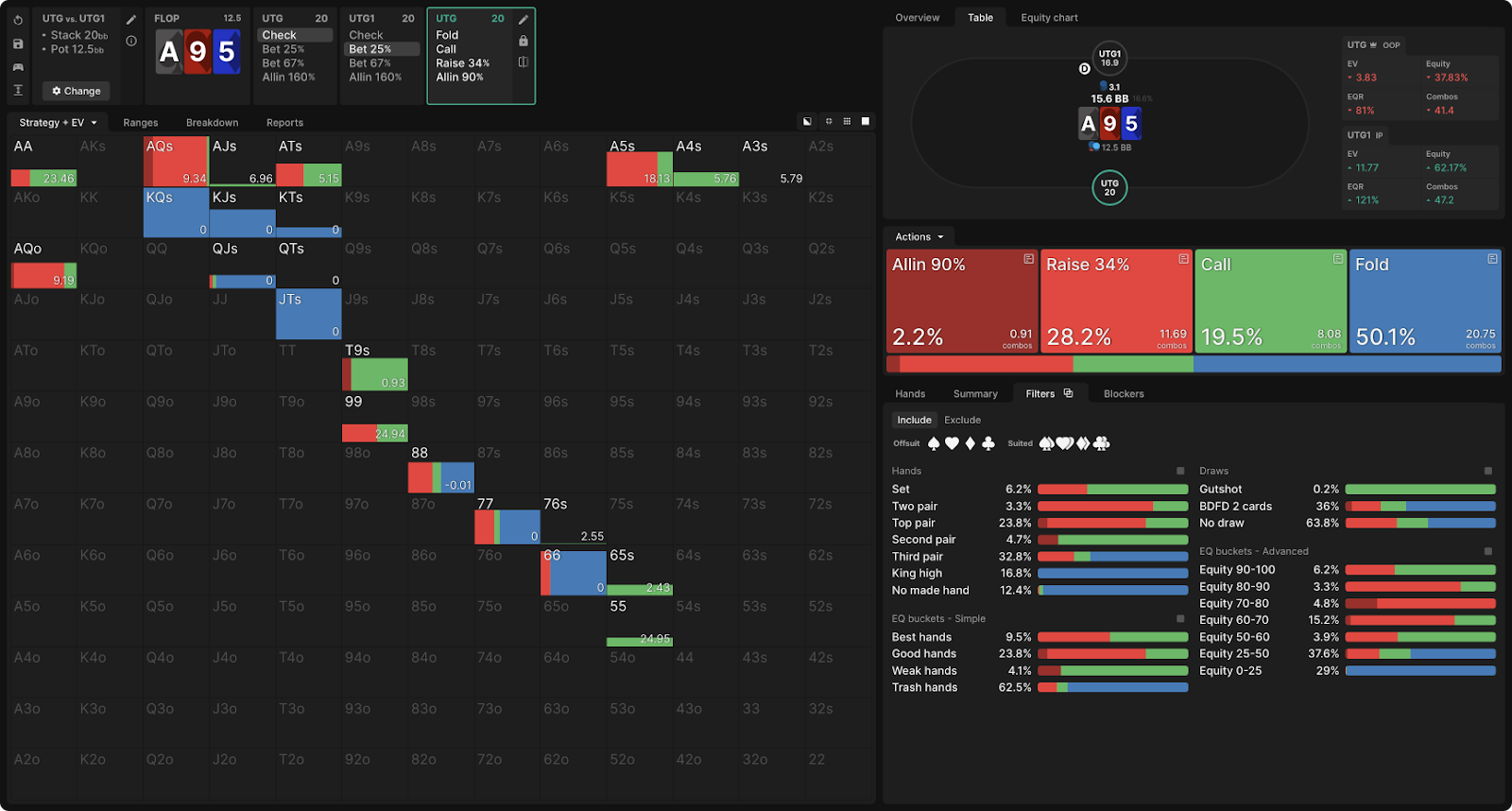
At the same time, it passes more often than the minimum protection frequency (MDF). There's some blocking effect here — when UTG+1 doesn't have an ace, it's much more likely that UTG does, so bluff isn't as profitable as it sounds, but it's mostly due to the strength of the UTG+1 range. On this board, he just doesn't have many hands to bluff with and UTG doesn't have many hands to defend with. Almost 60% of the UTG range falls into the folder with an equity of 0-25%, which makes it so weak that it has to either bluff or fold. To
arm pairs are not literally the bottom of the UTG pair, but they allow the best bluffing as they do not block the broadway arms that make up the UTG+1 fold range. In addition, they have terrible playability on the late streets, where they can either be overplay or beaten out with a bluff. UTG calls are made with hands that have formed a pair on the board, and therefore they are more likely to improve on late streets than pocket pair. The combination of the upper, lower and middle pair creates some confusion as to whether UTG will continue to play on future streets. This does not make the barrel unprofitable for UTG+1, which will have a significant edge in nuts, but provides some control over losses.
And the limitation of loss is the essence of the game when playing with a relatively weak range without a position.
3. Conclusion
The smaller the stacks become, the more important it becomes to prevent the opponent from realizing equity (denial of equity).
A call with a hand that is strong enough to play on the stack is essentially an adventure in that the chips you can get your opponent to put on future streets will cost more than the equity you can take away by making a raise right away. When the pot is big and the stacks are short, it is difficult to overcome this bar. Depriving even a small amount of equity is a big problem in a large pot.
- This is one of the reasons why 4-beta with the best hands so often proves to be the right decision.
Yes, this means that your villain has a big advantage in the colliding node of the game tree, but that's OK. And your callas are basically hands that would otherwise fold (and they fold as the ICM becomes more important), so all they can win on the post-flop is the cherry on the cake. The important thing is that you are aware of this and do not expect to win your “fair share” of the pot or find particularly profitable opportunities.
Awareness of one's own range and a focus on depriving an opponent of equity as a way to get the most out of a bad situation are the keys to post-flop success. With such shallow stacks, your strongest hands may not be strong, but you must recognize them for what they are and play them hard. If you do not make a raise, your opponent will have the opportunity not only to win against you, but also to overplay you on the next streets.