


Translated with the help of AI. We apologize for any errors and would appreciate your help in correcting them.
Translated by order of the educational portal university.poker
Article by Patric Harvey, Original Source: UPSWING Poker

If you play in tournaments with a large number of participants and/or low stakes, you know that there are many players with non-standard strategies. One of the common traits of weak players, in particular, is that they make a lot of limps. Targeting these weaker players and getting their chips will help you build up a larger stack and make a more substantial dipran. How to respond to limpers, especially in the early stages of a deep stack tournament, will be the focus of today's article. Let's get into it.
1. 4 questions to ask yourself when faced with a limp
Not all open-limp situations are the same. For this reason, every time we encounter a limp, we should ask ourselves 4 questions.
REMEMBER: This tip is about the early stages of a tournament when playing with a deep stack.
Question # 1: Who makes the limp and what are the trends of its strategy?
Is the limper a loose recreational player who limps 60% of the hands, sometimes limp folds, and all too often collides on a post-flop? Or is it a Tight recreational player who only limits 10% and has a lot of lim-raises in his range? Or is it something in between? We must be elastic in our ranges based on our understanding of the strategy of the opponent we are attacking (especially if it is one limper). Against a puddle recreational player, we can comfortably raise more hands knowing that there are a lot of bad hands in his range. But if it's a Tight player who only plays strong hands and can try to reraise, we need to be more careful.
Question # 2: What is our position?
The second important factor to consider is our position. Let's say we encounter a limp from a player on UTG. Obviously, we will be able to do raises in a much wider range from catoff and button than from earlier positions such as UTG+1 or UTG+2. This is because there are simply fewer players behind us to worry about. And that brings us to the next question.
Question #3: Who sits behind us and what are their trends?
When we meet a limp, we have to be careful with the players who are left behind us.
Here are the issues we need to consider:
- Are there players between us and Button in this hand who are going to complicate our lives, whether it's preflop or postflop?
- How does this affect our range and how broadly can we play against this lima?
Knowing these trends is extremely important when deciding how widely we should isolate. If the players behind us are passive and unlikely to make us a 3-bet, we can make a raise with a wider range than if there were loser-aggressive players in the position on us, who will often come into play.
Question # 4: What is our hand?
The last question to ask is: What is our hand, and which hands play well against open limpers?
Although we can (sometimes) attack the limps with any two cards, we still want to be able to win big pots on the post-flop and sometimes win on the showdown. Therefore, in such situations, we also have to take into account our actual stack.
Here is an example of a game from the middle position against the limp of a weak player from the early position in the depth of 150bb:
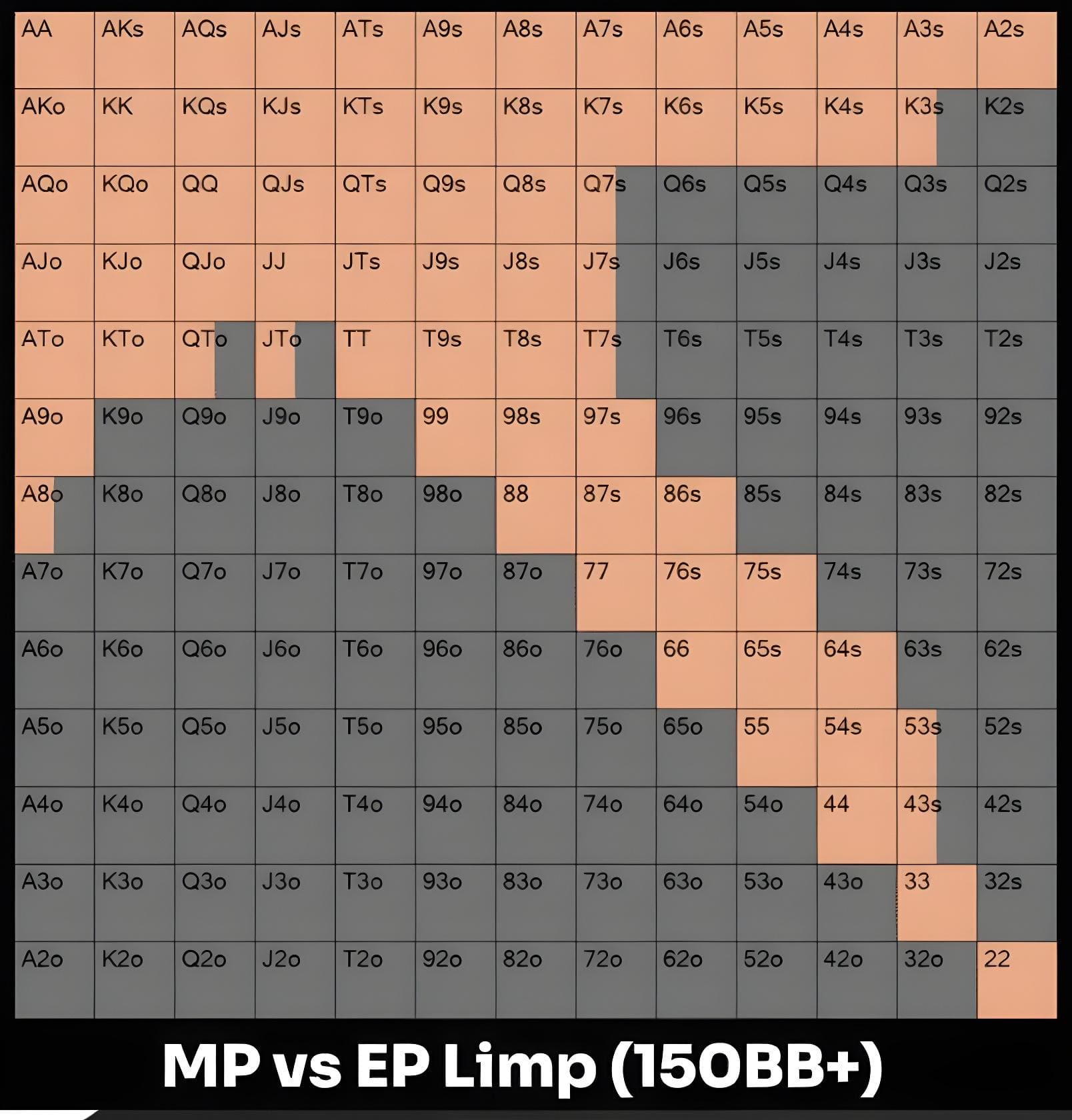
This range consists of premium hands, pocket pair, suited aces, suited Broadways, some offsuited Broadways, some suited kings, and some suited gappers/suited connectors. This range is pretty loose, but that's the way it's meant to be. If you're an experienced player, you should know how to outsmart your post-flop opponents, and so you can play more hands against weaker players. But we can always play a little bit already if we encounter a lime from a secret player or have aggressive players behind, or if you are just uncomfortable playing in such a free range. However, I hope that this chart, showing how freely you can play against limpers, will inspire you to join the game and attack them more often.
2. The size of raises against limpers
In addition to the issues listed above, the size of our raise is also important to consider when isolating the limper. The general idea is that we are trying to find the maximum amount it will call to. Plus, having a small fold equity on a preflop is not bad either. If they want to lim-fold our 5x raises, that's fine. But finding the maximum amount they are going to call is the optimal solution because we work on the assumption that we enter a profitable situation on the flop by playing a position against that limper after isolation. Therefore, we would like to have as much money as possible in the pot.
- Brief note for playing without a position: There will be situations when we encounter 1+ limes and will be on the blinds. When this happens, we will have to isolate the value of a part of the range with larger bets adding 2-3bb to the size of our raise.
3. Conclusion
Learning how to beat the worst players at the table and make even more money is a surefire way to maximize your win rate in the early stages of tournaments. And by increasing the stacks in the early stages, you will be in the best position to move to the later stages of the tournament, such as bubble, ITM stage and the final table. That's it!