


Translated with the help of AI. We apologize for any errors and would appreciate your help in correcting them.
The material is based on the original article: pekarstas.com
About the order of the educational portal university.poker
Success in poker largely depends on your approach to the preflop game. To move effectively through all stages, you must first focus on practicing preflop strategies before moving on to more complex postflop situations.
Understanding the basics of preflop involves not only learning mathematical data, but also knowing the theory that will help you evaluate your opponents' hands and adapt to different games.
Knowing about standard strategies and possible deviations from them will give you confidence in any situation at the table. For practice, you can use one of the recommended poker rooms, where you can improve your betting skills and apply the theory in practice.
1. Optimal bet sizes for open raises
Playing without a position (OOP) requires special attention to the size of the pot. It is important to remember that with smaller bet sizes, we reduce the risks associated with hitting the 3-bet.
Advantages of small bet:
- Fewer losses when colliding with 3-bets.
- Control over the sized pot by playing without a position.
- Less risk of major losses after call 3bet.
- An effective pricing strategy for blinds.
Disadvantages of small bet:
- More likely to get calls from players with a position
Cash game without ante
| Position | Open Raise sizing |
|---|---|
| Early and middle position (EP-MP) | 2.2 bb |
| Cut-off & button (CO-BU) | 2.5 bb |
| Small blind (SB) | 3 bb |
In games without ante, it is worth using small bet to minimize risks and control the size of the pot, keeping it small.
Cash game with ante
| Position | Open Raise sizing |
|---|---|
| Early and middle position (EP-MP) | 2.5 bb |
| Cut-off & button (CO-BU) | 3 bb |
| Small blind (SB) | 3.4-3.6 bb |
In the presence of ante, use slightly larger bet rates, since there is already dead money in the pot, and this gives your opponents the best pot-odds for calls. On the small blind, it is recommended to give up limps in order to avoid predatory rake at low limits, as well as to exploit the trends of players who do not sufficiently protect the blinds.
Isoleit-raises against limes
| Position | Open Raise sizing |
|---|---|
| In position (IP) | 3.5 bb + 1 bb (for each limper) |
| No Position (OOP) | 4.5 bb + 1 bb (for each limper) |
| Against the Lime with SB | 3.5 bb |
If the table has players who often limp, it is worth resorting to isolate raises, increasing the size of bets and limiting the opening range.
Deviations from the standard strategy
If your opponents often call, increase the open rate to 2.5x and narrow the opening range. Against recreational players (phishes) on blinds, open with larger bet sizes to extract more value and in order to avoid wide calls from other reg players.
2. Optimal range for open raises
Early position (EP):
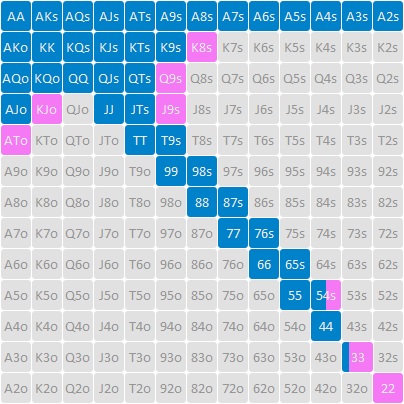
Standard range (16.1% — 213.5 combinations)
Additional hands (plus 3.7% — 48.5 combinations) — only against secret or weak players.

Middle position (MP):
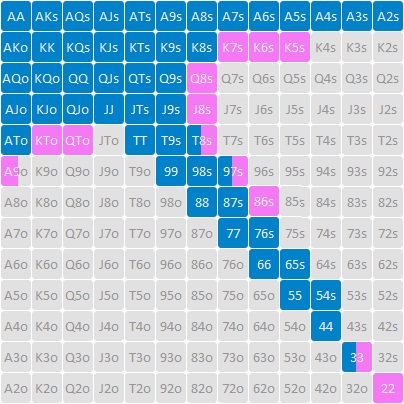
Standard range (20.3% — 269 combinations)
Additional hands (plus 5.1% — 67 combinations) — against secret or weak players.
Cut-off (CO):
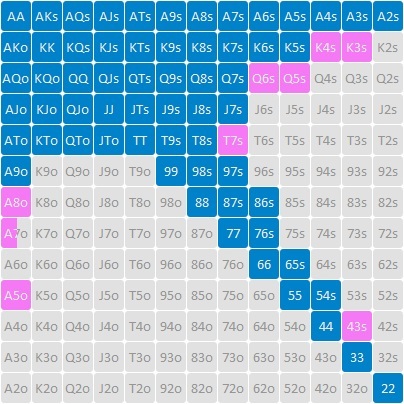
Standard range (27.3% — 362 combinations)
Additional hands (plus 4.1% — 54 combinations) — only against opponents prone to weak play.
Button (BU) button:
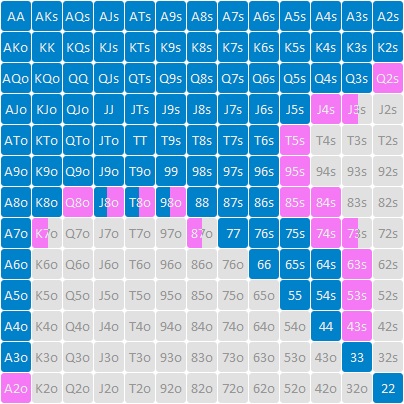
Standard range (42.8% — 568 combinations)
Additional hands (plus 7.4% — 98 combinations) — if playing tight or weak opponents.
Deviations from the standard strategy for Button button
If there are players on the blinds who are not defending wide enough, reduce the bet size on Button by using smaller bet sizes to get the best pot-odds for style. If the table looks very secret, you can even use min-raise, expanding the opening range, since such players will not be inclined to adjust, increasing the call or 3bet range.
Small blind (SB):
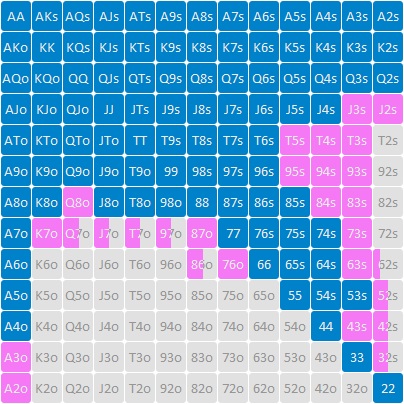
Standard range (44.8% — 594 combinations)
Additional hands (plus 12.1% — 161 combinations) — for secret or weak players.
Deviations from the standard strategy for the small blind
Many players tend to convert to blind styles, and this gives us the opportunity to use a raise or fold strategy, avoiding limes.