

Translated with the help of AI. We apologize for any errors and would appreciate your help in correcting them.
You can talk about emotions in life and not only countless times, for example, in this article you can read what they are and how to live them correctly. Owning your emotions is one of the main qualities of a successful poker player, which allows you not only to control and predict your own Tilt, preventing its development, but also to recognize the emotions of other players and try to predict them in advance. In the 1990s, American psychologists John D. Mayer and Peter Salovey identified and presented to the world a new type of intelligence that is responsible for the emotional side of life, designating it as emotional intelligence. At that time, this phenomenon did not cause huge popularity, but now scientists have realized that it can be used to achieve success, and that this type of intelligence is as important as the level of IQ when applying for a job and especially when actively working with other people.
1. What is Emotional Intelligence
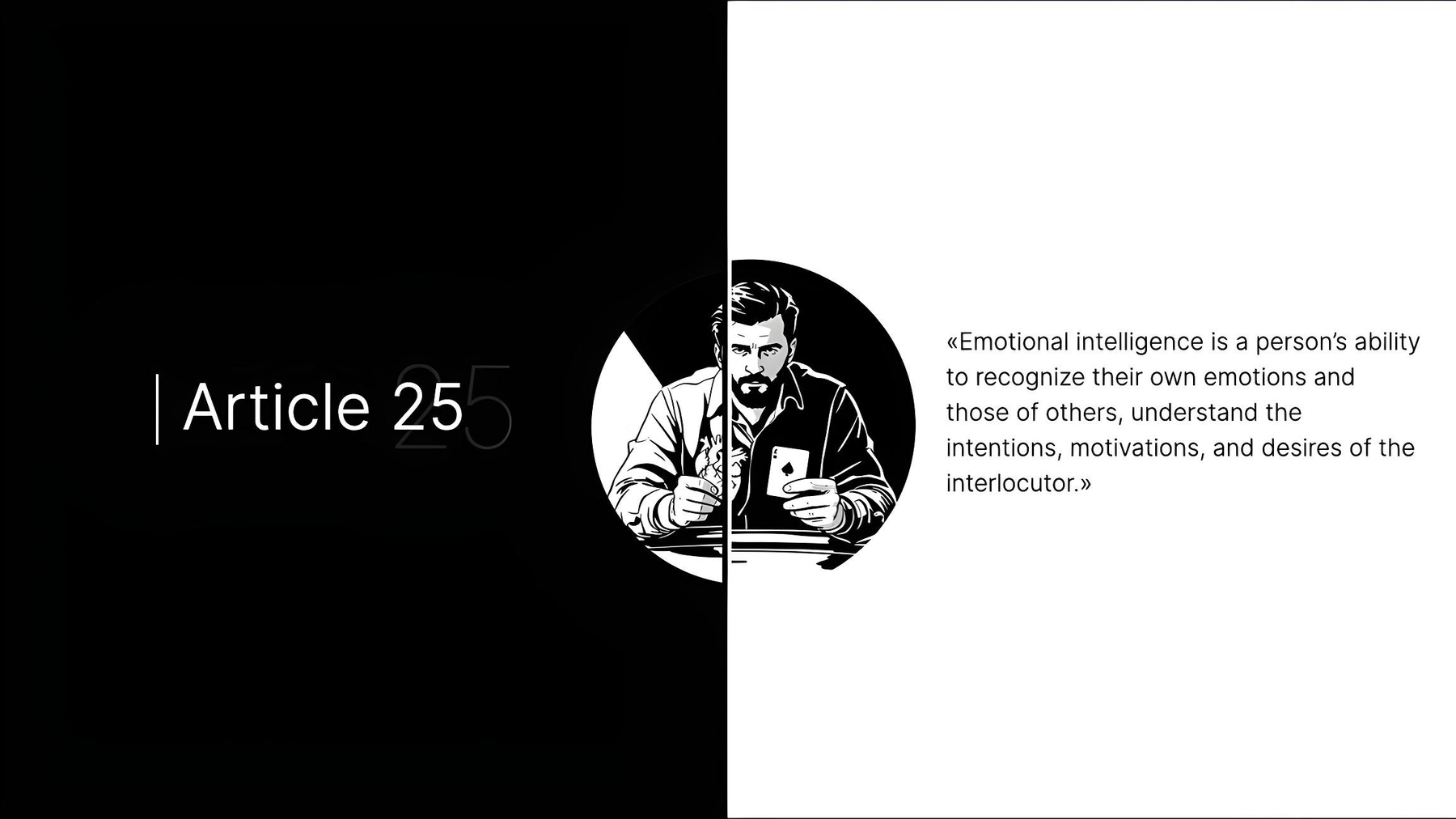
Emotional intelligence (EQ, emotional quotient) is a person's ability to recognize their own and other people's emotions, to understand the intentions of the interlocutor, his motivation and desires. As well as the ability to use this knowledge to solve practical problems that arise in life.
2. What is Emotional Intelligence
The ability to perceive emotions. This skill allows you to determine an emotion by facial expressions, gestures and actions of another, as well as by your inner voice to correctly call it. This skill develops well when a person is brought up in an emotionally open family, where it was customary to talk about their emotions and they were rarely embarrassed.
Understanding of emotions. It is based on the awareness of our own emotions, since we perceive the feelings of others through projection on our experience: "I understand how this person feels, because I know that in such a situation I feel myself." Understanding of emotions is formed through a cause-and-effect relationship, your personal experience. But in adulthood, the level of understanding of emotions increases, which is why we can identify the fake emotions of another person.
The ability to express your emotions. This skill is formed in childhood, the experience of emotions by relatives is taken as a basis (for example, a person who grew up in a family where everyone happily lived their birthday, looks forward to this holiday, no matter what figure awaits him, and a person from a family where the birthday was a cause for sadness or passed unnoticed, does not feel much emotionality about this holiday. Pumped emotional intelligence allows you to express your feelings ecologically, without hiding them, that is, not to fall into the Tilt, but to beat, for example, a pillow, do 50 push-ups and continue your game session with minimal losses.
The ability to manage emotions. This skill allows you to live emotions with benefit for a person, and not to harm. Thus, the experience of negative emotions relating to a situation does not poison the life of a person as a whole, but lasts a certain amount of time, really corresponding to the damage received. People who know how to manage emotions manage their own lives and sometimes even the lives of others! For example, in the profession of a pilot, this quality is very important in the event of emergency situations.
As for the poker player – pumped emotional intelligence allows you to control your emotions and systematically move in development in the game, without falling into extreme emotional states.
You can not compare EQ and IQ separately, each of them is very important. By developing equally mental and social skills, a person realize their potential. This means that he learns to influence his life, other people and the world as a whole. Emotional intelligence refers to soft skills that can and should be pumped for effective interaction with people. This skill allows you to quickly understand the essence of the problem, use the appropriate technique to solve it and get the maximum result. Now that it is clear that emotional intelligence is very necessary for a poker player, I propose to turn to, and how to develop it?
3. How to develop emotional intelligence
I want to say right away that the development of EQ is not a quick matter, but on average, with hard work, changes can be seen in a few months.
Basic methods
- Finding motivation : If you often experience anger, fear, or resentment in different situations and want to respond more calmly to them, find a greater motivation to change. For example, realize that constant outbursts of anger ruin the relationship with your loved one, and that he is not ready to perceive you in such a state, or that your work does not get better from this, but only worsens: you simply drain your money without completing the session with an understanding of what you are doing. And then start training, developing new reaction habits.
- Developing a new habit: Imagine that the habitual reaction of anger is something that has been built in your head since childhood and / or adolescence. And you need to create a new way of responding, to pave another road. Therefore, as soon as you want to show aggression in a stressful situation, that is, go the usual way, try to react in a new way. For example, if you are angry, try one day not to scream, collapse something or clench your fists to blood, but go for a walk. Try different ways to respond to situations, and eventually you will find a less traumatic way out of stress. It will be difficult at first, but over time, a new path will become a habit. To do this, you need a strong motivation: it helps not to turn off the unknown road to the usual way.
- Feedback: After several successful attempts to react in new ways, it is important to get feedback from someone else. Because your self-assessment is subjective. It may seem to you that you are doing well, making great progress and now you can relax. But in reality, the changes may not be visible or even be negative. You can ask anyone for feedback. If you are not going through the path of change alone, you can request feedback from a psychologist or just a loved one. He will observe you and your reactions and give a more or less objective assessment (which, however, you also need to be critical, especially if the assessment was given by a person interested in your changes).
Additional methods
There are also a few additional ways to boost your emotional intelligence.
They are all taken from D. Goleman's book on emotional intelligence:
- Internal dialogue: Imagine that your close friend talks about their marriage problems to everyone but you. If this thought is disturbing, talk to yourself. Ask the question, “Why is this bothering me?” and answer it. Having determined the cause of emotions, weaken them. Say to yourself, “I may feel rejected, but maybe my friend just didn't want to distract me from my work and my problems.” In this way, you will accustom yourself to analyze your emotions and learn to better understand yourself: what upsets you, what pleases you, what offends you, and so on. The next stage will be to learn how to talk about your emotions without offending the interlocutor.
- Developing empathy: To better understand other people's emotions, learn to analyze another person's body language. Body language expresses and evokes emotions. For example, if you notice that another person took a tense pose and shrank, think about the circumstances in which you yourself took such a pose. This will help you understand how your interlocutor feels.
Mutual understanding, this is the basis of care, arises as a result of emotional mood, thanks to the ability to empathize, ”says Daniel Goleman.
- Positive thinking. Learn to see the good in even the worst things for you – to gain experience where before you thought situations were against you. Positive thinking focuses on the pros rather than the cons of situations and events.
- Conscious reflection and introspection. Observe your reaction in all possible situations, analyze what emotions you have from communicating with different people and different activities. See how you respond to stressful situations. Analyze what exactly makes you feel something and why.
These additional techniques, coupled with the basic ones, will allow you to develop your emotional intelligence. But remember that if your emotional intelligence is at a low level, then for more effective work on it, it is better to contact a specialist who will help you understand why this happened and what needs to be done in your situation.