


Translated with the help of AI. We apologize for any errors and would appreciate your help in correcting them.
Translated by order of the educational portal university.poker
Article by Andrew Brokos, original source: GTO Wizard
Tribet pots are scary. Playing without a position is scary. Put these 2 factors together and you get the nightmare of many poker players.
As always, the best way to deal with any anxiety is to arm yourself with information
Once you understand the principles that guide players in such difficult situations, you will be able to make better decisions in large and important banks. You will still play them often – as we will see, this is inherent in the situation itself – but you can be calm knowing that your game is correct.
1. Playing preflop
The first thing to know about playing a post-flop without a position against 3-bettor in MTT is that you shouldn't do it very often. Even a little pressure from the ICM motivates you to do 4-betas or folds on the preflop more often than to call without a position.
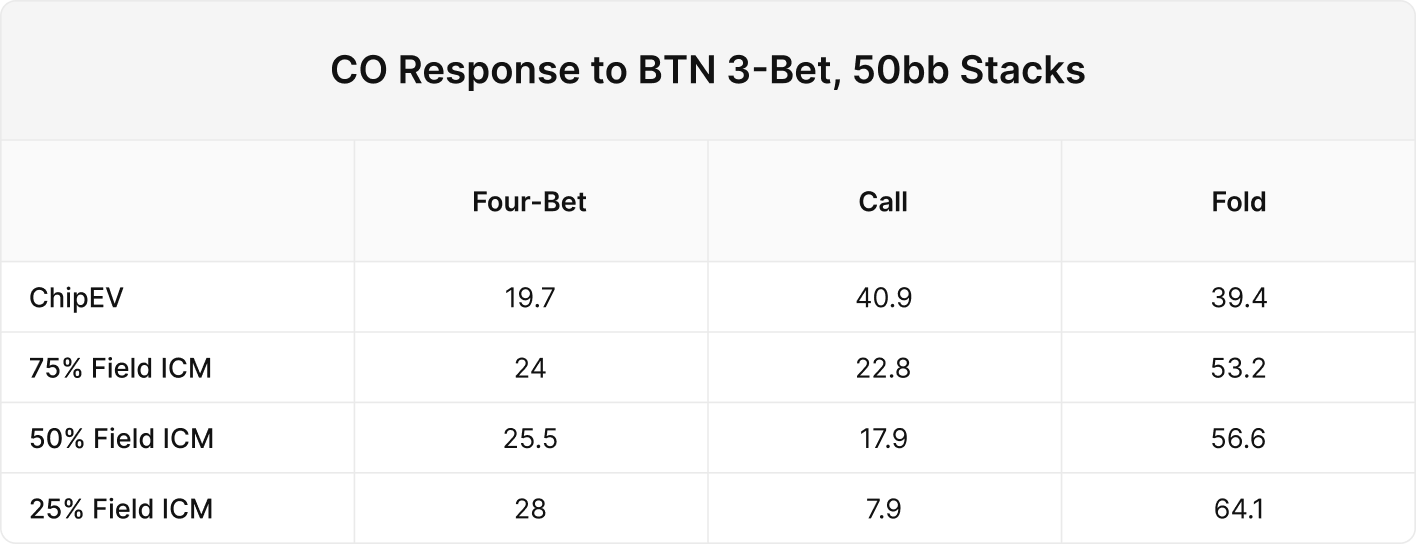
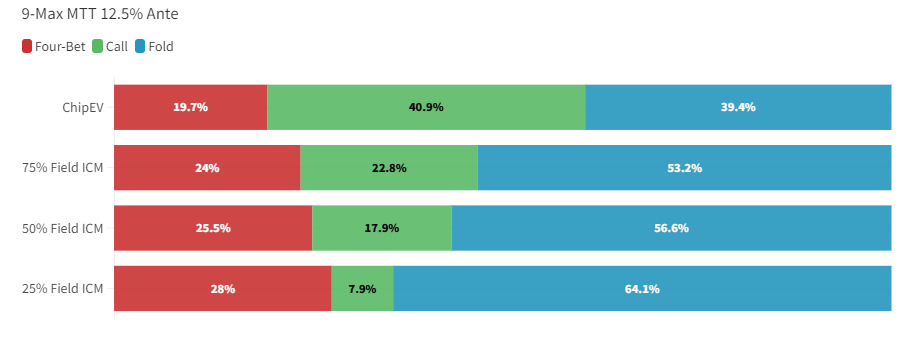
Call is a big part of your strategy when the stack depth gets smaller, for two reasons:
- Your opponent's 3-bet should be smaller, giving you the best chance for a call.
- Lack of position represents less responsibility, making it easier to implement equity with marginal hands.
Despite this, the call should remain your least frequent action in response to a 3-bet from a player in position at any stack depth. Among other things, smaller stacks also make all-in a more attractive solution.
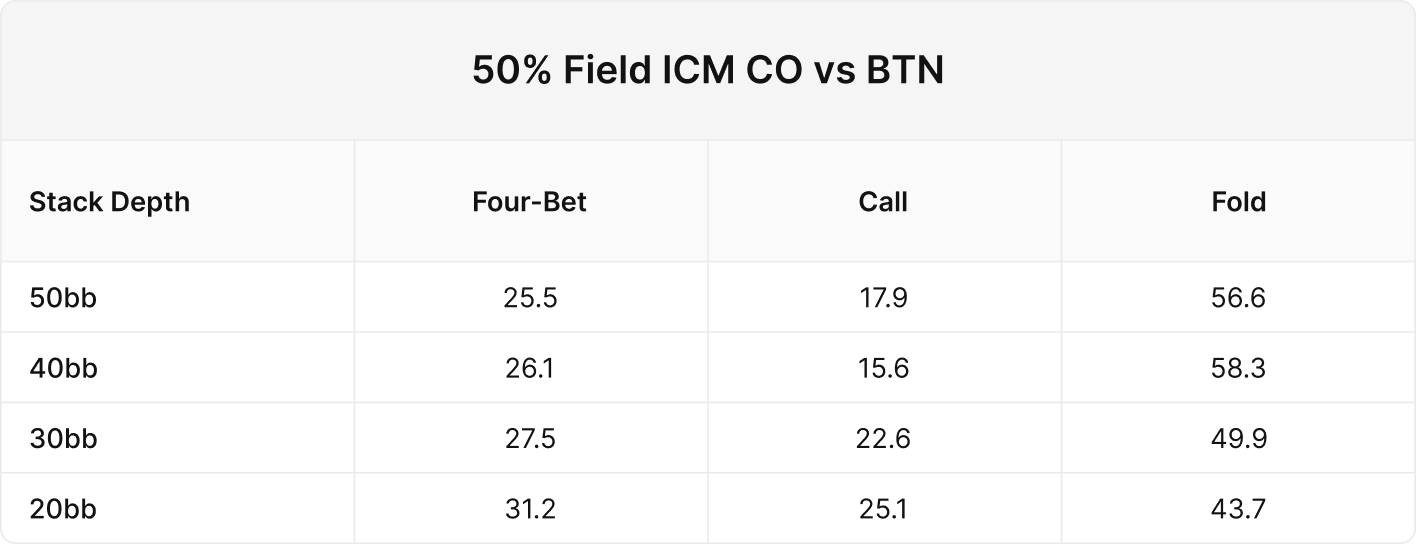
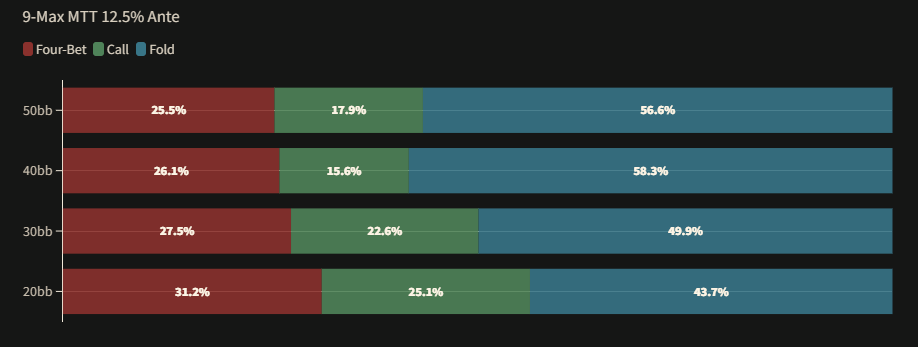
These numbers remain the same regardless of your position. The composition of the ranges changes to reflect the width of the initial opening range, but when faced with a 3-beta, the open-raiser folds, collates and makes 4-bets in the same proportions of this opening range, regardless of its position. This is due to the fact that the range of 3bet takes into account the position of the open-raiser.
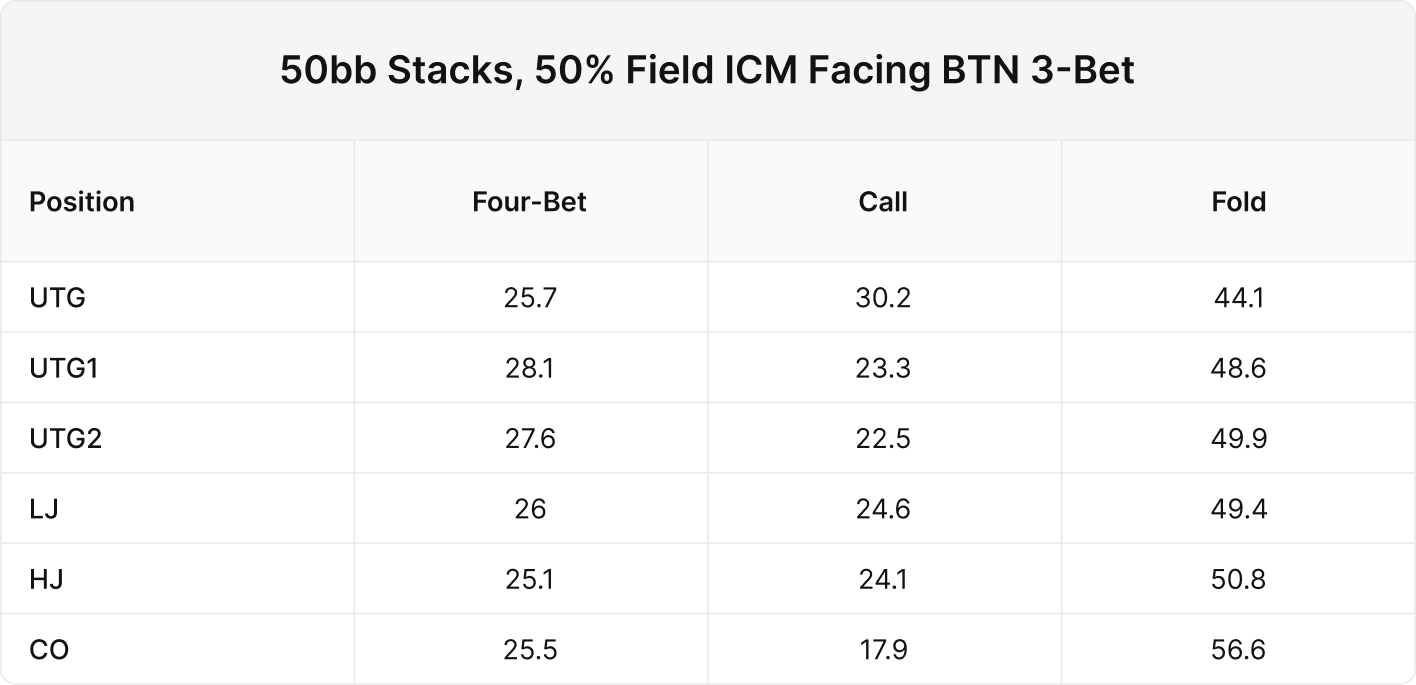
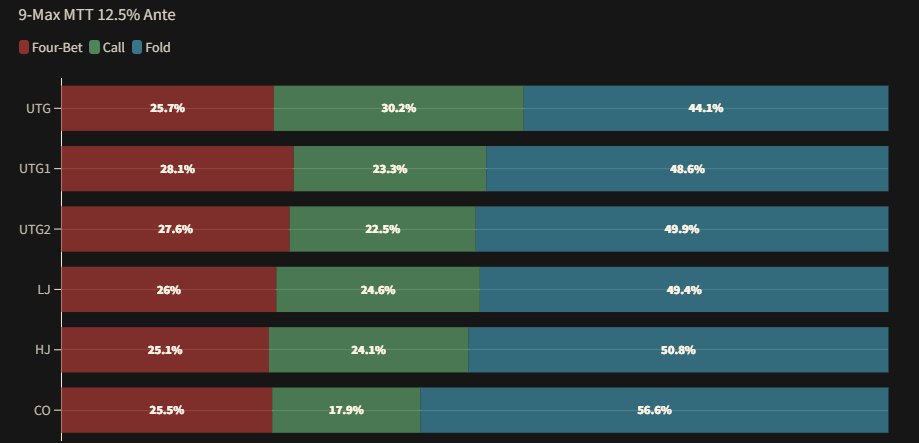
Thus, while a player opening from an early position will have a stronger range than a player opening from a late position, a 3-better range attacking an early position will also be stronger, resulting in an open racer responding with the same frequency. Below is a diagram of the distribution of reactions (4-beta, call and fold) to 3-bet for different positions in the depth of 50bb stacks in a moderate ICM environment with 50% of the remaining players. As we can see, slightly more ICM pressure leads to more folds and fewer calls.
2. Playing the flop
Call 3bet without a position means voluntary getting into a disadvantageous situation, since the price is small. You should expect that on the post-flop you will have a weaker range and you will lose more banks than you win.
In a 3-bet pot, the player who opens preflop and collites 3-bet always has a weaker range than the player who twisted the open-raise, for reasons similar to why the BB-color has a weaker range than the pre-flop-raiser in the single raise sweat:
- 3-bettor risks more than caller.
Because when CO opens 2.1bb and BTN reraises 6.82 bb, 3-bettor jeopardizes 6.82 bb, while caller risks only an additional 4.72 bb. - Caller completes preflop trades.
While the 3-bettor risks getting a 4-bet from a player who has not yet taken action behind his back, or from the initial racer. And the caller can be sure that he will see the flop. - It makes sense for the Koller to make a 4-bet with his strongest hands.
Slow play without a position is usually risky, so, with the exception of AA, the open raiser will usually to bet his 4bet strongest hands, which means that he will to collide with some kinked range.
Like a BB call, a 3bet call without a position means voluntarily getting into a disadvantageous situation because the price is not high. You should expect to have a weaker range on the post-flop and lose more banks than you win. It follows that you should almost always start a post-flop game with a check against a racer. Technically, there are some exceptions on the most coordinated boards where 3-bettor overpairs are the weakest, but you should by default make a check unless you have a very good reason to do otherwise.
- CO bet strategy in 3-bet pot vs BTN, 50bb stacks.
Flop:


Example:
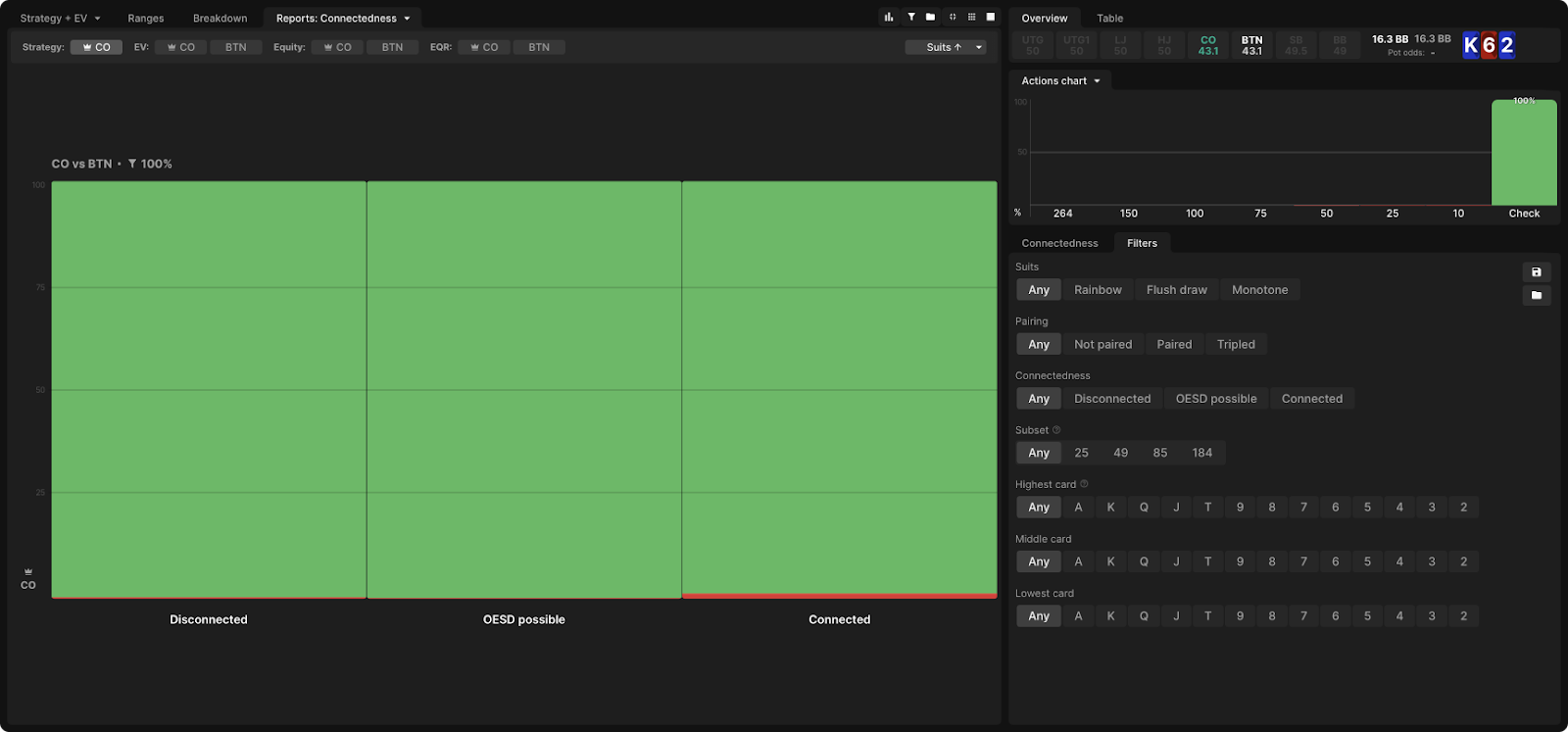
Smaller stacks make dock betas a little more appealing, but only slightly.
Consider the same situation, but in 20bb stacks:
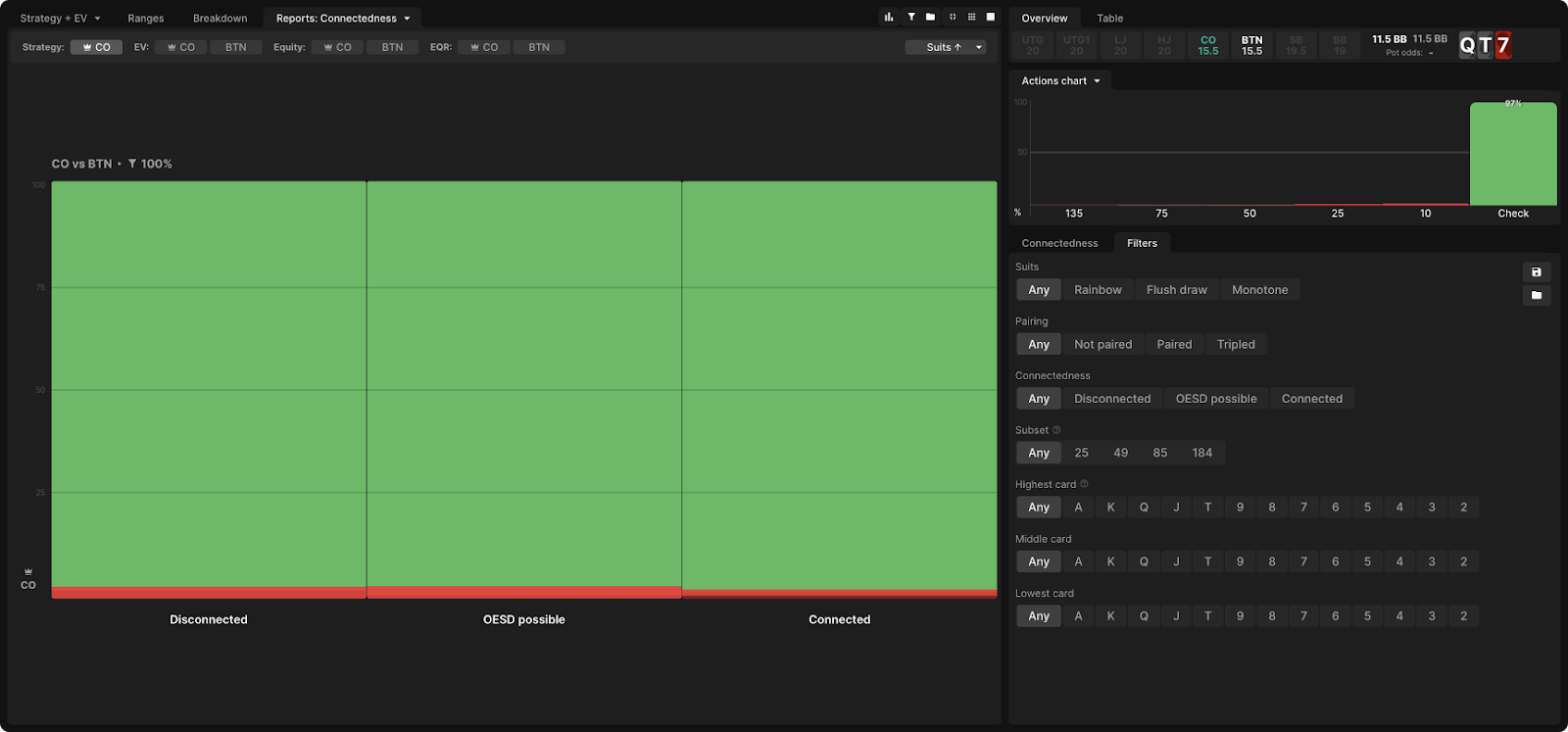
After the check, the 3-bettor will most likely give you a small cbet. This is the standard strategy of a player making a 3-bet on most flops. In response, you should call more often, but also often to discard the cards. Even a super-small extended bet is not a weakness.
CO response to an extended BTN rate of 25% of the pot in 3-bet pot in 50bb stacks:
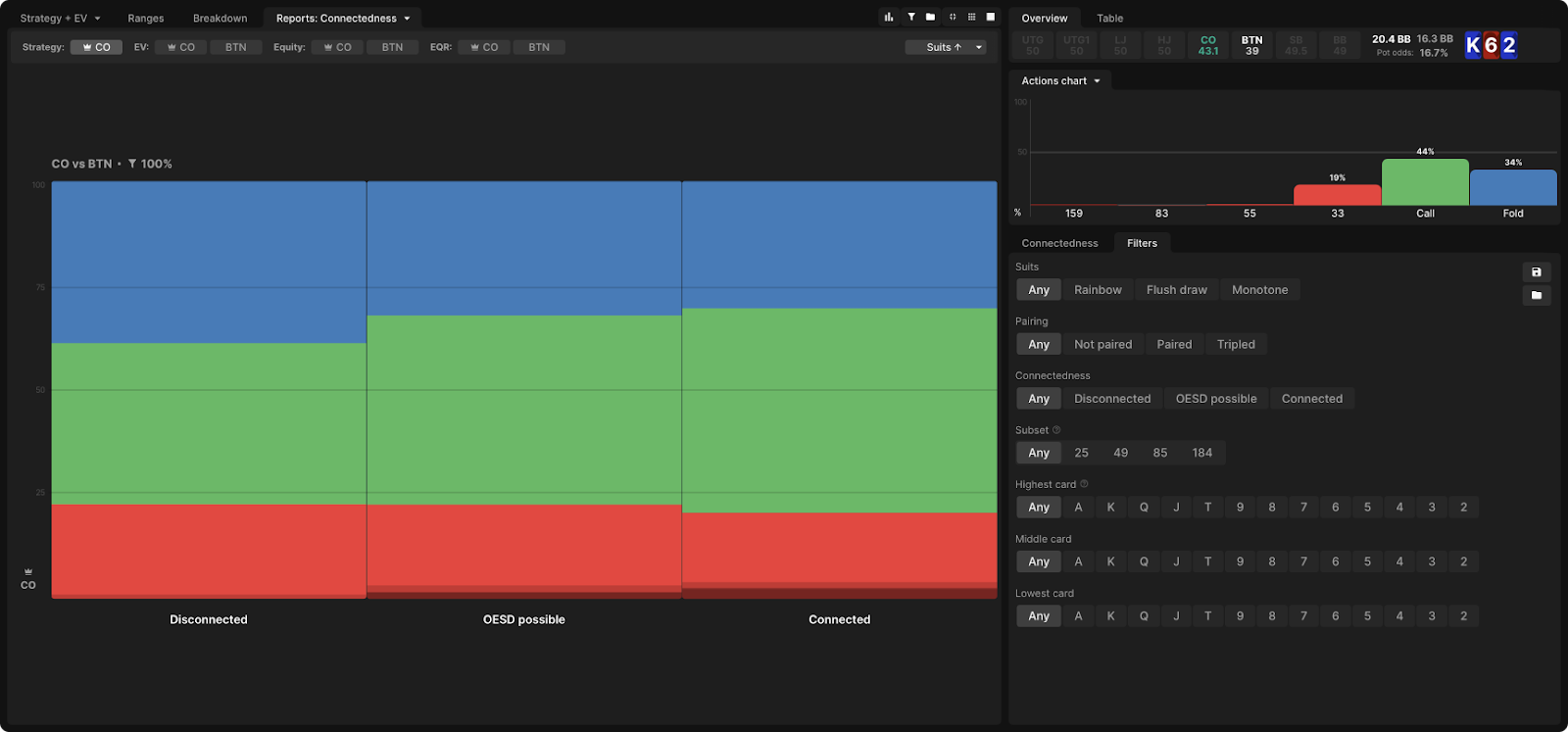
Note that the fold frequency of 34% is almost double the fold frequency of 20% dictated by the minimum protection frequency formula. This is a consequence of the equity advantage of the player who made the 3-bet. Just like in the single raise sweat vs BB, the player who made the 3-bet paid for this lucrative flop bluff, taking on a relatively greater risk on the preflop than the caller. As a preflop caller, you don't have to fight him hard for a pot, even if his cbet is tiny. Also note that due to the low SPR, the tiny continued bet is not “weak” and in no way limits the 3-better range.
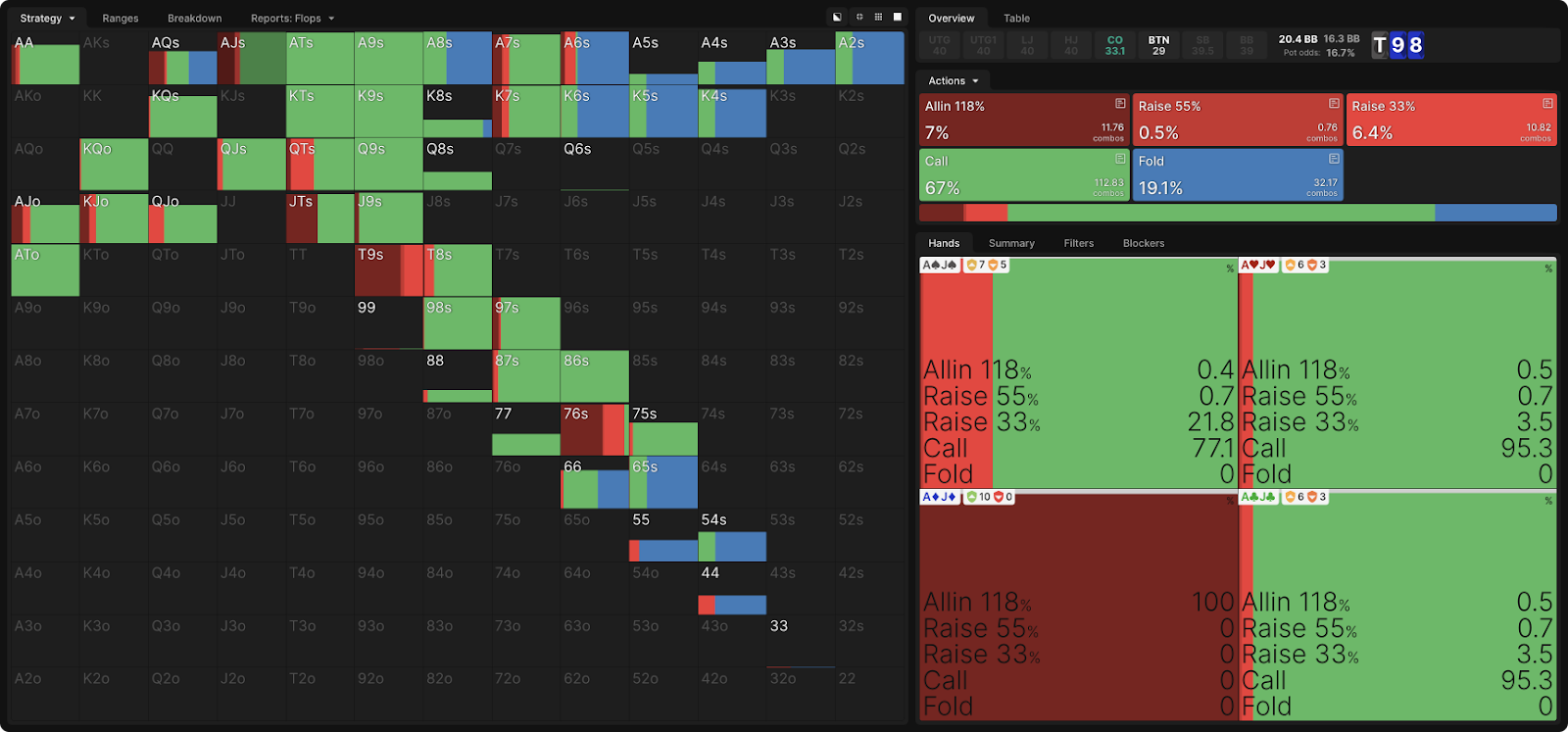
He will have enough opportunities to disperse the bank with turn and river bets if he wants to do so, so he has no problem making small bet with the strongest hands. A low SPR also means that you don't need a strong hand to stack-off on the stack. For example, on the K-6-2 board, the “rainbow” CO can check-raise 3-bettor on a button with K-8 and barrel on the value on most runaways. Even though you start with a 50 BB stack, the SPR on the flop is less than 3, so any top pair is a strong hand. A weaker K-x with no check-raise will check-call most of the time.
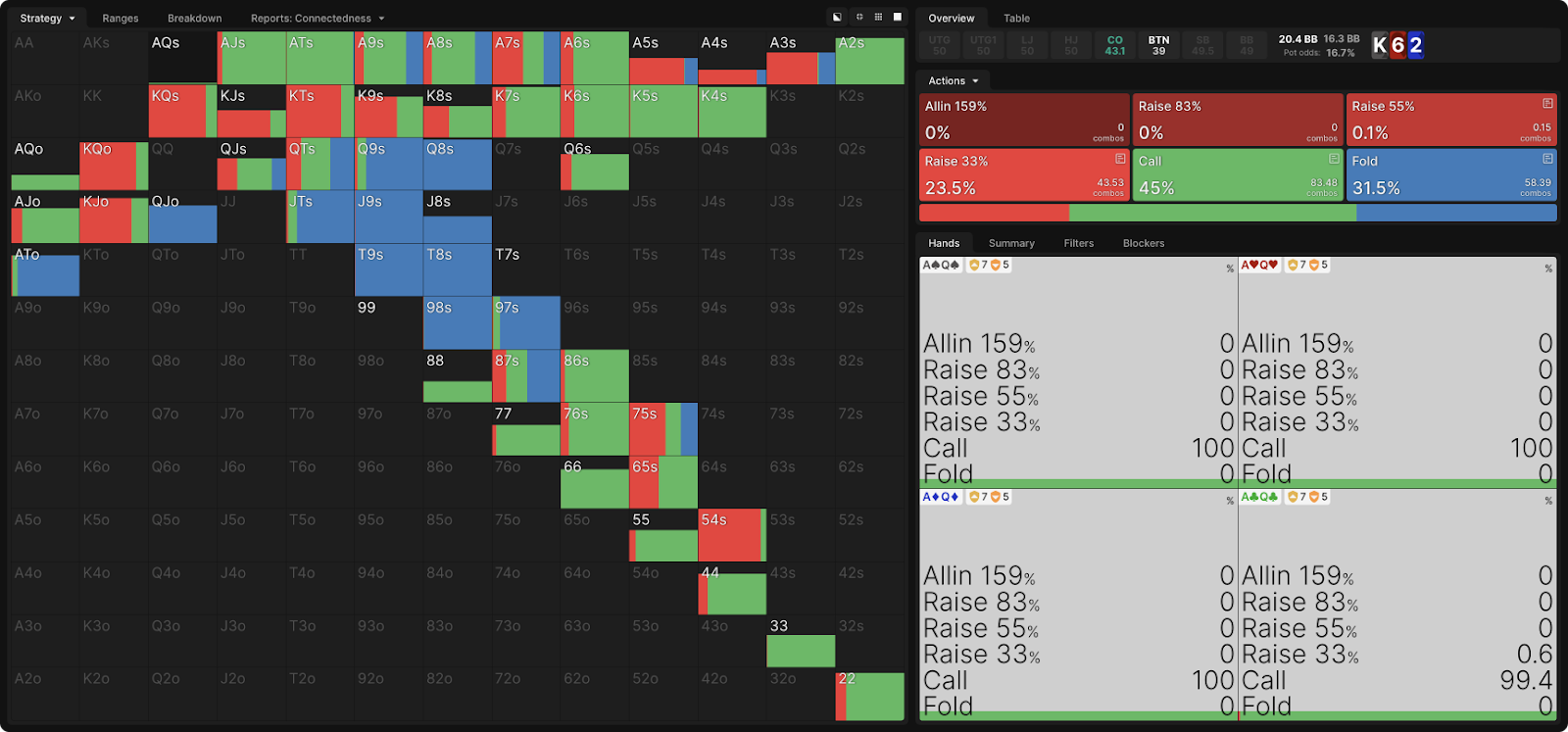
Sets and two pair are not as willing to check-raise as Kx hands, they are more inclined to play check-call and provoke BTN to bluff on the late streets. But Kx hands can be trimmed to prevent the implementation of BTN of its equity. Despite the fact that we talked earlier about CO fold more often than the minimum frequency of protection dictates, he nevertheless makes a lot of illogical calls and raises when he sees a tiny c-bet on such a dry board. He never folds the pair and rarely folds the Ace-hye. Stronger Aces-x make good calls as they dominate some Aces-x BTNs.
Weaker Aces require a backdoor flush draw (which they will have three times out of four) and frequent check-raise to continue playing, in part because you can get a fold from your opponent's dominated Aces. CO pulls the rest of its check-raise bluffs such as gatshots, hands with backdoor straight and flush draw. Honestly, this is not such a strong draw, and raising with them is not particularly profitable. But there are no strong draw on this board, and CO needs to bluff a little, so he can do it when he has a potential chance for improvement.
3. Playing on related board
On the board , CO check-raises are exceptionally small, regardless of whether there is a flush draw on the board or not. CO check-raises are almost always small, for the same reasons that BTN most often uses small extended bet.
But there are some exceptions on the most coordinated boards, as will be shown below:
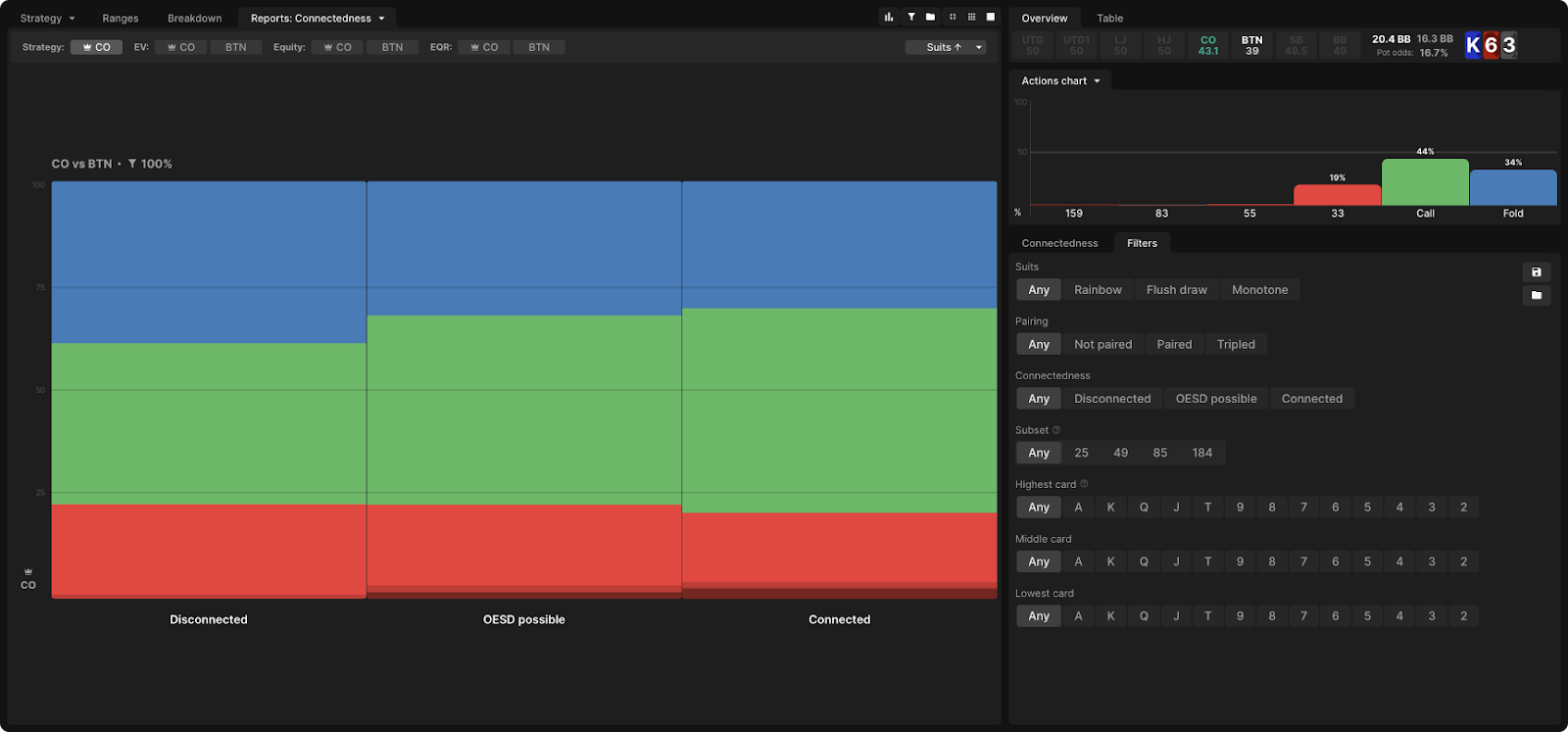
This check-push strategy is actually more intuitive to implement. Since the raise is made all-in, it is a small and more linear range with more equity.
- For example, on the board:


CO check-pushes mainly strong draw, such as 
 and
and , as well as strong but vulnerable ready hands, such as two older pair or lower straight:
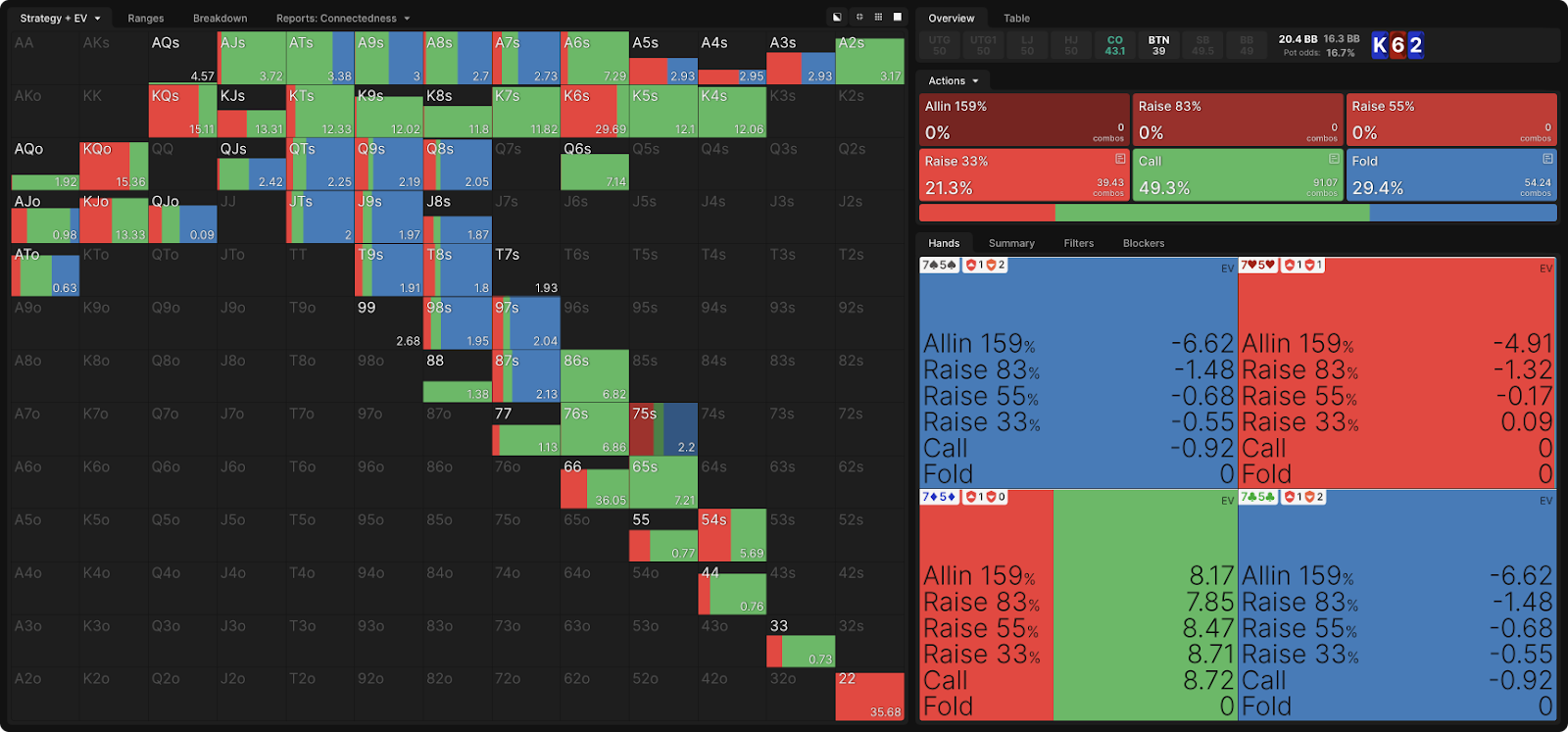
For the check-call strategy, we choose weaker draw, including nut flush draw and most straight draw with overcards. Passive play without a position is never perfect, but BTN bet is a concern for SO. For him, this is a situation for high-frequency bet. Indeed, on this flop, he waits for more than half of his range checks. Therefore, when BTN makes a bet, CO pays a lot of attention to this bet and raises much less often than on the K-6-2 flop.
4. Playing on boards with flush draw
Similar principles apply on board with flush draw, for example, on CO the check rate is less than K-x hands, because it has stronger draw with the same strong equity against Ace-x and younger BTN pair. His weakest bluffs are still gatshots and backdoor flush draws with one tambourine or two worms. Note that hands like this 
 (middle pair + flush draw) are especially bad for the raise.
Yes, there is a lot of equity here, but the best hands of the opponent will never fail, and weak hands, which are already very few, will immediately reset and will not continue. Therefore, it is better to raising with weak flush draw, which more often implement fold equity, but to call better with flush draw, having showdown valley against Button's bluff (these are high diamond Ace's hands).
5. Playing on the Late Streets

There are too many different scenarios on the late streets to even partially address. The good news is that the same strategic principles that guide you when playing against a BB against a pre-flop racer will serve you well when you are out of position against a 3-bettor.
You just need to keep two important variables in mind:
- If the SPR is small, your all-in threshold will also be small.
- Range on the preflop is much stronger and more concentrated around the higher cards.
Following these familiar principles, if you made a check and call on the flop, you will most often check on the turn. And if you made a raise on the flop, you will most often continue on the turn. The main exception will be cards that radically change the texture of the board. In the 3-bet pot, it is rather an ace or king than a Paired board or a card that completes the straight, as it would be in the single raise sweat.
6. Conclusion
Pots may be bigger, but the principle remains the same: avoid bad situations when you can. If you do call, realize that you are playing at a disadvantage and act defensively, paying special attention to the check, call, and fold.
Evaluate the strength of your hands depending on the context, paying attention to SPR and preflop bands.
Going on the offensive with a raise is a less common variant of the game, but it is suitable for strong hands that benefit from blocking the implementation of the opponent's equity. Bluff only by carefully selecting weak hands that have good potential for improvement. It is not always possible to avoid a loss, but by adhering to these principles, it is possible to avoid major mistakes.