

Translated with the help of AI. We apologize for any errors and would appreciate your help in correcting them.
Translated by order of the educational portal university.poker
Original source: GTO Wizard
You made a cold-call on the preflop. This is scary. You put a pre-flop-raiser in the check, and this is doubly scary, because the check from the raiser without a position (OOP) should not be capitulated, because it can play a check-raise. The good news is he didn't make the raise. The bad news: he didn't give up, which was probably what you were hoping for, even if you had a pair.
Now you need to play the turn, which means you need to solve a few things:
- How likely is the new card to help him, and to what extent?
- How to subtly make Velu bet and what bet size to choose?
- How often do you need to bluff and which hands are suitable for this?
Do not forget that even if the racer has become a little more droopy, it still has a fairly strong range. Scary...
The only thing to be afraid of is not knowing what to do.
As always, our reaction to such frightening situations will consist in a sober analysis of the strategy, tactics and frequency of bet. For a top poker player, the worst fear is not the risk of betting against a strong hand, losing a pot, or even falling under a bluff. It's all part of the game. The only thing to be afraid of is not knowing what to do. When you have the tools to assess the situation and come up with a sensible strategy, you can spend your energy on it rather than worrying and guessing. While not necessary, you can (re)read this article on how to play the flop as a cold collar in position (IP) before continuing. We will use the same examples to consider how a cold collar should approach playing the turn and river after a bet on the flop.
- Let's look at a few examples from MTT in a ChipEV environment in depth 40bb. The principles derived from them are suitable for a variety of other situations where you play as a cold collar in a position, regardless of the exact positions, stack sizes or game format.
1. Static flop
BTN doesn't bet often when the flop goes out:


When he bets, it is usually a large bet of about 55% of the pot and it is built polar: A - 20%, and 30% he usually bets on the middle flop.
He bets with the best hands most often, with the exception of JJ, which blocks most of the marginal UTG range:

In response, UTG does not often raise, as it has already put some of its strong hands, and static board is more suitable for slow play. Therefore, its call range is strong and will not be dropped.
Includes sets, two pair and many top and middle middle pair, as well as some marginal pair and draw:

Evaluation of thorns
Although BTN, like a cold collar, does not bet on this flop especially often against UTG, on most thorns it continues to bet with the majority of its range with which it bet on the flop. That's because UTG has already checked most of its best hands on the flop, unless the texture of the board changes significantly on the turn — which, by definition, is rarely the case on a static board — BTN usually wants to keep putting in the polar range. His most commonly used bet on the turn is again 55% of the pot, which allows him to put an all-in of 82% of the pot on the river. This is not a perfectly geometric bet structure, but close to it, especially given that the solver is limited in the choice of bet sizes.
As a cold caller, BTN doesn't need a card on the turn that strengthens its hand to keep betting, it needs to avoid cards that actively strengthen the UTG.
The frequency of BTN bet on the turn is closely related to its equity: type 6 cards or blank terns are the best for barreling:
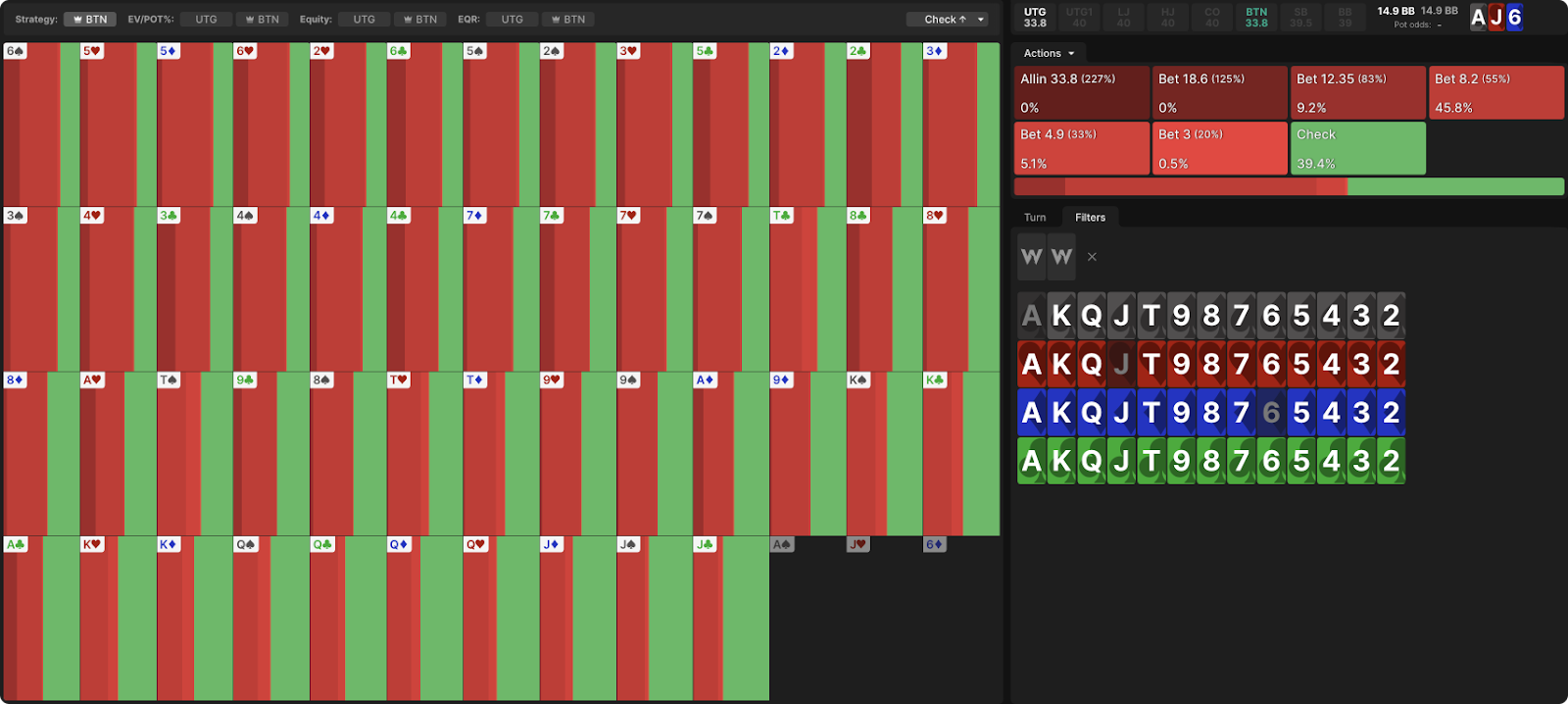
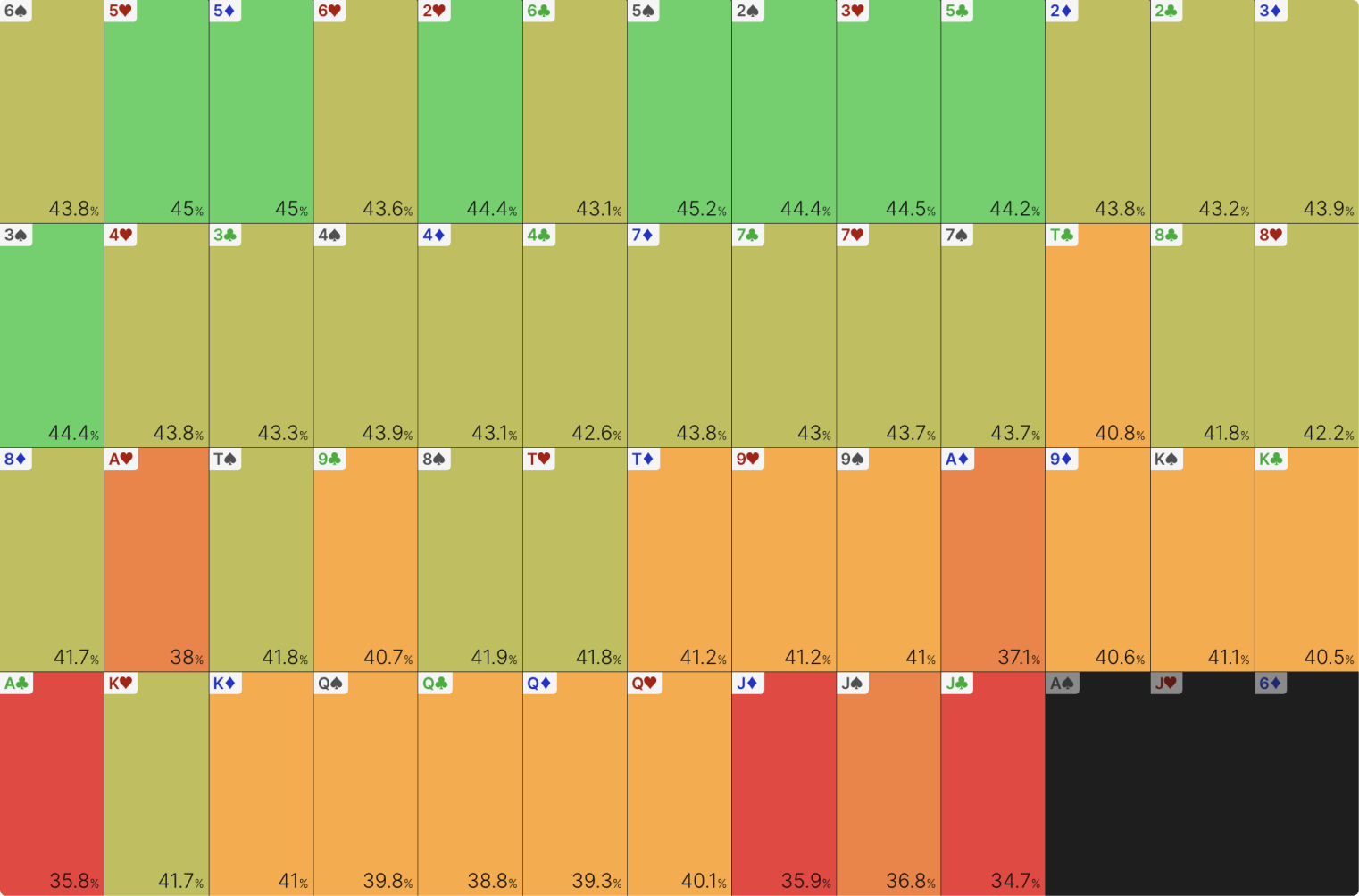
Although the UTG range is still not trapped, it is mostly linear, while the BTN range is more polarized. BTN does not need cards that strengthen it to keep betting, it is important for it to avoid cards that strengthen UTG. These are primarily broadway maps that give UTG a lot of new thrips, two pair and strips.
Blank turn
- For example, here's how equity is distributed on the turn
 :
:
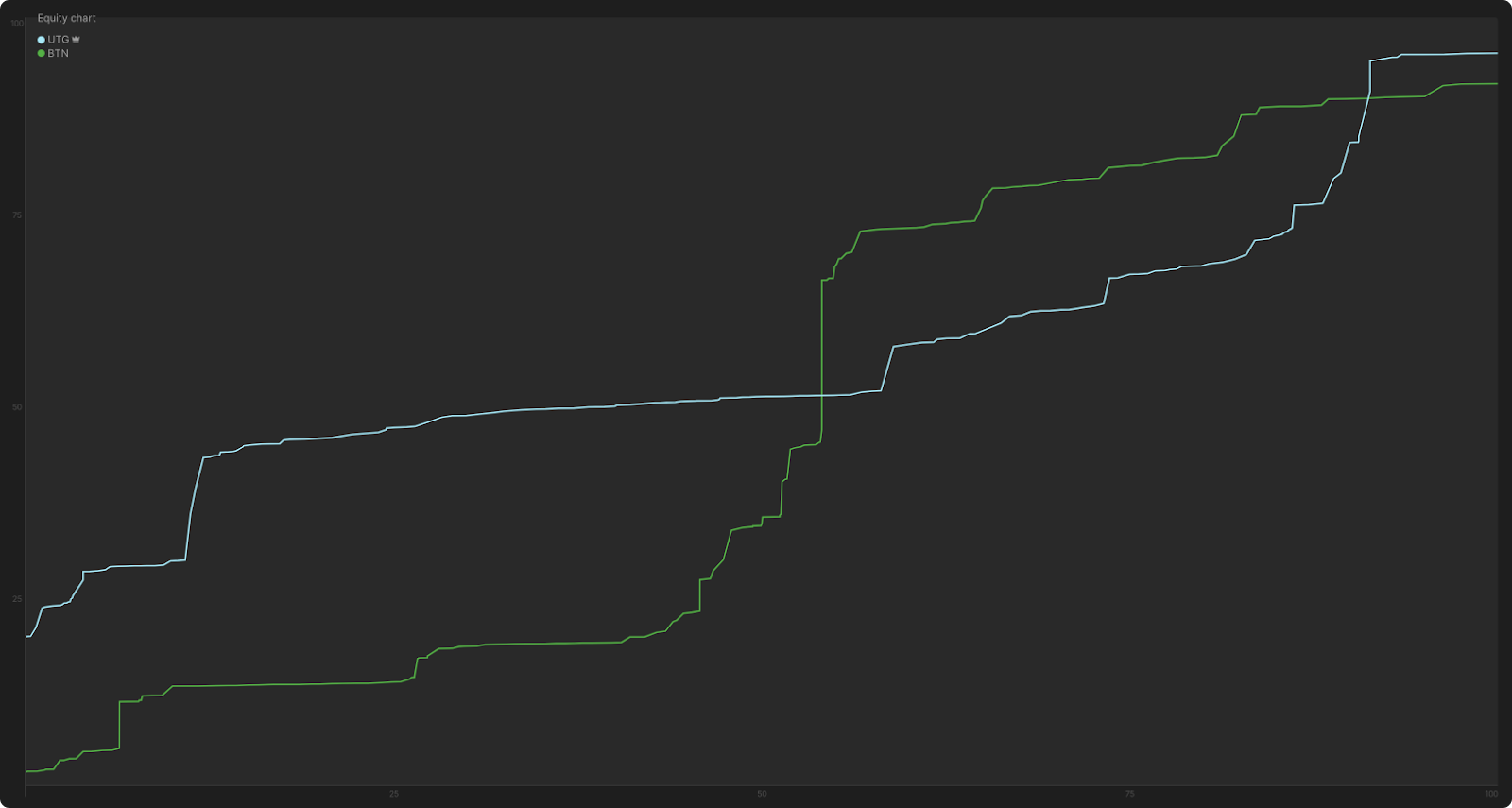
After the UTG check on the BTN turn, the polar range barrels, preferring younger pairs rather than gatshots and when bluffing:

Small pocket pair have only two outs, not four, and their outs are slightly less clean. However, they do not block UTG folds, which turns out to be more important in this situation. The main UTG folds are gatshots and pocket pair like KK, QQ and TT, so BTN doesn't want to have these cards on their hands when bluff.
Blank river river
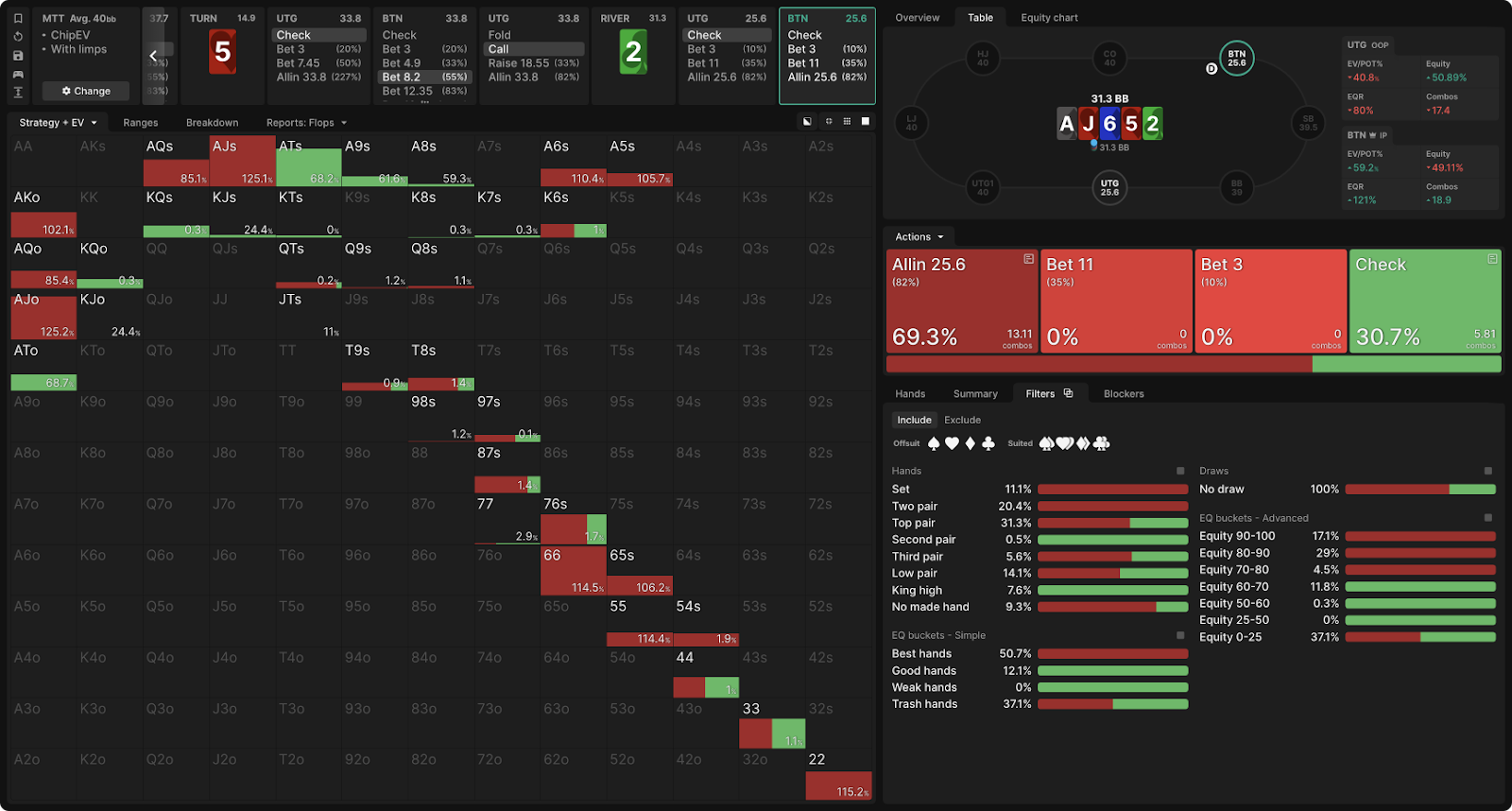
On the blank river, for example , BTN continues the polar strategy, putting all-in with 69% of its range. The main part of the range for the UTG colddown is hands with an ace, so any hand that is stronger than the top pair is good enough for a valley push, even if there is a real risk of hitting a slowly played monster.
From a practical point of view, this means that even AQ can be pushed to the value:
2. Dynamic flop
The BTN barreling strategy on a dynamic board 
 , such as , is not as different from a static board as might be expected.
After the bet of 33% of the pot — the most commonly used size on the flop — BTN further barrels about 60% of its range on this board, again giving preference to the bet size of 55% of the pot:

However, there are two important differences:
- BTN bets on the flop more often than on, so it reaches the turn with a more linear range.
- After the pot bet of 33% on the flop, the bet size of 55% on the turn moves further away from the geometric structure, leaving 116% of the pot on the stack.
These points are related. The purpose of the geometric betting structure is to increase the pot in the early streets with the hands you plan to put on the value or bluff all-in on the river. On a dynamic board, it is more difficult to predict which hands will be for the valley and bluff on the late streets. Therefore, the incentive to avoid aggressive pot buildup persists until the last card is opened.
The purpose of the geometric betting structure is to increase the pot with the hands you plan to bet on value or bluff all-in on the river.
As on the flop, after the check-bet call actions, BTN has a more polar range, and UTG has a more compressed range. On a more dynamic board, UTG has even less incentive to slouple the strongest hands. So, as before, the key question for BTN is, “How much does this card on the turn improve my opponent's range?”
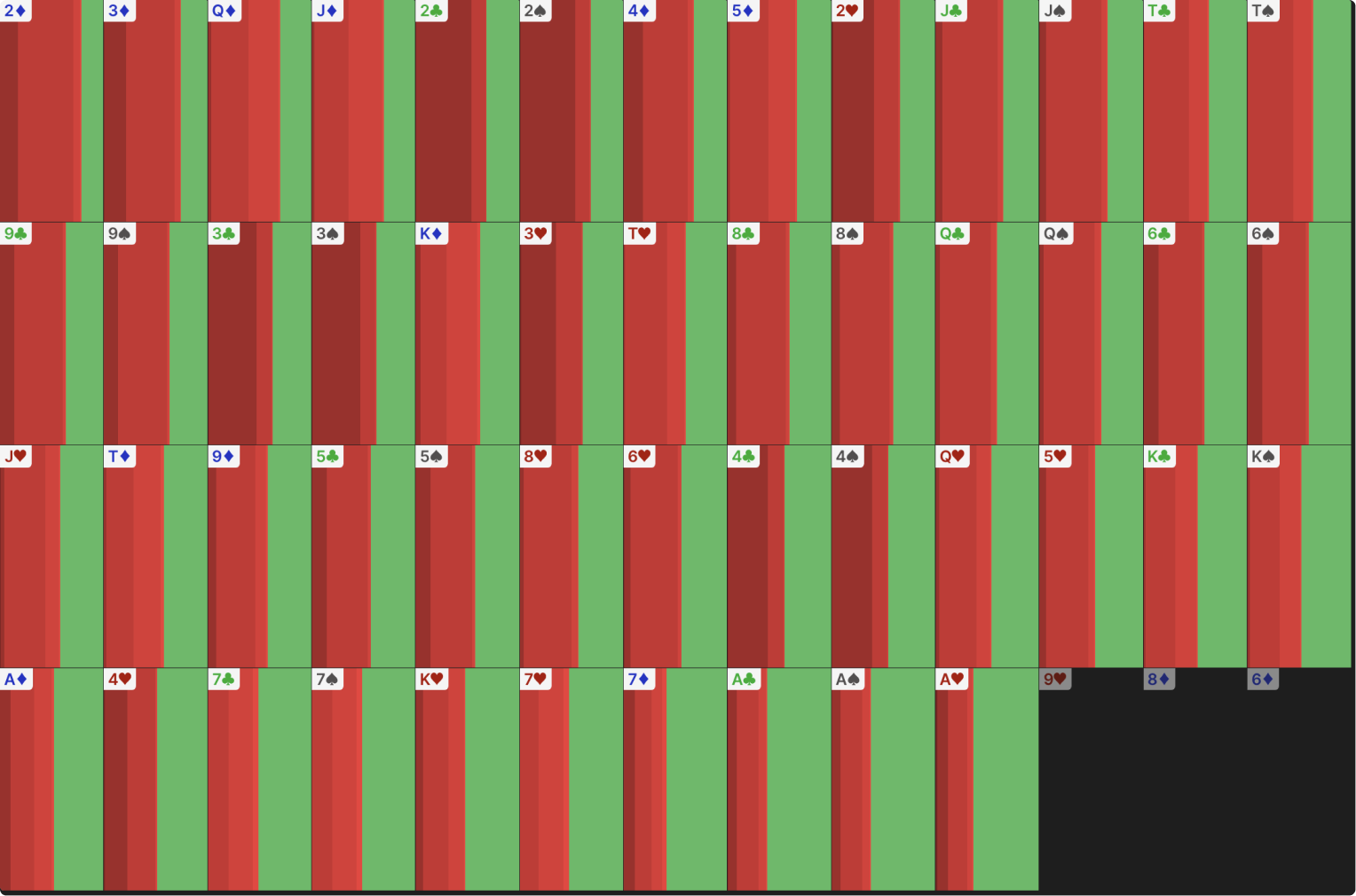
As can be seen from the general report on thorns above, not everything is as simple as putting often on forms and checking on cards that change the texture of the board. In fact, the four thorns with the highest BTN betting frequency are the cards covering the flush!  on the turn, technically unlocks the UTG, which often checks out with hands like
 and
and .
.
However, in general, BTN has much more strong arms and a more polar range:
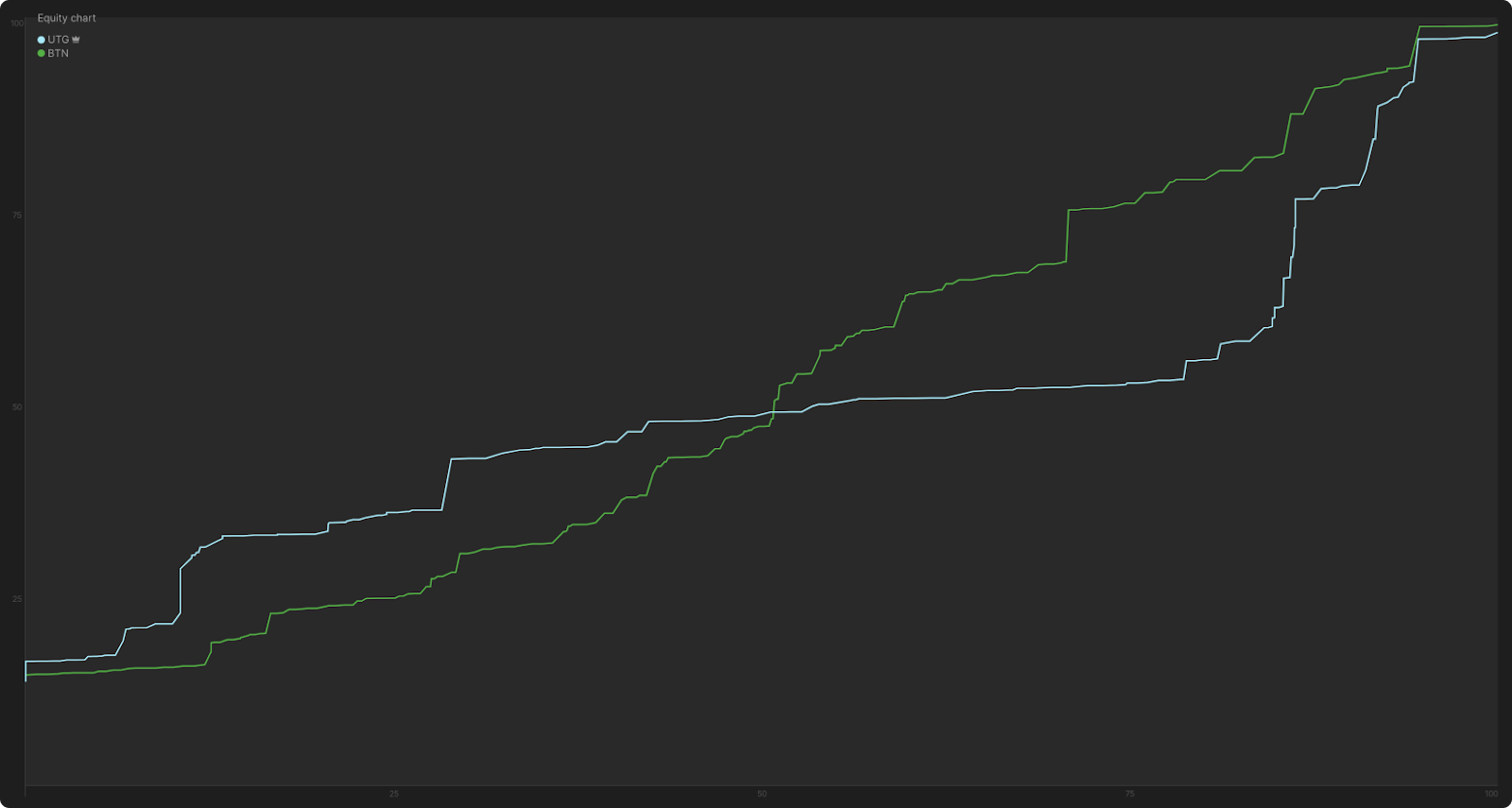
The worst thorn cards for BTN are the ace, the king, and the cards that cover the streets. While they are not there yet, BTN can continue to bet good pair on the value. After a bet of 55% of the pot on the turn, BTN can push to the value even 
 on the river
 .
.
The most difficult to draw thorns are those that are in the middle, for example , where there is no obvious dominance of bet or checks in the BTN strategy:
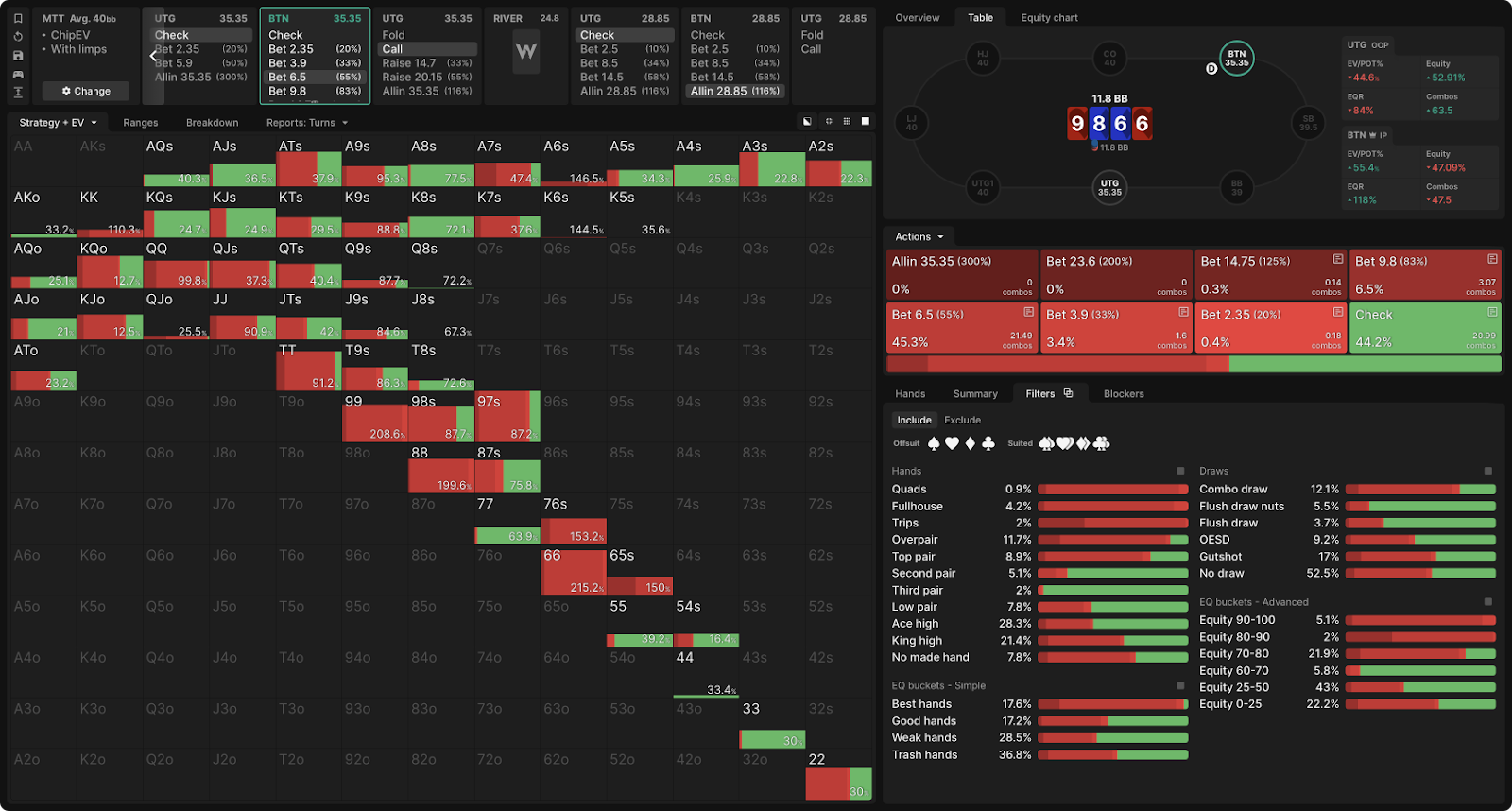

Important heuristics:
BTN will never slouple its strongest hands.
This is typical for dynamic boards. Many of BTN's strongest hands are overpairs who can lose value on the river. Even quads and full houses are betting, because a significant part of the UTG range consists of hands that want to watch the river for reinforcement.
BTN rarely bets with flush draw.
Its best bluff is overcards with one suit of backdoor flush draw, such as , which simultaneously block the range of UTG continuation and give a good potential for bluff on the river if the draw closes.
3. Conclusion
Barrel against the preflop raiser, who check and call on the flop, in fact, is not so scary. Even if the pre-flop riser range is not dropped, the pre-flop cold-color range after the bet on the flop remains more polar. The polar bet against the linear range should be familiar to you. When the cards on the turn and river do not enhance your opponent's range, you can continue to barrel the polar range using more geometric bet sizes on static boards.
Be ambitious in your Velu Beta!
Do not let the fear of getting into the monster prevent you from getting the maximum value from the opponent's many marginal hands. After the check-call on the flop, you can basically play bluff ketch, i.e. catch the bluff. If there is an understanding that you look trapped, you can call with good bluffcatchers. Also on many board with this SPR, one good pair will be enough to put on the turn and to push on the river on the value.