


Translated with the help of AI. We apologize for any errors and would appreciate your help in correcting them.
Translated by order of the educational portal
university.poker Source: upswingpoker.com
Playing a position against a player making a 3-bet is about playing to your advantage as a defending player. In this scenario, you will often not have the advantage of equity and the advantages of nuts combinations. You will only have a positional edge. This encourages you to play even more passively than you normally do as a defending player (on BB, for example) when you face aggression and force your opponent to make compromises. You reveal information by acting first on all the streets, bluffing, controlling the pot and squeezing additional equity out of marginal hands. A more solid stack depth increases your positional edge, as do more dynamic boards, so you need to evaluate these factors to determine the features of your particular hand in each specific situation.
1. Preflop vs 3bet
The following diagram shows the CO response to the 3-bet from the blinds at various stages of the tournament, at a depth of 50 BB stacks. The numbers will be slightly different when opening from different positions, but the patterns are the same. The templates will be different if someone equalized the open-raise, and then one of the blinds made a Squeeze. In such a scenario, a more secretive and aggressive game will usually be correct.
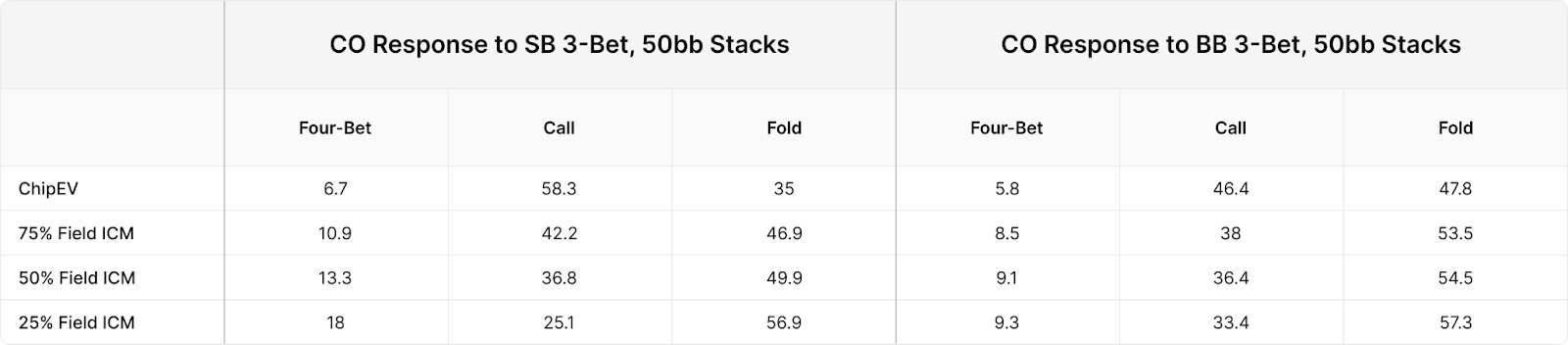
In the left column of the situation: chip EV medium, ICM medium 75% of the field remained, 50% and 25%.
Each of the two large groups is divided into 3 parts - the range of 4-beta, call and fold in %.
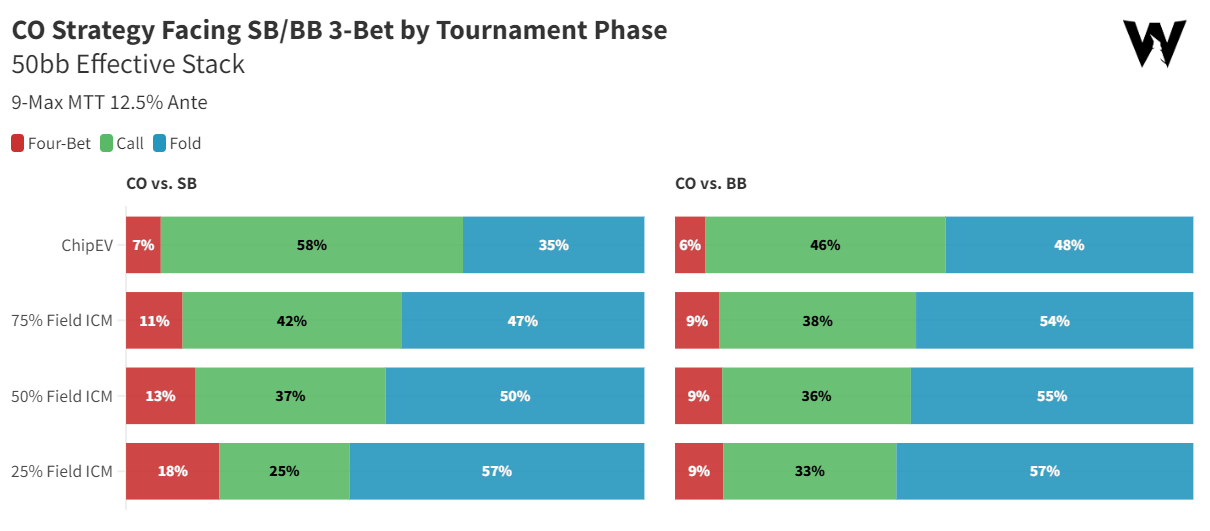
Call is an important part of your strategy even under pressure from ICM, which stimulates a more secretive and aggressive game. A higher risk premium results in fewer calls, more folds, and more raises (4-bets), as you might expect. But the magnitude of these differences varies dramatically depending on whether the 3-bet comes from SB or BB, which is perhaps even more surprising.
Your reaction to 3-bet depends largely on whether the 3-bet comes from SB or BB.
Indeed, there are several notable differences in how CO responds to 3-bet from SB or BB. In general, CO is more likely to have folditis and less likely to have 4-betitis against BB. His reaction to the 3-bet from BB does not change much at different stages of the tournament, especially compared to how much his reaction to the 3-bet from SB changes. Responses to 3-bet from BB remain relatively stable compared to responses to 3-bet from SB. This reflects differences in ranges, raise size, and incentives of the player doing the 3-bet. For SB, call is a less attractive option.
He receives only a small discount due to the fact that he already has part of the chips in the bank, while he does not close the trading circle on the pre-flop. Thus, he makes a 3-bet with a more linear range, even with those hands that are well played and through a call, in order to deprive BB equity, which is especially relevant as ICM pressure increases. BB call is very attractive. He gets amazing odds with his big blind and ante, and he doesn't have to worry about someone calling or raising the bet after him.
When he does 3-bet, he prefers to do it with a more polar range consisting of very strong hands that will be happy to go all-in preflop, and hands so weak that call with them is not particularly attractive. Thus, such hands are less likely to face a difficult decision if they receive a 4-bet. This more polar range encourages the BB to use a larger size at 3-beta, so the player opening the game will correctly drop hands he would not fold against the SB.
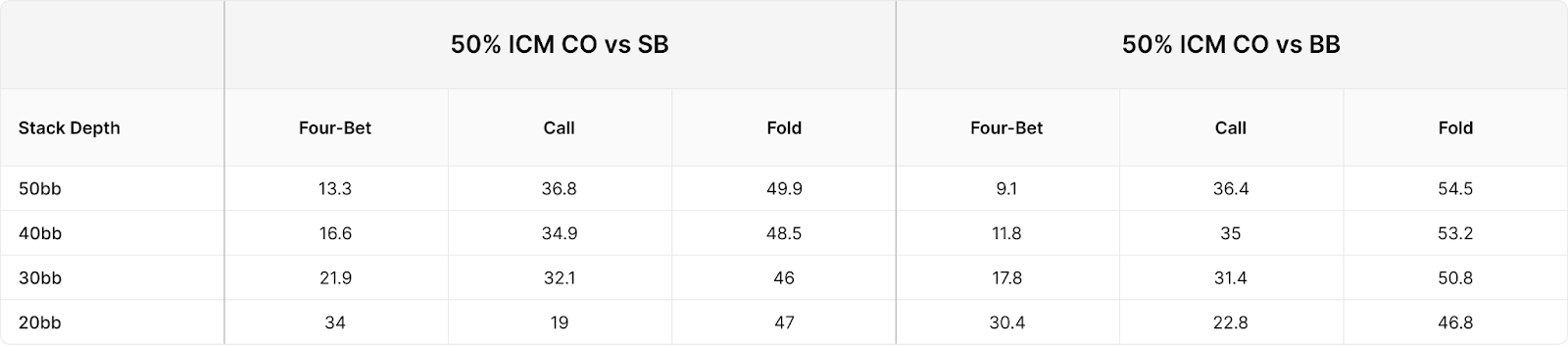
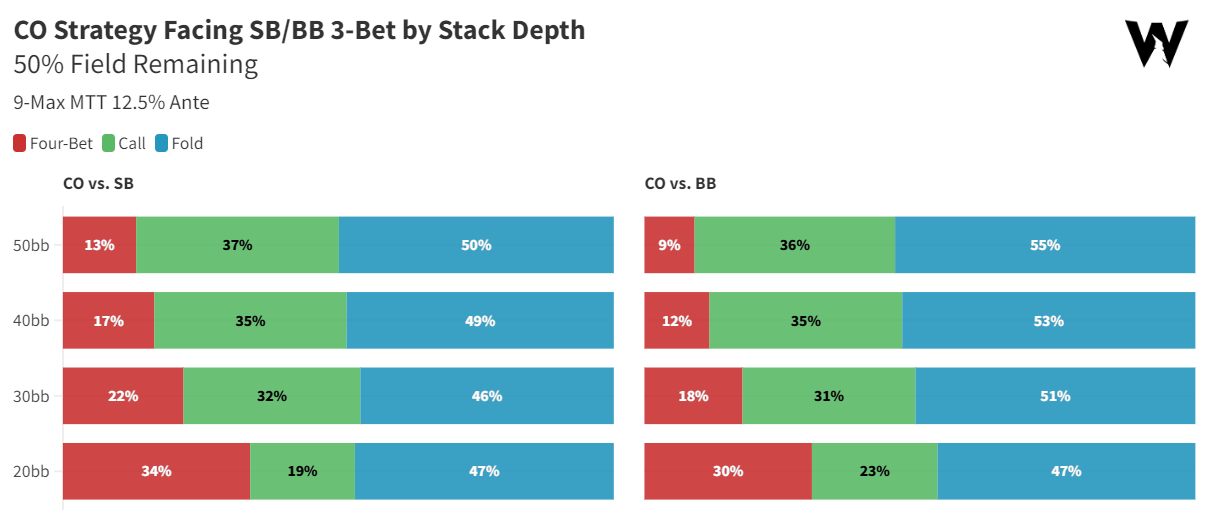
Another interesting trend is that the frequency of CO calls increases as the stacks increase. This is the opposite of what happens when an open racer receives a 3-bet from a player in position, which gives the key to understanding what is happening here. Playing on the post-flop is useful for the player in the position. The more money left to bet, the more his position is worth. Thus, the player outside the position (with a deeper stack) has more incentives to avoid playing on the post-flop, folding cards or making 4-bets.
As the stacks get smaller, the factor of being out of position becomes less and less important, making it increasingly attractive for him to take advantage of the pot's odds by making a call and seeing the flop with the hands he would fold in the deeper stacks. The post-flop game is more useful for the player in the position. Conversely, CO prefers not to complete the pre-flop giveaway when the stacks are deep because it expects to push its equity on the post-flop. That is, it collides with some weaker hands that it would fold in smaller stacks, but also with some surprisingly strong hands that it would make 4-bet if the stacks were smaller.
Here is his complete strategy in case of BB 3bet with 50bb stack and no ICM pressure:
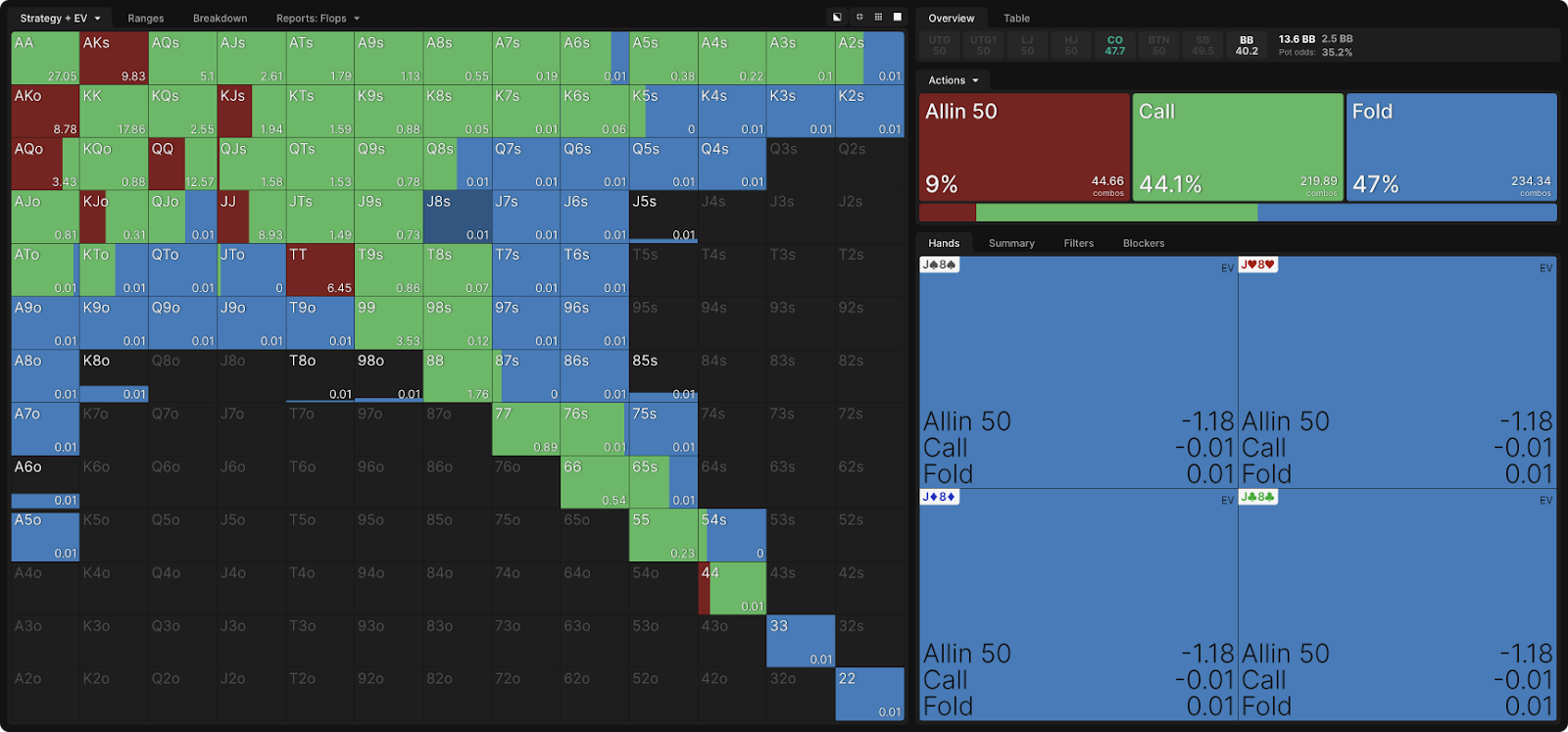

Suited and connector arms are best suited to profit from additional stack depth. Not only is the reward for the assembled straight or flush higher, but the deeper stacks also allow these hands to exert more pressure when floating and semi-bluffing with their draw. Even some offsuited broadway hands can call to the blinds who will not call to the BTN. Hands like ATo, which often turn into a top pair with a modest kicker or an average pair. The position allows you to keep the pot small and get out of it, in case of falling under dominate, as well as squeeze out additional equity on the showdown when you are ahead.
The lower SPR incentivizes the open raiser to defend his equity when he is ahead, rather than collide to potentially win even more on the post-flop.
With smaller stacks, the value of large offsuited hands increases, and smaller suited ones fall. If we reduce the stacks from 50bb to 30bb, the CO fold frequency will not change much, but the composition of the range that will continue to struggle will change slightly.
Smaller pair and suited connectors are now folding, and offsuited hands such as A9o and KTo are more likely to call:
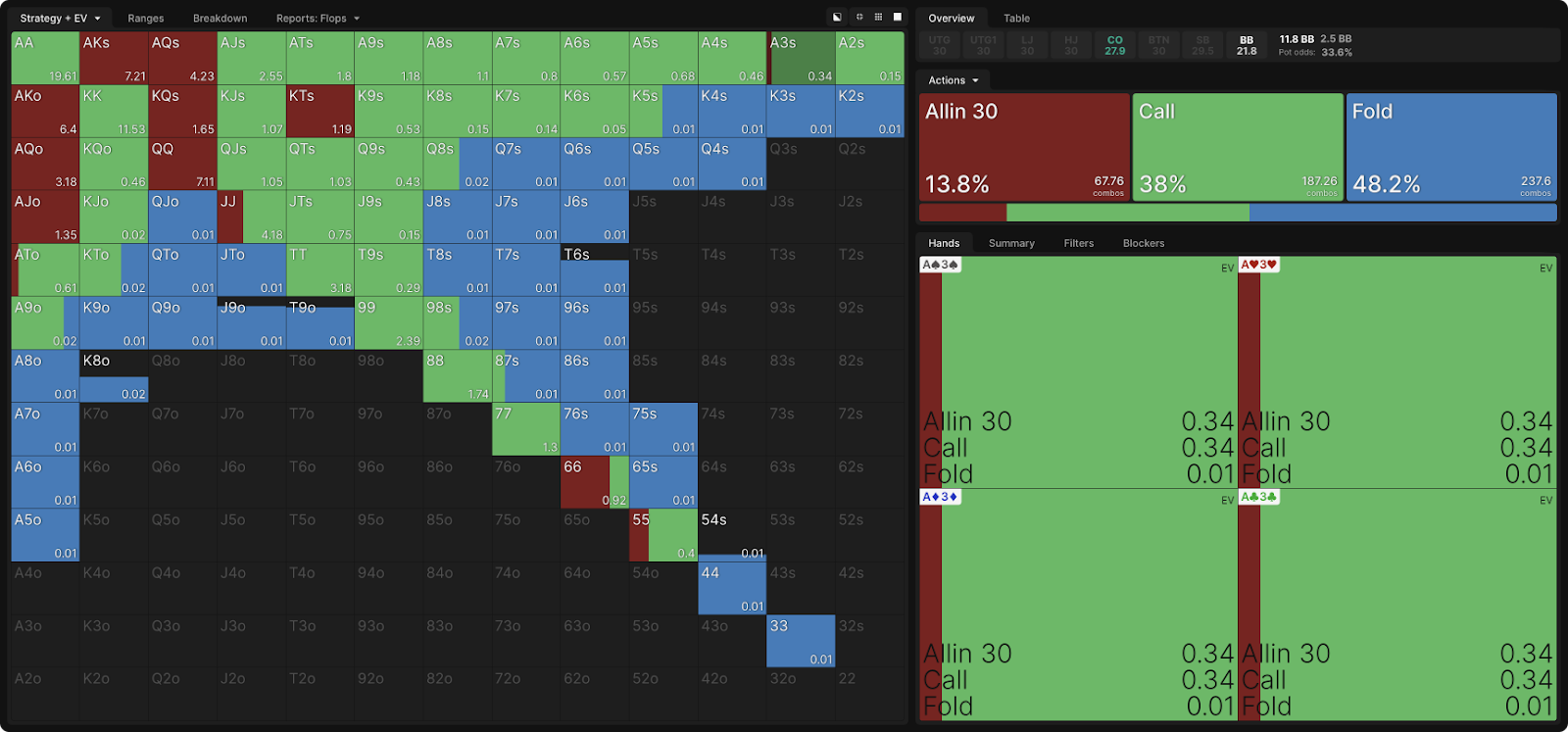
The biggest change we see is an increase in pushes with hands like AQ, AJo, and QQ. The CO push frequency increases as the lower SPR stimulates it to defend its equity when it is ahead, rather than collide to potentially win even more on the post-flop against dominant hands.
2. Game against counter-beta
After the 3bet call, you will most likely encounter a small counter-bet on the flop. This is by far the most likely action for 3-bet sweat for both SB and BB. Having smaller stacks, they prefer to place bets in the amount of 25% of the pot. With deeper stacks, they also place a lot of 50% pot bet, but your response to both options should be the same.
CO response to 25% c-bet from SB in 3-bet jar in 50bb stacks pot
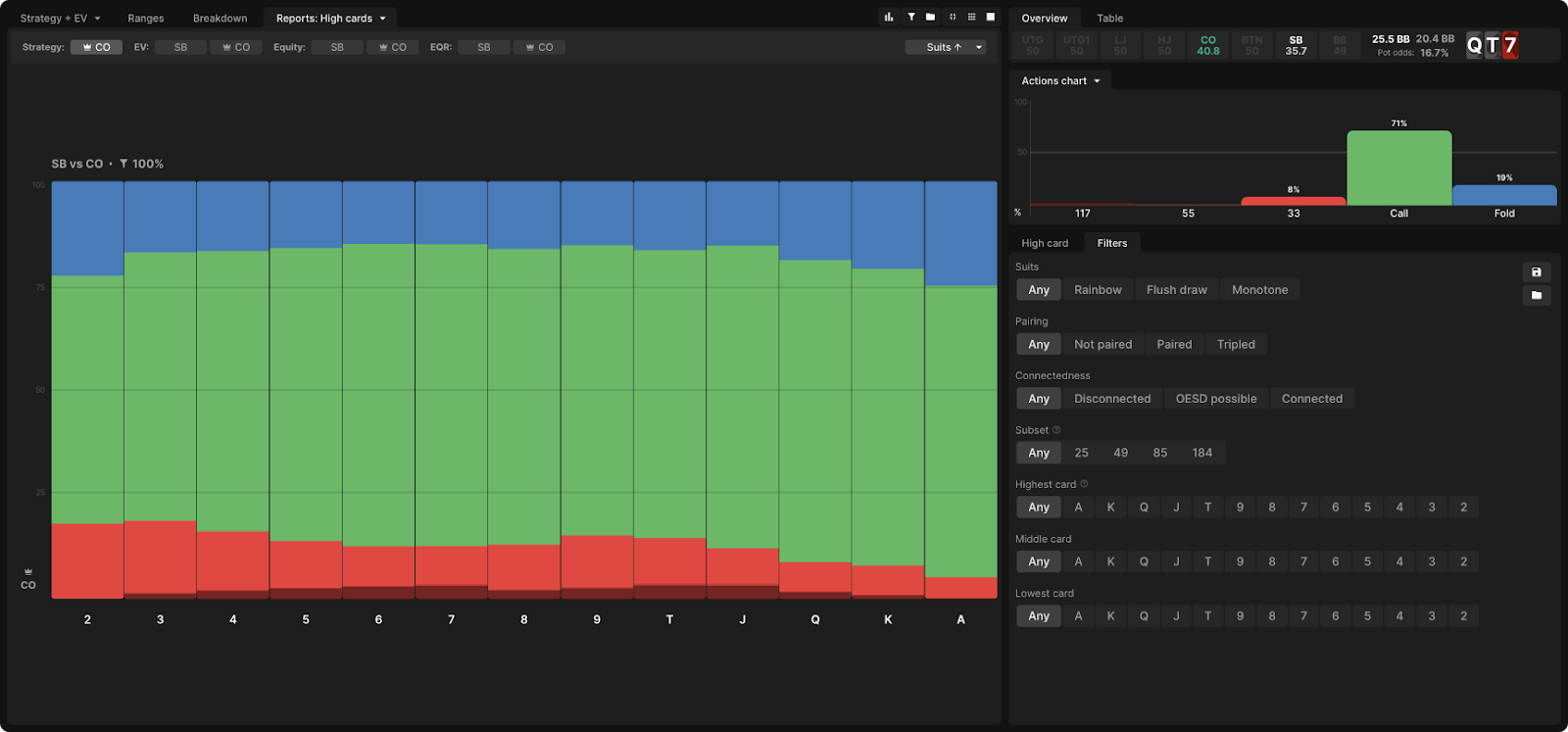
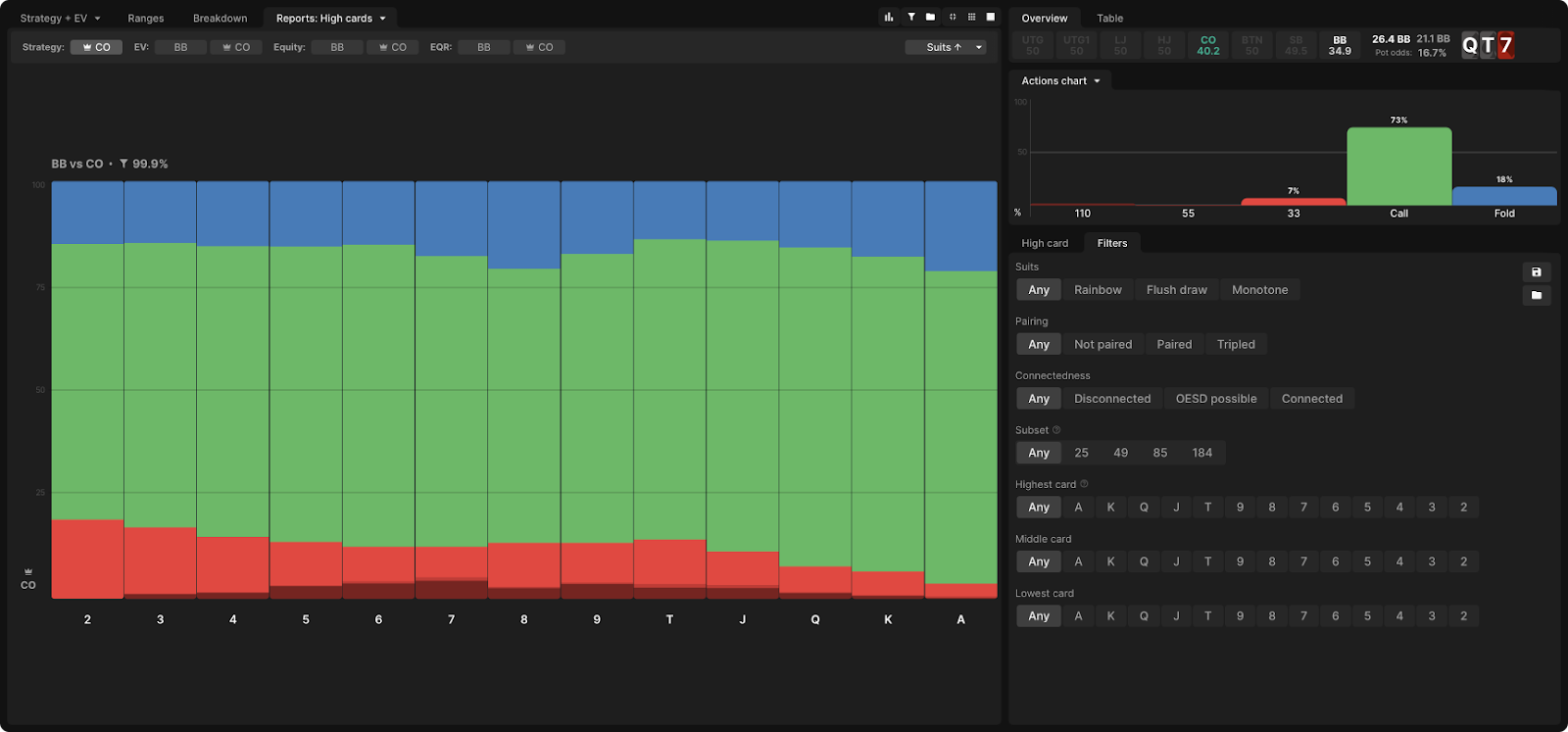
Basically, you need to call. Raise is a big part of your strategy on low-card boards, especially if they are more dynamic, but call is always your most frequent action. Like the preflop, playing poker on the late streets favors the player in position, so you tend to prefer that kind of finishing action on the flop. The more cards drop out, the worse for the preflop of the racer, because the big advantage it has over the collector is the predominance of the older pair in its range. The more cards on the board, the weaker these older pair are over. This is less true for low-card board cards, since a player making a 3-bet also has many unpaired overcards that can easily become stronger as a result of a high card on a turn or river. This is one reason why CO plays more aggressively on low boards.
A similar picture when playing against BB:
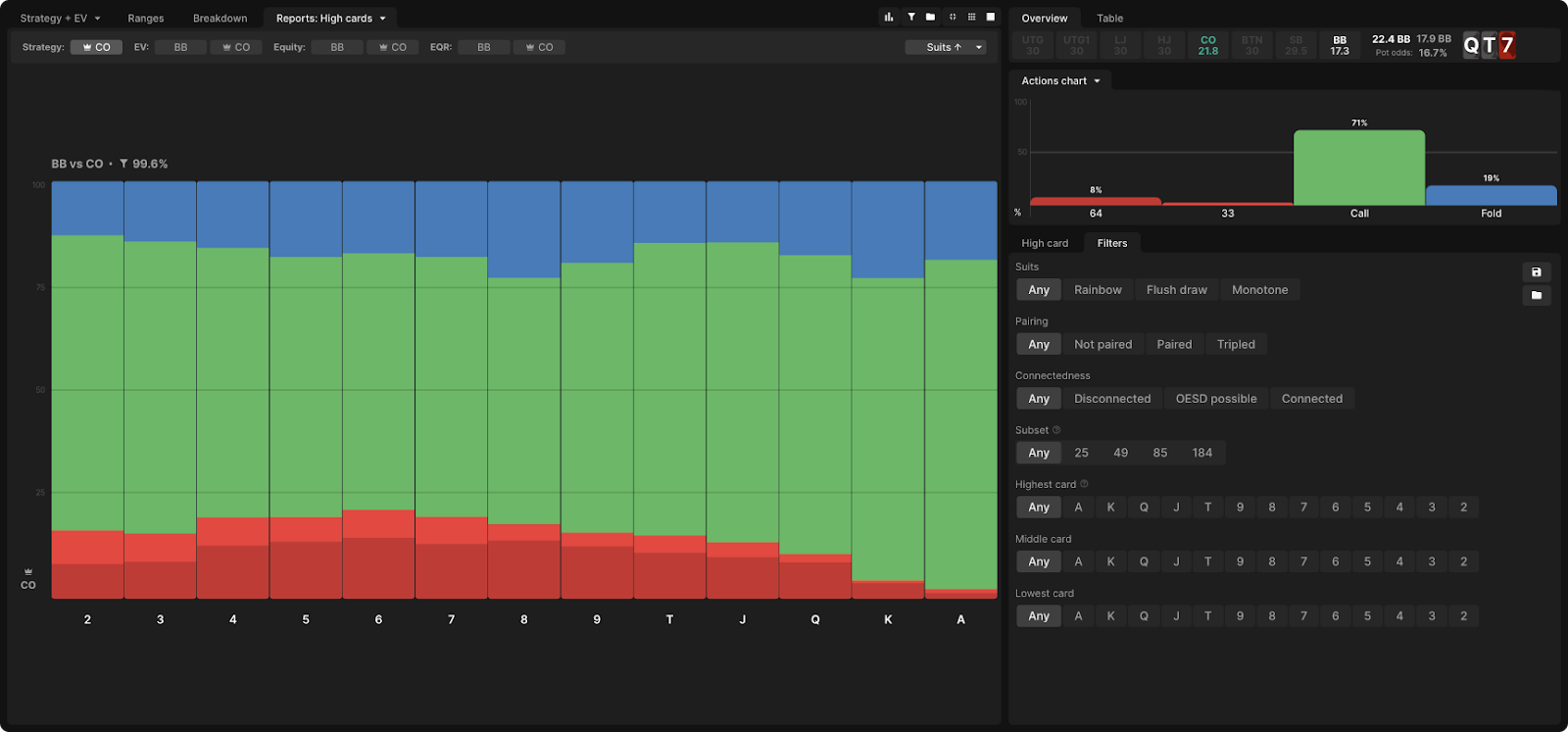
And with smaller stacks:
3. Playing on a static flop


 - a good example of a "rainbow" board, where even in the stacks of 50 bb the player making 3-bet prefers a small cbet, and the collider almost never makes a raise. CO doesn't actually get into MDF on this flop, despite some ambitious floats with hands like KJo and T8, with a backdoor flush draw. Board with an older ace is very good for a player doing a 3-bet, especially when they don't offer a lot of draw. Faced with a second barrel of 50% on the turn, the CO strategy is quite intuitive: it collides with any draw and most pair, but dumps its floats and the worst pair (low pocket pair), which now have only two outs to improve on the river.
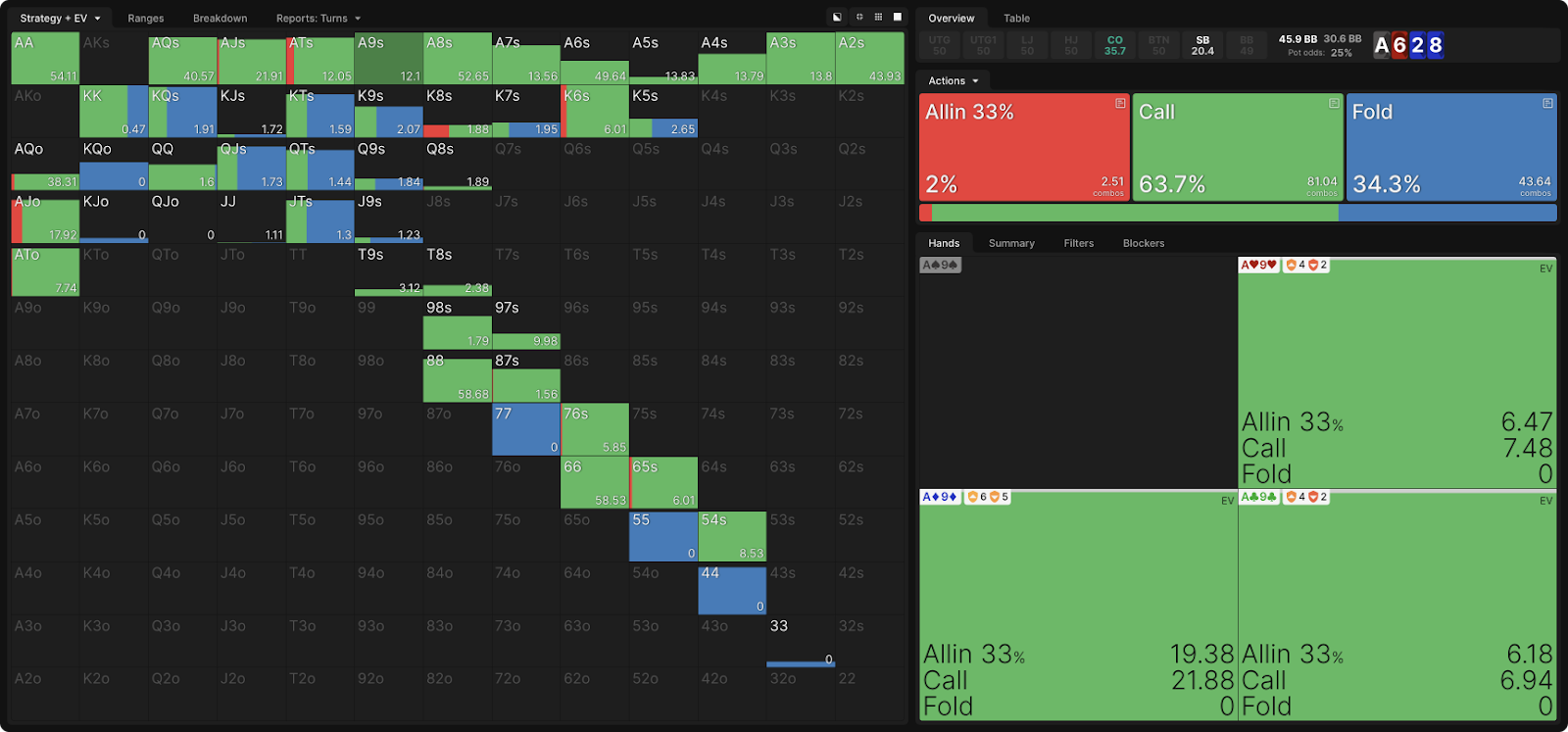
However, more often he encounters a check on the turn, and it is here that everything becomes more interesting.
- On this board:

SD starts betting with a polarized bet range.
A strong top pair or higher is the threshold for a value bet, while bluff for the most part does not come with a flush draw (many of them prefer to check in response so as not to be substituted for a raise), but from floats:
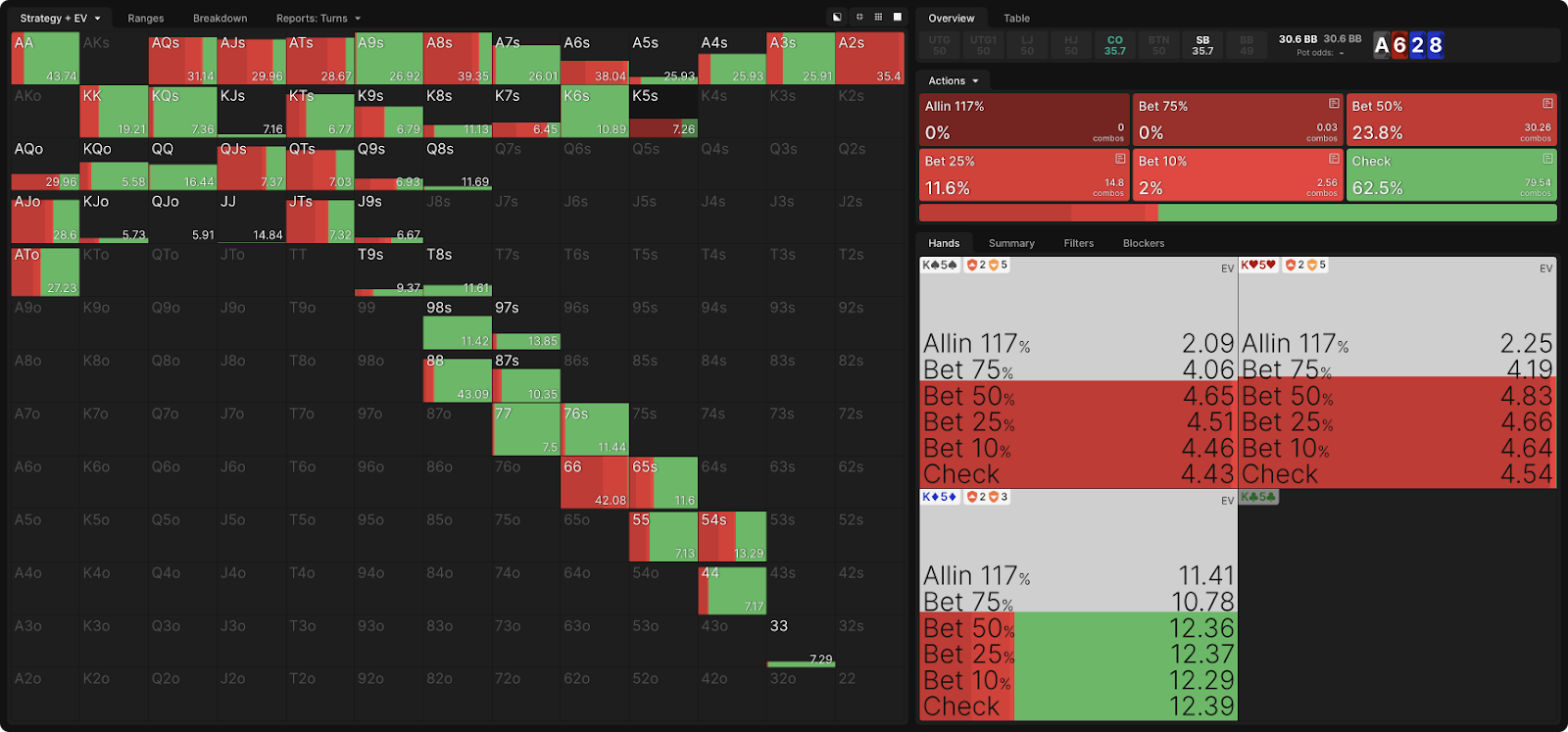
In the above example, you can see that the 
 hand that made up the turn flush draw mixes checks and bets (~30% by 70% in frequency), but K5 in other suits are 100% bluff bets.
4. Playing on a dynamic board
If we change the ace to a ten on the flop , the situation becomes much more dynamic. Especially in 3-bet-pote. Range is concentrated around large cards, so when a large card comes on the flop, especially an ace, both players will catch a large number of strong hands on the flop, which they will not be in a hurry to display. If there is no such card, then both players will receive a lot of hands on the flop with the potential for improvement on future streets, which makes protection and an obstacle to the implementation of equity by the opponent very important considerations.
In the 3-bet-pot, the range is concentrated around the higher cards.
Having received a cbet of 25% on this board, CO aggressively raises to protect its weaker top pairs. These hands are strong enough to go all-in now, but on many thorns they will lose their equity.
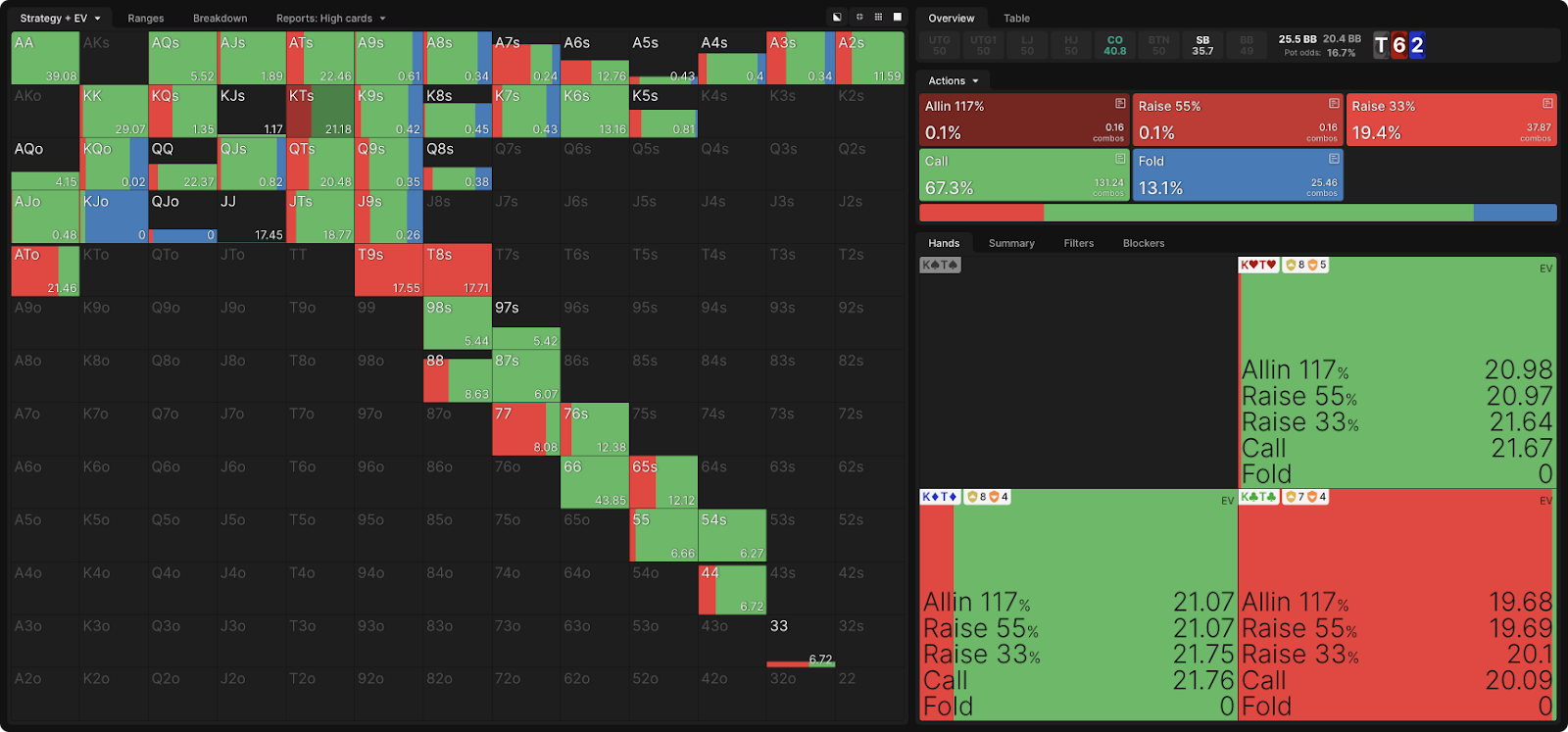
He also discards cards quite infrequently. Even with this frequency, SB can profitably bet any two cards. This is due to the fact that on a more dynamic board, SB does not have clean bluff and hands with virtually zero showdown valley.
- On the turn, the CO turn strategy basically follows the same logic as on the board:
It has a more robust raise range consisting mainly of strong but vulnerable pair (A8c is good enough to meet this requirement):
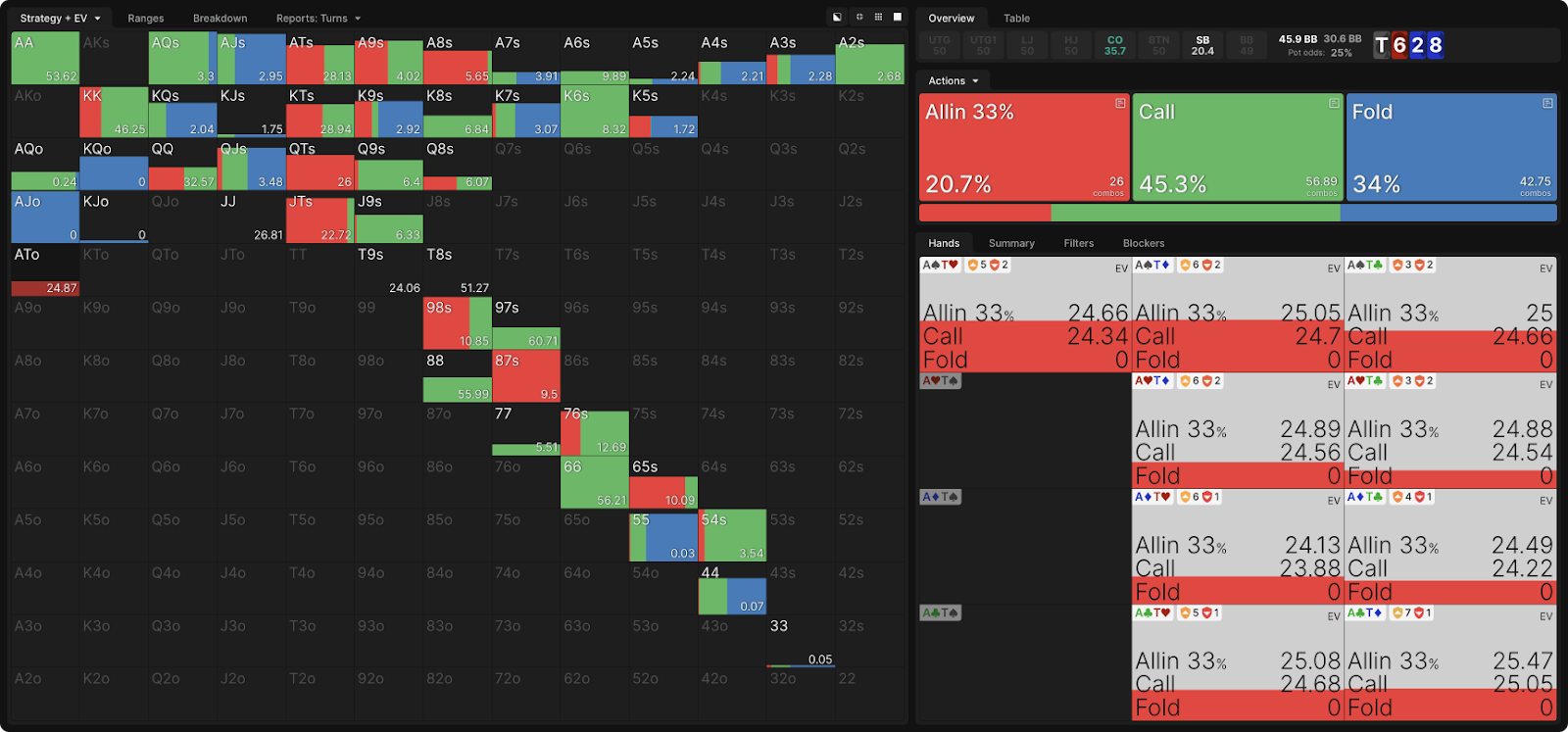
The hardest part here is probably the AQ call, even if that hand doesn't have a tambourine Diamonds. A call with small “pockets” may also seem risky, given the risk of a scary card on the river and/or a bet.
These scenarios are easier to summarize and understand if the following three factors are taken into account:
- Your intuition is right; you are likely to lose. These are your weakest calls, and against an equilibrium strategy they are hardly profitable. This means that if you get 3:1 chances, you will take about a quarter of the pot with them, whether it is through showdown with the best hand, bluff or Velu-beta. However, these callas have a place to be because of their price. (The situation becomes more unstable when you find yourself in an ICM environment, so you won't have to call preflop as often.)
- These hands work well as a trap along with your position (note that there is also a lot of AA and KK in this call range) to give your opponents difficult decisions on the river: did the ace on the flop only give you a top pair or maybe a set? Can I try bluffing into you on a blank river to squeeze out your AQs? If you do, then what is the risk of facing your sloppies or small pairs, which are now a little stronger, since no big cards came.
- Your opponent will also have many hands of medium strength that will want to make a check or block bet on the river. Your preflop position call can give you amazing Velha-bets on some rivers, while on others it will be possible to bluff well with some weak hands, which will complicate the life of your opponent without a position.
5. Conclusion

Playing against a strong 3-bettor range is always scary, but having a position helps a lot. It's also helpful to remember that your goal isn't to maximize your chances of winning the pot. On the contrary, it is an attempt to make as much money as possible. You have a weaker range and you should expect to lose more banks than you win, and that's fine because you got a good price for a preflop call.
Rather, your goal is to give your opponent difficult decisions. When you call, as is often the case before and after a flop, the opponent doesn't know if you're playing slow play, floating, or hoping desperately for a cheap showdown with a marginal pair. He will also not know whether this flash card or overcard on the turn helped your hand or vice versa - interfered. This, in turn, makes it difficult to determine whether to place a bet again, make a check-call, or make a check and fold the cards. Sometimes such a tribetchy is guessed correctly, but for the most part he is rarely 100% sure of the correctness of his decision. This will be your weapon in such situations.