

Translated with the help of AI. We apologize for any errors and would appreciate your help in correcting them.
According to the results of a survey in the Telegram chat, the topic of stability in life and profession worries many. This is not surprising, because in most cases the poker player himself is the manager of his time, the creators of his mode of the day, week and month. Also, players in tournament poker face protracted downswings and various sub-optimal psychological states.
1. Balance of life spheres
Achieving stability is more about personal effectiveness than psychology. It is for this reason that many people have difficulty achieving stability, since personal effectiveness is accumulated through years of hard work on oneself and on the methodology for achieving results in different spheres of life.
Without specific targeted training, very few will be able to achieve a high level of efficiency.
As a result, most people have difficulties with stability in life, and its absence gives rise to many destabilizing emotions that accumulate and lead a person's psychology to a suboptimal state. It's like a vicious circle. I am already joining here as a psychologist, and I can help you find conflict zones in your life and conduct harmonizing work in these areas. This will allow you to get a charge of strength and motivation for further work and create a more stable state.
Balance of life spheres | |
|---|---|
Family (relationship) | Work |
Work | Recreation (hobby) |
Money | Health |
I (the family) | Friends |
Material | Spiritual |
All these areas are interrelated and important for the promotion of each other, for personal growth and development.
If the family is on the axis
If you choose a career and do not give proper time to your family, then gradually tension will begin to accumulate in this area and eventually family problems will begin, which will necessarily have a negative impact on your career and undermine stability.
If there is work on the axis
Rest will be an excess in the direction of work, then exhaustion and burnout will begin, which ultimately leads to a lack of strength to work further, a decrease in the quality of work and demotivation and a lack of stability in both work and rest. You need a healthy balance.
Quieter you go - you will continue. And, in turn, if a person rests more than necessary, and does not know how to work systematically, this deprives him of stability in professional development, in personal growth, and therefore in life as a whole.
2. Checking the balance in your life
In order to understand the balance in your spheres of life, you can draw your own balance wheel by breaking the circle, as in the figure, into zones and putting a value between 0 and 10 of the development of each sphere in your life. Then you need to connect all the dots together and look at the resulting picture. Is your wheel round? Are you satisfied with these indicators? Or is the wheel not quite round? A square wheel or any other – will not go. Imagine that you are a car, it is important for the car that the wheel has the correct shape, so it will drive normally. If something happens to the wheel on the car, then it is changed, repaired, inflated, but they do not continue to ride on the wrong wheel. So why not be guided by this rule in your life?
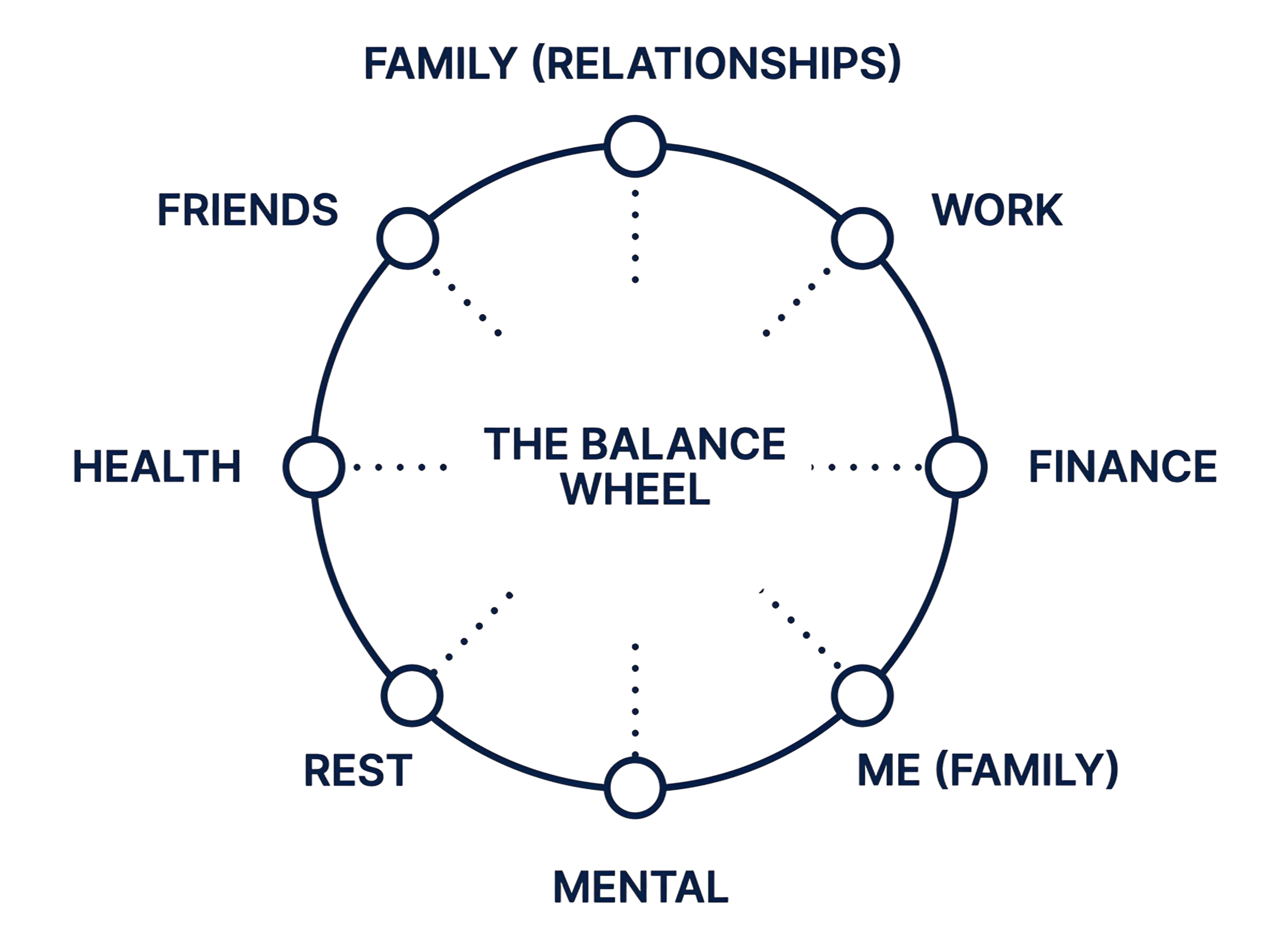
If some of the spheres in your life sink, have an imbalance – all this can be disassembled at a session with a psychologist, to understand how to tighten the sphere in order to make your wheel "go", to set in motion spheres that are completely at zero. Of course, some or other people may more or less prioritize different areas from this circle. This is normal. But if you have a fairly strong imbalance in your life, it will somehow create a certain tension over time that will not contribute to stability in your life.
3. Character traits leading to stability
Discipline(also self-discipline, organization)
A character trait that can be developed, which is responsible for the ability of a person to comply with the rules of work and norms of behavior. A very important trait in the profession of a poker player.
Time management (timing management)
It is an action or process of exercising conscious control over time spent on specific activities that specifically increases efficiency and productivity. Effective management requires the following actions: planning, goal setting, delegation, time analysis, organization, compilation of lists and, of course, prioritization taking into account different areas of life.
Psychological balance
It reflects your ability to express and experience all feelings and emotions, talk about your states and understand them in time, be able to adapt to environmental circumstances. As well as the ability to separate your actions and decisions from the emotional state, so as not to be guided by emotions during decision-making. To achieve psychological and emotional balance, it is necessary to work through tense areas in personal life and relationships with people and yourself. It is very important in psychological practice to work out a relationship with mom and dad, these are deep archetypes from childhood that affect our whole life. Here, the best recommendation is to work through this issue with a professional psychologist.
Continuous education and self-education.
Education is our fuel for moving up. Living conditions are constantly and rapidly changing, if you stop, the world will not wait for you. You may be stable now, but if you stop, it will most likely go away.
Work on yourself, your life and psychology in the same way as you work on a poker game, because everything in our lives is interdependent, different spheres of life influence each other. Your earnings in poker are related not only to the strategy of the game, but also to the rest of your life.