

Translated with the help of AI. We apologize for any errors and would appreciate your help in correcting them.
What this article is about
A long poker series tests more than just a player's technical level. Several weeks of intensive play gradually build up fatigue, intensify the emotional response to variance, and reduce decision-making quality. In this article, poker psychologist Sofi examines how to prepare mentally for WSOP Online, maintain concentration over the long run, recognize tilt in time, and recover between sessions so that you can continue playing your best poker by the end of the series.

WSOP Online is one of those series for which players clear their evenings in advance, rearrange their schedules, and open the client with an entirely different level of expectations.
The series takes place on GGPoker. Over six weeks, official WSOP gold bracelets and large prize pools are up for grabs. The scale of the series itself creates additional pressure: every tournament starts to feel slightly more important than usual, every elimination slightly more painful, and the desire to “play this series well” gradually turns into a demand you place on yourself. And this is exactly where the part of preparation that players often pay less attention to than strategy begins.
You may know your ranges well, review your game in a solver, and select tournaments carefully, but if your concentration falls apart by the third week, irritation becomes a background state, and every decision feels like an exam, technical preparation is no longer enough. WSOP Online is not only a poker series. It is a long-distance test for your mind. Let’s figure out how to get through it so that you can still play your best poker in the final tournaments.
1. Before the first hand: prepare more than just your strategy
Separate the goal from the result
“I want to win a bracelet” is a wonderful dream and a rather poor working goal.
The reason is simple: you cannot fully control the result of an individual tournament. You can make strong decisions, choose good sizings, maintain concentration, and still bust. If the only criterion for a successful series is the result, your brain quickly starts to perceive every loss as proof that something is going wrong. So, before the series starts, formulate several goals that are genuinely within your area of control.
For example:
- make decisions based on the available information rather than under the influence of the previous pot;
- mark 3–5 key hands for analysis after the session;
- notice the first signs of tilt and take a break before the emotion starts determining your play;
- maintain your usual sleep and recovery routine even during the busiest weeks.
The process does not guarantee a bracelet. But it is the quality of the process that determines how often you will give yourself a chance to win one.
Create a mental plan for the series
In poker, many difficult situations are predictable.
You will almost certainly lose several coin flips in a row. At some point, you will suffer a painful bad beat. You will spend several hours without good starting hands. You may go deep in a tournament and bust at the moment when you have already started imagining the final table. The exact moment is unknown. But the type of situation can absolutely be anticipated.
So answer several questions in advance:
- What will I do after three unpleasant all-ins in a row?
- How will I bring my attention back if I receive almost no playable hands for several hours?
- What signs will tell me that I am no longer analyzing decisions and am simply clicking buttons?
- What will I do after an especially painful elimination?
- How will I behave if a deep run ends differently from what I expected?
This is a way to avoid making decisions about your state at the very moment when your emotions have already taken control.
Know your own tilt triggers
There is no single type of “poker tilt.”
Injustice destroys one player. Another is undone by their own mistake. A third is irritated by weak opponents who win while making poor decisions. A fourth handles bad beats well but starts falling apart after several hours of card dead.
So instead of asking yourself “Am I tilting?”, it is more useful to understand:
what exactly triggers my tilt?
Take several of your most emotionally difficult recent sessions and identify recurring situations. Choose the three strongest triggers and come up with a response to each of them in advance.
For example:
- Trigger: lost a large pot after getting it in ahead.
+ Action: take your hands away from the mouse, take several calm breaths, and remind yourself: “The result of the hand does not change the quality of the decision made.”
The more specific the scenario, the easier it is to use it during play.
Make your playing environment part of your preparation
Online poker creates a strange situation: you can play the most important tournaments of the year in the same room where five minutes earlier you were watching YouTube, replying to messages, and dealing with household matters. Your brain is then expected to figure out on its own that things are serious now. You can give it a little help. If possible, set aside a place that will be associated specifically with playing during the series. Even if it is just a certain part of the table.
Create your own session-start ritual: change clothes, put away your phone, prepare water, open the necessary programs, and sit for a few minutes without informational noise. Some time before the tournaments start, it is better to put away social media, news, and household tasks that can wait. If you do not live alone, discuss in advance with those close to you the periods when it is especially important for you not to be distracted. Of course, perfect silence is not necessary for everyone. Some people work perfectly well with music, household noise, or a child nearby. There is no universal standard here.
The main question is different:
under what conditions are you personally able to maintain high-quality attention for a long time?
2. During the series: protect the resource you use to make decisions
Treat attention as a limited resource
In a multi-hour tournament, concentration rarely disappears instantly. It fades gradually.
You stop noticing the table dynamics. You ask yourself about your opponent’s range less often. You begin automatically repeating standard lines. At some point, you open a second tab, then your phone, and then realize that you have been playing almost on autopilot for the last twenty minutes. Periodically bring your attention back to the present moment.
Actually rest during breaks: stand up, walk around, drink some water, and look into the distance for a few minutes. But do not turn a five-minute break into five minutes of Telegram, news, and yet another stream of information. A break is not meant to have your brain switch from one screen to another. Before a difficult hand, you can also use a very simple breathing technique: a calm inhale for about four counts and a longer exhale. The goal is not to enter some special state. You simply need to bring your attention back from the emotion to your body and the decision at hand for a few seconds.
Manage your energy, not just your time
You can sit at the computer for ten hours. That does not mean you are capable of making decisions of the same quality for all ten hours.
During a long series, pay attention to the basic things that players strangely start treating as optional precisely when they are most necessary:
- drink water regularly;
- do not play a long session while hungry;
- choose food that allows you to maintain concentration comfortably;
- monitor your caffeine intake;
- do not try to compensate for lack of sleep with another cup of coffee and willpower;
- maintain at least an approximately stable sleep schedule.
Music, white noise, or silence can also affect concentration. Instead of looking for a universal “correct” option, observe yourself. What helps you think? And what merely makes a long session less boring while quietly taking away your attention? These are not always the same thing.
Reduce internal pressure in the later stages
The fewer players remain, the easier it is to forget one simple thing: this is still just a poker hand.
When a final table, a major pay jump, or potentially your best result in a long time is nearby, every decision starts to feel emotionally magnified. A player may become excessively cautious out of fear of making a mistake. Or, conversely, start forcing the action because they want to end the tension as quickly as possible. In moments like these, it is useful to verbalize the decision.
Say to yourself:
- “What range does my opponent have?”
- “What does their line represent?”
- “Which worse hands will pay me?”
- “Which better hands will fold?”
- “What would I do here if this were an ordinary tournament?”
Questions like these bring you out of the story “I’m almost at the WSOP final table” and back to the task you actually need to solve.
3. Between sessions: a series is not won only at the tables
Analyze your game without judging yourself
After an unsuccessful session, the brain loves to produce a deep strategic analysis at roughly this level: “What an idiot I am.”
There is little benefit in that. It is much more effective to choose several decisions you were unsure about and reconstruct the context.
- What did you know at that moment?
- How did you perceive your opponent’s range?
- What did you feel?
- How tired were you?
- Why did you choose that particular action?
Then ask the main question:
If I found myself in the same situation again with the same available information, would I make the same decision?
Poker requires you to evaluate the quality of a decision separately from the result. Sometimes a good call ends with a lost pot. Sometimes a terrible call brings a huge stack. If you allow the result to rewrite your assessment of your decision every time, learning quickly turns into chaos.
Leave poker-free days in your calendar
It is impossible to play at maximum intensity every day for six weeks and maintain quality.
And you do not need to try. Set aside at least one full day of rest per week in advance, and more when your workload is high.
Ideally, it should genuinely be a day without poker:
- do not open the client;
- do not check the series results;
- do not review hands;
- do not read poker discussions all evening;
- do not spend your “day off” watching other people’s final tables.
It is useful for the brain to receive periodic proof that the world still exists beyond the tournament lobby. After proper recovery, not only does your energy return. Your interest in the game returns as well.
Monitor your own state
During a long series, your body often notices fatigue before your conscious mind is ready to admit it.
Pay attention to:
- How are you sitting five hours into the session?
- Are you tensing your shoulders?
- Are you starting to grip the mouse more tightly?
- Does your breathing become shallow in large pots?
- Do you feel the urge to make decisions more quickly?
- Are things that did not bother you at the beginning of the session starting to irritate you?
These are not minor details. They are early signals that your resources are running out. Let each week of the series improve your system a little: a more comfortable chair, better lighting, food prepared in advance, calmer breaks, and a clear sleep schedule. This is how a professional environment around the game is built.
Your most consistent opponent in the series
Throughout WSOP Online, your opponents, stack sizes, buy-ins, and tournament stages will change at the tables.
But one opponent will be present practically every day. Your own fatigue.
- Anxiety.
- Irritation.
- Impatience.
- The desire to immediately win back a loss or, conversely, to protect the result after a big win.
So prepare for a long series not only technically. Create your rituals. Learn to notice tilt before it becomes behavior. Separate the result from the quality of the decision. Rest before your body forces you to rest. Then even a bracelet-free series can turn out to be a very good series. Because the true measure of a player’s progress is neither the absence of emotions nor endless calm. It is the ability to continue making strong decisions when the emotions have already appeared.
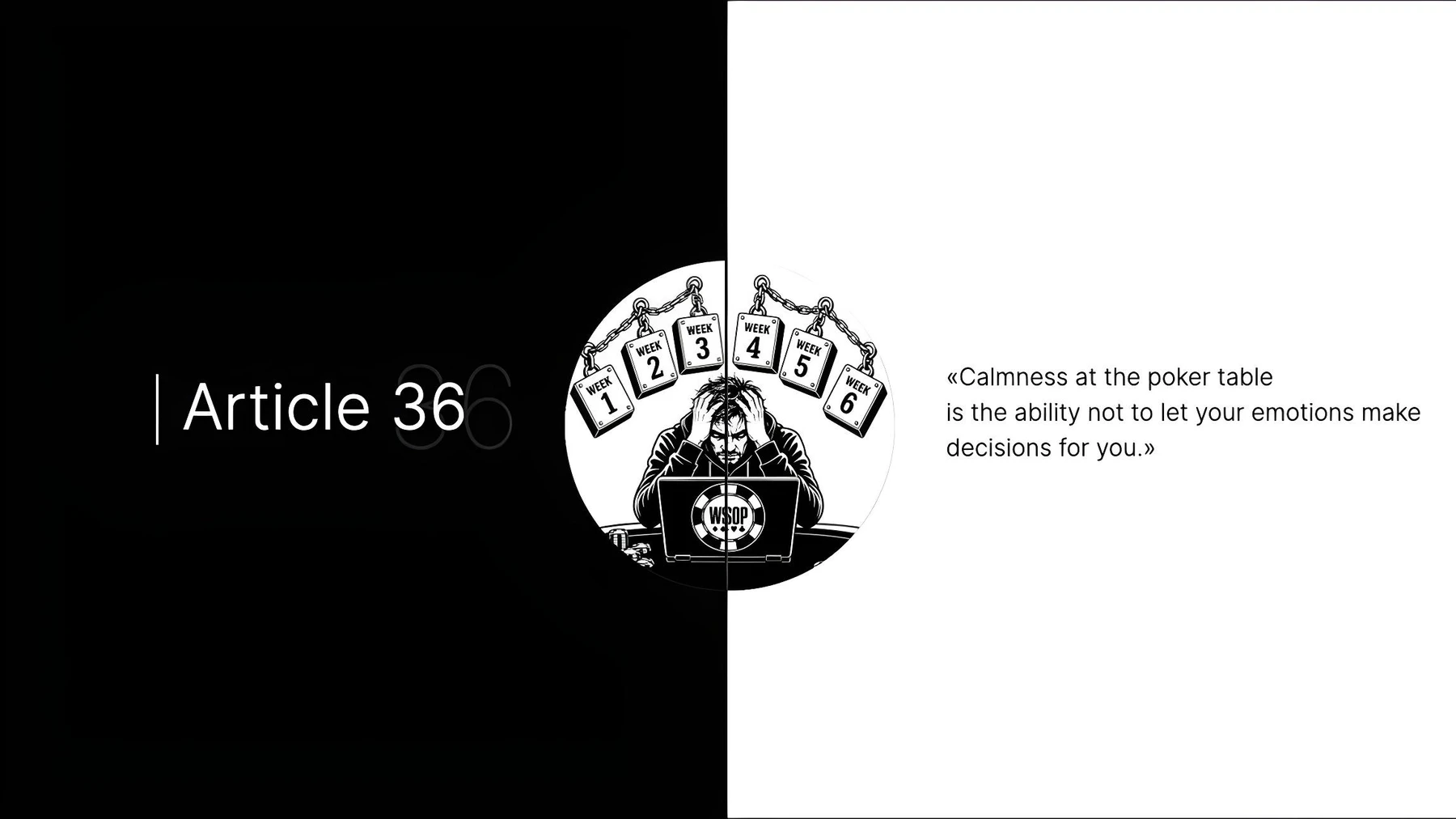
Calmness at the poker table is the ability not to give your emotions the right to make decisions for you.
4. Conclusion
WSOP Online cannot be completed on the enthusiasm of the first few days alone. The longer the series, the more important it becomes not to be able to play a lot, but to preserve decision quality from week to week. Mental preparation works here just like technical preparation: predefined goals, an understanding of your own triggers, working rituals, proper breaks, and honest observation of your state reduce the likelihood that fatigue and emotions will start controlling your game. You cannot control the cards, the results of all-ins, or how far you will go in a particular tournament. But you can control the state in which you make decisions. Over the long run, this becomes one of a player’s main advantages.