


Translated with the help of AI. We apologize for any errors and would appreciate your help in correcting them.
Many players face problems when playing in not very deep stacks. Some make expensive mistakes and fly out, others underplay potentially profitable situations and overfold. In this article, we will try to figure out in more detail how to play correctly when our stack in the tournament drops to 26-40 blinds.
1. When the right depth occurs
Here I would like to immediately make an important reservation: we will consider situations characteristic of the later stages of the tournament.
We understand that there is a chance to be actually with a small stack and at the beginning of the event if you lose a large pot. However, this will not happen as often. Therefore, today we will focus on those stages of the game where the average stack of the tournament will be in the range of values of interest to us. The most characteristic stages will be playing prebabble, bubble and further (that is, from the beginning of the ITMzone to the final table inclusive).
You don't need a huge stack to make your poker multifunctional!
Many amateur players who played even very loosely in the early stage of the tournament are severely clamped when their stack becomes less than 40 blinds. They begin to play much more secretly, thereby skipping potentially profitable draws. I'm used to acting exactly the opposite! Use a more tight-agressive style of play at the beginning of the tournament and try to put pressure on the table in its later stages. And here we come to a very important aspect.
2. Your friend fold equity
I remember back in 2020, I was drawing lines on a large canvas. None of my family could understand what exactly I was drawing.
And this is what it looked like:
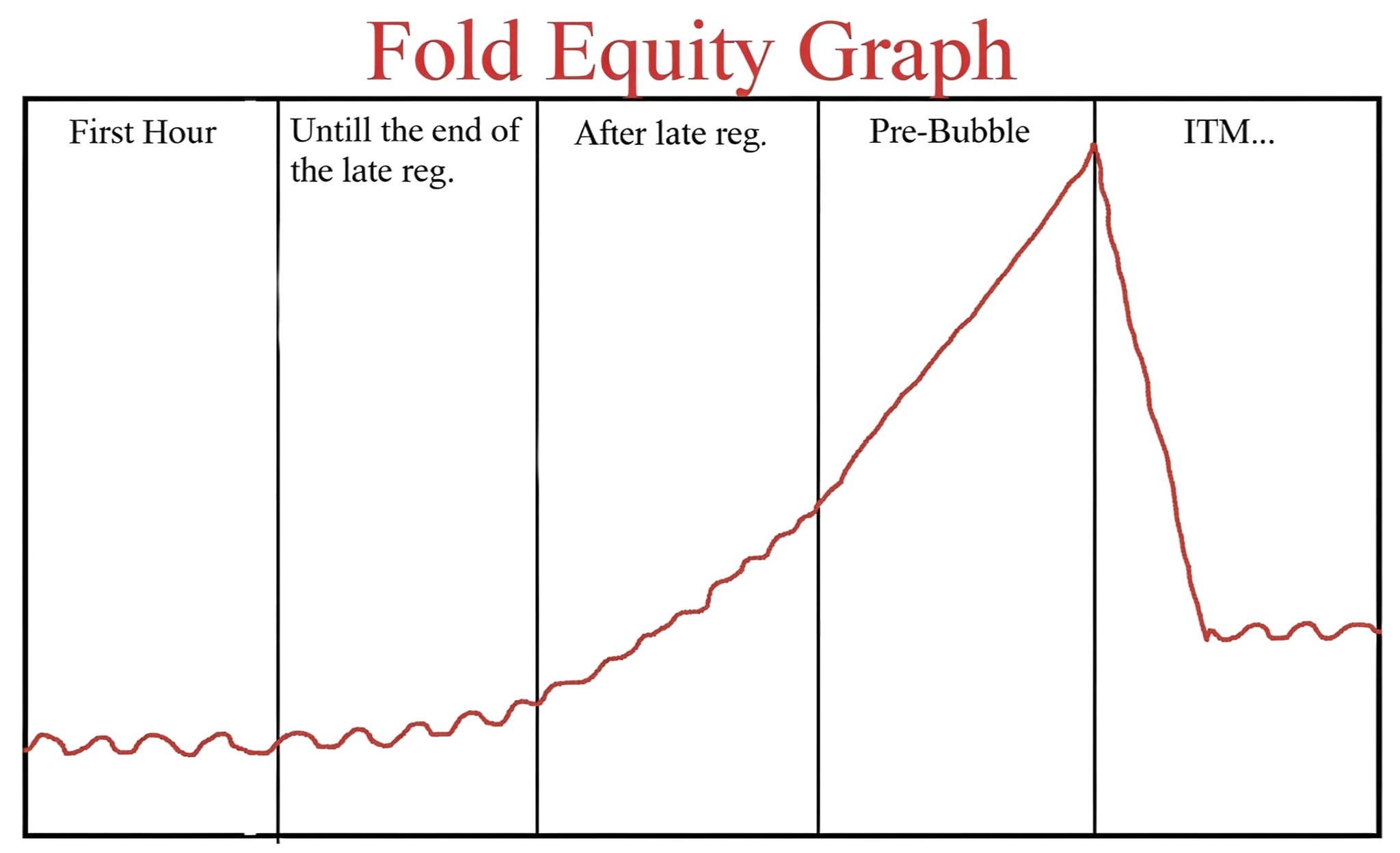
It was a fold equity schedule, which works according to the same scheme in almost any tournament. That's why I prefer to look for potentially beneficial situations in later stages! The first such situation is presented to us on the prebabble and bubble of the tournament, and, as we can see, immediately after the start of the ITMzone, it falls rapidly. At this stage in the game, as a rule, there are a lot of short stacks that have already guaranteed themselves minimum prize money. These players start playing much more actively, restyling and open pushing to either get a doubling or leave the tournament double. But a little later, when the pacemakers become more significant, and the short stacks become somewhat smaller, we will again find ourselves in a favorable zone where fold equity will again bring the aggressor potentially high expected value.
That is why it is very important to build the concept of your game in such a way that in the late stages of the tournament you find yourself on the side of the aggressor as often as possible, rather than a colleague.
I outlined the strategic aspect above. Let's take a closer look at the practical part.
3. Multifunctional stack
Which stack do I call multifunctional? Such a stack primarily provides a variety of draw lines that are available to you.
- Playing from the attacking line, we still want to actively look for situations that are beneficial for double barreling.
- We still have the opportunity to play cold-call in EP-HJ positions.
Of course, this is a very narrow range, but such a range is more likely dictated by the specific conditions of this situation than by the insufficient depth of the stacks. In particular, in stacks of 20 bb or less, the solver no longer finds suitable cold-call hands in positions such as EP+1 or LJ.
- At the lower boundary of the depth of the stack we are interested in, juicy restyling situations appear. They will work great primarily due to a fairly high fold equity.
I know the strategies that some reg players use, in which it is sometimes possible to find restiles and 35-40 bb, but I am not a fan of such. Since on the one hand we do not want to play too secretly, but on the other hand your open-raise in such stacks is already a more expensive investment, we need to think over the opening range from early positions.
4. What we will open
If we think about it as a percentage, opening in a 100 bb stack with a regular mini-raise, we invest only 2% of our stack in the game. But if your stack is only 40 bb, the opening raise will cost 5% of the chips that you have left. It should also be understood that opening, for example, from UTG, we will not be able to get too high fold equity simply because there will be 7 more players on the standard 8-max table after us who have not said their word. Therefore, it will be quite more reasonable to open the range by a few percent narrower than in deeper stacks. Especially for this article, I have prepared two versions of such discoveries for comparison.
Here's what they look like:
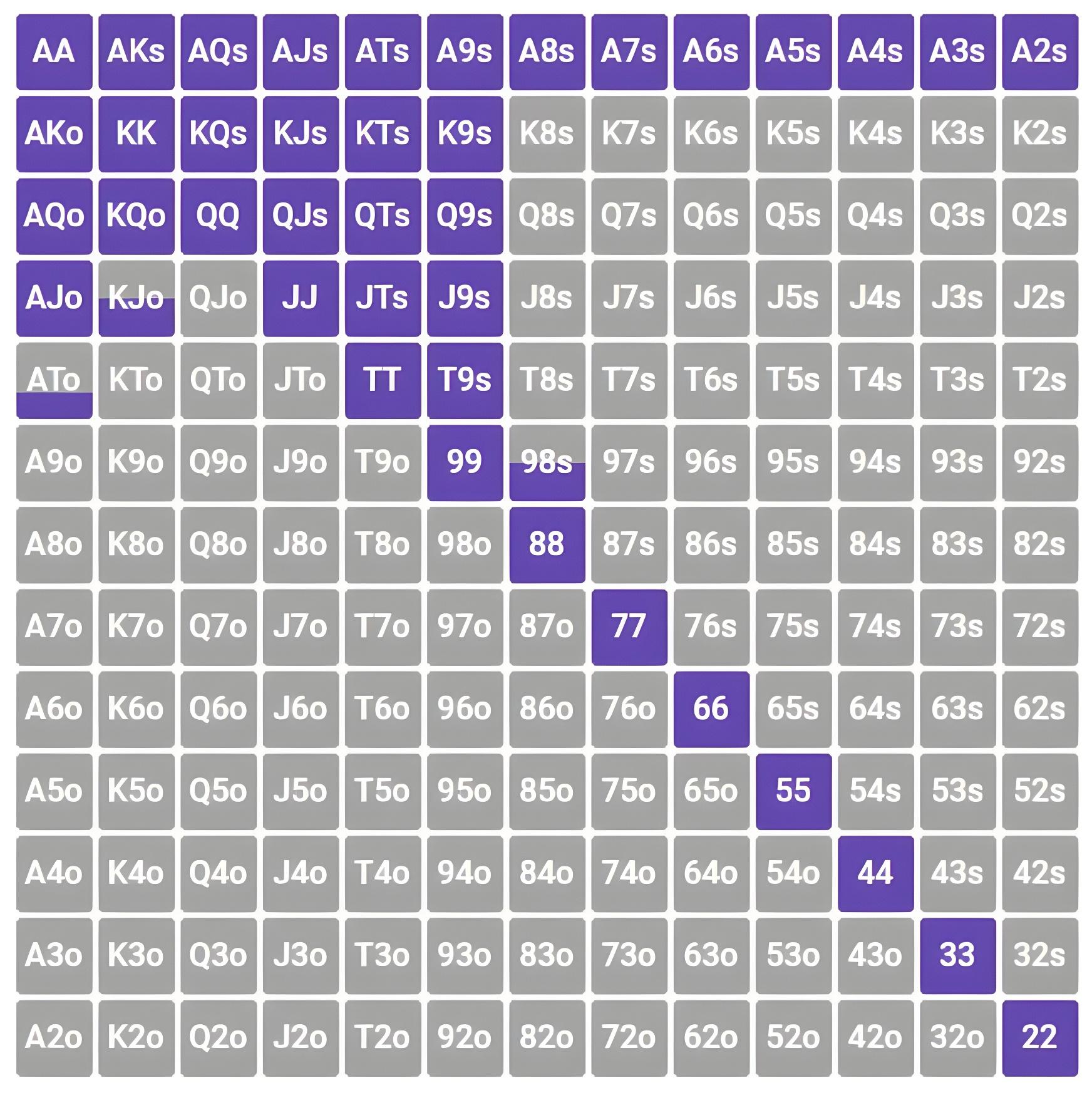
In the range above, you can see the proposed opening range for EP and EP+1 positions in a depth of 60 bb+.
Now just reduce the depth of the effective stack and see what happens:
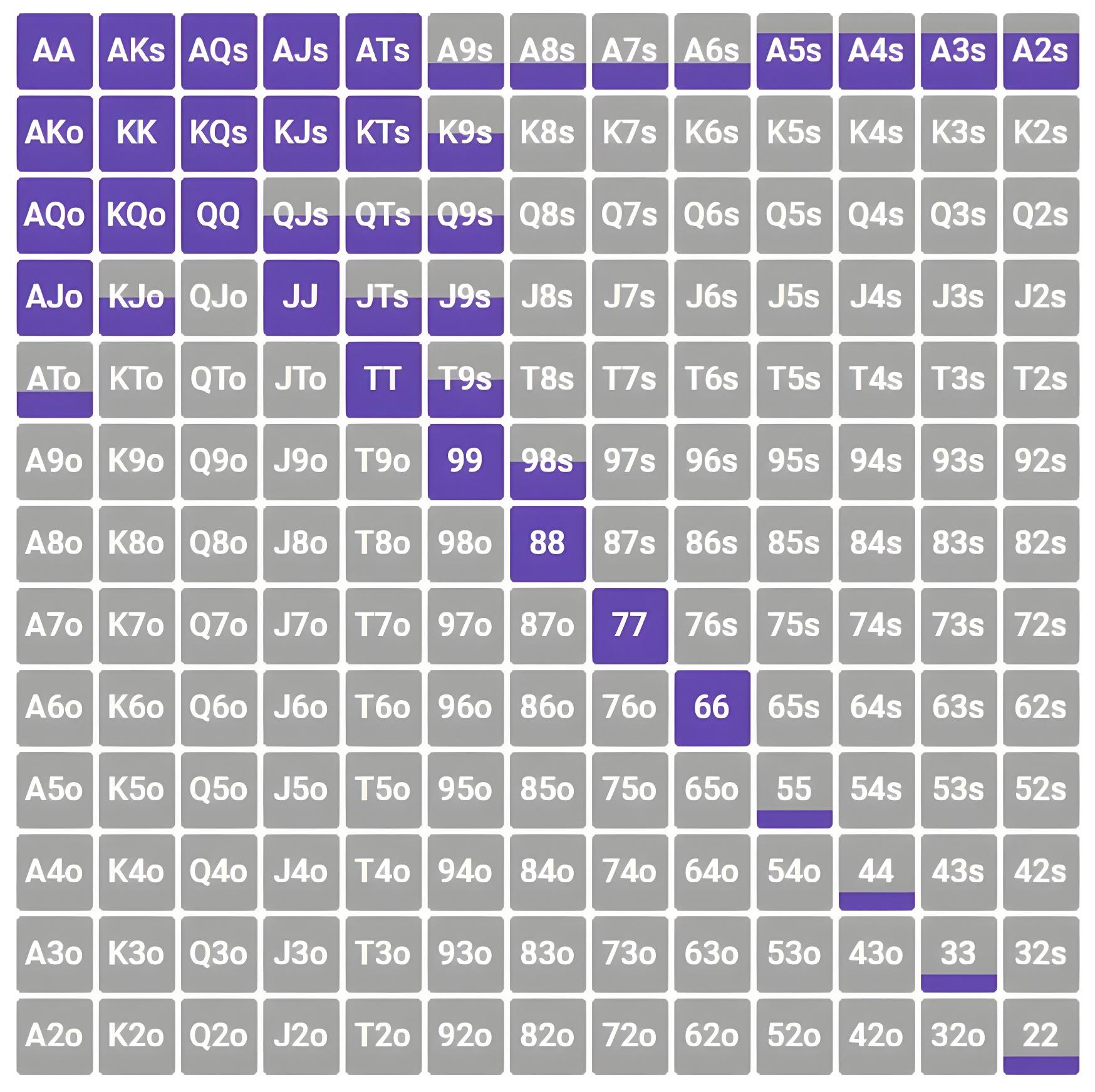

Let's now compare them and look at the proposed differences. In fact, it is quite normal to somewhat narrow your opening range when there is not enough comfortable depth in the stacks.
IMPORTANT NOTE: I keep repeating that any range remains variable, depending on the specific game situation!
In other words, it is beneficial for you to open wider from almost any position if:
- You are currently the table chip leader;
- The table is ready to overfold in your open raises;
- There are expensive short stacks if we are talking about knockout tournaments.
Please note that compliance with the condition of point A is quite feasible in the depth of 35-40 bb. This is especially true for tournaments with a more turbocharged structure, where the average effective stack will very often vary from 22 to 27 bb.
5. The main differences of preflop opening
- We practically eliminated low pocket pair (22-55), leaving very little weight for situations when you will play at a very secret table, or will be the chip leader of this table.
- We no longer want to open the hands of the A-6s - A-9s type with full weight, as it was at a greater depth. Of all the master hands, they are the weakest, since they do not have the potential on the straight, and at the same time they do not have a strong enough kicker to withstand the aces stronger.
- The 8-9s - K-9s arms also open with weight.
Some generalization can be made
We have almost completely eliminated or reduced the weight of hands that are not flexible enough for a post-flop draw, or just not good enough for playing in 3-bet cans! However, many amateur players are clamped and prefer to play significantly fewer hands in early positions in this depth, which will already be a mistake and, undoubtedly, overfolding. Also, you should always take into account that in the case of switching to a super-tait style of play, premium hands that come to you with a big share of probability will not be paid by your opponents.
6. Conclusion
It is very important to remember that it is over the game in the late stages of the tournament that you need to work as carefully as possible!
The mistakes and inaccuracies that you made at the beginning of the session are much less noticeable blunders, since in the case of an early departure, in fact, you lose only the starting buy-in. Mistakes in dipranes are very expensive mistakes, because it is because of them that we often do not see the desired progress and do not get a huge piece of our potential profit. I hope this article has been helpful to you. I wish you constant improvement in various aspects of the game, of which there are a great many in poker.