
Translated with the help of AI. We apologize for any errors and would appreciate your help in correcting them.
Translated by order of the educational portal university.poker
Original source: GTO Wizard

Position is an extremely valuable edge in poker.
Most players describe the comfort zone as being in position (IP) combined with a stronger preflop range. This situation, known in poker as “bread and butter”, occurs when we open from a late position and get a call from one of the blinds. As soon as our villain makes a check, we have the opportunity to make a cbet or make a check in response and open a free card on the turn. However, the poker universe extends far beyond this comfort zone.
We will inevitably find ourselves in uncomfortable situations, for example, when we raise from an early position and get a cold-call from a late position. Now we have to play the entire spot without a position (OOP). Despite retaining the advantage of having more nut hands on the preflop, what the GTO offers us may be illogical. In this article, we will look at which flops we can continue to be aggressive on, on which we should check more often, as well as some useful practical rules to consider when playing with live opponents. In this article, we will use solver solutions for NL50 cash game, depth 100 bb, UTG opens 2.5 bb, BTN makes a flat call.
1. preflop generates postflop
Before considering our post-flop strategy, it is extremely important to understand the state in which we come to it. We must evaluate our opponent and understand what the range of BTN preflop cold-calls looks like.
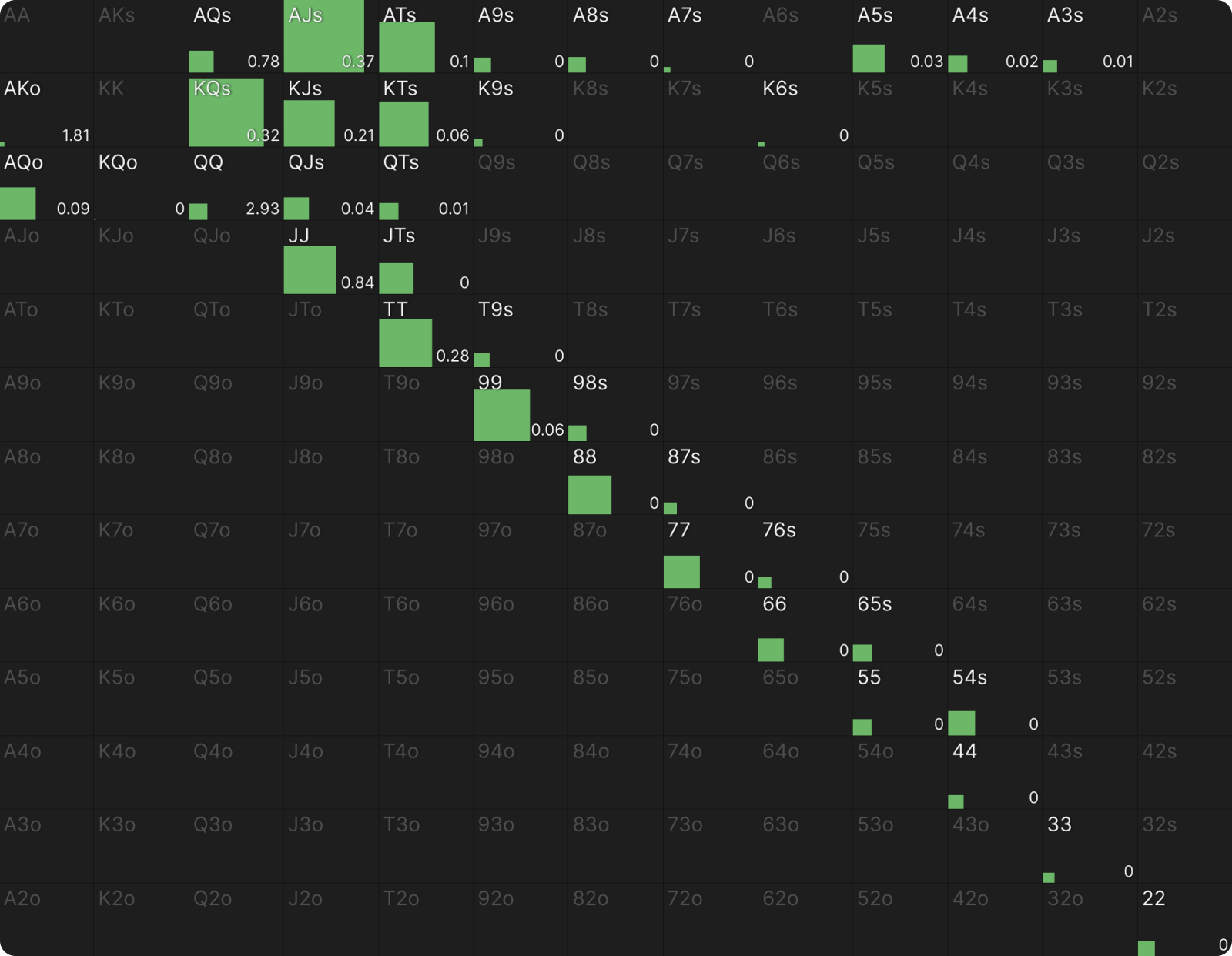

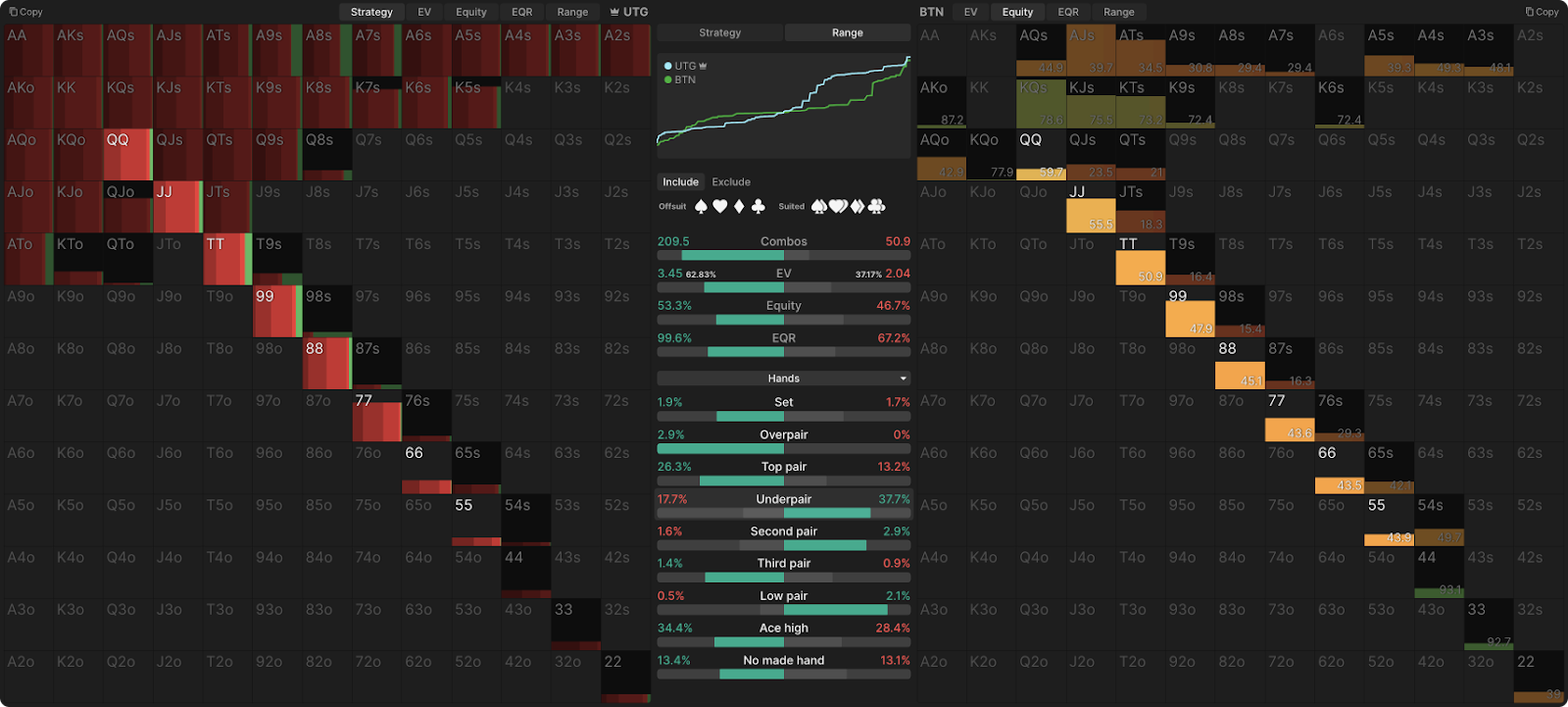
BTN collates 4% of its playable hands. The best hands, such as AJs–ATs, 99–JJ and KQs-KTs, are mostly indifferent between the raise and the call. In general, this is a narrow, linear range in which there are mostly low suited broadway cards and medium pocket pair. When we're at BTN in this scenario, it's easier to implement a robust 3bet or fold strategy. But when we are a player on UTG, we have to be prepared for our opponent to take us to another part of the game tree villain. It should be remembered that in a real situation, an opponent who makes you a flat call with BTN is likely to play wider than this range, which will affect the optimal post-flop strategy. You've probably come across players who make flat calls with all their A-x suited hands and with lower 22–55 pocket pairs, which the solver thinks are very low-frequency flat calls in a cash game.
2. The first solution on the flop: bet or check
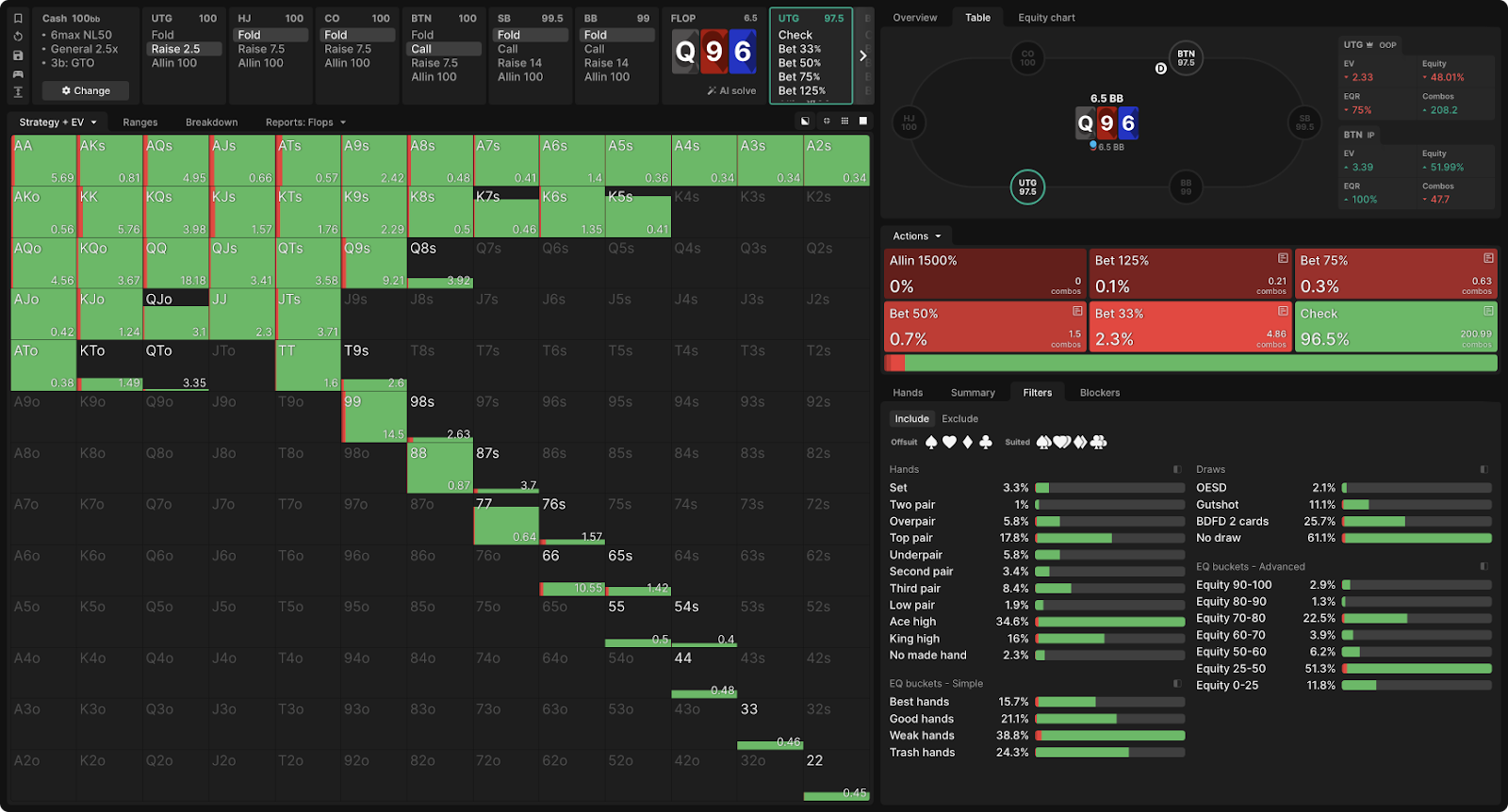
It's time to test your intuition with a quick survey before we show the solutions: UTG opens 2.5 bb, BTN collates (depth 100 bb). What is the UTG c-bet strategy on each of these four flops?
Flop #1:


- Cbet 100% of our range for jar size pot;
- Cbet 33% of our range for jar size pot;
- Cbet 33% of our range for jar size pot;
- The check is on our entire range.
Correct Answer:
Flop #2:


- Cbet 100% of our range for jar size pot;
- Cbet 50% of our range for jar size pot;
- Cbet 25% of our range for bank size in full pot;
- The check is on our entire range.
Correct Answer:
Flop #3:

- Cbet 100% of our range for jar size pot;
- Cbet 100% of our range for jar size pot;
- Cbet 33% of our range for jar size pot;
- The check is on our entire range.
Correct Answer:
Flop #4:

- Cbet 100% of our range for jar size pot;
- Cbet 100% of our range for jar size pot;
- Cbet 33% of our range for full size pot;
- The check is on our entire range.
Correct Answer:
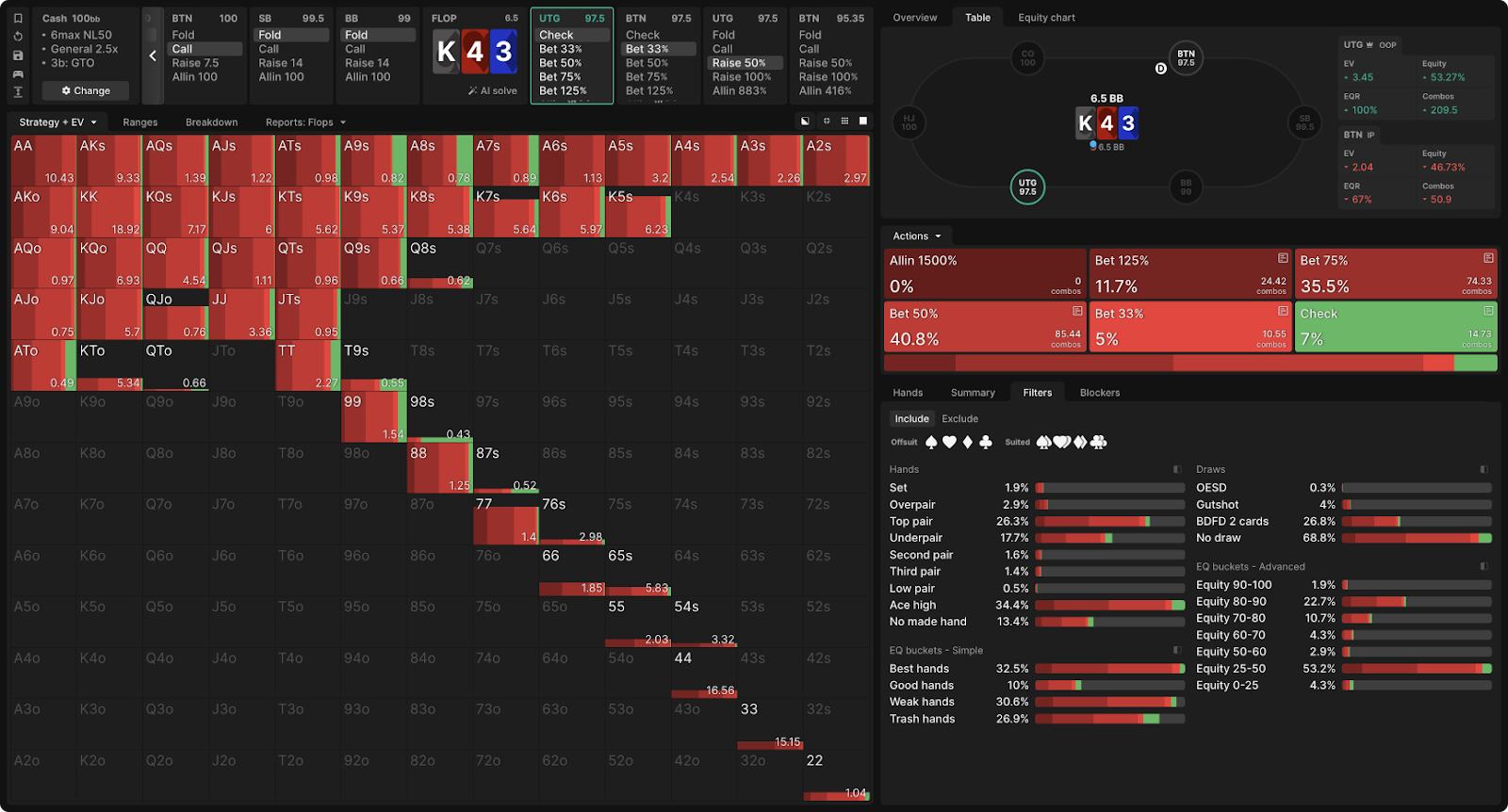
Of course, this is not entirely accurate, but it reflects the essence of the decision. UTG chooses a cbet of ½ pot in 40% of cases and ¾ pot in 35% of cases, with a small frequency of overbet, small bet and check.
A reliable strategy in the game is to combine the range of the two most used bet sizes and use the bet size that is between them, for example, 66%.
Since these two sizes make up 75% of our combinations, it is enough for us to simplify our strategy to a range bet of 66% of the pot. If you got the perfect result in this test, you are honored and praised! Let's now find out if you chose the answers for the right reasons. And if you did not answer all four questions correctly, you do not need to worry, as we will analyze everything.
3. Q-9-6 rainbow
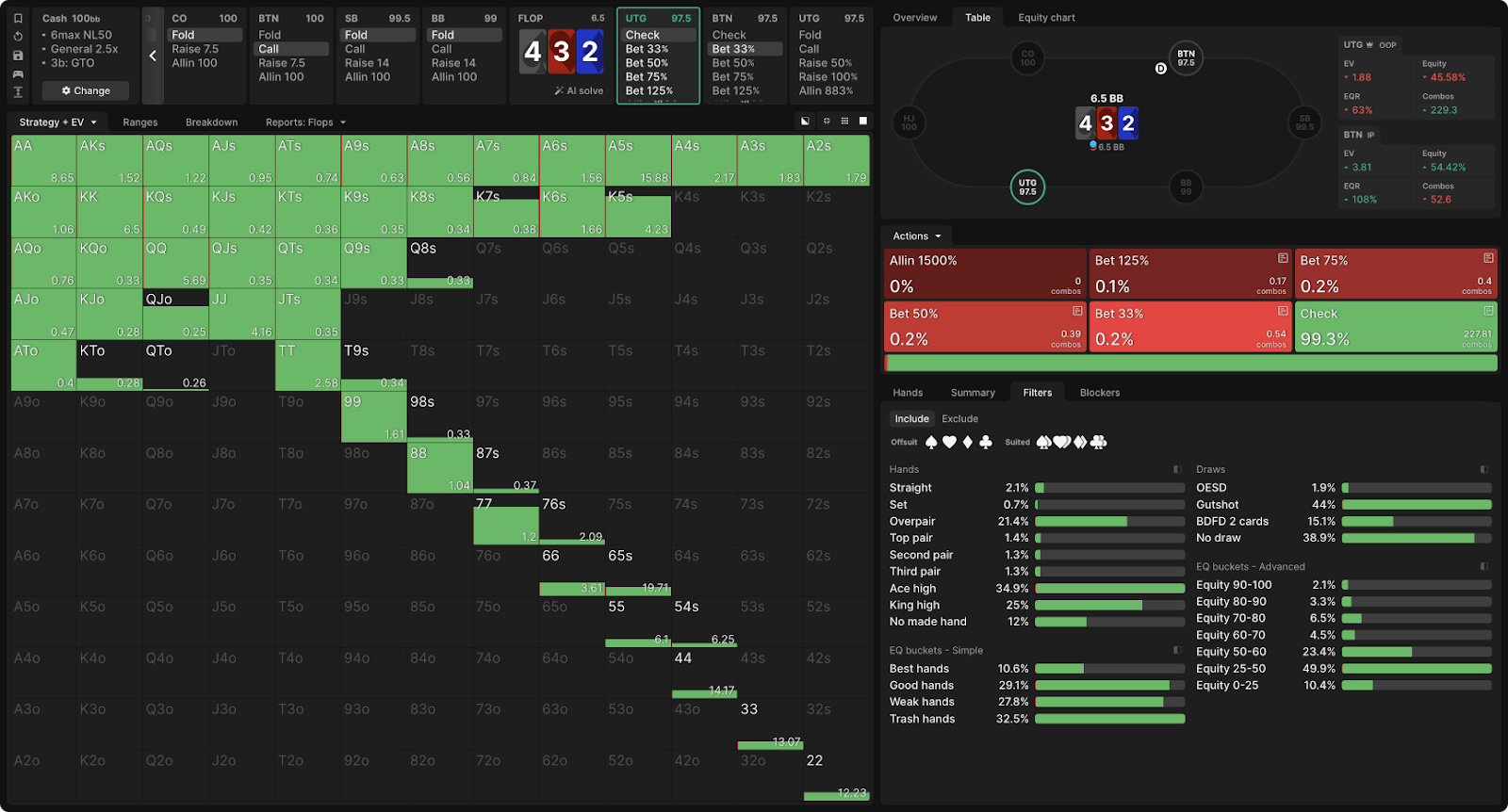
At first glance, it looks like a suitable flop for UTG. We're hooked on KQ and AQ and our Broadways have some draw equity. So, we might expect UTG to do c-bet quite often, which would certainly be the case if we were a pre-flop racer (PFR) in position. However, the correct answer is actually for UTG to check its entire range. BTN has an edge in equity of 53% and has a higher percentage of sets. With obvious flaws in equity and strong hands, UTG should be more conservative and try to limit the size of the pot while out of position.
Having received a check from UTG, BTN will make a small bet in approximately 40% of cases:
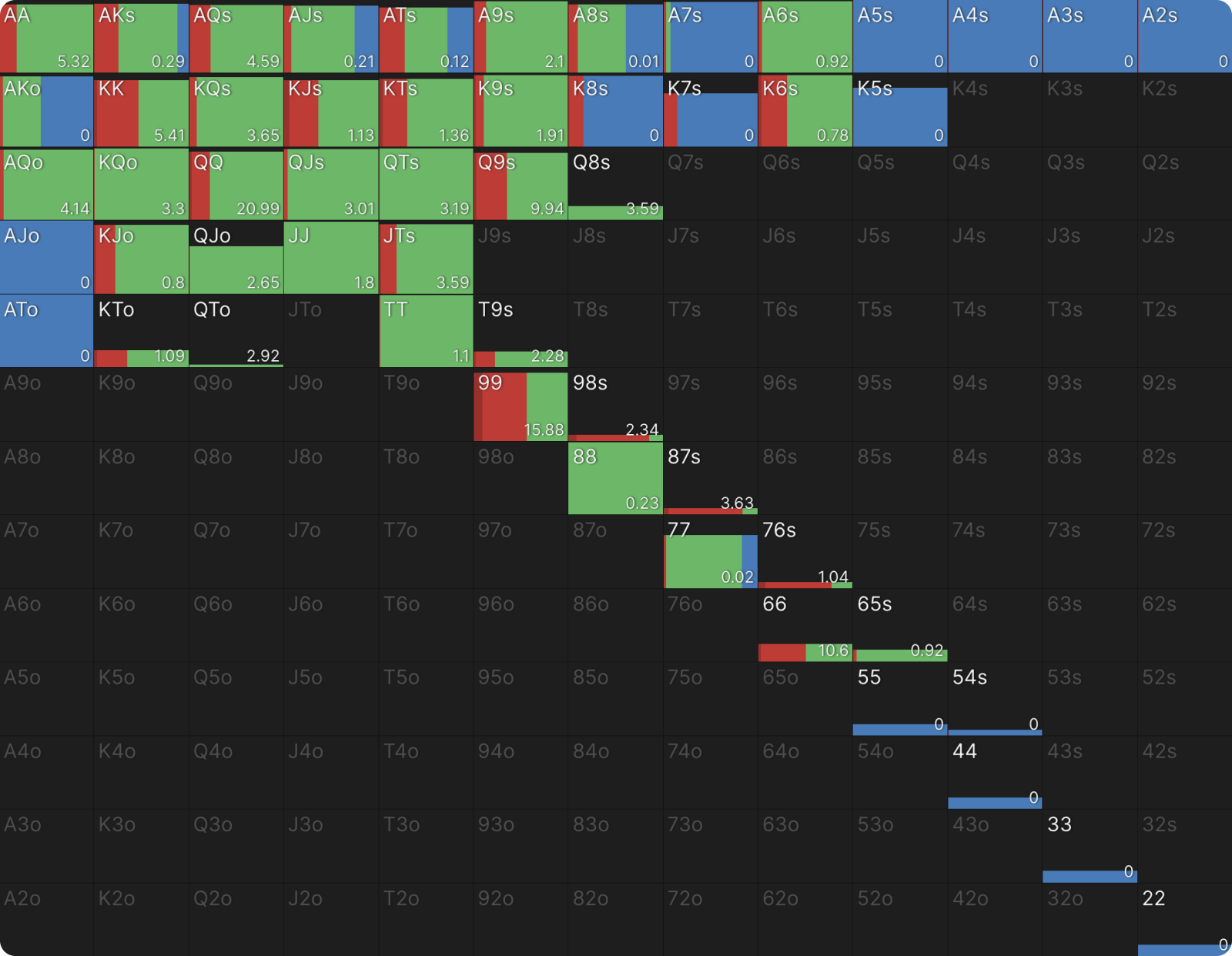
UTG will not make a check-raise very aggressively, as we see above, in only 10% of cases. Even a hand like AQo, a top pair of top kickers, will tend to play out as a check-call most of the time with a small percentage of the check-raise. Protection of the weak parts of our range and bluff ketch become a higher priority than direct value gathering with our good but not the best hands.
CONCLUSION: The takeaway from this flop example is that we should prefer a more passive path and keep the pot small when out of position, even with hands that are usually pure Velu Beta in position pot.
4. 4-3-2 rainbow
Once again, the optimal UTG strategy consists of a check with its entire range. This is somewhat counterintuitive, as some of you may have correctly reasoned that both players now don't have as many sets, so why doesn't the edge of UTG on a preflop with hands from the AA–QQ range turn into more aggressiveness on the flop? The answer was revealed a bit in the first part of this article.
Position is an extremely valuable edge in poker. Playing without a position as a preflop racer and playing in a position as a preflop racer are two fundamentally different ideas.
Being in a position with an advantage in the preflop range makes very little sense to put traps with our strong hands, because if we make a return check, we will immediately remove one street from the game tree and miss a good chance to build up a pot with a strong hand. Conversely, when we are without a position, we actually get more EV, allowing the player in the position to bet with their middle hands as equity/defense/bluff, and then attack with a check-raise. What do I mean when I talk about middle-hand betting as an equity/defense/bluff?
Let's take a look at the hands that BTN can put on when we make a check on UTG:
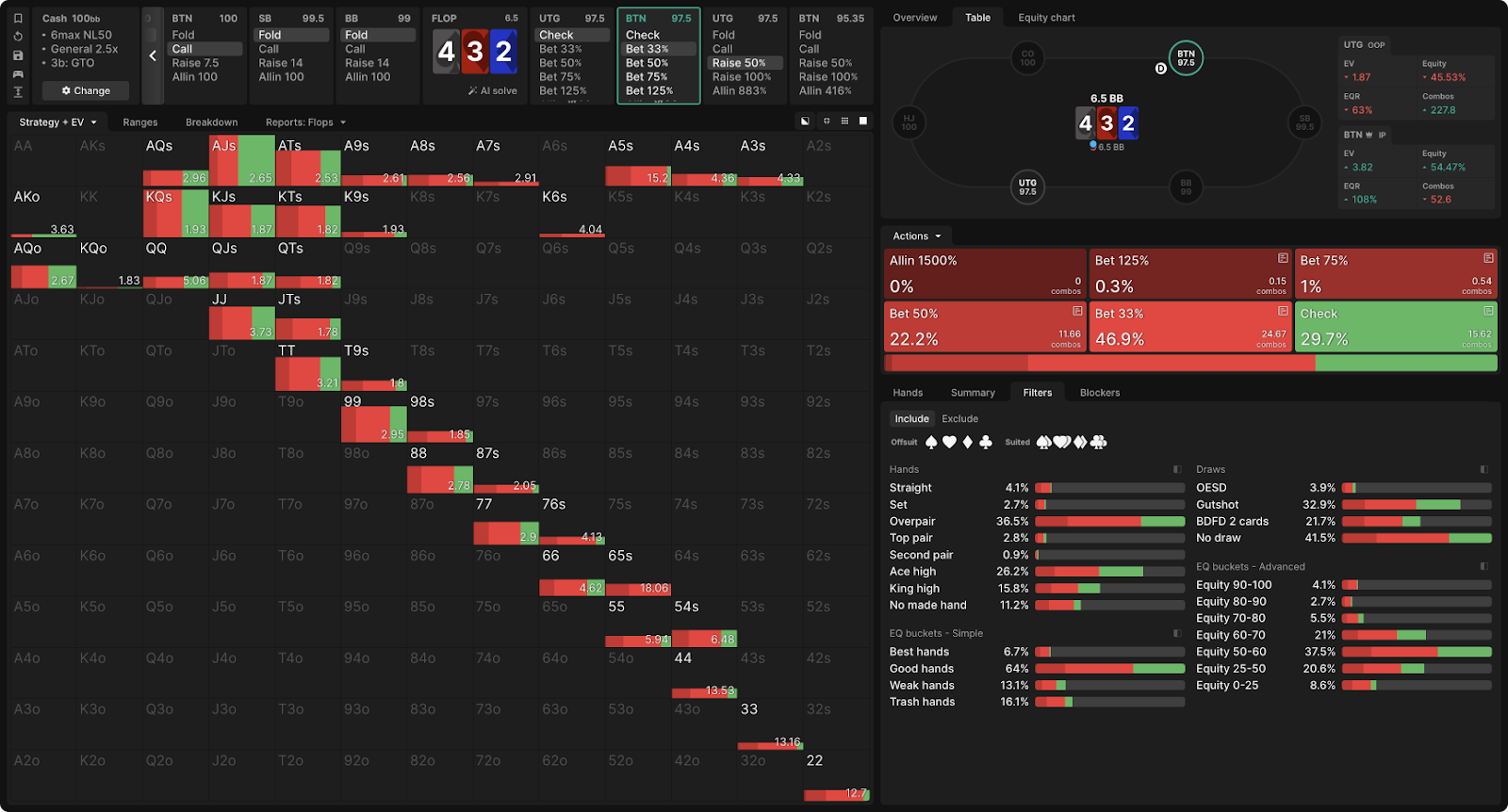
BTN puts on a wide range, including pure bluff (QJs, JTs), medium strength hands that need protection (77-TT), nut hands (A5s sets, straights), and hands that don't really fit anywhere (AJs actually has some showdown value, but still mostly bet). With this check strategy of the entire UTG range, it is possible to win more through bet from the middle and weak hands of BTN. If UTG had just made a c-bet, BTN would have simply continued with strong enough hands and fold their empty hands. However, BTN still has to deliver here.
The BTN range is essentially compressed to what I would call “decent” hands, with a good percentage of nuts combinations. UTG has a lot of hands that will just drop, but who have a chance to improve on the free turn map, for example, KQo/ATo, which can get into the overcard and in a very good position go to the river. So BTN has a good incentive to make a bet itself when UTG makes a check, but UTG also has a good incentive to make a check-raise when BTN makes a bet.
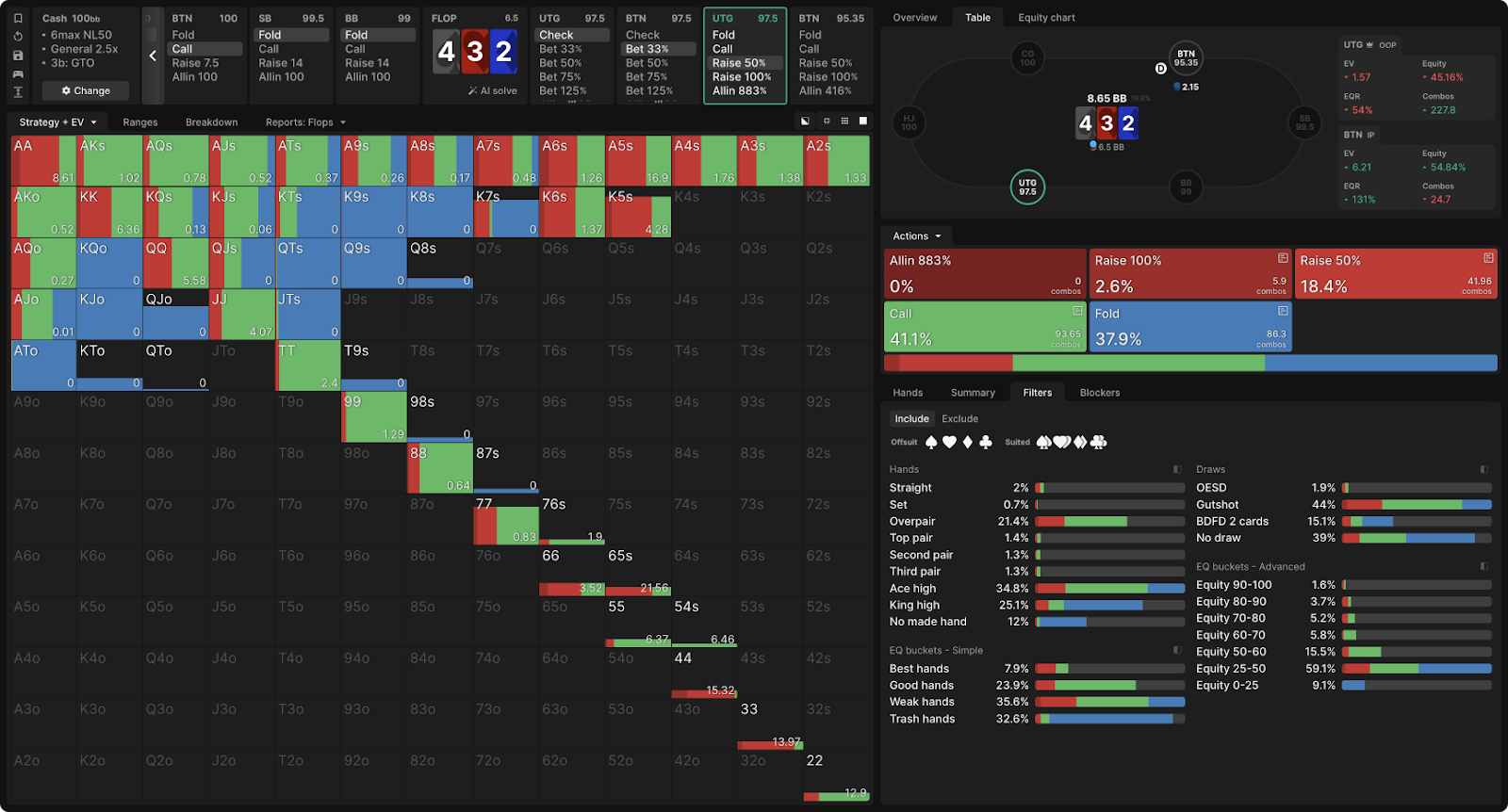
UTG will make a check-call with hands that are not strong enough to check-raise, such as 99, TT, AQs and AK. In fact, these are hands with sufficient equity at the autopsy, but with low equity when the check-raise is equalized.
UTG will also make a check-raise with a polar range of strong hands and bluff with high equity. Strong UTG arms include AA, KK, straights, and sets. Our bluff high equity bluffs include semi-bluffs such as 55 and 66, as well as Acehigh and Kinghigh backdoor or straight bluffs such as A7s, A6s and K6s. These are hands that have some potential to improve to something big towards the river, like an emergency exit in case we get stuck.
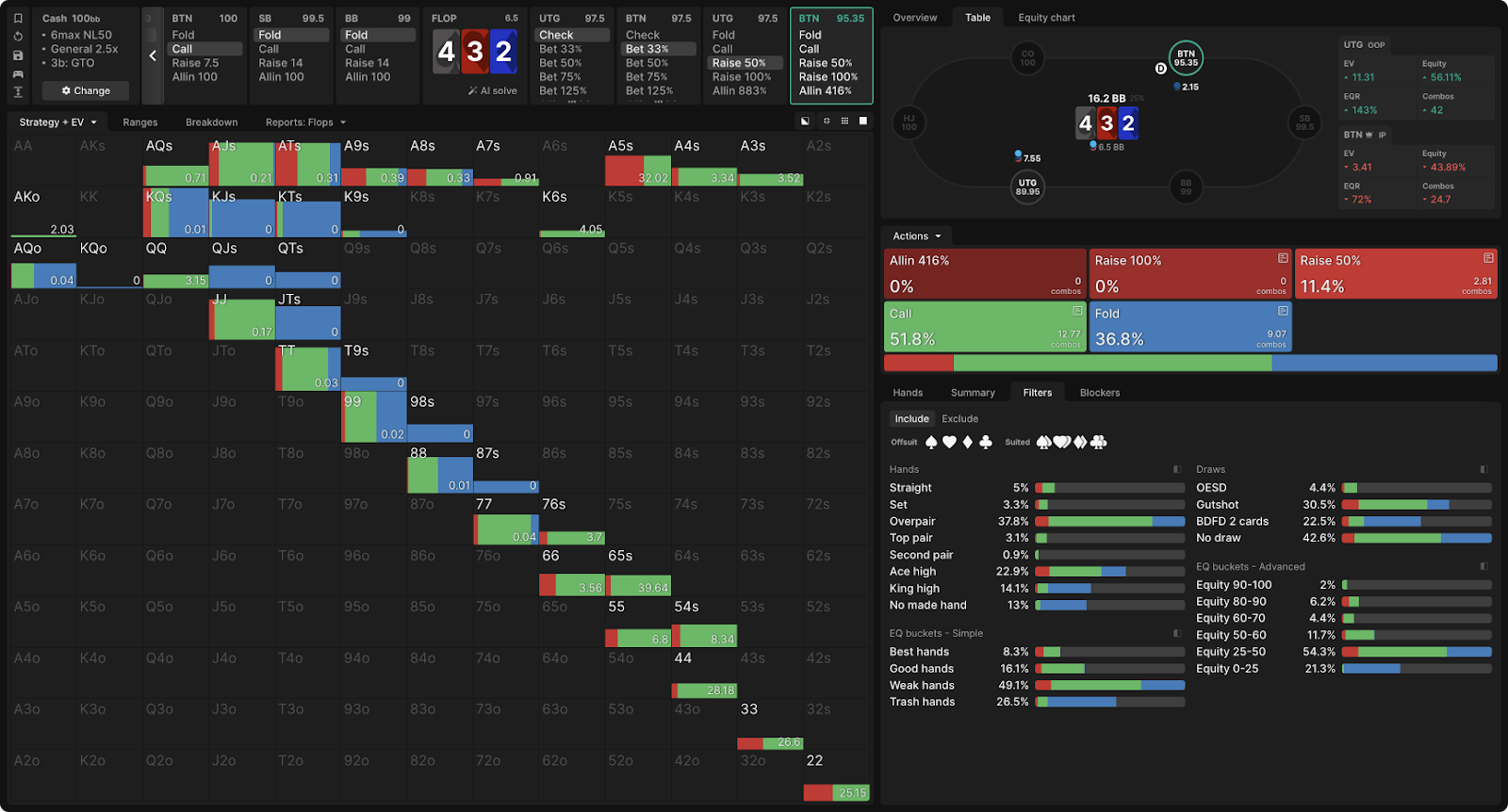
Having received a check-raise, BTN finds itself in an indifferent situation with hands as strong as 88–99, which now have to consider a straight fold on the flop. BTN will drop its worst bluff such as KJs, QJs and AQo, and continue with hands such as TT and JJ, which are now bluff catchers.
TO SUMMARIZE: On the low flop, none of the players have improved, it is theoretically reasonable for UTG to start with a check.
The reason is that UTG wins more with its velly hands, forcing BTN to bet with its medium and weak hands to then reraise with the polar range. A check-call with hands that are not strong enough in terms of equity also has a higher EV than a bet and an attempt to pick up the pot right away.
5. K-Q-6 rainbow
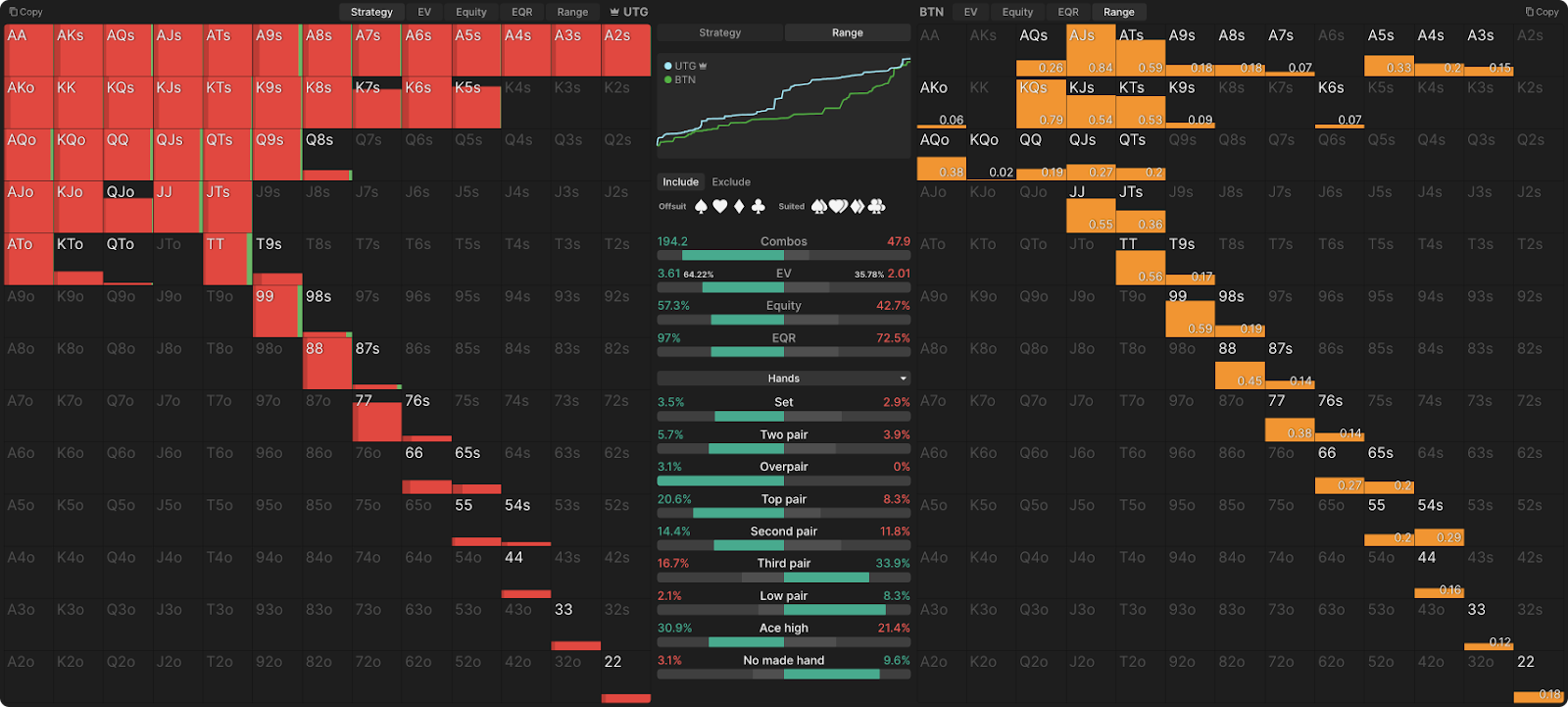
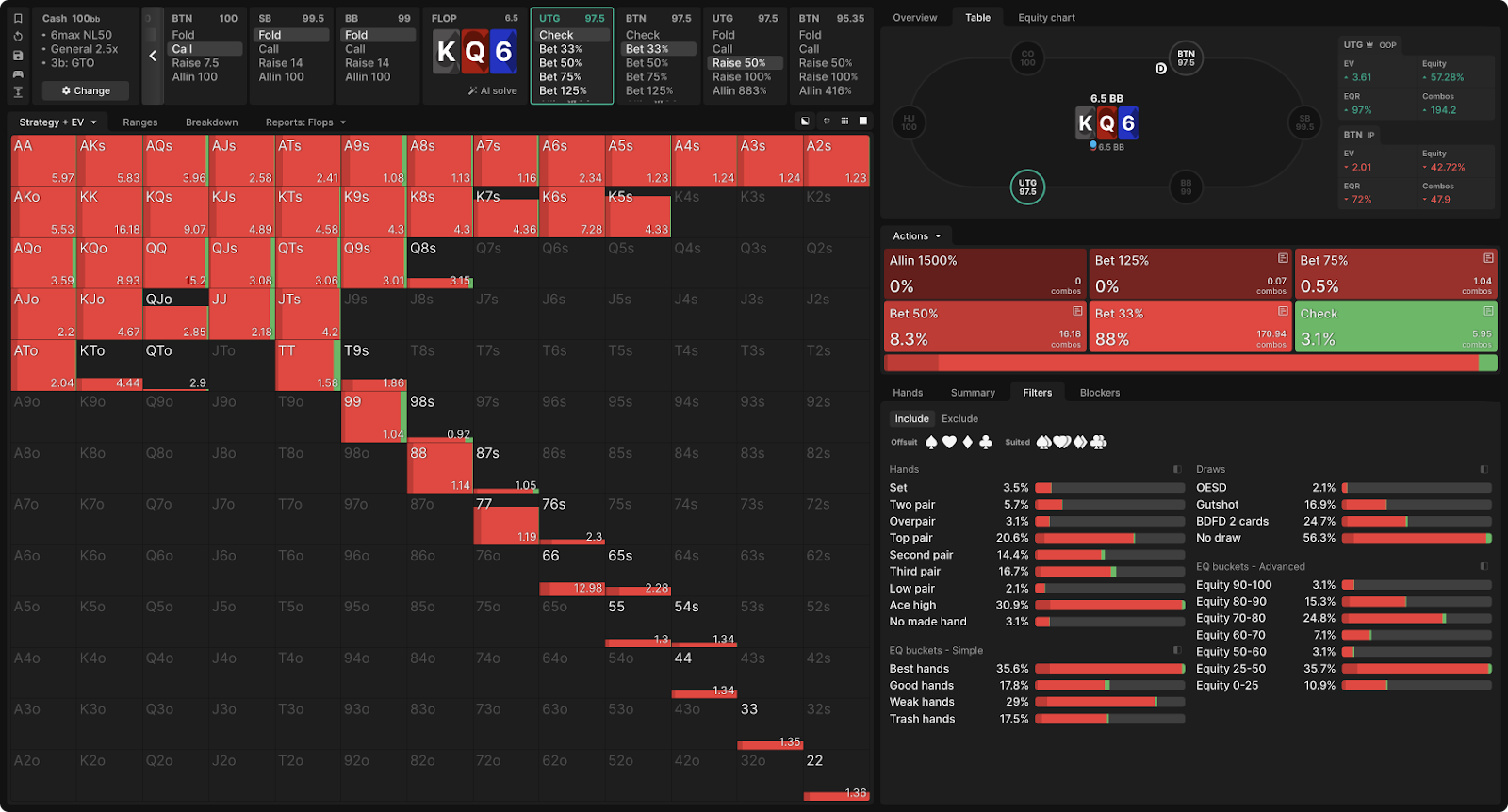
UTG has several advantages on this flop. He has a lot of sets, two pair and top pair. UTG has 57% equity equity. Even though it doesn't have a position, it's such a good flop that UTG is still free to attack, taking advantage of both equity and nuts edge. The expression “reckless” comes to mind, but a more appropriate description here would be a “free shot” at the bank, with which our villain can do nothing. In this high card flop, UTG gets more EV just by betting on their own bet. Since UTG has the most strong hands here, they get much more EV by betting on their own bet.
BTN has very little reason to start investing in the bank of their own free will when there are a lot of weak marginal hands in its range, so the previous check and checkraise strategy does not make sense here. Finally, a small rather than a big bet is good here, because BTN is very difficult to defend well even against a small bet, since it has so many weak hands with one pair that can count on, for example, only two outs. The idea is to make life as difficult as possible for the opponent, so a small bet that forces the opponent to either defend some really bad hands or fold a lot of cards works better here than a big bet.
A small bet is appropriate when it forces an opponent to either start defending really bad hands or start discarding a lot of cards.
6. K-4-3 rainbow
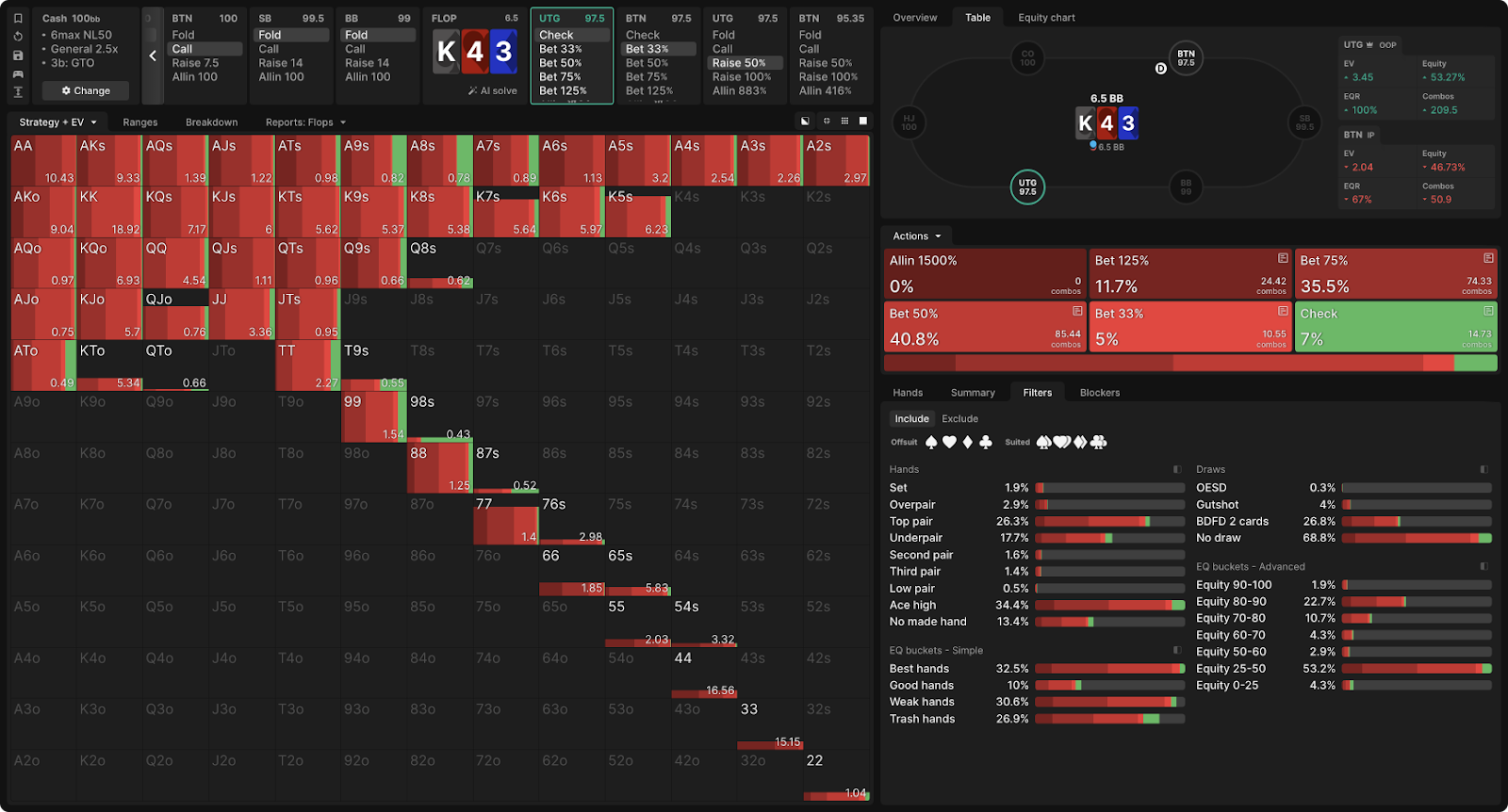
Another King-hai flop. What is the key difference between this K-4-3 and the K-Q-6 we saw earlier? First, consider that the BTN range consists of two broad categories: suited Broadways and medium pocket pair and a little bit of everything else. Pocket pair has a slightly higher representation due to the effect of blockers and combinatorics (6 pocket pair combinations versus 4 pocket suited Broadways). In addition, when a high card appears on the table, BTN has fewer Kx combinations, of course, due to the effect of removing cards. This means that a big percentage of the BTN range on this K-4-3 flop is pocket pair below the king. The big percentage of the BTN range on the K-4-3 flop is the unimproved pocket pair between K and 4.
On the K-Q-6 flop, a hand like 88 is easily folded. At the same time, only about a quarter of cases are protected against a small bet! But on the K-4-3 flop, the pocket pair has nothing to worry about. Since we expect that it will be easier for our opponent to make a call, we should start placing larger bet.
Even against a bet of 75% of the 88 pot, you still have to defend yourself in half of the cases.
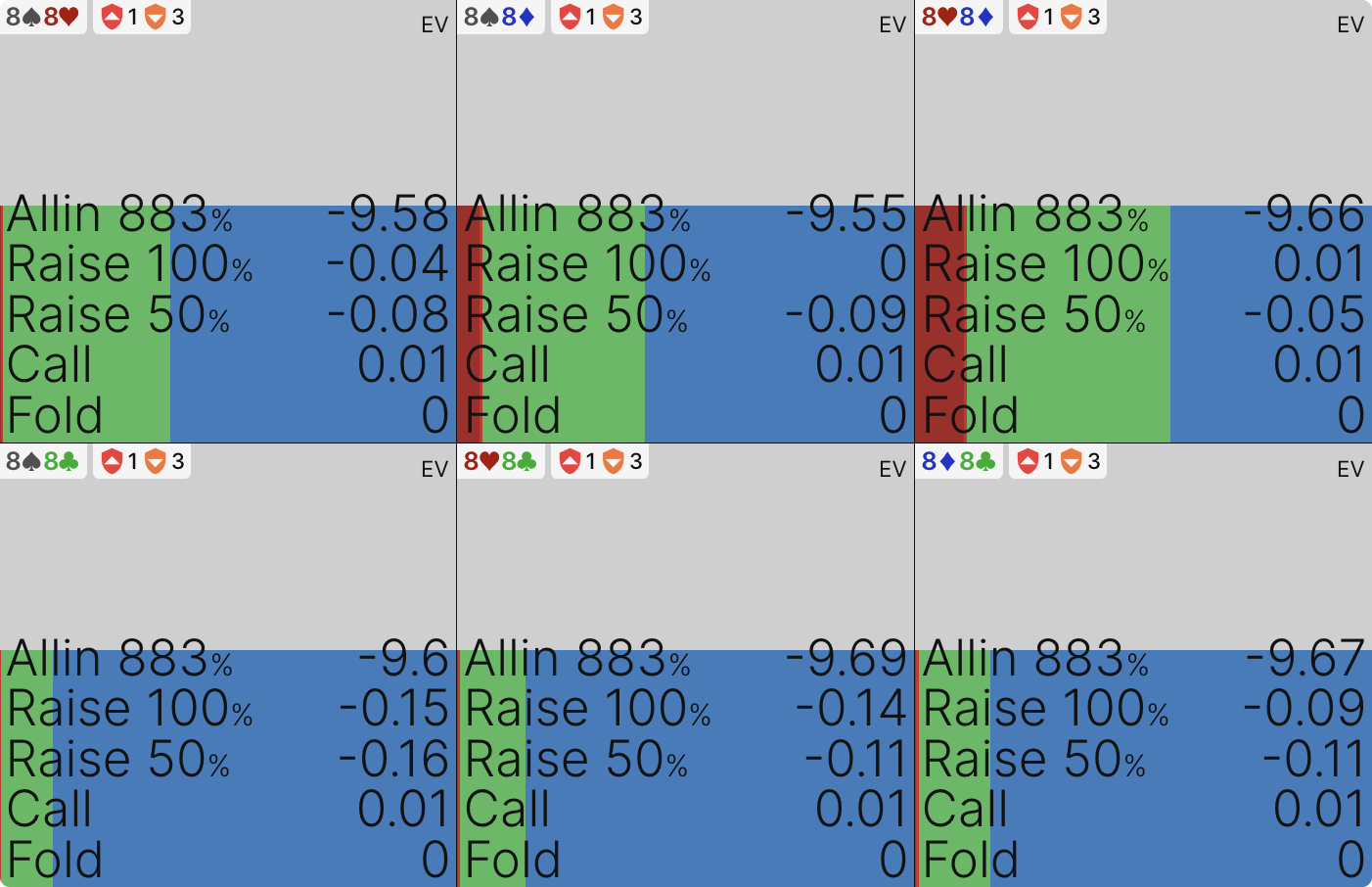
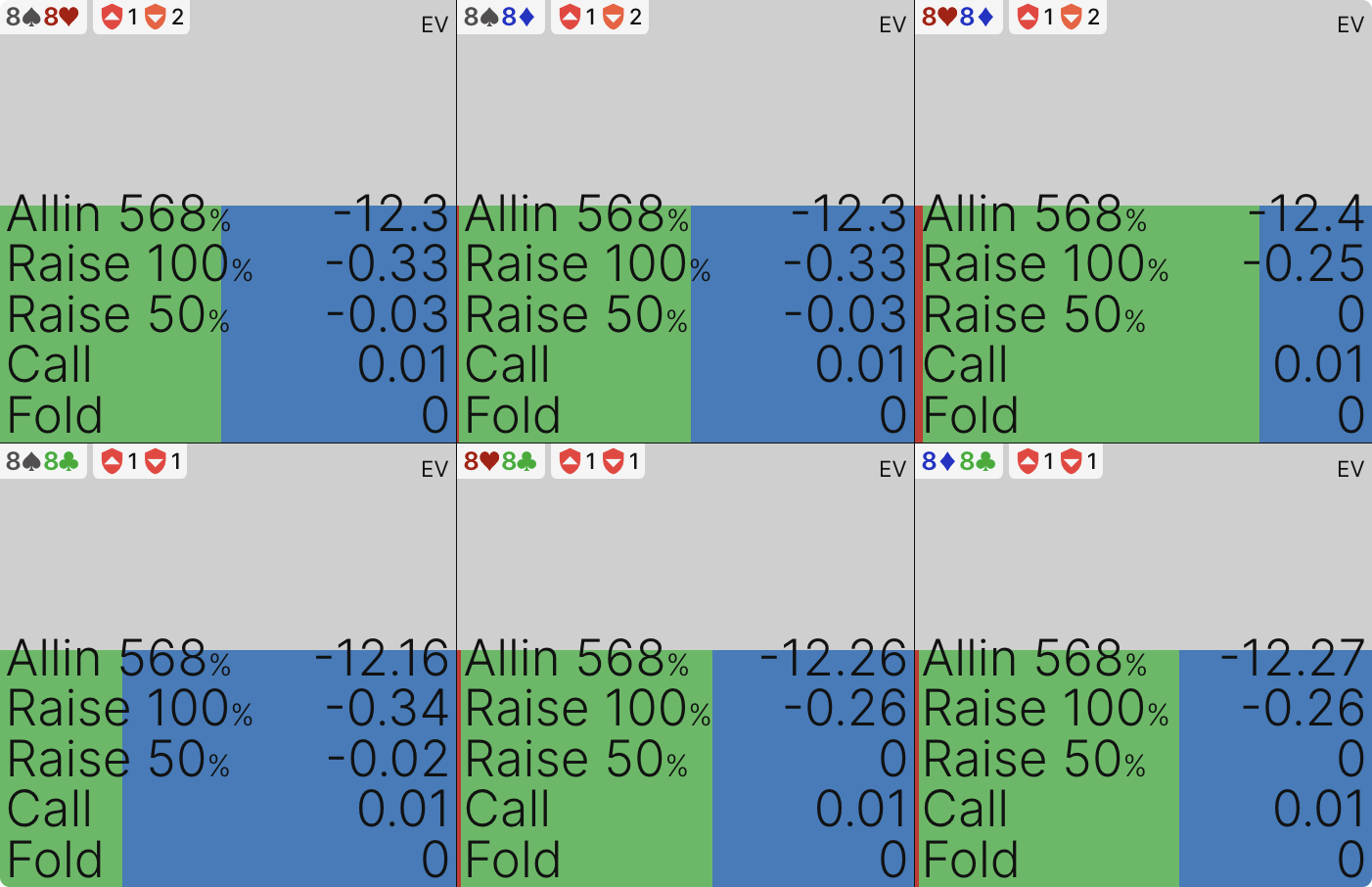
even against a bet of 75% of the pot
CONCLUSION: Since our opponent has to make a call with such hands more often, our valley hands win more by choosing a larger bet size on the K-4-3 flop. Since our Velu Hands want to make a big bet, our bluff can also use this size.
7. Aggregate Flop Reports
I'm a big fan of these reports. They allow us to see at a glance what a reliable counter-beta structure without a position should look like.
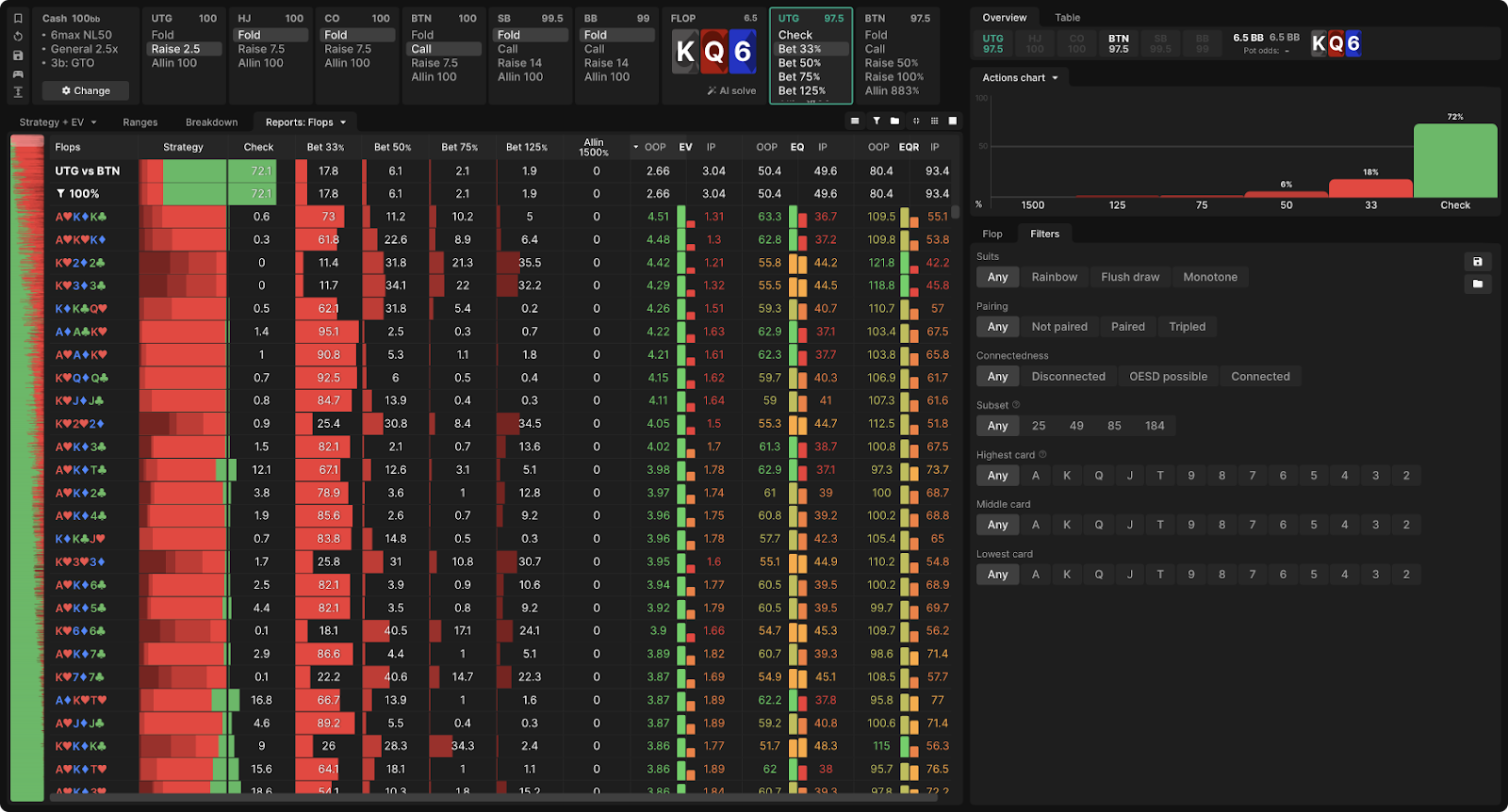
From here, we can see the global averages for each action across all flops. At UTG, we have to make a 72% check and, thus, counter-bet here only 28% of the time! Most live players probably do c-bet more often in this situation without a position than in this example.
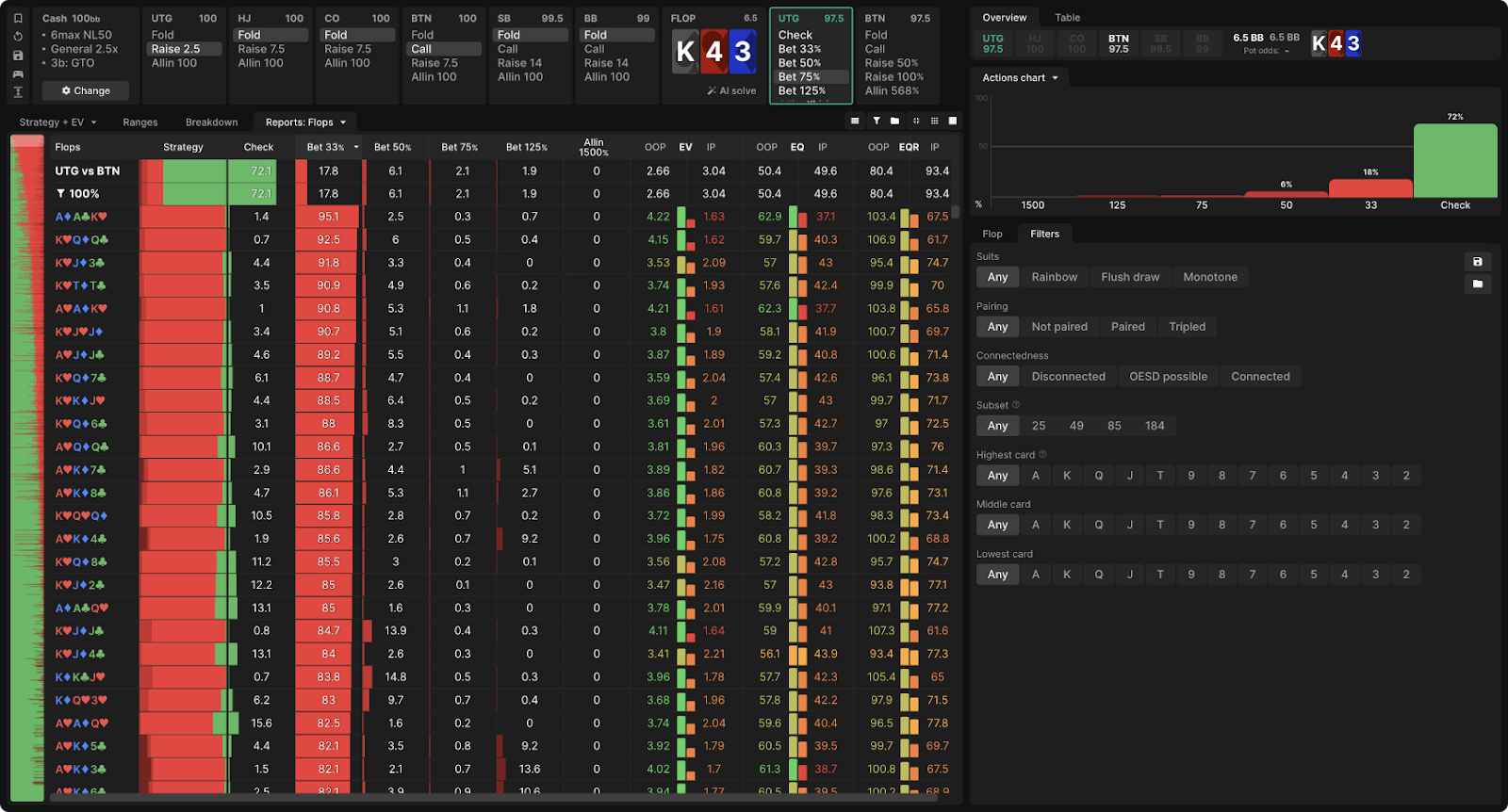
Here I sorted by the column "bet 33% of the pot" and we immediately see that such flops as AAK, KQQ, AKx and KTT are flops that largely fall within the UTG opening range. Thus, UTG can always start with a small bet. From here, I can choose either a high board filter or study, for example, paired boards or monotonous boards in more detail.
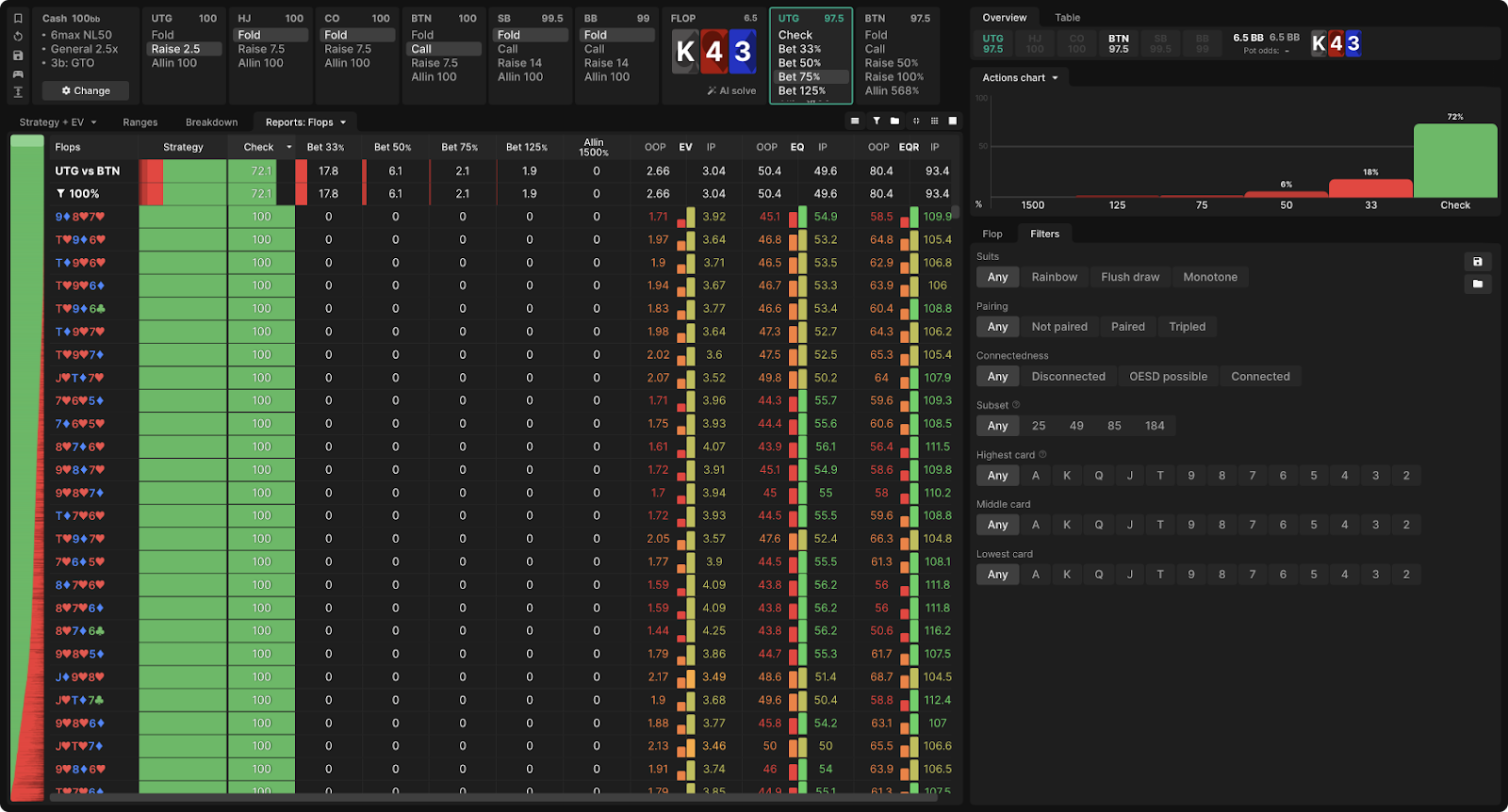
With the help of sorting by "Check", I learned that whenever there are 3 middle cards on the flop, it is right to start with a check. If I play as a BTN and see that someone often makes a cbet in this situation, I will know that my villain is most likely making a mistake and I will use this appropriately by raising or making a floating in the position.
8. Exploit
With the above ideas in mind, how can we apply our new knowledge in a real game against live opponents?
- First, when we open on a preflop, our opponents can make a flat call on the BTN wider than the GTO. It can also mean that they are less aggressive with the hands they should do 3-bet with, such as suited A-x, which forces them to make flat calls instead. It just means that we will get 3-bets on preflop less often. And they'll have a higher percentage of suited A-x and pocket pair on the post-flop, which we'll have to account for mostly on middle and low boards.
- Second, we don't always need to be super-conservative on an imperfect flop if our villain isn't aggressive enough. Starting with a check is the best way to earn more on your opponent's bets. It is even better if our villain is very passive and makes bet only with strong hands. Then we don't need to start attacking his bet with bluff checkraises. Instead, we should reset a little more often.
- Thirdly, if our villain is a “calling-station”, and will simply call everything in a row with hands of medium strength, it is reasonable to catch a hand like a set or overpara and play bet-bet-bet, and not make a check-raise when we earn more from an opponent's call. The most important thing we should not do in this situation is to start barrel with air and arrange a big bluff on the river against the “phone”!
- Finally, without any reeds (notes) on our opponent, it would be a good idea to follow the recommended GTO strategy, waiting when we need to wait, and making a big or small bet depending on how good the flop is for us. There will also be situations when we will mix bet and check. It is good to work out these situations in a special solver simulator.
9. Conclusion
The cold collar in the position has a more linear and strong range than the collier on BB, who has a lot of weak hands that collide because they have 1 blind already in the game. The player's range in position is particularly strong in middle cards and lower suited Broadways. Thus, flops with several middle cards are especially dangerous for UTG.
Continuing to bet as a pre-flop racer against a collier when you're in or out of a position are two fundamentally different things.
The lack of us being out of position throughout the hand means that we now need to play many flops very carefully. Even on a flop where UTG seems to stand relatively well, like a Q-9-6 rainbow, we're best off starting with a check. The BTN range is more compressed, which means he actually has a higher percentage of strong hands than we have on such a flop. Even a hand like a top pair with a top kicker is preferable to playing through a check-call.
UTG can still be aggressive on flops with high cards, which are very bad for the BTN pocket pair range. Flops with king and no middle cards are excellent for UTG. In terms of bet size, a larger bet size is good when we believe that our opponent is easier to make a call, and a smaller bet size is better when we believe that our opponent will have a hard time finding good enough bluff catchers.