


Translated with the help of AI. We apologize for any errors and would appreciate your help in correcting them.
We recommend reading the second part of this article as well: How to work on a poker game, part 2
In our profession of poker players, working on the game is an important and integral part of the craft. There are many ways to improve your strategy, but using different tools is not enough to be highly effective. It is also necessary to improve the training methodology itself. Alexey Exan13 is a coach with a lot of experience in terms of efficiency and, nevertheless, every year he updates and improves the methodology of working on the game and data processing. Having passed hundreds of students through himself, he confidently states that the main problem of Russian poker players is not the lack of useful materials and knowledge, but the very low ability of the average player to work correctly with the information available to him.
1. Working on a poker game
In this article, the trainer will talk about the fundamental knowledge outlined in the book by Jared Tendler and Barry Carter “Mind Games”. Many of you know that it was on the basis of this book that the video course "Psychology and Professionalism in Poker" was recorded

At the beginning of the book, Jared reveals 3 fundamental theories:
- Adult Learning Model: Three Stages of the Learning Process
- Surveyor: dynamic improvements to your game over time
- Procedural model: Helps to achieve a continuous and effective learning process and improve your game
They allow you to make the learning process as correct as possible.
2. Adult learning model
This is an open theory that distinguishes four main levels of the learning process:
- Unconscious incompetence.
The player does not realize that he lacks abilities. And for some players, this shortage does not have a positive or negative value. - Conscious incompetence.
At this level, you understand that you lack knowledge or abilities, you understand in which areas you can become better. This awareness comes either as a result of a deep analysis of one's game and psychological state, or at someone's suggestion. - Conscious competence.
The player has worked and honed certain skills, diligently using them in practice. At this level of competence, you still need to constantly keep your new abilities in mind in order to be able to apply them in the right situations. - Unconscious competence:
Your skills are learned and developed enough that you can use them at the level of automatism/subconsciousness. According to Tendler, the Unconscious Competence is the Holy Grail of the educational process, and, without a doubt, the main idea of this book.
The main idea is that our mind is able to make the right automatic strategic decisions, but for this it is necessary to introduce knowledge to the level of such competence, at which it will act automatically at the level of muscle memory without the participation of your mind. Then it can be called a skill
Many poker players understand the game itself much better than they play it. There is a lot of knowledge, but low efficiency of their use.
To bring the conscious strategic knowledge (level 3) to the automatic skill (level 4), a certain number of repetitions of the action are required. For different actions, the number of repetitions is different, something is produced more easily, and something is more difficult.
How to speed up the process of bringing knowledge to skills
There are several very effective methods to speed up the process of bringing knowledge to skills:
- Fewer tables during in-depth work on the game.
For example, if you bought a video course or took a training session to analyze the database and you have a whole list of knowledge that you need to introduce into the game – reduce the number of tables so that you have more time to notice those actions where you need to change the already established automatisms. - Knowledge structure and recording.
When learning, watching videos, streams or reading blogs, it is imperative to write down and structure the new information received, and not try to keep everything in your head. To clean up the mess in your head, you just need to write everything down, structure and process. The more beautiful and concise the better. By doing this, you will get pleasure and a feeling of freshness of mind. Before each session, it is worth repeating the recorded information. The trainer gives everyone a free layout (document) and video instructions on how to work with these documents. Just write to the coach or manager of Poker University. - Work on your psychology.
As mentioned above, there is a video course on psychology and professionalism in poker that is freely available on the site. The impact of this component cannot be overemphasized! By working on this, you will grow not only as a player, but also as a person! You will become more holistic, happier.
The coach himself passed this way and helped dozens of students to pass it! Spare no effort and time – work on your psychology. Or as Tendler would say - build up your psychological muscles! In order for each player to improve their game skills, Poker University has developed an excellent loyalty program with the possibility of free training from tournament poker coach Alexei Exan13.

3. Land surveyor
There is a so-called "Land Surveyor Model". Let's take a closer look.
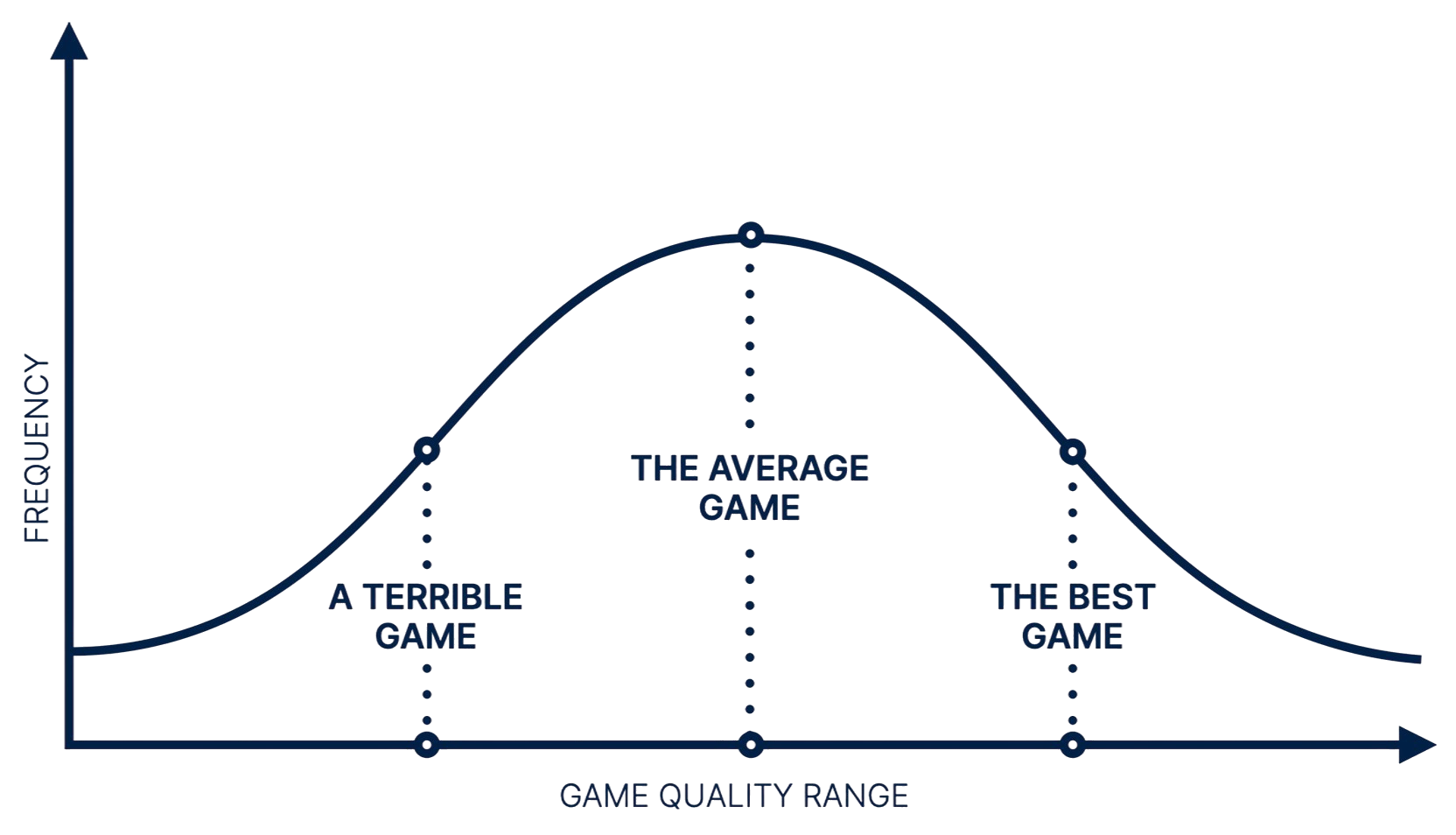
The right side of the chart, or the positive side, represents your best decisions. The left side is your worst decision. This is a Gaussian curve that displays the game's natural quality range. According to this theory, for qualitative growth in the game, first of all, it is necessary to strive to tighten our weaknesses. Many people act differently, try to pump themselves with more and more new knowledge or improve what they already do well. Often they do not even realize that the weak side can be in something banal at all, for example, in understanding how to defend against 3bet. In the book, Tendler explained that taillifting, rather than improving good qualities, has a greater effect on improving the “A” of the game. To push the front of the curve forward, you need to pull the rear.

4. Procedural model
The procedural model organizes the cyclical nature of the learning process.
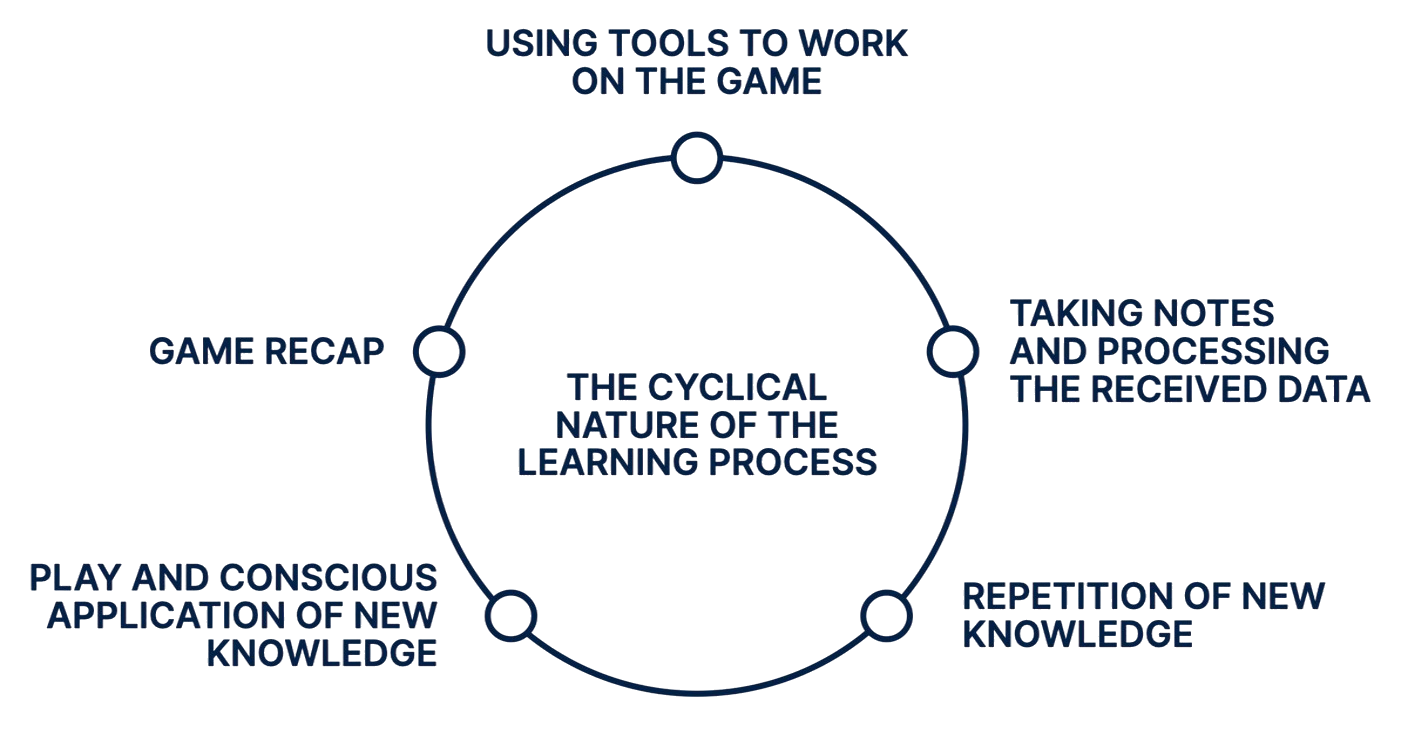
Setting to work
- Charging, cold shower;
- Repetition of the outline with psychological settings (work on beliefs and motivation);
- Repetition of strategic notes (better with visualization of the action in the mind);
Game
- Concentration on developing new skills;
- Discipline in decisions;
- We keep ourselves from weaknesses at the end of the session. We fight to the end!
Summing up the game
It is recommended to keep a table with an assessment of your game, immediately after the session:
- We independently assess the quality of game solutions on a 10-point basis;
- Evaluate how closely they followed the implementation of new strategic actions;
- Assess your psychological state during the session. Motivation, discipline, emotionality in decisions.
You can come up with your own criteria for evaluating the game. Constantly work according to your procedural model. Competition in poker is high and at a long distance those who have learned to work qualitatively and diversely on the game will have an advantage over the field edge!