


Translated with the help of AI. We apologize for any errors and would appreciate your help in correcting them.
Translated by order of the educational portal university.poker
Article by Andrew Brokos, original source: GTO Wizard
The standard situation in the game is: you open with a raise, someone calls, and a big blind (BB) props. What should you do? With which hands to call, with which to pass immediately, which ones can be twisted even more strongly into 4-bet? After a raise and one or more calls have been made, the re-raise becomes an attractive option for BB. Although he is unlikely to immediately take the pot, he has a good chance of knocking out at least one opponent, luring a lot of dead money into the pot, for which he will then be able to fight one-on-one. Hence, you should learn how to defend against BB squeezes, whether you are the original racer or one of the callers. This article will look at two scenarios – a raise with UTG followed by a BTN and SB call and a raise with CO followed by a BTN and SB call – to extrapolate the general strategic principles that will help you respond to BB's Squeeze in either case of other scenarios.
1. Initial Razor – Late Position
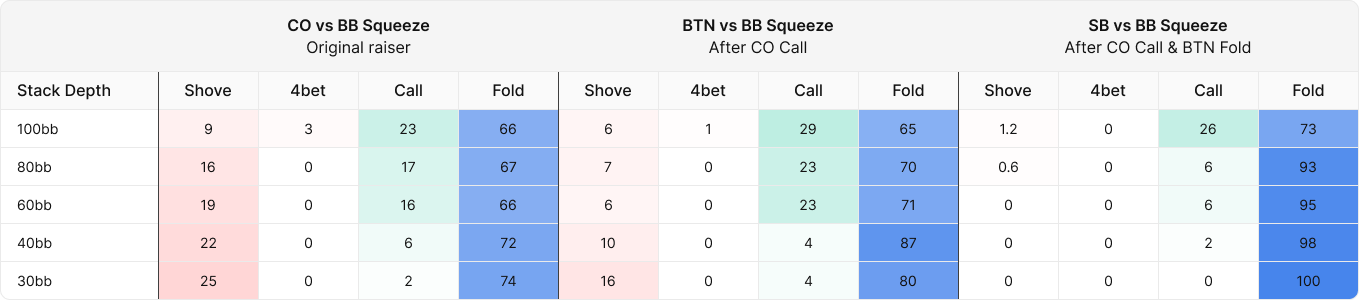
CO opens, BTN and SB call, BB props. This graph shows their reaction to this:
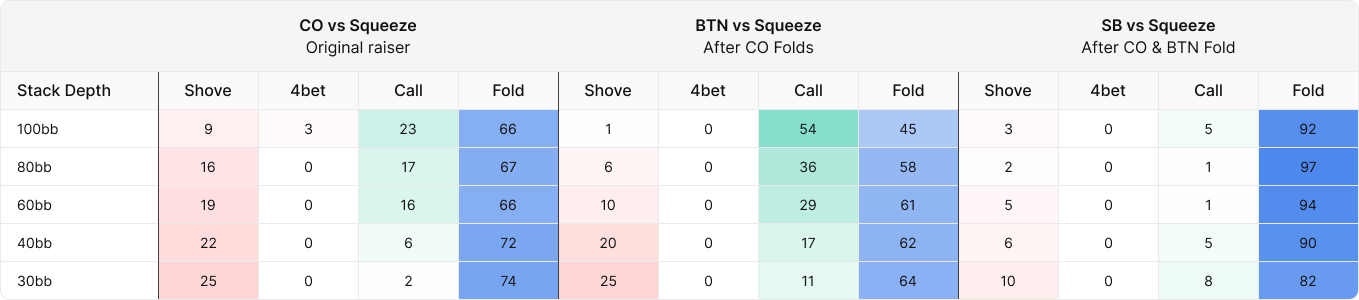
Further, these columns are divided into 4 reaction options: Push, 4 bet, call, fold. All this is divided into lines for different stack depths of 100bb, 80, 60, 40 and 30.)
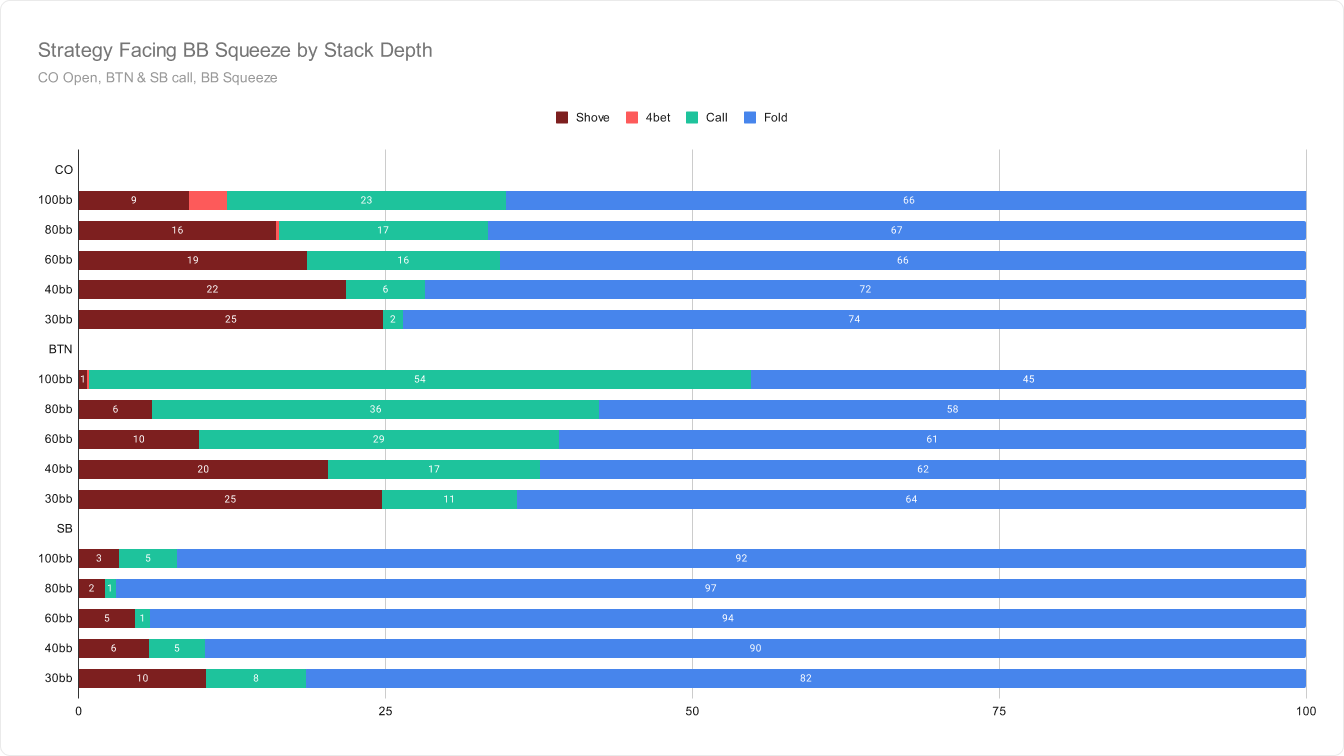
First, note that there are far fewer 4-bets than all-ins. This option is rarely used by any player at any stack depth. By the time of the BB squeeze, the pot already had more than 20bb. Therefore, 4-bet and subsequent fold in response to all-in are unattractive in such a large pot, as well as offering good pot chances for a BB call that will squeeze a linear range full of strong hands with high equity.
- For CO and BTN, call becomes less attractive as their stacks become smaller, even though BB's Squeeze offers more or less good odds for them. But smaller stacks reduce the value of post-flop play in position, increasingly biasing these players toward a “Push or fold” strategy, both of which are somewhat more likely to fold as the stacks get smaller.
- SB, being out of position and having the weakest range of the three, rarely responds to Squeeze. Unlike players in position, SB responds via Push or call as the stacks get smaller. The main feature of SB is the presence of the most capricious (limited) range of all; he has a huge incentive to push all his strong hands at once. At deeper stacks, this makes the Push unattractive and makes it difficult to implement post-flop equity. As the stacks become smaller, the limited SB range becomes less of a burden as it can take advantage of the calling (meaning that on the preflop after the BB squeeze, SB has the final word) to either go all-in on the preflop or play a postflop with a very low SPR and realize most or all of its equity.
- BTN also has a more limited range than CO, but it responds more often to Squeeze. The advantages of implementing the position are compensated by the lack of limited range equity. Unlike CO, BTN can act knowing that one player has already fold ed, guaranteeing him a position after the flop. Even if SB makes an overcall, it will be less of a problem for BTN than a BTN overcall for CO because an overcall without a position will realize less equity.
2. Initial Razor – in early position
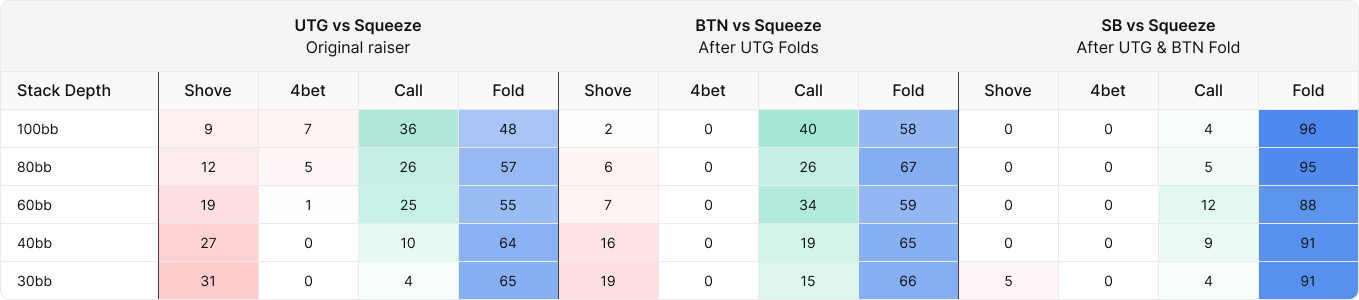
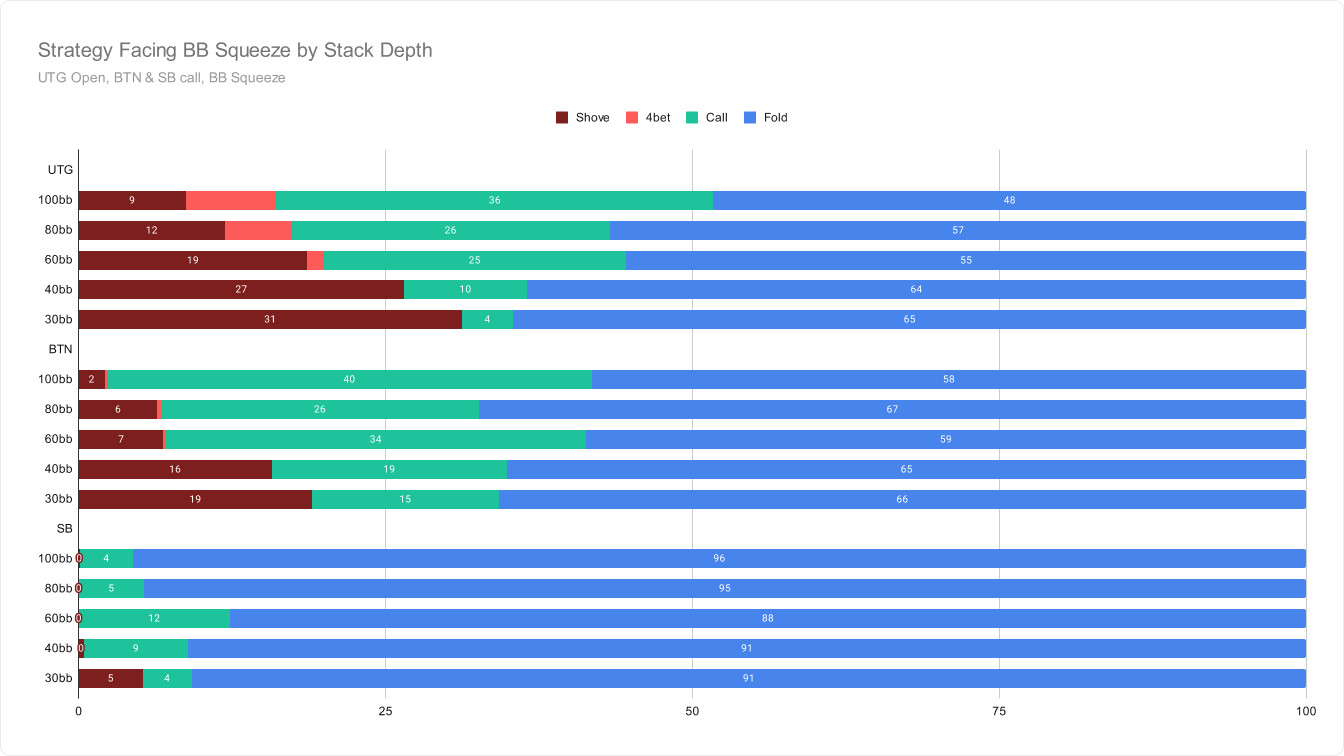
One key difference from a raise made with UTG rather than CO is that the initial raise range is significantly stronger than the BTN range. Consequently, it folds less than BTN, whereas CO folds more. Even though the BTN range is stronger when opening the UTG than when opening the CO, it still acts knowing that the four players have folds, which gives it more leeway to enter the pot than the UTG has. For the same reason, UTG re-raising is more common than CO, and a small 4-bet is a pretty good strategy for it.
BTN, on the contrary, is less bullish than when the original racer was CO, and more often folds, even after UTG has fold ed the cards. This is due to the fact that the BB range for the squeeze when opened from UTG is significantly stronger (7.9% of hands in a depth of 100bb versus 13% when opening CO). The BTN range is somewhat stronger, but not so much because it expects to play a post-flop position, and there are several marginal hands in its range. As with the late position racer, BTN has a higher call to 4-beta ratio than UTG. This is partly again because his range is less nutsome, but also because his position reduces the need to strip the equity of the player behind them.
3. When the original raiser calls the Squeeze
A 4-bet from the original racer almost always knocks out the players behind it. A call from him often leads to a call from other players, but almost never to a 4-bet from them. Even with stacks of 100 BB, the call from the original racer is a significant force, including the risk of slouple aces. Players who decide not to re-raise right away can't most often have a monster hand in the future, because you can't think of anything stronger than a raise in a strong BB squeeze range and a strong UTG call range.
The call from the original racer represents significant strength, including the risk of slouple aces.
Opening CO, call on BTN and SB, raise on BB, call CO:
Opening UTG, call with BTN and SB, raise with BB, call with UTG:
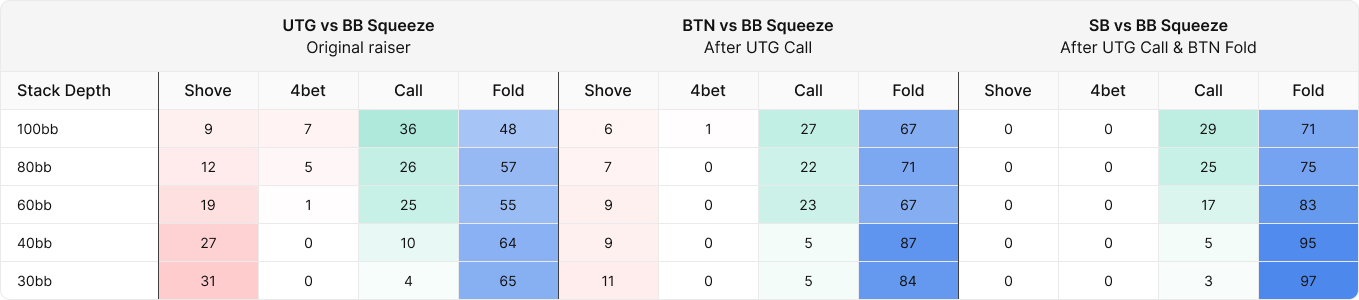
Interestingly, BTN collicates less often with UTG than when it folds, and SB collicates more often. The initial call range of SB already contains hands that perform well in multipots, whereas the BTN range allows for the possibility of heads-up sweat. Thus, SB is not trapped with such a large dead weight that it must fold, despite the tempting chances of the pot.
This is less true when the original raiser is CO, because then the SB range as a whole is much weaker, relative to the previous scenario where the open raiser was on the UTG. Faced with a raise from a late position, SB has more incentives to squeeze right away, except for very deep stacks. Consequently, he has very few hands strong enough to withstand two strong ranges, and with 30bb stacks, there are none at all. For SB, things are a little less gloomy if the Squeeze calls BTN. It still doesn't overcollite much, but the BTN call is less intimidating than the Co. call.
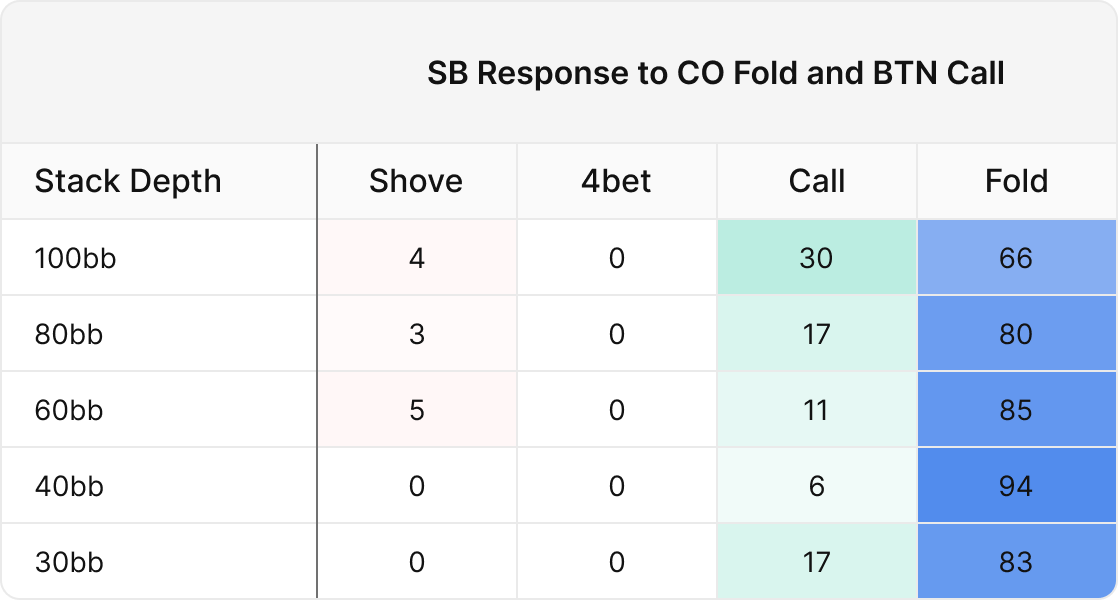
4. What these range looks like
When faced with a squeeze, all players folds their worst hands. They 4-beat or push most of their best hands, remembering that depending on the actions on the preflop of such hands, they may not have so many. The largest pair collide as a trap. In addition, two types of ranges can be noted: one - at which there can be heads-up pot, and another, where the range with overcall, in which there can be multiway sweats, if the play reaches the flop at all.
As an example, here is the BTN range for the squeeze call BB in 100bb stacks if the open raiser with CO discards cards in front of it:
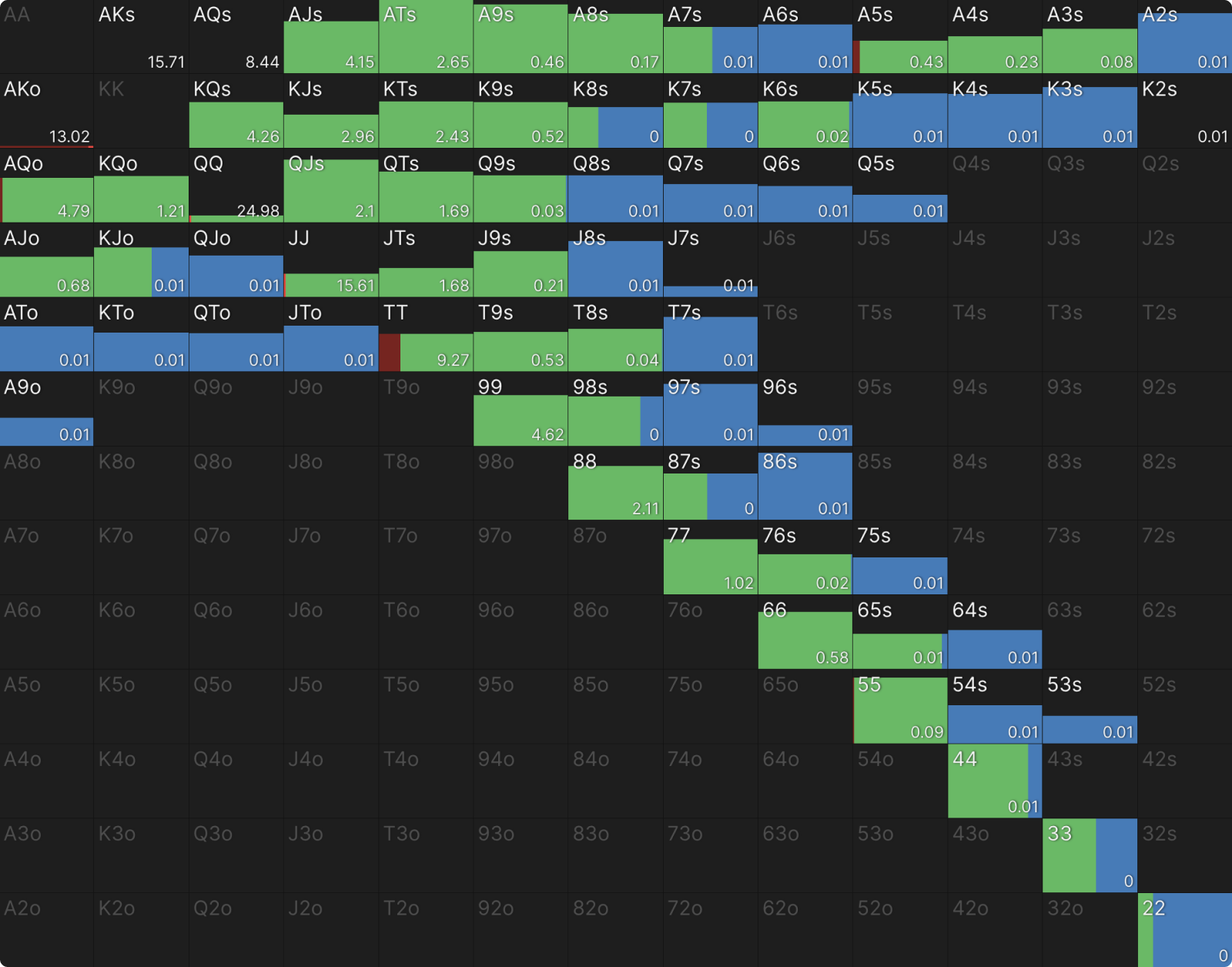
This range includes not only hands that perform well in multipots (pocket pair and suited Broadways), but also some suited connectors and offsuited Broadways that do not maintain their equity in multipots. This is because in this scenario, the button will often play one-on-one in a position against the BB button.
If CO has already called Squeeze, then small suited connectors and offsuited Broadways fall out of the range, leaving mainly pocket pair and suited Broadways:
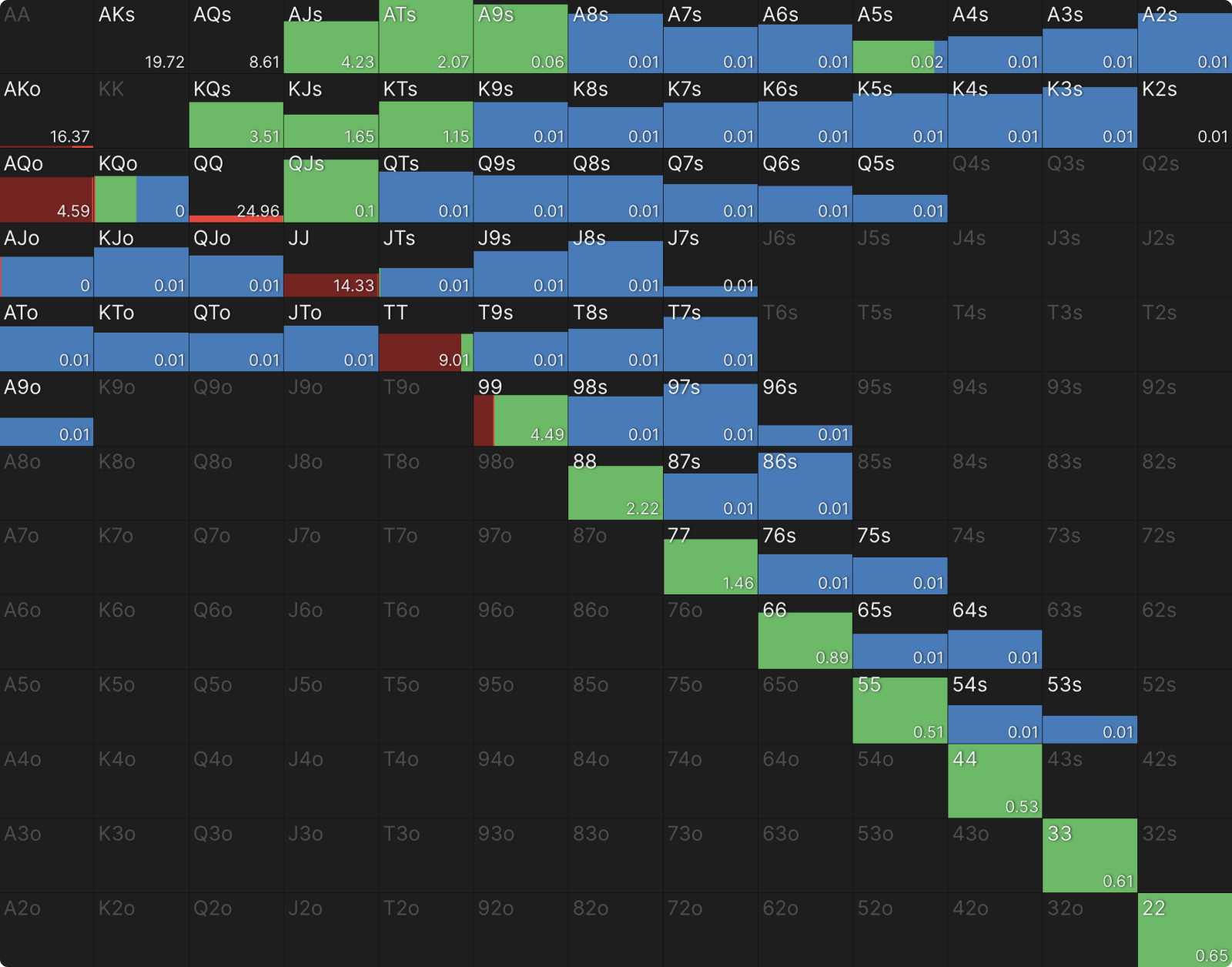
The best offsuited broadway cards are pushed by players, and most of the rest are folds. Even when CO fold the cards, BTN is ready to push these offsuited broadway hands.
With stacks of 60bb, it is most often furious:
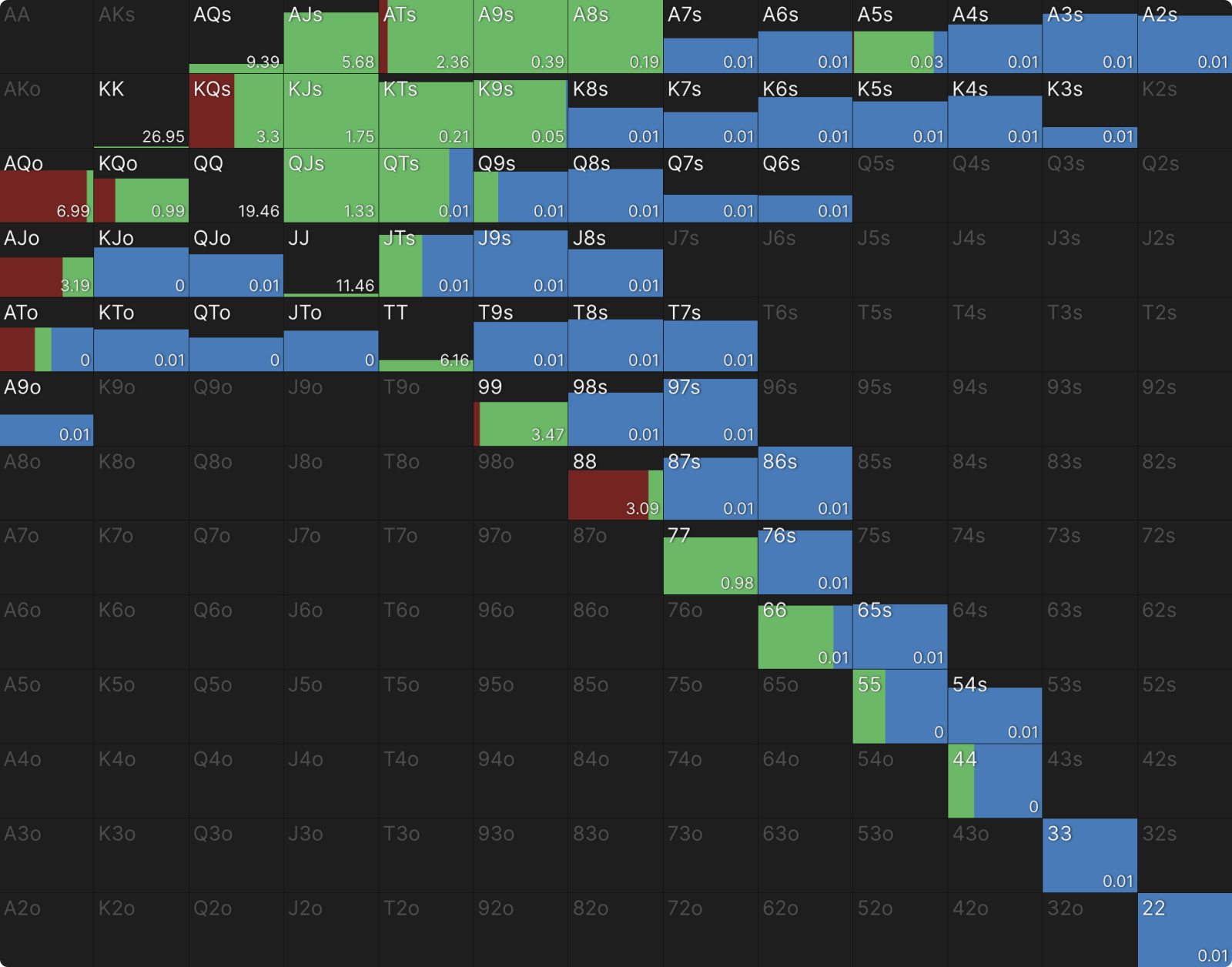
These patterns persist in most other arrangements as well: some suited connectors and offsuited Broadways are pretty good if the pot can become one-on-one, but these hands mostly push or folds as soon as the other player calls.
Suited connectors and offsuited Broadways are pretty good when the pot can become one-on-one, but these hands usually push or folds as soon as the other player calls.
Trap is an important part of the call strategy of the original racer. Whenever it has a significant call range, it includes AA and KK, often at full frequency.
Here is the CO reaction to a 100bb stacked Squeeze:
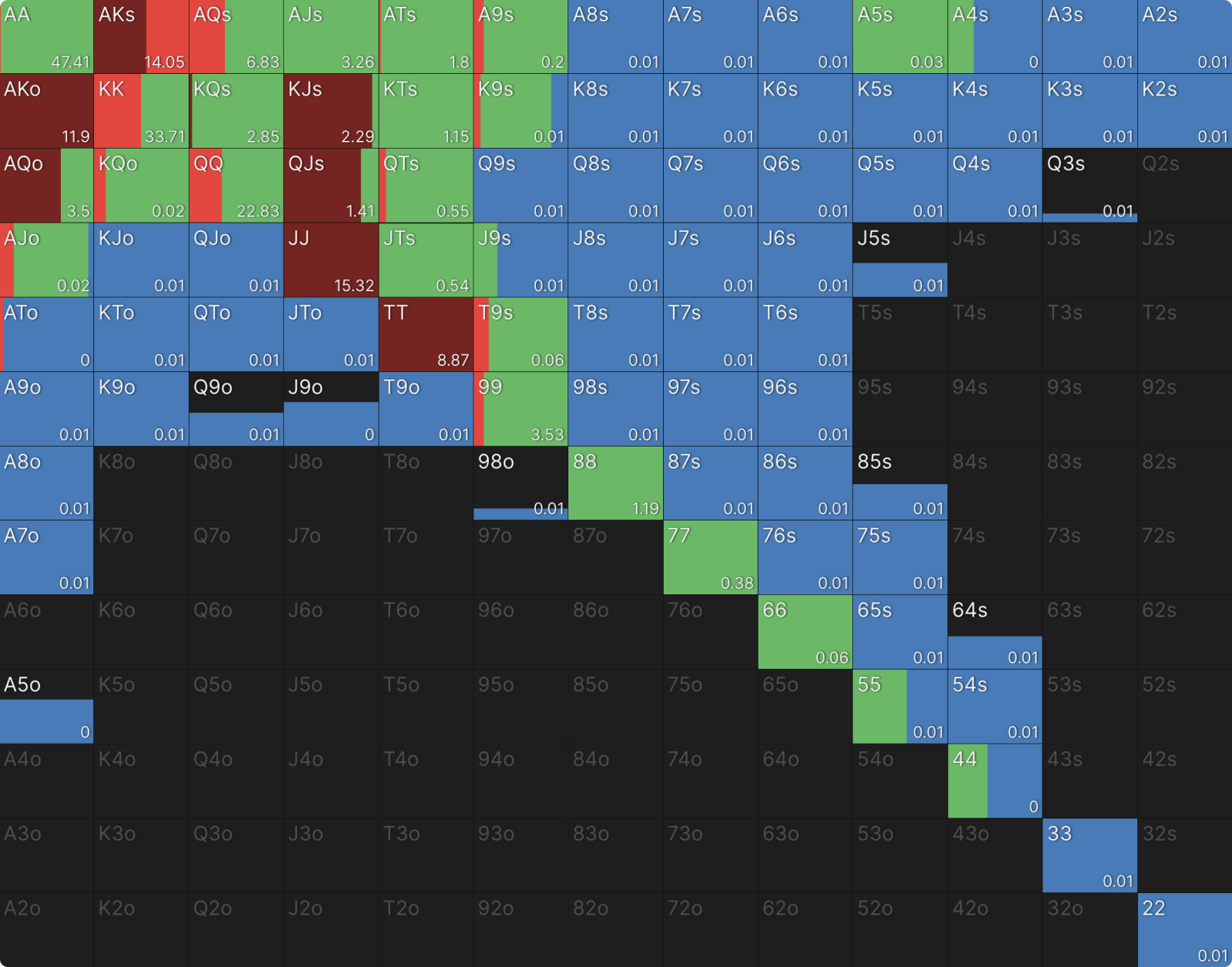
His call rarely causes a re-raise, but these hands are stable enough to trigger an overcall. Even in stacks of 100 BB in a Squeeze of sweat that grows into a multipot, the SPR on the postflop will be very low, making it easy to play these large pair.
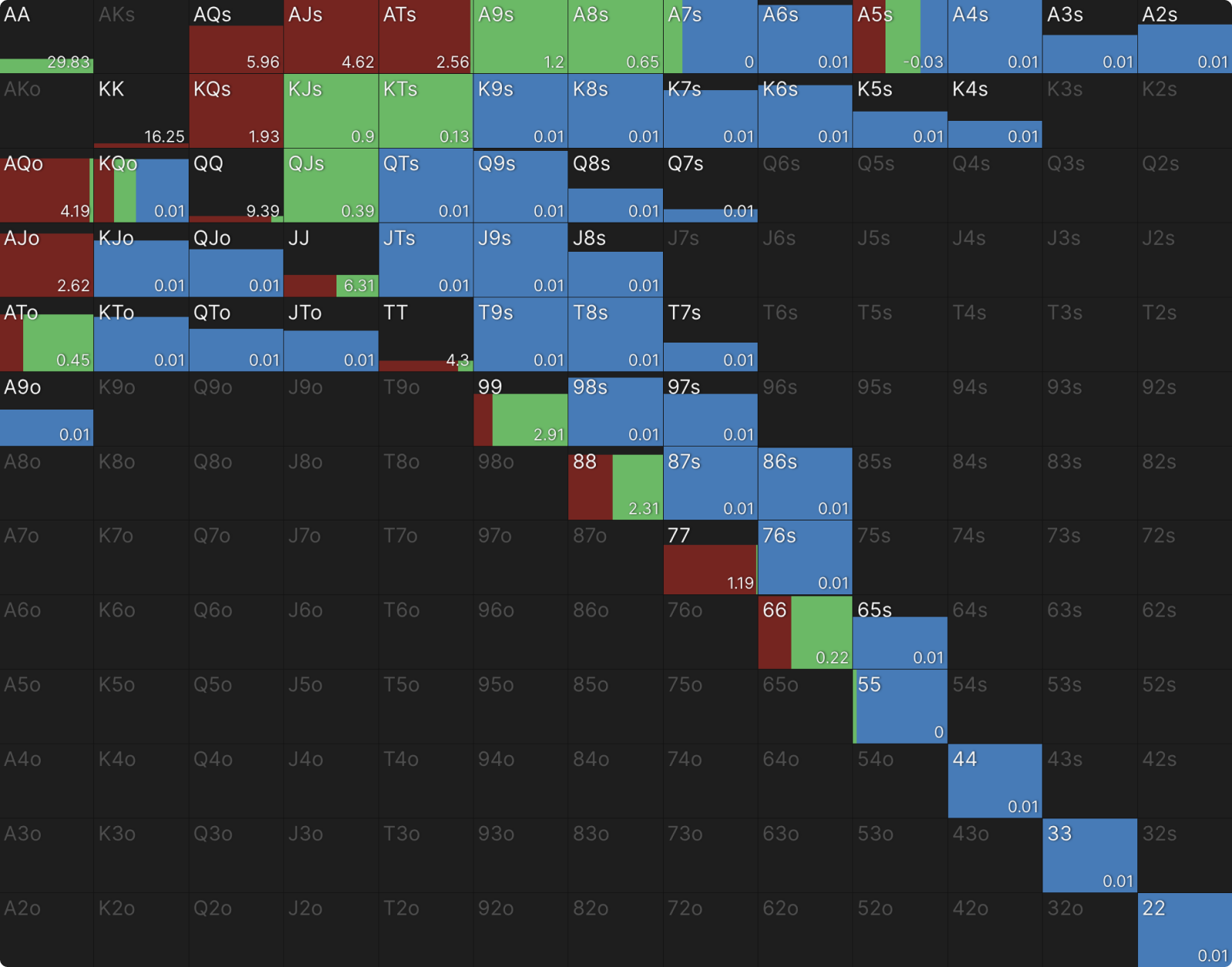
BTN is rarely exposed with large pairs after the initial raise call, but when it does, as in the case of 40bb stacks, if the raiser was on CO, it is a clean call, taking into account the BB squeeze and CO fold:

6. Operational adjustments
These strategies assume well-constructed range for all players, but like all GTO strategies, they are resistant to a wide range of opponents' strategies. Even in this case, the mistakes of one or more other players can create opportunities for exploitation in order to obtain greater profits. There are too many potential bugs to explore here all of them, but one is common enough to be remedied. Many players call raises with too wide and weak ranges, which increases the incentive for their opponents to re-raise and force them to quit the game in order to take away dead preflop money without a fight.
If BTN or SB collide too widely on the first round of trading, BB should squeeze a wider range (still linear and Velle-oriented, but with a lower threshold of what Velle it needs to collect). Then the initial racer should continue more often. At the same time, a wider range of BB (and a weaker range behind it) will stimulate both a larger number of calls and a larger number of 4-bits. A player who made too wide a call for the first time could be expected to also make too wide an overcall, which would further strengthen the incentive for the original racer to make another raise to deprive him of equity.
7. Conclusion
Responding to squeezes requires close attention to absolute and relative positions, which affect both the types of hands you need to call and how much you need to worry about displacing other players. The hands that benefit the most from one-on-one sweats (large pair and not the largest, offsuited broadway cards) have more incentives to raise, especially when a reasonable option is to switch to all-in, which can be even with fairly deep starting stacks. Smaller pair and suited broadway hands have more flexibility for call, as they retain their equity in multi-banks better and play better on post-flop. Deeper stacks stimulate more calls and fewer 4bets from players in a position, while shallower stacks stimulate more calls and fewer folds from players without a position.