
Translated with the help of AI. We apologize for any errors and would appreciate your help in correcting them.
In this article, we’ll examine how to play against a maniac in poker—an aggressive opponent who frequently bets, raises, and puts pressure on other players. We’ll discuss how not to give in to emotions, which hands to choose for playing, when it is better to simply wait for the opponent to make a mistake, and when you can use their aggression against them.

Translated by order of the educational portal university.poker
Original source: GTO Wizard
1. What Is a Maniac?
You probably have your own idea of whom you would call a “maniac” at the poker table. It may be a player who plays too aggressively, plays bad hands from bad positions, and hates giving up a pot. They may call despite the odds in the hope of improving or continue putting pressure on pots with garbage hands. The “Maniac” player profile models this type of player by changing their incentives in simulated poker games.
In the model, the Maniac profile receives an additional reward of 6% of the pot for betting and 3% for calling, while folding costs them an additional 6% of the pot. Thus, the Maniac is not only excessively aggressive but also extremely reluctant to fold hands. Therefore, adapting against them partly resembles playing against a Calling Station: both opponents tend to continue too widely, but one does so passively while the other does so aggressively. Simple models like this are useful because they allow us to run experiments and observe how changing these variables encourages us to adapt our strategy.
However, it is important to understand that simple models cannot perfectly capture the complexity of human psychology. For example, your image of a maniac may involve large bets, while the Maniac profile is indifferent to bet size. Moreover, it will often prefer small bets becausesmall bets with hands that would more often be played through a check in an equilibrium strategy usually lose less EV than large bets.
GTO strategies are usually more aggressive than the strategies of players without serious theoretical preparation.
It is also possible that some players you consider maniacs are actually excellent opponents familiar with GTO. GTO strategies are usually more aggressive than those chosen by players who have not studied theory. Therefore, if you are used to playing against such people, an opponent using GTO may seem like a maniac to you. In this article, we will examine how to adapt to the Maniac in various situations. Although we will analyze the common confrontation between the preflop raiser (PFR) and BB, we will begin with playing OOP in a 3-bet pot. In my experience as a coach, many people are concerned about this scenario, and for obvious reasons it occurs more often against a maniac than against other player types.
2. Preflop
All the reports and simulations below assume a no-limit cash game with 100bb stacks, but the conclusions we draw from them will not be strictly tied to this format. We will look for ideas on how to adapt to the Maniac in any situation—in both cash games and tournaments. These conclusions will not even be unique to no-limit Hold‘em. In these simulations, the Maniac’s preflop strategy was not changed: they do not use an excessively wide 3-bet range. If their 3-bet range were actually too wide, the optimal adjustment would become more exploitative: in particular, it would be worth using 4-bets more often.
You should also tighten your opening range from CO if you knew that a maniac was sitting to your left. These adjustments are not reflected in the simulations. They all assume that we reach the flop with a GTO range for this formation. Only the postflop reports were generated with the Maniac adjustments described above. However, there is another limitation here: the profile model does not account for future streets. This means that when building a flop strategy, the solver does not take into account that the Maniac may show excessive aggression on the turn.
In fact, based on the assumption that your maniac opponent will barrel too often on future streets, you may want to play slightly tighter than recommended here. This is somewhat counterintuitive, since usually, if we know that an opponent will make mistakes on the next street, it is profitable to create situations more often in which they can make that mistake. Indeed, if we expect excessive turn barreling, we may have an incentive to slowplay more often on the flop.
However, our weakest flop calls will not benefit from the Maniac’s mistake. Moreover, even knowing that the Maniac barrels too much, these hands will still often be forced to give up their equity, which may make folding on the flop a more profitable decision for them. Against such players, your strong hands realize more equity than usual, while your weakest hands realize less. In the long run, you will be profitable even without adjusting for this, but you can achieve even more if you predict the mistake in advance and account for it in your strategy.
3. Responding to a c-bet in a 3-bet pot
When CO plays against a GTO opponent on the BTN who made a 3-bet, CO leads on the flop about 5% of the time. Against the Maniac, the optimal strategy changes: CO always checks. This makes sense if we consider that the Maniac almost never checks back on the flop, whereas a GTO opponent would do so nearly 20% of the time. The primary purpose of a flop lead is to prevent the opponent from checking back for free; if they are not going to do that anyway, it is more profitable for you to check and allow them to put money into the pot with an excessively wide range before beginning your aggression.
Despite the Maniac’s excessive c-betting, CO’s response does not differ much from the response against a GTO opponent. They fold slightly less often and raise slightly more often:


This suggests that c-betting too frequently on the flop is not such a major mistake. Most BTN checks on the flop at equilibrium would be mixed strategies, so by betting too often, BTN does not make their game particularly vulnerable to exploitation. However, on specific flops where checking is a more important part of BTN’s strategy, we see more significant adjustments from CO.


 — this is the flop that BTN checks most often at equilibrium. A GTO player would check back 35% of the time; medium-strength hands such as KK and A8 would always or almost always be checked, whereas the Maniac bets 94% of the time.
CO folds at almost the same frequency against both players, but raises much more often against the Maniac:


At least in the case of a 3-bet pot, the pattern seems to be as follows: we play less aggressively until the Maniac has the opportunity to make an aggressive mistake, but afterward we punish that mistake by responding more aggressively than we would at equilibrium. Let’s see whether this pattern holds in another situation where we are the preflop aggressor.
4. Continuation Bet Against a Maniac
In the following examples, we will examine a single-raised pot between CO and BB. To compare CO’s c-bet strategies correctly, the option to donk-bet was disabled for BB in the simulation. As a result, in both scenarios the players reach the c-bet decision with identical ranges.
CO c-bets somewhat less often against the Maniac.


And when they do c-bet against the maniac, they use a smaller sizing more often:
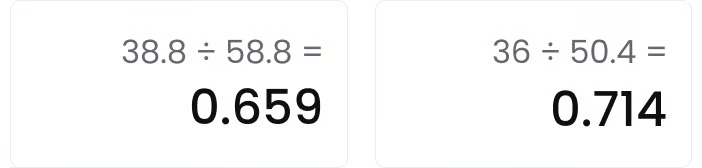
This indicates cautious, defensive play aimed at not losing equity to a raise that cannot be called. Although CO’s betting range against the Maniac is slightly stronger than against a GTO opponent, their response to a small check-raise barely changes.
As in the situation with a c-bet in a 3-bet pot, CO folds slightly less often and raises slightly more often:



5. Conclusion
Responding to aggression with aggression is a useful basic rule against maniacs, but optimal adjustment does not end there. It is important not only to punish the opponent’s excessive aggression but also to avoid creating situations in advance where they can pressure your weak hands.
Before the Maniac Has Shown Aggression
This means that before the maniac takes an aggressive action with a range you consider excessively wide, you should consider playing tighter and more passively. Your strongest hands benefit from allowing them to invest money with weak hands, while your marginal hands prefer not to invest money they may be unable to defend. And your weakest hands bluff less often because they expect fewer folds than they would get against a GTO player.
After the Maniac Takes an Aggressive Action
After the Maniac has bet or raised, you should seriously consider an aggressive response in order to extract thin value and deny them some equity. Thanks to playing more passively at the previous node of the decision tree, you reach this node with more strong hands at the same time that the maniac arrives here with too many mediocre hands. That is why you can respond much more aggressively after the Maniac makes a mistake.
This kind of post hoc exploit is attractive because it does not depend too heavily on how your opponent responds. After they have made a mistake by investing money with too wide a range, they will have to do something with hands that do not belong here. You are usually happy to see them fold and lose equity, but if they call or raise—as maniacs often will—your range contains enough strong hands that also profit from this. The only thing the Maniac cannot do is consistently end up with a strong hand after betting or raising if their range for those actions was too wide to begin with.
6. Conclusion
Playing against a maniac requires patience, discipline, and composure. Such an opponent can create a lot of pressure, but their excessive aggression often becomes the main source of profit. The key is not to try to outplay them in the chaos, not to respond to every bet on principle, and to choose situations where you truly have an advantage. The fewer emotions and the more calculation you bring to the table, the easier it is to turn a maniac from a threat into a convenient source of chips. The only thing the Maniac cannot do consistently is end up with a strong hand after betting or raising if they make those actions with an excessively wide range to begin with.